Wednesday, January 25, 2017

Vasco Da Gama Greatest All-Time Team

Expresso da Vitória 

Please also see my All-Time World Cup Team Index.

50 Brazilian Greatest Players (26th-50th)
SantosFlamengoSao PauloCorithiansBotafogo
Vasco Da GamaPalmeirasInternacional
FluminenseGremioCruzeiroAtlético MineiroBahia.

This is my selection of a 25 member all-time team for the club.  The number 25 was chosen because it is the official squad size for the Champions' League.

Club de Regatas Vasco da Gama was founded on August 21, 1898  by Portuguese immigrants, and it is still traditionally supported by the Portuguese community of Rio de Janeiro. The club is named after the Portuguese explorer Vasco da Gama.  In 1924 Vasco da Gama was pressured by the Metropolitan League to ban some players that were not considered adequate to play in the aristocratic league, notably because they were black or mulato and/or poor. After Vasco refused to comply with such a ban, the other big teams, Fluminense, Flamengo and Botafogo, among others, created the Metropolitan Athletic Association and prohibited Vasco from participating unless it complied with the racist demands.  Between 1947 and 1952, the club was nicknamed Expresso da Vitória (Victory Express), as Vasco won several competitions in that period, such as the Rio de Janeiro championship in 1945, 1947, 1949, 1950, and 1952, and the South American Club Championship in 1948. Players such as Ademir, Moacyr Barbosa, Bellini and Ipojucan defended Vasco's colors during that period.

Copa Libertadores 1998
Team
GK: Moacir Barbosa (Brazil)
Moacir Barbosa was one of the greatest keepers in Brazil's history, but he was, however, associated with Brazil's loss to Uruguay in 1950, in an upset loss dubbed as the Maracanazo.  He became the scapegoat of the event.  He was also a member of the Brazilian team that won the 1949 Copa America.  For his club career, he played over 10 seasons with Vasco Da Gama.  He won the Campeonato Sul-Americano de Campeões in 1948. 

GK: Jaguaré (Brazil)
When playing with CR Vasco da Gama, he won the championship of Rio de Janeiro. He also played for FC Barcelona, Sporting CP and SC Corinthians Paulista. The most successful period of his career was in the 1930s with the French club Olympique Marseille. In Brazil, he is also considered to be the person who popularised the use of gloves by goalkeepers.

GK: Carlos Germano (Brazil)
Carlos Germano started his career with Vasco De Gama in 1991. He was awarded the Silver Ball (Placar) in 1997.  He helped the club to win the Copa Libertadores in 1998, Vasco De Gama's first ever title.  He left the club in 2000 and played for many clubs.  He was capped 9 times for Seleção.  He was the backup goalkeeper for the team that won the 1997 Copa América and that reached the final of the 1998 FIFA World Cup in France.
Carlos Germano
RB: Cocada (Brazil) 
Cocada started his career with Flamengo, but did not succeed there.  He moved to Vasco De Gama and became a key player.  He scored the winning goal in the 1988 Campeonato Carioca final, where he beat his former team Flamengo. He then received a red car for insulting the manager of Flamingo who released him. His brother is the striker, Muller who was on the 1994 World Cup team.

RB: Orlando Lele (Brazil)
Orlando Lele began his career at Santos Futebol Clube in 1972, then transferred to the Coritiba Foot-Ball Club in 1973.  He joined America in 1974. He later played for Vasco between 1977 and 1981. He moved to Udinese in 1981. He played for Brazil 6 times. He made his debut in 1976 against Uruguay.

CB: Bellini (Brazil)
Bellini was Brazil's captain for the World Cup Finals in 1958. He was credited for starting the tradition of lifting the trophy high in the air, making the gesture winning symbol.  He won another World Cup in 1962 and participated also at 1966 FIFA World Cup as the team captain again.  He had 51 caps between 1957 and 1966. During his career he played for Vasco da Gama, São Paulo FC and Atlético Paranaense. 
Bellini
CB: Orlando Peçanha (Brazil)
During his club career Orlando Peçanha played for Vasco da Gama (1955–1960), Boca Juniors (1960–1964) and Santos (1965–1967). With Boca Juniors, he was their captain at one point. He was part of the Brazilian team that won the 1958 FIFA World Cup, and also participated in the 1966 FIFA World Cup as the vice captain of the team. In total he earned 30 caps.

CB: Augusto da Costa (Brazil)
Augusto da Costa captained the Brazil team to the 1950 FIFA World Cup final leading them to become the runners-up of the tournament after losing to Uruguay. He was born in Rio de Janeiro. He started his career in 1936, with São Cristóvão, leaving the club in 1944. In 1945 he joined Vasco, retiring in 1954. He played 20 games for the Brazilian national team and scored one goal.

CB: Brito (Brazil)
Brito was best remembered as a part of Brazil's great World Cup team in 1970.  He had 47 caps.  He also went to the 1966 World Cup Finals. For his club career, he played over 10 years with Vasco De Gama. He also played for Internacional, Flamengo, Cruzeiro, Botafogo, Corinthians, Atlético Paranaense and River-PI.  In 1970, he won the Bola de Prata as the Best XI in Brazilian championship.

LB/LW: Felipe (Brazil)
Felipe started in 1996 with Vasco De Gama.  He won the Copa Libertadores in 1998 with them.  He stayed with them until 2002. He later played for AS Roma, Galatasaray,  Palmeiras, Flamengo, etc.  He spent 5 seasons playing for  Al Sadd in Qatar. He earned 9 caps for Brazil, winning the Copa America in 2004.

LB/DM: Mazinho (Brazil)
Mazinho played 35 internationals for Brazil national team, winning the 1989 Copa América, 1994 World Cup and the Silver medal at the 1988 Olympics. He was also named in the squads for the 1990 World Cup and 1991 Copa América.  Mazinho played with Vasco da Gama, Palmeiras and Vitória in his homeland, with Lecce and Fiorentina in Italy, and with Valencia, Celta de Vigo and Elche in Spain. 

DM: Danilo Alvim (Brazil)
Danilo Alvim is considered one of he greatest defensive midfielder in Brazil's history.  He played 25 games for Brazil between 1946 and 1953, winning the 1949 Copa América. He played on the ill-fated 1950 team alongside Zizinho.  For his club career, he was a part of Vasco da Gama's legendary "the Victory Express" team. He also played for America. He won the 1948 South American Champions of Champions with Vasco.
Danilo Alvim
CM/DM: Ely (Brazil)
Ely do Amparo played for América and Canto do Rio.  Ely was  member of Vasco de Gama's "Expresso da Vitória squad" that won the Campeonato Carioca in 1945, 1947, 1949, 1950 and in 1952, winning the South American Club Championship in 1948 as well. Ely do Amparo also played for Sport from 1953 to 1955. For Brazil, he went to the World Cup Finals in both 1950 and 1954.

LB/CM/DM: Jorge Sacramento (Brazil)
Born in 1927, Jorge Sacramento was known to be a member of Vasco De Gama's "Victory Express".  He was known to be playing the midfield with Ely and Danilo Alvim.  The midfield was one of the greatest in Brazilian club football history.  He played for them between 1945 and 1954. He won all of the titles win by the team known as "Victory Express"

AM/CM: Juninho Pernambucano (Brazil)
Juninho Pernambucano was the leading player at Olympique Lyonnais leading them to seven consecutive Ligue 1 titles between 2002 and 2008.  In Brazil, his career was associated with Vasco da Gama. He won Copa Libertadores in 1998. For the national team, his selection was limited by the number of great attackers in his generation.  He was only capped 40 times and went to the 2006 World Cup Finals in Germany.
Juninho Pernambucano 

CM: Geovani da Silva (Brazil)
In 1983 he was transferred to Vasco da Gama, playing alongside the likes of Romário and Roberto Dinamite. He also played with Bologna, Karlsruher SC and Tigres de la UANL in Mexico. He ended his career in 2002. He represented Brazil at the 1983 World Youth Championship, where he became the top scorer, and was also elected as the best player of the tournament. Capped 24 times from 1985 to 1991.

LW: Francisco Aramburu "Chico" (Brazil)
Francisco Aramburu known as "Chico" started with Gremio, but joined Vasco de Gama, where he was a member of the famous "Victory Express" team. They won Southamerican Club Championship in 1948. In the 1950 World Cup Finals held in Brazil, he played four games and scored four goals. He played in the famous game against Uruguay, which later became known as "Maracanazo".

AM: Ademir de Menezes (Brazil)
Ademir formed a great attacking trio with Zizinho and Jair at the ill-fated World Cup Finals in 1950.  That line is considered the greatest ever seen in a World Cup Finals. He won the Golden Boot at the tournament, but unable to win the World Cup at home.  He also won the Copa America in 1949. For club football, he had two spells each with Sport Recife and Vasco da Gama. He also had one spell with Fluminense.
Ademir de Menezes

FW: Russinho (Brazil)
Russinho has played for Brazil national football team at the 1930 FIFA World Cup finals.  He played club football for Andarahy, Vasco da Gama and Botafogo, winning the Campeonato Carioca in 1924, 1929 and 1934 with Vasco da Gama and in 1935 with Botafogo.  He was the topscorer at Campeonato Carioca three times in 1924, 1929 and 1931.

FW: Ipojucan  (Brazil)
At the age of 11, Ipojucan joined Vasco da Gama, where he stayed for 20 years. He scored 225 goals in 413 matches for Vasco's main team from 1944 to 1954, making him the fifth-highest scorer on the team. In 1954, he moved to Portuguese Sports, where he finished his career. He was capped by the Brazilian National Team 9 times, and scored 1 goal.

ST: Edmundo (Brazil)
Nicknamed "Animal", he was known for drewing attention both on and off the pitch.  He played for a number of clubs in Brazil, Italy and Japan.  Edmundo was only selected 39 times for the Seleção, largely for his behaviour and playing in the same generation as Romario, Ronaldo, Bebeto, etc.  He played for Brazil in the victorious 1997 Copa América, and at the 1998 World Cup, where they finished in second place. 

ST Romario (Brazil)
Romario helped the Seleção to win the 1994 FIFA World Cup, receiving the Golden Ball as player of the tournament. He was named FIFA World Player of the Year the same year. He missed the 1998 World Cup Finals because of an injury. He also went to the World Cup in 1990.  He was one of very few strikers to surpass the mark of 1,000 goals. He was best remembered for his stint with Barcelona.
Edmundo and Romario
ST: Vava (Brazil)
Vava's nickname was "Peito de Aço" (Steel Chest). He played for Sport Club do Recife, C.R. Vasco da Gama, S.E. Palmeiras.  He was capped 20 times.  He won the World Cup in 1958 and 1962 World Cup Finals.  He won the co-winner of the Golden Shoe award in 1962.  He scored in the final of both 1958 (twice) and 1962 (once), thus becoming the first player to score in the final of two different world cups. 

ST: Bebeto (Brazil) 
Bebeto is the sixth highest goalscorer for his national team.  At the 1994 World Cup, he formed a formidable strike partnership with Romário to lead Brazil to their fourth World Cup title.  His best club career was with Deportivo La Coruna, where won the Pichichi Trophy in 1993.  He played for Flamengo, Vasco da Gama, Cruzeiro, Botafogo, Sevilla, Toros Neza, Kashima Antlers, and Al Ittihad.

ST: Roberto Dinamite (Brazil)
Roberto Dinamite is a legend at Vasco Da Gama.  He is their appearance record holder and all-time leading scorer. He was also the all-time leading scorer in the Brazilian Série A.  He had 38 caps scoring 20 goals for Brazil. He went to the World Cup Finals in 1978 and 1982.  He scored 3 goals in 1978.    He was the Copa América Top Scorer in 1983.  In 1982, he was backup striker who received a callup after Careca got injured and unable to play in Spain.
Roberto Dinamite

Honorable Mention
Donizete, Ramon Roque Rafagnelli, Mauro Galvão, Bismark, Pinga, Sabará, Fontana, Ricardo Rocha, Tostão, Acácio, Mazaropi, Coronel, Maneca, Fausto dos Santos, Juninho Paulista.

Squad Explanation
-- In the 1940's, Vasco Da Gama had a successful period with a team nicknamed "Expresso da Vitória".  They won the South American Championship of Champions in 1948. This tournament is seen as a precursor of the Copa Libertadores. Ademir de Menezes, Moacyr Barbosa, Danilo Alvim, Ely, Jorge Dias Sacramento Augusto da Costa, Ipojucan and Chico played for this team.
-- Unfortunately many players from that team was associated with the "Maracanazo".  Moacir Barbosa, Danilo Alvim and Ademir de Menezes would have bene ranked much higher on the Brazilian all-time team if Brail won the World Cup in 1950.  Augusto da Costa and Chico were  also a member of the team.
-- Moacir Barbosa was perhaps the best goalkeeper in the world at his peak. He was blamed for the defeat.   "The maximum punishment in Brazil is 30 years imprisonment, but I have been paying, for something I am not even responsible for, by now, for 50 years," he said shortly before his death.
-- Danilo Alvim, Ely and Jorge Dias Sacramento were a part of Vasco's "Expresso da Vitória" squad.  They formed one of the greatest midfield in Vasco Da Gama's history. 
-- In 1998, Vasco Da Gama won the Copa Libetadores.  Goalkeeper Carlos Germano, Felipe and Juninho Pernambucano made this all-time team.  Mauro Galvão also made honorable mention.
-- From 1995-2001, Juninho Pernambucano played for Vasco Da Gama.  He was very popular with the club.  The fans nicknamed him Reizinho de São Januário (The Little King of São Januário).  At one point, he was playing with Juninho Paulista.  They won the 2000 domestic Campeonato Brasileiro Série A championship and the international Copa Mercosur trophy. The team also featured Romario and Edmundo on attack. 
-- Both Edmundo and Romario were homegrown players.  They became friends in the 1980's when Romario was a star player with Vasco while Edmundo played on the reserve team.  However, the pair started a feud off the field around 1998. In 2000, the pair was reunited at the club and formed a brilliant partnership that easily destroyed Manchester United at the 2000 World Club Championship.  Both Edmundo and Romario made the team while Juninho Paulista is on honorable mention.
-- Bebeto was Romario's famous strike partner at the 1994 World Cup Finals, but the pair started as rivals in Brazil.  Romario was playing for Vasco while Bebeto played for crosstown rival Flamingo.  But when Romario left for PSV in 1988, Vasco signed Bebeto as his replacement.  Over here, Bebeto won the South American Footballer of the Year in 1989.  
--- Roberto Dinamite is their all-time appearance leader as well as all-time leading scorer.  The peak of Vava's club career was also spent here.
-- I took those players over Maneca who played for them in the 1940's. Tostão also spent a short time at the club.
-- Coronel missed out on the rightback spot.
-- Vasco Da Gama has many great centerbacks. All of my selected centerbacks have long careers with the club as well as a great career with the national team. Both Augusto da Costa and Bellini captained the national team at a World Cup Finals, while Brito and Orlando Peçanha had won the World Cup. Mauro Galvão was my last back dropped.  He deserved to be on the squad.
-- Ricardo Rocha did not have a long career here. Meanwhile, Leônidas da Silva and Domingos da Guia only played one season at the club.  

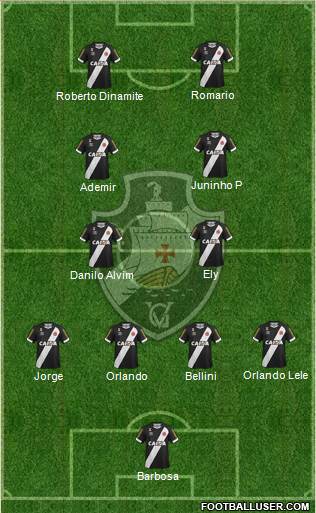
Formation


Tuesday, January 24, 2017

Palmeiras Greatest All-Time Team


Copa Libertadores 1999

Please also see my All-Time World Cup Team Index.

SantosFlamengoSao PauloCorithiansBotafogo
Vasco Da GamaPalmeirasInternacional
FluminenseGremioCruzeiroAtlético MineiroBahia.

This is my selection of a 25 member all-time team for the club.  The number 25 was chosen because it is the official squad size for the Champions' League.

The club was founded on August 26, 1914, as Palestra Italia , but changed to the current name on September 14, 1942. It is one of the most popular and successful Brazilian clubs, with around 17 million supporters, including a large number of Brazilians of Italian ancestry. They won the 1999 Copa Libertadores.
Brasileiro 1972 Champion
Team
GK: Marcos (Brazil)
Marcos spent his entire career at Palmeiras of the Série A in Brazil, from 1992 until his retirement in January 2012, and became one of the club's greatest idols, being nicknamed São Marcos ("Saint Mark" in Portuguese). He only earned 27 caps for Brazil, largely because of playing with Dida and Rogério Ceni in the same generation.  He was the starting goalkeeper of the champion Brazilian squad at the 2002 World Cup.
Marcos
GK: Emerson Leao (Brazil)
Emerson Leao played 80 times for Brazil. He won a World Cup in Mexico 1970 as the backup keeper.  He started at West Germany 1974 and Argentina 1978.  He was the first Brazilian goalkeeper in history to be team captain (during the 1978 World Cup). At the club level, he played for several clubs, his longest term being at Palmeiras.

GK:  Oberdan Cattani (Brazil)
Oberdan Cattani was one of the most famous Brazilian goalkeepers of the 1940s, a period in which the World Cups were suspended because of the Second World War. He is among the greatest idols of Palmeiras. He won four titles of Campeonato Paulista (1942, 1944, 1947 and 1950), the Rio-São Paulo Tournament of 1951.  He played 9 times for Brazil.

RB: Djalma Santos (Brazil)
Some considered DJ Santos as the best right back in the football history. He played in 4 World Cup Finals, winning twice in 1958 and 1962.  He is one of only three players to be included into three World Cup All Star team. Santos started his career with Portuguesa. In 1959, he moved to Palmeiras. He played almost 500 games for the club, winning several league and cup titles. He left the club in 1968, joining Atlético Paranaense for a short spell before retiring in 1970.
Djalma Santos
RB: Francisco Arce (Paraguay)
Arce was a part of the great defensive unit of Paraguay in 1998 and 2002.  Arce started his career in Paraguay playing for Cerro Porteño, where he won the national championship on three occasions. He then moved to Brazil where he played for big clubs such as Grêmio and Palmeiras. He won the Copa Libertadores in 1995 with Gremio, but he spent much of his career with Palmeiras.

CB: Djalma Dias (Brazil)
During his career, Djalma played for América Football Club - where he won the Rio state championship of 1960 - Sociedade Esportiva Palmeiras, Clube Atlético Mineiro, Santos Futebol Clube and Botafogo de Futebol e Regatas, He played 21 times for the Brazilian national team, but did not attend any major international tournament. 

CB/DM: Galeano (Brazil)
Galeano is the all-time appearance leader for Palmeiras. He was a part of team that won the Copa Libertadores in 1999.  He came into the game as a sub in the Final. In his domestic career, he also played form many clubs in Brazil.  He also played briefly for MKE Ankaragücü in Turkey and Gamba Osaka in Japan.

CB: Luis Pereira (Brazil)
Luis Pereira was widely considered to be the best central back in the Seleção's history. He was capped over 30 times, but only attended the 1974 World Cup Finals held in West Germany and remembered receiving a red card against Holland. He played 562 games with S.E. Palmeiras (34 goals) and 171 games with Atlético Madrid (17 goals). With Atletico Madrid, he was considered one of the best defender playing in Europe.  He won the La Liga title in 1977.
Luis Pereira
CB: José Junqueira (Brazil)
José Junqueira played his entire career with Palmeiras between 1931 and 1945. He was considered their best ever defender until the emerge of Luís Pereira. He was the first player to be honored with a bust at the Palestra Italia Stadium by the club. After him only Ademir da Guia, Waldemar Fiúme, Oberdan Cattani and Marcos received such homage.

LB: Geraldo Scotto (Brazil)
Scotto came to Palmeiras in 1958 from Santos, and spent nearly ten years at the club. During that time, he fought many duels with Garrincha and was known to be the greatest defender Garrincha ever faced. Scotto made 352 games for Palmeiras, scoring 3 goals. He was capped twice for Brazil, winning Copa Roca in 1960.

LB: Roberto Carlos (Brazil)
Roberto Carlos was regarded one of the best leftbacks in history.  He had 125 caps for Brazil playing in three World Cup Finals. He won 3 Champions League titles with Real Madrid and one World Cup title with Brazil in 2002.  In 1997 he was runner-up in the FIFA World Player of the Year.  He is especially famous for a free kick from 35m out against France in the Tournoi de France 1997. The goal is considered one of the greatest goals ever scored.
Roberto Carlos
CM/DM/RM: Waldemar Fiúme (Brazil)
Born in 1922, Waldemar Fiúme was nicknamed "O Pai da Bola"(Father of the Ball) because he could play for many positions.  He played his entire career for Palmeiras from 1941 to 1958. With 601 games, he is the fourth player in Palmeiras history in terms of appearance for the club. He won Copa Rio in 1951 and Torneio Rio–São Paulo on the same year.

DM: César Sampaio (Brazil)
César Sampaio is one of the few players who had played for the 4 major clubs from São Paulo (Santos, Palmeiras, Corinthians and São Paulo) and one of the greatest idols from Palmeiras' history. He won the Bola de Ouro (Brazilian Golden Ball award) twice, in 1990 and 1993.  Capped 47 times. He was a part of the squad that won both the Copa América and Confederations Cup in 1997, and played for Brazil at the 1998 World Cup finals

CM: Dudu (Brazil)
Dudu played over 600 games for Palmeiras from 1964 to 1975.  At the club, he was known for his partnership with Ademir de Guia. He won the Campeonato Brasileiro de Futebol 4 times.  He also spent the 1975-1976 season with Sevilla FC in Spain.  He capped 13 times for Brazil in the 1960's, but did not go to any major tournament.

RW: Julinho (Brazil)
During his career (1951–1967), Julinho played for Portuguesa, Fluminense and Palmeiras.  He was nominated as the best player in the history of Italy's Fiorentina in 1996, helping to win a scudetti.  He was one of the greatest winger in Serie A history.  He had 24 caps for Brazil.  He was one of the best player at the World Cup Finals in 1954.  He turned down a chance to play in the 1958 World Cup Finals in Sweden, giving the way for Garrincha to shine in the Finals.
Julinho 

LW/AM: Zinho (Brazil)
Zinho played with Flamengo, Palmeiras, Grêmio, Cruzeiro, Yokohama Flügels and Miami FC.  He was awarded Placar Bola de Prata 4 times: 1988, 1992, 1994, 1997. He was best remembered for winning the World Cup with Brazil at the 1994 World Cup in the US.  He played 7 games in the Finals.  In total, he had 57 caps for Brazil between 1989 and 1998.

AM/FW: Rivaldo (Brazil)
Rivaldo was a part of the attacking trio known as "Three R's" with Ronaldo and Ronaldinho at the 2002 World Cup Finals.  He scored 5 goals in 5 games as Brazil took its 5th World Cup. He also went to the WC Finals in 1998. He won the 1999 Ballon d' Or. He played for many clubs in his career.  He spent five years with Spanish club Barcelona.

AM: Alex de Souz (Brazil)
With Palmeiras, Alex won the Copa Libertadores in 1999. With Cruzeiro, Alex had the best performance in his career, winning the Brazilian triple crown (the State Championship, the Brasileirão and the Brazilian Cup).  He also played for Parma and Fenerbahçe. He was capped 47 times.  He never went to the WC Finals, due to playing at the same time as many god midfielders.  However, he captained Brazil as they won the Copa America in 2007.
Alex
FW: César Maluco (Brazil)
César played for Palmeiras from 1967 to 1974, where he is considered to be one of the greatest players in the history. He scored 180 goals for then, the club's second-highest scorer. Nicknamed "Crazy" because of such characteristics, he is currently the only player in Palmeiras history to become top scorer of a Brazilian Championship. He went to the World Cup finals in 1974.

FW: Leivinha (Brazil)
Leivinha played 21 times for Brazil from 1972 to 1974, scoring seven goals. He played in the first three matches of the 1974 World Cup Finals in West Germany.  At club level, Leivinha played for Portuguesa, Palmeiras, and Atlético de Madrid, winning national championships in both Brazil and Spain, as well as the UEFA and Intercontinental Cups.

AM/FW: Jair de Rosa Pinto (Brazil)
Jair was a member of the great offensive trio with Zizinho and Ademir for Brazil at the World Cup in 1950. He played for Flamengo and Vasco da Gama before the WC in 1950.  After the WC Finals, he played mainly for clubs in Sao Paulo.  For the national team, he only made two cameo appearances two years after the ill-fated World Cup Finals.

AM/FW: Ademir da Guia (Brazil)
Ademir is the son of Domingo Da Guia.  He started with Bangu, but moved to Palmeiras in 1962, where he was nicknamed "O Divino" (The Divine One) by his supporters.  He holds the record for the most appearances for the club and is the third best goalscorer ever, and was considered their greatest player.  For the national team, he only managed 9 appearance.  He went to the WC Finals in 1978.
Ademir da Guia 
ST: Heitor (Brazil)
Heitor was one of the most important players in the history of Palmeiras, being their greatest goalscorer of the team. He began his career in 1916, becoming the first idol of the club. In São Paulo, Heitor was a rival of Arthur Friedenreich, but together, they formed a great pair for the national team, notably in the South American championship of 1919.  He was also a star basketball player.

ST: Edmundo (Brazil)
Nicknamed "Animal", he was known as a talented yet controversial footballing figure, both on and off the pitch.  He played for a number of clubs in Brazil, Italy and Japan.  Edmundo was only capped 39 times, largely for his behavior and playing in the same generation as Romario, Ronaldo, Bebeto, etc. He played for Brazil in the victorious 1997 Copa América, and at the 1998 World Cup, where they finished in second place. 

ST: Evair (Brazil)
During his career Evair played for several clubs, he is most famous for his time with Palmeiras and also his contributions to Vasco da Gama, when the club won Brazilian Série A in 1997. He scored 125 goals for Palmeiras and he is the seventh top scorer of the club. He also played for Atalanta in Italy. He was only capped 9 times for the Seleção, largely due to playing in the same generation as Romario, Ronaldo, Bebeto, Edmundo, etc.
Evair
Honorable Mention
Francisco Rodrigues, Junior Ângelo de Souza, Junior Baiano, Amaral, José Altafini(Mazzola), Djalminha, Romeu Pellicciari, Jorge Mendonça, Chinesinho, Roque Junior,  Valdemar Carabina, Zinho, Jorginho Putinatti, Mazinho, Valdir de Moraes, Gino Imparato, Nascimento, Roque Júnior, Paulo Nunes, Vava, Cafu, Flávio Conceição, Velloso, Weverton, Gustavo Gómez, Matías Viña, Rony.
2020 Copa Libertadores winner

Squad Explanation

-- Palmeiras had a resurgence in the 1990's.  They won the Copa Libertadores in 1999.  I selected the following players from that team: Zinho, Alex de Souz, Marcos, Evair, Francisco Arce, Galeano and César Sampaio. Meanwhile, Roque Júnior, and Paulo Nunes earned honourable mention.
-- Marcos and Emerson Leao had won the World Cup.  Oberdan Cattani spent 14 years at the club. Valdir de Moraes was the 4th goalkeeper.  I also came up with Velloso.
-- Luis Pereira was widely considered to be the best centerback in the Brazil's history. He spent most of his prime years playing for the club.
 -- Roberto Carlos was selected because of the lack of a suitable alternative. I sometimes selected super star players who made thier name at a given club.  He also won two Brasileiro titles in his two seasons there.  He was selected on the Bola de Prata(Serie A Team of the Year)on both occasions as well.  He would be Geraldo Scotto's backup.  
-- On the right, Djalma Santos needed no introduction.  Francisco Arce was one of the best South American rightbacks in his time. He spent 5 seasons here.  They kept Cafu off the team.
-- Jair won many trophies for the club. He was a hero as the club that won the Campeonato Paulista in the Final against Sao Paulo in 1950.  The game was known as "Jogo da Lama" (The Mud Game).
-- On the right wing, Palmeiras had Julinho who is one of the greatest right wings in Brazil's history.
-- Ademir da Guia is considered the club's greatest player.  He is Domingo da Guia's son.
-- With Palmeiras, Edmundo won the Campeonato Brasileiro twice, in 1993 and 1994, scoring 34 goals in 89 appearances for the club. Despite his success, he had several disputes with his manager Wanderley Luxemburgo, and was involved in an altercation with his team-mate Antônio Carlos, which led to Edmundo being sacked by the club.  Nevertheless, he made my all-time team.
-- Rivaldo spent two seasons here, in which he was selected into Bola de Ouro team of the year.  However, his position was filled up by players who had done more for the club. As mentioned, Ademir da Guia is considered the club's greatest player.  Alex won the Copa Libertadores in 1999 while Jair spent 6 seasons here.  
-- The same applied to Djalminha who won Bola de Ouro Player of the Year award in 1996.  he also only made honorable mention.
-- Both Rivaldo and Zinho could play on the left as well as an attack midfielder.  Obviously, Rivaldo's prime was better than Zinho, but Zinho played 5 seasons here.  He also won the Copa Libertadores.  I have been thinking of dropping Zinho and select Rivaldo or Mazzola.  In December, 2019, I did a review of the team.  I decided to drop Francisco Rodrigues and select Rivaldo in his place.
-- Palmeiras has two great players named Dudu.  I selected Dudu(Born 1939).  He won the Campeonato Brasileiro 6 times.  Dudu (Born 1992) is currently playing for the club.  He has won a number of individual award while playing here. 
-- Heitor is their all-time leading scorer.
-- Mazzola (Jose Altafini) scored his first goal for the club at the age of 17.  That reminded a record.  He only played 2 seasons here.  So I could not justify dropping Heitor, Evair or Edmundo.  
-- Palmeiras won the 2020 and 2021 Copa Libertadores.  I added goalkeeper Weverton, Gustavo Gómez, Matías Viña and Rony to Honorable mention.

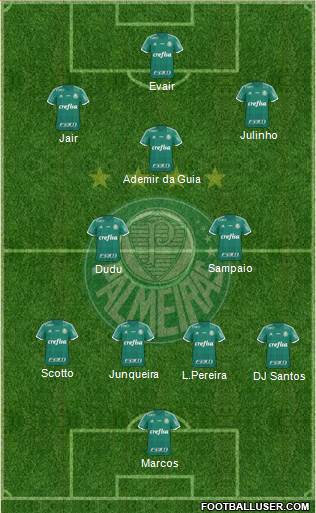
Formation


Monday, January 23, 2017

Corinthians Greatest All-Time Team

This blogger Artur Yanturin of Russia copied many of my blog teams.  This blog was one of them.  It was my Russia All-Time Team here.  His team was written in 2020, but mine was uploaded in 2014.   His Spartak Moscow All-Time team entry of was published in October 2020, but mine was uploaded in 2017.  His entry of the Dutch-German rivalry between Real Madrid and Barcelona was written in 2020, but mine was uploaded in 2014.  He also copied many many of my blog entries.

His Facebook and Instagram

World Club Cup 2000

Please also see my All-Time World Cup Team Index.

SantosFlamengoSao PauloCorithiansBotafogo
Vasco Da GamaPalmeirasInternacional
FluminenseGremioCruzeiroAtlético MineiroBahia.

This is my selection of a 25 member all-time team for the club.  The number 25 was chosen because it is the official squad size for the Champions' League.

Sport Club Corinthians Paulista was founded in 1910 by five railway workers from the district of Bom Retiro, who became impressed by the performances of London-based club Corinthian Football Club. It is the richest mon-European club in the world. In 2000, the club won the inaugural FIFA Club World Cup as the host nation's representative, repeating the feat in 2012 after winning the Copa Libertadores de América for the first time.
World Club Cup 2012
Team
GK: Ronaldo Giovanelli (Brazil)
Ronaldo Giovanelli began his career with Corinthians. He played over 600 games for Corinthians from 1986 and 1998.  He won Campeonato Paulista in 1988, 1995 and 1997.  He played for many clubs after leaving them in 1998.  He won the Bola de Prata award for the best goalkeeper in 1990 and 1994.  He was a part of the Fluminense squad that was relegated from Série B to Série C in 1998.  He was capped once in 1993. After retirement, he formed a band.
Ronaldo Giovanelli 
GK: Gilmar (Brazil)
Gilmar was the goalkeeper for World Cup Finals in 1958, 1962 and 1966 winning two titles. He had 104 caps. Also a member of Pele's Santos team of the 1960's. With Gilmar between the posts, Santos conquered almost every championship they competed in: they won five São Paulo State Championships, five National Championships, back-to-back Libertadores Cups and two Intercontinental Cups (1962 and 1963).

GK: Cassio Ramos (Brazil)
After playing mainly as a backup keeper for Greimo and PSV, Cassio Ramos joined Corinthians in 2012.  He helped to the club to win Copa Libertadores Cup and the World Club Cup in 2012.  He wont Golden Ball for the World Club Cup. He was called up many times for Brazil since 2007, but he did not earn his first cap until in 2017 against Japan.

RB: Ze Maria (Brazil) 
During his career (1966–1983),  Ze Maria played for Ferroviário (SP), Portuguesa, Corinthians and Internacional (RS) as a defender. From 1970 to1983, he played for Corinthians. For Brazil, he played in 46 games from 1971 to 1978. He was a member of the Brazilian squad at the 1970, but did not play.  He played in 1974 World Cup in West Germany.

CB/LB: Del Debbio (Brazil) 
Del Debbio started his career with São Bento in 1919. In 1921, to join Corinthians, where he stayed until 1931. During his stint at Corinthians, he won the Campeonato Paulista in 1922, 1923, 1924, 1928, 1929 and 1930. He joined Lazio of Italy in 1931, leaving the club in 1935 to play again for Corinthians. He was capped three times.

CB:  Carlos Gamarra (Paraguay)
Widely considered a top defender in South America during his peak years.  Carlos Gamarra played in Paraguay, Brazil, Greece, Italy and Portugal. He is the most capped player in Paraguayan football history.  He was named as the Paraguayan Footballer of the Year in 1997 and 1998, and was also included in the 1998 FIFA World Cup Team of the Tournament.  He also went to World Cup Finals in 2002 and 2006.
Carlos Gamarra
SW/CB: Domingos da Guia  (Brazil)
Domingos da Guia was a star defender during the 1940's. He was among the first skilled defender to play the game. He played for several clubs, but notably with Flamengo and Corinthians, and aboard with Boca Juniors. He had 30 caps. He was a star at the 1938 World Cup Finals in France. He made the all-star team at that World cup Finals.  His son is Ademir da Guia.

CB: Chicão (Brazil)
Between 1968–1985, Chicão played for many clubs: São Paulo FC, Atlético Mineiro, Santos FC, Londrina, Corinthians, Botafogo-SP Mogi Mirim, etc. He won one São Paulo State League (1975), one Brazilian League (1977) and one Minas Gerais State League (1980). For the Brazil, he played 9 times, from 1976 to 1979. He played 3 games at the 1978 World Cup.

LB: Wladimir (Brazil) 
Wladimir was best remembered for his time at Corinthians. He won four São Paulo State Championships, and is the most capped player in Corinthians history with 803 matches played. In 1998 Federação Paulista de Futebol named him in the Paulista League all-time best XI, alongside players like Rivelino, Ademir da Guia, Pelé, Djalma Santos and others. He was also named, by Placar Magazine, as the best left back in Corinthians history.

LB: Oreco (Brazil)
Oreco began his career at the Santa Maria in 1949, where he played for a year. He then played for Internacional of Porto Alegre, for which he played for seven years and won five Rio de Janeiro championships in that period. He was also a Corinthians player for eight years.  He won the 1958 World Cup as Nilton Santos' backup. He also played in the NASL.

DM/CM: Paulinho (Brazil)
Paulinho became famous with Corinthians.  In 2013, he was the best player for Brazil as they won the Confederation Cup.  he joined Tottenham Hotspurs during that summer. Aftervthe disappointment of the WC Finals in 2014, he joined Guangzhou Evergrande in China.  He won the Asian Champions' league immediately.  At the time of writing, he was capped 55 times. He appeared in both 2014 and 2018 World Cup Finals.
Paulinho
DM: Roberto Belangero (Brazil)
Roberto Belangero played for Corinthians from 1947 to 1960. He made 450 matches in the white jersey. He joined Newell's Old Boys, of Argentina, where he finished his career. He also played for the Brazilian national team, playing for the qualifiers and preparing for the 1958 World Cup, but missed the Finals due to an injury. concussion.

DM: Biro-Biro (Brazil)
Biro-Biro started his career in 1977, playing for Sport. In 1978, he moved to Corinthians., During his 11 seasons there,  he won the Campeonato Paulista four times and in 1988. He won the Placar's Campeonato Brasileiro Série A Bola de Prata award in 1982, and he scored 75 goals, in 592 matches, placing him as the 5th player with the most appearances for Corinthians. He also played for  Portuguesa, Coritiba, Guarani Botafogo-SP and Nacional-SP.

RM/CM: Socrates (Brazil)
Socrates was one of Brazil's greatest players. He earned over 60 caps between 1979 and 1986. He was the captain of 1982 and 1986 World Cuo team. One of the best attack midfielders in Brazil's history.  In 1983, he was named South American Footballer of the Year.  He spent 7 seasons with Corinthians.  He went abroad in 1984, playing a season in Serie A with Fiorentina.  He was also a MD, earning the degree while he was an active player.
Socrates
LW/AM: Rivelino (Brazil)
Rivelino is considered to be one of the greatest left-sided midfielder ever.  His signature move was the "flip-flap". He was a member of Brazil's great 1970 team and also played in the 1974 team.  He had 92 caps for Brazil.  He started his career with Corinthians, but in one of the club's worst period in history. He moved to Fluminense in 1974, forming a great team with Carlos Alberto.  He also played for Al Hilal in Saudi Arabia.
Rivelino
AM: Marcelinho Carioca (Brazil) 
Nicknamed "Pé-de-Anjo" (Angel Foot), the most successful player ever to play for Corinthians, he has scored 206 goals in 420 matches from 1994 to 2001. He has collected more trophies with Corinthians than any other player in their history, a total of 8 championships including 1998 and 1999 Brazilian National Championships and the Club World Cup, in 2000. He scored 505 goals, in his entire career.

AM/FW: Luisinho (Brazil) 
Luisinho played entire career (1949–1967) with Corinthians, except in season 1962–63 when play for Clube Atlético Juventus. He won three São Paulo State Championship in 1951, 1952 and 1954. He died at 67 years old.  Some people consider Luisinho, the greatest player ever for Corinthians. He was capped 11 times for the Seleção between 1955-1957.

AM/FW: Neto (Brazil)
In Brazil Neto is commonly considered one of the greatest free kick takers ever and one of the best Brazilian players of the early 1990s. He played for many clubs.  His longest career was with Corinthians. After Corinthians he played in many other clubs, in Brazil (Araçatuba, Atlético Mineiro, Matsubara, Santos) and abroad (Millonarios of Colombia). He was capped over 20 times.

AM: Vampeta  (Brazil)
Vampeta started his career with team Vitória, and later went to  PSV Eindhoven alongside Ronaldo in 1994. In 1998, he joined Corinthians. He then joined Inter Milan in summer 2000, being reunited with Ronaldo. In January 2001, Vampeta went to PSG for €12.196 million.  In 2007, he returned to Corinthians, signed a contract until the end of season.  He represented Brazil from 1998 until 2002, winning the 1999 Copa América and the 2002 FIFA World Cup.

CM/FW: Freddy Rincon (Colombia)
Freddy Rincon was one of the most important player during the Golden Generation of the 1990's.  He had 84 caps. He played in the 1990, 1994 and 1998 World Cup Finals.  He scored the equalizing goal vs West Germany in 1-1 draw at Italia 1990, securing Colombia a place in the 2nd round.  He was best remembered for his career in Brazil, where he played for Palmeiras, Corinthians, Santos and Cruzeiro. 
Freddy Rincon
ST/SS: Carlos Tevez (Argentina)
Tevez began his career with Boca Juniors, winning the Copa Libertadores and Intercontinental Cup in 2003. With Manchester United, he won a Champions' League. In 2009, he joined Manchester City becoming the first player to move between the two rival clubs since Terry Cooke in 1999. He helped City win their first league title in 44 years. He earned over 70 caps and appeared in two World Cup Finals.

ST: Neco (Brazil)
With great skill and tenacity, Neco was the first idol of Corinthians, being the first player to get a statue in the team's gardens (in 1929). As of 2006, Neco is the player who played the longest for Corinthians: 17 years in total.  He won the Paulista League eight times as a player (being top scorer in 1914 and 1920).  For Brazil, he won two South American Championships: 1919 (team's top scorer) and 1922 (top scorer). 
Neco
ST: Baltazar (Brazil)
Nicknamed Cabecinha de Ouro (Golden Head) by fans, Baltazar played as a striker for União Monte Alegre, Jabaquara, Corinthians, Juventus and União Paulista. His longest stint was with Corinthians, where he played from 1945 to 1957.  He had 31 caps for Brazil between 1950 and 1954.  He participated in the 1950 World Cup and 1954 World Cup, he played 4 matches, scoring 3 goals.

ST: Teleco (Brazil) 
Most of his career was spent with Corinthians, representing the club during one full decade. He was given the nickname Teleco by his grandmother when he was a young boy. He was referred to as "O Rei das Viradas" (King of the Twist) and "O Homem Gol" (Goal Man), for scoring 251 goals in 246 games as well as helping it to four state titles.

ST: Claudio (Brazil)
Cláudio is the all-time leading scorer of all time with 306 goals in 554. He was usually ranked as the 3rd best ever Corinthians player, after Rivelino and Sócrates.  He won the São Paulo State Championship in 1951, 1952 and 1954 and the Rio-São Paulo Tournament in 1950, 1953 and 1954. He was a member of the Palmeiras team that won the São Paulo state championship in 1942 and he was also part of the Seleção which won the South American Cup in 1949.
Claudio

Honorable Mention
Carlos Tevez, Ronaldo,Viola,  Basilio, Idário, Henrique, Marcelo Djian, Amaral, Jairo do Nascimento, Dida, Kleber, Paolo Guerrero, Walter Casagrande, Dida, Marcelinho Carioca, Ze Elias, Fabio Costa, Edílson, Renato Augusto, Gil, Tupãzinho.

Squad Explanation
--  Socrates, Rivelino and Claudio are often considered to be the greatest footballer for the club. Luisinho also is considered to be the club's greatest players by some fans.  Neco supposed to be another important player in the early history of the club.   Those names must be on any all-time team for Corinthians.
-- In 2018, the fans voted for Corinthians' Best XI: Cassio, Ze Maria, Freddy Rincón, Paulinho, Carlos Gamarra and Fabian Balbuena; Carlos Tevez, Ronaldo, Socrates, Rivellino and Wladimir.  Except Ronaldo and Balbuena, everyone from that team made my all-time team.  Please see below for Ronaldo.  Obviously, the younger fans forgot about Claudio, Neco and Luisinho.  Balbuena was an active player of the club at the time of the poll.  He had not done much in his career to be included.
-- Corinthians won Copa Libertadores and Intercontinental Cup in 2012, but I only selected Paulinho and Cassio to my all-time team.  At the time of Paulinho's departure from Corinthians, he was considered the most important Brazilian player after Neymar, especially after a good performance at the 2013 Confederation Cup.
-- Corinthians won the World Club Championship in 2000.  It was an early version of the World Club Cup.  Corinthians qualified for the tournament not because they were the defending Copa Libertadores champion.  They were the host. From that winning team, I selected Marcelinho Carioca, Freddy Rincon and Vampeta.
-- Carlos Gamarra's reputation in South America was very good.  He was one of the best defenders playing in Brazil during his prime, but he only spent a single season with the club.  I was not sure if he deserved to be on this team.  He won Serie A Brazilian Championship in 1998. I am also unsure about Domingos da Guia's career here.  As you might have known, he is considered to be Brazil's greatest defender.  He played between 1944 and 1948 with the club at the end of his career.  But in the end, I took both players.
-- Ronaldo Giovanelli made my all-time team for Corinthians. He is often listed as the club's greatest goalkeeper.  Ronaldo "The Phenomenon" did not make the team.  He only played two seasons here. He started his career here well.  He helped Corinthians win the Campeonato Paulista with 10 goals in 14 games. 
-- Gilmar spent half of his career here.  He got the second spot. Dida (goalkeeper) appeared in several all-time list, but he only spent very limited time with the club.  He seemed to have achieve more elsewhere.  I gave the final goalkeeping spot to Cassio who helped the club to win the Copa Libertadores and the World Club Cup in 2012. 
-- Fullback Wladimir (Brazil) is the club's all-time appearance leader.  In 1998, Federação Paulista de Futebol named him in the Paulista League all-time best XI.  Rivelino is also on the list.
-- Teleco scored 251 goals in 246 matches.  He was the Campeonato Paulista Top scorer in 1935, 1936, 1937, 1939 and 1941.
-- Basilio scored the goal that won the 1977 Sao Paulo State Champion, which ended the club's trophy drought stretching all the way back to 1954.  But I could not find a spot for him.
-- Instead, I decided to select one big-time player to the team. Ronaldo came to the club at the end of his career.  He only played a short time there. Carlos Tevez also did not play much, but he came at the beginning of his career when he was one of the best South American players in the world. Carlos Tevez at Corinthians was better than Ronaldo at Corinthians.
-- Renato Augusto, Jo, Edílson and Marcelinho Cairoca won the Bola de Ouro award(Player of the Year award) while playing for Corinthians, but I do not have space for them.
-- Rivaldo also played briefly for the club at the beginning of his career.


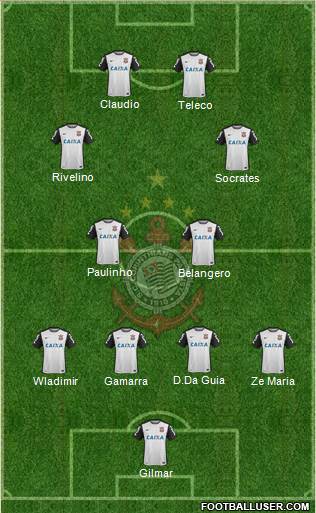
Formation