|
| England 1973 |
Please also see my All-Time World Cup Team Index
Brazil 1982 with Careca, etc
United Kingdom World Cup 1982
Netherlands Euro 1984 with Cruyff, Van Basten, Gullit
United Kingdom World Cup 1982
Netherlands Euro 1984 with Cruyff, Van Basten, Gullit
By 1973, Bobby Charlton and Gordon Banks were no longer with the English national team. Nevertheless, England was still viewed as a super power in football. However, because of an away defeat against Poland on June 1973, England needed to beat Poland at home on the last match of the World Cup Qualifiers in order to qualify for the World Cup Finals.
On October, 1973, England took on Poland at the Wembley Stadium. Before the match, Polish goalkeeper Jan Tomaszewski had been labelled "a clown" by Brian Clough. In turn, Tomaszewski had the match of his life as England only managed to draw 1-1. Poland's only goal came as a result of two separated bloopers by Norman Hunter and Peter Shilton on the same play. England surrendered an unlucky goal in the match and failed to qualify for the 1974 World Cup Finals. Poland went on to finish third at the World Cup Finals. Grzegorz Lato, Wladyslaw Zmuda, Jan Tomaszewski and Kazimierz Deyna all became international stars.
If England beat Poland that night, they would be qualified for the World Cup Finals. This is my selection of England for the World Cup Finals in 1974. Only 22 players were on the official roster back then.
On October, 1973, England took on Poland at the Wembley Stadium. Before the match, Polish goalkeeper Jan Tomaszewski had been labelled "a clown" by Brian Clough. In turn, Tomaszewski had the match of his life as England only managed to draw 1-1. Poland's only goal came as a result of two separated bloopers by Norman Hunter and Peter Shilton on the same play. England surrendered an unlucky goal in the match and failed to qualify for the 1974 World Cup Finals. Poland went on to finish third at the World Cup Finals. Grzegorz Lato, Wladyslaw Zmuda, Jan Tomaszewski and Kazimierz Deyna all became international stars.
 |
| England vs Poland 1973 |
Prediction
Two crucial mistakes in the decisive match against Poland shattered England's World Cup qualification dreams, highlighting the profound impact that minor moments can have on historical outcomes. If England was luckier in 1973, they could have gone to Germany in place of Poland.
Despite missing their star striker Włodzimierz Lubański, Poland finished third place in the World Cup Finals, with numerous experts placing them on par with the two finalist Netherlands and West Germany. the question arises: Does this imply that England was equally matched with Poland and potentially capable of reaching the semifinals?
The FIFA Organising Committee decided to seed the four previous World Cup semifinalists—Brazil, Italy, Uruguay, and West Germany (also the host). Consequently, England was not included as a seed but instead placed in one of the European pots for the draw. Given that the draw could not be predicted, I would simply replace Poland with England in Group Four. England would be set to compete against Italy, Argentina, and Haiti in the group stage.
Game 1: vs Argentina
Argentina had played to a draw against England just before the World Cup Finals. Notably, the English lineup was experimental during this match. Up to that point, Argentina had only defeated England once in history, back in 1964. The match took place in the "Taça das Nações" or "Little World Cup," held in Brazil in 1964. Argentina did not beat England again until the 1986 World Cup Finals, where the game was remembered for the controversial "Hand of God" incident. I am confident that England had the capability to secure a favorable result against Argentina, especially considering the match would be held on European soil. England had remained undefeated against Argentina in Europe until the 1998 World Cup, but the game technically should be counted as a draw since the game ended in a 2-2 draw within regulation time. Moreover, Argentina's performance in 1974 is most notably remembered for their crushing defeat at the hands of the Netherlands. So I predicted a victory for England.
Game 2: vs Haiti
It should be a walk in the peak.
Game 3: vs Italy
In West Germany, Italy finished third in their group behind Poland and Argentina respectively. However, in 1973, England faced Italy twice. Italy secured a 2-0 victory over England in June 1973 in Turin, marking the first time in history that Italy had defeated England. England fielded a lineup similar to the players I had chosen. Later that year, in November, Italy once again triumphed over England, this time at Wembley, establishing Italy as a formidable opponent for England. However, I doubt that Italy would be able to win three consecutive games against England. So England should at least secure a point and win the Group.
 |
| Mick Channon vs Italy |
Game 4 vs Sweden
Before facing England in this knockout stage fixture, Sweden participated in 6 matches in the year 1974, including 3 games in the first round of the World Cup Finals. They secured 2 victories, drew 3 times, and suffered a single defeat. Notably, Sweden triumphed in their previous game against Uruguay with a 3-0 scoreline. Nevertheless, in the three preceding matches, Sweden struggled to score, resulting in three consecutive 0-0 draws. So, I do not see Sweden as a formidable opponent.
Game 5 vs Yugoslavia
Just under three weeks prior, England drew 2-2 against Yugoslavia in Belgrade. England fielded an experimental squad distinct from this England team, making the result less significant. Additionally, Yugoslavia had a lackluster performance in 1974. Despite defeating Spain in the World Cup playoff matches in February, they only managed to win one game out of their next seven matches, with that victory occurring in the group stage against the minnow team Zaire.
Game 6 vs West Germany
By 1974, West Germany had already begun to dominate over England, with England failing to secure a victory in their last four encounters. West Germany had the advantage of being the host, with their team also being one of their best ever. This would be an easy victory for them.
Game 7: Third Place Match vs Brazil
In 1974, Brazil struggled to find an identity after Pele's retirement. Nonetheless, I did not believe England had a strong team, yet I still predicted them to reach a position that would have marked their second-best finish in World Cup history. But Brazil was probably still too good for England.
Team
GK: Peter Shilton (Leicester City)
Peter Shilton is considered one of the greatest keepers ever. He is England's all-time cap record-holder with 125. He earned his first cap in 1970 and his last 20 years later in 1990. He took England to 4th place in the 1990 World Cup. He played for 11 different clubs in his career, all in England. He won two straight European Cups in 1979 and 1980 with Nottingham Forrest. He was PFA Players' Player of the Year: 1977–78, an award rarely won by a goalkeeper.
 |
| Peter Shilton |
Ray Clemence was considered one of England's greatest keepers. From 1968 to 1981, he played for Liverpool where he won 3 European Cups and 2 UEFA Cups in the 1970's with Liverpool. Then, he won a UEFA Cup with Tottenham Hotspurs in 1984. He was voted as Liverpool's greatest keeper. For the national team, he was locked in a battle of number 1 with Peter Shilton for many years. He made 61 appearances for England between 1972 and 1983.
GK: Phil Parkes (Queens Park Ranger)
Born in 1950, Phil Parkes began his career at Walsall, turning professional in 1968, he made over 50 appearances in the Black Country before moving to Queens Park Rangers. Parkes was sold to West Ham in 1979 for £565,000, a world record for a goalkeeper at the time. He played there from 1979 to 1990. He also played for Ipswich Town for a few games. He was capped once for England in 1974.
DM/RB/LB: Paul Madeley (Leeds United)
Paul Madeley signed for Leeds from non-league Farsley Celtic in May 1962 and became a regular in the team from 1966 onwards. In his Leeds career, he played in every position on the pitch except goalkeeper. Don Revie called him a Royce-Rolls of a defender. He was a one club man where he played from 1983 to 1980 for Leeds United. He was capped 24 times for England between 1971 and 1977. He declined to be a stand-in player for the 1970 World Cup Finals.
Paul Madeley signed for Leeds from non-league Farsley Celtic in May 1962 and became a regular in the team from 1966 onwards. In his Leeds career, he played in every position on the pitch except goalkeeper. Don Revie called him a Royce-Rolls of a defender. He was a one club man where he played from 1983 to 1980 for Leeds United. He was capped 24 times for England between 1971 and 1977. He declined to be a stand-in player for the 1970 World Cup Finals.
RB/DM: Peter Storey (Arsenal)
Peter Storey spent 15 years at Arsenal from 1962 to 1977, winning the Inter-Cities Fairs Cup in 1970, the First Division title in 1970–71, and the FA Cup in 1971. He also was a losing finalist in the 1968 and 1969 League Cup and the 1972 FA Cup Final. He also won 19 caps for England between April 1971 and June 1973. He played in the Home Championships. He was transferred to Fulham in March 1977 before announcing his retirement eight months later. He only played 17 games over there.
 |
| Peter Storey |
Colin Todd started his career with Sunderland, but his most famous stint was with Brian Clough's Derby. His transfer fees in 1971 to Derby was a record for a defender in England. He would win the league title in his first season with Clough. He was PFA Player of the Year in 1974 after Derby won their second league title in 1974. He also played for Sunderland, Derby County, Everton, Birmingham City, Nottingham Forest, Oxford United and Luton Town. He earned 27 caps for England.
CB: Roy McFarland (Derby County)
Roy McFarland was one of the top defenders in the late 1960's and early 1970's. He played for Tranmere Rovers, Derby County and Bradford City. He was a key player for the great Derby side under Brian Clough. With them, he won two league titles in Division One. He played 28 times for England between 1971 and 1976, but was a part of the team that did not qualify for the World Cup Finals in 1974 after the memorable game against Poland in Wembley.
CB: Bobby Moore (Fulham)
Bobby Moore was the captain of the 1966 World Cup winning team. He was regarded one of the greatest defenders of all time and a perfect gentleman. He won a total of 108 caps for the England team, which at the time of his international retirement in 1973 was a national record. For his club career, he played mainly for West Ham, but he also played for Fulham for 3 seasons. He had a stint in the NASL playing for San Antonio and Seattle. He won a UEFA Cup Winners' Cup with West Ham.
Bobby Moore was the captain of the 1966 World Cup winning team. He was regarded one of the greatest defenders of all time and a perfect gentleman. He won a total of 108 caps for the England team, which at the time of his international retirement in 1973 was a national record. For his club career, he played mainly for West Ham, but he also played for Fulham for 3 seasons. He had a stint in the NASL playing for San Antonio and Seattle. He won a UEFA Cup Winners' Cup with West Ham.
 |
| Bobby Moore |
CM/LB: Emlyn Hughes (Liverpool)
Emlyn Hughes was at one point the captain of England and Liverpool. He was considered to be one of Liverpool's most important defenders. He played under Bill Shankly in the 1970's where he won two European Cups, four League titles and a single FA Cup. He was FWA Football of the Year in 1977. He earned 62 English caps between 1969 and 1980. He went to the 1970 World Cup Finals in Mexico and 1980 European Championship.
Emlyn Hughes was at one point the captain of England and Liverpool. He was considered to be one of Liverpool's most important defenders. He played under Bill Shankly in the 1970's where he won two European Cups, four League titles and a single FA Cup. He was FWA Football of the Year in 1977. He earned 62 English caps between 1969 and 1980. He went to the 1970 World Cup Finals in Mexico and 1980 European Championship.
LD: David Nish (Derby County)
Nish began his career with Leicester City in 1966. In 1972, Derby County paid a record transfer fee of £225,000 for his contract. At Derby he was part of the team that won the First Division in 1975.
He left Derby in 1979 for the NASL. He played for Tulsa Roughnecks, Seattle Sounders and San Jose Earthquakes in the United States. Nish earned five caps for the England national team in 1973 and 1974.
CB/DM: Norman Hunter (Leeds United)
Norman Hunter was known as one of the hardest tackler ever came out of English football. His nickname was "Bites Your Leg" Hunter. He was one of Don Revie's key players at Leeds United, forming a strong partnership with Jack Charlton. He was PFA Player of the Year in 1974. He later played Barnsley FC and Bristol City. He won the World Cup in 1966 as an unused player. He went to the following World Cup in Mexico, but only made a single appearance. In total, he played 28 times for England.
 |
| Norman Hunter |
Alan Ball was the youngest member of the World Cup winning team in 1966. He started his career with Blackpool. He also played with Everton, Arsenal, Southampton and various clubs in North America and Hong Kong. He played 72 times for England and was a key player at the World Cup finals in 1966 and 1970. He missed the ill-fated match vs Poland in 1973 due a suspension. In 2003 Ball was inducted into the English Football Hall of Fame in recognition of his talents.
AM/LM/CM: Martin Peters (Tottenham Hotspurs)
Martin Peters was an all-round midfielder who played for West Ham United, Tottenham Hotspur, Norwich City and Sheffield United. He was briefly a player/coach for Sheffield United. He earned 67 caps for England between 1966 and 1974, and was a member of the 1966 World Cup winning team. He also played in the 1970 World Cup Finals. A free kick specialist, he was described by England manager Sir Alf Ramsey, after a game against Scotland in 1968, as being "ten years ahead of his time"
AM/CM: Trevor Brooking (West Ham)
Trevor Brooking played most of his career for West Ham United making 647 appearances for the club. He won the 1975 FA Cup and the 1980 FA Cup in which he scored the only goal. West Ham also reached the Final of the 1976 Cup Winners' Cup. He was also the club's player of the season on four occasions. For England, Brooking was earned 47 caps. He went to Euro 1980 and the 1982 World Cup Finals, but only appeared twice in the two tournaments. He was knighted in 2004.
CM: Colin Bell (Manchester City)
Colin Bell is considered to be Manchester City's greatest ever player. He won the league in 1967-1968, FA Cup in 1969 and the UEFA Cup Winners' Cup in 1970. While Bell is considered to be one of England's greatest midfielder, he was unable to showcase his talents in the world stage. He was remembered as the substitute for Bobby Charlton at the WC Finals in 1970 against West Germany. In 1973, he was a part of the ill-fated national team that failed to qualify for West Germany 1974.
RW/FW: Mike Summerbee (Manchester City)
Mike Summerbee made his league debut playing for Swindon Town in 1959 at the age of 16. He made more than 200 appearances for the Wiltshire club, scoring 38 goals. In 1965, Manchester City signed Summerbee. Playing on the right wing, Summerbee was one of the most influential players in the Manchester City side which won four trophies in three seasons from 1968–70. Capped 8 times. He played 8 times for England between 1968 and 1972.
Trevor Brooking played most of his career for West Ham United making 647 appearances for the club. He won the 1975 FA Cup and the 1980 FA Cup in which he scored the only goal. West Ham also reached the Final of the 1976 Cup Winners' Cup. He was also the club's player of the season on four occasions. For England, Brooking was earned 47 caps. He went to Euro 1980 and the 1982 World Cup Finals, but only appeared twice in the two tournaments. He was knighted in 2004.
CM: Colin Bell (Manchester City)
Colin Bell is considered to be Manchester City's greatest ever player. He won the league in 1967-1968, FA Cup in 1969 and the UEFA Cup Winners' Cup in 1970. While Bell is considered to be one of England's greatest midfielder, he was unable to showcase his talents in the world stage. He was remembered as the substitute for Bobby Charlton at the WC Finals in 1970 against West Germany. In 1973, he was a part of the ill-fated national team that failed to qualify for West Germany 1974.
 |
| Colin Bell |
RW/FW: Mike Summerbee (Manchester City)
Mike Summerbee made his league debut playing for Swindon Town in 1959 at the age of 16. He made more than 200 appearances for the Wiltshire club, scoring 38 goals. In 1965, Manchester City signed Summerbee. Playing on the right wing, Summerbee was one of the most influential players in the Manchester City side which won four trophies in three seasons from 1968–70. Capped 8 times. He played 8 times for England between 1968 and 1972.
RW: Ian Callaghan (Liverpool)
Ian Callaghan held the all-time appearance record for Liverpool. He was a part of the team that made its historical promotion in 1962 and remained on the team as Liverpool won the European Cup twice in 1977 and 1978. He also played fopr Swansea. Callaghan also played four times at senior level for England. Although he was in the squad for the 1966 FIFA World Cup, he did not play in the final and so did not receive a medal until 2010. He was FWA Player of the year in 1974.
AM: Tony Currie (Sheffield United)
Currie started with Watford in 1967. He was transferred to Sheffield United in 1968 and went on to score 54 goals in 313 appearances and was also made captain by manager Ken Furphy in March 1974. In September 2014, as part of the club's 125th Anniversary celebrations, he was named Sheffield United's Greatest Ever Player. In 1976, he moved to Leeds United. His curling shot against Southampton F.C. In 1978 won ITV's The Big Match Goal of the Season that year. Capped 17 times.
ST/SS: Kevin Keegan (Liverpool)
Kevin Keegan was two-time European Footballer of the Year in 1978 and 1979. He won the European Cup in 1977 with Liverpool where he played from 1971 to 1977. He also found successes in the Bundesliga with Hamburger SV, where he played between 1977 and 1980. He later played for Southampton and Newcastle United after returning from Germany. He had 63 caps for England scoring 21 goals. However, his World Cup appearance was limited to 20 minutes against Spain at the World Cup Finals in 1982.
ST: Mick Channon (Southampton)
Mick Channon played notably for Southampton from 1965 and 1977, and then from 1979 and 1982. Between the two stints, he played for Manchester City. At the age of 34, he joined Norwich, where he played form 1982 and 1985. He played for Portsmouth. He retired in 1987 after playing for Funn Harps. For England, he was capped 46 times, but England failed to qualify for the World Cup Finals during his career. He also became known for his trademark windmill goal celebration.
ST: Allan Clarke (Leeds United)
Earlier in his career, Allan Clarke played Walsall, Fulham and Leicester. In 1969, he joined Leeds United, where he was a part of Don Revie's great team. They were the dominating team in England at the time. With Leeds United, Clarke won the Fairs Cup in 1971, scoring in the final against Italy's giant Juventus. They also reached the Final of the European Cup in 1975. He was capped 19 times for England. He made his debut during the 1970 World Cup Finals in Mexico.
ST: Martin Chivers (Tottenham Hotspurs)
From 1962 to 1966, Martin Chivers played with Southampton. He moved to Tottenham Hotspurs in 1968, breaking the tran sager record at the time. During the 1971–72 campaign, Chivers hit the best form of his career, netting 44 times in 64 first team appearances. He scored eight times in 11 UEFA Cup matches in 1972, in which Tottenham became champion. He was indicted to Tottenham's Hall of Fame. Chivers was capped 24 times for England scoring 13 goals between 1971 and 1973.
Player Pool
Alex Stepney, Jimmy Rimmer, Dave Watson, Kevin Beattie, Jeff Blockley, Chris Lawler, Paul Reaney, Mick Mills, Mike Pejic, Alec Lindsay, Martin Dobson, Alan Hudson, Dennis Tueart, Dave Thomas, Peter Taylor Malcolm Macdonald, Joe Royle, Rodney Marsh, Francis Lee, Kevin Hector, John Richards.
Ian Callaghan held the all-time appearance record for Liverpool. He was a part of the team that made its historical promotion in 1962 and remained on the team as Liverpool won the European Cup twice in 1977 and 1978. He also played fopr Swansea. Callaghan also played four times at senior level for England. Although he was in the squad for the 1966 FIFA World Cup, he did not play in the final and so did not receive a medal until 2010. He was FWA Player of the year in 1974.
AM: Tony Currie (Sheffield United)
Currie started with Watford in 1967. He was transferred to Sheffield United in 1968 and went on to score 54 goals in 313 appearances and was also made captain by manager Ken Furphy in March 1974. In September 2014, as part of the club's 125th Anniversary celebrations, he was named Sheffield United's Greatest Ever Player. In 1976, he moved to Leeds United. His curling shot against Southampton F.C. In 1978 won ITV's The Big Match Goal of the Season that year. Capped 17 times.
ST/SS: Kevin Keegan (Liverpool)
Kevin Keegan was two-time European Footballer of the Year in 1978 and 1979. He won the European Cup in 1977 with Liverpool where he played from 1971 to 1977. He also found successes in the Bundesliga with Hamburger SV, where he played between 1977 and 1980. He later played for Southampton and Newcastle United after returning from Germany. He had 63 caps for England scoring 21 goals. However, his World Cup appearance was limited to 20 minutes against Spain at the World Cup Finals in 1982.
 |
| Kevin Keegan |
Mick Channon played notably for Southampton from 1965 and 1977, and then from 1979 and 1982. Between the two stints, he played for Manchester City. At the age of 34, he joined Norwich, where he played form 1982 and 1985. He played for Portsmouth. He retired in 1987 after playing for Funn Harps. For England, he was capped 46 times, but England failed to qualify for the World Cup Finals during his career. He also became known for his trademark windmill goal celebration.
ST: Allan Clarke (Leeds United)
Earlier in his career, Allan Clarke played Walsall, Fulham and Leicester. In 1969, he joined Leeds United, where he was a part of Don Revie's great team. They were the dominating team in England at the time. With Leeds United, Clarke won the Fairs Cup in 1971, scoring in the final against Italy's giant Juventus. They also reached the Final of the European Cup in 1975. He was capped 19 times for England. He made his debut during the 1970 World Cup Finals in Mexico.
ST: Martin Chivers (Tottenham Hotspurs)
From 1962 to 1966, Martin Chivers played with Southampton. He moved to Tottenham Hotspurs in 1968, breaking the tran sager record at the time. During the 1971–72 campaign, Chivers hit the best form of his career, netting 44 times in 64 first team appearances. He scored eight times in 11 UEFA Cup matches in 1972, in which Tottenham became champion. He was indicted to Tottenham's Hall of Fame. Chivers was capped 24 times for England scoring 13 goals between 1971 and 1973.
 |
| Martin Chivers |
Player Pool
Alex Stepney, Jimmy Rimmer, Dave Watson, Kevin Beattie, Jeff Blockley, Chris Lawler, Paul Reaney, Mick Mills, Mike Pejic, Alec Lindsay, Martin Dobson, Alan Hudson, Dennis Tueart, Dave Thomas, Peter Taylor Malcolm Macdonald, Joe Royle, Rodney Marsh, Francis Lee, Kevin Hector, John Richards.
Squad Explanation
-- The original team was created in 2017. I reviewed the team in July, 2024.
-- Only 22 players were on the World Cup Finals' roster back in 1974.
-- Sir Alf Ramsey did not get sacked until May, 1974. In July 1974, Revie accepted the offer of the England manager's job. For this team, Alf Ramsey was never sacked due to his successful campaign. However, I was not making an England team under him. In this blog, I was the manager of this team, but I was using Sir Ramsey's selection pattern as a guideline. For instance, I retained Ramsey's attacking trio comprising Martin Chivers, Mick Channon, and Allan Clarke, who proved ineffective during the World Cup qualifying campaign scoring 3 goals in 4 matches. However, I decided to incorporate two wingers into the team, a position that Ramsey had neglected. Ian Callaghan and Mike Summerbee were two players whom Ramsey would have overlooked for his World Cup 1974 team.
-- Leeds United won the league with Liverpool and Derby County finishing 2nd and 3rd. Meanwhile, Manchester United were relegated from the First Division after 36 year stay in the top division. Southampton also went down, but Mick Channon had a great season. He was the First Division Top Scorer for the 1973-1974 season.
-- England switched to Admiral for jersey supplier in 1974. The new Admiral jersey made its debut on October, 1974 after the World Cup Finals. The Admiral jersey was associated with Don Revie. In real life, he was appointed as England's manager on July, 1974. Sir Alf Ramsey would have remained on his job if England qualified for the World Cup Finals. They would have continued with the old jersey. All photos on this blog were using the old jersey.
-- The PFA Players' Player of the Year award was won by Norman Hunter of Leeds United. The English players on the PFA Team of the Year were Paul Madeley, Roy McFarland, Norman Hunter, Colin Todd, Tony Currie, Allan Clarke, Mick Channon and Malcolm Macdonald. Except Macdonald, they all made the team. Macdonald was seldom used by England during the period around the World Cup Qualifiers.
-- The English players on the PFA Team of the Year were Paul Madeley, Roy McFarland, Norman Hunter, Colin Todd, Tony Currie, Allan Clarke, Mick Channon and Malcolm Macdonald. Except Macdonald, they all made the team. Macdonald was seldom used by England during the period around the World Cup Qualifiers. He played well for Newcastle United that season.
Goalkeepers
-- Ray Clemence had five caps before the World Cup Finals commenced. He participated in two World Cup Qualifiers, both against Wales, and three additional friendlies in 1974. Despite being the primary goalkeeper in the early 1970s, Peter Shilton did not feature in any matches in 1974.
-- Selecting the third goalkeeper posed a challenge. Peter Shilton and Ray Clemence maintained their positions consistently. Alex Stepney and Jimmy Rimmer, active in 1974, only had one appearance each for England. in 1968, and in 1976 respectively. So I chose Phil Parkes who actually played for England on April, 1974. Gordon Banks had retired in 1972 after a car accident that left him half blind.
Defenders
-- Bobby Moore was dropped after his mistake against Poland in the first World Cup Qualifying match (the away match not the decisive home match in Wembley) by Sir Ramsey. Despite this, Ramsey assured Moore that he would be part of the World Cup Finals squad. Moore's performance dipped while playing for West Ham in the 1973-1974 season. He departed the club early in 1974 and transferred to Fulham in the Second Division. Nonetheless, I believe Ramsey would have selected Moore for the 1974 World Cup Finals.-- Roy McFarland and Colin Todd were considered the best defensive duo of the 1970's. McFarland was one of England's greatest defenders. He was the starting central defender for England throughout 1973 and 1974. In the 1973-1974 season, Todd was England's second most capped player. He probably got ahead of Dave Watson who did not make his international debut until April, 1974.
 |
| Roy McFarland |
-- Norman Hunter who won the PFA Players' Player of the Year for the 1973–74 season would serve as the backup central defenders alongside Emlyn Hughes.
-- Emlyn Hughes, originally a left-back, was transformed by Bill Shankly into a central midfielder at Liverpool. Despite this, he served as England's primary left-back from 1970 to 1974. While featuring in various roles for Leeds United, Paul Madeley predominantly occupied the right-back position for England. In the 1973-1974 season, he was an undisputed starter for Leeds United. It was one of his best seasons.
-- Peter Storey was the only member of Arsenal's Double-winning squad who consistently received caps from manager Alf Ramsey. He was also mainly a midfielder, but Ramsey used him as a rightback. He also played regularly for England between 1973 and 1974. The other rightbacks of the period included Chris Lawler, Paul Reaney, etc.
-- In the early parts of 1974, Mike Pejic was the main leftback for England, but after interim manager Joe Mercer who took over from Sir Alf Ramsey's resignation in May, he preferred Alec Lindsay after he took over in May. Additionally, Mick Mills was a presence during that period. That season, he helped Ipswich to beat Real Madrid by scoring a deflected goal in the UEFA Cup. He made his England's debut in 1972, but did not receive his second cap until 1976. He played as a leftback for Ipswich, but he was used as a rightback by Ramsey in 1972. Terry Cooper suffered a serious injury in 1972, and he did not return until 1974. That injury would end his career in Leeds. In the end, I took David Nish. In 1972, Derby County shattered the British transfer record to acquire Nish. He featured in a lone match for England against Northern Ireland in 1972, slotting in as a left-back when Emlyn Hughes was absent due to Liverpool's involvement in the UEFA Cup Final. Subsequently, he returned to the national team in 1974, transitioning to a right-back position under the guidance of both Ramsey and Mercer,
Midifielders/Wingers
-- Norman Hunter, honored as the PFA Players' Player of the Year in the 1973–74 season, was designated as the midfield enforcer for the team. In this alternative world, he never made the blooper that caused England a spot in West Germany. Alongside him, I chose another player from the 1966 World Cup team, Alan Ball. Ball, a versatile box-to-box midfielder, assumed the captaincy at Arsenal during the same season. Furthermore, he was recognized as Arsenal's Player of the Season for that season. I also included another World Cup winner Martin Peters who could play across several positions. He captained the English side that played against Poland in Wembley.
 |
| Alan Ball |
-- In August, 1974, Everton broke the British transfer record to buy Martin Dobson from Burnley. For England, he made his debut 4 months earlier in April. He went onward to play 4 more times that year for the Three Lions. He played as a central defender and midfielder. He might be a useful bench player, but I stayed with the World Cup veterans.
-- Colin Bell was an undisputed selection for this team. In the 1973–74 season, Bell scored in a 2–1 defeat to Wolverhampton Wanderers in the FA Cup Final. He might be England's best attacking midfielder in this generation.
-- Tony Currie, renowned for his captivating style of play, would later excluded from manager Don Revie. However, during this timeframe, he was a consistent presence in the England squad. In 1973, Currie earned 5 caps, notably featuring in the crucial home World Cup Qualifiers against Poland. He belonged to a list of a English midfielders including Glenn Hoddle, Matt La Tissier, etc celebrated for their technical prowess, yet often overlooked by England managers who favored more physical or direct playing styles.
-- Sir Ramsey believed in a wingless system. During the late 1960s and early 1970s, both Ian Callaghan and Mike Summerbee were consistently overlooked by him. Callaghan was still selected by him for the 1966 World Cup squad and played against France in the World Cup Finals. However, he did not play any international matches from 1966 to 1977. Setting a record for the longest gap between appearances at 11 years and 49 days. His last two caps were earned during the 1976-77 season. He was the FWA Player of the Year in 1974. Summerbee received 8 caps from 1966 to 1973, with 5 of them earned between 1971 and 1973. Ramsey did not use him in any World Cup Qualifiers. His final appearance was in a friendly match against the Soviet Union in June 1973. Since Ramsey is not the manager of this team, I decided to select both of them.
 |
| Ian Callaghan |
-- On the left, I did not have a suitable candidate. Martin Peters would be the main left side player. John Connelly retired in 1973. Ray Kennedy was playing as a forward, and he was converted to be a left winger only after he was sold to Liverpool in the summer of 1974. Alan Hinton had not played for England since 1964. Dennis Tueart, Dave Thomas and Peter Taylor belonged to Don Revie's era.
-- Trevor Brooking debuted in April 1974 against Portugal as part of the rebuilding process following England's failed qualification. If England had qualified, Brooking's breakthrough in 1974 might not have occurred. However, in that match, he displayed his potential as a future asset for England. Subsequently, in games later that year, Brooking began forging a successful partnership with Kevin Keegan. I decided to add Brooking to the team.
Forwards
-- Kevin Keegan was a young and emerging talent during the World Cup Qualifiers, but saw limited action. Nonetheless, he featured in 6 matches for England in the 1973-1974 season, with some games occurring after England's failure to qualify for the World Cup Finals. Just ahead of the World Cup Finals, he delivered an outstanding performance against Newcastle United in the FA Cup Final in May 1974. Keegan netted two goals as Liverpool secured a 3-0 victory to claim the cup. He established himself as the next English superstar.-- Throughout the World Cup Qualifiers, Ramsey fielded the trio of Martin Chivers, Mick Channon, and Allan Clarke. Chivers earned 24 caps between 1972 and 1974, scoring 13 goals. Six of them came in 1973. He helped Tottenham Hotspurs to reach the 1974 UEFA Cup Final scoring 6 goals in the tournament. Channon was the top-scorer in the English First Divison 1973-1974 season, but he could not save his club Southampton from was relegating to the Second Division. From 1970 to up until the start of the 1974 World Cup Final, Allan Clark played 16 times for England, scoring 11 goals. He was also named on the PFA Team of the Year. The trio's failure to secure World Cup Finals qualification highlighted the lack of success with that combination. England scored just 3 goals in 4 matches, leading to uncertainty about sticking with Ramsey's selections.
 |
| Allan Clarke |
-- Rodney Marsh had a disappointing season at Manchester City, scoring just 9 goals compared to the 19 he had scored the previous season. His England career, spanning from 1971 to 1973, saw him earn 9 caps but only manage to score a single goal. His time with the national team came to an end following a dispute with Sir Ramsey in 1973. Similarly, his club mate Francis Lee saw his England career conclude after England's 3-1 loss to West Germany in the first leg of the European Championship quarter-final in 1972. Kevin Keegan emerged as his replacement. Despite these setbacks, Lee remained a standout player at Manchester City. Geoff Hurst also saw his England career end following England's defeat to West Germany.
-- Malcolm Macdonald stood out as one of the era's most prolific goal scorers. During the 1973-1974 season, his remarkable performance, which included scoring 28 goals across all competitions, earned him a spot in the PFA Team of the Year. However, his England record in 1974 was tarnished by underperformance. Despite earning 7 caps between 1972 and 1974, he failed to find the back of the net. It wasn't until 1975 that he showcased his scoring prowess on the international stage, netting all six of his goals that year. Kevin Hector made his debut in that famous World Cup Qualifier against Poland in 1973. His second and last cap came a month later against Italy.
Formation
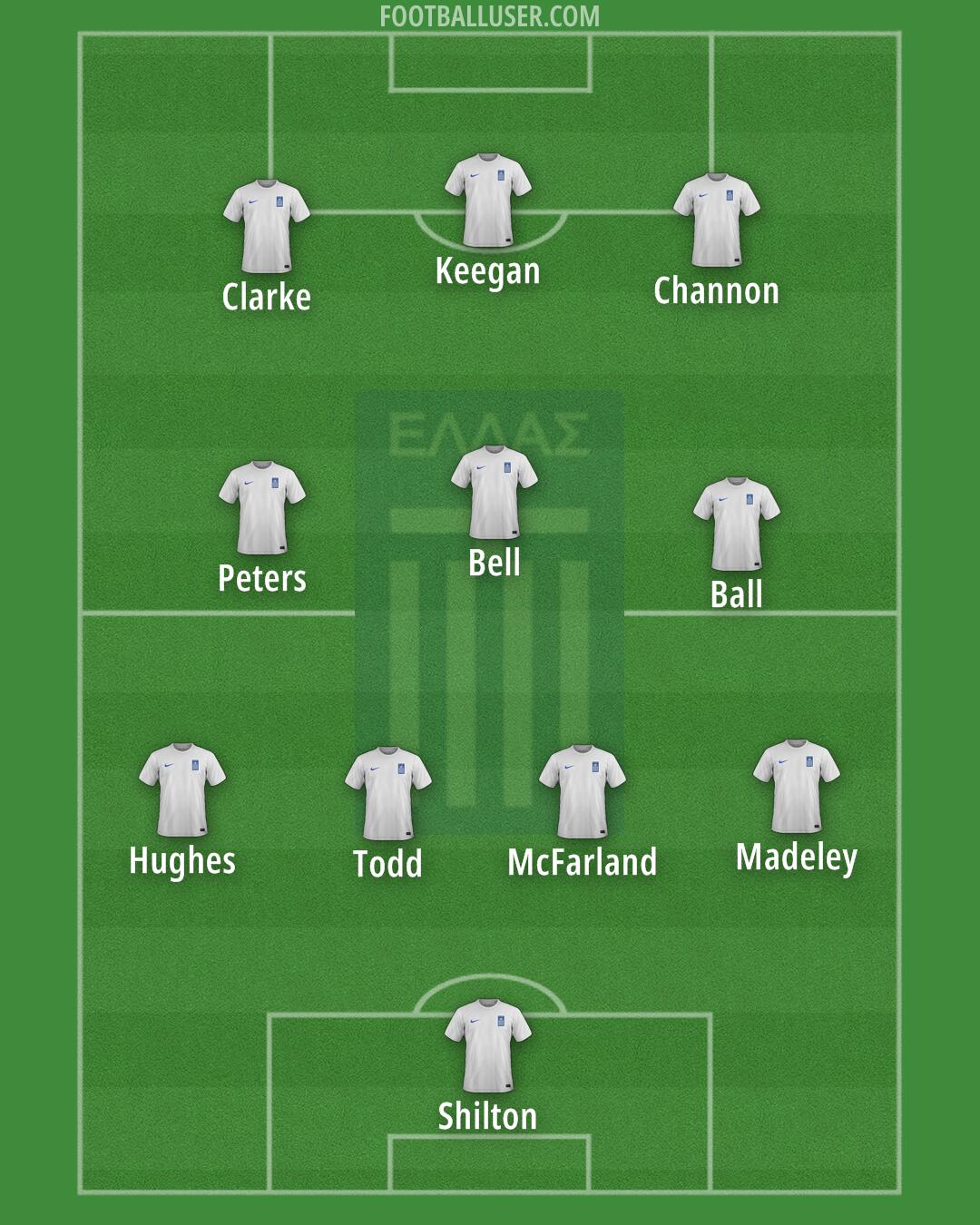
The starting eleven is similar to the most common lineup used by Sir Ramsey during that period, but I used Keegan instead of Chivers. Moore was briefly replaced by Norman Hunt during the World Cup Qualifier, but Sir Ramsey indicated that Moore would start in the World Cup Finals. However, I opted for Todd who played McFarland in the club level.
The starting eleven is similar to the most common lineup used by Sir Ramsey during that period, but I used Keegan instead of Chivers. Moore was briefly replaced by Norman Hunt during the World Cup Qualifier, but Sir Ramsey indicated that Moore would start in the World Cup Finals. However, I opted for Todd who played McFarland in the club level.