|
| Two CONCACAFA met in the second round of the 2002 World Cup Finals |
Please also see my All-Time World Cup Team Index.
I did not want to develop an All-CONCACAFA team. I preferred doing more in depth and detailed all-time teams. However, during a trip to Africa, I decided to do an All-African team. Afterward, I continued with an All-CONCACAFA team. I am unlikely to do an All-Europe or South American team.
The Confederation of North, Central American and Caribbean Association Football is better known as CONCACAFA. It is is the third-most successful FIFA confederation. Both the United States and Mexico have hosted successful World Cup Finals. The USMNT finished 3rd in the 1930 World Cup Finals. Cuba, Costa Rica and Mexico have reached the quarterfinal of the World Cup Finals.
 |
| Landon Donovan vs Rafael Marquez |
GK: Keylor Navas (Costa Rica)
After starting out at Saprissa Keylor Navas moved to Albacete in 2010, and then to Levante in La Liga. After a great performance with Levante, he won the La Liga Keeper of the Year award for 2014 with Levante. Then, he led Costa Rica to the quarter-final of the World Cup in Brazil. After the World Cup Finals, he earned a transfer to Real Madrid. With Real Madrid, he won three Champions League title as their starting keeper. He also played in the 2018 World Cup Finals.
GK: Brad Friedel (USA)
Brad Friedel is the current holder of the English Premier League record for most consecutive appearances with 310. He played with Liverpool, Blackburn Rovers, Aston Villa and Tottenham Hotspurs. He is one of the oldest player to start a game at the English Premiership. He also played for clubs in Denmark and Turkey. He earned 82 caps. He represented the USA at the World Cup in 1994, 1998 and 2002. He is best remembered for reaching the quarterfinal in 2002.
GK: Tim Howard (USA)
Tim Howard earned over 120 caps since 2002. He led the USA to the 2nd round at the World Cup Finals in 2014 with stunning performances throughout the tournament. Howard started his career with the North Jersey Imperials before making a move to the MetroStars in the MLS. His appearances soon attracted the attention of Manchester United, who signed him in 2003. He moved to Everton in 2007 where he became a star player and played until 2016. He is now with Colorado Rapids.
RB: Steve Cherundolo (USA)
Steve Cherundolo spent a year at the University of Portland before going to play in Germany. He was the captain of Hannover 96 of the German Bundesliga, where he spent his entire club career. He later set the team record for Bundesliga appearances. He played for the United States men's national soccer team at the 2006 and 2010 FIFA World Cups.
After starting out at Saprissa Keylor Navas moved to Albacete in 2010, and then to Levante in La Liga. After a great performance with Levante, he won the La Liga Keeper of the Year award for 2014 with Levante. Then, he led Costa Rica to the quarter-final of the World Cup in Brazil. After the World Cup Finals, he earned a transfer to Real Madrid. With Real Madrid, he won three Champions League title as their starting keeper. He also played in the 2018 World Cup Finals.
 |
| Keylor Navas |
Brad Friedel is the current holder of the English Premier League record for most consecutive appearances with 310. He played with Liverpool, Blackburn Rovers, Aston Villa and Tottenham Hotspurs. He is one of the oldest player to start a game at the English Premiership. He also played for clubs in Denmark and Turkey. He earned 82 caps. He represented the USA at the World Cup in 1994, 1998 and 2002. He is best remembered for reaching the quarterfinal in 2002.
GK: Tim Howard (USA)
Tim Howard earned over 120 caps since 2002. He led the USA to the 2nd round at the World Cup Finals in 2014 with stunning performances throughout the tournament. Howard started his career with the North Jersey Imperials before making a move to the MetroStars in the MLS. His appearances soon attracted the attention of Manchester United, who signed him in 2003. He moved to Everton in 2007 where he became a star player and played until 2016. He is now with Colorado Rapids.
RB: Steve Cherundolo (USA)
Steve Cherundolo spent a year at the University of Portland before going to play in Germany. He was the captain of Hannover 96 of the German Bundesliga, where he spent his entire club career. He later set the team record for Bundesliga appearances. He played for the United States men's national soccer team at the 2006 and 2010 FIFA World Cups.
Frank Sinclair started his career with Chelsea where he spent 8 seasons. He won the FA Cup in 1996-1997. And he won a League Cup with Leicester Town in 2000. He played for many clubs all over England. His performance in England led him to be call-up by Jamaica for the 1998 World Cup Finals in 1998. He was one of 7 English-born Jamaican players on the team. He played 28 caps for Jamaica between 1998 and 2003.
CB/DM/RB/LB: Carlos Salcido
Carlos Salcido played 124 times for Mexico between 2004 and 2014. He played in three World Cups: 2006, 2010, 2014, and three Gold Cups: 2005, 2007, 2011. He was a part of the Mexican team that won the gold medal at the 2012 Summer Olympics. He started his career with Guadalajara. He also found successes with PSV Eindhoven, Fulham and UANL. He had two stints with Guadalajara the ckub where he started his career in 2001.
 |
| Carlos Salcido |
CB/DM: Thomas Dooley (USA)
Thomas Dooley was the son of a US serviceman stationed in Germany and a German mother. He won the Bundesliga with Kaiserslautern in 1990-1991 and then the UEFA Cup with Schalke 04 in 1996-1997. He was capped 81 times between 1992 and 1999. He was a key player as the United States reached the 2nd round at the 1994 World Cup Finals and was the captain at the World Cup in 1998. He was the U.S. Soccer Athlete of the Year in 1993. He is a Members of the National Soccer Hall of Fame.CB: Rafael Marquez (Mexico)
Rafael Marquez is one of the best players in Mexico's history. He started his career with Atlas before moving to play in Europe, notably with Monaco and Barcelona. He was the first Mexican to win the European Champions' League. He is the first player ever to captain his national team in four consecutive World Cup Finals, captaining Mexico in the 2002, 2006, 2010, and 2014. He had a total of 146 caps for Mexico between 1997 and 2018. He won two Gold Cup in 2003 and 2011.
CB: Claudio Suarez (Mexico)
Nicknamed "El Emperador", Claudio Suarez is the Mexico's cap record holder with 178(third all-time in the world). He went to three World Cup Finals, where he had a big role in 1994 and 1998. ISuárez began his club career with UNAM Pumas, where he played from 1988 to 1996 where he became champion in 1991. He moved to Guadalajara as an important piece for the 1996 Apertura, and remained there for 3 years He played Chivas USA in the MLS between 2006 and 2009.
LW/LB: Alphonso Davis (Canada)
Davies was the first player born in the 2000s to play in a Major League Soccer match. Davies joined Bayern in January 2019 from MLS side Vancouver Whitecaps FC on a contract lasting for a then-MLS record transfer fee. Davies was named the Bundesliga Rookie of the Season for 2019–20.[6] In that season he also was part of the team winning the continental treble after Bayern won the Bundesliga, the UEFA Champions League and the DFB-Pokal.
 |
| Alphonso Davies |
LB: Emilio Izaguirre (Honduras)
Emilio Izaguirre started his career with Montagua. He was a key player with Celtic in Scotland from 2010 to 2017. He won the Scotland's Premiership Player of the Year, the SFWA Player of the Year and SPFA Player of the Year and Celtic Player of the Year in 2010, making a sweep of all individual award in Scotland. He also played a single season in Saudi Arabia for Al Fayha. For Honduras, he earned over 90 caps. He went to the World Cup Finals in 2010 and 2014.
Emilio Izaguirre started his career with Montagua. He was a key player with Celtic in Scotland from 2010 to 2017. He won the Scotland's Premiership Player of the Year, the SFWA Player of the Year and SPFA Player of the Year and Celtic Player of the Year in 2010, making a sweep of all individual award in Scotland. He also played a single season in Saudi Arabia for Al Fayha. For Honduras, he earned over 90 caps. He went to the World Cup Finals in 2010 and 2014.
DM: Wilson Palacios (Honduras)
Wilson Palacios started with Olimpia at home. He played in the English Premiership between 2007 and 2015 for Wigan, Tottenham Hotspurs and Stoke City. He also had a spell in the MLS with Miami. He had three brothers who also played for Honduras. He himself earned 97 caps. He went to 2010 and 2014 World Cup Finals.
DM: Gilberto Yearwood (Honduras)
Gilberto Yearwood is regarded as Honduras' greatest ever player. He spent 10 seasons playing in Spain between 1977 and 1986. He played for for Elche CF, Real Valladolid, CD Tenerife and Celta de Vigo. At home, he played with Real Espana, C.D. Olimpia, F.C. Motagua and C.D. Marathón. He made his international debut at the 1982 World Cup Finals in Spain. He had 46 caps for Honduras between 1982 and 1993. He scored his only goal for Honduras in 1991 against Jamaica.
AM: Luis de la Fuente (Mexico)
Luis de la Fuente is the first Mexican player to play in four countries (Mexico, Spain, Paraguay and Argentina). After he played in the WC in 1934, he went to play in Spain with Racing Club de Santander. He also played with Club Atlético Corrales in Paraguay and Vélez Sarsfield in Argentina. He was widely considered to be one of Mexico's greatest players.
FW: Cuauhtemoc Blanco (Mexico)
Cuauhtemoc Blanco was part of the Mexican national team at France '98, Korea-Japan 2002 and South Africa 2010. He won the Silver Ball and the Silver Shoe awards in the 1999 FIFA Confederations Cup, where Mexico won. He is tied with Ronaldinho as the all-time leading Confederations Cup goalscorer. He is also remembered for the Cuauhtemiña (also spelled Cuauhteminha), or Blanco Trick, which he performed notably at the 1998 World Cup.
ST: Julio Dely Valdes (Panama)
Julio Dely Valdes is considered to be Panama's greatest player. Dely Valdés began his professional career in 1987 with Deportivo Paraguayo of Argentina with his brother. He then moved to Club Nacional de Football in Uruguay. He was best-remembered for his stints with Paris Saint-Germain, Cagliari, Real Oviedo and Malaga, where he was a prolific scorer for each of them. He won the Cup Winners' Cup with PSG.
ST: Hugo Sanchez (Mexico)
Hugo Sanchez is considered to be the best Mexican player of all-time. He is remembered for his career in Spain where he played for both Atletico Madrid and Real Madrid. He won 5 straight Pichichi title in Spain. With Real Madrid, he won five consecutive league titles (from the 1985-86 to 1989-90 season), the Copa del Rey in 1989, and the UEFA Cup in 1986, playing alongside La Quinta del Buitre . The team was the dominant team in Spain during the 1980's. His nickname was "Hugoal".
Honorable Mention
Salvador Reyes (Mexico), Carlos Salcido (Mexico), Horacio Casarín (Mexico), David Suazo (Honduras), Paulo Wanchope (Costa Rica), Rolando Fonseca (Costa Rica), Christian Gamboa (Costa Rica), Mauricio Solis (Costa Rica), Eddie Pope (USA), DaMarcus Beasley (USA), Tab ramos (USA), Billy Gonsalves (USA), Michael Bradley (USA), Shaka Hislop (T&T), Craig Forest (Canada), Kasey Keller (USA), Luis Gabelo Conejo (Costa Rica), Jorge Campos (Mexico), Alberto García Aspe (Mexico), Andres Guardado (Mexico), Javier Hernandez (Mexico), Ricardo Osorio (Mexico), Wes Morgan (Jamaica), Ricardo Gardner (Jamaica) Antonio Carbajal (Mexico), Juan Tuñas ( Cuba), Wilson Palacios (Honduras), David Suazo (Honduras), José Cardona (Honduras), Allan Costly (Honduras), Oscar "Conejo" Sánchez (Guatemala), Jorge Dely Valdés (Panama), Bruce Wilson (Canada).
Squad Explaination
-- This team was created in 2019. I did a review in June, 2023 after I finished with Mexico, Canada, Costa Rica and the United States.
DM: Gilberto Yearwood (Honduras)
Gilberto Yearwood is regarded as Honduras' greatest ever player. He spent 10 seasons playing in Spain between 1977 and 1986. He played for for Elche CF, Real Valladolid, CD Tenerife and Celta de Vigo. At home, he played with Real Espana, C.D. Olimpia, F.C. Motagua and C.D. Marathón. He made his international debut at the 1982 World Cup Finals in Spain. He had 46 caps for Honduras between 1982 and 1993. He scored his only goal for Honduras in 1991 against Jamaica.
 |
| Gilberto Yearwood |
CM/DM: Claudio Reyna (USA)
Claudio Reyna was a star in the late 1990's. He played college soccer with University of Virginia, winning three NCAA titles in three years. He started his career with Bayer Leverkusen. While playing with Wolfsburg, he became the first American-born player to captain an European club team. He also played for Rangers and Manchester City. He earned 112 caps. He was on 4 World Cup teams. In 2002, he was named in the World Cup all-tournament team after the USMNT reached the quaterfinal.
AM: Luis de la Fuente (Mexico)
Luis de la Fuente is the first Mexican player to play in four countries (Mexico, Spain, Paraguay and Argentina). After he played in the WC in 1934, he went to play in Spain with Racing Club de Santander. He also played with Club Atlético Corrales in Paraguay and Vélez Sarsfield in Argentina. He was widely considered to be one of Mexico's greatest players.
AM/FW: Magico Gonzalez (El Salvador)
His real name is Jorge Alberto Gonzalez. Some said that he would be ranked among the greatest players ever if he was born Brazilian or Argentine. He played for ANTEL and Independiente Nacional 1906 over the course of two seasons, before moving to Club Deportivo Fútbolistas Asociados Santanecos. He was a star at La Liga during the 1980's. He mainly played for Cadiz. He led El Salvador to the first and only World Cup Finals in 1982. He had 62 caps. |
| Magico Gonzalez |
Cuauhtemoc Blanco was part of the Mexican national team at France '98, Korea-Japan 2002 and South Africa 2010. He won the Silver Ball and the Silver Shoe awards in the 1999 FIFA Confederations Cup, where Mexico won. He is tied with Ronaldinho as the all-time leading Confederations Cup goalscorer. He is also remembered for the Cuauhtemiña (also spelled Cuauhteminha), or Blanco Trick, which he performed notably at the 1998 World Cup.
SS/AM: Landon Donovan (USA)
Landon Donovan is perhaps the greatest American player of the modern era. He is the all-time leading scorer for the US national team. He represented the USA at three World Cup Finals. In 2002, he was named the best young player at the World Cup Finals. He was Honda Player of the Year for 6 times and US Soccer Athlete of the Year for 4 times and numerous awards in MLS. He had a brief spell with Leverkusen before returning to MLS. With LA Galaxy, he won four MLS Cup.
FW: Alejandro Morera Soto (Costa Rica)
Alejandro Morera Soto started his career with Alajuelense in 1925. He first joined Espanyol before joining Barcelona FC in 1933. He was a part of the legendary Barcelona of the 1930's, where he was their top scorer for the 1933-1934 season. He earned the nickname "El fenomeno costarricense" ("The Costa Rican phenomenon") in Barcelona. He scored over 60 goals for them. He also played for Hercules and La Havre. He played 7 times and scored 6 goals for Costa Rica.
Best remembered for his stint with Manchester United. In 1998-199 season, Manchester United won the triple(the Premier League, the FA Cup and the Champions' League), where he was both the top scorer in the Preimership and the Champions' League. Along with Russell Latapy and Pat Jennings, Yorke holds the record number of participations in different World Cup competitions, including qualifying stages – six in total (1990, 1994, 1998, 2002, 2006 and 2010).
Landon Donovan is perhaps the greatest American player of the modern era. He is the all-time leading scorer for the US national team. He represented the USA at three World Cup Finals. In 2002, he was named the best young player at the World Cup Finals. He was Honda Player of the Year for 6 times and US Soccer Athlete of the Year for 4 times and numerous awards in MLS. He had a brief spell with Leverkusen before returning to MLS. With LA Galaxy, he won four MLS Cup.
FW: Alejandro Morera Soto (Costa Rica)
Alejandro Morera Soto started his career with Alajuelense in 1925. He first joined Espanyol before joining Barcelona FC in 1933. He was a part of the legendary Barcelona of the 1930's, where he was their top scorer for the 1933-1934 season. He earned the nickname "El fenomeno costarricense" ("The Costa Rican phenomenon") in Barcelona. He scored over 60 goals for them. He also played for Hercules and La Havre. He played 7 times and scored 6 goals for Costa Rica.
FW/AM: Clint Dempsey (USA)
Clint Dempsey was perhaps the most successful American-born outfielder playing in Europe. He was best remembered for playing for Fulham between 2007 and 2012. He was their top-scorer for two seasons. He was their Player of the Season twice. He has also played for New England Revolution and Tottenham Hotspur. At the time of writing, he plays for Seattle Sounders in the MLS. He has over 130 caps and played in the World Cup Finals of 2006, 2010 and 2014.
ST: Dwight Yorke (T&T)  |
| Clint Dempsey |
Best remembered for his stint with Manchester United. In 1998-199 season, Manchester United won the triple(the Premier League, the FA Cup and the Champions' League), where he was both the top scorer in the Preimership and the Champions' League. Along with Russell Latapy and Pat Jennings, Yorke holds the record number of participations in different World Cup competitions, including qualifying stages – six in total (1990, 1994, 1998, 2002, 2006 and 2010).
ST: Julio Dely Valdes (Panama)
Julio Dely Valdes is considered to be Panama's greatest player. Dely Valdés began his professional career in 1987 with Deportivo Paraguayo of Argentina with his brother. He then moved to Club Nacional de Football in Uruguay. He was best-remembered for his stints with Paris Saint-Germain, Cagliari, Real Oviedo and Malaga, where he was a prolific scorer for each of them. He won the Cup Winners' Cup with PSG.
ST: Hugo Sanchez (Mexico)
Hugo Sanchez is considered to be the best Mexican player of all-time. He is remembered for his career in Spain where he played for both Atletico Madrid and Real Madrid. He won 5 straight Pichichi title in Spain. With Real Madrid, he won five consecutive league titles (from the 1985-86 to 1989-90 season), the Copa del Rey in 1989, and the UEFA Cup in 1986, playing alongside La Quinta del Buitre . The team was the dominant team in Spain during the 1980's. His nickname was "Hugoal".
 |
| Hugo Sanchez |
Salvador Reyes (Mexico), Carlos Salcido (Mexico), Horacio Casarín (Mexico), David Suazo (Honduras), Paulo Wanchope (Costa Rica), Rolando Fonseca (Costa Rica), Christian Gamboa (Costa Rica), Mauricio Solis (Costa Rica), Eddie Pope (USA), DaMarcus Beasley (USA), Tab ramos (USA), Billy Gonsalves (USA), Michael Bradley (USA), Shaka Hislop (T&T), Craig Forest (Canada), Kasey Keller (USA), Luis Gabelo Conejo (Costa Rica), Jorge Campos (Mexico), Alberto García Aspe (Mexico), Andres Guardado (Mexico), Javier Hernandez (Mexico), Ricardo Osorio (Mexico), Wes Morgan (Jamaica), Ricardo Gardner (Jamaica) Antonio Carbajal (Mexico), Juan Tuñas ( Cuba), Wilson Palacios (Honduras), David Suazo (Honduras), José Cardona (Honduras), Allan Costly (Honduras), Oscar "Conejo" Sánchez (Guatemala), Jorge Dely Valdés (Panama), Bruce Wilson (Canada).
Squad Explaination
-- This team was created in 2019. I did a review in June, 2023 after I finished with Mexico, Canada, Costa Rica and the United States.
-- This blog team is very "Eurocentric". Most players were selected for their club careers in Europe. I also believed that I should spread the team around different countries with better representation from each country.
-- The IFFHS put Raul Cardenas as a midfielder for their All-Time team for CONCACAF and Mexico, but he was mainly a centreback. So I did not select him. Instead, I went for Gilberto Yearwood who was Honduras' greatest player.
-- Hugo Sanchez (Mexico) is probably the greatest player from this region. He was known as "Hugoal". Some said that Magico Gonzalez (El Salvador) would be a bigger star if he was from Brazil or Argentina or if he played for a big club in Europe. Julio Dely Valdes and Dwight Yorke were also big stars in Europe when they were active players.
-- As expected, the team is dominated by American and Mexican players. The USA-Mexico rivalry is one of the most fierce rivalry in national team football.
-- Costa Rica reached the quarterfinal of the 2014 World Cup Finals before losing to Netherlands in a penalty shootout. Only Keylor Navas was selected into this team. I feel that the other players have not accomplished as much as some of the players selected. The United States and Mexico also did well in previous World Cup Finals.
-- As expected, the team is dominated by American and Mexican players. The USA-Mexico rivalry is one of the most fierce rivalry in national team football.
-- Costa Rica reached the quarterfinal of the 2014 World Cup Finals before losing to Netherlands in a penalty shootout. Only Keylor Navas was selected into this team. I feel that the other players have not accomplished as much as some of the players selected. The United States and Mexico also did well in previous World Cup Finals.
-- The IFFHS selected the following players for their All-Time Men CONCACAF dream team: Antonio Carbajal (Mexico), Carlos Salcedo (Mexico), Claudio Suarez (Mexico) , Rafael Marquez (Mexico), Andres Guardado (Mexico), Bryan Ruiz (Costa Rica), Raul Cardenas (Mexico), Luis de la Fuente (Mexico), Julio Cesar Dely Valdez (Panama), Hugo Sanchez (Mexico) and Clint Dempsey (USA).
They also created a Team B: Keylor Navas (Costa Rica) ,Gustavo Pena (Mexico), Marcelo Balboa (USA), Horacio Casarin (Mexico), Ramon Ramirez (Mexico), Thomas Dooley (USA), Michael Bradley (USA), Cuauhtémoc Blanco (Mexico), Hirbing Lozano (Mexico), Salvator Reyes (Mexico) and Carlos Hermosillo (Mexico).
-- John Barnes, Owen Hargreaves and John van 't Schip probably made this team if they played for a CONCACAF national team. They were all born in the region.
Goalkeepers
-- I took the three goalkeepers with the most decorated career playing in Europe.
-- Keylor Navas helped Costa Rica to reach the quarterfinal of the 2014 World Cup Finals. He also won two Champions League titles as the starting keeper for Real Madrid. He has achieved more than any other players from this conference.
-- Brad Friedel led the Americans to the quarterfinal of the 2002 World Cup Finals. He became the first goalkeeper to save two penalties in a World Cup Finals outside the shootout since 1974. He also holds the Premier League record for most consecutive games played with 310. During his prime, he had to share the duty with Kasey Keller. They were rated almost equally, but Keller did not shrine in a World Cup Finals, which put him out of this team. Instead, I took another American, Tim Howard. He had a great tournament at the 2009 FIFA Confederations Cup as well as the 2014 World Cup Finals. He also held the record of international appearances for an American goalkeeper. His club career in England also spoke for itself. I did not have a preference for number 2 or 3 on the team.
-- Shaka Hislop (T&T), Craig Forest (Canada), Kasey Keller (USA), Luis Gabelo Conejo (Costa Rica), Jorge Campos (Mexico), Guillermo Ochoa (Mexico) and Antonio Carbajal (Mexico) were some of the great keepers from this region.
Defenders
-- The rightback position was weaker. Gustavo Pena (Mexico) was the captain of Mexico in both 1966 and 1970 World Cup Finals. I mistook him as a righback in 2019 because IFFHS placed him there on their Mexico All-Time team. Both Pascal Chimbonda and Jocelyn Angloma were allowed to play for Guadeloupe while representing France because Guadeloupe is not a FIFA member. Both made my all-time team for Caribbean nations for special exceptional cases. But I decided to select CONCACAF players eligible for full international only for this blog team. So I did not consider them. Gilberto Martínez (Costa Rica) could also play in this position.
-- Steve Cherundolo (USA) had a stunning career with Hanover 96 while Ricardo Osorio played well with VfB Stuttgart. Not many rightbacks have done better in an European league. Carlos Salcido might be a better player than both of them, and he did win the Bundesliga Team of the Year as a rightback. I took him over Osorio. Frank Yallop (Canada), Paul Caligiuri (USA), Christian Gamboa (Costa Rica) and Allan Costly (Honduras) were also considered. Frank Sinclair also played as a rightback. He began his career asa leftback, but he was a much better central defender or rightback.
-- Players not from the bigger European or South American countries seldom won Player of the Award. Emilio Izaguirre won the Scotland's Premiership Player of the Year, the SFWA Player of the Year and SPFA Player of the Year and Celtic Player of the Year in 2010, making a sweep of all individual award in Scotland. He did it as a fullback. So in 2019, I took him as one of my leftbacks, but I had second thoughts in 2023. Is he better than Ramon Ramirez? Ramirez started as a midfielder, but Miguel Mejía Barón decided to move him to the leftback where he shone the most. In the end, I stayed with the Honduran.
 |
| Emilio Izaguirre |
-- In 2019, Bruce Wilson was selected because of his NASL career. There was some sort of romance about that era. He was a six-time all-star selection in an era when NASL was full of international star players. He also led Canada in the 1986 World Cup Finals, which was historical significance. However, by 2023, Alphonso Davis replaced him. He has outdone many players in the region. He helped Bayern Munich to win the Champions' League in 2020. He also led Canada to their first World Cup since 1986.
-- DaMarcus Beasley was converted into a left wingback late in his career. I was unsure if he was a better leftback than the other candidates, but he was a better overall player. He was the first American to play in 5 World Cup cycle. Andrés Guardado also operated as a left wingback. But I left both of them off the team.
-- Rafael Marquez was probably the greatest Mexican defender and the most decorated Mexican player playing in Europe since Hugo Sanchez. He is the first Mexican to win the European Champions' League. Claudio Suarez is the Mexico's cap record holder with 178 (third all-time in the world). He captained the 1999 Confederation Cup team. Then, we looked into two American central defenders. Both Marcelo Bilboa and Thomas Dooley were selected by IFFHS for their CONCACAF All-Time team for their B team. I took Dooley over Bilboa because of his vast experience playing in the Bundesliga. Eddie Pope and Carlos Bocanegra were also considered. The four players were close, I felt.
-- I seriously looked into Gustavo Pena (Mexico) and Carlos Salcido. Salcido was considered to be one of Mexico's greatest fullbacks. He started his career as a centreback and played most of it as left-back and rightback, then converted to defensive midfielder and ended it as centreback. I had yet to decide his best position. For my Mexico All-Time team, I took him as a leftback, but he could easily make this team as centreback.
--Wes Morgan was the captain of Leicester when they won their Premiership, but Frank Sinclair's career in the Premiership was longer. In 2019, I went with Morgan for the last central defender, but I went with Sinclair during my review of the team in 2023. He could also play rightback. Selecting a Jamaican was on my agenda.
Midfielders/Wingers
-- Cuban-born Chus Alonso played for Spain. He never played for Cuba, which made him ineligible. José Ramón Sauto spent 11 seasons with Real Madrid in the 1930's. He was the first Mexican-born player to play in Spain. Sometimes, historians credited Luis de la Fuente as the first Mexican who played professionally outside Mexico because Sauto came to Spain at a young age. His Mexican roots were sometimes forgotten. According to a report, Sauto was detained during the Spanish Civil War. One of the guards who was a Real Madrid fans recognized him and allowed him to escape. I did not consider him. -- The IFFHS put Raul Cardenas as a midfielder for their All-Time team for CONCACAF and Mexico, but he was mainly a centreback. So I did not select him. Instead, I went for Gilberto Yearwood who was Honduras' greatest player.
-- In 2019, I took Wilson Palacios over Michael Bradley, Ramon Ramirez and Pavel Pardo largely the team needed more players not from Mexico or the United States. He was of course more defensive. Bradley with his European experience might be more important, but Palacios might be better than Mauricio Solis (Costa Rica).
-- Claudio Reyna made the Team of the Tournament at the 2002 World Cup Finals. He could drop deeper in the midfield. He edged out Michael Bradley and Celso Borges.
 |
| Claudio Reyna |
-- For attack midfielders, I first took Jorge “El Mágico” González. El Salvador had a horrible World Cup Finals in 1982, but he had a wonderful club career in Spain after the World Cup. Many people said that he could become the best player in his generation, but his transfer to a bigger club failed to materialize. He never got the exposure outside La Liga. And if he was Brazilian, people would notice him more. Then, I selected took Luis de la Fuente. He was the first Mexican who played professionally outside Mexico. He was basically Mexico's first idol in football. Alberto García Aspe and Andres Guardado were the other top Mexican attack midfielders on my honorable mention. Tab Ramos (USA) also made honorable mention.
-- I did not have much wide players. No natural winger was selected except for Alphonso Davies. Christian Pulisic needed to wait his turn. At the time of writing, he is still young. Hirving Lozano already won CONCACAF Player of the year in 2018, and he was named in the IFFHS CONCACAF Team of the Decade for 2011-2020. He was on the second team for their CONCACAF Dream team. He was listed as a left wing, but most of his highlights showed him on the right. Against Germany in the 2018 World Cup Finals, he operated on the left and became the Man of the Match in a famous upset. He could cover both sides of the wings. Costa Rica also produced Herman Medford, Joel Campbell and Bryan Ruiz who could play on the left. I would love to have Jamaican-born John Barnes or Canadian-born John van 't Schip. In the end, I left the wing position without a true winger.
-- On the left, Clint Dempsey could be deployed there. He is the joint All-Time leading scorer for the USA.
Forwards
-- Along with Landon Donovan, Clint Dempsey was probably the greatest American player in the modern era. Both were tied for all-time leading scorer for the United States. Dempsey made second time for IFFHS All-Time Men CONCACAF Dream team, but they snubbed Donovan.
-- Roy Wegerle's club career in England was better than some of the players selected. He was a star in England, but his impact to the USMNT was limited. Perhaps, the prime of his club career was played before he became an American citizen. In 1994, he had a bench role in the World Cup Finals. By 1998, he barely made it to the team. So I left him off my USA All-Time team and this team.
-- I took Alejandro Morera Soto (Costa Rica) over compatriot Paulo Wanchope and Bryan Ruiz. Basically, I feel that the team needs an older player to balance out. He scored 63 goals in just 76 matches for FC Barcelona. In Spain, he was known as the "Costa Rican phenomenon".
-- Dwight Yorke (T&T) was a key player as Manchester United won their triple crown in 1999. He won the Premier League Player of the Season that year. He was a famous player at his times.
 |
| Dwight Yorke |
-- Julio Dely Valdes has a twin brother Jorge Dely Valdés and an older brother Armando Dely Valdés. His career in Europe was among the best in the region. He was Malaga All-Time leading scorer. He also made the first team of IFFHS All-Time Men CONCACAF dream team.
-- Hugo Sanchez won 5 straight Pichichi title in Spain. No explanation is needed for him. Cuauhtemoc Blanco helped Mexico to win the Confederation Cup in 1999, the highest honour for Mexico. I also selected him for his "Blanco Trick". He added "fun" to the game of football. I saw this as a "contribution" to the game. Javier Hernandez was Mexico's All-Time leading scorer, but I went with other players.
-- Hugo Sanchez won 5 straight Pichichi title in Spain. No explanation is needed for him. Cuauhtemoc Blanco helped Mexico to win the Confederation Cup in 1999, the highest honour for Mexico. I also selected him for his "Blanco Trick". He added "fun" to the game of football. I saw this as a "contribution" to the game. Javier Hernandez was Mexico's All-Time leading scorer, but I went with other players.
-- David Suazo spent 13 years playing over 300 games in Italy. He was the co-winner of the Serie A Foreign Player of the year in 2006 which he shared it with Kaka. I left him on honorable mention only. José Cardona went to play in Spain during the 1950's and 1960's. was one of the first player from Honduras to star for a club in Europe. He played with Atlético Madrid in the 1960's, scoring the winning goal at the Copa del Generalísimo in 1964. Both made honorable mention.
Formation
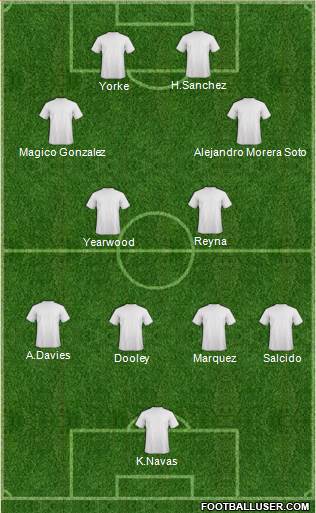


.jpg)