|
| Netherlands 1983 |
Surnamese-Dutch,
North Holland, South Holand.
Dutch Players' surnames starting with "Van"
The rest of Netherlands excluding North and South Holland
Netherlands All-Time Team After Johan Cruyff
Netherlands before Johan Cruyff (BC)
Dutch-Indos/Indonesia-born Dutch All-Time Team
Brazil 1982 with Careca, etc
United Kingdom World Cup 1982
Netherlands Euro 1984 with Cruyff, Van Basten, Gullit
United Kingdom World Cup 1982
Netherlands Euro 1984 with Cruyff, Van Basten, Gullit
In 1983, Spain beat Malta by 12-1 on the last match of Group 7 of the qualifying rounds of the 1984 European Championship that gave Spain the goal difference to qualify for Euro 1984 Finals. The result ended Netherlands' quest for a spot in Finals the following year. Spain won the group by the number of goals scored after both teams were tied in points and goal difference. They would eventually make it all their way to the Final the following summer in France before losing to the host. Netherlands' elimination marked the second straight times where they failed to qualify for a major tournament. They would also not qualified for the 1986 World Cup Finals two years later. As you might have known, Netherlands emerged from this chaotic period to become the European Champion in 1988.
Why do I write a blog team in 1984? I tried to do a 1986 World Cup team for Netherlands, but I realized that the team would be similar to their Euro 1988 team. Their Euro 1984 team on the other hand would be much more interesting. Youngster Marco Van Basten, Ruud Gullit, Frank Rijkaard and Ronald Koeman had solidified their status with the national team. Marco Van Basten was the league top scorer that season. Meanwhile, Johan Cruyff had revitalised his career. He was the Dutch Player of the Year in 1984. Willy van der Kerkhof was still a veteran on the team. So imagine if what can Netherlands do with a lineup that consisted of those players and Cruyff playing in his swansong tournament?
 |
| Frank Rijkaard and Ruud Gullit |
Prediction
Both Ruud Gullit and Ronald Koeman were 21 years old while Marco Van Basten was 19 years old in the summer of 1984. Netherlands would be led by Johan Cruyff who just had a fantastic season with Feyenoord.
If Netherlands took Spain's place in the Finals, I predicted Netherlands might have done better than Spain in the Group stage. Spain finished first in the group stage, but they went through the group stage by beating West Germany with a 90th minute goal on the last match of the Group stage. They drew in the first two matches against Romania and Portugal. Netherlands with this mixture of young talents and Johan Cruyff would have probably done better. They might have beaten Romania and Portugal easily. West Germany who was fielding an out of form Karl-Heinz Rummenigge also suffered one of their worst performance in a major tournament.
In the semifinal, they would meet Denmark, a team that would become the "Danish Dynamite" two years later in the World Cup Finals. In 1984, the world did not know that. Denmark still had Allan Simonsen who was 31 years old at the time, but he was playing club football at home. Michael Laudrup just turned 20 during the tournament. In April, 1984, Netherlands beat Denmark 6-0 at a friendly match. Denmark fielded both Laudrup and Simonsen, but Morten Olsen and Soren Lerby were missing. Netherlands was missing Marco Van Basten who was not yet a star player. Of course, Johan Cruyff was never recalled back to the national team after 1977. The result actually meant anything, but one might start to wonder.
In the Final, it would be tough to beat France. The midfield of Luis Fernandez, Jean Tigana, Alain Giresse and Michael Platini was probably the greatest midfield in the history of European football. Collectively, they were known as the "Carré Magique"(Magic Square). Michel Platini also had one of the best ever individual performance at a major tournament. He scored 9 goals. Moreover, they were the host.
In the actual Final, Spain was able to handle the French. France only managed to break the deadlock because of a blooper by Spain's goalkeeper Luis Arconada. They also nearly lost to Portugal in the semifinal. It took France two goals at the very end of extra time to make a comeback win against Portugal. Was France really that great in 1984?
Team (only 20 players)
GK: Piet Schrijvers (Zwolle)
Between 1971 and 1984, Schrijvers played 46 times for Netherlands. He was the backup keeper at both World Cup Finals in 1974, but he was the starting keeper at Euro 1976 and 1980, and the World Cup Finals in 1978. At club level, he spent nine years with AFC Ajax, winning five Eredivisie titles and two KNVB Cups. He also played for DWS, FC Twente and Zwolle.
GK: Hans Van Breukelen (Nottingham Forest)
Hans Van Breukelen started his career with FC Utrecht and then, Nottingham Forest. He moved to PSV in 1984, where he became a star. For the national team, he was a fixture since 1980. However, he did not help the Oranje to reach a major tournament until in 1988, where they won the first ever trophy for the Dutch national team. He had 73 caps.
GK: Joop Hiele (Feyenoord)
Team (only 20 players)
GK: Piet Schrijvers (Zwolle)
Between 1971 and 1984, Schrijvers played 46 times for Netherlands. He was the backup keeper at both World Cup Finals in 1974, but he was the starting keeper at Euro 1976 and 1980, and the World Cup Finals in 1978. At club level, he spent nine years with AFC Ajax, winning five Eredivisie titles and two KNVB Cups. He also played for DWS, FC Twente and Zwolle.
GK: Hans Van Breukelen (Nottingham Forest)
Hans Van Breukelen started his career with FC Utrecht and then, Nottingham Forest. He moved to PSV in 1984, where he became a star. For the national team, he was a fixture since 1980. However, he did not help the Oranje to reach a major tournament until in 1988, where they won the first ever trophy for the Dutch national team. He had 73 caps.
GK: Joop Hiele (Feyenoord)
Hiele earned seven caps for the Netherlands between 1980 and 1991. He was a member of the Dutch team that won the European title at the 1988 European Football Championship in West Germany, but was second choice behind Hans van Breukelen. His first cap and second had a 6 years gap. Hiele started his professional career with Feyenoord Rotterdam (1977–90), then moved to SVV (1990–92), Dordrecht'90 (1992–94) and ended his career at Go Ahead Eagles (1994–95).
RB: Ben Wijnstekers (Feyenoord)
Ben Wijnstekers was considered among the greatest defenders in Feyenoord's history. He made his professional debut at Feyenoord Rotterdam in 1975, but also played for K.R.C. Mechelen and Germinal Ekeren. He was capped between 1979 and 1986. He went to European Championship in 1980, but otherwise, in a period between two Golden Generations of Dutch players, where Netherlands failed to qualify for the World Cup Finals.
RB/CB/DM: Edo Ophof (Ajax)
During his club career, Edo Ophof started his career in 1976 with NEC. He became a starter in the 1978-1979 season. Then, Leo Beenhakker brought him to Ajax. He made his name with Ajax, where he played between 1980 and 1988. He later played for AZ and Utrecht at the end of his career. For the Dutch national team, he played 15 times between 1981 and 1985 under manager Kees Rijvers, scoring 2 goals.
CB/DM: Johnny Metgod (Real Madrid)
Johnny Metgod started his career with HFC Haarlem in 1975. After one season with Haarlem, he played for AZ Alkmaar. between 1976 and 1981. He appeared in the UEFA Cup Final against Ipswich in 1981. In 1982, Metgod moved to Spain to play for Real Madrid. He then moved to England in 1984 to sign for Nottingham Forest before signing for Tottenham Hotspur in 1987. He spent six years at Feyenoord between 1988 and 1994. from 1978 to 1983, he eared 21 caps for Netherlands.
CB: Michel van de Korput (Feyenoord)
From 1974 to 1980, Michel van de Korput played for Feyenoord. Then, he played three seasons in Italy with Torino between 1980 and 1983. He returned to Feyenoord in 1983 and was a part of the Double winning team with Johan Cruyff. He later played with Koln, Germinal Ekeren and Cappellen. He also earned 23 caps for the Netherlands national football team from 1979 to 1985, and participated in UEFA Euro 1980.
CB: Ronald Koeman (Ajax)
Ronald Koeman was the rock solid sweeper of Netherlands in the 1980's and 1990's. He was capped 78 times between 1983 and 1994. He was a part of the team that won the Euro 1988. He also won two European Cups, one each for PSV Eindhoven and Barcelona. He scored the winning goal for Barcelona's victory in 1992. The Cup was Barcelona's first ever European Cup. In Holland, he played for the big three, namely Ajax, PSV Eindhoven and Feyenoord as well as FC Groningen.
LB: Peter Boeve (Ajax)
Peter Boeve started his career at Vitesse and left them for Ajax in 1979. In 1980 Boeve scored Ajax's 2000th league goal since the introduction of the Eredivisie. After an injury in 1987, he moved o Belgian Beerschot VAC. Boeve was considered one of the best left backs of his generation. From 1982 to 1986, he played 16 caps for the Dutch national team.
LB: Adri Van Tiggelen (FC Groningen)
Adri Van Toggelen was the starting left back at Euro 1988, where Holland won its first major international trophy. He earned 56 caps. He also went to the World Cup Finals in 1990 and European Championship in 1992. He played mainly for Sparta Rotterdam early on in his career. He later moved to Anderlectd and PSV.
RB: Ben Wijnstekers (Feyenoord)
Ben Wijnstekers was considered among the greatest defenders in Feyenoord's history. He made his professional debut at Feyenoord Rotterdam in 1975, but also played for K.R.C. Mechelen and Germinal Ekeren. He was capped between 1979 and 1986. He went to European Championship in 1980, but otherwise, in a period between two Golden Generations of Dutch players, where Netherlands failed to qualify for the World Cup Finals.
 |
| Ben Wijnstekers, Peter Houtman, Johan Cruyff and Ruud Gullit |
During his club career, Edo Ophof started his career in 1976 with NEC. He became a starter in the 1978-1979 season. Then, Leo Beenhakker brought him to Ajax. He made his name with Ajax, where he played between 1980 and 1988. He later played for AZ and Utrecht at the end of his career. For the Dutch national team, he played 15 times between 1981 and 1985 under manager Kees Rijvers, scoring 2 goals.
CB/DM: Johnny Metgod (Real Madrid)
Johnny Metgod started his career with HFC Haarlem in 1975. After one season with Haarlem, he played for AZ Alkmaar. between 1976 and 1981. He appeared in the UEFA Cup Final against Ipswich in 1981. In 1982, Metgod moved to Spain to play for Real Madrid. He then moved to England in 1984 to sign for Nottingham Forest before signing for Tottenham Hotspur in 1987. He spent six years at Feyenoord between 1988 and 1994. from 1978 to 1983, he eared 21 caps for Netherlands.
 |
| Johnny Metgod |
From 1974 to 1980, Michel van de Korput played for Feyenoord. Then, he played three seasons in Italy with Torino between 1980 and 1983. He returned to Feyenoord in 1983 and was a part of the Double winning team with Johan Cruyff. He later played with Koln, Germinal Ekeren and Cappellen. He also earned 23 caps for the Netherlands national football team from 1979 to 1985, and participated in UEFA Euro 1980.
CB: Ronald Koeman (Ajax)
Ronald Koeman was the rock solid sweeper of Netherlands in the 1980's and 1990's. He was capped 78 times between 1983 and 1994. He was a part of the team that won the Euro 1988. He also won two European Cups, one each for PSV Eindhoven and Barcelona. He scored the winning goal for Barcelona's victory in 1992. The Cup was Barcelona's first ever European Cup. In Holland, he played for the big three, namely Ajax, PSV Eindhoven and Feyenoord as well as FC Groningen.
 |
| Ronald Koeman |
Peter Boeve started his career at Vitesse and left them for Ajax in 1979. In 1980 Boeve scored Ajax's 2000th league goal since the introduction of the Eredivisie. After an injury in 1987, he moved o Belgian Beerschot VAC. Boeve was considered one of the best left backs of his generation. From 1982 to 1986, he played 16 caps for the Dutch national team.
LB: Adri Van Tiggelen (FC Groningen)
Adri Van Toggelen was the starting left back at Euro 1988, where Holland won its first major international trophy. He earned 56 caps. He also went to the World Cup Finals in 1990 and European Championship in 1992. He played mainly for Sparta Rotterdam early on in his career. He later moved to Anderlectd and PSV.
CM: Frank Rijkaard (Ajax)
Frank Rijkaard was one of Netherlands' most important player. Capped 73 times. He won the 1988 European Championship in West Germany. He notably played for Ajax and AC Milan. He spent 5 seasons with AC Milan when Milan was considered the greatest club team in the world. He won two European Cup with them. In 1995, he led a young Ajax team to their famous Champions' League victory. That team is also considered one of the greatest club sides ever.
Frank Rijkaard was one of Netherlands' most important player. Capped 73 times. He won the 1988 European Championship in West Germany. He notably played for Ajax and AC Milan. He spent 5 seasons with AC Milan when Milan was considered the greatest club team in the world. He won two European Cup with them. In 1995, he led a young Ajax team to their famous Champions' League victory. That team is also considered one of the greatest club sides ever.
CM: Arnold Muhren (Manchester United)
Muhren was one of the few players who had won the European Cup (1972–73), the Cup Winners' Cup (1986–87) and the UEFA Cup (1980–81). He first made his name by playing for Ajax with his brother Gerrie. In 1978, he joined Ipswich, where he became one of the first Dutch players in the league. Capped 23 times. He was a part of the Euro 1988 winning team. He crossed the ball to Marco Van Basten where he scored the famous volley goal in the Final against the Soviet Union.
Muhren was one of the few players who had won the European Cup (1972–73), the Cup Winners' Cup (1986–87) and the UEFA Cup (1980–81). He first made his name by playing for Ajax with his brother Gerrie. In 1978, he joined Ipswich, where he became one of the first Dutch players in the league. Capped 23 times. He was a part of the Euro 1988 winning team. He crossed the ball to Marco Van Basten where he scored the famous volley goal in the Final against the Soviet Union.
 |
| Arnold Muhren |
Erwin Koeman is Ronald Koeman's brother. Koeman played with Groningen, Mechelen, where he won the Belgian League in 1989 and 1988 Cup Winners' Cup during the team's heyday and PSV, where they became league champions in 1990–91 and 1991–92. He won the Euro 88 and featured in the 1990 World Cup. In total, Koeman was capped 31 times, scoring twice between 1983 and 1994.
RM/CM: Willy van de Kerkhof (PSV)
Overall, Willy Van de Kerkhof appeared 63 times for his country between 1973 and 1986. He was a member of the 1974 World Cup team, but it was the 1978 World Cup Finals, where he carried the team to the Final against the host Argentina. He also went to the Euro 1980. His twin brother Rene was also a part of the 1978 World Cup team. For his club career, he played for FC Twente (1970-1973) and PSV Eindhoven (1973-1988). He was one of PSV's greatest players.
 |
| Willy van de Kerkhof |
During the 1990's, Gerald Vanenburg formed a dangerous partnership Marco Van Basten and Wim Kieft at Ajax. He would join PSV in 1986, where he played until 1993. He won an European Cup with them. He later played in Japan, Germany and France. For the national team, he was a part of the Golden Generation that won the European Championship in 1988. He played for Netherlands 42 times.
LW: Simon Tahamata (Standard Liège)
With Ajax, Simon Tahamata won the national title three times. (1976–77, 1978–79, 1979–80). He was known for his partnership with Tscheu la Ling, another player with Asian heritage. He also played for Standard Liège. With this team he became national champion twice (1981–82 and 1982–83). In 1984, he returned to the Netherlands to play for Feyenoord. In 1987, he again joined the Belgian competition, playing for Beerschot and Germinal Ekeren. He was capped 22 times between 1979 and 1986.
 |
| Simon Tahamata |
Ruud Gullit was the iconic captain of Netherlands that won the Euro 1988. In 1987, he moved from PSV Eindhoven to A.C. Milan for a world record transfer fee. He was an important player for AC Milan during the 1980's where they won two straight European Cups. He was the European Footballer of the Year in 1987 and the World Soccer Player of the Year in 1987 and 1989. He spent one season with Sampdoria winning the Italian Cup in 1994. He was considered one of all-time greats.
FW: Johan Cruyff (Feyenoord)
Johan Cruyff is the greatest Dutch player ever. He won the Ballon d'Or three times, in 1971, 1973 and 1974. He was considered one of the best players in history. He was noted for his brilliant performance at the World Cup in 1974, where the Netherlands finished second while charming the world with their Total Football. He also won three straight European Cups with Ajax in the 1970's. He moved to Barcelona in 1973 for a world record transfer fees, where he became a legend. He also played in the NASL.
 |
| Johan Cruyff |
Peter Houtman came from Feyenoord 's youth academy. He made his debut while at loan with FC Groningen in 1980. He was the league's top scorer that season. He had 4 different spells with Feyenoord in the 1970's and 1980's. He scored 90 goals in 153 official matches for them. His last appearance for them was in 1989. Between those spells, he played with Club Brugge, Sporting Portugal, Sparta Rotterdam (two spells), ADO Den Haag and Excelsior Rotterdam. From 1983 to 1985, he had 8 caps with the Netherlands, scoring 7 goals.
ST: Marco Van Basten (Ajax)
Marco Van Basten was probably the second best Dutch player and among the best striker in football's history. He won the Ballon d'Or three times. He led Oranje to the victory at Euro 1988 scoring 5 goals at the tournament. His goal in the Final is considered one of the best in history of the tournament. He only played 58 times for the Netherlands. He started his career with Ajax in 1981. He also won two European Cups with AC Milan, a club team that was considered the best ever. He played for them between 1987 and 1995.
 |
| Marco Van Basten |
Players Considered
Rene van der Gijp, Edward Metgod, Jurrie Koolhof, Rene Hofman, Cees Van Kooten, Huub Stevens, Ruud Krol, Johnny Rep, Pierre Vermeulen, Hugo Hovenkamp, Johan Neeskens, René van de Kerkhof, André Hoekstra, Arnold Mühren, Michel Valke, Dick Schoenaker, Wim Kieff, Bud Brocken, Jan Wouters, Jan Peters.
Squad Explanation
-- Before starting this blog, I envisioned this team to be just a younger version of the Euro 1988 team, plus Johan Cruyff and Willy van der Kerkhof. Let's see if I am wrong.
-- I am still undecided if I should do a 1982 World Cup team instead. The 1982 team could be more interesting. Ruud Gullit and Frank Rijkaard already made his national team debut in 1981. They would combine with Johan Cruyff, Johnny Rep and Johan Neeskens. That team also would consist a generation of Dutch star players who never played in a World Cup Finals. Jan Peters, Johnny Metgod, Arnold Muhren, Simon Tahamata and Tschen La Ling will be some of the names selected. However, Cruyff was not having a good year in the 1981-1982 season. Ruud Gullit and Frank Rijkaard were not yet impact players, and I could not put Marco Van Basten and Johan Cruyff together on the same team. It would not be a good team by the Dutch standard. (This statements on this paragraph were written before I started my research. I am keeping this here)
-- Three players were on the 1974 World Cup team. Johan Cruyff was of course the star of the tournament, but both Piet Schrijvers and Willy van de Kerkhof did not play in West Germany.
-- Eleven players from this team were also on Netherlands' Euro 1988 team. They were Hans van Breukelen, Joop Hiele, Ronald Koeman, Adri van Tiggelen, Jan Wouters, Frank Rijkaard, Erwin Koeman, Gerald Vanenburg. Ruud Gullit, Marco Van Basten and Wim Kieft.
-- Six of them were on the Euro 1980 team. They were Willy van der Kerkhof, Piet Schrijvers, Michel van de Korput, Ben Wijnstekers, Hans van Breukelen and Johnny Metgod.
-- Johan Cruyff had retired from international football in 1977 right before the 1978 World Cup Finals. I do not know enough about the politics behind Johan Cruyff 's decision to retire internationally and how politics and his relationship with various parties such as the KNVB would affect the situation in 1984. But since this is an imaginary team, I should look beyond anything in the real life. Moreover, this would be Cruyff's final curtain. In real life, he retired after the 1983-1984 season. This tournament would be his last appearance as a player.
 |
| 1983: Frank Rijkaard, Ronald and Erwin Koeman and Ruud Gullit |
-- Johan Cruyff had retired from international football in 1977 right before the 1978 World Cup Finals. I do not know enough about the politics behind Johan Cruyff 's decision to retire internationally and how politics and his relationship with various parties such as the KNVB would affect the situation in 1984. But since this is an imaginary team, I should look beyond anything in the real life. Moreover, this would be Cruyff's final curtain. In real life, he retired after the 1983-1984 season. This tournament would be his last appearance as a player.
-- That season, Feyenoord won the Eredivisie/KNVB Cup Double. I have six players from Feyenoord (Johan Cruyff, Ruud Gullit, Joop Hiele, Michel van de Korput, Ben Wijnstekers, and Peter Houtman), but I have six from Ajax.
-- I am not familiar with the performance of most of the players in the 1983-1984 season. I mainly used appearance as reference to select the rest of the team.
Goalkeepers
-- Piet Schrijvers was the main goalkeeper used by the Netherlands in the period before the European Championship. He had been on the national team pool since the 1970's. His last international match was on March, 1984.
-- Alongside with Schrijvers, Hans van Breukelen was one of the two main goalkeepers. He played twice during the Euro 1984 qualifiers. Both matches were played in 1982, but I did not know the background information. He appeared to be Schrijvers' understudy. He also played twice in the Spring of 1984. After 1984, he took over as Netherlands' number one after Schrijvers played his last international game.
 |
| Hans van Breukelen 1982 |
-- Pim Doesburg of PSV also played around the 1980's for the national team. He played in the 1980 Gold Cup as well as a member of the Euro 1980 team, but he was 39 years old at the time of Euro 1984. He also did not start toward the end of the 1983-1984 season for PSV. Hans van Breukelen would join PSV in the summer of 1984 and took over the starting position.
--Hans Galje was Ajax's starting goalkeeper until the Spring of 1984 when Stanley Menzo took over. It was Menzo's first season at the senior level. He represented the Netherlands in the youth level at the time. His first senior cap came in 1989. André van Gerven was another name I came upon, but his prime was before the 1983-1984 season. He lost his starting position to Theo Snelders in that season with FC Twente. Snelders' first international cap came in 1989. He also represented the Netherlands at youth level.
Defenders
-- Ben Wijnstekers, Edo Ophof, Ronald Koeman and Peter Boeve were the starting back four throughout the qualifiers. Adri van Tiggelen played in the latter stage of the qualifiers. I started the selection by taking the five of them.
-- Ernie Brandts was only 28 years old in 1984, but he was seldom used between 1981 and 1984 under manager Kees Rijvers. According to transfermarkt.com, he played once under him. Instead, I took Michel van de Korput who played 11 times and John Metgod 8 times for Rijvers. Ronald Spelbos and Sonny Silooy were left off because both van de Korput and John Metgod were more experienced player.
-- John Metgod moved from Real Madrid to Nottingham Forest in the summer of 1984. In 1984, the move was not seen as a downgrade. Nottingham Forest had been UEFA Cup semi-finalists the previous season and won the European Cup twice in the last six seasons.
-- Ronald Koeman played his first season with Ajax in the 1983-1984 season. He was 21 years old at the time of Euro 1984. He was one of the regular starting back four during the qualifiers.
 |
| Ronald Koeman and Ruud Gullit |
-- Ruud Krol was 35 years old in 1984. He played against Spain in February, 1983 in one of the qualifiers. It was his last ever international match. He was injured parts of the 1983-1984 season while playing in the Serie A. He returned to action by March, 1984 with Napoli. Napoli parted ways with him that summer, making the way for Diego Maradona to join Napoli. He was a legend with Napoli, but I do not know his fitness around the Spring of 1984. I decided not to select him.
Midfielders/Wingers
-- Willy van de Kerkhof was a regular player for the Dutch national team in that period. His twin brother Rene was no longer a part of the national team pool. Then, I took Frank Rijkaard and Arnold Mühren. I studied John Neeskens, Jan Peters, Jan Wouters and Frans Thijssen, but I did not select any of them. The midfield position might seem thin, but John Metgod and Edo Ophof could also play there.
-- Frank Rijkaard was already a regular member of the national team. He made his debut in 1982, but he only played once in the qualifiers. He would be 22 years on September, 1984. That season, he scored 10 goals for Ajax, which was among his best goal scoring years.
-- Arnold Mühren had a higher profile outside of the Netherlands due to the fact that he played for Ipswich and Manchester United. He earned his first cap in 1978, but from 1983 to 1986, he was seldom called onto the national team. It was almost entirely during his stint with Manchester United. I do not have information why he was ignored. In general, his career was known for being overlooked until the Euro 1988. However, I was an Ipswich fan in the 1980's. I watched plenty of him when he played for Manchester United. Due to my age, he was probably the only player on this team whom I watched regularly in the period. I decided to bring him to France. The decision was completely personal.
-- Johan Neeskens was only 32 at the time of the European Championship. He was playing for NY Cosmos. That year, NY Cosmos failed to reach the playoff for the first time since Pele joined the club in 1976. He was released by them on October, 1984. His career was not the same before and after Euro 1984. Frans Thijssen was playing for Vancouver Whitecap in 1984. Jan Wouters turned 24 in the summer of 1984, but at that point, he had only appeared once for the senior national team. His second cap came in 1986.
-- Jan Peters was playing in Italy with Genoa. I don't know his status in that season, but his career there was injury riddled and was considered a failure. His team finished third from the bottom and went down to Serie B that year.
-- Dick Schoenaker featured in the early parts of the qualifiers. He was among the highest goal scorers. He scored 4 goals in 5 appearance. I don't know why he did not play much in the latter stage. In fact, he was uncapped for the entire 1984 year. He should be on the team ahead of Muhren.
 |
| Netherlands vs Denmark in 1984 |
-- On the right wing, I took Gerald Vanenburg who played regularly for Netherlands during that period of time. He played in 7 qualifiers. Feyenoord used Ruud Gullit on the right. So I decided against selecting Rene van der Gijp and Bud Brocken who was also a right-sided player. Brocken played many matches in the qualifiers.
-- Simon Tahamata did not play much under Kees Rijvers, but I wanted a left-side attacker. He was a star player in the 1980's playing in Belgium. While I used Kees Rijvers' selections as reference, I was not building a team that would be managed by him. I am the manager of this team. So I took Tahamata.
-- The last last spots was between Erwin Koeman, Michel Valke and Dick Schoenaker. Erwin Koeman was a young player at the time. I took him largely because he appeared in the latter stage of the European qualifiers. He started in the most important qualifier against Spain in November, 1983. He played much more games than Frank Rijkaard in the period. Besides, he was a left midfielder, a position I don't have enough choices.
Forward
-- Johan Cruyff joined Feyenoord in the summer of 1983 after Ajax won the Double, but refused to extend his contract. He had a wonderful season with Feyenoord. He won the Double as well as picking up the Dutch Footballer of the Year award that year. He was 37 years old at the time of the Euro 1984, but he could easily make this national team.
-- Ruud Gullit played with Johan Cruyff at Feyenoord that season. He was a right forward. That season, he played 45 games scoring 25 goals. He received his first cap in 1981 as a 19 years. By 1984, he was a regular member of the national team.
-- In the 1983-1984 season, Marco Van Basten solidified his position as Ajax's starting center forward after Ajax sold Wim Kieft in the summer of 1983, the same summer when Johan Cruyff also left for Feyenoord. He became Eredivisie top scorer that year. He would be the league's top scorer for next three seasons. Between 1983 and 1987, he scored 118 goals in 112 league games. However, he only earned 3 caps before the Euro 1984 Final.
-- From 1981 to 1983, Johan Cruyff played with both Marco Van Basten and Frank Rijkaard in Ajax. Their relationship between them was known to be great.
-- Johnny Rep was playing with PEC Zwolle in Netherlands, but he was a shadow of himself.
-- Between 1983 and 1985, Peter Houtman scored 7 goals in 8 appearance. Five of those goals were scored between 1983 and 1984. However, he only played three times in the Euro Qualifiers, but I went with him over Wim Kieft.
 |
| Netherlands vs Sweden 1983 |
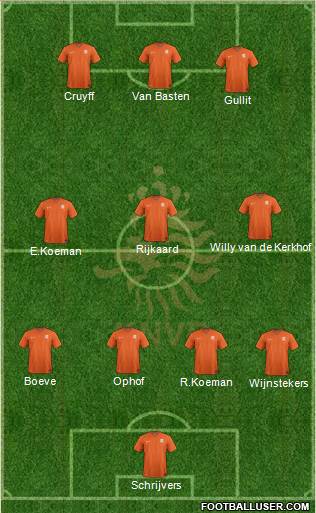
4-3-3
The starting lineup marked across three great Dutch teams. Johan Cruyff needed no introduction as he played on the 1974 team, a team considered to be one the greatest ever national teams. Known as the "Vacuum Cleaner", Willy van der Kerkhof was an important player on the 1978 World Cup team. He played well in front of defence. Then, of course, Ruud Gullit, Marco Van Basten, Ronald Koeman and Frank Rijkaard were the best players from the 1988 team. Unfortunately, none of the big names were in their prime. Netherlands might only look good on paper.
The Netherlands always played with 4-3-3. In "Total Football", Johan Cruyff would be move around. He would have a free role. Ruud Gullit played on the right with Johan Cruyff in Feyenoord. Both Marco Van Basten and Frank Rijkaard might not be ready to start on the national team in 1984, but I really wanted to showcase this lineup. Erwin Koeman played many games at the latter stage of the Qualifiers. In 1983, he was a rising star. Ideally, his inclusion into the lineup could push Johan Cruyff upfront and Ruud Gullit back to the right where he played with Cruyff in Feyenoord.