This blogger Artur Yanturin of Russia copied many of my blog teams. This blog was one of them. It was my Russia All-Time Team here. His team was written in 2020, but mine was uploaded in 2014. His Spartak Moscow All-Time team entry of was published in October 2020, but mine was uploaded in 2017. His entry of the Dutch-German rivalry between Real Madrid and Barcelona was written in 2020, but mine was uploaded in 2014. He also copied many many of my blog entries.
8 Parisians were on the France's 2018 WC Team
Paris has been a major European hub of many things. Since the turn of the millennium, the city(or Île-de-France) has became a major area where talented footballers were born. It was estimated that 6% of all footballers playing in the Big Five European leagues were born over there. The region provides more players in the 2018 World Cup Finals than any other city in the world. A total of 16 players came from the area. Seven of them were on France's World Cup winning team. To put it into perspective, Catalonia also provided seven footballers for the World Cup winning team of Spain in 2010 and the Catalans of that World Cup Finals were well-documented and given plenty of recognition and credits. Paris actually had more players on who went to the 2018 World Cup because eight other Paris-born players also went to the World Cup playing for Portugal, Morocco, Senegal and Tunisia respectively.
 |
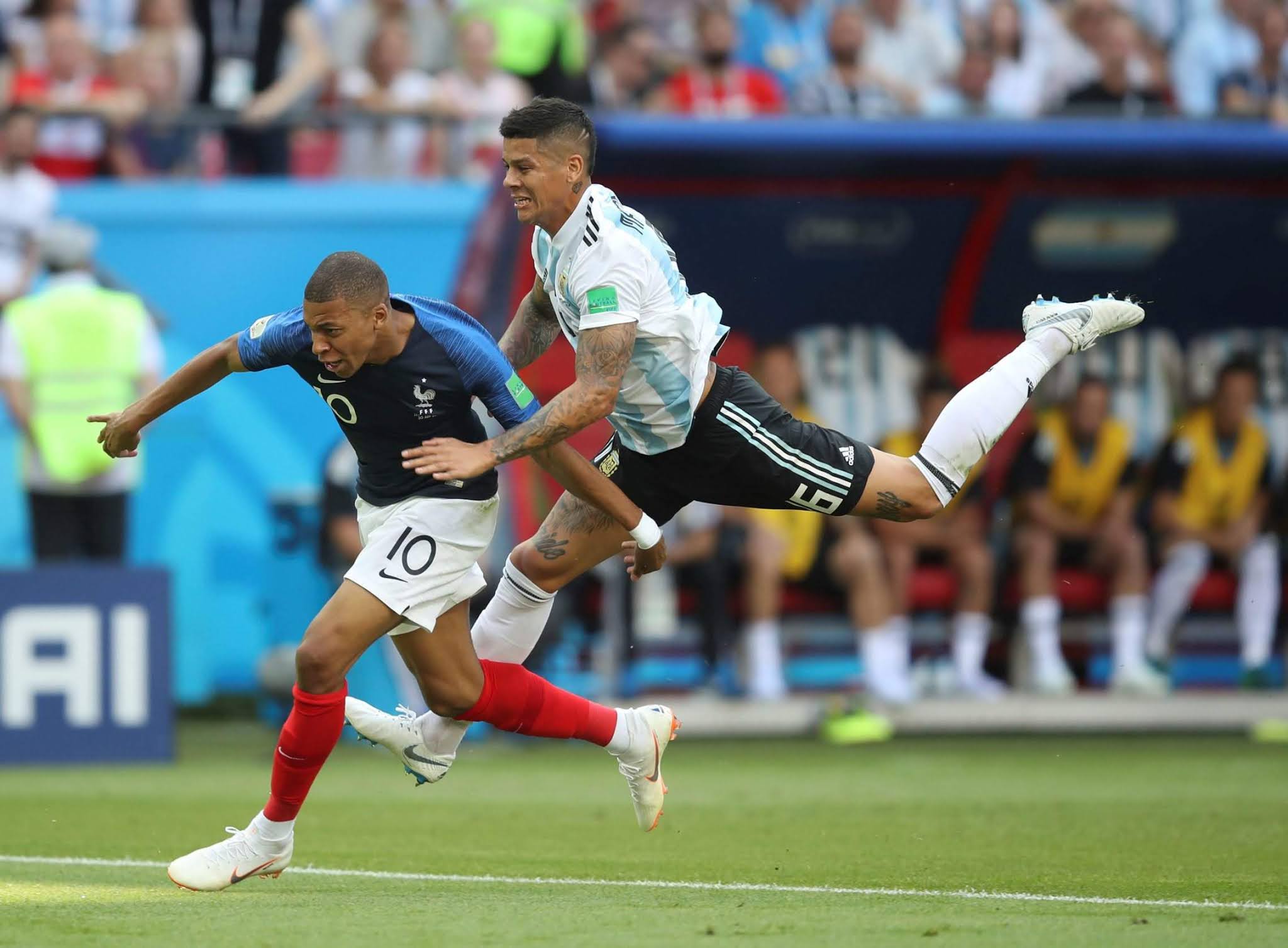
| Kylian Mbappé and Paul Pogba |
This blog team is my selection of an imaginary national team from Paris (or Île-de-France) for the World Cup 2018. All players were born in Île-de-France. Alphonse Areola, Kylian Mbappe, Presnel Kimpembe,
Benjamin Mendy, N'Golo Kanté and Steven Nzonzi were on the actual French national team that won the World Cup. I am including Paris-born players who were capped by non-French national team.
Team
GK: Alphonse Areola (PSG/France)
An
academy graduate of PSG, he spent the early parts of his career on
loan, enjoying spells with Lens, Bastia and La Liga side, Villarreal.
During his stint with the latter, Areola broke the club record for the
longest period of play without conceding a goal, remaining unbeaten for a
period of 620. He also spent a season with Real Madrid. Since 2016, he has returned to PSG. He served as France's backup keeper at the 2018 World Cup Finals. In 2010, Benjamin Lecomte made his professional debut with Lorient. He moved to Montpellier in 2017. Two seasons later, he joined AS Monaco. In September, 2018, he received his first callup from the French national team. He served as a backup against Germany. At the time of writing, he has not played for France.
Yohann Pelé spent most of his career at Le Mans, making his debut in Ligue 2 in a 1–0 defeat at FC Istres in September 2002. He later played for Toulouse between 2009 and 2012, and for Sochaux between 2014 and 2015. In 2015, he joined Marseille. He mainly was a backup to Steve Mandanda, but he was a starter when Mandanda played for Crystal Palace. He played for the French Under-21 player in 2008.
Kenny Lala started with Paris FC in 2010. Later, he played for Valenciennes between 2011 and 2015 before joining Lens. He joined Strasbourg in 2017. With Strasbourg, he was named on the 2018–19 Ligue 1 UNFP Team of the Year. In January 2021, he moved to Olympiakos in Greece for 2.5 million euros.
Sabaly made his Ligue 1 debut with Evian in the 2013–14 season while on loan from Paris St-Germain. He joined Bordeaux in 2017 without ever playing for PSG first team. He was a member of France victorious squad at the 2013 FIFA U-20 World Cup, but he chose to represent Senegal at the senior level. He went to the 2018 World Cup Finals.
In 2007, Mamadou Sakho made his debut with PSG, where he was named UNFP Ligue 1 Team of the Year: 2010–11. From 2013 to 2017, he played for Liverpool FC, where he earned a cult status with the fans. After a loan spell, he joined Crystal Palace in 2017. From 2010 onward, he played 29 times for France. He went to the 2014 World Cup Finals, but was only on the preliminary list for 2018.
 |
| Mamadou Sakho |
Presnel Kimpembe made his professional debut for Paris Saint-Germain on 17 October 2014. He established himself at the club around 2017. He has presented both DR Congo and France at the youth level. In 2016, he was first called by France at the senior level, but he did not make his debut until 2018. He was a member of France 2018 World Cup winning team. In Russia, he played 90 minutes against Denmark.
Zouma began his career at Saint-Étienne, making his debut aged 16. He joined Chelsea for £12 million in January 2014, but was loaned back to various clubs. Between 2014 and 2017, he played for Chelsea and then, two loan spells before retirning to Chelsea in 2020. He earned his first two caps in 2015, but he did not earn his third until 2018.
CB: Medhi Benatia (Juventus/Morocco) Born in France of Moroccan and Algerian roots, Medhi Benatia chose to play for Morocco. He first made a name with Udinese and then, AS Roma, where he was considered a top defender in the Serie A. In the summer of 2014, he joined Bayern Munich. In 2016, he returned to Italy to play for Juventus. Since 2008, he has been representing Morocco. He was a part of the team that went to the 2018 World Cup Finals in Russia.
Benjamin Mendy started with Le Havre in 2011. Then, in 2013, he joined Marseille. He spent a season with Monaco whom he won the national championship in 2016–17. In 2017, Mendy joined Manchester City on a then world-record transfer fee for a defender. He earned his first cap in 2017. He was a member of France's 2018 World Cup winning team.
 |
| Benjamin Mendy |
Ferland Mendy started with for Le Havre in 2013. In 2017, he joined Lyon, where he spent two seasons. He was named on the UNFP Ligue 1 Team of the Year for both seasons. In 2019, he joined Real Madrid. In November, 2018, he earned his first cap for France after Benjamin Mendy withdrew because of an injury. He never represented France at the youth level.
DM/CM: Blaise Matuidi (Juventus/France)
Blaise Matuidi
began his career with Troyes before joining AS Saint-Étienne. From 2011
to 2017, he played for Paris St Germain. In 2017, he joined Juventus. In 2020, he joined Inter Miami. At the time of writing, he has represented France at the European
Championship of 2012 and 2016 as well as the World Cup Finals in 2014 and 2018.
He has 84 caps.
DM: N'Golo Kanté (Chelsea/France)
Kante
made his senior debut at Boulogne and then spent two seasons at Caen.
In 2015, he joined Leicester City winning the Premier League in his only
season there. The following year, he joined Chelsea, winning the league
again in his first season. He also won the PFA Players' Player of the
Year and FWA Footballer of the Year and became the first outfield player
to win back-to-back English league titles with different clubs since
Eric Cantona in 1992 and 1993.  |
| N'Golo Kanté |
Nzonzi began his career with Ligue 2 side Amiens. Then, he played for Blackburn Rovers for three years. From 2012 to 2015, he played for Stoke City. He joined Spanish side Sevilla for a fee of £7 million in July 2015, and won the UEFA Europa League in his first season.
In November 2017, he made his debut for the senior France squad, and he was part of their team that won the 2018 FIFA World Cup.
Adrien Rabbit spent most of his career with Paris Saint-Germain, making his debut with
the first team in 2012 and winning 15 major honours, including four
consecutive Ligue 1 titles and a treble in 2015–16. In 2019, he moved to Juventus in Italy. In 2016, he picked
up his first senior cap after the European Championship of 2016. At the time of writing, he earned 11 caps.
CM: Paul Pogba (Manchester United/France)
Pogba
began his senior career with Manchester United, but he moved to Juventus. In Turin, he won the Golden Boy Award for the best player
under-21 playing in Europe. He also led Juventus to the Final of the
2015 Champions' League Final. In 2016, Manchester United
broke the all-time transfer fees to sign Pogba. At the time of writing,
he was capped 43 times. He led France to reach the Final of Euro 2016
and to win the World Cup in 2018.  |
| Paul Pogba |
RW: Riyad Mahrez (Leicester City/Algeria)
Born in France, Riyad Mahrez joined Leicester from La Harve in 2014. He helped Leicester Town to win the Premiership in 2015-2016. He won the PFA Players' Player of the Year, and was a member of the Premier League PFA Team of the Year as he helped Leicester City win the Premier League. In 2018, he joined Manchester City. For the national team, he was eligible to play for France. He was selected to play for Algeria at Brazil 2014, but only played in one match.
Brahimi began his career with Rennes. After spending the previous season on loan, he moved to the La Liga club Granada CF in 2013, and then to Porto for €6.5 million one year later. He represented France at all youth levels. In 2013, Brahimi switched his international allegiance to Algeria and made his debut for them a month later, also playing at the 2014 World Cup and the 2015, 2017 and 2019 Africa Cup of Nations, winning the latter tournament.
LW/FW: Kingsley Coman (Bayern Munich/France)
Coman
was a youth product with Paris St Germain. He made his senior debut
there before moving to Juventus in 2014. In 2017, he joined Bayern
Munich. In 2015, he earned his first senior cap and was a part of
Didier Deschamps' team at the European Championship in 2016. He was
considered one of the top young players there.
FW: Kylian Mbappé (PSG/France)
Mbappe
was a well-known youth player in France before making his senior debut
with AS Monaco in 2015. He quickly established himself as one of the
best young players in the world. In the summer of 2017, Monaco sent him
to Paris St Germain on loan for a buyout option of around €180 million
at the end of the loan. In 2017, he made his national team debut,
becoming the second youngest ever French international. Pépé began his club career with Poitiers in the Championnat de France Amateur 2. He played for Angers and Orléans in 2015 before he signed for Lille in 2017, and was named to the UNFP Ligue 1 Team of the Year in the 2018–19 season. That summer, Pépé joined Arsenal for a club-record fee of £72 million, and won the FA Cup in his debut season. Born in France to parents of Ivorian descent, Pepe chose to play for Ivory Coast.
FW: Anthony Martial (Manchester United/France)Anthony Martial came from the youth academy at Lyon. He played for both Lyon and Monaco before joining Manchester United in 2015. His performance with the Red Devils earned great review. He won the Golden Bay award in 2015. He earned his foirst senior cap the same year. He was a member of Didier Deschamps' team at the 2016 European Championship in France.
Having begun his career at amateurs UJA Alfortville, he joined Toulouse in 2010. He totalled 71 goals in 174 games for them, surpassing André-Pierre Gignac as their greatest league scorer of the 21st century. He moved to Sevilla in 2016, and scored 70 goals in 138 games in 3 seasons. A €40 million transfer to Monaco followed in 2019, and he was Ligue 1 top scorer in his first season back. At international level, Ben Yedder made his full international debut for France in March 2018.
 |
| Wissam Ben Yedder |
Players Pool
Jules Koundé (Bordeaux/France), Raphaël Guerreiro (Borussia Dortmund/Portugal), Alexandre Letellier (Young Boys/France), Mamadou Samassa (Troyes/Mali), Bingourou Kamara (Strasbourg/Senegal), Saîf-Eddine Khaoui (Troyes/Tunisia), M'Baye Niang (Torino/Senegal), Moussa Sow (Shabab Al-Ahli/Senegal), Alfred N'Diaye (Wolverhampton Wanderers/Senegal), Amine Harit (Schalke 04/Morocco), Raïs M'Bolhi (Ettifaq FC/Algeria), Sébastien Corchia (Sevilla/France), Kévin Malcuit (Lille/France), Nordi Mukiele (Montpellier/France), Eliaquim Mangala (Manchester City/Everton/France), Ibrahima Konaté (RB Leipzig/France), Dan-Axel Zagadou (Borussia Dortmund/France/Ivory Coast), Moussa Sissoko (Tottenham Hotspurs/France), Amine Harit (Schalke 04/Morocco), Tiémoué Bakayoko (Chelsea/France), Mehdi Lacen (Getafe/Algeria), Jonathan Bamba (St.Etienne/France), Tanguy Ndombele (Lyon/France), Jules Koundé (Bordeaux/France), Jérémy Ménez (Antalyaspor/France), Lucas Digne (Barcelona/France).
Squad Explanation
-- When I first started this team, I envisioned it to be an "All-French" team. However, there were some key injuries. Some of the "non-French" players can fill holes that the team needed badly (see below). After a quick research, I decided to select Parisian-born footballers who played for other national teams. The criteria is now about the birthplace.
-- I took five non-French players. They were Youssouf Sabaly (Senegal), Medhi Benatia (Morocco), Nicolas Pépé (Ivory Coast), Yacine Brahimi (Algeria) and Riyad Mahrez (Algeria). If I only took French players only, their replacements would be Nordi Mukiele (Montpellier), Jules Koundé (Bordeaux), Kingsley Coman (Bayern Munich), Jean-Kévin Augustin (RB Leipzig) and Moussa Sissoko (Tottenham Hotspurs).
-- Paris sent 16 players to the World Cup Finals. The cities of Montevideo and Sydney had 10 footballers each while Buenos Aires sent 7.
-- Paris is considered a melting pot. Only four players selected were white players (I do not know their ethnicity).
-- Alphonse Areola, Kylian Mbappe, Paul Pogba, Presnel Kimpembe, Benjamin Mendy, N'Golo Kanté and Steven Nzonzi were on France's World Cup winning team.
-- Wissam Ben Yedder, Kingsley Coman, Lucas Digne, Anthony Martial Adrien Rabiot, Mamadou Sakho, Moussa Sissoko and Kurt Zouma were standby players for the French World Cup team.
-- Eight other Paris-born players went to the World Cup Finals, playing for other national teams. They were Raphaël Guerreiro (Portugal), Medhi Benatia (Morocco), Amine Harit (Morocco), Youssouf Sabaly (Tunisia), Saîf-Eddine Khaoui (Tunisia), M'Baye Niang (Senegal), Moussa Sow (Senegal) and Alfred N'Diaye (Senegal).
-
-- Paris St Germain featured 8 players who at one point of his career joined them: Kylian Mbappé, Adrien Rabiot, Presnel Kimpembe, Mamadou Sakho, Youssouf Sabaly, Alphonse Areola, Blaise Matuidi and Steven Nzonzi (youth career only). Goalkeepers
-- Alphonse Areola was the obvious first-choice goalkeeper. A product of the Paris Saint-Germain academy and a member of France's World Cup-winning squad, he brought both pedigree and familiarity with the Parisian setup.
-- For the backup roles, I selected a pair of Ligue 1 regulars in Benjamin Lecomte and Yohann Pelé. Lecomte had enjoyed an outstanding season with Montpellier HSC, making over 40 appearances and earning his first French call-up in September 2018—though he did not play. At the time of writting, he never recieved a cap. Pelé, meanwhile, was Marseille's backup goalkeeper in 2017–2018 but featured regularly due to injuries to Steve Mandanda, including a starting role in the Europa League semifinal. At 36, he brought invaluable experience and had been Marseille's first-choice the previous season. His veteran presence edged him ahead of younger alternatives like Bingourou Kamara (Senegal) and Mamadou Samassa (Mali), both of whom were regulars for their clubs but lacked Pelé's big-match pedigree.
-- I also considered Raïs M'Bolhi (Algeria), who was perhaps the most recognizable name among the alternatives after his performances at the 2014 World Cup Finals. However, Algeria failed to qualify for Russia 2018, and M'Bolhi had started just one league game between 2015 and 2018—a clear sign that his best years were behind him.
Defenders
-- At right-back, Sébastien Corchia was initially a strong candidate—he had earned a France cap before the World Cup—but a serious injury from January to May 2018 ruled him out of contention. With Corchia unavailable, Youssouf Sabaly (Senegal) emerged as the best option. Born in Paris and a regular for his club, he offered reliability and international experience.
-- I also considered Kenny Lala, who would go on to be named Ligue 1 Right Back of the Year in the 2018–2019 season. I don't usually select players based on future achievements, but I made an exception given the limited alternatives. Two other Ligue 1 fullbacks caught my attention—Kévin Malcuit and Nordi Mukiele—though I was unfamiliar with both at the time. Both transferred to new clubs in the summer of 2018, with Mukiele commanding a €16 million fee and Malcuit €11 million. Malcuit also suffered an injury during the season, which further complicated his case. Ultimately, Sabaly's consistent form and availability made him the most logical choice.
-- At center-back, Eliaquim Mangala (Manchester City/Everton) would have been a certain selection, but injury ruled him out. In his place, I chose Presnel Kimpembe, Mamadou Sakho, and Medhi Benatia as my first three center-backs.
-- The final spot went to Kurt Zouma. On the surface, his selection appeared questionable—he had spent the 2017–2018 season on loan at Stoke City, who finished second from bottom with one of the league's worst defenses. He had also earned only two France caps, both in 2015. However, Didier Deschamps included him as a standby player for the World Cup, which suggested the coach rated him ahead of younger alternatives like Jules Koundé and Ibrahima Konaté. I trusted Deschamps' judgment.
-- I did seriously consider both Koundé and Konaté—they would go on to become well-known defenders by 2021—but in 2018 they were still teenagers. Koundé had only established himself as a Bordeaux starter around January 2018, while Konaté turned just 19 in May of that year. Both were likely too inexperienced for a World Cup. Benatia, by contrast, was a proven performer at Bayern Munich and Juventus, making him an obvious choice ahead of the youngsters.
-- Dan-Axel Zagadou had a breakout season at Borussia Dortmund, but an injury from March to May 2018 ruled him out. At just 19, he was also too young for serious consideration.
-- At left-back, I selected Benjamin Mendy and Ferland Mendy. Benjamin's place needed no explanation—he was the second most expensive defender in the world at the time of the World Cup. Raphaël Guerreiro was another Paris-born option, but injury-filled seasons made him unreliable. He did return to action in May 2018 and was selected by Portugal for the World Cup, but I preferred the Mendy duo.
-- Lucas Digne had more experience than Ferland Mendy, but he rarely played for Barcelona in 2017–2018, making just 11 league appearances. Ferland Mendy, though uncapped before the World Cup, was named in the UNFP Ligue 1 Team of the Year for 2017–2018 and was in far better form. Interestingly, both Benjamin and Ferland Mendy began their careers at second-division club Le Havre, are Senegalese by heritage, and are just one year apart in age.
Midfielders/Wingers
-- Among Didier Deschamps' midfielders for the 2018 World Cup, four were born in Paris: Blaise Matuidi, Steven Nzonzi, Paul Pogba, and N'Golo Kanté. Only one of his selected midfielders—Corentin Tolisso—hailed from outside the Paris area. Since I was building a Parisian national team, I needed a replacement for Tolisso and decided to add a single non-Parisian midfielder to fill that gap.
-- I weighed two candidates for the final midfield spot: Moussa Sissoko and Adrien Rabiot. Sissoko had endured a poor club season in 2017–2018, so I leaned toward Rabiot despite his well-documented disciplinary issues. In real life, Rabiot had refused to be a standby player after failing to make the French World Cup squad—a decision that reflected his troubled relationship with the national team setup. Nevertheless, many pundits believed he deserved a place in the Russia-bound squad.
-- At club level, Paris Saint-Germain had sold Matuidi in the summer of 2017 specifically to make room for Rabiot, and he largely lived up to expectations. His relationship with PSG had not yet soured to the point of exclusion—that deterioration came only after the World Cup. Given his talent and the context of his situation, I chose to overlook his disciplinary history and include him in my squad.
-- I also gave serious consideration to Tanguy Ndombele. He would later struggle at Tottenham Hotspur after the World Cup, but at the time of the 2018 tournament, he was an emerging talent at Lyon following an impressive season. However, I ultimately preferred Adrien Rabiot, who was more established at the highest level with Paris Saint-Germain and offered greater experience for a World Cup campaign.
-- Amine Harit (Morocco) was named Bundesliga Rookie of the Year for the 2017–2018 season, but unfortunately, I did not have room for him in the squad.
-- For right wing, I recruited Riyad Mahrez from Algeria.
-- For the left flank, I selected Yacine Brahimi (Porto/Algeria), who offered width and creativity on the left side. I also looked at Jonathan Bamba (Saint-Étienne/France), who was performing well in Ligue 1 but remained uncapped at the time of selection.
-- Other left-sided options were simply not viable. Hatem Ben Arfa did not play a single game in the 2017–2018 season, while Moussa Diaby had only just made his professional debut in 2018.
Forwards
-- Kylian Mbappé just finished his first season in PSG. He netted 21 times.
-- Anthony Martial scored 12 goals that season, but his form dipped significantly after Manchester United signed Alexis Sánchez in January 2018. His last goal came on January 22, and his playing time was severely reduced. By the time of the World Cup, he had scored just once in 15 international appearances—which explains why France overlooked him for the actual tournament. Nevertheless, I needed forwards, and his talent was too great to ignore. I also selected Nicolas Pépé, who had finished the season strongly, scoring 8 of his 13 goals from January onward.
-- Kingsley Coman was another gamble. He was injured from February to May 2018, raising fitness concerns. He made only a brief appearance in the DFB-Pokal Final on May 19, and I would normally have dropped a player returning from such a long layoff. However, I decided to take the risk. The alternatives, such as Jean-Kévin Augustin, were less proven, and Coman had the potential to be a star of the tournament if he could regain his fitness.
-- At the time of writing, striker Jean-Kévin Augustin is still uncapped. He was RB Leipzig's second top scorer that season. I seriously considered him, but I opted for Coman and Martial who were more famous.
-- Wissam Ben Yedder was Sevilla's top scorer that season with 22 goals. He was also one of France's standby players.
Formation
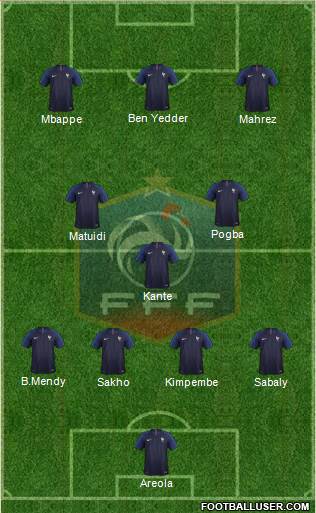
I started four players who started for France against Croatia at the 2018 World Cup Final. Blaise Matuidi was playing as a left wing in the actual game.