This blogger Artur Yanturin of Russia copied many of my blog teams. This blog was one of them. It was my Russia All-Time Team here. His team was written in 2020, but mine was uploaded in 2014. His Spartak Moscow All-Time team entry of was published in October 2020, but mine was uploaded in 2017. His entry of the Dutch-German rivalry between Real Madrid and Barcelona was written in 2020, but mine was uploaded in 2014. He also copied many many of my blog entries.
 |
| Euro 2016 Finals |
Please also see my All-Time World Cup Team Index.

This is my all-time 23-member team for  Albania,  Previously, I did an all-time team for Southeast Europe (Balkan Peninsula), excluding the former republics of Yugoslavia, Romania and Bulgaria. I have done a separated entries for them. I also did an all-time team for Greece, Turkey and Macedonia/Montenegro/Kosovo.
Albania entered the qualifying phase of the 1966 World Cup in England, marking their first-ever participation in the tournament. Placed in Group 5, the team concluded their campaign at the bottom, managing only one point from six matches. Notably, during the qualifiers for the UEFA Euro 1968, Albania held West Germany to a goalless draw, denying the Germans an opportunity to participate in the finals.
Subsequently, Albania faced an absence from the qualifying rounds of the 1970 World Cup, UEFA Euro 1972, UEFA Euro 1976, 1978 World Cup, and UEFA Euro 1980, for reasons unknown but suspected to be politically motivated. Following a six-year hiatus from international matches, Albania returned to the World Cup qualifying stage in 1982, achieving a placement higher than last for the first time in a qualifying match. Finland, instead, finished in the last position.
Regrettably, the World Cup 1990 qualifiers proved to be a low point in Albania's history, with six consecutive losses and no noteworthy performances to remember.
Although Albania had triumphed in the 1946 Balkan Cup and the 2000 Malta Rothmans International Tournament, they had never previously participated in any significant UEFA or FIFA tournaments until 2016. Finally, at Euro 2016, Albania made its inaugural appearance in a major men's football tournament. The team secured their first-ever victory in a European Championship and scored their first-ever goal in a major tournament when they defeated Romania on June 19, 2016.
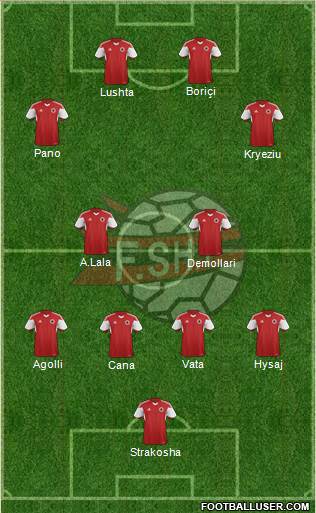
This is my all-time team for Albania. If there were an All-Time World Cup, this would be the 23 players I would bring to the tournament.
 |
| Balkan Cup 1946 winner |
Team
GK: Perlat Musta
Musta was a product of Partizani Tirana academy, and played for them between 1979 and 1991. He joined Dinamo București in 1991, but failed to settle. In 1994 he returned to Partizani Tirana where he played as starter in the next two seasons. He made his senior debut for Albania in 1981 against Finland and earned a total of 23 caps. He was also once the captain of the team in a match against Romania, which took place in 1987 on the Steaua Stadium.
 |
| Perlat Musta |
GK: Etrit Berisha
Born in Kosovo of Albanian ethnicity, Berisha played for Albania for over 68 times since 2012. He was their starting keeper at Euro 2016. For his club career, Berisha went on trial at Swedish side Kalmar in 2007, where he played in the senior squad between 2010 and 2013. He then spent three seasons with Lazio. From then, he played another 3 seasons with Atalanta. From 2019 to 2021, he played for SPAL. At the time of writing, he is playing for Torino.
GK: Foto Strakosha
Strakosha is regarded as one of Albania's most popular and greatest goalkeepers. In his 20-years playing career he played with 11 different clubs, initially in Albania before moving in Greece in 1991 to spent the majority of his career there until his retirement in 2005. He captained the Albania national team for a number of years before his retirement in 2005. He became Albanian's most ever capped player having 73 caps from 1990 to 2005.
RB: Elseid Hysaj
Born in Albania, Hysaj moved to Italy as a young age with his family where he began with Empoli. He played three seasons in the Serie B before his club moved to Serie A in 2013. From 2015 to 2021, he played for Napoli. In 2021, he moved to Lazio. At 18, he made his senior debut with Albania. At the time of writing, he has 61 caps. He started every game at Euro 2016 where Albania qualified in their first major tournament.
 |
| Elseid Hysaj |
Muhamet Dibra played club football in Albania for Vllaznia Shkodër and Partizani Tirana and won three National Championships in 1945, 1946 and 1948. He was also a member of the Albania national team between 1946 and 1953, where he earned 19 caps and also won the 1946 Balkan Cup. The road the Loro Boriçi Stadium is on in Shkodër is named after him and he received a number of notable awards for his services to sport in Albania.
CB/CM/DM: Lorik Cana
Cana played in France, England, Italy and Turkey, representing Paris Saint-Germain, Sunderland, Galatasaray, Lazio, FC Nantes and Olympique de Marseille as well as the Albania in which he is Albania's most capped player of all time, with 93 caps between 2003 until and 2016. He used to play primarily as a defensive and central midfielder but later switched to centre-back. He participated in the first major international competition for Albania, the UEFA Euro 2016 held in France.
 |
| Lorik Cana |
CB: Geri Cipi
After establishing himself at Flamurtari during the early 1990s, Geri Cipi moved to Maribor in the summer of 1998. He most notably played 76 games for Gent in Belgium. Later, he played for Frankfrut and Rot-Weiß Oberhausen in Germany before returning home in 2004 to play for SK Tirana. For Albania, he had 34 caps between 1995 and 2005. His uncle Kreshnik also played for Flamurtari and the national team.
CB: Berat Djimsiti
Berat Djimsiti was born in Zürich, Switzerland into an ethnic Albanian family from Serbia. He started his career with Zurich in 2011 where he played until 2016. In 2016, he moved to Atalanta in Italy. In 2018, he established as a starter. He represented Swizterland at the youth level. In 2016, he chose to play for Albania. Since 2015, he played regularly for them, but he was left out of final 23-man UEFA Euro 2016 squad.
CB: Rudi Vata
Vata's career in Western football began in France in 1991, when the KS Dinamo Tirana player claimed political asylum following an international match with the national team He played for Le Mans and Tours, before playing for Celtic between January 1993 and 1995–96. He became the first Albanian to win an honour in a major European country when he won the 1995 Scottish FA Cup with Celtic. earned a total of 59 caps, scoring 5 goals.
 |
| Rudi Vata |
LB: Ansi Agolli
Agolli played for many clubs all over the world. His longest stint was with Qarabağ in the Azerbaijan Premier League where he played from 2010 to 2019. From 2005 to 2018, Agolli had played 73 times for Albania. Agolli was named Albania's second acting captain under coach Gianni De Biasi for UEFA Euro 2016. After Lorik Cana was suspended, he served as their captain in the last three matches of the Finals.
DM: Altin Lala
Lala defected to Germany as a youngster where he started his football career with Borussia Fulda in 1994. He later played for Hanover 96 between 1998 and 2012. He joined Bayern Munich, but only played with Bayern Munich II. He recorded 79 appearances for Albania national team and is currently the second highest in Albania's international history, being overtaken only by Lorik Cana in 2014. He has also scored three goals for his country.
CM: Ramazan Rragami
Rragami started playing in his native town, Vllaznia, at the age of 16. He continued there until 1967 when he was recruited by the Partizani of Tirana and played there until 1970. He then returned to Villaznia. From 1965 to 1970, he was capped 20 times for Albania. He played in the famous 0-0 draw with European powerhouse West Germany in December 1967 that denied the Germans a place in the Finals of the European Championship in 1968.
 |
| Ramazan Rragami |
Llambi was known for his career in Italy. He was considered to be the first Albanian that has ever won a "Scudetto" in Italy's Serie A (with Bologna F.C. in the 1940–1941 season), although he never played a match during that year. He was also on the book of Inter Milan. He made his debut for Albania in an August 1946 friendly match against Montenegro and earned a total of 19 caps, scoring no goals. He was a part of the team that won the Balkan Cup.
LM/CM: Edwin Murati
Edwin Murati played for Panserraikos FC and Iraklis F.C. in Greece. He played also in France, Germany, and for the Albanian national football team. In December 2018 he was honoured for his services to Albanian football, alongside Perlat Musta and Qamil Teliti. He played 42 times for Albania between 1998 and 2006.
AM/CM: Sulejman Demollari
Demollari made 45 appearances for Albania between 1983 and 1995, the highest in the team's history who predominantly played during the communist era when Albania only played a limited amount of international matches. He played his entire career in Albania for Dinamo Tirana. He was among the first players to pursue a career abroad, signing for Dinamo Bucharest in 1991. He later had spells in Greece with Panionios and in Hungary with Győr FC.
AM: Ervin Skela
Skela played for many clubs all over Europe. He played the majority of his career in Germany, but he also played in Albania as well as Italy and Poland briefly. His longest stint was with Eintracht Frankfurt between 2001 and 2004. He also playd two seasons with FC Energie Cottbus. He is fourth most capped Albanian international with 75 appearances between 2000 and 2011 as well being the third highest goalscorer in the country's history with 13 goals.
 |
| Ervin Skela |
RW: Naim Kryeziu
Born in Gjakova, at the time in the Kingdom of Serbia, current day Republic of Kosovo, Kryeziu left his town in Kosovo as a youngster to join KF Tirana. Following the 1939 Italian invasion of Albania, he joined AS Roma, where he played until 1947. He won the 1940-1941 scudetto. From 1947 to 1952, he played for Napoli. He never played for either Albania or Italy.
FW: Refik Resmja
Refik Resmja started his career with Tirana, but shortly after signed with Partizani Tirana where he established himself as one of the greatest players of all time, setting several records and winning 9 trophies. He has also been an Albanian international, winning six caps between 1952 and 1963. During his career, Resmja held only one squad number, 11.
ST Sokol Kushta
Kushta was a striker and was ranked 30th in the 1987 European Footballer of the Year, matching in the ranking players such as Alessandro Altobelli, Glenn Hoddle, and Rudi Völler. Kushta spent the large part of his Albanian league career with hometown club Flamurtari during the 1980s. He also played in Greece after the fall of communism. He had a total of 31 caps for Albania.
FW: Panajot Pano
Panajot Pano was considered to be Albania's greatest player and was elected as its UEFA Jubilee Player. From the Greek ethnicity, Pano started with SK Tirana from 1957 to 1960. From 1960 to 1975, he played for Partizani Tirana. Pano earned 25 caps between 1963 and 1973. He also captained the national team in 10 occasionsIn 2009, he received the order Honor of the Nation from the government of Albania. It was the first time a footballer received that order.
 |
| Panajot Pano |
ST: Riza Lushta
Born in Serbia, Lushta with the local club Rudari Trepča. From 1934 to 1939, he played for Tirana. He then moved to Italy to play with A.S. Bari, and then Juventus F.C. (won one Coppa Italia in 1942), and Napoli, after which he went to France to play with AS Cannes. Eventually he went back to Italy and played with Alessandria, and then in Italian Third Division with Siena and in Italian Fourth Division with Forlì, and the Rapallo Ruentes, the team of Rapallo.
Ilir Përnaska is one of Dinamo's most famous players who is known for being one of the most prolific goalscorers in Albanian history, topping the domestic league's goalscoring charts in six successive seasons. He was part of the 'Golden Age' of Dinamo between 1971 and 1981. He made his debut for Albania in 1971 and earned a total of 15 caps, scoring 5 goals.
ST: Loro Boriçi
He played mostly for Partizan Tirana (won the 1949 and 1954 Albanian title and scored 68 goals for them) and Vllaznia (won the 1945 Albanian title). Boriçi was the reserve of Silvio Piola in Italian Serie A with S.S. Lazio. He captained Albania in winning the 1946 Balkan Cup. Today, Loro-Boriçi Stadium in Shkodër is named in his honour. H e made his debut for Albania in 1946 and earned a total of 24 caps, scoring 6 goals. He captained Albania in winning the Balkan Cup in 1946.
 |
| Loro Borici |
Honorable Mention
Qemal Vogli, Riza Haxhiu. Arjan Beqaj, Isli Hidi,Thomas Strakosha, Arjan Beqaj, Qemal Vogli, Blendi Nallbani, Hysen Zmijani, Safet Berisha, Arjan Xhumba, Ilir Shulku, Besnik Hasi, Mergim Mavraj, Muhedin Targaj, Elis Bakaj, Fatmir Vata, Altin Rrakli, Klodian Duro, Ali Mema, Hamdi Salihi, Odise Roshi, Igli Tare, Armand Sadiku, Alban Bushi, Medin Zhega, Qamil Teliti, Adrian Aliaj, Blendar Kola, Arben Minga, Altin Haxhi, Andi Lila.
Squad Explanation
-- Previously, I did an all-time team for Southeast Europe (Balkan Peninsula), excluding the former republics of Yugoslavia, Romania and Bulgaria. When I did a review of the team in 2021, I did not like some of the selections on that team. Instead of redoing that team, I created this Albania All-Time.
-- Before the 1990's, Albania was a closed country. It was hard to research their players before that. I have looked into the eras during and before the War when Albania became Italy's sphere of influence under Benito Mussolini. This historical period saw the emergence of notable Albanian football players such as Naim Kryeziu, Riza Lushta, and Loro Boriçi, who gained prominence while playing in Italy.
-- Panajot Pano was selected as the best Albanian footballer of all time by the Albanian Football Federation for the UEFA Jubilee award. Lorik Cana, Naim Kryeziu, Riza Lushta and Loro Boriçi were also considered their greatest players.
-- Albania won the Balkan Cup in 1946. I selected three players from that team: Sllave Llambi, Loro Boriçi and Muhamet Dibra. Qamil Teliti was on honorable mention.
-- The Euro 2016 Finals was Albania's first time ever qualifying for a major tournament. Etrit Berisha, Lorik Cana, Ansi Agolli and Elseid Hysaj made this team. All of whom were defensive players. Berat Djimsiti was not selected for the Finals in France, but he played in the Qualifiers.
-- Albania diaspora has done well in football, but I am only selected players who played for the national team of Albania or uncapped players of Albanian ancestry who might be eligible for Albania under a different circumstance.
-- It was estimated that 88% of Kosovo's population are of Albanian ethnicity. For my all-time teams of the former all republics of Yugoslavia, I included players who played for Yugoslavia. However, Albania is not a former republic of Yugoslavia. So I put Kosovo Albanians on this North Macedonia/Montenegro/Kosovo All-Time Team. At the time of writing, I am working on an All-Time team of Kosovo.
-- During the World War Two, Kosovo became a part of Italian-controlled Kingdom of Albania. I understand that the World War Two era and its impact on Kosovo can be a sensitive and controversial topic. As a result, it's best to refrain from using that period as a reason for their inclusion in the team. The war has been a subject of controversy when considering the composition of many all-time teams.
-- However to avoid controversy, I am including both Naim Kryeziu and Riza Lushta. Excluding them would be treachery to the people of Albania. It is important to note that both players were born in what is now modern-day Kosovo and are of Albanian ethnicity. Not having represented any national team in international matches, they were eligible to play for Albania. There were even rumors suggesting that Lushta had played unofficial games for them. Furthermore, their inclusion in the commemorative stamps issued by Albania in 2002 served as an official recognition of their status as Albanians. Considering these factors, it is only fitting that I select them for the team.
Goalkeepers
-- Foto Strakosha was at on point Albanian's most ever capped player having 73 caps from 1990 to 2005.
-- Both Thomas Strakosha and Etrit Berisha were teammates in Lazio. It is worth mentioning that Berisha, in fact, started ahead of Strakosha during their time at Lazio. I still opted for Etrit Berisha due to his status as Albania's second all-time cap leader among goalkeepers. It is notable that Foto Strakosha, Thomas's father, holds a slight edge with five more caps than Berisha.
-- The last goalkeeping spot was between Qemal Vogli and Perlat Musta. I took Musta because Vogli only played a few times for Albania.
-- Arjan Beqaj, Isli Hidi and Blendi Nallbani also came up during my research. They made honorable mention.
-- I also found out about Qemal Vogli. He was the youngest goalkeeper ever to play for Albania. His career, however, was cut short by political issues. I put him on honorable mention.
Defenders
-- Fahrudin Jusufi was a Gorani born in Dragas, Kosovo. I do not know much about the Gorani people and their connection to the Albanian ethnicity. I never saw his name on any of my research regarding "Albanian footballers". Since he was born in Kosovo, I also included him on my North Macedonia/Montenegro/Kosovo All-Time Team. However, he played for Yugoslavia, which made him ineligible for this team. I only selected uncapped player of Albanian ancestry.
-- Albania qualified for the Euro 2016 Finals conceding only 5 goals in the qualifying rounds. I already took goalkeeper Etrit Berisha. Lorik Cana, widely regarded as Albania's greatest player, rightfully earns his place here, due to his record for the beingv the most capped Albanian footballer. Then, I took their pair of fullbacks Ansi Agolli and Elseid Hysaj. Hysaj probably has the best club career outside Albania after Lorik Cana in the modern era.
 |
| Ansi Agolli |
-- Geri Cipi was a well-known central defender during his prime.
-- Rudi Vata deflected to the West, becoming one of the first Albanian footballers to play overseas. His name gained greater recognition on the global stage due to his extensive experience playing club football in Western Europe. Vata's international contributions were equally noteworthy, as he captained the national team on 21 occasions out of his 59 caps.
-- And then, I selected Berat Djimsiti who established himself as a starter in Atalanta, which constantly finished on top of Serie A table in the last few years. Albanian footballers seldom made it in a bigger club from one of the top five leagues in Europe. He was born in Switzerland, but chose to play for Albania.
Midfielders/Wingers
-- DM Altin Lala has over 70 caps for Albania, which was at one point a record. He is the second most capped player for Albania. His versatility across multiple positions added to his value as a player. Given that this team badly needed a defensive midfielder, he emerges as a solid candidate for the team. Please do not confuse him with Andi Lila who also earned 70 caps. Andi Lila made honorable mention.
 |
| Altin Lala |
-- I also don't know much about Ramazan Rragami, but his name was mentioned many times in a Facebook message group for Albanian fans. He was a star of the 1970's. I selected him based upon that.
-- I also came across Sabah Bizi, Lin Shllaku and Besnik Hasi. I needed more midfielders, but I put them on honorable mention.
-- Due to the circumstance of his death, Riza Haxhiu received legendary status in Albania. Abdurrahman Roza Haxhiu Stadium in Lushnja was named after him. I do not know about his playing style. I left him on honorable mention only.
-- AM/CM Sulejman Demollari was voted as Albania's greatest player by Albiansport. Attack midfielder Ervin Skela's name was mentioned in all of the list of the greatest Albanian players. So I left off Ali Mema, Klodian Duro, Elis Bakaj and Fatmir Vata for them.
-- LW Xhevat Prekazi, originally from Kosovo, faced challenges regarding his eligibility as he had not been capped at the senior level for Yugoslavia. Despite being Albanian, his status remained uncertain. While Naim Kryeziu, also born in Kosovo, was selected, the distinguishing factor was that Kryeziu was frequently regarded as one of Albania's greatest players. Ultimately, I decided not to include Prekazi in the team, as my preference leaned towards other players who had achieved legendary status in Albania. Nevertheless, it is worth acknowledging Prekazi's remarkable career in Turkey, which undoubtedly left a lasting impression.
Forwards
-- As previously mentioned, Panajot Pano is widely regarded as one of Albania's greatest footballers. Moving on to the forward positions, both Loro Boriçi and Riza Lushta were undisputed choices. Their contributions to Albanian football were so significant that they were honored with commemorative stamps in 2002, which is a testament to their impact. Additionally, there were rumors circulating about Riza Lushta having played for Albania unofficially.
-- Refik Resmja is considered the greatest goal scorer in the Albanian league. He scored 184 goals in just 130 league matches which made him the all-time top scorer of Albanian Superliga at the time of his retirement.
-- According Italy's "Guerin Sportivo"magazine, Ilir Përnaska was ranked 6th greatest goal scorer in Europe. They based their study on statistics.
-- Erjon Bogdani is Albania's all-time leading scorer, but I did not have a spot for him. Bogdani along with Riza Haxhiu, Ilir Shulku, Mërgim Mavraj, Igli Tare and Qamil Teliti are the bigger names missing on this team. Instead, I took Sokol Kushta who was an icon in the 1980's. He was one of the first Albanians allowed to play aboard.
 |
| Sokol Kushta |
Formation