Showing posts with label "Forgotten Great teams". Show all posts

Sunday, November 2, 2014

Forgotten Great Team: Steaua București 1986-1989


Please also see my All-Time World Cup Team Index.

This blogger Artur Yanturin copied my blog team.  His entry was written in October 2020, but mine was uploaded in 2014.  I also updated mine periodically.  I looked mistakes. He kept my mistakes.  He also copied many many of my blog entries.  

Забытая великая команда: "Стяуа" Бухарест 1986-1989

Этот блогер Артур Янтурин скопировал команду моего блога. Его запись была написана в октябре 2020 года, но моя была загружена в 2014 году. Я также периодически обновлял свою. Я посмотрел ошибки. Он сохранил мои ошибки. Он также скопировал многие из моих записей в блоге.

Acest blogger Artur Yanturin mi-a copiat echipa de blog. Intrarea lui a fost scrisă în octombrie 2020, dar a mea a fost încărcată în 2014. Am actualizat-o și pe a mea periodic. Am privit greșeli. Mi-a păstrat greșelile. De asemenea, a copiat multe dintre articolele mele de blog.

Romania 
GalatasarayFenerbahçe SK, Beşiktaş Red Star Belgrade, FK PartizanSteaua București


When it came to forgotten great teams of European football, Steaua București of the late 1980's was seldom mentioned.  Their 1985-1988 European Cup triumph was often perceived as being lucky.  His critics would say the strength of their team was assisted by political interference by the Romanian dictatorship.  However, one could not deny the fact that they were European Cup winner in 1986, the semi-finalist two years later, and then, followed by another Final appearance in 1989.

Romanian domestic football was dominated by two clubs, Steaua București and Dinamo București.  Steaua București was tied to the Romanian army while its rival Dinamo Bucharest was the club of the Secret Police.  From the 1960's onward, Dinamo București domianted Romania's Liga 1.  The 1980's began with them winning three straight Liga 1 titles.  Then, in 1983, Romanian Dictator Nicolae Ceaușescu's eldest son, Valentin, took over Steaua București.  Suddenly, the balance of power shifted to Steaua București.  In 1985, Steaua București won its first league title in 6 years.  They would win four more league titles and four cup titles before the collapse of the Ceaușescu dictatorship in 1989.  They went undefeated for 119 domestic games from 1986 to 1989, setting up a world record.


Their domination, however, was filled with controversies. Their players were exempted from the compulsory military service.  They took players from other clubs often in questionable circumstances. For example, they borrowed Gheorghe Hagi from Sportul Studențesc for the European Super Cup in 1987.  He supposed to be a guest player for one game, but he joined them permanently after scoring the only goal of the game.   There were also a lot of accusations of favoritism from referees, officials, etc. In the Romanian Cup Final of 1988, they scored at the 90th minute mark to break the 1-1 scoreline against Dinamo.  The goal would have sealed their victory, except the referee ruled it offside.  Valentin Ceaușescu protested against the decision by pulling the team off the field.  Dinamo, then, won the game by default and was presented with the trophy.  The next day, the referee changed his mind and Steaua was declared the winner.     

While the Ceaușescu dictatorship could control events in the domestic completions, it could not alter results outside Romania that put Steaua București on the map in Europe.  The rise of Steaua in Europe coincided with the rise of Romania's national team.  Romania surprised the football world in 1984 when it qualified ahead of World Cup winner Italy and Euro 1980 semi-finalist Czechoslovakia for the Euro 1984 in France.  At the time of the Euro 1984, Romania only had a single player from Steaua and he would depart the club after the tournament.  László Bölöni who was the star of the Qualifying campaign joined them immediately afterward. Three members of the squad, including Gheorghe Hagi, also followed him to the club throughout the 1980's.


The European Cup 1985-86 was an interesting year.  The English clubs had won 7 of the last 9 European Cups, but were banned from the completion after the Final in Heysel.  Thus, Everton was out of the touranment.  Sir Alex Ferguson was in charge of Aberdeen.  Hellas Verona was the surprise winner of Serie A, the season before. It featured Hans-Peter Briegel and Preben Larsen-ElkjaerMichel Platini's Juventus and Terry Venables' Barcelona FC were the favorites, but they met in the quarter-final with Barcelona progressing through to the semi-final.  Barcelona then came from behind to beat IFK Goteborg to reach the Final with Pichi Alonso scoring a hattrick in the 2nd leg.
Steaua București had an easier route to the European Cup Final.  They beat all of their opponents by winning in the home leg.  In the first round, they eliminated the aging Allan Simonsen's Vejle.  They lost the 1st leg before destroying Vejle in the 2nd leg.  In the second round, they again lost in the 1st leg to Honved and used home field advantage to oerturn them in the 2nd leg.  In the quaterfinal, they drew FC Kuusysi of Finland away and then, won the home leg by a single goal.  In the semi-final, they met Anderlecht that featured Morton Olsen and Enzo Scifo.  In the first leg, Steaus put up a stubborn defense in Belgium and only lostbthe match 1-0.  On the return leg, Steaus destroyed them by the score of 3-0.  

The European Cup Final of 1984-1985 was played in Seville, Spain. Due to travel restriction, only 200 Romanian fans were allowed to attend the Final.  They were outnumbered by the 50,000 Barcelona fans at the stadium.  Despite its storied history, Barcelona had never won the European Cup.  Diego Maradona left two seasons ago, but the team still had Bernd Schuster and Steve Archibald.  Expectations were very high for Barcelona. On the other hand, Victor Pițurcă and Marius Lăcătuș were two of Steaua's top players at time of the Final. Pițurcă was the top scorer at the club. Lăcătuș, nicknamed "the Beast" by the Steaua fans were the secondary striker. He would get more international recognition 4 years later at the WC Finals in Italy.

From the start of the match, Steaua parked the bus at the back.  Sweeper Miodrag Belodedici was the hero of the night by controlling Steaua's defense.  After 120 minutes of dull football, the game went into penalties where the drama finally began.  Helmuth Duckadam saved all four of Barcelona's penalties to seal the victory for Steaua. It would be the first ever European Cup victory for an Eastern European club.
Duckadam


Eight months later, Steaua captured their second European trophy when it beat Dynamo Kyiv of Igor Belanov and Oleh Blokhin 1-0 at the European Super Cup in Monaco.  Gheorghe Hagi made his debut with the club.  They would reach the European Cup Final again in 1989, where they were destroyed by Arrigo Sacchi's AC Milan. By the end of 1989, the Romanian people overthrew the Ceaușescu regime.  The best Steaua players moved aboard and marked the end of the Steaua dynasty in Romanian football.



Tuesday, September 30, 2014

Forgotten Great Team: European Cup winner Hamburger 1982-1983


Please also see my
 All-Time World Cup Team Index.
Juventus
Bayern MunichBorussia Dortmund,
Borussia MönchengladbachSchalke 04Werder Bremen,
Hamburger SVKaiserslauternBayer Leverkusen
FC KolnVfB Stuttgart


    The English clubs had won 6 straight European Cups before the  European Cup final in 1983.  When Juventus reached the Final and none of the English clubs did, it looked as if the changing of guard in European football was inevitable.  In 1981, Serie A lifted its ban on foreign players.  International players flocked to play in Italy.   A year later, Italy won their third World Cups in 1982.  The 1982-1983 season was probably the beginning of a Golden era in Serie A.  However, Hamburger SVwould not allow it to happen.  It pulled one of the bigger upsets in European Cup history by beating Juventus in the Final.   On paper, Juventus was the clear favorite.   Juventus fielded six World Cup winners, Dino Zoff, Claudio Gentile, Gaetano Scirea, Marco Tardelli, Antonio Cabrini and Paulo Rossi.   Michel Platini and Zbigniew Boniek were one of the best players at the World Cup.

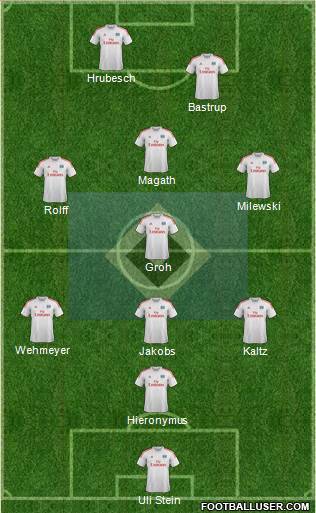
     However, Hamburger SV was not a pushover. They were having a Golden era of its own.  They won the Cup Winner's Cup in 1977 by beating Anderlecht. They reached the 1980 European Cup Final with Kevin Keegan, but lost to Brian Clough's Nottingham Forest.  In the semi-final, they destroyed Real Madrid 5-1 at home on the second leg.  Then, in 1982, they reached the Final of the UEFA Cup, but lost again.  At the time of the 1983 European Cup Final, they won two of the last three Bundesliga title(they would win the 1982-1983 title too).  They also went undefeated in league from the January of 1982 to the January of 1983.  Felix Magath, Manfred Kaltz and Horst Hrubesch who went to the WC Finals in Spain were the biggest names on the team.  Their manager Ernest Happel had already won a European Cup with Feyenoord and considered a very good manager.  Jimmy Hartwig who was one of the first Black players to be capped by West Germany was missing because of suspension.   Franz Beckenbauer left the club the season before. 


      Manfred Kaltz and Horst Hrubesch were an interesting pair.   They were Batman and Robin of football. Manfred Kaltz was one of the best crossers ever played the game.  His crosses were known as "Bananenflanken" (Banana crosses) because they curved liked a banana. Nicknamed "Das Kopfball-Ungeheuer" (the Header Beast), Hrubesch was one of the greatest headers of the ball.  He could header the ball with precision and power.  When the best crosser teamed up the best header of the ball, they became one of the most dynamic duo ever played the game.  In fact, Sven-Göran Eriksson was very concerned about them when IFK Göteborg met Hamburger SV in the Final of the 1982 UEFA Final a year earlier.  However, against Juventus, it was Felix Magath who scored the winner.  Magath who was the son of an American serviceman stationed in Germany was probably the most underrated German players of his generation. Just 9 minutes into the game, he shot the ball from the left corner of the box and the ball sailed straight into the right upper corner of the goal.  Hamburger held on and won their first European Cup in history.

International:
European Cup champions 1983
European Cup finalists 1980
European Cupwinners cup champions 1977
UEFA Cup finalists 1982

Domestic:
Bundesliga champions 1979, 1982, 1983
German Cup champions 1976

Kaltz and Hrubesch


Saturday, September 13, 2014

Forgotten Great Team: Bobby Robson's Ipswich Town

Bobby Robson 1981 UEFA Cup


Please also see my
 All-Time World Cup Team Index.

Ipswich Greatest All-Time Team
All-Time Team under Bobby Robson(Club only)
Manchester United All-Time Team Under Sir Alex Ferguson 
Manchester United All-Time Team Under Sir Matt Busby
Arsenal All-Time Team Under Arsene Wenger

In 1968, Bobby Robson was sacked by Fulham.  His managerial career seemed to be over.  He was married with a young famiy.  He was without money and out of job. Then, Ipswich Town gave him a chance in 1969.  He would repay them by turning the tiny club into one of the best in England.  Ipswich won the FA Cup in 1979 and then, the UEFA Cup in 1981.
1978 FA Cup

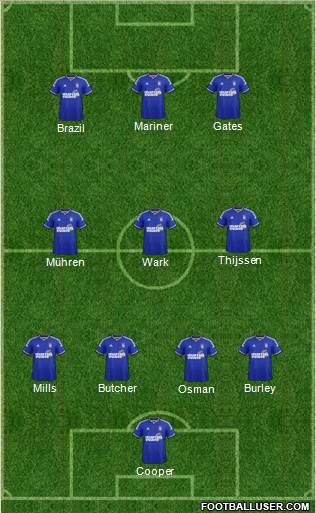
        Under Robson's 13 year-spell at Portman Road, he built the foundation of his successes through his academy.  It produced players such as Mick Mills, Alan Brazil, Trevor Whymark, Brian TalbotJohn Wark, Terry Butcher, George Burley, Mick Mills, Colin ViljoenKevin Beattie, and Eric Gates.   He only bought 14 players during his reign at Ipswich Town, including Allan Hunter, Paul Mariner, David Johnson and Bryan Hamilton.   Arnold Muhren and Frans Thijssen also arrived from Holland in an era where few foreigners played in England. 

Ipswich 1980-81


Monday, August 18, 2014

La Quinta del Buitre


Please also see my
 All-Time World Cup Team Index.
Real Madrid All-Time Team Under Florentina Perez
Real Madrid All-Time Team Under Miguel Munoz
Real Madrid Argentine Best XI
Real Madrid Castilla Greatest All-Time
Real Madrid All-Time Team for Foreign Players

Real Madrid All-Time Team for Spanish players

     In 1984, Real Madrid's reserve team coached by Amancio Amaro won the Segunda Divisió.  The club was ineligible for promotion because the Spanish league disallowed the reserve team from playing together with the senior team in the same division. Even before the team sealed the title, Spanish sport journalist Julio César Iglesias already nicknamed the five home grown players as "La Quinta del Buitre" (Vulture's Cohort) in an article he wrote for El Pais.  "El Buitre" or "Vulture" was the nickname of Emilio Butragueño, the most charismatic player of the group. The other four members were Manolo Sanchís, Martín Vazquéz, Míchel, and Miguel Pardeza.Except for Michel, all members of the group would be promoted to the first team even before the publication of the article. 

      Manolo Sanchís and Martín Vazquéz were the first two to make their senior debut in November 4th, 1983.  Manolo Sanchís even scored a goal that evening.  He  was the son of Manuel Sanchís Martínez who won a European Cup with Real Madrid in 1966.  Three months later, it would be Butragueño's turn.  He scored two goals and provided another for Real Madrid to come from 2-0 to win the game.  A legend was born.

     Meanwhile, another future Real Madrid legend Hugo Sanchez joined the club in 1985 from Atletico Madrid.  He would win 4 La Liga scoring titles or Pichichi trophies(he also won one with Atletico Madrid).  He would coin the nickname "Quinta de los Machos"(The Macho Squadron or the Fifth Male) for the remaining veteran players, namely Francisco Buyo, Rafael Gordillo, Jose Antonio Camacho and Antonio Maceda on the team.

     The group would win 5 consecutive La Liga titles and two UEFA Cups.  Ironically,  all five members of La Quinta del Buitre  only played once on the same field together.  It was largely because  Miguel Pardeza left Real Madrid for a loan spell and then a permanent move to Real Zaragoza in 1987.  All five members of  "La Quinta del Buitre" would represent Spain at the 1990 World Cup Finals in Italy.


Tuesday, December 10, 2013

Botafogo 1955 to 1964

Please also see my All-Time World Cup Team Index.
My All-Time Botafogo team here.


Botafogo de Futebol e Regatas was actually the merge of two football clubs, Club de Regatas Botafogo and the Botafogo Football Club, in 1942.  Finally, they found successes by winning the Campeonato Carioca in 1948.  That team included a young talent named Nilton Santos. In  1953, Garrincha joined the club as a very, raw talent.  According to legend, he nutmegged on Nilton Santos on his trial match.  From 1955 to 1964, Botafogo enjoyed one of its greatest period. The team consisted of Quarentinha, Paulo ValentimDidi (bought from Fluminense), Tome, Pampolini and others. 

In 1957, João Saldanha became their coach.  They won the Campeonato Carioca in 1958.  They beat Fluminense 6-2.  Paulo Valentime scored 5 goals.  In 1961, they would win again.  This time, the team was reinforced by Mario Pagallo and Amarillo.  Then, in 1962, they repeated their successes in the Campeonato Carioca and  also won the Rio-Sao Paulo Championship(Torneio Rio-Saulo) for the first time.


In 1963, Botafogo had a historical series of matches against Pele's Santos.  At the Final of Taca Brazil, Santos beat Botafogo 4-3 on the first game, but Botafogo won the second match by 3-1, which forced a decisive third match.  Santos easily took apart Botafogo 5-0. A few months later, Santos and Botafogo would meet again at the Copa Libertadores.  The first leg need in a 1-1 draw, but Santos beat them again in the 2nd leg.  Santo went on to become champion.  The epic battles defined an era in Brazilian football.  The rivalry became legendary.


Garrincha

In 1964, Botafogo was again crowned the champion of Rio-Sao Paulo Championship.  They beat Santos 3-2 on the first leg, but the Brazilian FA decided to cancel the rest of the series and reward bot teams co-champions, despite Botafogo winning the first and only match of the series.  After 1964, new players such as Gerson and Jairzinho emerged.  They would eventually replace Didi and Garrincha.  The new Botafogo continued their successes by winning another Rio-San Paulo Championship in 1966, two Campeonato Cariocas in 1967 and 1968 and one Brazil Cup in 1968. Mario Zagello would coach them.


The Botafogo team of Manga, Nilton Santos, Zagallo, Didi, Quarentinha, Amarildo and Garrincha was one of the best teams in the history of world football.