|
| Euro 1996 Sammer and Freund |

Some of the unpublished posts from this blog have been turned into a two-volume book: The Multiverse of the Beautiful Game: National Teams of Pure Fantasy.
Volume 1 takes you back in time and asks the questions every football fan has dreamed about. What if Brazil had a more beautiful team in 1982 — would they have cruised to the title? What if the United Kingdom could send its team to the 1970 World Cup? I believe they would have been the strongest side on earth. What if Argentina had fielded both Omar Sivori and Alfredo Di Stéfano together in 1958? What if Johan Cruyff had lined up alongside Marco van Basten, Ruud Gullit, and Frank Rijkaard? What if Eusébio had played for Brazil? And that's only scratching the surface — Volume 1 is packed with legendary "what ifs" that will keep you turning pages.
Volume 2 brings the fantasy closer to home. What if England had Michael Olise, Erling Haaland and others in 2026 — could they go all the way? What if Yugoslavia had gone to the World Cup in 2018? Then, Germany could have won the World Cup in 2002 if they selected Yıldıray Baştürk, Stefan Effenberg, Sebestian Deisler, Mehmet Scholl, etc. And if East Germany played in Euro 1996 with Matthias Sammer, Michael Ballack, Jens Jeremies, Bernd Schneider, Thomas Doll, Carsten Jancker, Ulf Kirsten, Jörg Heinrich, etc. What if the United States could select more players in 2010? It would be the greatest American side ever. And what if Cristiano Ronaldo and Lionel Messi had actually played for the same national team in 2006? It could have happened — if the soccer gods had smiled on us.
Please also see my All-Time World Cup Team Index.
East Germany All-Time Team
East Germany All-Time Team
Germany All-Time Team
North Rhine-Westphalia, Bavaria
German Americans/American Germans
German Turks
German-born Players Capped by Other National Teams
Germany All-Time Team After Beckenbauer
Germany All-Time Team Without Bayern Munich Players
North Rhine-Westphalia, Bavaria
German Americans/American Germans
German Turks
German-born Players Capped by Other National Teams
Germany All-Time Team After Beckenbauer
Germany All-Time Team Without Bayern Munich Players
Franz Beckenbauer famously predicted that "Die Mannschaft" would improve after unification, drawing upon the players pool of East Germany. However, East German football actually went dead. Most of the East German players who represented the unified German national team after reunification were born before the late 1970's. They came from the youth development systems of the former East Germany. Many clubs from East Germany faced challenges during the transition period, including financial difficulties and struggles to adapt to the new competitive landscape. Today, not many players from the former GDR areas were playing in the Bundesliga. Toni Kroos who was born before the fall of the Berlin Wall remained the only star player who were developed after unification. At the 2014 WC Finals, he was the only one who was born in the former East Germany on the national team. East German clubs seldom appeared in the top level of Bundesliga. At the time of writing, no East German club is playing there.
However, players from East Germany made significant contributions to "Die Mannschaft" in the first decade following reunification. Matthias Sammer, for instance, was awarded the Player of the Tournament title at Euro 1996, a historic moment marking Germany's first major international triumph post-unification. Furthermore, Michael Ballack emerged as a standout player for Germany during a challenging period from 1998 to 2006. Despite the national team facing difficulties, Ballack's exceptional performances stood out. He played a crucial role in guiding Germany to the Final of the 2002 World Cup. Without Sammer and Ballack, the performance of Germany would be different. Moreover, Thomas Doll, Ulf Kirsten, Thomas Linke, Steffen Freund, Jens Jeremies and Bernd Schneider all represented Germany regularly throughout their prime.
 |
| Three East Germans: Schneider, Ballack, and Jeremies, |
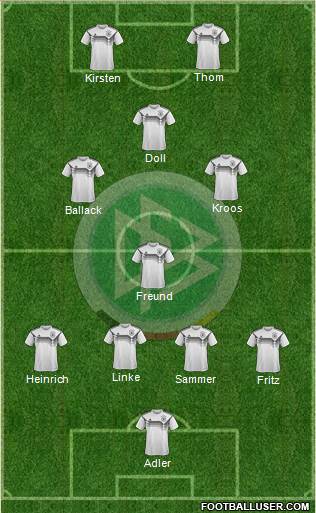
This is the all-time team for East German players after the reunification of Germany in 1990. All players are born in the formerly German Democratic Republic. If there were an All-Time World Cup, this would be the 23 players I would bring to the tournament.
Team
GK: René Adler
Adler started at age six playing for VfB Leipzig's youth side. After nine years for Leipzig, Adler joined the youth system of Bayer 04 Leverkusen in 2000. He signed a five-year contract at Bundesliga rivals Hamburger SV in 2012. He made his debut for Germany on 11 October 2008 in a World Cup qualifier against Russia. Despite having been confirmed as Germany's main team goalkeeper for the World Cup, a serious rib injury prevented him from travelling to South Africa.
 |
| Rene Alder |
Enke started his career with Carl Zeiss Jena. He most notably played for Benfica and Barcelona, but made the majority of his appearances for Bundesliga side Hannover 96 in his homeland. He won eight full international caps for the German national team between the 1999 Confederations Cup and his death in 2009, and was part of the squad which finished as runners-up in Euro 2008. He was projected to start in the 2010 World Cup Finals.
GK: Frank Rost
Rost began with Markkleeberg before joining Werder Bremen. He made his Bundesliga debut during the 1995–96 season, He helped Bremen win the 1998–99 DFB-Pokal. He was also the second goalkeeper in Bundesliga to score from open play. He also had a successful careers with Schalke 04 and Hamburger SV. He was capped 4 times for Germany between 2002 and 2003. he previously represented East Germany at the Under-16 level.
RB: Clemens Fritz
Having begun his career at Rot-Weiß Erfurt and Karlsruher SC, he joined Bayer Leverkusen in 2003. In 2006 he moved to Werder Bremen, winning the DFB-Pokal and helping them to the UEFA Cup final in 2009. In a two-year international career for Germany starting in 2006, he earned 22 caps and scored two goals. He was part of their team which finished as runners-up at UEFA Euro 2008.
CB/RB: René Schneider
René Schneider played mostly for Hansa Rostock and Borussia Dortmund. During his time at Dortmund he gained a Champions League medal in 1997, making one appearance en route to the final. He played for Germany national football team and was a participant at the 1996 UEFA European Championship.
CB: Thomas Linke
Thomas Linke was remembered as a hard-nosed tackler with tremendous heading ability. He started his career in East Germany. He played in 13 Bundesliga seasons in representation of Schalke 04 and Bayern Munich, totaling 340 games. Having gained his first cap for Germany in his late 20's, Linke went on to represent the nation in the World Cup in 2002 and one European Championship in 2000. He had 43 caps from 1997 and 2004.
CB: Robert Huth
Huth was signed for Chelsea from the youth system of German club 1. FC Union Berlin in 2001. He spent 4 years with Chelsea. He joined Middlesbrough in August 2006 for a fee of £6 million. He spent three years at the Riverside. In 2009, Huth signed for Stoke City for a then-club record fee of £5 million. He joined Leicester on loan in January 2015, helping them to win the Premier League title in 2016. He was capped 19 times between 2004 and 2009.
CB: Marko Rehmer
Rehmer played for hometown 1. FC Union Berlin: he arrived in the first division at almost 25, joining former East Germany's F.C. Hansa Rostock during the 1997 winter transfer window. For the following six years, Rehmer played with another club from his city, Hertha BSC; being an important defensive unit as the side always made the UEFA Cup in the first four seasons. Between 1998 and 2003, he was capped 35 times for Germany.
SW: Matthias Sammer
With Borussia Dortmund as a player, Sammer won the Bundesliga and DFL-Supercup in 1995, the Bundesliga, DFL-Supercup, and European Footballer of the Year in 1996, and the UEFA Champions League and Intercontinental Cup in 1997. He also played for Inter Milan and Dynamo Dresden. With Germany as a player, Sammer won the UEFA Euro 1996, where he was named the tournament's best player, and was subsequently awarded the Ballon d'Or later that year. Sammer retired with 74 total caps, 23 for East Germany and 51 for the unified side.
LB: Marcel Schmelzer
Marcel Schmelzer started his professional career with Borussia Dortmund, making his first appearance on 9 August 2008. He became their their captain in 2016. He was named on Kickers' Team of the Year for the 2010-2011 season. He retired in 2022 after 17 years with the club. From 2010 to 2014, he was capped 18 times by Germany. He was a member of Germany's European Championship team in 2012.
LB/CB/LM: Jörg Heinrich
Heinrich joined amateur side Kickers Emden in 1990. In 1994, he left Kickers Emden for Bundesliga side SC Freiburg. In 1997, he also won the Champions League with Borussia Dortmund, playing all 90 minutes in their 3–1 victory over Juventus in the Final. In 1998, Heinrich moved to ACF Fiorentina before returning to Borussia Dortmund in 2000. He was capped 37 times. He started at the WC Finals in France.
DM: Steffen Freund
Steffen Freund started his career at Stahl Brandenburg in East Germany. In 1991 he was transferred to FC Schalke 04. Schalke sold him to Borussia Dortmund in 1993 where he stayed until 1998. During his time at Dortmund, he gained a Champions League medal in 1997. After this he transferred to Tottenham Hotspur where he stayed until 2003. He won UEFA Euro 1996 with Germany and also competed in the FIFA World Cup 1998.
Formation
RB: Clemens Fritz
Having begun his career at Rot-Weiß Erfurt and Karlsruher SC, he joined Bayer Leverkusen in 2003. In 2006 he moved to Werder Bremen, winning the DFB-Pokal and helping them to the UEFA Cup final in 2009. In a two-year international career for Germany starting in 2006, he earned 22 caps and scored two goals. He was part of their team which finished as runners-up at UEFA Euro 2008.
CB/RB: René Schneider
René Schneider played mostly for Hansa Rostock and Borussia Dortmund. During his time at Dortmund he gained a Champions League medal in 1997, making one appearance en route to the final. He played for Germany national football team and was a participant at the 1996 UEFA European Championship.
CB: Thomas Linke
Thomas Linke was remembered as a hard-nosed tackler with tremendous heading ability. He started his career in East Germany. He played in 13 Bundesliga seasons in representation of Schalke 04 and Bayern Munich, totaling 340 games. Having gained his first cap for Germany in his late 20's, Linke went on to represent the nation in the World Cup in 2002 and one European Championship in 2000. He had 43 caps from 1997 and 2004.
 |
| Thomas Linke |
Huth was signed for Chelsea from the youth system of German club 1. FC Union Berlin in 2001. He spent 4 years with Chelsea. He joined Middlesbrough in August 2006 for a fee of £6 million. He spent three years at the Riverside. In 2009, Huth signed for Stoke City for a then-club record fee of £5 million. He joined Leicester on loan in January 2015, helping them to win the Premier League title in 2016. He was capped 19 times between 2004 and 2009.
CB: Marko Rehmer
Rehmer played for hometown 1. FC Union Berlin: he arrived in the first division at almost 25, joining former East Germany's F.C. Hansa Rostock during the 1997 winter transfer window. For the following six years, Rehmer played with another club from his city, Hertha BSC; being an important defensive unit as the side always made the UEFA Cup in the first four seasons. Between 1998 and 2003, he was capped 35 times for Germany.
SW: Matthias Sammer
With Borussia Dortmund as a player, Sammer won the Bundesliga and DFL-Supercup in 1995, the Bundesliga, DFL-Supercup, and European Footballer of the Year in 1996, and the UEFA Champions League and Intercontinental Cup in 1997. He also played for Inter Milan and Dynamo Dresden. With Germany as a player, Sammer won the UEFA Euro 1996, where he was named the tournament's best player, and was subsequently awarded the Ballon d'Or later that year. Sammer retired with 74 total caps, 23 for East Germany and 51 for the unified side.
 |
| Matthias Sammer |
Marcel Schmelzer started his professional career with Borussia Dortmund, making his first appearance on 9 August 2008. He became their their captain in 2016. He was named on Kickers' Team of the Year for the 2010-2011 season. He retired in 2022 after 17 years with the club. From 2010 to 2014, he was capped 18 times by Germany. He was a member of Germany's European Championship team in 2012.
LB/CB/LM: Jörg Heinrich
Heinrich joined amateur side Kickers Emden in 1990. In 1994, he left Kickers Emden for Bundesliga side SC Freiburg. In 1997, he also won the Champions League with Borussia Dortmund, playing all 90 minutes in their 3–1 victory over Juventus in the Final. In 1998, Heinrich moved to ACF Fiorentina before returning to Borussia Dortmund in 2000. He was capped 37 times. He started at the WC Finals in France.
DM: Steffen Freund
Steffen Freund started his career at Stahl Brandenburg in East Germany. In 1991 he was transferred to FC Schalke 04. Schalke sold him to Borussia Dortmund in 1993 where he stayed until 1998. During his time at Dortmund, he gained a Champions League medal in 1997. After this he transferred to Tottenham Hotspur where he stayed until 2003. He won UEFA Euro 1996 with Germany and also competed in the FIFA World Cup 1998.
 |
| Steffen Freund |
CM/DM: Jens Jeremies
Best known for his tackling abilities, Jeremies played for three clubs during his professional career, most notably Bayern Munich which he helped to win 16 titles, 12 as an important unit, in a career also marred by many injuries. Jeremies won 55 caps for Germany, representing the nation in two World Cups and as many European Championships and helping it finish second in the 2002 World Cup.
DM: Tim Borowski
Tim Borowski spent 11 years of his 12-year professional career with Werder Bremen, amassing Bundesliga totals of 236 games and 32 goals and winning three major titles, including the 2004 national championship. He played a single season in Bayern Munich. Borowski played 33 times for the German national team between 2002 and 2008. He represented the country at the 2006 World Cup and Euro 2008.
CM: Toni Kroos
Toni Kroos became a member of Bayern Munich's first team at the age of 17, Kroos played a loan spell at Bayer Leverkusen, before going back to Munich and winning back-to-back Bundesliga titles and the 2012–13 Champions League. After winning the World Cup in 2014, he joined Real Madrid . In Madrid, he won the two UEFA Champions League. He was a key player for Germany since 2010. He won the World Cup in 2014 as one of Germany's star players.
AM/CM/RM: Bernd Schneider
Nicknamed Schnix by fans and teammates, Schneider started out at his hometown club Carl Zeiss Jena and made a name for himself during his decade-long stint at Bayer Leverkusen. He earned the nickname "The White Brazilian" for his dribbling and passing skills as well as his accurate free kicks and corners. He was capped 81 times between 1999 and 2006. He was a key player at the World Cup Finals in 2002 and 2006.
CM: Michael Ballack
Born in East Germany, Michael Ballack was the best German player of his generation. first made his name with Bayer Leverkusen, helping them to the Final of the Champions' League in 2002. On the same summer, he helped Germany reaching the Final of Japan/Korea 2002, but missing the Final game himself. He moved to Bayern Munich after the World Cup Finals. He also played for Chelsea before his retirement. He had 98 caps between 1999 and 2010.
AM: Thomas Doll
Doll began his career with local side BSG Lokomotiv Malchin, before joining East German first-division DDR-Oberliga side Hansa Rostock. In 1986 he was transferred to Berliner FC Dynamo, where he won two East Germany titles (in 1987 in 1988). After reunification Doll was one of the most sought-after players of coming out of the former East Germany. He played as an attacking midfielder for Hamburger SV, Lazio, Eintracht Frankfurt and Bari. He played for both East Germany and Germany. He went to Euro 1992 for Germany.
LW: Jorg Bohme
As a professional he has played for FC Carl Zeiss Jena, 1. FC Nürnberg, Eintracht Frankfurt, 1860 München, Arminia Bielefeld, FC Schalke 04 and Borussia Mönchengladbach. On club level he won two German Cup trophies with FC Schalke 04. He was capped 10 times and participated in the 2002 FIFA World Cup, where Germany finished as runners-up.
FW: Andreas Thom
In his career, Thom played as a forward for Dynamo Berlin, Bayer Leverkusen, Celtic and Hertha Berlin. He was the first East German to join a Bundesliga club in 1990. He was also one of the first East German players to play for the unified Germany. He played 51 times for East Germany throughout the 1980s and played 10 more times for the unified German national team in the early 1990s. He went to European Championship in 1992.
ST: Carsten Jancker
Jancker played between 1993 and 2009 for various teams including FC Köln, Rapid Wien, FC Bayern Munich, Udinese Calcio, FC Kaiserslautern, Shanghai Shenhua F.C., and SV Mattersburg. Jancker's time at Bayern between 1996 and 2002 was the best period of his career, a spell which included four Bundesliga titles and victory in the 2001 UEFA Champions League. He was capped 33 times for Germany.
-- Both Mattias Sammer and Ulf Kirsten went to the 1994 World Cup Finals in the United States. Sammer was a starter, but he did not play against the ill-fated match against Bulgaria. Kirsten had a bench role. -- The European Championship of 1996 was Germany' first international title after the reunification. Matthias Sammer was an important player as he was named the Player of the Tournament. He would win the Ballon d'Or that year. Steffen Freund played in four of the matches while. René Schneider was an unused sub.
-- Rene Adler briefly assumed the role of the starting goalkeeper in 2010 but missed the World Cup Finals due to an injury, allowing Manuel Neuer to step in and shine in South Africa, ultimately becoming one of Germany's greatets ever goalkeeper. Nevertheless, from 2008 to 2010, both Enke and Adler were preferred over Neuer.
-- Zickler was well-decorated because of Bayern Munich. However, his career was marred by recurring injuries, leading him to predominantly serve as a backup player for Jancker and Elber during his time in Munich. Despite this, he made 12 appearances for the German national team between 1998 and 2002. Olaf Marschall only made one more appearance for the national team than Zickler, but he was named on the 1997–98 Kickers' Bundesliga Team of the Season after he helped FC Kaiserslautern winning the Bundesliga title that year. He was the league's second highest scorer after Ulf Kirsten. I considered him an important player in the history of Kaiserslautern. So, I decided to take him over Zickler. In fact, Marschall should be ahead of Thom.
Best known for his tackling abilities, Jeremies played for three clubs during his professional career, most notably Bayern Munich which he helped to win 16 titles, 12 as an important unit, in a career also marred by many injuries. Jeremies won 55 caps for Germany, representing the nation in two World Cups and as many European Championships and helping it finish second in the 2002 World Cup.
DM: Tim Borowski
Tim Borowski spent 11 years of his 12-year professional career with Werder Bremen, amassing Bundesliga totals of 236 games and 32 goals and winning three major titles, including the 2004 national championship. He played a single season in Bayern Munich. Borowski played 33 times for the German national team between 2002 and 2008. He represented the country at the 2006 World Cup and Euro 2008.
CM: Toni Kroos
Toni Kroos became a member of Bayern Munich's first team at the age of 17, Kroos played a loan spell at Bayer Leverkusen, before going back to Munich and winning back-to-back Bundesliga titles and the 2012–13 Champions League. After winning the World Cup in 2014, he joined Real Madrid . In Madrid, he won the two UEFA Champions League. He was a key player for Germany since 2010. He won the World Cup in 2014 as one of Germany's star players.
 |
| Toni Kroos |
Nicknamed Schnix by fans and teammates, Schneider started out at his hometown club Carl Zeiss Jena and made a name for himself during his decade-long stint at Bayer Leverkusen. He earned the nickname "The White Brazilian" for his dribbling and passing skills as well as his accurate free kicks and corners. He was capped 81 times between 1999 and 2006. He was a key player at the World Cup Finals in 2002 and 2006.
CM: Michael Ballack
Born in East Germany, Michael Ballack was the best German player of his generation. first made his name with Bayer Leverkusen, helping them to the Final of the Champions' League in 2002. On the same summer, he helped Germany reaching the Final of Japan/Korea 2002, but missing the Final game himself. He moved to Bayern Munich after the World Cup Finals. He also played for Chelsea before his retirement. He had 98 caps between 1999 and 2010.
 |
| Michael Ballack |
Doll began his career with local side BSG Lokomotiv Malchin, before joining East German first-division DDR-Oberliga side Hansa Rostock. In 1986 he was transferred to Berliner FC Dynamo, where he won two East Germany titles (in 1987 in 1988). After reunification Doll was one of the most sought-after players of coming out of the former East Germany. He played as an attacking midfielder for Hamburger SV, Lazio, Eintracht Frankfurt and Bari. He played for both East Germany and Germany. He went to Euro 1992 for Germany.
LW: Jorg Bohme
As a professional he has played for FC Carl Zeiss Jena, 1. FC Nürnberg, Eintracht Frankfurt, 1860 München, Arminia Bielefeld, FC Schalke 04 and Borussia Mönchengladbach. On club level he won two German Cup trophies with FC Schalke 04. He was capped 10 times and participated in the 2002 FIFA World Cup, where Germany finished as runners-up.
FW: Andreas Thom
In his career, Thom played as a forward for Dynamo Berlin, Bayer Leverkusen, Celtic and Hertha Berlin. He was the first East German to join a Bundesliga club in 1990. He was also one of the first East German players to play for the unified Germany. He played 51 times for East Germany throughout the 1980s and played 10 more times for the unified German national team in the early 1990s. He went to European Championship in 1992.
 |
| Andreas Thom |
Jancker played between 1993 and 2009 for various teams including FC Köln, Rapid Wien, FC Bayern Munich, Udinese Calcio, FC Kaiserslautern, Shanghai Shenhua F.C., and SV Mattersburg. Jancker's time at Bayern between 1996 and 2002 was the best period of his career, a spell which included four Bundesliga titles and victory in the 2001 UEFA Champions League. He was capped 33 times for Germany.
ST: Olaf Marschall
Olaf Marschall was a star player in East Germany before the reunification. He joined Austrian outfit SCN Admira/Wacker. He joined Dynamo Dresden to help the East German outfit escape relegation from the German Bundesliga in 1993–94. In 1994, he joined 1. FC Kaiserslautern and established himself as one of the elite scorers in the Bundesliga. He won the DFB-Pokal in 1996 and in 1998 the Bundesliga title. He earned caps for both East Germany and Germany.
ST: Ulf Kirsten
Kirsten started with Dynamo Dresden in 1983. He was one of the first East German footballers to enter the Bundesliga after the German reunification. In the German Bundesliga he played 350 matches for Bayer Leverkusen and scored 182 goals. He was Bundesliga top scorer 3 times. Kirsten's 100 caps are almost evenly split: 49 for East Germany and 51 for the re-unified Germany. Kirsten played for his country at the 1994 and 1998 World Cups and Euro 2000.
Honorable Mention
Frank Rost, Perry Bräutigam, Ronny Teuber, Dirk Heyne, Dirk Stahmann, Dirk Schuster, Heiko Scholz, Frank Rohde, Heiko Peschke, Stefan Beinlich, Rico Steinmann, Norbert Nachtweih, Ralf Hauptmann, Sven Kmetsch, Alexander Zickler, Nils Petersen, Olaf Marschall, Uwe Rosler, Rainer Ernst, Tobias Werner, Heiko Scholz. Axel Kruse, Uwe Rösler.
Olaf Marschall was a star player in East Germany before the reunification. He joined Austrian outfit SCN Admira/Wacker. He joined Dynamo Dresden to help the East German outfit escape relegation from the German Bundesliga in 1993–94. In 1994, he joined 1. FC Kaiserslautern and established himself as one of the elite scorers in the Bundesliga. He won the DFB-Pokal in 1996 and in 1998 the Bundesliga title. He earned caps for both East Germany and Germany.
ST: Ulf Kirsten
Kirsten started with Dynamo Dresden in 1983. He was one of the first East German footballers to enter the Bundesliga after the German reunification. In the German Bundesliga he played 350 matches for Bayer Leverkusen and scored 182 goals. He was Bundesliga top scorer 3 times. Kirsten's 100 caps are almost evenly split: 49 for East Germany and 51 for the re-unified Germany. Kirsten played for his country at the 1994 and 1998 World Cups and Euro 2000.
 |
| Ulf Kirsten |
Honorable Mention
Frank Rost, Perry Bräutigam, Ronny Teuber, Dirk Heyne, Dirk Stahmann, Dirk Schuster, Heiko Scholz, Frank Rohde, Heiko Peschke, Stefan Beinlich, Rico Steinmann, Norbert Nachtweih, Ralf Hauptmann, Sven Kmetsch, Alexander Zickler, Nils Petersen, Olaf Marschall, Uwe Rosler, Rainer Ernst, Tobias Werner, Heiko Scholz. Axel Kruse, Uwe Rösler.
Squad Explanation
-- This team was created on January 24, 2016. I updated the format of the team on January 22nd, 2025.
-- This team was created on January 24, 2016. I updated the format of the team on January 22nd, 2025.
-- All players were born or came from East Germany still under GDR. In total, 38 players from the former GDR or the subsequent new federal states have played for the reunified Germany. Nils Petersen is probably the last player born in GDR to earn his first senior cap, which occurred in 2018.
-- At the World Youth Championship in 1987, East Germany narrowly lost to the talented Yugoslavia in the quarterfinal and finished 3rd. Matthias Sammer was the star of the team. I believe East Germany might have their Golden era from 1996 to 2006. They almost qualified for Italia 1990 with Matthias Sammer, Ulf Kirsten and Andreas Thom. They only needed a draw against Austria on the last match of the World Cup Qualifiers. If they qualified for the 1990 World Cup Finals, East Germany would have been one of the best ever East German team. The trio later contributed a lot to the German national team after the reunification in 1990. Thomas Doll also played that match as a sub against Austria. Dariusz Wosz and Olaf Marschall had been capped by GDR.
-- Germany finished second in the 1992 European Championship held in Sweden. It was the unified Germany's first major tournament. Matthias Sammer, Thomas Doll and Andreas Thom were on that team.
 |
| Thomas Doll |
-- In 1998, Olaf Marschall and Jens Jeremies went to the World Cup Finals in France. East Germany could also select Carsten Jancker, Thomas Linke, Bernd Schneider, Jens Jeremies, Steffen Freund and Ulf Kiirsten. Matthias Sammer suffered an injuryb that sidelined him for the most of the 1997-1998 season. He would retire because of this. Thomas Doll, Andreas Thom and Dariusz Wosz were old, but they would probably make it to the World Cup Finals. Michael Ballack who was 21 years old in 1998 and just played his first Bundesliga season in 1998 might be included. East Germany might have a very good team in that World Cup Finals in France.
-- In 2002, MIchael Ballack, Carsten Jancker, Bernd Schneider, Jorge Bohme, Jens Jeremies, Thomas Linke, and Marko Rehmer went to Japan/Korea. In addition, Kirsten was a regular starter for Leverkusen that season as they finished runner-up at the Champions' League. Robert Enke was already capped by Germany and would have been the starter for the East German National Team. Tim Borowski made his NT debut a month after the World Cup Finals. He probably would have made the East German team as well. Robert Huth was an emerging player with Chelsea in 2002, but had not made his professional debut. I have also done an alternative German team at the 2002 World Cup Finals. This team included German-Turks who helped Turkey to finish 3rd in the World Cup Finals.
-- By the time of 2014 World Cup Finals, Toni Kroos remained as the only German player born inside GDR on the World Cup winning team.
Goalkeepers
-- Robert Enke began his career with Carl Zeiss Jena in East Germany before gaining recognition at Borussia Mönchengladbach. Following Jens Lehmann's retirement from international football, Enke secured the top goalkeeper position for the national team over Hans-Jorg Butt, Rene Adler and Manuel Neuer. Tragically, Enke was expected to start in the 2010 World Cup finals before his untimely death.
 |
| Robert Enke |
-- Selecting the third goalkeeper proved to be a difficult decision, with contenders including Frank Rost, Ronny Teuber, Perry Bräutigam, Dirk Heyne and Rene Muller. Bräutigam, Heyne and Muller had represented East Germany internationally and went on to play in the Bundesliga, were among the options. Frank Rost represeneted East German at the Under 16 level. Between 2002 and 2003, he earned 4 caps. The Bild ranked him as the 28th greatest footballer for Hamburger SV. I took him over Rene Muller because Muller's peak was before the reunification in 1990.
Defenders
-- Did DGR contribute to the German national team? Yes, because of just one player Mathias Sammer. He helped Germany to win the UEFA Euro 1996, where he was named the tournament's best player, and was subsequently awarded the Ballon d'Or later that year. He was probability the last great sweeper to play the game as the position no longer existed. He should also be a midfielder.
-- Thomas Linke was probably the second most famous central defender after Sammer. Robert Huth started his career full of promises while playing for Chelsea but somehow did not live up to expectation. However, he was a key player as Leicester Town won the league title. Marko Rehmer played 35 times for Germany. He went to two major tournaments.
-- Apart from these four players, I did not have any suitable candidate. Dirk Schuster was one of the few players who had played for both East Germany and Germany, but he did not have the same name recognition as Huth or Rehmer. Dirk Stahmann was 32 years old by the time of the reunification in 1990. He was one of FC Magdeburg's greatest footballers. Matthias Herget was born in 1955 in Annaberg-Buchholz, East Germany, but he grew up in West Germany. He earned 39 caps for West Germany between 1983 and 1988. So, he is ineligible for this team because he was a West German before 1990. Roman Neustädter was born in Ukraine of German ancestry. He was not from GDR.
-- I could only find two rightbacks of note. Clemens Fritz played in Euro 2008. He had 21 caps for Germany. Meanwhile, René Schneider was actually a central defender who could also play on the right. He only represented Germany once, but collected a winning medal at Euro 1996 as an unused sub. Heiko Scholz was capped once by Germany in 1992.
-- The leftback position was stronger. Marcel Schmelzer had a long career with Borussia Dortmund. He was named Bundesliga Team of the Year in the 2010-2011 season. Jörg Heinrich was a versatile player who started for Germany in the 1998 World Cup Finals. He played for some smaller clubs in East Germany before being discovered by SC Freburg in 1994.
 |
| Jörg Heinrich |
Midfielders/Wingers
-- Steffen Freund was a vital member of Germany's Euro 1996 winning squad. His illustrious career spanned successful stints at Schalke 04, Borussia Dortmund, and Tottenham Hotspur, earning him a prestigious spot in the Tottenham Hotspur Hall of Fame. Jens Jeremies rose from Dynamo Dresden to prominence at Bayern Munich, garnering recognition as part of the Kickers Team of the Year thrice and playing a pivotal role in Germany's 1998 World Cup campaign. Tim Borowski achieved all-timer status at Werder Bremen. For Germany, he was particularly noted for his impactful substitute appearance in the quarter-final against Argentina in the 2006 World Cup Finals, where he set up a crucial goal for Miroslav Klose.
-- Maximilian Arnold was born after the unification.
-- Norbert Nachtweih did not retire until 1999. However, by 1990, he had passed his prime. He was playing in Cannes at the time.
-- Dariusz Wosz was born in Poland. His family moved to East Germany, where he started his career and earned 7 caps for GDR. His international caps from GDR qualified him for this team because he was an East German international player. He was deep lying playmaker. However, I decided to drop him in 2025 because I had too many midfielders. Kroos, Sammer or even Ballack could operate in the deep position.
-- Michael Ballack was probably Germany's best player from 2000 to 2010. Without him, Germany would not reach the Final of the 2002 World Cup Finals. Toni Kroos was also considered Germany's best player at the 2014 World Cup Finals, but he was the only GDR-born German player on the national team at that point in time. He was born in January 1990. East Germany formally ceased to exist in October 1990. He is probably the last good footballer born in German Democratic Republic (East Germany) while it still existed. His brother Felix Kroos was born in unified Germany.
-- Thomas Doll joined in 1991 after just one season in the Bundesliga. While he impressed in his initial Italian campaign, subsequent years were marred by persistent injuries. Injuries plagued not only his club endeavors but also hindered his international career. He could have had a better career.
-- With Mathias Sammer's availability in the midfield, this position was the strongest on the team. The East German (GDR) midfielders of this era may have even outshone their Western counterparts between 1990 and 2018. While notable West German players like Stefan Effenberg, Mehmet Scholl, Dietmar Hamann, Bastian Schweinsteiger, Mesut Özil, and Ilkay Gündogan made their mark, the likes of Sammer, Ballack, and Kroos stood out as exceptional talents, arguably surpassing their Western counterparts.
-- Known as the "White Brazilian", Bernd Schneider was more of a playmaker than a winger, but he could be a dangerous on the right. He was a key player as Germany reached the Final of the World Cup in 2002. On the same year, he guided Bayer Leverkusen to the Champions' League Final. Thomas Doll also played on the right side of the midfield during Euro 1992. So, the right side was taken care of without a significant wide player.
 |
| Bernd Schneider |
-- On the left, I already had Jörg Heinrich who could operate as a left midfielder. And then, I selected Jorg Bohme. I took him over Dariusz Wosz because he could play on the left. He was an unused player in the 2002 World Cup Finals.
Forwards
-- Ulf Kirsten was the Bundesliga Top Scorer 3 times in his career. He earned 100 caps, 49 for East Germany and another 51 for Germany. He was probably the best GDR striker after 1990.
-- In 2016, the team only had three strikers. It also included Carsten Jancker and Andreas Thom. The team would be better if I could have one more forward. So, in 2025, I made the decision to drop midfielder Dariusz Wosz from the team due to an excess of midfielders. However, instead of introducing another forward in his place, I carefully assessed the abilities of the four remaining candidates - Carsten Jancker, Andreas Thom, Olaf Marschall, and Alexander Zickler - to determine the final three selections.
-- In 2016, I selected Andreas Thom primarily due to his distinction as the first East German to sign with a Bundesliga club, Bayer Leverkusen, back in 1990. Moreover, he was among the pioneering East German players to represent the unified Germany. In 2025, I again opted to stick with Thom due to his influential legacy among former GDR footballers post-reunification. Additionally, Thom held Celtic's transfer record upon his move to Scotland in 1995, during a period of significant investment by the Scottish club.
-- Carsten Jancker was a cult hero for his imposing stature and unique appearance. He had a well-decorated career with Bayern Munich, where he spent 6 seasons. He was capped 33 times for Germany. I do believe that he was ahead of the other three remaining players. Notably, in Munich, Jancker shared the pitch with Brazilan striker Elber while Zickler played behind them.
 |
| Carsten Jancker |
Formation