 |
| Euro 2016 Final |

Some of the unpublished posts from this blog have been turned into a two-volume book: The Multiverse of the Beautiful Game: National Teams of Pure Fantasy.
Volume 1 takes you back in time and asks the questions every football fan has dreamed about. What if Brazil had a more beautiful team in 1982 — would they have cruised to the title? What if the United Kingdom could send its team to the 1970 World Cup? I believe they would have been the strongest side on earth. What if Argentina had fielded both Omar Sivori and Alfredo Di Stéfano together in 1958? What if Johan Cruyff had lined up alongside Marco van Basten, Ruud Gullit, and Frank Rijkaard? What if Eusébio had played for Brazil? And that's only scratching the surface — Volume 1 is packed with legendary "what ifs" that will keep you turning pages.
Volume 2 brings the fantasy closer to home. What if England had Michael Olise, Erling Haaland and others in 2026 — could they go all the way? What if Yugoslavia had gone to the World Cup in 2018? What if the United States could select more players in 2010? It would be the greatest American side ever. And what if Cristiano Ronaldo and Lionel Messi had actually played for the same national team in 2006? It could have happened — if the soccer gods had smiled on us.
Please also see my All-Time World Cup Team Index.
Portugal
French Black Players
African American Players,
Black Portuguese Players
Afro-Brazilian Players
Sporting CP Academy All-Time Team
This is my selection of a 23 member all-time team for Black Portugese players. The number 23 was chosen because it is the official squad size for the World Cup Finals.
Afro-Portuguese, African-Portuguese or Black Portuguese are Portuguese citizens or residents of Portugal with total or partial ancestry from any of the Black ethnic groups of Africa. Most of those perceived as Afro-Portuguese are descent of immigrants from former Portuguese overseas provinces in Africa. Alternatively, Afro-Portuguese may also refer to populations of partial Portuguese descent living throughout Africa.
The impact of Black players on Portuguese football is great. Eusebio and Mario Coluna were leading members of Portugal's Gold Generation in the 1960's. Eder scored the winning goal at Euro 2016.
Team
GK: Nuno Espírito Santo
During his club career, Nuno first made a name for himself in Spain, playing for three teams in five years between 1997 and 2002. He later represented Porto in his country, albeit with little impact, and also played professionally in Russia. Nuno was part of the Portuguese squad at the Euro 2008, but never won a cap for the national team. He represented and played at the 1996 Summer Olympics.
RB: Jose Bosingwa
Born in Mbandaka, Zaire to a Portuguese father and a Congolese mother, Jose Bosingwa started with Boavista before joining FC Porto coached by José Mourinho for 2003–04. He played 8 matches as Porto won the Champions' League that season. In 2008, he joined Chelsea along with his national teammmate Deco. Later, he also played in Turkey. He was capped 25 times for Portugal between 2007 and 2015. He went to the Euro 2008.
RB: Miguel
Miguel played the vast majority of his professional career with Benfica (five seasons) and Valencia (seven). Miguel gained 59 caps for Portugal during the 2000s, and represented the country in two World Cups (2006 and 2010) and as many European Championships (2004 and 2008). In 2004, he was a part of the national team that finished second in Euro 2004.
CB: Vicente Lucas
Born in Mozambique while it was under Portugal, Vicente played for C.F. Os Belenenses in 13 Primeira Liga seasons, making his debut in 1954 and winning the Portuguese Cup six years later. He gained 20 caps for Portugal, his debut coming on 3 June 1959 in a 1–0 win against Scotland. He was a member of the 1966 World Cup squad.
CB: Bruno Alves
Bruno Alves spent most of his professional career at Porto, winning a total of nine titles, seven as first-choice, and appearing in 171 official games. He also won trophies in Russia with Zenit St. Petersburg, and in Turkey with Fenerbahçe. A Portuguese international since 2007, Alves represented the country in two World Cups and three European Championships, winning the 2016 edition of the latter tournament.
LB: Hilario
Hilario was first noticed at Sporting de Lourenço Marques in Portuguese Mozambique along with teammate Eusébio. He joined Sporting CP in 1958 while Eusebio went to Benfica. He played his entire professional career with Sporting CP, appearing in nearly 450 official games and winning seven major trophies. He was the starting leftback of Portugal in 1960's. He went to the 1966 World Cup finals in England.
DM: Costinha
Costinha played in the lower division in Portugal before getting discovered by Monaco. In 2001, he joined FC Porto, where he was a part of the team that won the Champions league in 2003. He also played in Russia, Italy and Spain. Capped over 50 times. He played at both Euro 2004 and 2000, and the 2006 FIFA World Cup. D uring the latter, on 25 June, he took part in the Battle of Nuremberg, being one of four players sent off against the Netherlands after two bookable offenses.
DM: William Carvalho
Born in Luanda, Angola, Carvalho moved to Portugal when he was just a few years old. At the time of writing, except two loan spells, he has mainly played for Sporting SP. Carvalho first grained international recognition when he was named player of the tournament at the 2015 European Under-21 Championship. At Euro 2016, he established as a starter of the national team. He was also a member of Portugal's team at the 2014 and 2018 WC Finals.
DM: Oceano
Born in Cape Verde, he was probably the greatest player from there. Oceano's family emigrated to Portugal when he was a child. He started his career at Almada A.C. in the lower leagues and after spells in the second division with Odivelas F.C. and C.D. Nacional, he signed with Sporting Clube de Portugal for the 1984–85 season. He appeared in over 400 matches for two spells. In between, he played for Real Sociedad and Toulouse. He earned 54 caps and was a top player in the early 1990's. He went to Euro 1996.
CM: Mario Coluna
ST: Eusebio
Along with Pele, he was considered to be the best player in the world during the 1960's. He helped Portugal reach third place at the 1966 World Cup, being the top goalscorer of the tournament with nine goals (including four in one match against North Korea) and received the Bronze Ball award. He won the Ballon d'Or award for European footballer of the year in 1965 and was runner-up in 1962 and 1966. He played for Benfica 15 out of his 22 years as a footballer. He won the European Cup in 1961.
Honorable Mention
José Luís Vidigal, Rolando, Nelson Marcos, Jorge Cadete, Nélson Semedo, Silvestre Varela, José Maria Júnior, Bruma, João Mário, Nuno Mendes, Ariza Makukula, Rafael Leão, Manuel Fernandes, Eliseu, Gelson Martins, Shéu, Renato Sanches, Abel Xavier, Danilo Pereira.
-- In 2023, I decided to add leftback Eliseu. With Pepe rejoining the team at the same time, I need to rework the defense. To make things easier to understand, I simply need a 4th central defender. Bruno Alves, Rolando and Abel Xavier were at one point on the team. Danilo Pereira has been playing for PSG for his third season. He already has over 60 caps. He may be ready to replace Rolando or Abel Xavier. And I also considered Hélder, but his career and also that of Rolando did not stand out. Abel Xavier only played 20 times for Portugal, but he stood out in the Euro 2000 where Portugal reached the semifinal. In the semifinal, however, his hand ball led to a penalty that eliminated them from the tournament. His hairstyle probably made him a more famous player than he actually was. He only played 14 games in Liverpool, and could not really hold his places with AS Roma, Everton, Hanover, etc. So it would be between Danilo Pereira and Bruno Alves for the last back.
-- William Carvalho also played a part in that Euro 2016 victory, but when I first created the blog, he only made honourable mention. In 2017, I decided to select him to the squad. I dropped José Luís Vidigal who spent his career playing in Italy.
-- Eder rarely scored so he was not expected to be selected, but he scored the most important goal on Portugal's history. That put him in a special place in Portugal's football history.
-- I am including naturalised Brazilians Liedson. The criteria is about Portuguese citizenship and race. He led Sporting SP the Final of the 2005 UEFA Cup. He scored over 100 goals for them.
-- Matateu scored 219 goals in 291 games, but somehow I did not select him in 2016. Seriously, how did it happen? In 2023, I added him to the team.
Formation
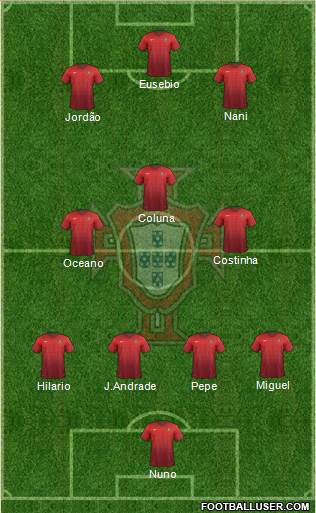
Portugal
French Black Players
African American Players,
Black Portuguese Players
Afro-Brazilian Players
Sporting CP Academy All-Time Team
This is my selection of a 23 member all-time team for Black Portugese players. The number 23 was chosen because it is the official squad size for the World Cup Finals.
Afro-Portuguese, African-Portuguese or Black Portuguese are Portuguese citizens or residents of Portugal with total or partial ancestry from any of the Black ethnic groups of Africa. Most of those perceived as Afro-Portuguese are descent of immigrants from former Portuguese overseas provinces in Africa. Alternatively, Afro-Portuguese may also refer to populations of partial Portuguese descent living throughout Africa.
The impact of Black players on Portuguese football is great. Eusebio and Mario Coluna were leading members of Portugal's Gold Generation in the 1960's. Eder scored the winning goal at Euro 2016.
 |
| Jorge Andrade and Costinha |
Team
GK: Nuno Espírito Santo
During his club career, Nuno first made a name for himself in Spain, playing for three teams in five years between 1997 and 2002. He later represented Porto in his country, albeit with little impact, and also played professionally in Russia. Nuno was part of the Portuguese squad at the Euro 2008, but never won a cap for the national team. He represented and played at the 1996 Summer Olympics.
GK: Neno
Born in Cape Verde, Neno played with F.C. Barreirense and Vitória S.C. before making a name with Victoria Guimarães, where he played three spells. Between 1990 and 1995, he played with Benfica, where he was a starter for at least two seasons. Between 1989 and 1996, he was capped 9 times by Portugal. His first match was against Brazil in 1989. He lost his spot in the Euro 1996 team to Nuno.
GK: Bruno Varela
Born in Lisbon and of Cape Verdean descent, Bruno Varela came from Benfica's academy, but he started his career their B team. He made his name with Vitória Setúbal before returning to Benfica in 2017. He played briefly on loan to Ajax. He is now with Vitória Guimarães. In 2017, he received his first senior call-up, but did not earn any cap. At the time of writing, he had several call-ups, but yet to have played.
RB: Jose Bosingwa
Born in Mbandaka, Zaire to a Portuguese father and a Congolese mother, Jose Bosingwa started with Boavista before joining FC Porto coached by José Mourinho for 2003–04. He played 8 matches as Porto won the Champions' League that season. In 2008, he joined Chelsea along with his national teammmate Deco. Later, he also played in Turkey. He was capped 25 times for Portugal between 2007 and 2015. He went to the Euro 2008.
 |
| Jose Bosingwa |
Miguel played the vast majority of his professional career with Benfica (five seasons) and Valencia (seven). Miguel gained 59 caps for Portugal during the 2000s, and represented the country in two World Cups (2006 and 2010) and as many European Championships (2004 and 2008). In 2004, he was a part of the national team that finished second in Euro 2004.
CB: Vicente Lucas
Born in Mozambique while it was under Portugal, Vicente played for C.F. Os Belenenses in 13 Primeira Liga seasons, making his debut in 1954 and winning the Portuguese Cup six years later. He gained 20 caps for Portugal, his debut coming on 3 June 1959 in a 1–0 win against Scotland. He was a member of the 1966 World Cup squad.
CB: Bruno Alves
Bruno Alves spent most of his professional career at Porto, winning a total of nine titles, seven as first-choice, and appearing in 171 official games. He also won trophies in Russia with Zenit St. Petersburg, and in Turkey with Fenerbahçe. A Portuguese international since 2007, Alves represented the country in two World Cups and three European Championships, winning the 2016 edition of the latter tournament.
CB: Jorge Andrade
Jorge Andrade started with Estrela da Amadora and was bought by Porto FC in 2000. After Japan/Korea 2002, he joined Deportivo La Coruna, where he had a great career. In 2007, he joined Juventus, but this spell was very unsuccessful due to injuries. He was capped 51 times by Portugal and went to the World Cup Finals in 2002 and the European Championship in 2004. In 2004, Portugal finished second while playing at home.
Jorge Andrade started with Estrela da Amadora and was bought by Porto FC in 2000. After Japan/Korea 2002, he joined Deportivo La Coruna, where he had a great career. In 2007, he joined Juventus, but this spell was very unsuccessful due to injuries. He was capped 51 times by Portugal and went to the World Cup Finals in 2002 and the European Championship in 2004. In 2004, Portugal finished second while playing at home.
CB: Pepe
Pepe moved to Portugal playing for Maritimo. In 2004, he moved to Porto while he established himself as one of the best defender in Portugal. In 2007, he earned a dream move to Real Madrid. He won two Champions' league with them. Although born in Brazil, he chose to represent Portugal. At Euro 2016, he emerged as one of Portugal's best player as Portugal won their first ever international trophy. He earned the Man of the Match in the Final against France.
Pepe moved to Portugal playing for Maritimo. In 2004, he moved to Porto while he established himself as one of the best defender in Portugal. In 2007, he earned a dream move to Real Madrid. He won two Champions' league with them. Although born in Brazil, he chose to represent Portugal. At Euro 2016, he emerged as one of Portugal's best player as Portugal won their first ever international trophy. He earned the Man of the Match in the Final against France.
 |
| Pepe |
LB: Hilario
Hilario was first noticed at Sporting de Lourenço Marques in Portuguese Mozambique along with teammate Eusébio. He joined Sporting CP in 1958 while Eusebio went to Benfica. He played his entire professional career with Sporting CP, appearing in nearly 450 official games and winning seven major trophies. He was the starting leftback of Portugal in 1960's. He went to the 1966 World Cup finals in England.
LB: Eliseu
After starting out at Belenenses, he went on to spend most of his career with Málaga after signing in 2007, appearing in 224 official games and scoring 27 goals in two separate spells. In 2014 he signed with Benfica, with whom he won three consecutive Primeira Liga titles among other major trophies over four seasons. A full international since 2009, Eliseu was part of the Portugal national squad that won Euro 2016. He had 29 caps.
DM: Costinha
Costinha played in the lower division in Portugal before getting discovered by Monaco. In 2001, he joined FC Porto, where he was a part of the team that won the Champions league in 2003. He also played in Russia, Italy and Spain. Capped over 50 times. He played at both Euro 2004 and 2000, and the 2006 FIFA World Cup. D uring the latter, on 25 June, he took part in the Battle of Nuremberg, being one of four players sent off against the Netherlands after two bookable offenses.
 |
| Costinha |
Born in Luanda, Angola, Carvalho moved to Portugal when he was just a few years old. At the time of writing, except two loan spells, he has mainly played for Sporting SP. Carvalho first grained international recognition when he was named player of the tournament at the 2015 European Under-21 Championship. At Euro 2016, he established as a starter of the national team. He was also a member of Portugal's team at the 2014 and 2018 WC Finals.
DM: Oceano
Born in Cape Verde, he was probably the greatest player from there. Oceano's family emigrated to Portugal when he was a child. He started his career at Almada A.C. in the lower leagues and after spells in the second division with Odivelas F.C. and C.D. Nacional, he signed with Sporting Clube de Portugal for the 1984–85 season. He appeared in over 400 matches for two spells. In between, he played for Real Sociedad and Toulouse. He earned 54 caps and was a top player in the early 1990's. He went to Euro 1996.
CM: Mario Coluna
Mario Coluna is one of the greatest player ever for both Portugal and Benfica. He spent most of his career with Benfica, appearing in 525 official games and scoring 127 goals during 16 professional seasons. Dubbed Monstro Sagrado (Sacred Monster), he won 19 major titles with his main club, including ten national leagues. He won two European Cup with Benfica in 1961 and 1962. He was the captain of Portugal in the 1966 World Cup. He was known to be Eusebio's friend and his top assister on the field.
RW: Espirto Santo
Born in Lisbon, of São Toméan descent, Espirto Santo became the first Black player to represent Portugal. Between 1937 to 1954, he played 7 times for Portugal. As for his club career, he spent his entire career playing for Benfica. Nicknamed The Black Pearl, he was a prolific goalscorer, with Peyroteo even claiming he was a more complete footballer than him.
LW/AM: Luís Boa Morte
Having come through the youth ranks with Sporting Clube de Portugal, Boa Morte received his first big break by joining Premier League side Arsenal in 1997. He also went on to play for Southampton, Fulham and West Ham United. He joined Greek side Larissa before moving on to South African side Orlando Pirates. In October 2012 he returned to England and joined fourth-tier side Chesterfield. Boa Morte earned 28 caps for Portugal and was selected for the 2004 Olympics and the 2006 FIFA World Cup.
RW: Nani
Nani came through the ranks of Sporting CP. In 2007, he joined Manchester United, where his career was up and down. He was a part of the team that won the Champions' League in 2009. He earned over a 110 caps for Portugal. He is a regular member of the national team from 2006 onward. He contributed to Portugal's winning Euro 2016 as one of their key players. He also particoipated at the 2014 World Cup Finals in Brazil.
FW: Liedson
Liedson moved to Sporting CP in 2003 after playing for Corinthians and Flamengo without successes. From 2003 to 2011, he scored 173 goals for them, becoming one of the club's greatest players. He helped them to reach the UEFA Cup Final in 2005. With Corinthians, he won the Copa Libertadores in 2012. Although he is a Brazilian by birth, he chose to play for Portugal. He was first capped by Portugal in 2009 and went to play at the World Cup in 2010. He had 15 caps in total.
ST: Eder
Born in Bissau, Guinea-Bissau, Eder made his Primeira Liga debut for Académica on 24 August 2008. He also played for Braga, Swansea, Lille and Lokomotiv Moscow. At time of the writing, he has 32 caps, but unfortunately, known for his low scoring rate. However, he scored the only goal against France at the Final of Euro 2016 that gave Portugal its first ever major international trophy. He was also on the 2014 World Cup team.
ST: Rui Jordão
Rui Jordão played for Benfica, Sporting CP, Racing Zaragoza and Vitoria SC. With Sporting CP, he was the league's top scorer twice and was Portuguese Player of the Year in 1980. He had 37 caps in total. He was probably best remembered for scoring twice against France at the semifinal of Euro 1984 in one of the most famous game of the tournament.
 |
| Captain of Portugal in 1966 |
Born in Lisbon, of São Toméan descent, Espirto Santo became the first Black player to represent Portugal. Between 1937 to 1954, he played 7 times for Portugal. As for his club career, he spent his entire career playing for Benfica. Nicknamed The Black Pearl, he was a prolific goalscorer, with Peyroteo even claiming he was a more complete footballer than him.
LW/AM: Luís Boa Morte
Having come through the youth ranks with Sporting Clube de Portugal, Boa Morte received his first big break by joining Premier League side Arsenal in 1997. He also went on to play for Southampton, Fulham and West Ham United. He joined Greek side Larissa before moving on to South African side Orlando Pirates. In October 2012 he returned to England and joined fourth-tier side Chesterfield. Boa Morte earned 28 caps for Portugal and was selected for the 2004 Olympics and the 2006 FIFA World Cup.
RW: Nani
Nani came through the ranks of Sporting CP. In 2007, he joined Manchester United, where his career was up and down. He was a part of the team that won the Champions' League in 2009. He earned over a 110 caps for Portugal. He is a regular member of the national team from 2006 onward. He contributed to Portugal's winning Euro 2016 as one of their key players. He also particoipated at the 2014 World Cup Finals in Brazil.
 |
| Nani |
Liedson moved to Sporting CP in 2003 after playing for Corinthians and Flamengo without successes. From 2003 to 2011, he scored 173 goals for them, becoming one of the club's greatest players. He helped them to reach the UEFA Cup Final in 2005. With Corinthians, he won the Copa Libertadores in 2012. Although he is a Brazilian by birth, he chose to play for Portugal. He was first capped by Portugal in 2009 and went to play at the World Cup in 2010. He had 15 caps in total.
Born in Bissau, Guinea-Bissau, Eder made his Primeira Liga debut for Académica on 24 August 2008. He also played for Braga, Swansea, Lille and Lokomotiv Moscow. At time of the writing, he has 32 caps, but unfortunately, known for his low scoring rate. However, he scored the only goal against France at the Final of Euro 2016 that gave Portugal its first ever major international trophy. He was also on the 2014 World Cup team.
 |
| Eder scoring against France |
Rui Jordão played for Benfica, Sporting CP, Racing Zaragoza and Vitoria SC. With Sporting CP, he was the league's top scorer twice and was Portuguese Player of the Year in 1980. He had 37 caps in total. He was probably best remembered for scoring twice against France at the semifinal of Euro 1984 in one of the most famous game of the tournament.
ST: Matateu
His professional career, which spanned more than 20 years, was closely associated to Belenenses. He won the Bola de Prata twice during his spell with the club, and scored 219 goals in 291 Primeira Liga games, being dubbed the World's Eighth Wonder. Matateu's was Belenenses most-capped ever player for the Portugal national team. He had a total 27 caps scoring 13 goals between 1952 and 1960. His brother is Vincente Lucas.
Along with Pele, he was considered to be the best player in the world during the 1960's. He helped Portugal reach third place at the 1966 World Cup, being the top goalscorer of the tournament with nine goals (including four in one match against North Korea) and received the Bronze Ball award. He won the Ballon d'Or award for European footballer of the year in 1965 and was runner-up in 1962 and 1966. He played for Benfica 15 out of his 22 years as a footballer. He won the European Cup in 1961.
 |
| Eusebio |
José Luís Vidigal, Rolando, Nelson Marcos, Jorge Cadete, Nélson Semedo, Silvestre Varela, José Maria Júnior, Bruma, João Mário, Nuno Mendes, Ariza Makukula, Rafael Leão, Manuel Fernandes, Eliseu, Gelson Martins, Shéu, Renato Sanches, Abel Xavier, Danilo Pereira.
Squad Explanation
-- The idea of the blog team came after watching a documentary on Laurie Cunningham's influence on a generation of English Black players. I created a blog team for them. I later expanded blog teams to other countries.
-- The idea of the blog team came after watching a documentary on Laurie Cunningham's influence on a generation of English Black players. I created a blog team for them. I later expanded blog teams to other countries.
-- This team was created in 2016. I redid it in March, 2023.
-- Portugal's colonies in Africa are Angola, Mozambique, Guinea-Bissau, Cape Verde, São Tomé and Príncipe and Equatorial Guinea.
-- Eusebio, Mario Coluna, Pepe and Hilario are on my All-Time Portugal team. They are automatic selections for this team.
-- I have four players on the 1966 World Cup team. They are Eusebio, Mario Coluna, Vicente Lucas and Hilario. They were all from Mozambique. Jose Aguas was born in Angola, but he was not of African descent. Vicente Lucas's brother Matateu also played for Portugal. He did not go to the World Cup Finals.
-- Nani, Eder, William Carvalho, Eliseu and Bruno Alves are members of Portugal's Euro 2016 World Cup game. Renato Sanches was on this team.
-- According to various source, Cristiano Ronaldo has some Cape Verdean blood in him. I excluded him because of the uncertainty. I normally used the "one drop rule" for all of my ethnicity or race-related blog teams, but not for players with distant relations. I tried my best to limit to grandparents.
-- Espírito Santo was the first Black player to play for Portugal. I think he is the third ever Black player to play for an European national team. He earned his first cap in 1937 playing against Spain. Andrew Watson (Scotland) and Raoul Duiagne (France) were the first two players. Originally, I did not know about him. I removed Silvestre Varela in November, 2019.
-- When I first researched this team, I only found 4 keepers, whom I knew nothing about. I chose three with the most experience according to their bios and two of which chose to play for different national teams. And I made an exception case of including Portuguese-born goalkeepers of African descent who chose to represent a country other than Portugal. Nuno was the only one with some international experience with Portugal. Ernesto was born in Portugal, but he represented Cape Verde internationally. Fernando played for Angola. I only accepted that for the goalkeeper position.
-- In September, 2020, I discovered another goalkeeper Neno who ironically was a club mate of Nuno. Both were on the national team pool around the same time. I dropped Fernando. Then in December, 2020, I discovered Bruno Varela. Finally, I have no more players cap-tied to another country..
-- Octávio de Sá, Acúrsio Carrelo and Costa Perira were all white goalkeepers born in Mozambique. They were ineligible.
-- Portugal's colonies in Africa are Angola, Mozambique, Guinea-Bissau, Cape Verde, São Tomé and Príncipe and Equatorial Guinea.
-- Eusebio, Mario Coluna, Pepe and Hilario are on my All-Time Portugal team. They are automatic selections for this team.
-- I have four players on the 1966 World Cup team. They are Eusebio, Mario Coluna, Vicente Lucas and Hilario. They were all from Mozambique. Jose Aguas was born in Angola, but he was not of African descent. Vicente Lucas's brother Matateu also played for Portugal. He did not go to the World Cup Finals.
-- Nani, Eder, William Carvalho, Eliseu and Bruno Alves are members of Portugal's Euro 2016 World Cup game. Renato Sanches was on this team.
-- According to various source, Cristiano Ronaldo has some Cape Verdean blood in him. I excluded him because of the uncertainty. I normally used the "one drop rule" for all of my ethnicity or race-related blog teams, but not for players with distant relations. I tried my best to limit to grandparents.
-- Espírito Santo was the first Black player to play for Portugal. I think he is the third ever Black player to play for an European national team. He earned his first cap in 1937 playing against Spain. Andrew Watson (Scotland) and Raoul Duiagne (France) were the first two players. Originally, I did not know about him. I removed Silvestre Varela in November, 2019.
Goalkeepers
-- I have difficult time looking for goalkeepers. In general, not many Black (or African descent) goalkeepers were playing in the top European leagues. I think it has to do with racism. It is similar to the lack of Black quarterbacks in American football before the 2000's. -- When I first researched this team, I only found 4 keepers, whom I knew nothing about. I chose three with the most experience according to their bios and two of which chose to play for different national teams. And I made an exception case of including Portuguese-born goalkeepers of African descent who chose to represent a country other than Portugal. Nuno was the only one with some international experience with Portugal. Ernesto was born in Portugal, but he represented Cape Verde internationally. Fernando played for Angola. I only accepted that for the goalkeeper position.
-- In September, 2020, I discovered another goalkeeper Neno who ironically was a club mate of Nuno. Both were on the national team pool around the same time. I dropped Fernando. Then in December, 2020, I discovered Bruno Varela. Finally, I have no more players cap-tied to another country..
-- Octávio de Sá, Acúrsio Carrelo and Costa Perira were all white goalkeepers born in Mozambique. They were ineligible.
Defenders
-- Jose Bosingwa was a big part of Jose Mourinho's Porto. He later followed him to Chelsea. Miguel also established himself in Valencia when it was a top club in Europe. Nélson Semedo might have played for Barcelona, but Jose Bosingwa and Miguel were more famous. On the left, Hilario is probably Portugal's greatest leftback. In 2016, I only went with a single leftback. In 2023, I added Eliseu who had a long career in Spain to team while dropping one of the centerbacks.-- Pepe had been sensational throughout Euro 2016. He was perhaps the best Portuguese player in the Finals as Portugal won their first major international tournament. He now holds the record of caps for a Portuguese defender. I was not clear about Pepe's race. I selected him on the original 2016 team. Then, I took him off the team because i was unsure of his racial background. In 2023, I found this website information listing him as one of the Black players to watch at the 2014 World Cup Finals. The BET+ is an online streaming service with Black contents. Thus, he "rejoined" the team.
-- Vicente Lucas was not on my Portugal All-Time team, but he was very close. Jorge Andrade played for Deportivo La Coruna during their most successful period. He was also ranked very high among Portuguese defenders. Those three were my top selection for the centerback position.
 |
| Vicente Lucas |
-- Bruno Alves had 96 caps. At the time of writing, he is the 8th most capped player for Portugal. He was voted into Portuguese Football Hall of Flame as a "Diamond Foot". I also confirmed his racial background from wikipedia. Meanwhile, Danilo Pereira was as much of a defensive midfielder than a central defender. So I stayed with Bruno Alves. Please also see the midfield section about Danilo Pereira.
-- Rolando was born in São Vicente, Cape Verde. He started with C.F. Os Belenenses. He spent a long career with Porto while going on loans to Napoli, Inter Milan, etc. He later played with Marseille and Braga. From 2009 to 2018, he made 21 caps. He played in the 2012 European Championship.
-- Abel Xavier played for clubs in Portugal, Italy, Spain, the Netherlands, England, Turkey, Germany and the USA. He played for both Liverpool and Everton. Xavier earned 20 caps. He was selected for UEFA Euro 2000, and became one of the key figures in the competition, not only due to playing some of his best football but also due to a distinctly bleached-blonde hairstyle with a matching beard. He also played in the 2002 World Cup Finals.
-- Shéu who has Chinese ancestry, was born in Inhassoro, Portuguese Mozambique. He arrived in Portugal in 1970. His career in Benefica was impressive. I only put him on honorable mention.
Midfielders/Wingers
-- Mario Coluna was considered one of the best midfielders of his generation, also being viewed as one of the most talented Portuguese players of all time. During his 16 years with Benfica, Coluna played in 525 games and amassed 10 Primeira Liga titles, 7 cups, and 2 European Cups, breaking Real Madrid's dominance in the last tournament. One of the European Cups was won before Eusebio joined Benfica. So he knocked off Real Madrid without Eusebio.-- Shéu who has Chinese ancestry, was born in Inhassoro, Portuguese Mozambique. He arrived in Portugal in 1970. His career in Benefica was impressive. I only put him on honorable mention.
-- With 53 caps, Costinha was also selected into the team. He helped Porto to win the 2004 Champions' League. Oceano was a top midfielder in the early 1990's, a period right before the emerge of the Golden Generation, but he did play with that group of players at Euro 1996. He was an all-timer with Sporting CP. He was ranked among Portuguese defensive midfielders. He was voted into Portuguese Football Hall of Flame as a "Diamond Foot".
 |
| Oceano |
-- In 2023, I consider to replace William Carvalho with Danilo Pereira. Danilo Pereira had much more exposure than Carvalho because he played for PSG, but Carvalho was a more important player for Portugal. Carvalho earned more caps in the same period and played more in the Euro 2016 victory. So I would stay with him for now.
-- Renato Sanches was actually too young, but his contribution for Euro 2016 was too important for the history of Portuguese football. So I selected him to the team in 2016, but his career has not panned out ever since. Finally, in 2023, I dropped him for Matateu (see below).
-- Espirto Santo was the first Black Portuguese to play for the national team. I honored him with a spot.
-- Nani was highly rated, but he somewhat did not live up to expectation. His club career at the highest level was also just fair. However, he redempted himself for Portugal when he was an important player as Portugal won the Euro 2016.
-- Rafael Leão is a wing forward who played mainly on the left. At the time of writing, his potential was enormous, but he is still new. For now, I left him on honorable mention. Luís Boa Morte's spot was for him to take.
-- Renato Sanches played for Benfica for a single season (2015-2016) before moving to Bayern Munich in 2016. He played a big role during Portugal's Euro 2016 winning campaign. Then, he played for Swansea before turning his career around with Lille. He did not attend the 2018 World Cup, but returned to the Euro 2020.
-- Rui Jordão was Portuguese Player of the Year in 1980. He had 37 caps in total. He was probably best remembered for scoring twice against France at the semi-final of Euro 1984 in one of the most famous game of the tournament.
-- Nani was highly rated, but he somewhat did not live up to expectation. His club career at the highest level was also just fair. However, he redempted himself for Portugal when he was an important player as Portugal won the Euro 2016.
-- Rafael Leão is a wing forward who played mainly on the left. At the time of writing, his potential was enormous, but he is still new. For now, I left him on honorable mention. Luís Boa Morte's spot was for him to take.
-- Renato Sanches played for Benfica for a single season (2015-2016) before moving to Bayern Munich in 2016. He played a big role during Portugal's Euro 2016 winning campaign. Then, he played for Swansea before turning his career around with Lille. He did not attend the 2018 World Cup, but returned to the Euro 2020.
Forwards
-- Did I need to go into Eusebio? In his prime, he was considered as good as Pele. He won the Ballon d'Or in 1965 and was runner-up in 1962 and 1966. He is Benfica's all-time top scorer with 473 goals in 440 competitive matches. -- Rui Jordão was Portuguese Player of the Year in 1980. He had 37 caps in total. He was probably best remembered for scoring twice against France at the semi-final of Euro 1984 in one of the most famous game of the tournament.
 |
| Rui Jordão |
-- I am including naturalised Brazilians Liedson. The criteria is about Portuguese citizenship and race. He led Sporting SP the Final of the 2005 UEFA Cup. He scored over 100 goals for them.
-- Matateu scored 219 goals in 291 games, but somehow I did not select him in 2016. Seriously, how did it happen? In 2023, I added him to the team.
Formation


