|
| Ignacio Kortabarria and José Ángel Iribar 1976 showing the Basque flag in 1976 |
Please also see my All-Time World Cup Team Index.
Athletic Bilbao, Real Sociedad,
Spain
Basque, Catalonia, Castile without Madrid players, Madrid Community, Andalusia, Valencian Community, Galicia, Aragon.
Asturias, Canary Islands, Ceuta and Melilla, Extremadura, Murica.
Spain
Basque, Catalonia, Castile without Madrid players, Madrid Community, Andalusia, Valencian Community, Galicia, Aragon.
Asturias, Canary Islands, Ceuta and Melilla, Extremadura, Murica.
The Basque country is the homeland of the Basque people. It consists areas that are parts of Spain and France. The Basque footballers have been capped by many countries. Athletic Bilbao is the symbol of Basque nationalism. It is one of the most successful clubs in Spain. It has an unwritten rule that the club only fields Basque players.
It comprises the Autonomous Communities of the Basque Country and Navarre in Spain and the Northern Basque Country in France. The region is home to the Basque people (Basque: Euskaldunak), their language (Basque: Euskara), culture and traditions. The area is neither linguistically nor culturally homogeneous, and certain areas have a majority of people who do not consider themselves Basque, such as the south of Navarre
Squad Explanation
-- Andoni Zubizarreta, Telmo Zarra, Andoni Zubizarreta, Xabi Alonso and Jacinto Quincoces were automatic selections. I also decided to select players from Basque diaspora. Didiner Deschamps, Jose Nasazzi, Diego Forlan and Gonzalo Higuain were too good to be ignored. They were of Basque descent. Bixente Lizarazu actually played for Atletico Bilboa. I took different approaches toward different regional teams.
This is my All-Time 23 member team for the Basque people. I am including overseas Basque players who were capped by other countries. The number 23 was chosen because it is the official squad size for the World Cup Finals and other major tournaments.
Team
GK: Andoni Zubizarreta (Spain)
Andoni Zubizarreta represented La Roja in 4 World Cup Finals. He was at one point Spain's cap record holder. He started with Athletic Bilboa. He also played for Barcelona and Valencia. He won Barcelona's first ever Champions' League in 1992. After the 1993–94 UEFA Champions League, where Barcelona lost 0–4 to A.C. Milan in the final, Zubizarreta was deemed surplus to requirements.
GK: José Ángel Iribar (Spain)
José Ángel Iribor spent his entire career with Athletic Bibao from 1962 to 1980, except a season at the club's feeder club, CD Basconia. He played over 600 games in a 18 year career. For the national team, he played 49 times for Spain between 1964 and 1976. He was Spain's starting keeper at the 1964 European Championship as Spain won their first ever major trophy. He was also Spain's starting keeper at the World Cup Finals in 1966.
GK: Luis Arconada (Spain)
Luis Arconada played his entire career with Real Sociedad, capturing back-to-back La liga titles from 1980 to 1982. He was capped 68 times, helping Spain to reach the Euro 1984 Final. His blunder, however, in the Final caused Spain to lose in that Final against France. He also went to the 1978 and 1982 World Cups as well as Euro 1980.
RB: José Orue (Spain)
José Orue was a long-time footballer for Atletic Bilboa during the 1950's. At the time of writing, he is their fourth most appearance record for the club. He won one league and three Copa del Rey trophies in the 50's, including the double in the 1955–56 campaign. He earned 3 caps for Spain.
RB/CB: Jose Nasazzi (Uruguay)
He was the captain of Uruguay's legendary team that won the World Cup in 1930. He is regarded by many as Uruguay's greatest ever football player. He was known as "El Gran Mariscal" (The Great Marshal) and had already won the gold medal at the 1924 and 1928 Olympic Games, as well as the South American Championship in 1923, 1924 and 1926, by the time of the first World Cup.
CB: Jacinto Quincoces (Spain)
Jacinto Quincoces was one of the greatest defenders of the pre-war era. He played for Deportivo Alavés from 1920 to 1931. From 1931 to 1942, he played for Real Madrid. He won the first ever title for Real Madrid in 1930. He was widely considered one of the first soccer idols in Spain. He played 25 times for Spain between 1928 and 1936. He made his international debut in 1928 against Mexico. He went to the World Cup Finals in 1934.
CB: Andoni Goikoetxea (Spain)
Nicknamed "The Butcher" for his style of play, Goikoetxea played mainly for Atletic Bilboa, but also with Atletico Madrid. He was a part of Javier Clemente's Bilboa team that won back-to-back league title from 1982 to 1984. However, he was best remembered for almost ending Diego Maradona's career with a tackle in 1983. A year later, he became the focal point of the infamous brawl between Barcelona and Atletic Bilboa at the Final of Copa del Rey.
CB: Jesús Garay (Spain)
Rated among the best ever centre-back to be capped for Spain, Garay went to the World Cup Finals in 1962. He spent 10 seasons with Athletic Bilboa and then, Barcelona for another 5 seasons. He won five major titles with Athletic Bilboa. He also played a single season with CD Málaga. He had 29 caps. He was part of the squad that competed at the 1962 World Cup.
LB: Bixente Lizarazu (France)
Bixente Lizarazu was the leftback for the all-conquering French team of 1990's and early 2000's. He won the World Cup in 1998 and European Championship in 2000. He had 97 caps. Lizarazu began his professional career with Girondins de Bordeaux, but better known for playing with Bayern Munich for 9 seasons. He won the Champions' League in 2001. He is a Basque and he also played for Atletico Bilbao.
LB: Agustin Aranzabal (Spain)
From 1993 to 2004, he starred for Real Sociedad. He helped the club to finish second during the 2002–03 season. He moved to Zaragoza in 2004, but could not find any successes. He retired in 2008, but in early 2010, he retired and joined Kitchee SC from Hong Kong, playing along side Albert Celades. He had 28 caps and went to the World Cuo Finals in 1998.
DM: Ignacio Zoco (Spain)
Ignacio Zoco was best remembered for his 12 seasons with Real Madrid. He was a member of the Ye Ye team of Real Madrid that defined an era in Spanish football. He won the 1966 European Cup with the club. He played more than 20 times with Spain, winning the 1964 European Nations' Cup and also representing the nation at the 1966 World Cup.
DM: Didier Deschamps (France)
Deschamps was only the second player in history to captain his team to lift the three big trophies: the Champions League trophy, the World Cup trophy and the European Championship trophy. He started his career with Nantes. The prime of his career was spent with Marseille and Juventus, where he won a Champions League for both club. He earned 103 caps and was the captain of 1998 World Cup winning team for France.
 |
| Basque National Team |
GK: Andoni Zubizarreta (Spain)
Andoni Zubizarreta represented La Roja in 4 World Cup Finals. He was at one point Spain's cap record holder. He started with Athletic Bilboa. He also played for Barcelona and Valencia. He won Barcelona's first ever Champions' League in 1992. After the 1993–94 UEFA Champions League, where Barcelona lost 0–4 to A.C. Milan in the final, Zubizarreta was deemed surplus to requirements.
GK: José Ángel Iribar (Spain)
José Ángel Iribor spent his entire career with Athletic Bibao from 1962 to 1980, except a season at the club's feeder club, CD Basconia. He played over 600 games in a 18 year career. For the national team, he played 49 times for Spain between 1964 and 1976. He was Spain's starting keeper at the 1964 European Championship as Spain won their first ever major trophy. He was also Spain's starting keeper at the World Cup Finals in 1966.
GK: Luis Arconada (Spain)
Luis Arconada played his entire career with Real Sociedad, capturing back-to-back La liga titles from 1980 to 1982. He was capped 68 times, helping Spain to reach the Euro 1984 Final. His blunder, however, in the Final caused Spain to lose in that Final against France. He also went to the 1978 and 1982 World Cups as well as Euro 1980.
RB: José Orue (Spain)
José Orue was a long-time footballer for Atletic Bilboa during the 1950's. At the time of writing, he is their fourth most appearance record for the club. He won one league and three Copa del Rey trophies in the 50's, including the double in the 1955–56 campaign. He earned 3 caps for Spain.
RB/CB: Jose Nasazzi (Uruguay)
He was the captain of Uruguay's legendary team that won the World Cup in 1930. He is regarded by many as Uruguay's greatest ever football player. He was known as "El Gran Mariscal" (The Great Marshal) and had already won the gold medal at the 1924 and 1928 Olympic Games, as well as the South American Championship in 1923, 1924 and 1926, by the time of the first World Cup.
Jacinto Quincoces was one of the greatest defenders of the pre-war era. He played for Deportivo Alavés from 1920 to 1931. From 1931 to 1942, he played for Real Madrid. He won the first ever title for Real Madrid in 1930. He was widely considered one of the first soccer idols in Spain. He played 25 times for Spain between 1928 and 1936. He made his international debut in 1928 against Mexico. He went to the World Cup Finals in 1934.
 |
| Jacinto Quincoces |
Nicknamed "The Butcher" for his style of play, Goikoetxea played mainly for Atletic Bilboa, but also with Atletico Madrid. He was a part of Javier Clemente's Bilboa team that won back-to-back league title from 1982 to 1984. However, he was best remembered for almost ending Diego Maradona's career with a tackle in 1983. A year later, he became the focal point of the infamous brawl between Barcelona and Atletic Bilboa at the Final of Copa del Rey.
CB: Jesús Garay (Spain)
Rated among the best ever centre-back to be capped for Spain, Garay went to the World Cup Finals in 1962. He spent 10 seasons with Athletic Bilboa and then, Barcelona for another 5 seasons. He won five major titles with Athletic Bilboa. He also played a single season with CD Málaga. He had 29 caps. He was part of the squad that competed at the 1962 World Cup.
LB: Bixente Lizarazu (France)
Bixente Lizarazu was the leftback for the all-conquering French team of 1990's and early 2000's. He won the World Cup in 1998 and European Championship in 2000. He had 97 caps. Lizarazu began his professional career with Girondins de Bordeaux, but better known for playing with Bayern Munich for 9 seasons. He won the Champions' League in 2001. He is a Basque and he also played for Atletico Bilbao.
 |
| Bixente Lizarazu |
LB: Agustin Aranzabal (Spain)
From 1993 to 2004, he starred for Real Sociedad. He helped the club to finish second during the 2002–03 season. He moved to Zaragoza in 2004, but could not find any successes. He retired in 2008, but in early 2010, he retired and joined Kitchee SC from Hong Kong, playing along side Albert Celades. He had 28 caps and went to the World Cuo Finals in 1998.
DM: Ignacio Zoco (Spain)
Ignacio Zoco was best remembered for his 12 seasons with Real Madrid. He was a member of the Ye Ye team of Real Madrid that defined an era in Spanish football. He won the 1966 European Cup with the club. He played more than 20 times with Spain, winning the 1964 European Nations' Cup and also representing the nation at the 1966 World Cup.
DM: Didier Deschamps (France)
Deschamps was only the second player in history to captain his team to lift the three big trophies: the Champions League trophy, the World Cup trophy and the European Championship trophy. He started his career with Nantes. The prime of his career was spent with Marseille and Juventus, where he won a Champions League for both club. He earned 103 caps and was the captain of 1998 World Cup winning team for France.
CM/DM/LM: Jose Maria Zarraga (Spain)
From 1951 to 1961, he played for Real Madrid. He won 11 major trophies, including 5 straight European Cups– he played in all the finals, and totalled 31 appearances combined in those victorious campaigns. The 1959-1960 team was considered one of the greatest ever club sides in history. He made 8 appearance with Spain and once as the captain.
CM: Xabi Alonso (Spain)
Xabi Alonso started with Real Sociedad. He joined Liverpool in 2004 winning the Champions' League trophy in his first season. In 2009, he moved to Real Madrid, winning the Champions' League again in 2014. In 2014, he joined Bayern Munich. He was a key member of the Spanish team that won the World Cup in 2010 and two European Championships in 2008 and 2012. His 114 caps make him the fifth most capped player in the nation's history.
AM/RM: Gaizka Mendieta (Spain)
Gaizka Mendieta was a big star while playing for Valencia between 1993 and 2001. He led them to back-to-back Champions' League Final in 2000 and 2001. He moved to Lazio in 2001, but he failed to find his form. Then, he played one season with Barcelona, where the club only finished 6th at the league. He would also play with Middesbrough FC. He earned 40 caps. He went to Euro 2000 and the World Cup Finals in 2002.
LW: Agustin Gainza (Spain)
Agustín Gaínza is one of Atletico Bilboa's greatest players. He spent his entire career with Athletic Bilbao, winning 10 major titles between 1940 and 1959. When he retired, he was the club's appearance record holder. He won 33 caps and was the captain of Spain in the 1950 World Cup Finals in Brazil, where they finished 4th.
FW/RW: Joseba Etxeberria (Spain)
Joseba Etxeberria started his career with Real Sociedad, but after a single season, he moved to Athletic Bilbao in 1995, breaking the transfer record for an under 18 player in Spain. The transfer also broke off formal relationship between the two clubs. He was capped 53 times, representing his country at the 1998 World Cup, Euro 2000 and Euro 2004.
AM/ST: Diego Forlan (Uruguay)
Diego Forlan's career in Europe started slowly, but his career finally took off after heading to Spain in 2004. He was two-time European Golden Shoe winner in 2004-2005 and then, 2008-2009. His best years were with Villarreal and Atletico Madrid, winning the UEFA Europa League with the latter. He had 112 caps, leading Uruguay to the 2011 Copa America title as well the semi-final of the 2010 World Cup Finals. He won the Golden Ball at South Africa 2010.
ST: Mundo (Spain)
Edmundo Suárez Trabanco was known as Mundo. He is the highest scorer in Valencia's history and remained one of the top scorers in La Liga's history. He started his career with Athletic Bilbao, playing a single game before the Spanish Civil War cut short his stay. He played for Valencia after the War between 1939 and 1950. Capped 3 times.
ST: Rafael Moreno Aranzadi "Pichichi" (Spain)
The award for la Liga top-scorer is named after him. He scored 240 goals in 170 matches for Athletic Bilbao. He won 4 Copa del Rey. In 1920, Pichichi was a member of the very first Spain national team that played at the Summer Olympic Games in Belgium. He earned five senior caps during one month, his debut coming on 28 August in a 1–0 win against Denmark.
ST: Gonzalo Higuain (Argentina)
Born in France of an Argentinian player Jorge Higuain, Gonzalo first starred for River Plate in Argentina. He joined Real Madrid in 2006. He became a fan's favourite after scoring the winning goal against Espanyol on his debut season. He would stay with the club until 2013. For the national team, he earned 52 caps. He was brought into the national team after Argentina struggled to qualify for South Africa 2010.
ST: Isidro Langara (Spain)
Langara was a star player with Real Oviedo before the start of the Spanish Civil War. After the War, he became an exile playing for San Lorenzo in Argentina. He scored 110 goals in 121 games. In 1940, he was the league's joint-top scorer. In 1943, he moved to play for Real Espana in Mexico. He was the league's top scorer. In 1946, he returned to Spain and played fro Real Oviedo again.
ST: Telmo Zarra (Spain)
Athletic Bilbao's greatest player. Zarra signed for Athletic after playing one season for Erandio. He became a prolific goalscorer in his 15 seasons at the club, winning the Pichichi Trophy as the highest scorer in La Liga on six occasions. During his career, Zarra scored a total of 251 league goals, a Spanish record that lasted nearly six decades. His 81 goals in the Copa del Rey remains a record today .He was capped 20 times and scored 20 goals for Spain. He was a member of the 1950 World Cup team.
Honorable Mention:
Ivan Campo, Aitor Karanka, Agustin Aranzabal , Jose Ramon Alexanko, Leonardo Cilaurren, Jose Mari Bakero, Estanisiao Argote, Luis Regueiro, Bata, Fernando Llorente, Dani, Urrutti, Juan Alonso, Ignacio Eizaguirre, Julen Guerrero, Jose Eulogio Garate, Julio Salinas, Cesar Azpilicueta. Asier del Horno, Javi Martínez, Kepa Arrizabalaga, Aritz Aduriz, René Petit (France), Asier Illarramendi, Ion Andoni Goikoetxea, Jose Eulogio Garate, Ander Herrera, Pablo Zanaleta (Argentina), Ezequiel Garay (Argentina), Rafael Alkorta (Spain), Francisco-Gamborena.
From 1951 to 1961, he played for Real Madrid. He won 11 major trophies, including 5 straight European Cups– he played in all the finals, and totalled 31 appearances combined in those victorious campaigns. The 1959-1960 team was considered one of the greatest ever club sides in history. He made 8 appearance with Spain and once as the captain.
CM: Xabi Alonso (Spain)
Xabi Alonso started with Real Sociedad. He joined Liverpool in 2004 winning the Champions' League trophy in his first season. In 2009, he moved to Real Madrid, winning the Champions' League again in 2014. In 2014, he joined Bayern Munich. He was a key member of the Spanish team that won the World Cup in 2010 and two European Championships in 2008 and 2012. His 114 caps make him the fifth most capped player in the nation's history.
 |
| Xabi Alonso |
Gaizka Mendieta was a big star while playing for Valencia between 1993 and 2001. He led them to back-to-back Champions' League Final in 2000 and 2001. He moved to Lazio in 2001, but he failed to find his form. Then, he played one season with Barcelona, where the club only finished 6th at the league. He would also play with Middesbrough FC. He earned 40 caps. He went to Euro 2000 and the World Cup Finals in 2002.
LW: Agustin Gainza (Spain)
Agustín Gaínza is one of Atletico Bilboa's greatest players. He spent his entire career with Athletic Bilbao, winning 10 major titles between 1940 and 1959. When he retired, he was the club's appearance record holder. He won 33 caps and was the captain of Spain in the 1950 World Cup Finals in Brazil, where they finished 4th.
FW/RW: Joseba Etxeberria (Spain)
Joseba Etxeberria started his career with Real Sociedad, but after a single season, he moved to Athletic Bilbao in 1995, breaking the transfer record for an under 18 player in Spain. The transfer also broke off formal relationship between the two clubs. He was capped 53 times, representing his country at the 1998 World Cup, Euro 2000 and Euro 2004.
AM/ST: Diego Forlan (Uruguay)
Diego Forlan's career in Europe started slowly, but his career finally took off after heading to Spain in 2004. He was two-time European Golden Shoe winner in 2004-2005 and then, 2008-2009. His best years were with Villarreal and Atletico Madrid, winning the UEFA Europa League with the latter. He had 112 caps, leading Uruguay to the 2011 Copa America title as well the semi-final of the 2010 World Cup Finals. He won the Golden Ball at South Africa 2010.
 |
| Diego Forlan |
Edmundo Suárez Trabanco was known as Mundo. He is the highest scorer in Valencia's history and remained one of the top scorers in La Liga's history. He started his career with Athletic Bilbao, playing a single game before the Spanish Civil War cut short his stay. He played for Valencia after the War between 1939 and 1950. Capped 3 times.
ST: Rafael Moreno Aranzadi "Pichichi" (Spain)
The award for la Liga top-scorer is named after him. He scored 240 goals in 170 matches for Athletic Bilbao. He won 4 Copa del Rey. In 1920, Pichichi was a member of the very first Spain national team that played at the Summer Olympic Games in Belgium. He earned five senior caps during one month, his debut coming on 28 August in a 1–0 win against Denmark.
ST: Gonzalo Higuain (Argentina)
Born in France of an Argentinian player Jorge Higuain, Gonzalo first starred for River Plate in Argentina. He joined Real Madrid in 2006. He became a fan's favourite after scoring the winning goal against Espanyol on his debut season. He would stay with the club until 2013. For the national team, he earned 52 caps. He was brought into the national team after Argentina struggled to qualify for South Africa 2010.
 |
| Gonzalo Higuain |
Langara was a star player with Real Oviedo before the start of the Spanish Civil War. After the War, he became an exile playing for San Lorenzo in Argentina. He scored 110 goals in 121 games. In 1940, he was the league's joint-top scorer. In 1943, he moved to play for Real Espana in Mexico. He was the league's top scorer. In 1946, he returned to Spain and played fro Real Oviedo again.
ST: Telmo Zarra (Spain)
Athletic Bilbao's greatest player. Zarra signed for Athletic after playing one season for Erandio. He became a prolific goalscorer in his 15 seasons at the club, winning the Pichichi Trophy as the highest scorer in La Liga on six occasions. During his career, Zarra scored a total of 251 league goals, a Spanish record that lasted nearly six decades. His 81 goals in the Copa del Rey remains a record today .He was capped 20 times and scored 20 goals for Spain. He was a member of the 1950 World Cup team.
 |
| Telmo Zarra |
Honorable Mention:
Ivan Campo, Aitor Karanka, Agustin Aranzabal , Jose Ramon Alexanko, Leonardo Cilaurren, Jose Mari Bakero, Estanisiao Argote, Luis Regueiro, Bata, Fernando Llorente, Dani, Urrutti, Juan Alonso, Ignacio Eizaguirre, Julen Guerrero, Jose Eulogio Garate, Julio Salinas, Cesar Azpilicueta. Asier del Horno, Javi Martínez, Kepa Arrizabalaga, Aritz Aduriz, René Petit (France), Asier Illarramendi, Ion Andoni Goikoetxea, Jose Eulogio Garate, Ander Herrera, Pablo Zanaleta (Argentina), Ezequiel Garay (Argentina), Rafael Alkorta (Spain), Francisco-Gamborena.
Squad Explanation
-- Andoni Zubizarreta, Telmo Zarra, Andoni Zubizarreta, Xabi Alonso and Jacinto Quincoces were automatic selections. I also decided to select players from Basque diaspora. Didiner Deschamps, Jose Nasazzi, Diego Forlan and Gonzalo Higuain were too good to be ignored. They were of Basque descent. Bixente Lizarazu actually played for Atletico Bilboa. I took different approaches toward different regional teams.
-- I should create an all-Basque team without the diaspora or another one with just the diaspora. I am not sure if I could find goalkeepers for the diaspora team.
-- The team consisted two World Cup winning captains, Didiner Deschamps and Jose Nasazzi
--
I have yet to decide if I should
follow Athletic Bilbao's policy of using non-Basque footballer born or
trained in the country. Iñaki Williams is born in the Basque Country of Ghanaian parents. He is
eligible to play for Athletic Bilbao. He is a good player, but still a long way
before I put serious thought on selecting him. Jonás Ramalho and Yuri Berchiche are two of
the more famous non-Basque ethnic footballer playing for the club.
-- Antonine Griezmann came from the youth academy of Real Sociedad, which made him eligible for Athletic Bilboa. So I had to
think deep into the issue for his elibility. If the Basque national team is a FIFA-sanctioned national team, the Basque-born
players would likely played for the Basque national team. However, Griezmann was born in France of German and Portuguese background. No one would ever know if he would ever be entitled to a Basque passport by just spending some time in the country. Athletic Bilboa's policy is not the citizenship law of an imaginary Basque nation. So I assumed that he probably would be playing for France even if Basque was a FIFA-sanctioned national team,
-- Basque had strength in keepers. Juan Alonso, Urrutti and Ignacio Eizaguirre were great keepers, but could not make the cut. The three goalkeepers are probably among the greatest in Spain. Andoni Zubizarreta and José Ángel Iribar did not need introduction. Luis Arconada's blunder in the Final of Euro 1984 hurt his reputation, but he was one of the best goalkeepers in his time.
-- Spain won the 2024 European Championship with a strong Basque connection. Of the 15 players who played on the Final against England. seven players who either played or had played for the two Basque team, Athletic Bilbao and Real Sociedad. Two more players were also on the team.
--
Jose Nasazzi's mother came from Basque. I did not learn of it until
November, 2019. He should be on this team. I am sure that I left off
many players with maternal side of the family being of Basque
background. I replaced Rafael Alkorta (Spain) with him.
-- Juan Usatorre was a Soviet Union central defender of Basque origin. He was born in Moscow from a family of political exiles. In his career, he played with Torpedo Moscow, Spartak Moscow, Lokomotiv Moscow and Dinamo Minsk. From 1962 to 1965, he starred in Minsk. He was capped by the USSR 10 times. His background was interesting.
-- Jose Nasazzi would
probably be a centerback in the modern football, but he is often listed
as a rightback. At the time of writing, José
Orue is their fourth most appearance record for
the club. I rewarded him a spot. The fact that he played for Atletic Bilboa helped his case. Cesar Azpilicueta had done many things in his career, but Atletic Bilboa was very important for Basque nationalism. Pablo
Zanaleta (Argentina) probably deserved a spot too.
-- Because of Jose Nasazzi, I only took three other central defenders and a single rightback. Jacinto Quincoces was one of the greatest defenders of the pre-war era. Then, I selected Jesús Garay was among the greatest ever from Spain. Andoni Goikoetxea earned his reputation through his toughness. Ivan Campo, Aitor Karanka, Rafael Alkorta, Jose Ramon Alexanko and Ezequiel Garay did not have as famous as the three other central defenders I have selected.
-- I selected Andoni Goikoetxea, not Jon Andoni Goikoetxea. Andoni Goikoetxea
was also known for his controversial rivalry with Diego Maradona. He
broke Maradona's ankle earning the nickname "Butcher of Bilboa". Their
rivalry led to a massive brawl between the two teams in the Final of the
1984 Copa Del Rey. Jon Andoni Goikoetxea known as as Goiko could play
in various position. He was mainly an attacker. Andoni Goikoetxea was the centerback known for his rivalry with Diego Maradona.
-- Bixente Lizarazu (France) took over the leftback position. I left Asier del Horno off and and I selected Jose Maria Zarraga who was a key member of Real Madrid of the 1950's. He could play as a left back.
-- Gaizka Mendieta, Xabi Alonso and Didier Deschamps easily took three of the midfield spots. Jose Maria Zarraga served as the captain of Alfredo Di Stefanio's Real Madrid team, and Ignacio Zoco was among the best ever midfielders in his time.
-- Leonardo Cilaurren, Jose Mari Bakero and Javi Martinez deserved a spot, but the players ahead of them were too good.
--
Agustín Gaínza is one of Athletic Bilbao's greatest players. He spent his entire career with Athletic Bilbao. Joseba Etxeberria was selected for his commitment to Athletic Bilbao,
which is considered to be liked the real national team of Basque.
-- Telmo Zarra is probably the best known striker from Basque.
-- The award for La Liga top-scorer was named after Rafael Moreno Aranzadi "Pichichi" (Spain).
-- Fernando Llorente deserved his chances with the team. He might be more famous than Joseba Etxeberria, but Etxeberria was chosen ahead of him because he played his entire career with the two Basque clubs. He also played 50 times for Spain. The same reason applied to Jose Eulogio Garate.
-- Telmo Zarra is probably the best known striker from Basque.
-- The award for La Liga top-scorer was named after Rafael Moreno Aranzadi "Pichichi" (Spain).
-- Fernando Llorente deserved his chances with the team. He might be more famous than Joseba Etxeberria, but Etxeberria was chosen ahead of him because he played his entire career with the two Basque clubs. He also played 50 times for Spain. The same reason applied to Jose Eulogio Garate.
-- Diego Forlan is listed as a Basque, but Diego's bloodline came from his mother's side. Pablo Forlan is not a Basque.
Starting lineup
Basque has a number of great strikers, but Diego Forlan proved himself at the World Cup Finals, the highest stage in football.
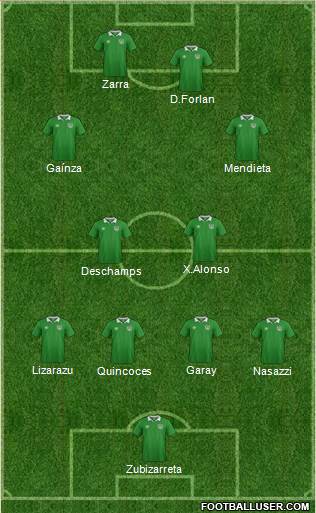
Starting lineup
Basque has a number of great strikers, but Diego Forlan proved himself at the World Cup Finals, the highest stage in football.