|
| 2014 Copa Libertadores |
Boca Juniors, River Plate, Independiente, Estudiantes de La Plata
San Lorenzo , Racing Club, Velez Sarsfield.
Argentine-born players capped by other national teams
This is my selection of a 25 member all-time team for the club. The number 25 was chosen because it is the official squad size for the Champions' League.
San Lorenzo is also considered one of the "big five" ("Los 5 Grandes") of Argentine football by Argentine press, with Independiente, River Plate, Boca Juniors, and Racing Club. San Lorenzo plays its home games at Estadio Pedro Bidegain, popularly known as Nuevo Gasómetro. In 1968, San Lorenzo won the Metropolitano championship, and became the first team in the professional era of Argentine football to complete a season without losing a game. In 1972, they won both of the Argentine league titles, this time they completed the Nacional championship without losing a single game. In 2014, they won the Copa Libertadores.
Team
GK: Agustín Irusta (Argentina)
Irusta made his professional debut for San Lorenzo in 1963. He went on to make 257 league appearances for the club, which is the club record for a goalkeeper, and the fifth highest tally of appearances in any position. Irusta also played for the Argentina national team. Irusta was one of five players to win four league titles with San Lorenzo between 1968 and 1974. In 1977 Irusta joined Unión de Santa Fe before his retirement in 1978.
GK: Carlos Buttice (Argentina)
Carlos Buttice started his career with Club Atlético Los Andes. He played for most of his career in clubs of Argentina, Brazil and Chile. His longest stay was with San Lorenzo and Bahia. In Chile Buttice played for Unión Española. He was part of the 1977 Unión Española team that won the Primera División de Chile.
GK: Sebastián Saja (Argentina)
Saja had nearly 200 overall appearances for San Lorenzo de Almagro, being voted South America's best goalkeeper in 2002. In 2001, he helped the team win the Clausura and the Copa Mercosur, adding the following year's Copa Sudamericana. From 2003 to 2007, he played in Spain, Brazil, Mexico and Brazil. Between 2011 and 2016, he played form Racing. At the time of writing, he plays in Spain. Capped 4 times.
CB/RB: Jorge Olguín (Argentina)
Jorge Olguín started his career at San Lorenzo in 1971, where he won three trophies (1972 Metropolitano, 1972 Nacional and 1974 Nacional). In 1978, Olguín was included in Argentina's world cup squad playing as a rightback. He was sold to Independiente after the World Cup. In 1984 Olguín was sold to Argentinos Juniors, where he helped them win their first and only Copa Libertadores title.
RB: Antonio Rosl (Argentina)
Antonio Rosl played club football for Club Atlético San Lorenzo de Almagro in Argentina where he was part of the team that famously went unbeaten for the whole of the 1972 Nacional championship. In 1976, he retires in Gimnasia y Esgrima La Pla. He earned 13 caps between 1967 and 1973.
CB: Rafael Albrecht (Argentina)
He started his career with Club Atlético Tucumán in 1957. In 1960, he was signed by Estudiantes, where he was called to play for the Argentina national team in 1961. In 1962 he was transferred to San Lorenzo for 10 million pesos, a huge amount for those days. The 'Matadores' team won the 1968 Metropolitano Championship without losing a single game. In 1970, he moved to play for Leon in Mexico. For Argentina, he went to both 1962 and 1960 WC Finals.
CB: Ramón Heredia (Argentina)
Heredia started in 1969 with San Lorenzo. He was part of the squad that won both league titles in 1972. He joined Atlético Madrid in 1973 and played in the 1974 European Cup Final. He then moved to Paris Saint-Germain, where again he would be used rarely. After two seasons with the latter, he chose to retire. He played 30 times for Argentina, including appearances at the 1974 FIFA World Cup.
CB: Angel Zubieta (Spain)
Zubieta started with Athletic Bilbao. In 1936, he became the youngest player ever to play for Spain at the age of only 17 years and 9 months. During the Spanish Civil War, he joined San Lorenzo during a tour of South America with the Basque Country national team. He stayed with the club for 13 seasons and he is the 3rd on appearance record. with most games for the club. In 1952 Zubieta returned to Spain, joining Deportivo de La Coruña.
CB: Oscar Calics (Argentina)
He started his career at Banfield in 1958, where he grained promotion to the first division in 1962. In 1966 he moved to San Lorenzo where he was called to Argentina for the 1966 World Cup. In 1968 he won the title of the Metropolitan Tournament with San Lorenzo, with the team known as Los Matadores. In 1970, he went to Atletico Nacional in Colombia.
CB: Oscar Ruggeri
Oscar Ruggeri was considered one of the greatest defenders from Argentina. He had 97 caps. He played in 3 World Cup Finals, winning the one in 1986 and finishing second in 1990. He was La Liga Foreign Player of the Year in 1989 and South American Player of the Year in 1991. He played for both Vélez Sarsfield, San Lorenzo, River Plate and Boca Juniors as well as Real Madrid in Spain.
LB: Sergio Villar (Uruguay)
Villar is the all-time appearances record holder of San Lorenzo. In 1968, won the Metropolitano championship, and became the first team in the professional era of Argentine football to complete a season without losing a game. In 1972, Villar was part of the San Lorenzo team that won both of the Argentine league titles, this time they completed the Nacional championship without losing a single game. Villar won his fourth title with San Lorenzo in 1974 when the club won the Nacional championship.
DM: Luis Monti (Argentina/Italy)
The ruthless central midfielder led Argentina to the WC Final in 1930 where they lost to Uruguay. Four years later, he became an Oriundo and won the World Cup with Italy. He was also remembered for getting injured at the Battle of Highbury in 1934 when England played Italy. Monti started his career in 1921 with Huracán. The following year he signed with Boca Juniors but left without playing a game. He joined San Lorenzo. In 1930, he joined Juventus in Italy, where he played until 1939.
DM/CM: Roberto Telch (Argentina)
Tech has the second most appearances for San Lorenzo behind Sergio Villar. Telch is one of only five players to have won four league championships with San Lorenzo. He also played Unión de Santa Fe and Colón de Santa Fe. He retired at the end of the 1980 season with a total of 630 appearances in the Argentine Primera, a record only surpassed by Hugo Gatti and Ricardo Bochini. In 1974 Telch went to the 1974 World Cup.
DM/CM: Nestor Gorosito (Argentina)
Néstor Pipo Gorosito began his playing career at River Plate, and subsequently had 3 spells at San Lorenzo where he scored 72 goals in 241 appearances. He also have a lengthily with Chile's Universidad Católica. Gorosito also played for Swarovski Tirol in Austria between 1989 and 1991, and in Japan with Yokohama Marinos in 1996. He also made 19 appearances for Argentina national team between 1989 and 1997.
CM: Victorio Cocco (Argentina)
Cocco helped Unión de Santa Fe in the Argentine 2nd division to grain promotion to the Primera in 1966. He was signed by San Lorenzo in 1968 and was a part of the team's great team of the 1970's. He briefly played for Deportivo La Coruña in Spain, River Plate. Atlético Atlanta (as a player manager) and Boca Juniors. Capped 6 times.
AM: Leandro Romagnoli (Argentina)
Leandro Romagnoli was a homegrown talent of San Lorenzo. He played over 200 matches before he signed with Mexico's Tiburones Rojos de Veracruz in 2005. A year later, he joined Sporting Clube de Portugal. He rejoined San Lorenzo in 2009. In 2014, he helped them to win the Copa Libertadores. He won the 2001 U-20 World Cup with Argentina. He earned one senior cap playing against the USA in 2003.
AM: José SanFilippo (Argentina)
During his club career he played for San Lorenzo, Boca Juniors and Banfield in Argentina, Nacional in Uruguay, and Bangu and SC Bahia in Brazil. He is the 5th highest scoring player in Argentine football. At the international level, Sanfilippo played for the Argentina in the 1958 and 1962 World Cup Finals. He was also part of the Argentina squads that won the 1955 Pan American Games and the 1957 South American Championship.
SS: Rinaldo Martino (Argentina/Italy)
Martino was signed by San Lorenzo in 1941 at the age of 19 from Belgrano de Rosario. In 1949 Martino joined Juventus in Italy, helping them to record their first championship since the 1930s. He retuned to South America. He played with Nacional in Uruguay, Boca Juniors and C.A. Cerro. He earned over 20 caps for Argentina before moving to play in Italy, where he earned a single cap for Italy.
ST: Lobo Fischer (Argentina)
Nicknamed "El Lobo" (the "Wolf"). With San Lorenzo, he won three championship and he remains one of the foremost strikers in the club's history. Among others, he also played for Botafogo FR in Brazil and CD Once Caldas in Colombia. From 1967 onward he also played 35 matches for the national team for which he scored 12 goals.
ST: Alfredo Carricaberry (Argentina)
In 1919, Alfredo Carricaberry joined San Lorenzo de Almagro, where he spent most of his career playing until 1930 with a total of 297 games and 104 goals, where he won two titles in 1923 and 1924. Caricaberry also played for the Argentina national team, winning the Silver medal at the 1928 Olympic Games and one Copa América in 1927.
ST: Rene Pontoni (Argentina)
Pontoni started his career with Gimnasia y Esgrima de Santa Fe before joining Newell's Old Boys in 1940. In 1944 Pontoni joined San Lorenzo where he helped the team to win the Primera División in 1946. He also played for Independiente Santa Fe in Colombia and Portuguesa in Brazil. Pontoni made his debut for the Argentina in 1942. He scored 19 goals in 19 games for his country, helping them to become South American champions in 1945, 1946 and 1947.
ST: Hector Scotta (Argentina)
Scotta played with Unión de Santa Fe but he moved to San Lorenzo in 1971. In 1975 Scotta was the topscorer of the Nacional championship with 28 goals and Metropolitano champion with 32 goals, this made him the topscorer in South America and in world football for 1975. Scotta was awarded the Olimpia de Plata as the Argentine sports writer's footballer of the year. He also played for Grêmio, Ferro Carril Oeste, Boca Juniors and Sevilla FC.
ST: Hector Veira (Argentina)
Veira started his career in 1963 with San Lorenzo. In 1964 he became the topscorer in the Argentina Primera División at the age of only 18. In 1968 he helped San Lorenzo to win the Metropolitano championship without losing a game, the first ever unbeaten champions. He also played for Huracán, Laguna, Atlético Banfield, Sevilla, Corinthians, CSD Comunicaciones and Universidad de Chile. Capped twice.
ST: Isidro Lángara (Spain)
Isidro Lángara started with Real Oviedo in Spain, where he was the the Pichichi winner in 3 straight seasons. Due to the Spanish Civil War, he went to play in Mexico and Argentina. With San Lorenzo, he was the star player alongside René Pontoni and Reinaldo Martino. With Club Espana in Mexico, he was top scorer twice, in 1944 and 1946. Still today he is the only footballer in history to be top scorer in major leagues on three different continents.
ST: Beto Acosta (Argentina)
In a professional career which spanned 18 years (nearly 700 official games and more than 250 goals), he played for San Lorenzo in four different spells. Additionally, he represented clubs in France, Chile, Japan and Portugal. In 1994, he was crowned the top scorer in South American football, netting 33 times in only 25 matches. Acosta appeared with Argentina in two Copa América tournaments in 1993 and 1995.
Honorable Mention
Bartolome Colombo, Horacio Ameli, Paulo Silas, Rubén Cousillas, Oscar Passet, Mirko Blazina, Jose Chilavert, Rolando Escudero, Bernardo Romeo, Ezequiel Lavezzi, Julio Buffarini, Eduardo Tuzzio, Horacio Ameli, Rubén Ayala, Arturo Arrieta, Pablo Michelini, Norberto Boggio.
Squad Explanation
-- San Lorenzo won the 2014 Copa Libertadores. Leandro Romagnoli was rewarded a spot on the team. Rightback Julio Buffarini is too young and his career here was too brief. Sebastián Torrico is named as a honorable mention.
-- There are plenty of good goalkeepers, namely Rubén Cousillas, Oscar Passet, Mirko Blazina and Jose Chilavert. They could only make honorable mention. Jose Chilavert spent 4 years here, where he made a name, but I did not see his name appeared in most conversations about the greatest ever from San Lorenzo. His career was much better elsewhere. I put him on honourable mention. Mirko Blazina was a keeper from Yugoslavia playing in the 1940's.
-- Agustín Irusta and Carlos Buttice are chosen as the top two goalkeepers. The third keeper was between Sebastian Saja and Sebastián Torrico. They were about the same. Saja at the time of writing has played longer for the club so I gave him the third spot.
-- I was deciding between Oscar Calics and Oscar Ruggeri. Oscar Calics was with that great team of 1970's, but Ruggeri is a more famous name (but for his career elsewhere). I could not decide which one to select. So I took both of them.
-- Another "Oscar" was also considered. I dropped Oscar Basso because I don't have much information with him. I also do not know much about Arturo Arrieta.
-- José SanFilippo is all-time great from Argentina. He played for many clubs, but his longest spell was actually with San Lorenzo.
-- Ezequiel Lavezzi spent a short spell with the club. He was sensational, but not enough to make the all-time team. He was also not homegrown so the "homegrown" factor does not apply to him.
-- Luis Monti seemed to have been forgotten by the fans of the club. His name does not appear in a lot of San Lorenzo's all-time list. People forgot that his longest spell in Argentina was with the club. He played for them between 1922 and 1930. I selected Monti because he is perhaps the greatest Argentine midfielder. I even ranked him among the greatest ever in his position.
-- San Lorenzo had a successful tour in Europe in the 1940's. They beat the Spanish national team twice (7-5 and 6-1) and other teams as well. After the tour, the club became well-known in Europe. It defined the club's place in the world of football. Striker Rene Pontoni was offered to join Barcelona after the tour, but he went home. Rinaldo Martino stayed behind and joined Juventus in Italy. Ángel Zubieta who was a Spanish exile from Basque also went on the tour. During the tour, he was finally reunited with his mother. He was an idol with San Lorenzo. I also selected Isidro Lángara who was also an exile from Basque during the Spanish Civil War.
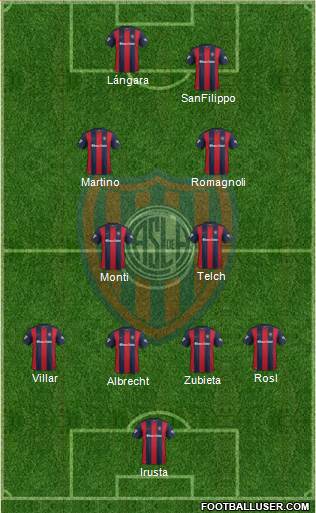
Formation
Argentina World Cup 1946
Angels with Dirty Faces with Di Stefano in the WC 1958
Argentina All-Time Team before 1978,
Argentina All-Time Team After Maradona.
Angels with Dirty Faces with Di Stefano in the WC 1958
Argentina All-Time Team before 1978,
Argentina All-Time Team After Maradona.
Provincia de Córdoba, Argentina All-Time Team
Provincia de Santa Fe, Argentina All-Time Team
The City of Buenos Aires
Argentina All-Time Team without players from Santa Fe, Cordoba and Buenos Aires
Provincia de Santa Fe, Argentina All-Time Team
The City of Buenos Aires
Argentina All-Time Team without players from Santa Fe, Cordoba and Buenos Aires
This is my selection of a 25 member all-time team for the club. The number 25 was chosen because it is the official squad size for the Champions' League.
San Lorenzo is also considered one of the "big five" ("Los 5 Grandes") of Argentine football by Argentine press, with Independiente, River Plate, Boca Juniors, and Racing Club. San Lorenzo plays its home games at Estadio Pedro Bidegain, popularly known as Nuevo Gasómetro. In 1968, San Lorenzo won the Metropolitano championship, and became the first team in the professional era of Argentine football to complete a season without losing a game. In 1972, they won both of the Argentine league titles, this time they completed the Nacional championship without losing a single game. In 2014, they won the Copa Libertadores.
 |
| 1968 the undefeated team |
GK: Agustín Irusta (Argentina)
Irusta made his professional debut for San Lorenzo in 1963. He went on to make 257 league appearances for the club, which is the club record for a goalkeeper, and the fifth highest tally of appearances in any position. Irusta also played for the Argentina national team. Irusta was one of five players to win four league titles with San Lorenzo between 1968 and 1974. In 1977 Irusta joined Unión de Santa Fe before his retirement in 1978.
GK: Carlos Buttice (Argentina)
Carlos Buttice started his career with Club Atlético Los Andes. He played for most of his career in clubs of Argentina, Brazil and Chile. His longest stay was with San Lorenzo and Bahia. In Chile Buttice played for Unión Española. He was part of the 1977 Unión Española team that won the Primera División de Chile.
GK: Sebastián Saja (Argentina)
Saja had nearly 200 overall appearances for San Lorenzo de Almagro, being voted South America's best goalkeeper in 2002. In 2001, he helped the team win the Clausura and the Copa Mercosur, adding the following year's Copa Sudamericana. From 2003 to 2007, he played in Spain, Brazil, Mexico and Brazil. Between 2011 and 2016, he played form Racing. At the time of writing, he plays in Spain. Capped 4 times.
CB/RB: Jorge Olguín (Argentina)
Jorge Olguín started his career at San Lorenzo in 1971, where he won three trophies (1972 Metropolitano, 1972 Nacional and 1974 Nacional). In 1978, Olguín was included in Argentina's world cup squad playing as a rightback. He was sold to Independiente after the World Cup. In 1984 Olguín was sold to Argentinos Juniors, where he helped them win their first and only Copa Libertadores title.
RB: Antonio Rosl (Argentina)
Antonio Rosl played club football for Club Atlético San Lorenzo de Almagro in Argentina where he was part of the team that famously went unbeaten for the whole of the 1972 Nacional championship. In 1976, he retires in Gimnasia y Esgrima La Pla. He earned 13 caps between 1967 and 1973.
CB: Rafael Albrecht (Argentina)
He started his career with Club Atlético Tucumán in 1957. In 1960, he was signed by Estudiantes, where he was called to play for the Argentina national team in 1961. In 1962 he was transferred to San Lorenzo for 10 million pesos, a huge amount for those days. The 'Matadores' team won the 1968 Metropolitano Championship without losing a single game. In 1970, he moved to play for Leon in Mexico. For Argentina, he went to both 1962 and 1960 WC Finals.
 |
| Rafael Albrecht |
CB: Ramón Heredia (Argentina)
Heredia started in 1969 with San Lorenzo. He was part of the squad that won both league titles in 1972. He joined Atlético Madrid in 1973 and played in the 1974 European Cup Final. He then moved to Paris Saint-Germain, where again he would be used rarely. After two seasons with the latter, he chose to retire. He played 30 times for Argentina, including appearances at the 1974 FIFA World Cup.
CB: Angel Zubieta (Spain)
Zubieta started with Athletic Bilbao. In 1936, he became the youngest player ever to play for Spain at the age of only 17 years and 9 months. During the Spanish Civil War, he joined San Lorenzo during a tour of South America with the Basque Country national team. He stayed with the club for 13 seasons and he is the 3rd on appearance record. with most games for the club. In 1952 Zubieta returned to Spain, joining Deportivo de La Coruña.
CB: Oscar Calics (Argentina)
He started his career at Banfield in 1958, where he grained promotion to the first division in 1962. In 1966 he moved to San Lorenzo where he was called to Argentina for the 1966 World Cup. In 1968 he won the title of the Metropolitan Tournament with San Lorenzo, with the team known as Los Matadores. In 1970, he went to Atletico Nacional in Colombia.
CB: Oscar Ruggeri
Oscar Ruggeri was considered one of the greatest defenders from Argentina. He had 97 caps. He played in 3 World Cup Finals, winning the one in 1986 and finishing second in 1990. He was La Liga Foreign Player of the Year in 1989 and South American Player of the Year in 1991. He played for both Vélez Sarsfield, San Lorenzo, River Plate and Boca Juniors as well as Real Madrid in Spain.
 |
| Oscar Ruggeri |
LB: Sergio Villar (Uruguay)
Villar is the all-time appearances record holder of San Lorenzo. In 1968, won the Metropolitano championship, and became the first team in the professional era of Argentine football to complete a season without losing a game. In 1972, Villar was part of the San Lorenzo team that won both of the Argentine league titles, this time they completed the Nacional championship without losing a single game. Villar won his fourth title with San Lorenzo in 1974 when the club won the Nacional championship.
The ruthless central midfielder led Argentina to the WC Final in 1930 where they lost to Uruguay. Four years later, he became an Oriundo and won the World Cup with Italy. He was also remembered for getting injured at the Battle of Highbury in 1934 when England played Italy. Monti started his career in 1921 with Huracán. The following year he signed with Boca Juniors but left without playing a game. He joined San Lorenzo. In 1930, he joined Juventus in Italy, where he played until 1939.
 |
| Luis Monti |
DM/CM: Roberto Telch (Argentina)
Tech has the second most appearances for San Lorenzo behind Sergio Villar. Telch is one of only five players to have won four league championships with San Lorenzo. He also played Unión de Santa Fe and Colón de Santa Fe. He retired at the end of the 1980 season with a total of 630 appearances in the Argentine Primera, a record only surpassed by Hugo Gatti and Ricardo Bochini. In 1974 Telch went to the 1974 World Cup.
DM/CM: Nestor Gorosito (Argentina)
Néstor Pipo Gorosito began his playing career at River Plate, and subsequently had 3 spells at San Lorenzo where he scored 72 goals in 241 appearances. He also have a lengthily with Chile's Universidad Católica. Gorosito also played for Swarovski Tirol in Austria between 1989 and 1991, and in Japan with Yokohama Marinos in 1996. He also made 19 appearances for Argentina national team between 1989 and 1997.
CM: Victorio Cocco (Argentina)
Cocco helped Unión de Santa Fe in the Argentine 2nd division to grain promotion to the Primera in 1966. He was signed by San Lorenzo in 1968 and was a part of the team's great team of the 1970's. He briefly played for Deportivo La Coruña in Spain, River Plate. Atlético Atlanta (as a player manager) and Boca Juniors. Capped 6 times.
AM: Leandro Romagnoli (Argentina)
Leandro Romagnoli was a homegrown talent of San Lorenzo. He played over 200 matches before he signed with Mexico's Tiburones Rojos de Veracruz in 2005. A year later, he joined Sporting Clube de Portugal. He rejoined San Lorenzo in 2009. In 2014, he helped them to win the Copa Libertadores. He won the 2001 U-20 World Cup with Argentina. He earned one senior cap playing against the USA in 2003.
 |
| Leandro Romagnoli |
During his club career he played for San Lorenzo, Boca Juniors and Banfield in Argentina, Nacional in Uruguay, and Bangu and SC Bahia in Brazil. He is the 5th highest scoring player in Argentine football. At the international level, Sanfilippo played for the Argentina in the 1958 and 1962 World Cup Finals. He was also part of the Argentina squads that won the 1955 Pan American Games and the 1957 South American Championship.
 |
| José SanFilippo |
Martino was signed by San Lorenzo in 1941 at the age of 19 from Belgrano de Rosario. In 1949 Martino joined Juventus in Italy, helping them to record their first championship since the 1930s. He retuned to South America. He played with Nacional in Uruguay, Boca Juniors and C.A. Cerro. He earned over 20 caps for Argentina before moving to play in Italy, where he earned a single cap for Italy.
ST: Lobo Fischer (Argentina)
Nicknamed "El Lobo" (the "Wolf"). With San Lorenzo, he won three championship and he remains one of the foremost strikers in the club's history. Among others, he also played for Botafogo FR in Brazil and CD Once Caldas in Colombia. From 1967 onward he also played 35 matches for the national team for which he scored 12 goals.
ST: Alfredo Carricaberry (Argentina)
In 1919, Alfredo Carricaberry joined San Lorenzo de Almagro, where he spent most of his career playing until 1930 with a total of 297 games and 104 goals, where he won two titles in 1923 and 1924. Caricaberry also played for the Argentina national team, winning the Silver medal at the 1928 Olympic Games and one Copa América in 1927.
ST: Rene Pontoni (Argentina)
Pontoni started his career with Gimnasia y Esgrima de Santa Fe before joining Newell's Old Boys in 1940. In 1944 Pontoni joined San Lorenzo where he helped the team to win the Primera División in 1946. He also played for Independiente Santa Fe in Colombia and Portuguesa in Brazil. Pontoni made his debut for the Argentina in 1942. He scored 19 goals in 19 games for his country, helping them to become South American champions in 1945, 1946 and 1947.
ST: Hector Scotta (Argentina)
Scotta played with Unión de Santa Fe but he moved to San Lorenzo in 1971. In 1975 Scotta was the topscorer of the Nacional championship with 28 goals and Metropolitano champion with 32 goals, this made him the topscorer in South America and in world football for 1975. Scotta was awarded the Olimpia de Plata as the Argentine sports writer's footballer of the year. He also played for Grêmio, Ferro Carril Oeste, Boca Juniors and Sevilla FC.
ST: Hector Veira (Argentina)
Veira started his career in 1963 with San Lorenzo. In 1964 he became the topscorer in the Argentina Primera División at the age of only 18. In 1968 he helped San Lorenzo to win the Metropolitano championship without losing a game, the first ever unbeaten champions. He also played for Huracán, Laguna, Atlético Banfield, Sevilla, Corinthians, CSD Comunicaciones and Universidad de Chile. Capped twice.
ST: Isidro Lángara (Spain)
Isidro Lángara started with Real Oviedo in Spain, where he was the the Pichichi winner in 3 straight seasons. Due to the Spanish Civil War, he went to play in Mexico and Argentina. With San Lorenzo, he was the star player alongside René Pontoni and Reinaldo Martino. With Club Espana in Mexico, he was top scorer twice, in 1944 and 1946. Still today he is the only footballer in history to be top scorer in major leagues on three different continents.
 |
| Isidro Lángara |
In a professional career which spanned 18 years (nearly 700 official games and more than 250 goals), he played for San Lorenzo in four different spells. Additionally, he represented clubs in France, Chile, Japan and Portugal. In 1994, he was crowned the top scorer in South American football, netting 33 times in only 25 matches. Acosta appeared with Argentina in two Copa América tournaments in 1993 and 1995.
 |
| Beto Acosta |
Honorable Mention
Bartolome Colombo, Horacio Ameli, Paulo Silas, Rubén Cousillas, Oscar Passet, Mirko Blazina, Jose Chilavert, Rolando Escudero, Bernardo Romeo, Ezequiel Lavezzi, Julio Buffarini, Eduardo Tuzzio, Horacio Ameli, Rubén Ayala, Arturo Arrieta, Pablo Michelini, Norberto Boggio.
Squad Explanation
-- San Lorenzo won the 2014 Copa Libertadores. Leandro Romagnoli was rewarded a spot on the team. Rightback Julio Buffarini is too young and his career here was too brief. Sebastián Torrico is named as a honorable mention.
-- There are plenty of good goalkeepers, namely Rubén Cousillas, Oscar Passet, Mirko Blazina and Jose Chilavert. They could only make honorable mention. Jose Chilavert spent 4 years here, where he made a name, but I did not see his name appeared in most conversations about the greatest ever from San Lorenzo. His career was much better elsewhere. I put him on honourable mention. Mirko Blazina was a keeper from Yugoslavia playing in the 1940's.
-- Agustín Irusta and Carlos Buttice are chosen as the top two goalkeepers. The third keeper was between Sebastian Saja and Sebastián Torrico. They were about the same. Saja at the time of writing has played longer for the club so I gave him the third spot.
-- I was deciding between Oscar Calics and Oscar Ruggeri. Oscar Calics was with that great team of 1970's, but Ruggeri is a more famous name (but for his career elsewhere). I could not decide which one to select. So I took both of them.
-- Another "Oscar" was also considered. I dropped Oscar Basso because I don't have much information with him. I also do not know much about Arturo Arrieta.
-- José SanFilippo is all-time great from Argentina. He played for many clubs, but his longest spell was actually with San Lorenzo.
-- Ezequiel Lavezzi spent a short spell with the club. He was sensational, but not enough to make the all-time team. He was also not homegrown so the "homegrown" factor does not apply to him.
-- Luis Monti seemed to have been forgotten by the fans of the club. His name does not appear in a lot of San Lorenzo's all-time list. People forgot that his longest spell in Argentina was with the club. He played for them between 1922 and 1930. I selected Monti because he is perhaps the greatest Argentine midfielder. I even ranked him among the greatest ever in his position.
-- San Lorenzo had a successful tour in Europe in the 1940's. They beat the Spanish national team twice (7-5 and 6-1) and other teams as well. After the tour, the club became well-known in Europe. It defined the club's place in the world of football. Striker Rene Pontoni was offered to join Barcelona after the tour, but he went home. Rinaldo Martino stayed behind and joined Juventus in Italy. Ángel Zubieta who was a Spanish exile from Basque also went on the tour. During the tour, he was finally reunited with his mother. He was an idol with San Lorenzo. I also selected Isidro Lángara who was also an exile from Basque during the Spanish Civil War.
Formation