
Real Madrid All-Time Team Under Florentina Perez
Real Madrid All-Time Team Under Miguel Munoz
Real Madrid Argentine Best XI
Real Madrid Castilla Greatest All-Time
In July, 2000, Luis Figo, the captain of Barcelona, made a controversial move from Barcelona to arch rival Real Madrid shortly after the ascent of Florentino Perez to Real Madrid's presidency. Perez had promised to bring Figo to Real Madrid if he was elected President of Real Madrid and he wuld later promise to bring one superstar to the team every year. This transfer marked the first of many Galactico transfers to Real Madrid. In the next two seasons, Zinedine Zidane and Ronaldo would arrive. In the beginning, things were looking good at the Spanish capital. Real Madrid won the Champions' League title in 2002 and then, a league title the following season. However, everything started to fall apart in the summer of 2003 when David Beckham moved to Madrid.
At end of the end
of the 2002-2003 season, Captain
Fernando Hierro and Coach Vicente del Bosque were released. The club did not sign any replacement for Hierro, but planned to use homegrown central back Francisco Pavon as its starter. The original Galactico policy was actually not just only about signing superstars every year. Perez also promised to promote youth team graduates such Pavon to the first team. He even coined the term Zidanes and Pavones for his Galactico policy using Pavon as his poster boy. To be fair, Pavon looked impressive when he filled in for the injured Hierro the season before. When Hierro returned to the starting lineup in Spring of 2003, he played poorly. In fact, he was blamed for Real Madrid's elimination at the Champions' League by Juventus. For coach, President Florentino Perez hired Carlos Queiroz, who worked with Figo at Sporting CP and Beckham at Manchester United.
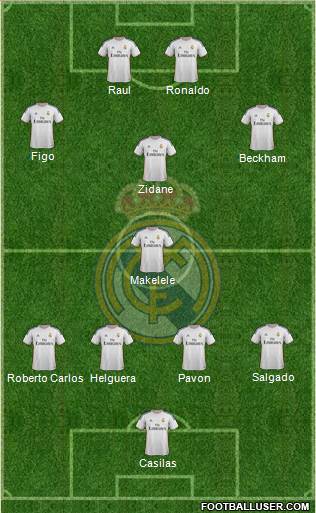 |
| Deam lineup that never happened |
The preceding season, however, started well. The team was leading the league table and reached the
Final of the Copa Del Rey. But the team collapsed shortly after the Madrid train bombings in March, 2004. Before the bombings, the team only lost one league matches. But for the next 11 La Liga matches after the
bombing, Real Madrid only managed 3 victories. They finished 4th on the
league table. And six days after the bombings, Real Madrid lost to
Real Zaragoza at the Final of Copa del Rey. For the next three years,
the team went "trophyless".
Most people blamed the collapse of the team on the departure of Makelele and Hierro that created a defensive vacuum in the lineup. The team was filled with great attackers, but the central backs and defensive midfielders were not up to standard. For the next few years, while the media focused on the Galactico signings, Perez actually signed Jonathn Woodgate, Walter Samuel, Sergio Ramos, Thomas Gravesen and Palbo Garcia to solve the club's defensive and midfield woes, but all of them failed. Sergio Ramos who joined Real Madrid at the age of 19 would learn his trade as a rightback for many years before he matured into one of the best central backs in La Liga and led the team winning La Decima in 2014. Perez resigned on 27th February, 2006. Figo left the summer before, Zidane retired 4 months later and Ronaldo moved on the following December. It marked the end of the first Galactico era. Real Madrid would win its first trophy in 3 years the season after Perez's departure. Meanwhile, Francico Pavon left the club in 2007 after an unremarkable career at the club. He never lived up to Zidanes and Pavones tag.
One interesting thing that also happened during the season was that while Real Madrid searched for a central midfielder, a player who would become one of the best central midfielders in the world was sitting on the bench. Esteban Cambiasso was a backup player while Beckham struggled as a central midfielder. He transferred to Inter Milan at the end of 2003-2004 season.


Some of the unpublished posts from this blog have been turned into a two-volume book: The Multiverse of the Beautiful Game: National Teams of Pure Fantasy.
Volume 1 takes you back in time and asks the questions every football fan has dreamed about. What if Brazil had a more beautiful team in 1982 — would they have cruised to the title? What if the United Kingdom could send its team to the 1970 World Cup? I believe they would have been the strongest side on earth. What if Argentina had fielded both Omar Sivori and Alfredo Di Stéfano together in 1958? What if Johan Cruyff had lined up alongside Marco van Basten, Ruud Gullit, and Frank Rijkaard? What if Eusébio had played for Brazil? And that's only scratching the surface — Volume 1 is packed with legendary "what ifs" that will keep you turning pages.
Volume 2 brings the fantasy closer to home. What if England had Michael Olise, Erling Haaland and others in 2026 — could they go all the way? What if Yugoslavia had gone to the World Cup in 2018? What if the United States could select more players in 2010? It would be the greatest American side ever. And what if Cristiano Ronaldo and Lionel Messi had actually played for the same national team in 2006? It could have happened — if the soccer gods had smiled on us.

No comments:
Post a Comment