Sunday, December 19, 2021

Extremadura All-Time Best XI

This blogger Artur Yanturin of Russia copied many of my blog teams.  This blog was one of them.  It was my Russia All-Time Team here.  His team was written in 2020, but mine was uploaded in 2014.   His Spartak Moscow All-Time team entry of was published in October 2020, but mine was uploaded in 2017.  His entry of the Dutch-German rivalry between Real Madrid and Barcelona was written in 2020, but mine was uploaded in 2014.  He also copied many many of my blog entries.

His Facebook and Instagram

Fernando Morientes


Some of the best posts from this blog have been turned into a two-volume book: The Multiverse of the Beautiful Game: National Teams of Pure Fantasy.

Volume 1 takes you back in time and asks the questions every football fan has dreamed about. What if Brazil had a more beautiful team in 1982 — would they have cruised to the title? What if the United Kingdom could send its team to the 1970 World Cup? I believe they would have been the strongest side on earth. What if Argentina had fielded both Omar Sivori and Alfredo Di Stéfano together in 1958? And what if in the same World Cup, Di Stéfano could play with Kubala, Gento, Basora, Luis Suarez Miramontes and Ramallets? What if Johan Cruyff had lined up alongside Marco van Basten, Ruud Gullit, and Frank Rijkaard? What if Eusébio had played for Brazil? And that's only scratching the surface — Volume 1 is packed with legendary "what ifs" that will keep you turning pages.

Volume 2 brings the fantasy closer to home. What if England had Michael Olise, Erling Haaland and others in 2026 — could they go all the way? What if Yugoslavia had gone to the World Cup in 2018? Could Spain have won the 2010 World Cup without Catalan players? Could Catalonia do it alone? And could they have won Euro 2024 with only Basque players? The Williams brothers, Zubimendi and Laporte? What if Basque could recruit Otamendi, Griezmann , etc?  What if the United States could select more players in 2010? It would be the greatest American side ever. And what if Cristiano Ronaldo and Lionel Messi had actually played for the same national team in 2006? It could have happened — if the soccer gods had smiled on us.

*** Both Volume One and Volume Two are available now on Amazon. ***


Please also see my All-Time World Cup Team Index.

 
This is my selection of All-time Best XI team for Extremadura.  
 
Located in the central-western part of the Iberian Peninsula, Extremadura is crossed from east to west by the Tagus and Guadiana rivers. The autonomous community is formed by the two largest provinces of Spain: Cáceres and Badajoz. Extremadura is bordered by Portugal to the west and by the autonomous communities of Castile and León (north), Castilla–La Mancha (east) and Andalusia (south).

Founded in 1924, CF Extremadura was the region's major football team, but it folded in 2010.  Extremadura Unión Deportiva is the only major club left.  It was founded in 2007.  At the time of writing,  it never reached the  Primera División, the top tier of the Spanish league.  José Antonio Reyes played for them for a few games before he passed away.

Joaquín Vázquez was the first player born in Extremadura capped by Spain.  He competed in the 1920 Summer Olympics, where Spain win a silver medal.  Rafael Gordillo is the most capped player born here.  Extremadura autonomous football team (Selección de fútbol de Extremadura) played a few games in 2007 and 2008.


In 20 La Liga seasons, César Sánchez played 401 games, with Valladolid, Real Madrid, Zaragoza, Valencia and Villarreal, being first choice in three of those clubs and winning seven major titles with the second, including the 2002 Champions League.  He started five out of nine UEFA Champions League matches during the capital side's victorious campaign, He also appeared once for Spain in 2000 when Spain played against Germany.
César Sánchez
RB: Francisco Melo  
In 1964, Francisco Melo started with Real Valladolid where he would play for four seasons.  He played for Atlético de Madrid between 1968 and 1976, winning the Spanish League in 1970 and 1973, and the Intercontinental Cup in 1975. He played in the 1974 European Cup Final, which Atlético lost.  Paco Melo played two games with the Spanish national team, was called up in another five games.

Pedro José's career was closely associated with CF Extremadura, and he only played with teams from his native region in 25 years as a senior. He represented his main club in all four major levels of Spanish football, helping it promote twice to La Liga, in 1996 and in 1998, and appearing in more than 600 competitive matches during his spell (72 goals).  He left the side in 2004 at almost 37, and played a further six years in amateur football, with Mérida UD and Imperio de Mérida CP.

Alejo began his career with Barcelona, but never made an appearance for the first team. He then became a member of the legendary Figueres team that almost earned promotion to La Liga in 1991–92, playing alongside players such as Toni, Luis Cembranos, Pere Gratacós, Tab Ramos and Tintín Márquez. He joined Celta Vigo in late 1992, and made 158 top flight appearances during four and a half seasons with the club. Alejo then played for Elche.  

LB/LW:  Rafael Gordillo 
Rafael Gordillo was known as the greatest left wingback in Spanish history.  He played at the same time as Camacho for both club and country.  Both players started on the left side.  Camacho supported him defensively.  He was a legend at both Real Betis and Real Madrid. He was voted the Best Player in Spain for 1979-1980 season.  He played with the great Real Madrid side of the 1980's, winning 5 La Liga titles and an UEFA Cup. He appeared in nearly 80 matches for Spain and representing the nation in five international tournaments.
Rafael Gordillo
DM/CM: Roberto Marina 
Marina started his professional career with Atlético Madrid, being definitely promoted to the first team for the 1982–83 season.  He scored the 3,000th league goal for the club.  Marina finished his 15-year career with spells with RCD Mallorca and CD Toledo (the latter in the second division), retiring at the age of nearly 34. He earned his first (and only) cap for Spain: on 26 May 1985 he played six minutes in a friendly with the Republic of Ireland, in Cork.

CM: Adelardo Rodriguez 
Adelardo spent 17 years with Atletico Madrid.  He held the appearance record for the club.  He played over 550 matches for the club from 1959 to 1976. During his spell, the club won three La Liga titles (65–66, 69–70 and 72–73), five Copa del Reys (1960, 1961, 1965, 1972 and 1976), the 1962 European Cup Winners' Cup, the 1974 Intercontinental Cup. He earned 14 caps for Spain between 1962 and 1970.  He went to the World Cup in 1962 and 1966.
Adelardo Rodriguez 

CM: Ito
Ito started playing professionally with local CF Extremadura.  He spent a season with Celta before joining Real Betis in 1998.  He joined Espanyol in 2004.  With Espanyol, Ito won the 2006 edition of the Copa del Rey and, although a reserve in the Catalan team's 2006–07 league campaign.   Ito earned his sole cap for Spain on 23 September 1998, appearing in the last two minutes of a 1–0 friendly win over Russia.

Nicknamed Paquete, Higuera started with Mallocra in 1982.  In summer 1988, Higuera signed with Real Zaragoza, being instrumental in their 1995 triumph in the UEFA Cup Winners' Cup, all this while often partnered offensively with Juan Esnáider, Miguel Pardeza and Gustavo Poyet.  Higuera joined Mexico's Puebla FC in 1997, being accompanied by Pardeza in the adventure.  He played 6 times for Spain between 1992 and 1995.
 Francisco Higuera 
Morientes started with Albacete.  He later signed with Zaragoza in 1995.  Between 1997 and 2005, he played for Real Madrid, winning three Champions' League titles.  He was a starter until the signing of Ronaldo in 2002.  Then, he had a loan stint with AS Monaco FC.  He also played with Liverpool, Valencia, etc.  Morientes earned 47 caps for the Spain national team, representing the country in two World Cups (totalling five goals) and Euro 2004.

Manolo played local CP Cacereño and CE Sabadell FC before he moved to Real Murcia.  In 1988, Manolo signed with Atlético Madrid, where he knew his most successful years, forming a formidable attacking partnership with Paulo Futre.  He was crowned top scorer in 1991–92 with 27 goals.  He went on to total 28 caps and nine goals, representing the nation in the 1990 World Cup finals where he only appeared in the first group stage game against Uruguay (0–0).
Manolo

Honorable Mention
Victor, David Cortés,  Fernando Pacheco, Edu Moya, Iván Cuéllar, Casto, Pedro Porro, Diego Lozano, Ciriaco Cano, Joaquín Vázquez, Ito, Ernesto Valverde, Ángel Cuéllar.

Squad Explanation
-- At the time of writing, sixteen players born have played for Spain.  So the pool is very limited.  I only have the resource to build an All-Time Best XI.  
-- Adelardo Rodríguez was the first player from Extremadura who played in a World Cup match.  He went to the 1962 World Cup in Chile.  Rafael Gordillo is the most capped player born here. 
-- Extremadura autonomous football team (Selección de fútbol de Extremadura) played a few games in 2007 and 2008.  Ciriaco Cano and Manolo also coached the Extremadura national team. This is their starting lineup against Peru in 2008.  Casto, Edu Moya, Sergio Rodríguez, José María Cidoncha, Sergio Benito, "Ito", "Javito", Jesús Rueda, Enrique, Rocha y Troteiro. Jugaron también: Samir, "Teté", Agustín Fernández, Parra, Guzmán, Carballo, David Generelo, "Chirri", Sabino y Rai.  
-- In 2020, Marca created an All-time Best XI for Extremadura.  The team was as followed: César Sánchez; David Cortes, Roberto Marina, Rafael Gordillo; Ernesto Valverde, Adelardo Rodríguez, Ángel Cuéllar, Victor; Francisco Higuera, Fernando Morientes, Manolo (3-4-3).  My team is different from them.
-- César Sánchez was an easy choice for goalkeeper.  The creation of Extremadura autonomous football team was proposed by him.  I gave him credit for that.  Furthermore, he spent a long career in La Liga, including starting most of Real Madrid's games during its Champions' league winning year in 2002.  He was also capped once for Spain. Fernando Pacheco who spent many seasons in La Liga could be an alternative.
-- César Sánchez actually started ahead Iker Casillas in Real Madrid, but Casillas was a teenager at the time.
-- For rightback, I took Francisco Melo over Pedro Porro.  At the time of writing, Pedro Porro is only 22 years old.  His career was still ahead of him.  He is the most recent player from Extremadura capped by Spain.  David Cortés was selected by Marca as Extremadura's greatest ever rightback. He was liked a journeyman who moved from clubs to clubs throughout his career.  I preferred Melo.
-- Marca did not select any natural central defender.  Roberto Marina played as a central defender for them.  I did not know if he ever played in that position.   From my research, he was a defensive midfielder. For my team, I selected Pedro José and Alejo Indias.  Both players were uncapped player born here.  Pedro Jose was a club legend for CF Extremadura.  He played over 600 games for them.  I awarded him for being a local hero.  Alejo Indias spent many years in La Liga.  He was the only central defender whom I founded have played so long at the highest level in Spain.
-- Rafael Gordillo was one of the best left-sided player from Spain.  Rafael Gordillo was the obvious choice for one of the leftbacks.  He is an Andalusian, but born in Extremadura.  I also selected him on my Andalusia All-Time Team.  He was better known as a left wingback, but in Real Madrid, he was often used as a left wing in front of Camacho.  For this team, I  put him as a leftback so that I could start an extra midfielder.  I did not know if Diego Lozano was also a leftback.  Lozano spent many seasons with Atlético Aviación, which is now Atletico Madrid.  He played 5 times for Spain in 1949.  He started his career as a left winger, but played mainly as a defender.  I also believed Miguel Ángel Ochoa was a leftback.  He competed in the men's tournament at the 1968 Summer Olympics.
-- For midfield, I first took Adelardo Rodríguez who would serve as mu box-to-box midfielder.  He currently holds the appearance record for Atletico Madrid.  Then, I selected Francisco Higuera who had a good career with Zaragoza.  Then, I had to choose between Roberto Marina and Ito.  I could have selected Marina as a central defender and dropped either Pedro José and Alejo Indias.  Marina definitely had a better career than the two defenders. Marca selected him as a central defender, but I did not have any information about his career as a central defender.  
-- Ito played for CF Extremadura, but Roberto Marina played for a better club side.  Since Marca selected him as one of their Best XI, I copied their ideas.  As mentioned, they used him as a central defender, but I took him as a midfielder.
-- Ito is much better known players than the players selected.  I took Pedro Jose and Alejo Indias because of their playing position. But should I take Ito?  In the end, I decided to select Ito over left wing Ángel Cuéllar.  I do believe Angel Cueller's peak was greater than Ito, but Ángel Cuéllar's career was limited due to the injuries.  He spent a long period of his career in the lower division while Ito had a longer career.   Then, I would put Francisco Higuera as a side forward in a 4-3-3 formation.  
-- Ángel Cuéllar made his debut for Real Betis' first team aged 18 in 1990.  In June 1995, Cuéllar signed a five-year deal with league powerhouse FC Barcelona, but suffered 2 years of injury-riddled career there.  He made a return to Real Betis in 1997, but was not a regular starter.  He stayed there until 2004.  He played in the lower division until retirement. He played twice for Spain in 1994 and 1995.  He had represented Spain at the youth level.
-- Fernando Morientes was the all-time leading scorer from Extremadura for the Spanish national team.  He had remarkable career with Real Madrid.  His credentials were well-known. Manolo won the Pichichi Trophy in the 1991–92 season for being the top scorer in La Liga.  Then, I put Francisco Higuera on the left side.  He was mainly an attack midfield, but he had played as a forward.
-- Victor and Ernesto Valverde made honorable mention.  Over 18 seasons, Victor appeared in 561 matches both major levels of Spanish football combined, scoring 167 goals (342 games and 93 goals in La Liga). He played nine years with Valladolid (two spells), and four with Villarreal.Ernesto Valverde was best remembered for coaching career in Barcelona. He played for six teams in a 14-year professional career, including Espanyol, Barcelona and Athletic Bilbao.
-- Joaquín Vázquez was the first player from Extremadura capped by Spain, but I only out him on honorable mention.

Formation
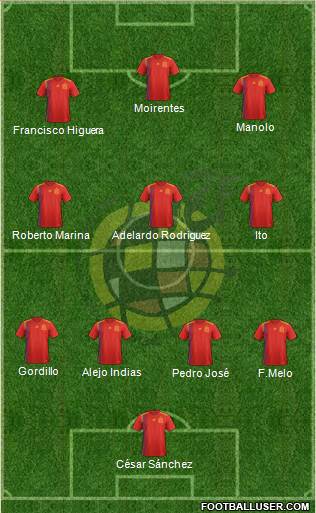
4-3-3


Tuesday, November 23, 2021

Canary Islands, Ceuta and Melilla All-Time Team

This blogger Artur Yanturin of Russia copied many of my blog teams.  This blog was one of them.  It was my Russia All-Time Team here.  His team was written in 2020, but mine was uploaded in 2014.   His Spartak Moscow All-Time team entry of was published in October 2020, but mine was uploaded in 2017.  His entry of the Dutch-German rivalry between Real Madrid and Barcelona was written in 2020, but mine was uploaded in 2014.  He also copied many many of my blog entries.

His Facebook and Instagram

David Silva and Pedro


Some of the best posts from this blog have been turned into a two-volume book: The Multiverse of the Beautiful Game: National Teams of Pure Fantasy.

Volume 1 takes you back in time and asks the questions every football fan has dreamed about. What if Brazil had a more beautiful team in 1982 — would they have cruised to the title? What if the United Kingdom could send its team to the 1970 World Cup? I believe they would have been the strongest side on earth. What if Argentina had fielded both Omar Sivori and Alfredo Di Stéfano together in 1958? And what if in the same World Cup, Di Stéfano could play with Kubala, Gento, Basora, Luis Suarez Miramontes and Ramallets? What if Johan Cruyff had lined up alongside Marco van Basten, Ruud Gullit, and Frank Rijkaard? What if Eusébio had played for Brazil? And that's only scratching the surface — Volume 1 is packed with legendary "what ifs" that will keep you turning pages.

Volume 2 brings the fantasy closer to home. What if England had Michael Olise, Erling Haaland and others in 2026 — could they go all the way? What if Yugoslavia had gone to the World Cup in 2018? Could Spain have won the 2010 World Cup without Catalan players? Could Catalonia do it alone? And could they have won Euro 2024 with only Basque players? The Williams brothers, Zubimendi and Laporte? What if Basque could recruit Otamendi, Griezmann , etc? What if the United States could select more players in 2010? It would be the greatest American side ever. And what if Cristiano Ronaldo and Lionel Messi had actually played for the same national team in 2006? It could have happened — if the soccer gods had smiled on us.

*** Both Volume One and Volume Two are available now on Amazon. ***

Parts of this blog have been collected into a book: The Multiverse of the Beautiful Game: National Teams of Pure Fantasy, Volume 1 and 2. 

It is available for purchase on Amazon.com. Please click here.


Please also see my All-Time World Cup Team Index.

 
This is my selection of all-time 23 member team for the Canary Islands, Ceuta and Melilla.  

Both Ceuta and Melilla are Spanish enclaves sat on the northern shores of Morocco's Mediterranean coast. Together they form the European Union's only land borders with Africa.  The Canary Islands are closer to Africa than they are to Europe and so geographically they are part of the African continent.  I stopped short of calling this team "Spanish Northern Africa" or "Spanish Africa".  Plazas de soberanía is a term describing a series of Spanish overseas minor territories scattered along the Mediterranean coast bordering Morocco or that are closer to Africa than Europe.  However, this is about football and none of these territories factored much in the football world.  

The two main football teams in the Canary Islands are CD Tenerife and UD Las Palmas.  They are two of the most geographically isolated European professional clubs.  Ceuta and Melilla do not have any significant football clubs.  They played mainly in the lower division.  

Team
GK: Antonio Betancort (Canary Islands)
Antonio Betancourt played as a goalkeeper for Las Palmas before moving to Real Madrid in 1961. With Real Madrid, he had two spells with a more lengthy spell between 1963 and 1971. In between, he played for Deportivo La Coruña. He was considered a member of the Ye-Ye team. He was also capped by the Spanish national team. He went to the 1966 World Cup Finals in England as a backup to José Ángel Iribar.  
Antonio Betancourt 
GK: Juan Antonio Pérez Sáez (Canary Islands)
Juan Antonio Perez was born in Las Palmas de Gran Canaria.  He started with Tudelano, but he almost spent his entire career with local club UD Las Palmeas between 1974 and 1987.  He played mainly in the top division.  He spent two seasons with Club Deportivo Logroñés at the end of his career before retiring in 1989.  

GK Manuel López Santana "Manolo" (Canary Islands)
Simly known as "Manolo" or "Manolo Lopez", Manolo joined UD Las Palmeas when when he was only 16 years old.  He made his debut in 1981.  He spent a season with AgD Ceuta, where he set the record of 1,223 minutes without conceding a goal, previously held by Dino Zoff.  Then, he spent 5 seasons with Tenerife club, where he was at one point their captain.  He is currently the General Director of Sports for the Government of the Canary Islands .

RB: Manuel Pablo (Canary Islands)
Manuel Pablo came from the Canary Islands.  He started with his hometown club Las Palmas.  He moved to Deportivo La Coruna in 1998, where he almost spent his entire career and helped them to win their first ever la Liga title in 2000. He retired in 2016 at the age of 40 after over 450 games for them. He was capped 13 times for Spain between 2000 and 2004.

CB/RB: Foncho (Canary Islands)
Foncho began his career with Tenerife in the 1955-1956 season. After a brief stint at Real Murcia and Eldense, he joined FC Barcelona, ​​where he would play for seven years from 1960 to 1967.  His team reached the 1961 European Cup Final.  He did win the 1963 Generalissimo Cup and the 1965-66 Fairs Cup,  He joined Real Zaragoza in the 1967-1968 season.  With Spain, he earned 2 caps in 1961.

CB: Migueli (Ceuta)
Migueli was born in Ceuta.  He started his career with Cadiz in 1970. In 1973, he joined FC Barcelona, winning the 1979 and 1982 Cup Winners Cup.  He spent 20 seasons over there. Known for his physical power, he was nicknamed Tarzan.  He had 32 caps for Spain between 1974 and 1980.  He went to the World Cup Finals in 1978 as well as Euro 1980 held in Italy.  He was named Don Balón Award )Best Spanish Player) for two seasons: 1977–78, 1984–85.
Migueli 
CB: Paco Jémez (Canary Islands)
Jémez was born in Las Palmas, Canary Islands.  During his career, he played for Córdoba CF, Real Murcia, Rayo Vallecano, Deportivo de La Coruña and Real Zaragoza, Paco Jémez, which he helped to the 2001 conquest of the Copa del Rey.  Jémez played 21 times for Spain between 1998 and 2001.  He was a participant at UEFA Euro 2000, taking part in three matches in an eventual quarter-final exit. 

SW: Tonono  (Canary Islands)
Tonono made his professional debut with hometown's UD Las Palmas, in 1962.  He would only play for one club in his entire career, being part of the squads in the late 1960s and early 1970s that achieved three top-five finishes in the top flight – including the second place in 1969.  He was capped 22 times.  He did not appear, however, in any major international tournament, as the national team did not qualify for any during his international spell.

LB: Rafael Lesmes (Ceuta)
Over 12 La Liga seasons Rafael Lesmes played for Real Valladolid (two spells) and Real Madrid, appearing in 263 games in the competition. He began his career with local Atlético Tetuán, and retired in 1962 at the age of 35.  With Real Madrid, Lesmes was part of the team that won five consecutive European Cups. Lesmes was an unsused player at the 1950 World Cup.  In total, he played twice for Spain in 1955 and 1958 respectively.
Rafael Lesmes 
LWH/CM/DM: Juan Guedes (Canary Islands)
Juan Guedes was considered one of UD Palmas greatest players.  He was born in 1942.  He started with Porteño as a youth before he moved to UD Las Palmas Youth Team. At just 18 years old, he made his first team debut in 1961.  He played for eight years in the First Division and participated in the 1969-70 Fairs Cup. He became their captain and was considered a "symbol of Canarian football".  He died in 1971 at the age of 28.  He played twice for Spain.  

CM/DM:  Jose Pirri (Ceuta)
Jose Pirri is regarded as one of Spain's greatest player.  He had 41 caps in a career that lasted 12 years. He played in two World Cup Finals: 1966 and 1978. He played for Real Madrid for 15 years, between 1964 and 1979, winning ten Spanish league titles, four Spanish cups, and the 1966 European Cup. He was a member of the Real Madrid team that was known as the Yé-Yé team.  He also played for Granada between 1963 and 1964.
Pirri
MF: Hilario Marrero (Canary Islands)
Hilario played for Real Club Victoria before he joined Deportivo de La Coruña in 1928.  In 1931 he was transferred to Real Madrid, where he played for five seasons, and won two leagues and two cups.  Later, he played Valencia CF and FC Barcelona in between he returend briefly for Deportivo La Coruna.  He was capped twice by Spain.  He went to the 1930 World Cup Finals.

AM: Juan Carlos Valeron (Canary Islands)
Juan Carlos Valeron started his career with La Palmas.  He played for Mallocra and Atletico Madrid before he moving to Deportivo La Coruna, where he would play 13 seasons between 2000 and 2013.  He was widely considered to be one of the greatest midfielders of his generation, but injuries had limited his career. He only played 46 times for Spain between 1998 and 2005.  He went to the Euro 2000, the World Cup Finals in 2002 and Euro 2004.
Juan Carlos Valeron 
AM/CM: German Dévora (Canary Islands)
Germán Dévora scored 129 goals, spread over 453 matches in the First and Second Division, the Spanish Cup (Generalissimo and the King), the Copa de Fairs and UEFA Cup for UD Las Palmes. he is their all-time leading scorer.  He was a star of their golden team in the 1960's. He was capped 5 times between 1968 and 1972.  His debut was against Sweden where he played with Tonono , Juan Guedes and Paco Castellano.

AM/LM: David Silva (Canary Islands)
David Silva became a starter at Valencia in 2006 which forced Palbo Aimar to leave the club.  In 2010, he joined Manchester City helping the club to win their first Preimership in over 40 years. For Spain, he had over 120 caps from 2006 onward.  He was a key player throughout the period as Spain won the "triple crown": two European Championship and a World Cup.  He also represented Spain at every major tournament from 2008 onward.
David Silva
CF/RWF: Alfonso Silva 
(Canary Islands)
At the age of 17, he joined the Real Club Victoria before he played for Atlético de Madrid from 1946 to 1955, winning two league titles.  He moved back home to play for UD La Palmas in 1957.  For Spain, Alfonso Silva was capped 5 times.  Along with Luis Molowny and Rosendo Hernández, Silva went to the 1950 World Cup Finals in Brazil. Spain finished in fourth position, their best result until the 2010 World Cup.  

LW/MF: José Padrón (Canary Islands)
José Padrón played for RCD Español, Sevilla FC and FC Barcelona before going to France.  After leaving French team Cannes in 1937, he signed for Sochaux in Ligue 1, where he won the 1937–38 championship.  Padrón played 5 times for Spain, scoring two goals.  One of his cap was against England in 1929, where England lost their first ever away match outside the British Isles.

LW/FW: Vitolo (Canary Islands)
Vitolo began his career with Las Palmas before joining Sevilla in 2013, where he won three straight Europa League in 2014, 2015 and 2016.  He signed with Atlético Madrid in 2017, but joined the side in January, 2018.  He won the Europa League in his first season and adding the subsequent Super Cup.  At the international level, he made his debut for Spain in 2015.  He had 12 caps.
 
AM/SS/LW/CM: Luis Molowny  (Canary Islands)
In 1946, after winning the Canarian regional championships with Marino FC, Luis Molowny joined Real Madrid. During his 11-year stint in Madrid, Molowny appeared in 198 games all competitions comprised, netting 107 times.  He conquered five titles with his main club, including two national championships and the 1955–56 edition of the European Cup. He earned seven caps for Spain while playing in the 1950 World Cup Final.
Luis Molowny 
FW: Rosendo Hernández (Canary Islands)
Hernández started playing football with local Canary Islands clubs SD Tenisca and CD Mensajero. From 1950 to 1952, Hernández competed almost exclusively in La Liga (the exception being the 1950–51 season in Segunda División), representing RCD Español and Real Zaragoza.  he gained 4 caps for Spain. He was selected for the 1950 FIFA World Cup,

FW/SS: Paco Campos (Canary Islands)
Campos began his career in 1934 with Marino. After the Spanish Civil War, he moved to Atlético Aviación (now Atlético Madrid), where he played until 1948. In the late 1940s, he was part of the Delantera de la Seda frontline with José Juncosa, Alfonso Silva, Antonio Vidal Caturla and Adrián Escudero. He joined Sporting de Gijón between 1948 and 1952.  he scored 5 goals in 6 caps for Spain.

ST: Ángel Arocha (Canary Islands)
Ángel Arocha  was a striker highly appreciated by Barcelona fans for his great ability to score goals, scoring 236 goals in 240 games between 1926 and 1933. Arocha was capped twice by Spain where he scored 2 goals. After playing for Barça, he signed for Club Atlético de Madrid between 1933 and 1936. He died fighting on the Balaguer front in the Spanish Civil War in Franco's army. 

FW: Pedro (Canary Islands)
Pedro won 20 titles for Barcelona from 2008 to 2015.  In 2015, he joined Chelsea in the English Premier League.  In 2020, he moved to Italy where he played for AS Roma and Lazio.  He was a part of the Spanish national team that won the World Cup in 2010 and the European Championship in 2012.  He also participated in the following World Cup and European Championship.  He had 65 caps.
Pedro
Honorable Mention
Gabriel Jorge (Canary Islands), Jose Perez Garcia (Canary Islands), Manolo Lopez (Canary Islands), Vicente Valcarce (Canary Islands), Diego Rodríguez (Canary Islands),  Paco Castellano (Canary Islands), Jose Bravo (Canary Islands), Felipe Martin (Canary Islands), Juanito (Canary Islands), Francisco Lesmes (Ceuta), Jose Bravo (Ceuta), Nayim (Ceuta), Vicente Valcarce (Canary Islands),  Antonio Guayre (Canary Islands), Rubén Castro (Canary Islands), Ramoní (Melilla), Pepillo II (Melilla), Ángel López (Canary Islands), Paco Campos (Canary Islands), Machín (Canary Island), Jonathan Viera (Canary Islands), Luis Valle (Canary Islands), Pedri (Canary Islands).

Special Recognitions
Arico Suárez (Canary Islands born Argentine international), Pier (Italian-born player who grew up in the Canary Islands).

Squad Explanation
-- The original idea was to create an all-time team for Canary Islanders only.  However, the lack of an adequate leftback forced me to reconsider my idea. So in the end, I combine this team with Ceuta and Melilla.  The Canary Islands is geographically closer to Africa than Europe.  Rafael Lesmes from Ceuta would solved my issue of the lack of a leftback from the Canary Islands.
-- I almost selected Arico Suárez who a defensive left-half player. He was born in Gran Canaria who represented Argentina in the 1930 World Cup Finals, making him the first Canary Islander to play in the World Cup.  However, I could not drop several local hero. So I stayed with an all-Spanish international team. I have different criteria for different teams to fill holes   Lorenzo Fernández and José Santamaría of Uruguay were on my Galicia All-Time team because the team needed players from their position.
-- I used overseas Basque and Catalan players for my respectively all-time teams.  I found many information on these players online. However, the ethnicity from those regions is different from the other ethnicity in Spain.  So I am using birth place as my criteria for this team.  All players must be born in the three regions.
-- I also considered changing this team into the Spanish Island All-Time team that also included the Balearic Island.  The Balearic Islands also did not have enough players to form their own all-time team.  Miguel Nadal would boost this team, and I could also select Albert Riera for my leftback position.  However, the name Spanish Islands are seldom mentioned anywhere.  The two island groups were far away from each other.  On the other hand, the Canary Islands is a part of the African continent.  So a Spanish African or Spanish North African all-time team seems more logical.  Besides,  Pirri, and Migueli would make a powerful team with David Silva and Juan Antonio Valeron. 
-- At the time of writing, Melilla only produced a single Spanish international.  Ramoní who starred for Sevilla in the 1950's played twice for Spain in 1952 against Argentina and Germany respectively. He played club football with Mellia-born Pepillo II in Sevilla.  Pepillo II spent a few seasons with Real Madrid.  He played for the national B team 9 times, but never played for the senior side. No footballer from Melilla was selected onto this team.  The two players mentioned were put on honorable mention.
-- A website listed Hilario Marrero, Ángel Arocha, José Padrón, David Silva, Pedro Rodríguez, Vitolo Rosendo Hernández, Luis Molowny, Juan Guedes, Tonono and Juan Carlos Valerón as Canary Islands' greatest footballers.  Jonathan Viera was also mentioned, but I bypassed him for older players. He only made on honorable mention.
--  David Silva was a part of Spain's triple crown team from 2008 and 2012. Pedro Rodríguez was not on the 2008, but played on both 2010 World Cup Finals and Euro 2012.
-- Spain finished 4th at the 1950 World Cup Finals.  It was Spain's best position for 60 years until they won the World Cup in 2010. The roster included Rafael Lesmes, Luis Molowny, Rosendo Hernández and Alfonso Silva.
1950 World Cup team
-- The golden age of Canarian football came at the end of the 1960s, with the emergence of UD Las Palmas. They went from the Second Division to fighting for the league title and qualified for European competitions. That team that finished runner-up in 1968-1969 La-Liga was led by Tonono, Juan Guedes, Germán Dévora and Francisco Castellano. They were selected for Spain while in Las Palmas. 
-- CD Tenerife did not feature as many native-born players.  Ángel Arocha and Foncho played for them.
-- Goalkeeper Antonio Betancort was famous due to being a part Real Madrid's Ye-Ye team.  He did not play in the 1966 European Cup Final, but was the hero of the semi-final.  Jose Perez Garcia was one of the most important goalkeepers in the history of Hercules, but I went with two goalkeepers who were heros of clubs in the Canary Islands. Juan Antonio Pérez Sáez played many games for Las Palmes.  Manuel López Santana "Manolo" is often considered to be CD Tenerife.  Manolo Lopez was basically the only other goalkeeper of note I found.
-- Leftback Robert Carlos was born in Santa Cruz de Tenerife.  Of course, he is not the same Roberto Carlos of Brazil and Real Madrid.  He played in the lower division for Tenerife, Malaga B, etc.  At one point, he was one of two leftbacks I found from Canary Islands.  Vicente Valcarce who spent many seasons with Malaga was the most famous of the two.  In the end, I decided players to expand this team to include players from Ceuta. Rafael Lesmes was part of the Real Madrid team that won five consecutive European Cups. For rightback, I simply took Manuel Pablo who earned more caps than Ángel López.  He was also on my Deportivo La Coruna All-time team.  Foncho could also play on the right.  So I only took a single rightback.
-- For central defenders, Migueli stood out as probably the most famous from Canary Island.  Tonono with over 20 caps was for many years the most capped Canarian player.   Franz Beckenbauer described him as one of the best defenders of his time. Then, I took Foncho, simply because he was better known. He spent 7 seasons for Barcelona in the 1960's.  He played in the 1961 European Cup Final.
-- Paco Castellano was Tonono's clubmate with Las Palmas where they were considered the Golden period of Canarian football, but I decided to put him on honorable mention along with Felipe Martin.  Instead, I chose between two more modern players,  Juanito and Paco Jémez.  I selected Paco Jemez because he had 21 caps.
-- For midfielders, Pirri needed no introduction. Arico Suárez would have been the obvious choice, but I decided not to select Canary-born players who played for the other nations.   He was described as a defensive player.  
-- Juan Guedes was legend at La Palmas while Hilario Marrero was listed as one of the Canary Islands' greatest players.
-- People had high hopes for Jese Rodriguez. He was tipped to be the next big time with Real Madrid, but he played one good season. I am undecided if he should be put on honorable mention.
--  Pedro and Afonso Silva played on the right side.  Alfonso Silva was a star right wing-half for Atletico Madrid. AM/SS/CM: Luis Molowny was an inside-left.  He could be an attack midfielder or left wing.  He was known for his crosses. His surname originated from County Clare in Ireland. The spelling of the name was a variation for Maloney.
-- Juan Antonio Valerón broke Tonono's record of international caps for Canary Islanders. Valeron alongside Luis Molowny and David Silva almost kept out German Dévora of the team.  In the end, I dropped rightback Ángel López for Devora.  Devora was a local club legend. And I also decided to keep this team all Spanish international because of Devora.  Arico Suárez of Argentina would have gotten on this team, but i could not drop Devora.
-- AM: Pier Luigi Cherubino grew up in the Canary Islands, but he was born in Italy.  I ruled him ineligible.  And I also had Juan Antonio Valerón, David Silva and Luis Molowny ahead of him.
-- Nayim scored a last-minute goal for Real Zaragoza in the 1995 UEFA Cup Winners' Cup Final against Arsenal.  He was from Ceuta. He made honorable mention.  I also did not have space for Eleuterio Santos.  He was on my Real Zaragoza all-time team. 
-- The left side attack was very strong.  Vitolo edged out Jonathan Viera and Machín.  Jonathan Viera probably should get into the team, but I went for older players.  With Gabilondo and Germán, Machín formed one of Atlético' Madrid's great midfield lines. They were nicknamed "The Three Musketeers".  Vitolo is a member of my Sevilla All-Time team.
Vitolo 
-- I selected José Padrón who was the first player capped from the Canary Islands. During World War Two, he served under Raymond Dronne as part of the Free France, being part of the North African campaign, the Normandy landings, and took part in the Liberation of Paris from the Nazis. He was the last survivor of La Nueve, the first company that entered Paris. While playing with Espanyol, his team included two other Canarian players Rafael Oramas Rafael González. 
-- Both Rosendo Hernández and Alfonso Silva were on Spain's 1950 World Cup team.  Silva was an all-timer with Atletico Madrid.
-- Ángel Arocha joined FC Barcelona as a heir apparent to legendary Paulino Alcántara.  He scored 203 goals in 210 matches for FC Barcelona.  He is considered one of the leading goal scorers in their history, Then, I took Paco Campos from 1930's was the other realistic option in the forward position.  In the late 1940s, he was part of the Delantera de la Seda frontline of Atletico Madrid which also featured Canarian Alfonso Silva. He is the highest scoring player from the Canary Islands in La Liga.  He also scored 5 goals in 6 caps for Spain. 
-- Paco Campos edged out Miguel González.  With Atlético Madrid, Miguel González scored 73 goals in 252 games, winning two league titles and one Cup. He scored 2 goals in 15 games for the Spain national team between 1953 and 1958.

Formation
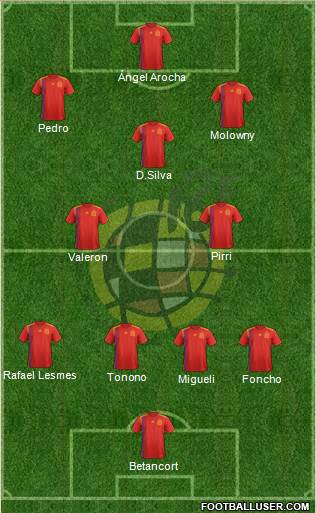
I lined up the best players. The fullbacks were old-fashioned.  Pedro had played on the right wing for Spain while Luis Molowny was a left-sided player.  Pirri was a box-to-box midfielder.  So i was not sure if I have enough defensive presence on the midfield.