Some of the best posts from this blog have been turned into a two-volume book: The Multiverse of the Beautiful Game: National Teams of Pure Fantasy.
Volume 1 takes you back in time and asks the questions every football fan has dreamed about. What if Brazil had a more beautiful team in 1982 — would they have cruised to the title? What if the United Kingdom could send its team to the 1970 World Cup? I believe they would have been the strongest side on earth. What if Argentina had fielded both Omar Sivori and Alfredo Di Stéfano together in 1958? What if Johan Cruyff had lined up alongside Marco van Basten, Ruud Gullit, and Frank Rijkaard? What if Eusébio had played for Brazil? And that's only scratching the surface — Volume 1 is packed with legendary "what ifs" that will keep you turning pages.
Volume 2 brings the fantasy closer to home. What if England had Michael Olise, Erling Haaland and others in 2026 — could they go all the way? What if Yugoslavia had gone to the World Cup in 2018? What if the United States could select more players in 2010? It would be the greatest American side ever. And what if Cristiano Ronaldo and Lionel Messi had actually played for the same national team in 2006? It could have happened — if the soccer gods had smiled on us.
Please also see my All-Time World Cup Team Index.
This is my selection of a 25 member all-time team for players who graduated from Barcelona's academy (La Masia, or The Farmhouse). The number 25 was chosen because it is the official squad size for the Champions' League.
Catalonia All-Time Team,
Barcelona All-Time Team
Barcelona All-Time Team for Spanish Players
Barcelona Dutch Best XI
Dutch-German Rivalry between Real Madrid and Barcelona.
Real Madrid Castilla Academy All-Time Team
Sporting CP Academy All-Time Team
La Masia de Can Planes, usually shortened to La Masia (Catalan pronunciation: [lə məˈzi.ə]; English: "The Farmhouse") is a term used for FC Barcelona's youth academy. It has been in operation since 1979 and has graduated numerous footballers into Barcelona’s first team. "The player who has passed through La Masia has something different to the rest, it's a plus that only comes from having competed in a Barcelona shirt from the time you were a child," former Barcelona coach Pep Guardiola said about the academy.
Team
GK: Victor Valdes (Spain)
Victor Valdes spent most of his career with Barcelona. With them, he won three Champions' league title. He also had a unsuccessful stint with Manchester United. For the national team, he only managed 20 caps due to playing behind Iker Casillas during the prime of his career. He was part of the Spanish squads that won the 2010 FIFA World Cup and UEFA Euro 2012, despite not playing in either tournament.
GK: Pepe Reina (Spain)
Pepe Reina first became a star at Villarreal when he helped the club to reach the Champions' league for the first time in history. A year later, he joined Liverpool FC. At Liverpool FC, he won three Premier League Golden Glove. He was a part of Spain at the World Cup 2010, Euro 2008 and Euro 2012, but served as a backup to Iker Casillas.
GK: Salvador Sadurní (Spain)
After one season on loan to neighbours CE Mataró he returned to alma mater FC Barcelona, where he remained for the rest of his 16-year career. He won the Ricardo Zamora Trophy in the 1968–69, 1973–74 and the 1974–75 season. He was a backup for the national team at both the 1962 FIFA World Cup and 1964 European Nations' Cup tournaments,
RB: Albert Ferrer (Spain)
Ferrer represented the nation in two World Cups and at the 1992 Olympic Games, winning the latter tournament. He was a part of Barcelona's Dream Team in the 1990's. He won a Champions' League with Barcelona in 1992. After Louis van Gaal took over, Barcelona gradually signed more Dutch players and his places were uncertain. He left for Chelsea.
CB/RB: Carles Puyol (Spain)
As an one-club man, Carles Puyol served as the long-time team captain for his only club Barcelona after taking over from Luis Enrique in August 2004, and went on to appear in 593 official games for the club and win 20 major titles, including three Champions League: 2005–06, 2008–09, 2010–11. He earned 100 caps for Spain, winning the World Cup in 2014 and the European Championship in 2008.
CB: Gerard Piqué (Spain)
Gerard Pique left the youth team of Barcelona to join Manchester United's academy in 2004. He made his debut with the senior side in the same year. He returned to Barcelona in 2008. He was La Liga Best Defender for the 2009-2010 season. From 2008 to 2018, he earned 102 caps for Spain. He was a part of the Golden Generation that won the 2010 World Cup and two European Champions.
CB: Manuel Sanchís Martínez (Spain)
Like his son, Manuel Junior, he represented Real Madrid and Spain. They were one of only three father/son pairs to have won the European Cup/Champions League. He played in 213 La Liga games over the course of ten seasons. He also represented CD Condal, Real Valladolid and Córdoba CF. An international during nearly two years, Sanchís appeared with the national team at the 1966 World Cup.
CB: Ferran Olivella (Spain)
Ferran Olivella was capped 18 times for Spain, but better remembered for being the captain of the Spanish national that won the European Championship in 1964. He was also an unused sub at the World Cup Finals in 1966. For club football, he played his entire career with Barcelona, winning the Inter-Cities Fairs Cup three times in the 1960's.
LB: Sergi Barjuan (Spain)
Sergi was promoted to Barcelona's first time in 1993. He helped them to win the UEFA Cup Winners' Cup in 1997. He moved to Atletico Madrid in 2002. He played there until retiring in 2005. He was capped 56 times for the Spanish national team. He went to two World Cup Finals (1994 and 1998) and two European Championships (1996 and 2000).
DM: Sergio Busquets (Spain)
Known for his dirty style of play, Sergio Busquets was Spain's unsung hero at winning the 2010 World Cup and the Euro 2012 tournaments. He made his national team debut in 2009. He has earned 111 caps at the time of writing. At the club lebel, he started his career in 2008 with Barcelona. He has been an important member of the team ever since. His father Charles played goalkeeper for Barcelona during the 1990's.
LB: Jordi Alba (Spain)
Jordi Alba started his career at Barcelona, but was released after being deemed too small. After joining Cornellà, he moved to Valencia. In 2012 he returned to Barcelona. At the time of writing, he has over 70 caps and was a member of the team that won the Euro 2012. He attended the 2014 and 2018 World Cup Finals.
DM: Pep Guardiola (Spain)
At the club level, Pep Guardiola won a Champions' League with Barcelona in 1992. It was Barcelona's first ever European Cup. He was their captain from 1997 to 2001. He also played for Brescia and Roma in Italy, Al-Ahli in Qatar, and Dorados de Sinaloa in Mexico. He was capped 47 times for Spain, winning the Olympic Gold Medal in 1992, and later appeared at the 1994 World Cup and Euro 2000. He also played friendly matches for Catalonia.
CM: Josep Fuste (Spain)
Josep Fuste played for Barcelona between 1960 and 1972. He also played for CA Osasuna and Hércules CF. Fusté also played 8 times for Spain. He got his debut in the 1964 European Championship. He was a part of the team that won it. He also played for Spain at the World Cup in 1966 a
AM./CM: Xavi (Spain)
Xavi was perhaps one of greatest playmakers of his generation. He won everything in football. Xavi has won 31 trophies, only surpassed by Andrés Iniesta as the most successful Spanish player in history. For the national team, he had 133 caps and was a part of the team that won the 2010 World Cup and two European Championship in between. He was named Euro 2008's player of the tournament. He was finished third at the Ballon d'Or in 2010 and 2011.
CM: Guillermo Amor (Spain)
Amor was a product of FC Barcelona's youth ranks, and made his first-team debuts in the 1988–89 season. He was a part Johan Cruyff's Dream Team that the 1992 European Cup. Amor left Barça in 1998, whet he was among the leader in appearance for the club. He then played for Fiorentina and Villarreal CF. At the international level, he earned 37 caps. He appeared in Euro 1996 and the 1998 World Cup Finals.
CM: Luis Suarez Miramontes (Spain)
Luis Suarez Miramontes was considered to be Spain's greatest player until 1970's, Luis Suarez won Ballon d'Or in 1960. In 1964, he led La Roja in winning the European Championship. For club football, he played as a midfielder for Deportivo de La Coruña, CD España Industrial, FC Barcelona, Inter Milan and Sampdoria. He was a member of "Grande Inter" and won two consecutive European Cups.
RW: Carlos Rexach (Spain)
From 1965 to 1980, Carlos Rexach played for Barcelona. He won the Pichichi Trophy in 1971. He also won the Cup Winners' Cup in 1979. He was also known for his partnership with Johan Cruyff at Barcelona. He won a combined eight titles both capacities combined, including the La Liga championship in the 1973–74 season and the 1979 Cup Winners' Cup. For the national team, he was capped 15 times. He went to the 1978 World Cup Finals in Argentina, but only appeared once in the Finals.
RW: Lobo Carrasco (Spain)
Between 1978 and 1989, Lobo played for Barcelona FC. He held the record with most Cup Winners' Cup titles. He then spent three seasons with Ligue 1 club FC Sochaux-Montbéliard. He retired after a short stint with UE Figueres. He had 35 caps with Spain between 1979 and 1988, and attended the Euro 1980 and 1984 and the 1986 World Cup in Mexico.
LM/CM/AM: Andres Iniesta (Spain)
Andres Iniesta scored the World Cup winning goal in 2010 that gave Spain its first ever World Cup title. At Euro 2012, Iniesta led Spain to their second consecutive continental crown, again being chosen as the Man of the Match of the final against Italy, and was named the Player of the Tournament. He also won Champion' league trophies with Barcelona. He had over 130 caps for Spain from 2006 to 2018.
LW/AM: Luis Garcia (Spain)
At the club level, Luis Garcia played for Barcelona and Atletico Madrid before moving to Liverpool in 2004. He won the 2005 Champions' League under Rafael Benitez after going down 3-0 at half time against AC Milan. It was marked as one of the greatest comeback in history. He played in Greece and Mexico. He was capped 20 times for Spain between 2005 and 2008. He went to the 2006 World Cup Finals in Germany.
AM/SS: Cesc Fabregas (Spain)
Cesc was lured to play for Arsenal's academy in 2003 from Barcelona FC. He made his first time debut as a teenager. he helped Arsenal to reach the Champions' league Final in 2005. He retuned to Spain in 2011 with Barcelona, but returned to England in 2014, joining Chelsea. He was a part of Spain that won the World Cup in 2010 and two European Championships.
RW/FW: Lionel Messi (Argentina)
Born and raised in central Argentina, Lionel Messi was diagnosed with a growth hormone deficiency as a child. At age 13, he relocated to Spain to join Barcelona. At time of writing, he won 4 World Player of the Year and 5 Ballon d'Or. For Argentina, he has played over 130 times. At the time of writing, he has not won an international trophy for the national team, but reached three Finals in his career.
ST: Eduardo Manchón (Spain)
Between 1950 and 1957 he played for Barcelona, where he belonged to the legendary "Five Cups-Barça" side, which won all five possible trophies in 1952. During his time with the club, he won La Liga twice, the Spanish Cup four times, the Copa Eva Duarte twice, and even the Latin Cup. He earned a single cap for Spain in 1954.
ST: Pedro (Spain)
From 2008 to 2015, Pedro played for Barcelona FC. During the 2009–10 season, he became the first player in history to score in six different official club competitions in one season. In 2015, he joined Chelsea. Since 2010, he has earned over 65 caps for Spain. He was a part of the team that won the 2010 World Cup and Euro 2012.
ST: Paulino Alcántara (Spain)
Born in the Philippines of a half-Spanish, half-Filipino, he made his debut for Barcelona at the age of 15 and remains the youngest player to play or score for the club. He also scored 100 goals in 69 matches, making him the club's highest goalscorer He was selected for the Philippine national football team in 1917 and represented his country at the Far Eastern Championship Games. In 1921. he was selected to play for Spain. He scored 6 goals in 5 games for Spain.
Honorable Mention
Jordi Cruyff, Fernando Navarro, Ramón Calderé, Albert Luque, Mikel Arteta, Thiago Motta, Ivan De La Pena, Gerard López, Thiago, Martí Vergés, Gonzalvo III, Justo Tejada, Antonio Olmo, Francisco Carrasco, Tente Sánchez, Oleguer Presas, Bojan Krkić.
Squad Explanation
-- The criteria is about the senior and overall careers of the players. Their performance as a player for Barcelona is not the main factor, but I do look for it as a minor factor.
--Victor Valdes, Albert Ferrer, Carlos Puyol, Ferran Olivella, Sergi Barjuan, Pep Guardiola. Xavi, Andres Iniesta, Lionel Messi, Paulino Alcántara are on my Barcelona All-Time Team. They formed the backbone of this team.
-- SD España Industrial served as Barcelona reserve team before 1956 when they became independent from Barcelona. In 1970, it merged with Atlètic Catalunya to become Barcelona B team. So any player who played for them before 1956 should be considered a part of Barcelona's academy player. Luis Suarez Miramontes and Manuel Sanchís Martínez became eligible because of that connection.
-- Pep Guardiola’s side from 2008 to 2012 was considered Barcelona's greatest period. The side was also filled with homegrown players. Xavi, Lionel Messi, Andreas Iniesta, Carles Puyol, Gerard Pique, Sergio Busquest, Jordi Alba and Pedro were selected. Cesc Fabregas also belonged to this generation, but he was selected for his career with Spain and Arsenal. As mentioned, the overall career is the main criteria.
-- There ain't many goalkeepers eligible. Victor Valdes was the obvious choices and followed by Salvador Sadurní. Then, I took Pepe Reina who had a remarkable career with Liverpool FC.
-- Manuel Sanchís Martínez? Yes, he was an all-time great who played for Real Madrid "Ye-ye" team. Not many people knew of his connection to Barcelona FC. He never got his chance with Barcelona and was assigned to SD España Industrial(Condal). He beat out Antonio Olmo and Fernando Navarro for a spot on the team. The rest of the defenders are obvious choices. Antonio Olmo was the only defender who was seriously considered, but failed to find a spot.
-- Gerard López, Thiago, Martí Vergés, Gonzalvo III and Thiago lost out because of too many midfielders.
-- I selected Luis Suarez Miramontes, not Luis Suarez Diaz of Uruguay. He was the greatest player for Barcelona before Johan Cruyff joined the team. He actually played for Deportivo La Coruna's senior team before he moved to play for SD España Industrial, which served as Barcelona's reserve team. After careful consideration, I decided that he was eligible.
-- Both Cesc Fabregas and Gerard Pique also left Barcelona's youth team and joined the youth team of Arsenal and Manchester United respectively. I still considered them as a part of La Masia's alumni. Gerard Piqué also included on my Manchester United's academy. Most of his youth career was spent here.
-- Most of my all-time teams are loaded with strikers, but I struggled to find eligible strikers. I almost selected Albert Luque who had a good career with Deportivo La Coruna. Anyway, Lionel Messi played on the center of attack. So I do not need too many center forwards(strikers).
Formation
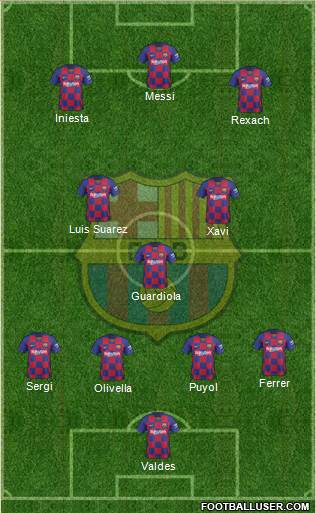
-- Lionel Messi must play in the center. I also pushed Andreas Iniesta up front so that I could play both Luis Suarez Miramontes and Xavi. Pep Guardiola was a much better passer than Sergio Busquets, but te team might need Busquets' defensive presence.

,
This is my selection of a 25 member all-time team for players who graduated from Barcelona's academy (La Masia, or The Farmhouse). The number 25 was chosen because it is the official squad size for the Champions' League.
Catalonia All-Time Team,
Barcelona All-Time Team
Barcelona All-Time Team for Spanish Players
Barcelona Dutch Best XI
Dutch-German Rivalry between Real Madrid and Barcelona.
Real Madrid Castilla Academy All-Time Team
Sporting CP Academy All-Time Team
La Masia de Can Planes, usually shortened to La Masia (Catalan pronunciation: [lə məˈzi.ə]; English: "The Farmhouse") is a term used for FC Barcelona's youth academy. It has been in operation since 1979 and has graduated numerous footballers into Barcelona’s first team. "The player who has passed through La Masia has something different to the rest, it's a plus that only comes from having competed in a Barcelona shirt from the time you were a child," former Barcelona coach Pep Guardiola said about the academy.
 |
| Carles Puyol and Xavi |
GK: Victor Valdes (Spain)
Victor Valdes spent most of his career with Barcelona. With them, he won three Champions' league title. He also had a unsuccessful stint with Manchester United. For the national team, he only managed 20 caps due to playing behind Iker Casillas during the prime of his career. He was part of the Spanish squads that won the 2010 FIFA World Cup and UEFA Euro 2012, despite not playing in either tournament.
GK: Pepe Reina (Spain)
Pepe Reina first became a star at Villarreal when he helped the club to reach the Champions' league for the first time in history. A year later, he joined Liverpool FC. At Liverpool FC, he won three Premier League Golden Glove. He was a part of Spain at the World Cup 2010, Euro 2008 and Euro 2012, but served as a backup to Iker Casillas.
 |
| Victor Valdes and Pepe Reina |
After one season on loan to neighbours CE Mataró he returned to alma mater FC Barcelona, where he remained for the rest of his 16-year career. He won the Ricardo Zamora Trophy in the 1968–69, 1973–74 and the 1974–75 season. He was a backup for the national team at both the 1962 FIFA World Cup and 1964 European Nations' Cup tournaments,
RB: Albert Ferrer (Spain)
Ferrer represented the nation in two World Cups and at the 1992 Olympic Games, winning the latter tournament. He was a part of Barcelona's Dream Team in the 1990's. He won a Champions' League with Barcelona in 1992. After Louis van Gaal took over, Barcelona gradually signed more Dutch players and his places were uncertain. He left for Chelsea.
 |
| Albert Ferrer |
As an one-club man, Carles Puyol served as the long-time team captain for his only club Barcelona after taking over from Luis Enrique in August 2004, and went on to appear in 593 official games for the club and win 20 major titles, including three Champions League: 2005–06, 2008–09, 2010–11. He earned 100 caps for Spain, winning the World Cup in 2014 and the European Championship in 2008.
CB: Gerard Piqué (Spain)
Gerard Pique left the youth team of Barcelona to join Manchester United's academy in 2004. He made his debut with the senior side in the same year. He returned to Barcelona in 2008. He was La Liga Best Defender for the 2009-2010 season. From 2008 to 2018, he earned 102 caps for Spain. He was a part of the Golden Generation that won the 2010 World Cup and two European Champions.
CB: Manuel Sanchís Martínez (Spain)
Like his son, Manuel Junior, he represented Real Madrid and Spain. They were one of only three father/son pairs to have won the European Cup/Champions League. He played in 213 La Liga games over the course of ten seasons. He also represented CD Condal, Real Valladolid and Córdoba CF. An international during nearly two years, Sanchís appeared with the national team at the 1966 World Cup.
CB: Ferran Olivella (Spain)
Ferran Olivella was capped 18 times for Spain, but better remembered for being the captain of the Spanish national that won the European Championship in 1964. He was also an unused sub at the World Cup Finals in 1966. For club football, he played his entire career with Barcelona, winning the Inter-Cities Fairs Cup three times in the 1960's.
LB: Sergi Barjuan (Spain)
Sergi was promoted to Barcelona's first time in 1993. He helped them to win the UEFA Cup Winners' Cup in 1997. He moved to Atletico Madrid in 2002. He played there until retiring in 2005. He was capped 56 times for the Spanish national team. He went to two World Cup Finals (1994 and 1998) and two European Championships (1996 and 2000).
 |
| Sergi |
Known for his dirty style of play, Sergio Busquets was Spain's unsung hero at winning the 2010 World Cup and the Euro 2012 tournaments. He made his national team debut in 2009. He has earned 111 caps at the time of writing. At the club lebel, he started his career in 2008 with Barcelona. He has been an important member of the team ever since. His father Charles played goalkeeper for Barcelona during the 1990's.
LB: Jordi Alba (Spain)
Jordi Alba started his career at Barcelona, but was released after being deemed too small. After joining Cornellà, he moved to Valencia. In 2012 he returned to Barcelona. At the time of writing, he has over 70 caps and was a member of the team that won the Euro 2012. He attended the 2014 and 2018 World Cup Finals.
DM: Pep Guardiola (Spain)
At the club level, Pep Guardiola won a Champions' League with Barcelona in 1992. It was Barcelona's first ever European Cup. He was their captain from 1997 to 2001. He also played for Brescia and Roma in Italy, Al-Ahli in Qatar, and Dorados de Sinaloa in Mexico. He was capped 47 times for Spain, winning the Olympic Gold Medal in 1992, and later appeared at the 1994 World Cup and Euro 2000. He also played friendly matches for Catalonia.
 |
| Pep Guardiola |
Josep Fuste played for Barcelona between 1960 and 1972. He also played for CA Osasuna and Hércules CF. Fusté also played 8 times for Spain. He got his debut in the 1964 European Championship. He was a part of the team that won it. He also played for Spain at the World Cup in 1966 a
AM./CM: Xavi (Spain)
Xavi was perhaps one of greatest playmakers of his generation. He won everything in football. Xavi has won 31 trophies, only surpassed by Andrés Iniesta as the most successful Spanish player in history. For the national team, he had 133 caps and was a part of the team that won the 2010 World Cup and two European Championship in between. He was named Euro 2008's player of the tournament. He was finished third at the Ballon d'Or in 2010 and 2011.
CM: Guillermo Amor (Spain)
Amor was a product of FC Barcelona's youth ranks, and made his first-team debuts in the 1988–89 season. He was a part Johan Cruyff's Dream Team that the 1992 European Cup. Amor left Barça in 1998, whet he was among the leader in appearance for the club. He then played for Fiorentina and Villarreal CF. At the international level, he earned 37 caps. He appeared in Euro 1996 and the 1998 World Cup Finals.
CM: Luis Suarez Miramontes (Spain)
Luis Suarez Miramontes was considered to be Spain's greatest player until 1970's, Luis Suarez won Ballon d'Or in 1960. In 1964, he led La Roja in winning the European Championship. For club football, he played as a midfielder for Deportivo de La Coruña, CD España Industrial, FC Barcelona, Inter Milan and Sampdoria. He was a member of "Grande Inter" and won two consecutive European Cups.
 |
| Luis Suarez Miramontes |
From 1965 to 1980, Carlos Rexach played for Barcelona. He won the Pichichi Trophy in 1971. He also won the Cup Winners' Cup in 1979. He was also known for his partnership with Johan Cruyff at Barcelona. He won a combined eight titles both capacities combined, including the La Liga championship in the 1973–74 season and the 1979 Cup Winners' Cup. For the national team, he was capped 15 times. He went to the 1978 World Cup Finals in Argentina, but only appeared once in the Finals.
RW: Lobo Carrasco (Spain)
Between 1978 and 1989, Lobo played for Barcelona FC. He held the record with most Cup Winners' Cup titles. He then spent three seasons with Ligue 1 club FC Sochaux-Montbéliard. He retired after a short stint with UE Figueres. He had 35 caps with Spain between 1979 and 1988, and attended the Euro 1980 and 1984 and the 1986 World Cup in Mexico.
LM/CM/AM: Andres Iniesta (Spain)
Andres Iniesta scored the World Cup winning goal in 2010 that gave Spain its first ever World Cup title. At Euro 2012, Iniesta led Spain to their second consecutive continental crown, again being chosen as the Man of the Match of the final against Italy, and was named the Player of the Tournament. He also won Champion' league trophies with Barcelona. He had over 130 caps for Spain from 2006 to 2018.
 |
| Andres Iniesta |
At the club level, Luis Garcia played for Barcelona and Atletico Madrid before moving to Liverpool in 2004. He won the 2005 Champions' League under Rafael Benitez after going down 3-0 at half time against AC Milan. It was marked as one of the greatest comeback in history. He played in Greece and Mexico. He was capped 20 times for Spain between 2005 and 2008. He went to the 2006 World Cup Finals in Germany.
AM/SS: Cesc Fabregas (Spain)
Cesc was lured to play for Arsenal's academy in 2003 from Barcelona FC. He made his first time debut as a teenager. he helped Arsenal to reach the Champions' league Final in 2005. He retuned to Spain in 2011 with Barcelona, but returned to England in 2014, joining Chelsea. He was a part of Spain that won the World Cup in 2010 and two European Championships.
RW/FW: Lionel Messi (Argentina)
Born and raised in central Argentina, Lionel Messi was diagnosed with a growth hormone deficiency as a child. At age 13, he relocated to Spain to join Barcelona. At time of writing, he won 4 World Player of the Year and 5 Ballon d'Or. For Argentina, he has played over 130 times. At the time of writing, he has not won an international trophy for the national team, but reached three Finals in his career.
 |
| Lionel Messi |
Between 1950 and 1957 he played for Barcelona, where he belonged to the legendary "Five Cups-Barça" side, which won all five possible trophies in 1952. During his time with the club, he won La Liga twice, the Spanish Cup four times, the Copa Eva Duarte twice, and even the Latin Cup. He earned a single cap for Spain in 1954.
ST: Pedro (Spain)
From 2008 to 2015, Pedro played for Barcelona FC. During the 2009–10 season, he became the first player in history to score in six different official club competitions in one season. In 2015, he joined Chelsea. Since 2010, he has earned over 65 caps for Spain. He was a part of the team that won the 2010 World Cup and Euro 2012.
ST: Paulino Alcántara (Spain)
Born in the Philippines of a half-Spanish, half-Filipino, he made his debut for Barcelona at the age of 15 and remains the youngest player to play or score for the club. He also scored 100 goals in 69 matches, making him the club's highest goalscorer He was selected for the Philippine national football team in 1917 and represented his country at the Far Eastern Championship Games. In 1921. he was selected to play for Spain. He scored 6 goals in 5 games for Spain.
Honorable Mention
Jordi Cruyff, Fernando Navarro, Ramón Calderé, Albert Luque, Mikel Arteta, Thiago Motta, Ivan De La Pena, Gerard López, Thiago, Martí Vergés, Gonzalvo III, Justo Tejada, Antonio Olmo, Francisco Carrasco, Tente Sánchez, Oleguer Presas, Bojan Krkić.
Squad Explanation
-- The criteria is about the senior and overall careers of the players. Their performance as a player for Barcelona is not the main factor, but I do look for it as a minor factor.
--Victor Valdes, Albert Ferrer, Carlos Puyol, Ferran Olivella, Sergi Barjuan, Pep Guardiola. Xavi, Andres Iniesta, Lionel Messi, Paulino Alcántara are on my Barcelona All-Time Team. They formed the backbone of this team.
-- SD España Industrial served as Barcelona reserve team before 1956 when they became independent from Barcelona. In 1970, it merged with Atlètic Catalunya to become Barcelona B team. So any player who played for them before 1956 should be considered a part of Barcelona's academy player. Luis Suarez Miramontes and Manuel Sanchís Martínez became eligible because of that connection.
-- Pep Guardiola’s side from 2008 to 2012 was considered Barcelona's greatest period. The side was also filled with homegrown players. Xavi, Lionel Messi, Andreas Iniesta, Carles Puyol, Gerard Pique, Sergio Busquest, Jordi Alba and Pedro were selected. Cesc Fabregas also belonged to this generation, but he was selected for his career with Spain and Arsenal. As mentioned, the overall career is the main criteria.
-- There ain't many goalkeepers eligible. Victor Valdes was the obvious choices and followed by Salvador Sadurní. Then, I took Pepe Reina who had a remarkable career with Liverpool FC.
-- Manuel Sanchís Martínez? Yes, he was an all-time great who played for Real Madrid "Ye-ye" team. Not many people knew of his connection to Barcelona FC. He never got his chance with Barcelona and was assigned to SD España Industrial(Condal). He beat out Antonio Olmo and Fernando Navarro for a spot on the team. The rest of the defenders are obvious choices. Antonio Olmo was the only defender who was seriously considered, but failed to find a spot.
-- Gerard López, Thiago, Martí Vergés, Gonzalvo III and Thiago lost out because of too many midfielders.
-- I selected Luis Suarez Miramontes, not Luis Suarez Diaz of Uruguay. He was the greatest player for Barcelona before Johan Cruyff joined the team. He actually played for Deportivo La Coruna's senior team before he moved to play for SD España Industrial, which served as Barcelona's reserve team. After careful consideration, I decided that he was eligible.
-- Both Cesc Fabregas and Gerard Pique also left Barcelona's youth team and joined the youth team of Arsenal and Manchester United respectively. I still considered them as a part of La Masia's alumni. Gerard Piqué also included on my Manchester United's academy. Most of his youth career was spent here.
-- Most of my all-time teams are loaded with strikers, but I struggled to find eligible strikers. I almost selected Albert Luque who had a good career with Deportivo La Coruna. Anyway, Lionel Messi played on the center of attack. So I do not need too many center forwards(strikers).
Formation
-- Lionel Messi must play in the center. I also pushed Andreas Iniesta up front so that I could play both Luis Suarez Miramontes and Xavi. Pep Guardiola was a much better passer than Sergio Busquets, but te team might need Busquets' defensive presence.
,