I found this old issue of "World Soccer" from 2/2001 at home. The article was "100 Rising Stars". Almost 15 years later, the youngsters grew up and even retired. Let's see how they were.
Players were born 1978 to 1982.
* David Villa born in 1981 was missing. Klose(1978) too.
* I highlighted in bold the players who became well-known among soccer fans.
Yakubu Abubakari
Ishmael Addo
Rabiu Afolabi
Julius Aghahowa
Pablo Aimar
Mohammad Al-Shlhoob
Matthew Amoah
Juan Arango
Gerald Asamoah
Emille Baron
DaMarcus Beasley
Igor Biscan
Wilfred Bouma
Wes Brown
Moises Candelario
John Carew
Fabian Carini
Iker Casillas
Antonio Cassano
Cristian Chivu
Lambros Choutos
Pholippe Chrstanval
Joe Cole
Bobby Convey
Walter Corozo
Paulo Da Silva
Stephane Dalmat
Sebastian Deisler
Boubacar Diarra
Aruba Dindane
Landon Donovan
Kieron Dyer
Edu
Emre Belezoglu
Samuel Eto'o
Fabio Aurelio
Francisco Farinos
Pascal Feindound
Barry Ferguson
Gabri
Ronaldo Garcia
Steven Gerrard
Helton
Ahmed Salah Hosny
Pius Ikedia
Junichi Inamoto
Issac(angola)
Juan
Carlos Idriss Kameni(Cameroon)
Robbie Keane
Harry Kewell
Mateja Kezman
Mickel Landreau
Peter Luccin
Luis Felipe(Portugal)
Claudio Maldonado
Rafael Marquez
Matuzalem(Brazil)
Philippe Mexes
Aaron Mokoena
Jhonnier Montano
Tressor Moreno
Emile Mpenza
Adrian Mutu
Szilard Nemeth
Andres Olivera
Michael Owen
Christos Patsatzoglou
Andrea Pirlo
Claudio Pizarro
David Pizarro
Stipe Pletikosa
Prince Daye
Luis Gatty Ribeiro
John Arne Riise
Juan Roman Riquelme
Leandro Romagnoli
Ronaldimho
Tomas Rosicky
Walter samuel
Roque Santa Cruz
Javier Saviola
Simao Sabrosa
Gonzalo Sorondo
David Suazo
Jean-Michel Tchouga
Rodrigo Tello
Christian Timm
Razundara Tjikuzu
Svetoslav Todorov
Joselito Vaca
Jan Vennegoor of Hesselink
Nicola Ventola
Xavi
Ngidi Yemweni
Jonathan Zebina
Emmanuel Zulu
Please also see my All-Time World Cup Team Index.
Ethnicity
French Black Players
Black English players
French Algerian
African American Players, German Americans/American Germans
German Turks
Hispanic/Latino American Players(USA)
Italian diaspora
Polish diaspora
Black Portuguese Players
Afro-Brazilian Players
Surnamese-Dutch
Dutch-Indos/Indonesia-born Dutch All-Time Team
Chinese Diaspora
I am Lincoln W Chan from Hong Kong also aka Excapegoat at bigsoccer. This blog is mainly about all-time teams.
Thursday, September 4, 2014
Wednesday, September 3, 2014
World Cup 1958: Missing players
Please also see my All-Time World Cup Team Index.
What if Argentina sent this team to Sweden 1958
The World Cup Finals was an interesting tournament. A few dramatic events forced teams not to take their best players to the tournament, which gave way to the 17 years old Pele and Garrincha to shine in Sweden.
Hungary: Because of the Hungarian Revolution of 1956 and the Soviet invasion that followed, several members of the Magical Magyars that charmed the world 4 years ago went into exile. Ferenc Puskás was 31 years old in 1958. He was "club-less" and out of shape at the time of Sweden 1958. But if there were no Soviet invasion, he would have been playing regularly from 1956, and would have arrived in Sweden in good shape. His performance in 1958 onward proved that he could play at the highest level past the age of 31. Sándor Kocsis and Zoltán Czibor were playing regularly outside of Hungary. Gyula Grosics, József Bozsik and Nándor Hidegkuti went to Sweden, where they were eliminated in the first round.
Argentina: As mentioned in a previous blog, Argentina lost
Omar Sivori, Antonio Angelillo and Humberto Mashio
due to oriundo. Alfredo Di Stéfano was the best player in the world and he was also an Argentine too.
England: The Munich air Disaster was only four months before the start of the World Cup Finals in Sweden. Duncan Edwards, Roger Byrne and Tommy Taylor would have been starters, and Eddie Colman probably would make the team too. England went out in the first round.
Please also see my All-Time World Cup Team Index.
Tuesday, September 2, 2014
The most unsportmenlike match: Indonesia vs Thailand (Tiger Cuo 1998)
Please also see my All-Time World Cup Team Index.
South East Asia(ASEAN).
On August 31st, 1998, Indonesia and Thailand met at the last match of the Group A of the Tiger Cup. The game was one of the most unsportmenlike games in the history of football. A day earlier, the host Vietnam finished second in the group on goal difference after beating Malaysia by only a single goal. Thus, the winner of Group A must play Vietnam at the semifinal in Hanoi and Singapore the Group B winner was perceived as the easier opponent. Besides, all of Gorup A matches were played in Ho Chi Minh City and both Indonesia and Thailand did not want to move to Hanoi for the semifinal. At the start of the match, Indonesia was leading the Group by 2 points. They would finish first with a draw.
The first half was a boring match, with both teams barely making an attempt to score. During the second half both teams scored and the match was 2-2 draw heading toward injury time. Then, during injury time, Indonesian defender Mursyid Effendi deliberately scored an own goal, despite the Thai's attempts to stop him doing so. The Thais immediately tried to score an own goal, but it was too late, Thailand finished as the group winner.
In the semi-finals, Thailand lost to Vietnam, and Indonesia also lost to Singapore. In the final, Singapore surprised the host by winning 1-0. Both Thailand and Indonesia were punished for unsportmenship and Mursyid Effendi was banned from football for life.
Please also see my All-Time World Cup Team Index.
Monday, September 1, 2014
From NCAA soccer to Chelsea's executive: Michael Emenalo
Please also see my All-Time World Cup Team Index.
Michael Emenalo is one of the few Black executive in English football. At the time of writing, he is criticised by Chelsea fans for his mismanagement of recent transfers. However, at one point, he was considered to be a genius at the "art" of football transfers. His assent to the top of football world was very dramatic.
Emenalo left Nigeria for a college education in the US. He joined Boston University in 1986, where he excelled in both classroom and the soccer field. He earned "All-American" selection while at BU. Upon graduation, he went to play for Molenbeek in Belgium, Eintracht Trier in Germany and Notts County F.C in England before going back to the MLS. Emenalo was part of the original allocated players for Major League Soccer and spent two seasons (1996–97) with the San Jose Clash. After that, he played with Lleida in Spain and Maccabi Tel Aviv in Israel.
He was capped 14 times by Nigeria, and played all but one of Nigeria's game at USA 1994.
At Maccabi Tel Aviv, he played under Avram Grant and Grant was impressed with his intelligence. When Grant went to Chelsea, he brought Emenalo with him in 2007. Perhaps, he was one of the few professional players with a college degree. He quickly worked his way up. On 8 July 2011, Chelsea appointed Emenalo Technical Director, making him one of the most powerful men at the club. His responsibilities include heading the scouting and academy programs.
![]() |
| Emenalo went to Boston University and became one of the few Black, football executive in Europe. |
Friday, August 29, 2014
Sporting Lisbon SP Youth Academy All-Time Team
This blogger Artur Yanturin of Russia copied many of my blog teams. This blog was one of them. It was my Russia All-Time Team here. His team was written in 2020, but mine was uploaded in 2014. His Spartak Moscow All-Time team entry of was published in October 2020, but mine was uploaded in 2017. His entry of the Dutch-German rivalry between Real Madrid and Barcelona was written in 2020, but mine was uploaded in 2014. He also copied many many of my blog entries.
Parts of this blog have been collected into a book: "The Multiverse of the Beautiful Game: National Teams of Pure Fantasy, Volume 1".
![]() |
| Luis Figo |
Parts of this blog have been collected into a book: "The Multiverse of the Beautiful Game: National Teams of Pure Fantasy, Volume 1".
Argentina World Cup 1946, Argentina World Cup 1958, Spain World Cup 1958, United Kingdom World Cup 1970, Brazil 1982 with Careca, United Kingdom World Cup 1982, Netherlands Euro 1984 with Cruyff, Van Basten, Gullit.
It is available for purchase on Amazon.com. Please click here. ***
Please also see my All-Time World Cup Team Index
Portugal
Benfica, Porto, Sporting SP
This blog was originally written before I started my entire All-Time World Cup Team series. It was just few paragraphs about the wingers groomed Sporting Clube de Portugal (Academia Sporting). They are known for producing great wingers/wing forwards. Paulo Futre, Cristiano Ronaldo, Luis Figo, Nani, Simao, Ricardo Quaresma and Luís Boa Morte all came through the academy. Two of them won Ballon D'Or. In 2019, I started to write about youth academies. Sporting CP is among the best in the world, largely because of their wingers. So I simply edited this blog entires.
Sporting Clube de Portugal is one of the big three in Portuguese football. They won numerous of domestic titles and the 1963-1964 European Cup Winners' Cup. They are also famous for their football academy. Paulo Futre, Cristiano Ronaldo, Luis Figo, João Moutinho, Nani, Simao, Ricardo Quaresma, Rui Patricio, Nuno Valente, etc are some of their most famous graduates. Eight of Portugal's starting eleven and two of three subs used at the Final of Euro 2016 came from the academy.
Team
GK: Rui Patrício (Portugal)
Rui Patrico was a graduate of Sporting CP's academy. Between 2006 and 2018, he played for their first team. In 2018, he moved to play in for Wolverhampton Wanderers. He became a part of Portugal's player pool in 2008, but only made his debut in 2010. He was the starting keeper at Euro 2012 and 2016, World Cup Finals 2014 and 2018. Euro 2016. His performance at Euro 2016 helped Portugal to win their first major international tournament.
GK: Vitor Damas (Portugal)
Vitor Damas was the starting keeper for Sporting CP from 1966 to 1976, winning two leagues and three cups, including the double in 1973–74. He had spells with Racing Santander in Spain. He played for with Vitória S.C. and Portimonense SC before returning to Sporting in 1984. He had 29 caps. He was second-choice at both Euro 1984 and the 1986 World Cup, but in the latter tournament, he played two matches.
GK: Manuel Bento (Portugal)
Manuel Bento is the Portugal Goalkeeper of the Year for 8 times. He represented Portugal at the European Championship in 1984, where Portugal nearly pulled an upset over eventual winner and host France in the semifinal. He also played in the 1986 World Cup. He earned 63 caps in total. At the club level, he played nearly 20 years for Benfica, appearing in 630 appearances. He was Portuguese Footballer of the Year in 1977.
RB: Miguel (Portugal)
Miguel played the vast majority of his professional career with Benfica (five seasons) and Valencia (seven). Miguel gained 59 caps for Portugal during the 2000s, and represented the country in two World Cups (2006 and 2010) and as many European Championships (2004 and 2008). In 2004, he was a part of the national team that finished second in Euro 2004.
RB: Cédric Soares (Portugal)
Cédric Soares's career started with Sporting CP, going on to appear in 93 competitive games over the course of four Primeira Liga seasons and scoring two goals. He signed for Southampton in 2015. At the time of writing, he is on loan with Arsenal. He has 33 caps at the moment. He was a part of the team that won the Euro 2016. He also went to the 2018 World Cup Finals.
CB: Alexandre Baptista (Portugal)
Baptista played his entire professional career, which spanned 11 years, with Sporting Clube de Portugal, winning five major titles whilst being first-choice in four of those. He took the pitch as the Lisbon side defeated MTK Budapest FC to conquer the 1963–64 edition of the UEFA Cup Winners' Cup. For Portgual, he earned 11 caps. He played on all matches at the 1966 World Cup Finals.
CB: José Fonte (Portugal)
Fonte started his professional career with Sporting CP B, moving to England with Crystal Palace in 2007. In 2010 he signed with Southampton where he made 288 appearances in all competitions, until he joined West Ham United in January 2017; he then represented Dalian Yifang in China and Lille in France. Fonte was part of Portugal's squad at Euro 2016 and the 2018 World Cup, winning the former tournament.
CB: Marco Caneira (Portugal)
Marco Caneira started his career at Sporting SP, also appearing briefly for Benfica and represented Valencia in La Liga for a couple of years before returning to Sporting. Over ten seasons, he amassed Primeira Liga totals of 126 matches and one goal; he retired in 2015, after a four-year stint with Videoton. Internationally, Caneira appeared for Portugal at 2002 and 2006 World Cups and earned 25 caps in six years.
CB: João Laranjeira (Portugal)
From 1970 to1979, João Laranjeira played for Sporting CP. Then, he played for Benfica from 1979 to 1982. Then, he played a single season with Amora. Laranjeira gained 12 caps for the Portugal national team. He played his first national team match on June 11, 1972 as part of the Brazilian Independence Cup against Ecuador. Portugal finished second.
LB: Augusto Inácio (Portugal)
Inácio started playing for Sporting CP, signing at the age of 27 for FC Porto and winning several Primeira Liga championships and domestic cups with both clubs. He was a part of Porto's 1986–87 European Cup victory. He earned 25 caps for Portugal. His debut came on 5 December 1976 in a 2–1 win over Cyprus in the 1978 World Cup qualifiers, and he represented the nation at Euro 1984 and the 1986 World Cup.
DM: William Carvalho (Portugal)
Born in Luanda, Angola, Carvalho moved to Portugal when he was just a few years old. At the time of writing, except two loan spells, he has mainly played for Sporting SP. Carvalho first grained international recognition when he was named player of the tournament at the 2015 European Under-21 Championship. At Euro 2016, he established as a starter of the national team. He was also a member of Portugal's team at the 2014 WC Finals.
DM: Miguel Veloso (Portugal)
Miguel Veloso started his career with Sporting CP in 2005. Later, he payed with Genoa, FC Dynamo Kyiv and Verona. From 2007 onward, he has over 50 caps for Portugal. He was a member of the 2008 European Championship team as well as the 2010 and 2014 World Cup team. His father António Veloso also played for Portugal.
DM: Eric Dier (England)
CM: Carlos Xavier (Portugal)
Born in Portuguese Mozambique, Carlos Xavier played 11 seasons with Sporting CP before joining Real Sociedad with teammate Oceano in 1991. He returned to Sporting CP also with Oceano in 1994. At the international level, he was capped 10 times between 1981 and 1993. His twin brother Pedro was also a capped player for Portugal.
CM Joao Mario (Portugal)
João Mário started with Sporting CP. In 2016, he joined Inter Milan. He played briefly on loan to West Ham, but at the time of writing, he is now on loan to Russian club Lokomotiv Moscow. Since 2014, he had over 40 caps for Portugal. He played every matches at Euro 2016, where Portugal won their first major international trophy. He also went to the 2018 World Cup Finals.
CM: Joao Moutinho (Portugal)
Joao Moutinho established himself at Sporting before moving to Porto. In his first season, he won the treble, including the 2011 Europa League. In 2013, Porto sold him to Monaco. For Portugal, he became a key player since Euro 2012. He was a part of the team that won the Euro 2016 in France. In 2012, he missed the penalty against Spain in semifinal shootout. Four years later, urged by Cristano Ronaldo, he converted his penalty kick against Poland.
RW: Nani (Portugal)
Nani came through the ranks of Sporting CP. In 2007, he joined Manchester United, where his career was up and down. He was a part of the team that won the Champions' League in 2009. He earned over a 110 caps for Portugal. He is a regular member of the national team from 2006 onward. He contributed to Portugal's winning Euro 2016 as one of their key players. He also particoipated at the 2014 World Cup Finals in Brazil.
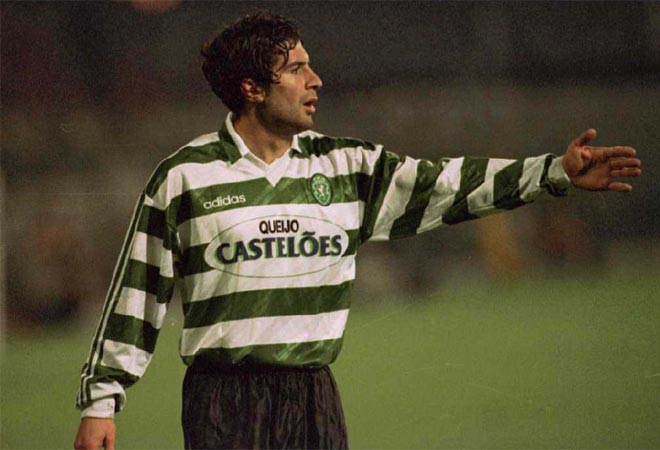
RW: Luis Figo (Portugal)
Luis Figo is probably one of Portugal's greatest players. He was the 2000 European Footballer of the Year and the 2001 FIFA World Player of the Year. He started with Sporting CP. He was known for his controversial 2000 transfer from Barcelona to bitter rivals Real Madrid. It set a world record fee of £37 million (€62 million). With Real Madrid, he was the first member of the Galacticos. He won the Champions' League title in 2002. He played for Inter Milan and Sporting SP.
RW/LW: Ricardo Quaresma (Portugal)
Ricardo Quaresma started his career with Sporting CP and moved to Barcelona as a highly, rated winger in 2003. After three successful years with Porto, he went to Inter Milan and then, Besiktas. He is often seemed as a player unable to fulfill his talents. However, he had a great Euro 2016, where Portugal won its first ever major trophy. He scored the lone goal vs Croatia in the round of 16 and the winning penalty kick in the quarterfinal against Poland.
LW: Paulo Futre (Portugal)
Paulo Futre won a European Cup with Porto in 1987. He was the best Portuguese player in the 1980's. He gained more than 40 caps for his country, representing it at the 1986 World Cup in Mexico. He played in Spain, France, Italy and Japan, most notably with Atlético Madrid and Porto. With Porto, he won the European Cup in 1987, putting on a Man of the match performance in the final against FC Bayern Munich.
LW: Simão Sabrosa
Having played in his country for two of the three biggest teams in the nation, Benfica and Sporting, he also spent several years of his professional career in Spain, notably with Atlético Madrid. He won the 2004–05 national championship with the first club and the 2010 Europa League with the third, amongst other accolades. from 1998 to 2010, he earned 85 caps. He was a member of Euro 2004 and 2008 as welll as the 2006 and 2010 World Cup team.
FW/RW: Adolfo Mourão
Adolfo Mourão was born in 1912. He played his entire career with Sporting CP from 1928 to 1944. He made his national team debut 11 March 1934 in Madrid, in a 0-9 defeat against Spain.In total, he played 15 times for Portugal, scoring two goals. According various source, he was also a right winger.
FW/LW: Cristano Ronaldo (Portugal)
Cristano Ronaldo is one of the greatest forward of his generation. He is the most expensive players in history from 2009-2013 when he moved from Manchester United to Real Madrid. At the time of writing, he won the Ballon d'Or winner twice and won Champions' League titles with both Manchester United and Real Madrid. He helped Portugal to reach the Final of European Championship in 2004 and 2016, winning it in 2016.
ST: Rui Águas
Águas started his career with amateurs Real Desportivo Benfica and played in the lower division before joining Benfica in 1985. He later also played for Porto. He also played in Italy for Reggiana. In total, Águas received 31 caps for the national team, scoring ten goals. His last game was for the 1994 World Cup qualifiers on 17 November 1993, losing to Italy 0–1.
ST: Jorge Cadete (Portugal)
From 1987 to 1995, Jorge Cadete played for Sporting CP. He was remembered for playing with Celtic in Scotland, where he was the league scorer in his only season there(1996-1997). He later played with Celta Vigo, Benfica, etc. Cadete won 33 caps for the Portuguese national team scoring five goals, 22 while at Sporting, nine while at Celtic and two as a Celta player. He went to Euro 1996.
Honorable Mention
Fernando Manuel Antunes Mendes, Nuno Valente, Hugo Viana, Luís Boa Morte, Adrien Silva, Silvestre Varela.
Squad Explanation
-- Sporting CP helped produce two FIFA World Player of the Year winners (Luís Figo and Cristiano Ronaldo), two Ballon d'Or winners (Luís Figo and Cristiano Ronaldo) and one runner-up (Paulo Futre), and one FIFA Ballon d'Or winner (Cristiano Ronaldo).
-- Vitor Damas, Beto, Fernando Mendes, Carlos Xavier, Luis Figo and Cristano Ronaldo are on my Sporting CP All-Time team.
-- The criteria is the overall career of individual players. For example, Manuel Bento, Paulo Futre, Cristano Ronaldo, etc did little with the club, but they are still considered the greatest players ever produced by this academy.
-- The blog was created in August, 2014 before I created my first All-Time team in October, 2014. I was amazed by the numbers of wingers produced Sporting CP. It was simply a paragraph or two describing the wingers. I mentioned Paulo Futre, Cristiano Ronaldo, Luis Figo, Nani, Simao, Ricardo Quaresma and Luís Boa Morte.
-- Portugal won the 2016 European Championship with significant contributions from Sporting CP. Eight of Portugal's starting eleven and two of three subs used at the Final of Euro 2016 came from the academy. They are Cristano Ronaldo, Rui Patricio, Joao Mario, William Carvalho, Adrin Silva, Jose Fonte, Joao Moutinho, Nani, Ricardo Quaresma and Cedric. However, only Rui Patricio, Joao Mario, William Carvalho and Adrien Silva were active player for the club in 2016, but they are largest representatives from a Portuguese club.
-- I took Augusto Inácio over Fernando Mendes and Nuno Valente for the leftback position.
-- The centerback position is relatively weak. João Laranjeira and Alexandre Baptista are club legends. Marco Caneira was capped 25 times.
-- I selected Fernando Mamede Mendes who was a midfielder. The other Fernando Manuel Antunes Mendes was a leftback.
-- Carlos Xavier's twin brother played for South China, a club that I supported.
-- Eric Dier was an important player as England reached the semifinal of the 2018 World Cup Finals. He was also responsible for Tottenham Hotspurs reaching the Champions' League Final.
-- Since the original blog team was aboiut wingers, I am overloaded with wingers. I have three left wingers.
-- Paulo Futre was the greatest Portuguese players between Esuebio's generation and Luis Figo. He did not play much for Sporting CP, but the criteria for this team is about the overall career. He have done enough with his club career.
--Cristano Ronaldo was more of a wing forward. I do not need to explain why I selected him. Cristiano Ronaldo was the first player to play for Sporting CP's U16, U18, U19, U21, B team and the senior team in one season.
-- I could not drop Simão Sabrosa so I took him as well.
-- I brought three right wingers because I could not decide between Nani and Ricardo Quaresma. Both players were often described as flops. Their careers largely affected by false expectations when they were young players. They have decent careers and contributed to Portugal's Euro 2016 victories, which was Portugal's highest honors.
-- Adolfo Mourão played his entire career with Sporting SP, but I do not know if the academy existed in the 1930's. He was also listed as a right winger. So I have four right wingers.
-- Ricardo Quaresma is less than two years older than Cristano Ronaldo. He made his senior debut with Sporting CP the season before Ronaldo made his. Both were rated as good as each other. They were transferred out of the club on the same summer. He went to Barcelona while Ronaldo headed to Manchester United. His career was not as good as Ronaldo, but he did help Portugal to win the European Championship in 2016 as an important player of the team.
-- I have no space for wingers, Luís Boa Morte and Silvestre Varela.
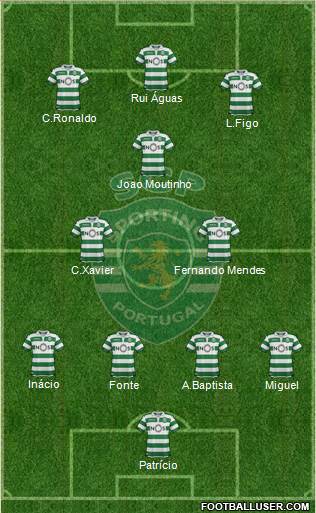
Formation
Portugal
Benfica, Porto, Sporting SP
This blog was originally written before I started my entire All-Time World Cup Team series. It was just few paragraphs about the wingers groomed Sporting Clube de Portugal (Academia Sporting). They are known for producing great wingers/wing forwards. Paulo Futre, Cristiano Ronaldo, Luis Figo, Nani, Simao, Ricardo Quaresma and Luís Boa Morte all came through the academy. Two of them won Ballon D'Or. In 2019, I started to write about youth academies. Sporting CP is among the best in the world, largely because of their wingers. So I simply edited this blog entires.
Sporting Clube de Portugal is one of the big three in Portuguese football. They won numerous of domestic titles and the 1963-1964 European Cup Winners' Cup. They are also famous for their football academy. Paulo Futre, Cristiano Ronaldo, Luis Figo, João Moutinho, Nani, Simao, Ricardo Quaresma, Rui Patricio, Nuno Valente, etc are some of their most famous graduates. Eight of Portugal's starting eleven and two of three subs used at the Final of Euro 2016 came from the academy.
![]() |
| Ricardo Quaresma and Cristano Ronaldo |
Team
GK: Rui Patrício (Portugal)
Rui Patrico was a graduate of Sporting CP's academy. Between 2006 and 2018, he played for their first team. In 2018, he moved to play in for Wolverhampton Wanderers. He became a part of Portugal's player pool in 2008, but only made his debut in 2010. He was the starting keeper at Euro 2012 and 2016, World Cup Finals 2014 and 2018. Euro 2016. His performance at Euro 2016 helped Portugal to win their first major international tournament.
GK: Vitor Damas (Portugal)
Vitor Damas was the starting keeper for Sporting CP from 1966 to 1976, winning two leagues and three cups, including the double in 1973–74. He had spells with Racing Santander in Spain. He played for with Vitória S.C. and Portimonense SC before returning to Sporting in 1984. He had 29 caps. He was second-choice at both Euro 1984 and the 1986 World Cup, but in the latter tournament, he played two matches.
![]() |
| Vitor Damas |
Manuel Bento is the Portugal Goalkeeper of the Year for 8 times. He represented Portugal at the European Championship in 1984, where Portugal nearly pulled an upset over eventual winner and host France in the semifinal. He also played in the 1986 World Cup. He earned 63 caps in total. At the club level, he played nearly 20 years for Benfica, appearing in 630 appearances. He was Portuguese Footballer of the Year in 1977.
RB: Miguel (Portugal)
Miguel played the vast majority of his professional career with Benfica (five seasons) and Valencia (seven). Miguel gained 59 caps for Portugal during the 2000s, and represented the country in two World Cups (2006 and 2010) and as many European Championships (2004 and 2008). In 2004, he was a part of the national team that finished second in Euro 2004.
Cédric Soares's career started with Sporting CP, going on to appear in 93 competitive games over the course of four Primeira Liga seasons and scoring two goals. He signed for Southampton in 2015. At the time of writing, he is on loan with Arsenal. He has 33 caps at the moment. He was a part of the team that won the Euro 2016. He also went to the 2018 World Cup Finals.
CB: Alexandre Baptista (Portugal)
Baptista played his entire professional career, which spanned 11 years, with Sporting Clube de Portugal, winning five major titles whilst being first-choice in four of those. He took the pitch as the Lisbon side defeated MTK Budapest FC to conquer the 1963–64 edition of the UEFA Cup Winners' Cup. For Portgual, he earned 11 caps. He played on all matches at the 1966 World Cup Finals.
CB: José Fonte (Portugal)
Fonte started his professional career with Sporting CP B, moving to England with Crystal Palace in 2007. In 2010 he signed with Southampton where he made 288 appearances in all competitions, until he joined West Ham United in January 2017; he then represented Dalian Yifang in China and Lille in France. Fonte was part of Portugal's squad at Euro 2016 and the 2018 World Cup, winning the former tournament.
CB: Marco Caneira (Portugal)
Marco Caneira started his career at Sporting SP, also appearing briefly for Benfica and represented Valencia in La Liga for a couple of years before returning to Sporting. Over ten seasons, he amassed Primeira Liga totals of 126 matches and one goal; he retired in 2015, after a four-year stint with Videoton. Internationally, Caneira appeared for Portugal at 2002 and 2006 World Cups and earned 25 caps in six years.
CB: João Laranjeira (Portugal)
From 1970 to1979, João Laranjeira played for Sporting CP. Then, he played for Benfica from 1979 to 1982. Then, he played a single season with Amora. Laranjeira gained 12 caps for the Portugal national team. He played his first national team match on June 11, 1972 as part of the Brazilian Independence Cup against Ecuador. Portugal finished second.
![]() |
| João Laranjeira |
Inácio started playing for Sporting CP, signing at the age of 27 for FC Porto and winning several Primeira Liga championships and domestic cups with both clubs. He was a part of Porto's 1986–87 European Cup victory. He earned 25 caps for Portugal. His debut came on 5 December 1976 in a 2–1 win over Cyprus in the 1978 World Cup qualifiers, and he represented the nation at Euro 1984 and the 1986 World Cup.
DM: William Carvalho (Portugal)
Born in Luanda, Angola, Carvalho moved to Portugal when he was just a few years old. At the time of writing, except two loan spells, he has mainly played for Sporting SP. Carvalho first grained international recognition when he was named player of the tournament at the 2015 European Under-21 Championship. At Euro 2016, he established as a starter of the national team. He was also a member of Portugal's team at the 2014 WC Finals.
DM: Miguel Veloso (Portugal)
Miguel Veloso started his career with Sporting CP in 2005. Later, he payed with Genoa, FC Dynamo Kyiv and Verona. From 2007 onward, he has over 50 caps for Portugal. He was a member of the 2008 European Championship team as well as the 2010 and 2014 World Cup team. His father António Veloso also played for Portugal.
DM: Eric Dier (England)
Eric Dier grew up in Portugal with British parents and was signed by Sporting CP at an early age. He spent two seasons on the first there. In 2014, he joined Tottenham Hotspurs in England. Dier was one of models for England's Umbro kit in 2011 as a 16 years old before he was considered by England at any level. In 2015, he received his first senior cap. He was a part of the team at Euro 2016 in France.
CM: Fernando Mendes (Portugal)
Fernando Mendes was a star in the 1960's. Except for one season, he played his entire career for Sporting CP. He earned 21 caps between 1959 and 1965. During the World Cup qualifying round for England 1966, he got injured and never fully recovered. He did not make it to the World Cup Finals and never played for Portugal again. He later played for Atlético Clube de Portugal.![]() |
| Eric Dier |
CM: Carlos Xavier (Portugal)
Born in Portuguese Mozambique, Carlos Xavier played 11 seasons with Sporting CP before joining Real Sociedad with teammate Oceano in 1991. He returned to Sporting CP also with Oceano in 1994. At the international level, he was capped 10 times between 1981 and 1993. His twin brother Pedro was also a capped player for Portugal.
CM Joao Mario (Portugal)
João Mário started with Sporting CP. In 2016, he joined Inter Milan. He played briefly on loan to West Ham, but at the time of writing, he is now on loan to Russian club Lokomotiv Moscow. Since 2014, he had over 40 caps for Portugal. He played every matches at Euro 2016, where Portugal won their first major international trophy. He also went to the 2018 World Cup Finals.
CM: Joao Moutinho (Portugal)
Joao Moutinho established himself at Sporting before moving to Porto. In his first season, he won the treble, including the 2011 Europa League. In 2013, Porto sold him to Monaco. For Portugal, he became a key player since Euro 2012. He was a part of the team that won the Euro 2016 in France. In 2012, he missed the penalty against Spain in semifinal shootout. Four years later, urged by Cristano Ronaldo, he converted his penalty kick against Poland.
RW: Nani (Portugal)
Nani came through the ranks of Sporting CP. In 2007, he joined Manchester United, where his career was up and down. He was a part of the team that won the Champions' League in 2009. He earned over a 110 caps for Portugal. He is a regular member of the national team from 2006 onward. He contributed to Portugal's winning Euro 2016 as one of their key players. He also particoipated at the 2014 World Cup Finals in Brazil.
![]() |
| Nani |
Luis Figo is probably one of Portugal's greatest players. He was the 2000 European Footballer of the Year and the 2001 FIFA World Player of the Year. He started with Sporting CP. He was known for his controversial 2000 transfer from Barcelona to bitter rivals Real Madrid. It set a world record fee of £37 million (€62 million). With Real Madrid, he was the first member of the Galacticos. He won the Champions' League title in 2002. He played for Inter Milan and Sporting SP.
RW/LW: Ricardo Quaresma (Portugal)
Ricardo Quaresma started his career with Sporting CP and moved to Barcelona as a highly, rated winger in 2003. After three successful years with Porto, he went to Inter Milan and then, Besiktas. He is often seemed as a player unable to fulfill his talents. However, he had a great Euro 2016, where Portugal won its first ever major trophy. He scored the lone goal vs Croatia in the round of 16 and the winning penalty kick in the quarterfinal against Poland.
LW: Paulo Futre (Portugal)
Paulo Futre won a European Cup with Porto in 1987. He was the best Portuguese player in the 1980's. He gained more than 40 caps for his country, representing it at the 1986 World Cup in Mexico. He played in Spain, France, Italy and Japan, most notably with Atlético Madrid and Porto. With Porto, he won the European Cup in 1987, putting on a Man of the match performance in the final against FC Bayern Munich.
![]() |
| Paulo Futre |
Having played in his country for two of the three biggest teams in the nation, Benfica and Sporting, he also spent several years of his professional career in Spain, notably with Atlético Madrid. He won the 2004–05 national championship with the first club and the 2010 Europa League with the third, amongst other accolades. from 1998 to 2010, he earned 85 caps. He was a member of Euro 2004 and 2008 as welll as the 2006 and 2010 World Cup team.
FW/RW: Adolfo Mourão
Adolfo Mourão was born in 1912. He played his entire career with Sporting CP from 1928 to 1944. He made his national team debut 11 March 1934 in Madrid, in a 0-9 defeat against Spain.In total, he played 15 times for Portugal, scoring two goals. According various source, he was also a right winger.
FW/LW: Cristano Ronaldo (Portugal)
Cristano Ronaldo is one of the greatest forward of his generation. He is the most expensive players in history from 2009-2013 when he moved from Manchester United to Real Madrid. At the time of writing, he won the Ballon d'Or winner twice and won Champions' League titles with both Manchester United and Real Madrid. He helped Portugal to reach the Final of European Championship in 2004 and 2016, winning it in 2016.
![]() |
| Cristano Ronaldo |
Águas started his career with amateurs Real Desportivo Benfica and played in the lower division before joining Benfica in 1985. He later also played for Porto. He also played in Italy for Reggiana. In total, Águas received 31 caps for the national team, scoring ten goals. His last game was for the 1994 World Cup qualifiers on 17 November 1993, losing to Italy 0–1.
ST: Jorge Cadete (Portugal)
From 1987 to 1995, Jorge Cadete played for Sporting CP. He was remembered for playing with Celtic in Scotland, where he was the league scorer in his only season there(1996-1997). He later played with Celta Vigo, Benfica, etc. Cadete won 33 caps for the Portuguese national team scoring five goals, 22 while at Sporting, nine while at Celtic and two as a Celta player. He went to Euro 1996.
![]() |
| Jorge Cadete |
Fernando Manuel Antunes Mendes, Nuno Valente, Hugo Viana, Luís Boa Morte, Adrien Silva, Silvestre Varela.
Squad Explanation
-- Sporting CP helped produce two FIFA World Player of the Year winners (Luís Figo and Cristiano Ronaldo), two Ballon d'Or winners (Luís Figo and Cristiano Ronaldo) and one runner-up (Paulo Futre), and one FIFA Ballon d'Or winner (Cristiano Ronaldo).
-- Vitor Damas, Beto, Fernando Mendes, Carlos Xavier, Luis Figo and Cristano Ronaldo are on my Sporting CP All-Time team.
-- The criteria is the overall career of individual players. For example, Manuel Bento, Paulo Futre, Cristano Ronaldo, etc did little with the club, but they are still considered the greatest players ever produced by this academy.
-- The blog was created in August, 2014 before I created my first All-Time team in October, 2014. I was amazed by the numbers of wingers produced Sporting CP. It was simply a paragraph or two describing the wingers. I mentioned Paulo Futre, Cristiano Ronaldo, Luis Figo, Nani, Simao, Ricardo Quaresma and Luís Boa Morte.
-- Portugal won the 2016 European Championship with significant contributions from Sporting CP. Eight of Portugal's starting eleven and two of three subs used at the Final of Euro 2016 came from the academy. They are Cristano Ronaldo, Rui Patricio, Joao Mario, William Carvalho, Adrin Silva, Jose Fonte, Joao Moutinho, Nani, Ricardo Quaresma and Cedric. However, only Rui Patricio, Joao Mario, William Carvalho and Adrien Silva were active player for the club in 2016, but they are largest representatives from a Portuguese club.
-- I took Augusto Inácio over Fernando Mendes and Nuno Valente for the leftback position.
-- The centerback position is relatively weak. João Laranjeira and Alexandre Baptista are club legends. Marco Caneira was capped 25 times.
-- I selected Fernando Mamede Mendes who was a midfielder. The other Fernando Manuel Antunes Mendes was a leftback.
-- Carlos Xavier's twin brother played for South China, a club that I supported.
-- Eric Dier was an important player as England reached the semifinal of the 2018 World Cup Finals. He was also responsible for Tottenham Hotspurs reaching the Champions' League Final.
-- Since the original blog team was aboiut wingers, I am overloaded with wingers. I have three left wingers.
-- Paulo Futre was the greatest Portuguese players between Esuebio's generation and Luis Figo. He did not play much for Sporting CP, but the criteria for this team is about the overall career. He have done enough with his club career.
--Cristano Ronaldo was more of a wing forward. I do not need to explain why I selected him. Cristiano Ronaldo was the first player to play for Sporting CP's U16, U18, U19, U21, B team and the senior team in one season.
-- I could not drop Simão Sabrosa so I took him as well.
-- I brought three right wingers because I could not decide between Nani and Ricardo Quaresma. Both players were often described as flops. Their careers largely affected by false expectations when they were young players. They have decent careers and contributed to Portugal's Euro 2016 victories, which was Portugal's highest honors.
-- Adolfo Mourão played his entire career with Sporting SP, but I do not know if the academy existed in the 1930's. He was also listed as a right winger. So I have four right wingers.
-- Ricardo Quaresma is less than two years older than Cristano Ronaldo. He made his senior debut with Sporting CP the season before Ronaldo made his. Both were rated as good as each other. They were transferred out of the club on the same summer. He went to Barcelona while Ronaldo headed to Manchester United. His career was not as good as Ronaldo, but he did help Portugal to win the European Championship in 2016 as an important player of the team.
-- I have no space for wingers, Luís Boa Morte and Silvestre Varela.
Formation
Monday, August 18, 2014
La Quinta del Buitre
Please also see my All-Time World Cup Team Index.
Real Madrid All-Time Team Under Miguel Munoz
Real Madrid Argentine Best XI
Real Madrid Castilla Greatest All-Time
Real Madrid All-Time Team for Foreign Players
Real Madrid All-Time Team for Spanish players
In 1984, Real Madrid's reserve team coached by Amancio Amaro won the Segunda Divisió. The club was ineligible for promotion because the Spanish league disallowed the reserve team from playing together with the senior team in the same division. Even before the team sealed the title, Spanish sport journalist Julio César Iglesias already nicknamed the five home grown players as "La Quinta del Buitre" (Vulture's Cohort) in an article he wrote for El Pais. "El Buitre" or "Vulture" was the nickname of Emilio Butragueño, the most charismatic player of the group. The other four members were Manolo Sanchís, Martín Vazquéz, Míchel, and Miguel Pardeza.Except for Michel, all members of the group would be promoted to the first team even before the publication of the article.
Manolo Sanchís and Martín Vazquéz were the first two to make their senior debut in November 4th, 1983. Manolo Sanchís even scored a goal that evening. He was the son of Manuel Sanchís Martínez who won a European Cup with Real Madrid in 1966. Three months later, it would be Butragueño's turn. He scored two goals and provided another for Real Madrid to come from 2-0 to win the game. A legend was born.
Meanwhile, another future Real Madrid legend Hugo Sanchez joined the club in 1985 from Atletico Madrid. He would win 4 La Liga scoring titles or Pichichi trophies(he also won one with Atletico Madrid). He would coin the nickname "Quinta de los Machos"(The Macho Squadron or the Fifth Male) for the remaining veteran players, namely Francisco Buyo, Rafael Gordillo, Jose Antonio Camacho and Antonio Maceda on the team.
The group would win 5 consecutive La Liga titles and two UEFA Cups. Ironically, all five members of La Quinta del Buitre only played once on the same field together. It was largely because Miguel Pardeza left Real Madrid for a loan spell and then a permanent move to Real Zaragoza in 1987. All five members of "La Quinta del Buitre" would represent Spain at the 1990 World Cup Finals in Italy.
Subscribe to:
Posts (Atom)