This blogger Artur Yanturin copied my blog team. His entry was written in 2020, but mine was uploaded in 2014. I also updated mine periodically. I looked mistakes. He kept my mistakes. He seemed to be someone from the formerly Soviet Union. He should know the topic much more than I do, but he still made my mistakes. He also copied many many of my blog entries. His Spartak Moscow All-Time team entry of was published in October 2020, but mine was uploaded in 2017. His entry of the Dutch-German rivalry between Real Madrid and Barcelona was written in 2020, but mine was uploaded in 2014.
Этот блогер Артур Янтурин скопировал мою блог-команду. Его запись была написана в 2020 году, но моя была загружена в 2014 году. Я также периодически ее обновлял. Я нашел ошибки. Он сохранил мои ошибки. Казалось, он был кем-то из бывшего Советского Союза. Он должен был знать эту тему гораздо лучше, чем я, но все равно допускал мои ошибки. Он также скопировал многие-многие мои блогерские записи.
Его запись "Состав Спартака Москва за всю историю" была опубликована в октябре 2020 года, а моя - в 2017 году. Его запись о голландско-немецком соперничестве между Реал Мадрид и Барселоной была написана в 2020 году, а моя - в 2014 году.
 |
| Russia Euro 2008 |

Some of the unpublished posts from this blog have been turned into a two-volume book: The Multiverse of the Beautiful Game: National Teams of Pure Fantasy.
Volume 1 Picture football's wildest dreams actually coming true. Could Brazil's already-beautiful 1982 side, with Careca leading the line, have cruised to the title? And what about the United Kingdom sending its team to the 1970 World Cup? I believe they would have been the strongest side on earth — Gordon Banks, Bobby Moore, Jack Charlton, George Best, Denis Law, Jinky Johnstone and Billy Bremner could have beaten Brazil. How about 1982? Consider Argentina fielding Omar Sivori, Alfredo Di Stéfano, Amadeo Carrizo, Nestor Rossi and Ángel Labruna in 1958 — and in that same World Cup, Alfredo Di Stéfano playing with László Kubala, Francisco Gento, Estanislau Basora, Luis Suárez Miramontes and Antoni Ramallets. Could Yugoslavia win the World Cup in 1994 with Predrag Mijatović, Davor Šuker, Dejan Savićević, Dragan Stojković, Robert Prosinečki, Zvonimir Boban, Robert Jarni and Siniša Mihajlović? Imagine Johan Cruyff lining up alongside Marco van Basten, Ruud Gullit, Frank Rijkaard and Ronald Koeman. They could win the 1984 European Championship. And had France beaten Bulgaria and qualified for the 1994 World Cup Finals, they could have sent a team with Eric Cantona, Jean-Pierre Papin, Zinedine Zidane, Youri Djorkaeff, Marcel Desailly, Lilian Thuram, Fabien Barthez and Didier Deschamps.
Volume 2 What if England had Michael Olise, Erling Haaland, Antoine Semenyo and Jamal Musiala in 2026 — could they go all the way with Harry Kane and Jude Bellingham? Could Spain have won the 2010 World Cup without Catalan players? Could Catalonia do it alone? And could they have won Euro 2024 with only Basque players? What if Yugoslavia had gone to the World Cup in 2018 with Luka Modrić, Edin Džeko, Miralem Pjanić, Jan Oblak, Ivan Perišić, Nemanja Matić, Mario Mandžukić and Aleksandar Kolarov ? And imagine Cristiano Ronaldo and Lionel Messi actually playing for the same national team in 2006 — it could have happened, if the soccer gods had smiled on us.
Please also see my All-Time Team Index.
Soviet Union, Russia, Ukraine, Georgia, Armenia/Armenian diaspora
Soviet Union, Russia, Ukraine, Georgia, Armenia/Armenian diaspora
After the breakup of the Soviet Union, Russia's best performance was at Euro 2008. The reached the semifinal after beating Holland 3-1 in the quarterfinal. They also reached the quarterfinal of the 2018 World Cup Finals as the host.
If there were an All-Time World Cup, this would be the 23 players I would bring to the tournament. The team consisted of Russian players from both the Soviet Union and Russia.
 |
| World Cup 2018 |
GK: Lev Yashin Лев Яшин
Lev Yashin is considered the greatest keeper in the history of the game. He dressed head to toe in black, thus earning his nickname the 'Black Spider', which enhanced his popularity. With the national team, he won the 1956 Summer Olympics and the 1960 European Championship held in France. He also played in three World Cup Finals, in 1958, 1962 and 1966. He took the USSR to 4th place in 1966. He spent his entire career with Dynamo Moscow between 1950 and 1970.
 |
| Lev Yashin |
Rinat Dasaev was considered one of the best keepers in the world during the 1980's. He was capped 91 times from 1979 to 1990, being the second-most capped player ever for the Soviet Union. He appeared in the 1982, 1986 and 1990 FIFA World Cups, as well as the Euro 1988, where the Soviets finished second. He spent most of his career with Spartak Moscow. In the West, he played for Seville in Spain between 1988 and 1990.
GK: Yevhen Rudakov Евгений Рудаков
Yevhen Rudakov was an ethnic Russian born in Moscow. His career was associated with Dynamo Kyiv where he is regarded as their greatest keeper. He became the first foreigner to win Ukraine's Player of the Year in 1971. He was also the Soviet player of the year the same year. He also represented the USSR 42 times and helped them reach the Euro 1972 finals.
Yevhen Rudakov was an ethnic Russian born in Moscow. His career was associated with Dynamo Kyiv where he is regarded as their greatest keeper. He became the first foreigner to win Ukraine's Player of the Year in 1971. He was also the Soviet player of the year the same year. He also represented the USSR 42 times and helped them reach the Euro 1972 finals.
CB/RB: Aleksandr Starostin Александр Старостин
Before the founding of Spartak Moscow, he played for Moscow clubs: RGO Sokol (1918-1921), ISS (1922), Krasnaya Presnya (1923-1925), Food Industry (1926-1930) and Promkooperatsiya (1931, 1934), Dukat "(1932-1933). With Spartak Moscow, he was the first captain of the team. From 1931 to 1935, he played 11 unofficial matches for the Soviet Union. Since 1932, he was their captain.
CB: Vagiz Khidiyatullin Вагиз Хидиятуллин
From 1978 to 1990, Vagiz Khidiyatullin earned 58 caps and scored 6 goals for the USSR. He represented the Soviets at the 1980 Summer Olympics, 1988 UEFA European Championship and the 1990 FIFA World Cup. He was also on the squad of the 1982 World Cup team. His domestic club career at home was spent with Spartak Moscow and CSKA Moscow. Overseas, he played from 1988 to 1990 for Toulouse FC in France. |
Vagiz Khidiyatullin
|
Anatoli Bashashkin was captain of the Soviet Union at the 1952 Olympics, but following their politically embarrassing defeat to Yugoslavia he was stripped of the captaincy. He played CDSK Moscow that won four domestic titles in the 1940s and earlier 1950s (1947, 1948, 1950, 1951), but following the 1952 Olympics the team was disbanded by Joseph Stalin. He also played for Spartak Moscow.
CB: Anatoli Maslyonkin Анатолий Маслёнкин
Anatoli Maslyonkin earned 33 caps for the USSR national football team, and participated in two World Cups, as well as the first ever European Nations' Cup in 1960, where the Soviets were champions. He also won a goal medal in Football at the 1956 Summer Olympics. Most of his career was with Spartak Moscow, where he played from 1953 to 1963.
Anatoli Maslyonkin earned 33 caps for the USSR national football team, and participated in two World Cups, as well as the first ever European Nations' Cup in 1960, where the Soviets were champions. He also won a goal medal in Football at the 1956 Summer Olympics. Most of his career was with Spartak Moscow, where he played from 1953 to 1963.
CB: Albert Shesternyov Альберт Шестернёв
Albert Shesternyov was the most famous defender from the former Soviet Union. Nicknamed "Ivan the Terrible", he was the captain of the great Soviet team of the 1960s. He earned 90 caps, an appearance record only broken subsequently by Oleg Blokhin and Rinat Dasaev in the late 1980s. He played for CSKA Moscow for his entire career between 1959 and 1972. After leading CSKA to their first national title in 19 years he chose to retire from football on a high at only 30. He was the Soviet Player of the Year in 1970.
 |
| Albert Shesternyov |
CB: Viktor Onopko Виктор Онопко
Viktor Onopko was an Ukrainian, but chose to play for Russia after the collapse of the USSR. He picked up 4 caps for CIS and 109 caps for Russia. He played in the 1994 and 2002 World Cups, as well as Euro 96. He played for Shakhtar Donetsk, Spartak Moscow, Real Oviedo, Rayo Vallecano, Alania Vladikavkaz and FC Saturn.
LB: Evgeny Lovchev Евгений Ловчев
Evgeny Lovchev was the Soviet player of the Year in 1972. He played 52 times for the USSR national team. He represented the USSR at the 1970 World Cup Finals and the 1972 Summer Olympics. He was one of the best fullback of his time. In 1970, he became the first player to be booked on a World Cup Finals match, in the opening game of the tournament against Mexico. At the club level, he played mainly for Spartak Moscow from 1969 to 1978.
 |
| Evgeny Lovchev |
Yuri Zhirkov played over 50 times for Russia. He was named in the UEFA Euro 2008 Team of the Tournament after helping the team to the semi-finals. It was Russia's best result since the collapse of the Soviet Union. He earned a big move to Chelsea in 2009, but he moved to FC Anzhi Makhachkala in 2011 and then, Dynamo Moscow in 2013. He also played for CSKA Moscow.
DM: Valery Voronin Валерий Воронин
Valery Voronin was Soviet Footballer of the Year in 1964 and 1965. Between 1960 and 1968, Voronin earned 63 caps and scored 5 goals for the USSR, and represented the country in the 1962 and 1966 World Cups. He was a key player during the peak of Soviet football. During his club career he played for FC Torpedo Moscow, winning the championship twice.
CM: Igor Netto Игорь Нетто
Igor Netto was regarded among the best midfielders in Soviet history. He played most of his career for Spartak Moscow. He was the captain of the USSR from 1954 to 1963. He led the country to the gold medal in the 1956 Summer Olympics, and victory at the first ever European Championship in 1960. He missed all but one match in the 1958 FIFA World Cup due to injury, and also played all four matches in the 1962 FIFA World Cup when the Soviet Union reached the quarterfinals. In total he collected 54 international caps and four goals.
 |
| Igor Netto |
Sergey Ilyin was probably the best left winger in Soviet football history. He was best known for his stint with Dinamo Moscow, where he was the captain from 1935 to 1941. In 1927, he already selected to play for the Russian Republic(under USSR), where they were the top team in the USSR. In 1930, he played for the USSR against Turkey and Turkey was one of the few national teams that played against the CCCP.
AM/CM: Yuriy Voynov Юрий Войнов
Yuriy Voynov earned 23 caps for the USSR , and represented the country in the 1958 FIFA World Cup and the 1960 European Nations' Cup, where the USSR were crowned the first ever European champions. He was selected to the 1958 FIFA World Cup team of the tournament. In 1956 Voinov played couple of games for the Ukraine at the Spartakiad of the Peoples of the USSR.
CM: Fyodor Cherenkov Фёдор Черенков
Fyodor Cherenkov played 494 matches for Spartak Moscow between 1977 and 1993, more
than any other player in the club's history. He played on the Soviet
national team, scoring 12 goals in 32 appearances. He was the Soviet Player of the Year in 1983 and 1989. Later, he played for Red Stars Football Club in France during the 1990-1991 season.
RW: Igor Chislenko Игорь Численко
Igor Chislenko was a legendary winger for Dinamo Moscow and one of the best winger in his time. He also played for the USSR national football team, appearing 54 times for the Soviet Union and scored 21 goals. He played in the 1962 and 1966 World Cup, was a runner up in Euro 1964 and was one of the stars of the 1966 World Cup. He also appeared in 1964 and 1968 European Championship.
RW: Andrey Kanchelskis Андрей КанчельскисIgor Chislenko was a legendary winger for Dinamo Moscow and one of the best winger in his time. He also played for the USSR national football team, appearing 54 times for the Soviet Union and scored 21 goals. He played in the 1962 and 1966 World Cup, was a runner up in Euro 1964 and was one of the stars of the 1966 World Cup. He also appeared in 1964 and 1968 European Championship.
Andrey Kanchelskis was one of the first former Soviet players that succeeded in playing club football in the West after the collapse of the USSR . He is best remembered for his spells with English clubs Manchester United and Everton, and in Scotland with Rangers. Despite being an ethnic Lithuanian born in Ukraine, he chose to play for Russia, where he played over 35 times between 1992 and 1998. He was also capped by USSR and CIS for 17 and 6 caps respectively.
 |
| Andrey Kanchelskis |
ST/CF/WF: Grigory Fedotov Григорий Федотов
Fedotov was considered to be one of Soviet greatest players. In 1938, Fedotov joined CDKA , where he immediately got into the main team and became the team's leading forward. The football league resumed in 1945, where he formed a attack line with Vsevolod Bobrov. He was first player to score 100 goals in the Championship of the Soviet Union. The Grigory Fedotov Club was named after him. His son Vladimir Fedotov was capped 22 times for USSR.
AM/LW: Andrei Arshavin Андрей Аршавин
Arshavin began his career at Zenit Saint Petersburg in 2000. He won numerous trophies with the club until his departure in 2009: the Russian Premier League, Russian Premier League Cup, Russian Super Cup, UEFA Cup and the UEFA Super Cup. During his time with Zenit, Arshavin was named Russian Footballer of the Year in 2006. He then went on to star at the Euro 2008 where Russia reached the semi-final. It was the best finishes for any former Soviet republics. He moved to Arsenal in 2009.
FW: Valentin Ivanov Валентин Иванов
Valentin Ivanov appeared 59 times for the Soviet Union, scoring 26 goals. He is the Soviet national football team's third-highest goalscorer of all time, behind only Oleg Blokhin and Oleg Protasov. He is the co-leading scorer at the 1962 World Cup Finals and the 1960 European Nations' Cup top scorer, helping the Soviets to win the latter tournament. He spent his entire career with Torpedo Moscow.
FW: Viktor Ponedelnik Виктор Понедельник
Viktor Ponedelnik first started playing for a local team, Rostselmash, in 1956. In 1958 he switched to SKA Rostov-on-Don and was invited to join the Soviet national team when he was playing in the lower division. In the 1960 European Championship, the only major Championship ever won by the Soviet Union, Ponedelnik headed home the winning goal in extra time in the final game against Yugoslavia. In total, he was capped 29 times for the Soviet Union, scoring 20 goals.
ST: Eduard Streltsov Эдуард Стрельцов
Eduard Streltsov was one of the greatest strikers in Soviet history. He first won an Olympic Gold medal in 1956. He was the Soviet Footballer of the Year in 1967 and 1968. He was part of the squad that won the gold medal at the 1956 Melbourne Olympics, and came seventh in the 1957 Ballon d'Or. At the club level, he was a one club player for Torpedo Moscow. In 1996, Torpedo renamed their home ground "Eduard Streltsov Stadium" in his honour.
Arshavin began his career at Zenit Saint Petersburg in 2000. He won numerous trophies with the club until his departure in 2009: the Russian Premier League, Russian Premier League Cup, Russian Super Cup, UEFA Cup and the UEFA Super Cup. During his time with Zenit, Arshavin was named Russian Footballer of the Year in 2006. He then went on to star at the Euro 2008 where Russia reached the semi-final. It was the best finishes for any former Soviet republics. He moved to Arsenal in 2009.
 |
| Andrei Arshavin |
Valentin Ivanov appeared 59 times for the Soviet Union, scoring 26 goals. He is the Soviet national football team's third-highest goalscorer of all time, behind only Oleg Blokhin and Oleg Protasov. He is the co-leading scorer at the 1962 World Cup Finals and the 1960 European Nations' Cup top scorer, helping the Soviets to win the latter tournament. He spent his entire career with Torpedo Moscow.
FW: Viktor Ponedelnik Виктор Понедельник
Viktor Ponedelnik first started playing for a local team, Rostselmash, in 1956. In 1958 he switched to SKA Rostov-on-Don and was invited to join the Soviet national team when he was playing in the lower division. In the 1960 European Championship, the only major Championship ever won by the Soviet Union, Ponedelnik headed home the winning goal in extra time in the final game against Yugoslavia. In total, he was capped 29 times for the Soviet Union, scoring 20 goals.
ST: Eduard Streltsov Эдуард Стрельцов
Eduard Streltsov was one of the greatest strikers in Soviet history. He first won an Olympic Gold medal in 1956. He was the Soviet Footballer of the Year in 1967 and 1968. He was part of the squad that won the gold medal at the 1956 Melbourne Olympics, and came seventh in the 1957 Ballon d'Or. At the club level, he was a one club player for Torpedo Moscow. In 1996, Torpedo renamed their home ground "Eduard Streltsov Stadium" in his honour.
 |
| Eduard Streltsov |
Honorable Mention
Vsevolod Bobrov, Igor Akinfeev, Stanislav Cherchesov, Alexei Khomich, Oleh Makarov, Valeri Karpin, Igor Shalimov, Grigory Fedotov, Dmitri Alenichev, Roman Pavlyuchenko, Alexey Smertin, Sergei Ignashevich, Yuriy Nikiforov, Konstantin Krizhevsky, Mikhail Ogonkov, Boris Kuznetsov, Gennady Logofet, Aleksandr Anyukov, Mário Fernandes Nikolai Manoshin, Fedor Selin, Aleksandr Mostovoi, Alexey Smertin, Valeri Karpin, Dmitri Alenichevs, Andrey Starostin, Yuri Gavrilov, Artem Dzyuba, Alexander Kerzhakov, Nikolai Manoshin, Valentin Bubukin, Sergei Salnikov, Artem Dzyuba, Alexander Kerzhakov, Vasily Butusov, Mikhail Butusov, Konstantin Zyryanov, Igor Dobrovolski, Nikolai Starostin, Pyotr Starostin.
Vsevolod Bobrov, Igor Akinfeev, Stanislav Cherchesov, Alexei Khomich, Oleh Makarov, Valeri Karpin, Igor Shalimov, Grigory Fedotov, Dmitri Alenichev, Roman Pavlyuchenko, Alexey Smertin, Sergei Ignashevich, Yuriy Nikiforov, Konstantin Krizhevsky, Mikhail Ogonkov, Boris Kuznetsov, Gennady Logofet, Aleksandr Anyukov, Mário Fernandes Nikolai Manoshin, Fedor Selin, Aleksandr Mostovoi, Alexey Smertin, Valeri Karpin, Dmitri Alenichevs, Andrey Starostin, Yuri Gavrilov, Artem Dzyuba, Alexander Kerzhakov, Nikolai Manoshin, Valentin Bubukin, Sergei Salnikov, Artem Dzyuba, Alexander Kerzhakov, Vasily Butusov, Mikhail Butusov, Konstantin Zyryanov, Igor Dobrovolski, Nikolai Starostin, Pyotr Starostin.
Squad Explanation
-- I did a review of this team in February, 2022. I did not really like my final selections in 2014. I also expanded the honorable mentions.
-- All the players from the Soviet Union era were selected through ethnicity and birth place. The players after the collapse of the Soviet Union were based upon the national team they chose. All players who had represented the Russian national team are eligible for this team. I do not consider playing for one of the republics at the Spartakiad of the Peoples of the USSR as "cap-tied".
-- Rinat Dasaev, Lev Yashin, Igor Netto, Eduard Streltsov and Albert Shesternyov were the greatest Russian footballers of all-time.
-- In total, Russia sent 66 players to the World Cup for the Soviet national team between 1958 and 1990. They have the highest number ahead of Ukraine which sent 54 players. In 1958, the Soviets went to their first ever World Cup Finals. Eighty-Two percent of the team came from Russia. By 1962, the number shrunk to 55%. In 1982, the Russians only consisted 27% of the Soviet team, and was overtook by Ukrainians. They remained the second largest group until the last World Cup Finals of the CCCP.
-- Russia reached the semifinal of Euro 2008. Andrei Arshavin., Yuri Zhirkov, Konstantin Zyryanov and Roman Pavlyuchenko were named in the Team of the Tournament. On the same year, FC Zenit Saint Petersburg played a exciting type of football as they took the UEFA Cup. Andrei Arshavin, Yuri Zhirkov and Konstantin Zyryanov were also on the team. Andrei Arshavin probably was the best Russian player since the collapse of the USSR. Yuri Zhirkov also found successes playing for Chelsea. Thus, the two of them made this all-time team. Roman Pavlyuchenko and Konstantin Zyryanov only made honorable mention.
-- Russia reached the quarter-final of the 2018 World Cup Finals as the host. However, Yuri Zhirkov was the only player who made this team. Mário Fernandes, Igor Akinfeev, Igor Smolnikov, Artem Dzyuba and Sergei Ignashevich made honourable mention.
 |
| Yuri Zhirkov |
-- In 2016, the Russian post office created a series of stamp for "Football Legends" series in anticipation of the 2018 World Cup Finals held in Russia. The players on the stamps were Valentin Bubukin, Yuri Voynov, Valentin Ivanov, Gavriil Kachalin, Sergey Salnikov, Eduard Streltsov and Lev Yashin. I did not know how they came up with tis list. So I did not use them as a reference to this blog team. Voynov, Streltsov and Yashin made this team. Kachalin was a top coach.
-- The IFFHS created two All-Time Dream team for Russia. Their first team consisted of Lev Yashin, Vladimir Ponomaryov, Anatoli Bashashkin, Albert Shesternyov, Mikhail Ogonkov, Valery Voronin, Igor Netto, Igor Chislenko, Eduard Streltsov, Vsevolod Bobrov and Grigory Fedotov. And then, they were followed by a B team, which included the following players: Rinat Dasayev, Vladimir Kesarev, Anatoli Maslyonkin, Vagiz Khidiyatullin, Evgeny Lovchev, Fyodor Cherenkov, Yuri Gavrilov, Vasili Trofimov, Nikita Simonyan ,Valentin Ivanov and Sergei Salnikov
-- Sport24.ru came up a list of greatest Russian footballers. They were not in order: Igor Akinfeev, Victor Onopko, Sergey Ignashevich, Yuri Zhirkov, Alexey Smertin, Dmitry Alenichev, Andrey Arshavin,Valery Karpin, Alexander Mostovoy, Alexander Kerzhakov, Andrey Kanchelskis, Sergey Semak, Ilya Tsymbalar, Artem Dzyuba and Alexander Anyukov.
Goalkeepers
-- Yevhen Rudakov was an ethnic Russian born in Moscow. He started his career with Torpedo Moscow. His career was associated with Dynamo Kyiv where he was regarded as their greatest keeper. Sometimes, he is listed as the greatest goalkeeper from Ukraine, but I put him with my Russian team.
-- Of course, Rinat Dasaev and Lev Yashin were considered among the greatest ever goalkeepers in history. Igor Akinfeev was seriously considered for this team, especially after the World Cup Finals in 2018, but it was hard to break into this team with Yashin and Dasaev firmly established themselves on the team. Stanislav Cherchesov, Alexei Khomich and Oleh Makarov were some of the top Russian goalkeepers in the Soviet era.
Defenders
-- Albert Shesternyov was the most famous defender from the former Soviet Union. Nicknamed "Ivan the Terrible", he was the captain of the great Soviet team of the 1960s. Anatoli Bashashkin was another central defender who should be included on this team without question. Anatoli Maslyonkin was named first time central defender for the 33 Top Soviet Players award in 5 straight seasons between 1958 and 1962.
-- Viktor Onopko was a Ukrainian, but he opted to play for Russia after the collapse of the Soviet Union. So he was ineligible to represent Ukraine in football. Thus, he belonged to this All-Russian team. I selected him because he held the record for most international appearances for the Russian national team.
 |
| Viktor Onopko |
-- Vagiz Khidiyatullin was a Tartar born in Tatarstan, Russia. I am including him on my former Soviet Union without Russia, Georgia, Ukraine and Central Asia All-Time team because he was an ethnic minority, but I also included him on this Russian team because of his birth right. He was born in Russia, so he should be eligible to represent "Russia" even as an ethnic minority.
-- Despite Konstantin Krizhevsky being named among the Top 33 Soviet players on nine occasions, he was only given an honorable mention. Sergei Ignashevich also could not get into the team. He
was added to honourable mention after the 2018 World Cup Finals, due to his impressive record of over 120 caps.
-- The rightback position was weak. Mikhail Ogonkov was on my original team, but he was a leftback. So I took him out. I looked into Gennady Logofet. He was the all-time appearance leader for Spartak Moscow at one point. Then, I considered Aleksandr Anyukov. Some of the contemporaries suggested Mário Fernandes when I reviewed this team in 2022. Ultimately, I decided to include Aleksandr Starostin in my team. He is considered one of the early standout players from Russia. Although he primarily played as a central defender, I couldn't find a spot for him in that position. However, due to his versatility in playing across the defensive line and his significant reputation, it would be unjust not to have him in this team.
-- Evgeny Lovchev easily took one of the leftback spots.Yuri Zhirkov was well-known because of playing in Western Europe. I also credited him for his longevity. His international career lasted 16 years. Boris Kuznetsov and Mikhail Ogonkov made honorable mentions.
Midfielders/Wingers
-- In the midfield positions, three spots were occupied by Valery Voronin, Igor Netto, and Fyodor Cherenkov. Cherenkov, who was honored as one of the Top 33 Players of the Soviet Union on nine occasions, along with Voronin and Netto, was frequently hailed as one of the greatest midfielders in the history of the USSR. Andrey Arshavin was probably the most successful Russian playing in Western Europe from both before and after the Soviet periods.
 |
| Fyodor Cherenkov |
-- Igor Netto was born in Moscow of Estonian descent. His inclusion was in doubt for this team, but almost everyone recognised him as an Russian player. So I kept him. He captained the team when they won the 1956 Olympics. In the 1962 World Cup Finals, he showed sportmanship when he told the referee to disallow a Soviet goal against Uruguay when the ball went through a hole in the net instead of the goal.
-- I was choosing one midfielder out of this group for my last midfielder, Yuri Voynov, Viktor Kolotov and Andrey Starostin. Both Kolotov and Voynov were often listed as Ukrainian footballers, but both were ethnic Russians. They both represented Ukraine at the Spartakiad of the Peoples of the USSR. It was not the same as representing Ukraine after the collapse of the Soviet Union. I do not consider that as cap-tied to Ukraine.
-- Viktor Kolotov was an ethnic Russian player from Kazan. He played for Russian clubs before joining Dynamo Kyiv in 1971. He made his debut for the Soviet national team before he went to Ukraine. He was voted into "World Soccer World XI" in 1976. Yuriy Voynov transferred from Zenit to Dynamo Kyiv in 1956. He already earned his first Soviet cap in 1954 against Hungary. So both players went to Ukraine after they established themselves as footballers.
-- Voynov was named 6 times in the 33 Best Footballers of season in the USSR while Kolotov won one more time. Both were on the first team 5 times. Since they were different eras, the significance of the award did not matter as much. In the end, I selected Voynov. He was more decorated on the international team level.
-- While I recognized the importance of Andrey Starostin and his brothers, I found it challenging to assess their true value. The era of Russian football during their time was still in its early stages. Although I had given other players a place in the team for their pioneering contributions, Andrey Starostin stood out as one of the Soviet Union's finest midfielders. Similarly, Fedor Selin was not considered for the same reason. However, Grigory Fedotov and Andrei Starostin were different as they played in positions that I specifically needed.
-- The Starostin brothers' conflict with Lavrenty Beria was well-documented. In 1942 they were arrested under false accusation to conspire to assassinate Joseph Stalin and other charges. Later these charges were replaced with ‘lauding bourgeois sports’, and they were sentenced to 10 years of GULAG labor camps. After Stalin's death they were rehabilitated.
-- Fedor Selin, Aleksandr Mostovoi, Alexey Smertin, Valeri Karpin, Nikolai Manoshin, Dmitri Alenichevs and Yuri Gavrilov were also seriously considered.
-- According to a Russian website, Fedor Selin started his career as a center forward. Andrei Starostin described him as the "King of Air". He later played as a midfielder. I already had 5 midfielders on the team. I did not have any space for him.
-- Valeri Karpin was on my 2014 team, but I forgot why I put him there. Perhaps, he belonged to the first generation of Russian players who never played for the CCCP. In early 2000's, he played with Aleksandr Mostovoi in Celta Vigo. Mostovoi might be the better of the two in Vigo. Both made honourable mention for this revised team.
-- Dmitri Alenichevs is the only Russian player who managed to win both the Champions League and the UEFA Cup, scoring in both final matches for Porto. He made honourable mention.
-- Igor Dobrovolski was born in Ukraine. He played in Moldova before moving to Russia, but he was cap-tied to Russia. He was eligible and made honourable mention.
-- Andrey Kanchelskis, a right winger, was born in Ukraine to a Lithuanian father. However, he made the decision to represent Russia in football. In the context of this blog, he was considered cap-tied to Russia. He held the distinction of being the first prominent player to emerge in the West following the dissolution of the Soviet Union. Another exceptional right winger was Igor Chislenko, who was widely regarded as one of the best in his position.
-- I needed a left winger. Sergey Ilyin was widely considered to be the greatest left winger from the Soviet Union. He was best known for his stint with Dinamo Moscow, where he was the captain from 1935 to 1941. However, I did not have any space for him. Both Yuri Zhirkov and Andrey Arshavin could operate on the left side of the attack. Besides, I needed a spot for Grigory Fedotov. He could also play as a wing-forward on the left.
-- The Grigory Fedotov Club is a symbolic club that unites Soviet and Russian football players who have scored 100 or more goals in their careers . The club also includes foreign players who have scored 100 goals for Russian clubs. How could I leave out Grigory Fedotov when this club was named after him?
Forwards
-- Valentine Ivanov was the third All-Time leading scorer for the Soviet Union behind two Ukrainians, namely Oleg Blokhin and Oleg Protasov, making him the number one Russian on the list. He also made 12 times for 33 Best Footballers of the Soviet Union (9 first team). He ranked 5th in total.
-- Viktor Ponedelnik scored the winning goal in the 1960 European Championship final against Yugoslavia and shared the top scorer award with several players, and then helped the Soviet team take the Euro 1964 silver medal, scoring in the semi-finals against Denmark.
-- Artem Dzyuba and Alexander Kerzhakov are the current top two all-time leading scorers for Russia, but their careers could not match that of the strikers from the Soviet era. Valentin Bubukin and Sergei Salnikov also made honourable mentions. Salnikov made "Top 33" 9 times, but the players on this team were more legendary.
-- Vasily Butusiv participated in the 1912 Olympics, where he scored what is considered to be Russia's first-ever international goal. He was part of the renowned Butusov brothers, alongside Mikhail, Kirill, Konstantin, Alexander, and Pavel, all of whom were footballers. While some regarded Mikhail as the standout among the brothers, I must admit that my knowledge about them is limited, and I am not well-versed in their individual accomplishments.
-- Oleg Salenko achieved a remarkable feat in the 1994 World Cup, setting a record by scoring five goals in a single game during Russia's 6-1 victory against Cameroon. He shared the Golden Boot award with Bulgarian player Hristo Stoichkov in that tournament. Salenko, who was born in Leningrad to a Ukrainian father and a Russian mother, had the opportunity to represent both Ukraine and Russia. While he received one cap for Ukraine, he played nine times for Russia. Despite his notable achievement, some perceive him as more of a one-match wonder. It is worth noting that his last international match coincided with the game against Cameroon.
 |
| Streltsov, Yashin and Netto |
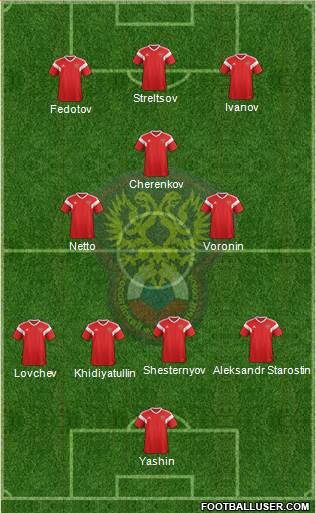
Starting lineup
Aleksandr Starostin had played as a right side defender. Fedotov had played on the left side.