Friday, November 4, 2016

PSV Eindhoven Greatest All-time Team

This blogger Artur Yanturin of Russia copied many of my blog teams.  This blog was one of them.  It was my Russia All-Time Team here.  His team was written in 2020, but mine was uploaded in 2014.   His Spartak Moscow All-Time team entry of was published in October 2020, but mine was uploaded in 2017.  His entry of the Dutch-German rivalry between Real Madrid and Barcelona was written in 2020, but mine was uploaded in 2014.  He also copied many many of my blog entries.

His Facebook and Instagram

2015-2016 League Title

Please also see my All-Time World Cup Team Index.

Ajax Amsterdam, PSV, Feyenoord.
Surnamese-Dutch,
North Holland, South Holand.
The rest of Netherlands excluding North and South Holland
Netherlands All-Time Team After Johan Cruyff
Netherlands before Johan Cruyff (BC)

This is my selection of a 25 member all-time team for the club.  The number 25 was chosen because it is the official squad size for the Champions' League.

The club was founded in 1913 as a team for Philips employees. PSV Eindhoven’s history contains two golden eras revolving around the UEFA Cup victory in 1978 and the 1987–88 European Cup victory as part of the seasonal treble in 1988. The team has won the Eredivisie 23 times, the KNVB Cup nine times and the Johan Cruijff Schaal ten times. 

Since its foundation, it has played in the Philips Stadion and has upheld its club colours (red and white). Its elaborate connection with Philips can be witnessed in its sponsoring, shared technology and board member ties. Fans have named themselves 'boeren' (Dutch pronunciation: [ˈbuːrə(n)], Dutch for either peasants or farmers), taking pride in Eindhoven's status of being a provincial city and their Brabantian heritage.
1988 European Cup
Team
GK:  Jan Van Beveren (Netherlands)
Jan van Beveren was considered one of the best keepers in the 1970's.  In 1970, Van Beveren joined PSV Eindhoven, where he won three Eredivisie titles, two domestic cups and the UEFA Cup in 1978. His career with the national team was cut short because of a feud with Johan Cruyff. He did not go to the World Cup Finals in 1974 as a result.

GK: Hans Van Breukelen  (Netherlands)
Hans Van Breukelen started his career with FC Utrecht and then, Nottingham Forest.  He moved to PSV in 1984, where he became a star.  For the national team, he was a fixture since 1980.  However, he did not help the Oranje to reach a major touranemt until in 1988, where they won the first ever trophy for the Dutch national team. He had 73 caps.

GK: Heurelho Gomes (Brazil)
Heurelho Gomes started Cruzeiro in Brazil.  He made a name for himself at Dutch club PSV, and also spent six years at Tottenham Hotspur.  He also played for 1899 Hoffenheim.  He only earned only 11 caps, largely to fierce competition with Dida, Marcos, Julio Ceasar, Rogerio Ceni, etc. He was a part of the 2010 World Cup team. 

RB:: Eric Gerets (Belgium)
Eric Gerets is considered one of the greatest European rightbacks in history. His best club career was spent with Standard de Liège and PSV Eindhoven.  He won the 1988 European Cup with PSV as their captain. He also played briefly for AC Milan and MVV Maastricht.  Gerets was capped 86 times.  He played a big role as the Red Devils finished second at the Euro 1980 and reached the semi-final of the WC 1986 Finals.
Eric Gerets
RB: Sjef van Run (Netherlands)
Born 1904, Sjef van Run was capped 25 times in the 1930's.  He played for the Dutch National team in the 1934 World Cup Finals, held in France. For his club career, he played his entire career with PSV Eindhoven, appearing in 359 league matches between 1926 and 1942.  He died in 1973 at the age of 69.

CB:  Jaap Stam  (Netherlands)
Stam became the most expensive Dutch player and the most expensive defender in the world when Manchester United bought him for 10.6 million pounds.  He also played for PSV Eindhoven, Manchester United, Lazio, AC Milan and Ajax. Sam was capped 67 times for Holland, scoring three goals. He was in their squads for three European Championships and the 1998 World Cup.

CB: Alex  (Brazil)
Alex was a star with Santos at home.  He joined Chelsea in 2004, but he was loaned to Dutch team PSV. Alex finally joined Chelsea in 2007, where he won the FA Cup in 2009 and a league and FA Cup "double" in 2010, as well as reaching the 2008 Champions League Final. He also played for Paris Saint-Germain and Milan. Alex earned 17 caps for Brazil between 2003 and 2008, winning the 2007 Copa América. 

CB: Ernie Brandts (Netherlands)
Ernie Brandts started with De Graafschap, but his' greatest club career was spent with PSV Eindhoven, where he won the UEFA Cup in 1978.  He played 28 times for Holland between 1977 and 1985.  He was the starting centre-back in the 1978 World Cup Finals, where Netherlands reached the Final.  Against Italy, he became the first player ever to score a goal and an own goal in the same game.

CB:  Ronald Koeman (Netherlands)
Ronald Koeman was the rock solid sweeper of Nethertlands' Euro1988 team.  He was capped 78 times. He also won two European Cups, one each for PSV Eindhoven and Barcelona FC.  He scored the winning goal for Barcelona's victory in 1992. The Cup was Barcelona FC's first ever European Cup.  In Netherlands, he played for all of the "big three" clubs, namely Ajax, PSV Eindhoven and Feyenoord.
Ronald Koeman
LB: Jan Heintze (Denmark)
Heintze played with PSV Eindhoven, winning the European Cup in 1988.  He also played for Bayer Uerdingen and Bayer Leverkusen in the Bundesliga. He played 86 matches for Denmark between 1987 and 2002, but missed the 1992 European Championship because of an injury.  He was their captain for his last two years with the national team.

LB: Jan Poortvliet (Netherlands)
Jan Poortvliet was a long time member of PSV Eindhoven. He played for them from 1974 to 1983.  After leaving them, he played club football in Austria, Belgium and France. He had 19 caps.  He was a part of Oranje's team at the World Cup Finals in 1978 and European Championship in 1980. 

DM: Mark van Bommel (Netherlands)
In Holland, Mark van Bommel's career was associated PSV Eindhoven, where he had two separated stints.  However, his most famous part of his career was spent with Bayern Munich. He was their first ever non-German captain.  He played 79 times for Netherlands and was a main player as they reached the Final of the 2010 World Cup Finals in South Africa. 
Mark Van Bommel

CM: Phillip Cocu (Netherlands)
Cocu played for AZ and Vitesse Arnhem before joining PSV Eindhoven. He played for FC Barcelona between 1998 and 2004. During Cocu’s second stint at PSV, he won another three Eredivisie titles and reached the Champions League semi-finals. With 101 caps, Cocu is fifth on the list of most Dutch international appearances.  He also played at the 1998 and 2006 World Cup, as well as the 1996, 2000 and 2004 European Championships. 


CM: Willy van de Kerkhof (Netherlands)
Overall,  Willy Van de Kerkhof appeared 63 times for his country.  He was a member of the 1974 World Cup team, but it was the 1978 World Cup Finals, where he carried the team to the Final against the host Argentina.  His twin brother Rene was also a part of the 1978 team.  For his club career, he played for FC Twente and PSV Eindhoven.

RW: Rene van de kerkhof (Netherlands)
Willy's twin brother.  His best year was in 1978 while playing for PSV.  He was the runners-up at the World Cup, he also won the UEFA Cup, the Dutch championship and the KNVB Beker.  He also played in Hong Kong.  Before the 1978 World Cup final, the opponent Argentinians objected to the cast he wore on his injured forearm which delayed his participation in the Final.

RW/LW/FW: Arjen Robben (Netherlands)
Robben was an important player for Bayern Munich's dominance in Europe as they reached three Champions' League Finals in 4 years, winning one in 2013.  He also played with Real Madrid, Chelsea and PSV Eindhoven.  For the national team, he had 96 caps between 2003 and 2017.  He helped Netherlands to reach the Final of the 2010 World Cup Finals and then, four years later the semi-final in 2014. 
Arjen Robben
RW: Gerald Vanenburg (Netherlands)
He amassed Eredivisie totals of 372 games and 112 goals for Ajax and PSV combined, winning fifteen major titles between the two clubs, including the 1988 European Cup with the latter. Subsequently he played in Japan, France and Germany, in a 20-year professional career. Vanenburg earned more than 40 caps for the Netherlands, appearing at the 1990 World Cup and Euro 1988 and winning the latter tournament.

AM: Willy van der Kuijlen (Netherlands)
In 1964, he was signed by PSV. Van der Kuijlen ended up playing for the club 18 years, winning three Eredivisie titles, two domestic cups and the UEFA Cup in 1978. He was also crowned Eredivisie top scorer three times. After short periods with MVV Maastricht and Overpelt, he retired at age 37.  Capped 22 times.  His international career was limited due to his clashes with Johan Cruyff.

AM: Ruud Gullit (Nethertlands)
Ruud Gullit was the iconic captain of Dutch Euro 1988 winning team.  In 1987,  he moved from PSV Eindhoven to A.C. Milan for a world record transfer fee.  He was an important player for AC Milan during the 1980's where they won two straight European Cups. He was the European Footballer of the Year in 1987 and the World Soccer Player of the Year in 1987 and 1989.  He spent one season with Sampdoria winning the Italian Cup in 1994.  He earned 66 caps.
Ruud Gullit
ST: Luc Nilis  (Belgium)
Luc Nilis played for K.F.C. Winterslag, R.S.C. Anderlecht, PSV Eindhoven and Aston Villa. During his time with PSV, Nilis formed one of the deadliest partnerships in Europe with team-mate Ruud van Nistelrooy, who signed for PSV in 1998. He joined Aston Villa,  but his career there was limited to a serious injury.  Capped 58 times for Belgium.

ST: Coen Dillen (Netherlands)
Nicknamed Het Kanon (the cannon), Coen Dillen spent 12 years with PSV Eindhoven.  He scored 43 goals in the 1956/1957, a goal record for a single season in the Eredivisie that still remains unbroken today.  He scored twenty goals in a nine-match period between 27 January and 31 March 1957.  He also played for Brabantia and Helmondia '55.. Internationally, he only played 5 times for Netherlands, scoring 4 goals.
Coen Dillen

ST: Wim Kielf (Netherlands)
Wim Kielf played for Ajax in the late 1970's and then, moved to Italy in 1983.  He played for Pisa and then, Torino.  In 1987, he joined PSV  and immediately won the European Cup in 1988.  For the national team, he was a part of the Golden Generation that won Euro 1988 and participated at the WC in 1990 and Euro 1992.  He mainly used a substitute role at both Euro 1988 and the WC in 1990.

ST: Ruud Van Nistelrooy (Netherlands)
Ruud Van Nistelrooy was a prolific goal scorer. He won the top scorer award in three different European domestic leagues. He started with PSV Eindhoven.  He spent 5 seasons with Manchester United where he was voted as their best player twice.  With Real Madrid, he finished second as the European Golden Boot. Van Nistelrooy earned 70 caps and scored 35 goals for the Netherlands. He played in 2006 World Cup and two European Championship.
Ruud Van Nistelrooy
ST Romario (Brazil)
Romario helped the Seleção to win the 1994 FIFA World Cup, receiving the Golden Ball as player of the tournament. He was named FIFA World Player of the Year the same year. He missed the 1998 WC Finals because of an injury. One of very few strikers to surpass the mark of 1,000 goals. He was best remembered for his stint with Barcelona.

ST: Ronaldo (Brazil)
Ronaldo was widely considered among the greatest ever to have play the game.  He led Brazil to two World Cup Finals matches, winning the one in 2002.  He scored 8 goals in 2002.  He also went to the USA 1994, but did not play. He was the winner of Ballon d'Or twice and the FIFA World Player of the Year three times.  He is the second top-scorer in World Cup history.  He played for both Barcelona and Real Madrid, and for both AC Milan and Inter Milan. 
Ronaldo
Honorable Mention
Ronald Waterreus (Netherlands), Piet Fransen (Netherlands), Soren Lerby (Denmark), Hallvar Thoresen (Norway), Ivan Nielsen (Denmark), Arthur Numan (Netherlands), Georginio Wijnaldum, Wilfred Bouma (Netherlands), Erwin Koeman (Netherlands), Mateja Kežman (Serbia), Jan Vennegoor of Hesselink (Netherlands), André Ooijer (Netherlands), Ralf Edström (Sweden), Björn Nordqvist (Sweden), Ibrahim Afellay (Netherlands), Jefferson Farfan (Peru), Berry van Aerle (Netherlands), Huub Stevens (Netherlands), Luuk de Jong (Netherlands), Memphis Depay (Netherlands), Pierre Kerkhoffs (Netherlands), Johann Vogel (Switzerland),  Park Ji-sung (South Korea),
Gheorghe Popescu (Romania), Andrés Guardado (Mexico).

Squad Explanation
-- In the 1987-1988 season, PSV Eindhoven enjoyed its greatest season. They won the Eredivisie with 9 points ahead of the second placed Ajax.  They then won the Cup by beating Roda FC.  They completed the treble when they beat Benfica for their first European Cup.  I selected Hans van Breukelen, Eric Gerets, Ronald Koeman, Jan Heintze, Wim Kielf and Gerald Vanenburg to be on my all-time team. Willy van de Kerkhof did not play in the Final, but was a member of the team. He also played in the UEFA Cup in 1978, making him a part of both generations. Soren Lerby and Berry van Aerle made my honourable mention.  Ruud Gullit left for AC Milan, the season before.
-- In 1978, PSV beat Bastia of France to win the UEFA Cup.  Bastia featured Johnny Rep.  From the UEFA Cup winning team, , I selected Willy van der Kuijlen, the Van de Kerkhof twins, Jan van Beveren, Ernie Brandts and Jan Poortvliet.
--Goalkeeper Jan Van Beveren and Hans van Breukelen were considered among the best ever from Netherlands.  Heurelho Gomes (Brazil) won four straight league titles with PSV and took them to the semifinal of the Champions' League.
-- In his three seasons at PSV, Ronald Koeman scored 51 goals in 98 league appearances, averaging more than one goal every two matches.
-- Alex is a surprised selection over Huub Stevens.  He won three Eredivisie titles in his three seasons at the club.  He helped PSV to reach the semifinal of the Champions' League.
-- Eric Gerets was considered among the best rightback in Europe during his time with the club.   Jan Heintze is 3rd in appearance record for the club. 
-- I am not familiar with fullback Sjef van Run.  Berry van Aerle was kept out the team by Sjef van Run and Eric Gerets, despite the fact that I am not familiar with Van Run.  
-- The midfield is strong.  Willy and Rene van de Kerkhof are probably automatic selections on most PSV all-time team. I also have Phillip Cocu and Mark Van Bommel on this team.
-- The world took notice of Ruud Gullit while he played for PSV.  He was named the Dutch Footballer of the Year in 1986.  AC Milan paid a world record fee to buy him from PSV in 1987.
-- Arjen Robben also played limited time with PSV, but he was homegrown.  I have different criteria for smaller clubs outside the big four leagues.  It is much harder for them to keep a superstar long than a mega clubs in Spain or England.  Robben also had a great partnership with Mateja Kežman, but I did not have space for Kežman.  I have Ruud Van Nistelrooy, Romario and Ronaldo ahead of him.
-- Willy van der Kuijlen spent 18 years with the club.  He holds the record for the most league appearances and the most league goals.
-- The club was the stepping stone for both Romario and Ronaldo.  
-- Ronaldo has limited time with PSV, but he scored 42 goals in 46 games.  I cannot ignore that stats. 
-- Romario was Eredivide top scorer three straight seasons, winning the Dutch player of the Year in 1989.
-- Ruud Van Nistelrooy was the top scorer at the Eredivisie twice. He also won the Dutch Player of the Year award twice while playing for the club.  I also took his strike partner Luc Nilis.  Luc Nilis also won the Dutch Player of the Year award in 1995.  He also played with Ronaldo.

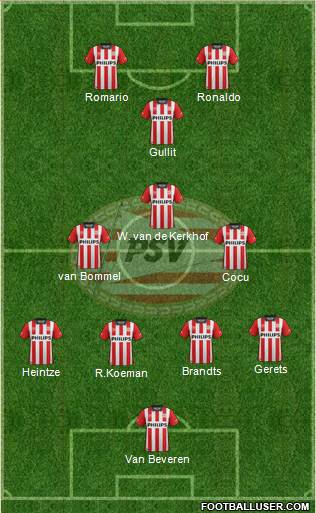
Formation
Coen Dillen should start ahead Ronaldo.  He is PSV through and through while Ronaldo only spent a season here.  


Wednesday, November 2, 2016

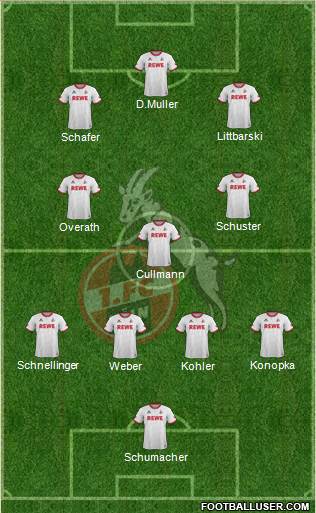
FC Koln Greatest All-Time Team

This blogger Artur Yanturin of Russia copied many of my blog teams.  This blog was one of them.  It was my Russia All-Time Team here.  His team was written in 2020, but mine was uploaded in 2014.   His Spartak Moscow All-Time team entry of was published in October 2020, but mine was uploaded in 2017.  His entry of the Dutch-German rivalry between Real Madrid and Barcelona was written in 2020, but mine was uploaded in 2014.  He also copied many many of my blog entries.

His Facebook and Instagram

1963-1964 Bundesliga champion

Please also see my All-Time World Cup Team Index.

Bayern Munich, Borussia Dortmund, 
Borussia Mönchengladbach, Schalke 04, Werder Bremen,
Hamburger SV, Kaiserslautern, Bayer Leverkusen, 
FC Koln, VfB Stuttgart, Eintracht Frankfurt, Wolfsburg.

FC Koln was formed in 1948 as a merger of the clubs Kölner Ballspiel-Club 1901 and SpVgg Sülz 07.  Like many of Germany's other professional football clubs, 1. FC Köln is part of a larger sports club with teams in other sports like handball, table tennis and gymnastics. 1. FC Köln had around 78.500 members as of May 2016, making it the fourth largest club in Germany

This is my selection of a 25 member all-time team for the club.  The number 25 was chosen because it is the official squad size for the Champions' League.

The club's nickname Die Geißböcke (The Billy Goats) refers to the club's mascot, a male goat named Hennes after the veteran FC player and (later) manager Hennes Weisweiler. The first Hennes was donated by a circus entrepreneur as a Cologne carnival joke. The current mascot is Hennes IX as of 1 August 2019 after Hennex VIII was retired by the club due to old age.
Koln won the Double in the 1977-1978 season
Team
GK: Harald Schumacher (Germany)
Harald "Toni" Schumacher had 76 caps between 1979 and 1986.  He won the 1980 European Championship in Italy and came second at the World Cup finals, in both 1982 and 1986.  He was best remembered for a highly controversial incident in the 1982 World Cup semifinal against France when he collided with and seriously injured French defender Patrick Battiston.  He spent the prime of his career with FC Koln, where he won the "Double" in 1978. 
Toni Schumacher
GK: Bodo Illgner (Germany)
Bodo Illgner played for Köln between 1986 and 1996.  He joined  Real Madrid in 1996, winning the Champions league in 1998. His starting position was succeeded by Iker Casillas. He was capped 54 times between 1987 and 1994.  He helped West Germany to the 1990 World Cup, where he became the first goalkeeper to keep a clean sheet in a World Cup final. He also played in 1994 World Cups Finals and two other European Championship.

GK: Manfred Manglitz (Germany)
Manfred Manglitz was a member of the West Germany squad at 1970 FIFA World Cup, playing four times for his country from 1965 to 1970.  His career, however, was remembered for a match fixing scandal known as "Bundesligaskandal" in 1971. He received a lifetime ban. For his club career, he played with Bayer Lverkusen, FC Koln and MSV Duisburg.

RB: Harald Konopka (Germany)
Harald Konopka won three German Cup's with 1. FC Köln and was runner-up with them in two other editions.  Konopka was part of the famous FC Köln squad that won the Bundesliga and the Cup in the same season (double) in 1978. He also played a season for Borussia Dortmund for the remainder of his career. Capped twice. He went to the World Cup Finals in 1978. He played once in the Finals.

ST/RB: Karl-Heinz Thielen (Germany)
Born in 1940, Karl-Heinz Thielen played for his entire career for Koln from 1959 to 1973.  He made nearly 300 appearances for the club. He won the German league in 1962.  Then, he won the first ever Bundesliga in the 1963-1964 with the club. The title was the first ever Bundesliga title in Germany.  He was capped twice for the West german national team in the 1960's.

CB: Jurgen Kohler (Germany)
Jurgen Kohler was regarded one of the best defenders in the 1990's.   He earned 105 caps for West Germany/Germany between 1986 and 1998.  He won the World Cup in 1990 and the European Championship in 1996.  For his club career, he played with Koln, Bayern Munich, Juventus and Borussia Dortmund.  He won the Champions' League in 1997 with Borussia Dortmund.  He was Footballer of the Year in Germany in 1997.
Jurgen Kohler
CB: Gerhard Strack (Germany)
He earned 10 caps and scored one goal for West Germany from 1982 to 1983, and was included in the West German team for the 1984 UEFA European Football Championship, but did not play. The one goal he scored, against Albania in a European Championship qualifier in 1983, was vital: it ensured that West Germany qualified for Euro 84 ahead of Northern Ireland.

CB: Paul Steiner (Germany)
Steiner appeared in 349 games in the Bundesliga, scoring 27 times from 1979 until 1991 with MSV Duisburg and 1. FC Köln. With the latter side, he was instrumental in five league finishes in the top three, also winning the German Cup in 1983 and losing the 1985–86 UEFA Cup to Real Madrid.  Capped once in 1990.

CB: Wolfgang Weber (Germany)
Wolfgang Weber played his entire career for FC Köln between 1963 and 1978.  He was capped 53 times.  He was best remembered for scoring the last minute equaliser For West Germany at the Final of the World Cup in 1966 against England that sent the Final into extra time.  He also played at the European Championship in 1968 and the World Cup Finals in 1970.  He had 53 caps between 1964 and 1975.

CB/LB: Karl-Heinz Schnellinger (Germany)
In his prime, Karl-Heinz Schnellinger was considered one of the best leftbacks in the world.  He participated in 4 World Cup Finals, unfortunaitely sandwiched between West Germany's two World Cup winning tournaments.  He was remembered one of the first German footballer to star in Italy.  He had a remarkable stint with AC Milan and As Roma.  He won the European Cup in 1969 with AC Milan. He was awarded the (German Footballer of the Year) in 1962. 
Karl-Heinz Schnellinger
CB/LB: Herbert Zimmermann (Germany)
Herbert Zimmermann  started as a striker for Bayern Munich.  He never found much playing time, but was a part of the squad of FC Bayern Munich that won the Bundesliga in 1973 and 1974, and the European Cup in 1974.  He joined Koln in 1974 and converted into a successful defender.  He was capped 14 times. He was a part of the team that won the European Championship in 1980.  He also went to the World Cup in 1978.

LB: Jonas Hector (Germany)
After beginning his youth career with SV Auersmacher in his home state of Saarland, Hector transferred to 1. FC Köln in 2010, whee he captained in 2016.  For Germany, he received his first cap in 2014.  He played in the European Championship of 2016 and the 2018 World Cup.  At the time of writing, he has over 40 caps for Germany. He won the 2017 Confederation Cup.

DM/SW: Bernhard Cullmann (Germany)
Bernhard Cullmann began his footballing career in 1969 with SpVgg Porz, until he was signed by 1. FC Köln in 1970. He played 341 matches in the Bundesliga for them before his retirement in 1984. He played 40 matches for the German team between 1973 and 1980, scoring six goals.[4] He participated at the 1974 FIFA World Cup, the 1978 FIFA World Cup, and the victorious UEFA Euro 1980.

CM: Bernd Schuster (Germany)
Schuster was the star of West Germany's Euro 1980 winning team, but disagreed with the German Football Association and seldom played for West Germany after the tournament.  He started with FC Koln in 1978. He was a star at La Liga in the 1980's, playing for Barcelona, Real Madrid and Atletico Madrid. He was the first player to have won the Spanish Cup for the big three in Spain. He later played for Bayer Leverkusen.
Bernd Schuster

LM/CM: Wolfgang Overath (Germany)
Wolfgang Overath was one of the best left midfielders in history,  He won the 1974 World Cup with West Germany at home, where he kept Gunter Netzer from the starting lineup. In total he won 81 caps for the national side between 1963 and 1974, scoring 17 goals.  In addition to 1974 World Cup Finals, he also went to the 1966 and 1970 World Cup Finals. He had World Cup medals for 1st, 2nd and 3rd place. He spent all of his career with Koln, winning the Bundesliga in 1963.  
Wolfgang Overath
RW/AM: Pierre Littbarski   (Germany)
Littibarski was a major star in the 1980's.  He had over 70 caps and played in three World Cup Finals (1982, 1986 and 1990) with Germany reaching the Final all 3 times, winning his final World Cup in 1990. He spent most of his career with Koln, winning the DFB-Pokal once, in 1983, and was three times runner up in the Bundesliga (1982, 1989 and 1990).  He has also played for RC Paris in Ligue 1 as well as for JEF United Ichihara and Brummel Sendai in Japan.
Pierre Littibarki
LW:  Hans Schafer  (Germany)
Hans Schafer played for 1. FC Köln between 1948 and 1965. He also played for the West Germany, earning 39 caps and scoring 15 goals. He played in three World Cups, in 1954, 1958, and 1962, earning a winner's medal in 1954 and scoring a total of seven goals. Between 1957 and 1962, Schäfer captained Germany 16 times. He was German Player of the Year in 1963. He spent all of his career with Koln.
Hans Schafer winning the 1964 Bundesliga

AM: Heinz Frohe (Germany)
He played for 1. FC Köln (1966–1979), winning the Bundesliga title in 1978, and the DFB-Pokal in 1968, 1977 and 1978. He also played for TSV 1860 München (1979–1980). Earned 39 caps and scored 8 goals for Die Mannschaft (West Germany). He was in the winning squad for the 1974 FIFA World Cup. He also played in the 1976 European Football Championship and the 1978 FIFA World Cup.

AM: Josef Rohrig (Germany)
Josef Rohrig played at 1. FC Köln for ten years between 1950 and 1960, and was part of the team which reached the final of the DFB-Pokal and finished second the German football championship. He also made sporadic appearances for the West Germany national football team between 1950 and 1956, playing 12 times and scoring two goals.

AM: Thomas Hassler (Germany)
Hassler was a star player in the 1990's.  He played for Koln, Juventus, Roma, Karlsruher, 1860 Munich and SV Salzburg. He appeared over 100 times for the German national team. He was a member of the teams which won the 1990 FIFA World Cup (as West Germany) and UEFA Euro 1996. He also appeared at the 1994 and 1998 FIFA World Cups, the 1992 and 2000 UEFA European Championships, and the 1988 Olympic Games.

FW: Klaus Allofs (Germany)
Klaus Allofs made his name with Fortuna Düsseldorf, where he was the Bundesliga top-scorer in 1978-1979, winning two German Cup with them.  He later played for Koln, Olympique de Marseille, Bordeaux and Werder Bremen.  With Werder Bremen, he won the 1992 Cup Winners' Cup. He had 56 caps. He was the top scorer at the European Championship in 1980, where West Germany was the champion.  He played at European Championship in 1984 and the World Cup Finals in 1986.
Klaus Allofs

FW: Lukas Podolski (Germany)
Born in Poland, Lukas Podolski grew up in Germany.  He made 81 appearances for Koln before moving to Bayern Munich. With Bayern, Podolski won the Bundesliga and DFB-Pokal double in 2008. Podolski returned to 1. FC Köln in 2009. He later played for Arsenal, Inter Milan, Galatasaray and Kobe Vissel. He was capped over 120 times.  He is a regular member of the national team from 2003 to 2016.  He was a part of the team that won the World Cup in 2014.
Lukas Podolski
ST: Heinz Hornig (Germany)
Hornig was capped by West Germany on seven occasions, making his debut in 1965 and his final appearances the following year. He was a member of the German squad at the 1966 FIFA World Cup, although he did not play a game in the tournament. He played his club football for 1. FC Köln between 1962 and 1970, and he appeared for them in the 1962–63 European Cup against Dundee.

ST: Hannes Löhr (Germany)
Hannes Löhr scored 166 top division goals for 1. FC Köln. He is the all-time leading scorer for the club.  He played with their great team in the 1960's.  He also won the Double in 1978 for the club.  Löhr won 20 caps for West Germany and appeared at the 1970 FIFA World Cup in Mexico.  He was a part of the team that won the 1972 European Championship, but did not play in the Finals.

ST: Dieter Muller (Germany)
Muller played for Koln, Stuttgart, Bordeaux, Grasshopper Club Zurich, FC Saarbrucken and Kickers Offenbach.  He set a record for the most goals scored by a player in a single Bundesliga match. In 1977, he scored six goals to Köln's 7–2 victory over Werder Bremen.  He was crowned Bundesliga topscorer that season and the season before in 1978. He was capped 12 times. He was best remembered for scoring a hat trick against Yugoslavia and a goal against Czechoslovakia at Euro 1976.
Dieter Muller

Honorable Mention
Jonas Hector (Germany), Armin Görtz (Germany), Dieter Prestin (Germany), Thomas Allofs (Germany), Heinz Simmet (Germany), Fritz Pott (Germany), Hansi Sturm (Germany), Roger van Gool (Belgium), Morten Olsen (Denmark), Christian Muller (Germany), Henrik Andersen (Denmark)

Squad Explanation
-- FC Köln had a great team in the early 1960's. They won the first Bundesliga in 1964.  Hans Schäfer, Karl- Heinz Schnellinger, Wolfgang Overath, Wolfgang Weber, Karl-Heinz Thielen and Heinz Hornig. Hannes Löhr was not on the 1963-1964 team. Schnellinger also left for AC Milan in 1963.
-- In 2018, the Bundesliga official website came up with their Best XI: Toni Schumacher, Harald Konopka, Wolfgang Webber, Jonas Hector, Thomas Hassler, Pierre Littbarski, Wolfgang Overath, Heinz Frohe, Hans Schafer, Dieter Muller and Lukas Podolski. Ten of the players listed were selected by my all-time team in 2016. 
-- When I wrote this blog team in 2016, Jonas Hector was too young to be considered at the time.  I put him on honourable mention.  In November, 2019, he replaced Henrik Andersen (Denmark) on the team.  Andersen's career here was affected by his injuries. I feel an additional two seasons to help Hector's position.
-- Hannes Löhr played in the 1960's, but was also a member of the 1978 Double winning team.  He is their all-time leading scorer.
-- From the 1978 "Double"(Bundesliga/German Cup) winning team, I selected Harald Schumacher, Gerhard Strack, Herbert Zimmermann, Harald Konopka,  Bernhard Cullmann, Heinz Frohe and Dieter Muller made the team. Wolfgang Weber was on the team, but did not play that season.  He retired soon afterward.
-- Dieter Muller was Bundesliga top scorer twice (1977 and 1978).  He was the hero at the 1976  European Championship, which was the first major tournament where West Germany played since the retirement of Gerd Muller. His namesake and his performance were newsworthy back then and he lived up to his namesake.
-- FC Koln reached the Final of the UEFA Cup in 1986, where they lost to Real Madrid.  From that period, I selected Harald Schumacher, Pierce Littibarski and Paul Steiner.  Thomas Hassler also played that season, but he was a young player.
-- Goalkeeper Harald Schumacher was also known as Toni Schumacher.  He played for Koln between 1972 and 1987. He was the famous German goalkeeper starting at the World Cup Finals in 1982 and 1986. Anton Schumacher was a goalkeeper for Koln between 1960 and 1968.  He was also known as "Toni Schumacher".  He played with another "Harold", Haraldo Konopka around the same time.  To avoid confusion, he earned the nickname "Toni", but would prove to be more confusing later in the club's history.
-- Manfred Manglitz was not punished for his match fixing scandal in 1971.
-- Schnellinger was one of the best defender in the world during his time with Koln.  He was awarded the (German Footballer of the Year) in 1962. 
-- Bernd Schuster only played two seasons, but he made his name here.  I sometimes selected great players who made their name in a smaller clubs.  It is much harder for a smaller club to keep a player such as Schuster for too long.  The same applied to Jürgen Kohler who also only spent two seasons here, but he made his first senior national team cap here.

Formation


Monday, October 31, 2016

VfB Stuttgart Greatest All-Time Team

Bundesliga 1983-1984 title
Please also see my All-Time World Cup Team Index.

Bayern Munich, Borussia Dortmund,
Borussia Mönchengladbach, Schalke 04, Werder Bremen,
Hamburger SV, Kaiserslautern, Bayer Leverkusen, 
FC Koln, VfB Stuttgart, Eintracht Frankfurt, 
Wolfsburg.
Baden-Württemberg

This is my selection of a 25 member all-time team for the club.  The number 25 was chosen because it is the official squad size for the Champions' League.

VfB Stuttgart is best known for its football team which is part of Germany's first division Bundesliga. VfB Stuttgart has won the national championship five times, most recently in 2006–07; the DFB-Pokal three times; and the UEFA Intertoto Cup a record three times.

The football team plays its home games at the Mercedes-Benz Arena, in the Neckarpark which is located near the Cannstatter Wasen where the city's fall beer festival takes place. Second team side VfB Stuttgart II currently plays in the Regionalliga Südwest, which is the second highest division allowed for a reserve team. The club's junior teams have won the national U19 championships a record ten times and the Under 17 Bundesliga six times.

1952 German Champion

Team
GK: Eike Immel (Germany)
Impel started with Borussia Dortmund.  He made a two million Deutsche Mark transfer to VfB Stuttgart in 1986, the biggest fee ever paid for a goalkeeper in the history German football at that time. He played 9 years as Stuttgart's regular goalkeeper, winning the Bundesliga title in 1992 and the UEFA Cup runner-up medal in 1989 with them. Afterwards he left for Manchester City, where he retired at the end of the 1995–96 season. Capped 19 times, largely because he retired from the West German team at the age of 28.
Eike Immel
GK: Timo Hildebrand (Germany)
Hildebrand was as part of what became known as "Stuttgart's young wild ones" team under coach Felix Magath in the early 2000's. Hildebrand also played a significant role in Stuttgart's victorious 2006–07 Bundesliga campaign, figuring as a backbone for the next generation of "wild ones" helping Stuttgart provide the third-best defence of the season. In 2007, he joined Valencia, but he never found the same successes after his stint with Stuttgart.  Earned 7 caps.

GK: Günter Sawitzki  (Germany)
Sawitzki played with tiny Sodingen, who had finished third in Germany in 1955, to join VfB Stuttgart in 1956. He stayed with VfB Stuttgart for the rest of his career.  For the national team, He was Toni Turek's successor in the West German goal. He went to the 1958 and 1962 FIFA World Cup, although he remained reserve on both occasions.

RB: Andreas Hinkel (Germany)
Andreas Hinkel started his career with VfB Stuttgart in 2000, before moving to La Liga club Sevilla in 2006.  He also played for Celtic and Freiburg.  While with stuttgart, he belonged to a generation known as the "wild ones".  Hinkel played 21 matches for Germany between 2003 and 2009, and was in their squad for Euro 2004.

CB/RB: Thomas Berthold (Germany)
He began his career in 1982 with Eintracht Frankfurt and played for them until 1987. From 1987 until 1991 he played in Italy: for Hellas Verona (1987–1989) and AS Roma (1989–1991). He then returned to Germany, signing for FC Bayern Munich (1991–1993) and VfB Stuttgart (1993–2000). He also played for Adanaspor. Between 1985 and 1994, Berthold earned 62 caps, participating in Mexico 1986 and Euro 1988 held in West Germany. He was a member of the West German team that won the 1990 World Cup,

CB: Karl-Heinz Forster (Germany)
With West Germany, Forster earned 81 caps between 1978 and 1988. He won the European Championship in 1980, and came 2nd at the World Cup in both 1982 and 1986.  He was regarded one of the best defenders in the 1980's.  He played with VFB Stuttgart and Marseille.  With Stuttgart, he won a Bundesliga in the 1983–84 season.  He won two league titles in France. His brother Bernd also played for West Germany and VfBStuttgart.
Karl-Heinz Forster
CB/LB: Günther Schäfer (Germany)
In his sixteen years playing for VfB Stuttgart, the defender gained the status of being one of the most popular players ever to play for them and one of the few players to earn two German championship titles with them. The most well-known play of his career was to clear a ball from the goal line by a bicycle kick, risking injury, in the final match of the 1991-92 season against Bayer Leverkusen, which Stuttgart went on to win 2-1, thus gaining the German championship title that season.

CB: Bernd Förster (Germany)
Förster started with SV Waldhof Mannheim, in Bundesliga 2. In 1975, he switched to FC Bayern Munich, but his stay there was highly unsuccessful. After establishing himself in the top flight with 1. FC Saarbrücken, Förster switched to VfB Stuttgart, where he played with his brother Karlheinz in the back-four. Capped 33 times, he was a key player at the WC finals in 1982, where he partnered his brother Karl-Heinz.

CB: Zvonimir Soldo (Croatia)
Soldo played with NK Dinamo Zagreb, NK Zadar and NK Inter Zaprešić in Croatia before joining VfB Stuttgart in 1996 where he played until 2016. During this period, Soldo won the German cup in 1997 and reached the European Cup Winners Cup final in 1998, as well as finishing as runner-up in the 2002/03 campaign. Capped 61 times.  He was Croatia's team at the 1998 World Cup Finals, where they reached the semi-final. He also played in Japan/Korea four years later.

LB: Ludovic Magnin (Switzerland)
In 1999, he made his professional debut for Yverdon Sports. In the summer of 2000, he transferred to Ticino side AC Lugano. In 2002, Magnin joined Werder Bremen, where he won the double (German Championship and German Cup). In 2005, he transferred to VfB Stuttgart, where he became a first-team regular within the first season and was a key player for his team in the following 2006–07 season.  Earned 63 caps and was at one point, the Swiss captain.

LB: Philipp Lahm (Germany)
Philipp Lahm was the captain of the 2014 World Cup winning team.  He also won the treble in 2013 when Bayern Munich won the Champions' League, the German Cup and the Bundesliga.  He also played with VfB Stuttgart on loan. He earned 113 caps for Germany at the end of the World Cup Finals in 2014 where he retired from the national team.  He was included in the World Cup team of the tournament in 2006 and 2010.  

CB/CM: Guido Buchwald (Germany)
The best game of Buchwald's career was probably the final of the 1990 FIFA World Cup where he effectively marked the skilled footballer Diego Maradona, earning him the nickname "Diego". He was also part of Germany's disappointing 1994 FIFA World Cup squad and collected in his career 76 caps. He spent most of his career with Stuttgart, winning two league titles.  At the end of his career, he played in Japan.
Guido Buchwald
CM: Hermann Ohlicher (Germany)
Hermann Ohlicher spent ten seasons in the Bundesliga with VfB Stuttgart, playing 318 matches in the West German top-flight between 1973 and 1985. He won the league title in 1984, playing alongside Asgeir Sigurvinsson, Karl-Heinz Forster,  Guido Buchwald, etc,  He is Stuttgart's all-time appearance leader

CM: Karl Allgöwer (Germany)
Karl Allgöwer started with 2. Bundesliga team Stuttgarter Kickers from 1977 to 1980 as striker.  He moved to local rival VfB Stuttgart in 1980.   In 1989 the powerful free-kick specialist was part of the team that got defeated by Diego Maradona's SSC Napoli in the UEFA Cup final. He was capped 10 times. He was non-playing member at Mexico 1986.

CM: Bo Larsson (Sweden)
Bo Larsson was Sweden Player of the Year in 1965 and 1973.  He was the first player to win the award twice. He spent most of his career with Malmo.  He spent three seasons as a top player with Vfb Stuttgart.   He was awarded "Athlete of the Year" in 1969 by the city of Stuttgart.  In total he got 70 caps, scoring 17 times, and played at the 1970 FIFA World Cup, 1974 FIFA World Cup and 1978 FIFA World Cup.
Bo Larrson
CM/DM: Sami Khedira (Germany)
He began his career at VfB Stuttgart, winning the Bundesliga in 2007, before moving to Real Madrid in 2010. In his five seasons in Spain, he won seven domestic and international trophies, including the UEFA Champions League in 2014. In 2015, he moved to Italian side Juventus on a free transfer, and immediately won the Serie A title in his first season with the club.  Earned over 70 caps.  He was a key player for Germany since 2009, winning the WC in 2014.

CM/SW: Matthias Sammer (Germany)
With Borussia Dortmund as a player, Sammer won the Bundesliga and DFL-Supercup in 1995, the Bundesliga, DFL-Supercup, and European Footballer of the Year in 1996, and the UEFA Champions League and Intercontinental Cup in 1997. He also played for Inter Milan and Dynamo Dresden. With Die Mannschaft as a player, Sammer won the UEFA Euro 1996, where he was named the tournament's best player, and was subsequently awarded the Ballon d'Or later that year. Sammer retired with 74 total caps, 23 for East Germany and 51 for the unified side.  
Matthias Sammer

CM: Asgeir Sigurvinsson (Iceland) 
Asgeir Sigurvinsson is conisdered to be Iceland's greatest players.  He spent his foreign career with Standard Liege, Bayern Munich and VfB Stuttgart.  He spent 8 seasons with Standard Liege before spending an un successful season with Bayern Munich. He won the Bundelsliga in 1983-1984 with Stuttgart after joining them in 1982. He had 46 caps.

AM/CF/RW: Robert Schlienz (Germany)
Schlienz joined VfB Stuttgart in 1945 after the War. But in 1948, he amputed his left forearm after a car accident. Despite being handicapped, he was the captain and playmaker at VfB Stuttgart, leading the team to win the German Championship twice in 1950 and 1952 (runner-up in 1953) and the German Cup twice in 1954 and 1958. He earned three caps for West Germany under the famous coach Sepp Herberger.
Robert Schlienz
AM/CM: Hansi Müller (Germany)
Playing for his hometown side VfB Stuttgart, he took part in Euro 1980 with West Germany after a brief taste of action at the 1978 World Cup Finals, where he started all four games. The tournament would prove to be Müller's international peak as they emerged victorious. He had a disappointing 1982 World Cup, and despite returning to Italy to play for F.C. Inter Milan, he made his 42nd and last appearance for Die Mannschaft the following year.

AM: Krassimir Balakov  (Bulgaria)
Krassimir Balakov was one of the star player from the Golden Generation of the 1990's. He made 92 appearances for Bulgaria, between 1988 and 2003.  He was best remembered for forming a successful attacking partnership with strikers Fredi Bobic and Giovane Élber at Stuttgart, where he won two UEFA Intertoto Cups (2000 and 2002) and a DFB-Pokal (1997).  Before Stuttgart, He also had a successful spell with Sporting CP, playing with Luis Figo.
Krassimir Balakov 
ST: Mário Gómez (Germany)
Gomez started with Stuttgart before moving to Bayern Munich in 2009, winning a Bundesliga title in 2006-2007.  With Bayern Munich, Gómez was the Bundesliga top scorer in 2011, and helped the team to seven honours, including the UEFA Champions League in 2013.  Later, he played for Fiorentina and Besiktas.  At the time of writing, he has 78 caps.  He appeared in most major tournaments between 2008 and 2018.

ST: Giovane Elber (Brazil)
Discovered by AC Milan at the age of 18,  Elber went unnoticed there before he moved to Grasshopper Club Zürich.  At Stuttgart he formed the so-called magic triangle with Krassimir Balakov and Fredi Bobic. The following summer, he moved to Bayern Munich where, save for one year, he was always crowned the club's top scorer. He won the Champions' League in 2001. Due to stiff competition, Élber only played 15 times for Brazil.  
Elber
ST: Fredi Bobic (Germany)
Born in Yugoslavia, he emigrated to Germany as a baby.  He first made a name with Stuttgart.  In 1996, he was the Bundesliga's top scorer with 17 goals. At Stuttgart, he formed part of a successful attacking line-up, along with  Giovane Élber and attacking midfielder Krasimir Balakov, known as the "magic triangle".  He would also play for Borussia Dortmund, Hertha Berlin, etc.  Capped 37 times.  He helped Germany to win the Euro 1996 in England.

ST: Jurgen Klinsmann (Germany)
Klinsmann won the World Cup in 1990 and then, captained the 1996 European Championship winning team.  He played in all major international tournaments from 1988 until his retirement in 1998.  He had successful club spells with Inter Milan and Tottenham Hotspurs. He was a popular player while in England, despite a lot of negative press at the time of his signing.  He won both the FWA Footballer of the Year and PFA Player of the Year in 1995. 
Jurgen Klinsmann

Honorable Mention
Alexander Hleb (Belarus), Dieter Hoeneß (Germany), Ricardo Osorio (Mexico), Karl Barufka (Germany), Matthias Sammer (Germany), Kevin Kurányi (Germany), Cacau (Germany), Rolf Blessing, Fritz Walter (Germany), Erwin Waldner (Germany), Erich Retter (Germany), Helmut Roleder (Germany), Marcelo Bordon (Brazil).

Squad Explanation
-- This is not a balanced team.  I am out of my depth with my knowledge of this club.  I selected too many midfielders and strikers.
-- From the early 1950's, Stuttgart won two league titles.  Robert Schlienz was the only member of that era that made my team and Karl Barufka was the last player dropped.
-- From the 1983-1984 Bundesliga winning team, I have the following players: Asgeir Sigurvinsson, Karl-Heinz Forster, Hermann Ohlicher, Bernd Forster and Guido Buchwald. 
-- VfB Stuttgart won the 1990-1991 Bundesliga.  It was the first champion after the unification.  The team was under-represented here.   I only have three players from that team: Matthaus Sammer, Guido Buchwald, Günther Schäfer and Eike Immel.   Fritz Walter only made honorable mention.
-- Fritz Walter was the top scorer in the Bundesliga that season.  However, I have Jurgen Klinsmann, Giovane Élber and Fredi Bobic ahead of him.
-- Matthaus Sammer played two seasons here.  He was a part of the 1990-1991 Bundesliga winning team, the first ever champion after an unified Germany.  He scored 9 goals as a midfielder.  It was significant that he was a former East German player on that team.
-- From 2006-2007 Bundesliga winning team, I have the following players on this all-time team: Timo Hidebrand and Mario Gomez.  Sami Khedria was a young player that season. 
-- The team was also the finalist at the 1989 UEFA Cup, losing to Diego Maradona's Napoli in the Final. Eike Immel, Guido Buchwald, Ásgeir Sigurvinsson, Karl Allgöwer and Jurgen Klinsmann were a part of that team.  Klinsmann first made his name in the tournament.
-- I selected Thomas Hitzlsperger over Karl Barufka.  I am not too familiar with Barufka.
-- Giovane Élber, Fredi Bobic and Krasimir Balakov formed an attack line what was known as the "magic triangle"(German: Magisches Dreieck).  Under manager Joachim Löw, they were one of the most exciting line in the Bundesliga in the late 1990's.  They reached the Final of the 1998 Cup Winners Cup before losing 1-0 to Chelsea.  Zvonimir Soldo and Thomas Berthold also played on that team.
-- Zvonimir Soldo edged out Marcelo Bordon for one of the spots. Soldo was the captain of the club for over 200 matches.  He was a part of the team that reached the Final of the 1998 Cup Winners Cup.  He later played with  the team known as "Young and Wild".
 -- Philipp Lahm only spent two seasons on loan with Vfb Stuttgart. He made a big impact over there, finishing second as the German Player of the Year in his first season.  Lahm played with the Stuttgart team that was known as the "Young and Wild" although he was not considered a key member. He joined the club after the 2002-2003 season where Stuttgart finished second in the Bundesliga.  Kevin Kuranyi, Alexander Hleb, Timo Hildebrand and Andreas Hinkel contributed to that team. Both Timo Hildebrand and Andreas Hinkel was very good for Stuttgart during that era. Hildebrand edged out Helmut Roleder for one of goalkeepers' spots. Zvonimir Soldo was the veteran on this young team.  Only Hidebrand, Lahm, Hinkel and Soldo made this all-time team.
-- Jurgen Klinsmann made his name with the club, but he was not homegrown.  He won the 1988 German Player of the Year while playing for them.  
-- Mario Gomez was the German Player of the Year in 2007 when VfB Stuttgart won the Bundesliga.

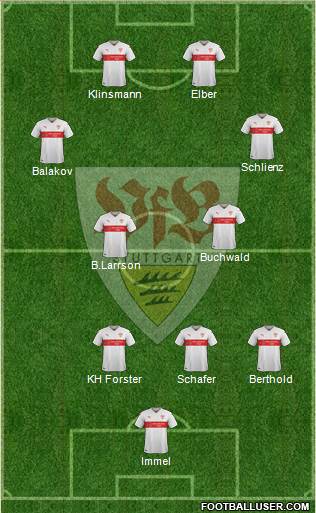
Formation