Sunday, November 6, 2016

Feyenoord Greatest All-Time Team

This blogger Artur Yanturin of Russia copied many of my blog teams.  This blog was one of them.  It was my Russia All-Time Team here.  His team was written in 2020, but mine was uploaded in 2014.   His Spartak Moscow All-Time team entry of was published in October 2020, but mine was uploaded in 2017.  His entry of the Dutch-German rivalry between Real Madrid and Barcelona was written in 2020, but mine was uploaded in 2014.  He also copied many many of my blog entries.

His Facebook and Instagram


1970 European Cup Winner
Please also see my All-Time World Cup Team Index.

Ajax Amsterdam, PSV, Feyenoord.
Surnamese-Dutch,
North Holland, South Holand.
The rest of Netherlands excluding North and South Holland
Netherlands All-Time Team After Johan Cruyff
Netherlands 1984
Netherlands before Johan Cruyff (BC)

This is my selection of a 25 member all-time team for the club.  The number 25 was chosen because it is the official squad size for the Champions' League.

Feyenoord is one of the most successful clubs in the Netherlands, winning 14 Eredivisie titles, 12 KNVB Cups and two Johan Cruyff Shields, having won in the international stage one European Cup, two UEFA Cups and one Intercontinental Cup. The club have played continuously in the top tier of the Dutch football system since gaining promotion to Eerste Klasse, the Eredivisie's forerunner competition, in 1921, more time than other club in the country, which has dominated alongside Ajax and PSV Eindhoven.
UEFA Cup 2001-2002

Team
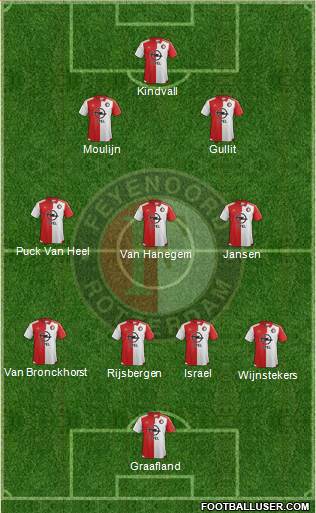
GK: Eddy Pieters Graafland (Netherlands)
Eddy Pieters Graafland played with Ajax between 1952 and 1958, but was better remembered for playing with Feyenoord between 1958 and 1970.   His prime was the 1960's, but he played in Feyenoord's European Cup victory in 1970. However, it was his last ever match for the club.  He also won four Eredivisie: 1960–61, 1961–62, 1964–65, 1968–69.  He also earned 47 caps for the Netherlands national football team between 1957 and 1967, but he did not attend any major tournament. 

Eddy Pieters Graafland

GK: Ed de Goey (Netherlands)
Ed De Goey played for both Sparta Rotterdam and Feyenoord. He later spent 6 seasons with Chelsea during the pre-Roman Abramovich days, winning the Cup Winners' cup in 1998.  He had 31 caps for the Dutch national team. He went to the 1994 World Cup Finals in the 1994, starting all of Oranje's games.  He was a member of the World Cup squad in 1998 and European Championship of 1996 and 2000.

GK: Eddy Treijtel (Netherlands)
Eddy Treijtel went to Feyenoord from Xerxes/DHC in 1968 along with Willem van Hanegem,  Treijtel's best years were spent at Feyenoord whetre he played until1979.  He won the UEFA Cup in 1974. He was remembered by killing a gull with a goal kick in 1970.  Between 1979 and 1985, he played with AZ 67.  In total, he played 5 times for the Netherlands between 1969 and 1976.  He went to the World Cup Finals in 1974 as a backup keeper.

RB: Ben Wijnstekers (Netherlands)
Ben Wijnstekers was considered among the greatest defenders in Feyenoord's history.  He made his professional debut at Feyenoord Rotterdam in 1975, but also played for K.R.C. Mechelen and Germinal Ekeren at the end of his career. He was capped 36 times between 1979 and 1986.  He went to European Championship in 1980, but otherwise, in a period between two Golden Generations of Dutch players, where Netherlands failed to qualify for the World Cup Finals.

Ben Wijnstekers
RB: Ulrich van Gobbel (Netherlands)
He made his debut in the first team of Willem II. In the 1989/90 season, he moved to Feyenoord, where he played for most of his career. At Feyenoord, he won the UEFA Cup. During the 1995/96 season, he moved to Galatasaray. Van Gobbel was the first Dutch footballer ever to play for a Turkish top club. After a subsequent short stay in England with Southampton, he returned to Feyenoord. He was capped 8 times for the Netherlands.

CB/RB: Wim Rijsbergen (Netherlands)
Wim Rijsbergen later played in the North American Soccer League, for the New York Cosmos. Rijsbergen began his professional career at PEC Zwolle, and ended it in 1986 at FC Utrecht. He played for Feyenoord between 1971 and 1978.  From 1979 to 1983, he joined NY Cosmos.  He had 28 caps for the Dutch national team.  He was a part of Oranje's World Cup team on both 1974 and 1978, where they finished second in both Finals.

CB: John De Wolf (Netherlands)
De Wolf began his professional career with Sparta Rotterdam in 1983. After two seasons in the team, he departed for FC Groningen. With Feyenoord, he won the Dutch league championship in 1992–93 with the club and three Dutch Cups. Feyenoord also made it to the 91–92 Cup Winners' Cup semi-final. He also played for Wolverhampton Wanderers, VVV-Venlo, Hapoel Ashkelon and Zwart Wit'28.  He was capped 6 times for the Netherlands between 1987 and 1994.  He went to the World Cup Finals in 1994.

CB: Ivan Nielsen (Denmark) 
Ivan Nielsen started his senior career with Fremad Amager in Denmark. He was most prominently played professionally for Dutch clubs Feyenoord Rotterdam and PSV Eindhoven, winning the European Cup with PSV with Frank Arnesen and Jan Heintze. He was capped 51 times between 1980 and 1989. He represented Denmark at 1986 World Cup and two European Championship tournaments(1984 and 1988).

CB:  Rinus Israel (Netherland)
Nicknamed "IJzeren Rinus (Iron Rinus)", Rinus Israel had 47 caps for Netherlands between 1964 and 1974.  He was a part of the 1974 World Cup team that finished second at the World Cup Finals in West Germany.  During his career, he played for DWS (1962–66), Feyenoord Rotterdam (1966–74), Excelsior Rotterdam (1974–75) and PEC Zwolle (1975–82).  His best career was with Feyenoord.  He won an European Cup and an UEFA Cup with Feyenoord.  He was the Dutch Player of the Year in 1970 and 1975.

Rinus Israel

LB/DM:  Giovanni Van Bronckhorst (Netherlands)
Van Bronckhorst played for his country in three World Cups, in 1998, 2006 and 2010, as well as three European Championships, in 2000, 2004 and 2008.  He was the captain of the Dutch national team at the World Cup Finals in 2010, where they finished second behind Spain.  He played 106 times for Holland.  He won the Champions' League for Barcelona in 2005-2006. He also played wirh Feyenoord, Arsenal and Rangers.  

LB/CB: Cor Veldhoen (Netherlands)
Cor Veldhoen spent his entire career with Feyenoord between 1956 and 1970.  He played over 380 games for them.  He was a member of the team that won the European Cup in 1970.  Feyenoord enjoyed their best period wityh him on the team.  The trophy was the first ever European title won by a Dutch club team.  He earned 27 caps between 1961 and 1967 for the Dutch national team.

CM/DM: Theo De Jong (Netherlands)
During his career he played for NEC Nijmegen and Feyenoord Rotterdam. He earned 15 caps and scored 3 goals for the Netherlands national football team, and played for them in the 1974 FIFA World Cup Final.  De Jong was a member of the Feyenoord team that won the UEFA Cup in 1974, beating Tottenham Hotspur in the then two-legged final. He later played 3 seasons in Hong Kong for Seiko.

DM: Paul Bosvelt (Netherlands)
Paul Bosvelt played for Go Ahead Eagles and Twente before making his big move to Feyenoord in 1997, making 167 appearances, during which he led Feyenoord to the league title in 1999 and won the UEFA Cup in 2002.  He spent two seasons with Manchester City and finished his career at Heerenveen.  Bosvelt was capped 24 times between 2000 and 2004.  He played in Euro 2000 and Euro 2004.  He retired in 2004 from the national team.

Paul Bosvelt
CM/DM: Georginio Wijnaldum (Netherlands)
Wijnaldum made his debut for Feyenoord in 2007, becoming their youngest player.  He first played for Newcastle, but better known for his career in Liverpool, winning the Champions League in 2019 and a Premier League title. In 2021, he signed with PSG.  Internationally, he played 90 caps for the Netherlands, contributing to their third-place finish in the 2014 World Cup. He also earned the Dutch Footballer of the Year award.

CM: Wim Jansen (Netherlands)
Jansen was a part of the great Feyenoord team of the late 1960's and early 1970's.  He formed a great midfield with Willem van Hanegem and Theo De Jong. They became the first Dutch club to win the European Cup in 1970.  He later played rfor Washington Diplomats and then, Ajax. He was an important of Netherlands' World Cup team in 1974. He also went to the 1978 World Cup Finals. He earned 65 caps between 1967 and 1980.

CM: Willem Van Hanegem (Netherlands)
In the Netherlands, Willem Van Hanegem was widely considered the second best Dutch player in the 1970's and perhaps, the greatest player for Feyenoord. With them, he won the European Cup in 1970 and an UEFA Cup in 1974.  For the Netherlands, he was capped 52 times between 1968 and 1979.  He was an important player at the World Cup Finals in 1974, where Netherlands finished second, but he missed the World Cup Finals in 1978.  He also played in NASL with Chicago Sting in 1979.

Willem Van Hanegem

CM: Franz Hasil (Austria)
Franz Hasil started his career at local giants Rapid Wien before moving abroad to play for Schalke 04 in Germany. After one season in Germany, he moved to Feyenoord in 1969 and was part of their European Cup victory in 1970. He left them in 1973. He played for Austria Klagenfurt between 1973 and 1977. Hasil was capped 21 times for Austria between 1963 and 1974. He made his international debut in 1963 against Hungary.

CM/LM: Puck Van Heel (Netherlands)
Puck Van Heel was an inside-left and left wing-half in the 1930's. He spent his entire career with Feyenoord.  He was a cornerstone of the Feyenoord success preceding the World War II, winning five Eredivisie Championships and two KNVB Cups. During his time there, he became the team captain for the club. He was capped 64 times, a record until 1979.  He went to the World Cup finals in 1934 and 1938.

LW: Coen Moulijn (Netherlands)
Coen Moulijn was considered the best left winger in Dutch football and probably the best player from Feyenoord.  He started his career with Xerxes in 1954.  A season later, he joined Feyenoord. He stayed there until 1972. He won the European Cup and the Intercontinental Cup with them in 1970. He had 38 caps between 1956 and 1969 at a time when the Netherlands was not considered a major power in football.  He scored 4 goals for the Netherlands national football team.

Coen Moulijn 

LW: Arie de Vroet (Netherlands)
From 1938 and 1950, Arie de Vroet played for Feyenoord with the war in between.  After the War, he became the captain of the Dutch National Team.  In 1950, he left for France and became a professional player, ending his amateur status and his career with the national team. He first played for La Havre between 1950 and 1952 and then, Rouen for a singel season.  He played 22 times for the national team.  He went to the 1948 Olympics.

RW/ST: Dirk Kuyt (Netherlands)
Dirk Kuyt started as a striker, but played mainly as right wing. He started his career with FC Utrecht, but the peak of his career was spent with Feyenoord, Liverpool FC and Fenerbahce. He played 104 times for Netherlands.  He went to World Cup in 2006, 2010 and 2014 as well as the European Championship in 2008 and 2012. He played a big role in both World Cup Finals, where Netherlands finished 2nd and 3rd. He was Dutch Footballer of the Year in 2006.

AM/FW/RW: Ruud Gullit (Netherlands)
Ruud Gullit was the iconic captain of Netherlands' Euro 1988 winning team.  In 1987,  he moved from PSV Eindhoven to A.C. Milan for a world record transfer fee.  He was an important player for AC Milan during the 1980's where they won two straight European Cups. He was the European Footballer of the Year in 1987 and the World Soccer Player of the Year in 1987 and 1989.  He spent one season with Sampdoria winning the Italian Cup in 1994.  He earned 66 caps.

Ruud Gullit

FW: Johan Cruyff (Netherlands)
Johan Cruyff is the greatest Dutch player ever.  He won the Ballon d'Or three times, in 1971, 1973 and 1974.  He was considered one of the best players in history.  He was noted for his brilliant performance at the World Cup in 1974.  He also won three straight European Cups with Ajax in the 1970's.  He moved to Barcelona in 1973 for a world record transfer fees, where he became a legend. He also played in the NASL.

ST: Cor van der Gijp (Netherlands)
Cor Van der Gijp made his professional debut at his hometown club SC Emma in 1950. From 1955 to 1964,  he played for Feyenoord winning two league titles in the Netherlands.   He played in a famous forward line alongside Henk Schouten and Coen Moulijn.  He is their all-time leading scorer. From 1964 to 1967, he played for Blauw Wit.  He played 13 times scoring 6 goals for the Dutch national team between 1954 and 1961. He represented them at the 1952 Olympic Games.

ST: Ove Kindvall (Sweden)
Ove Kindvall started his career at IFK Norrköping, where he played until he joined Feyenoord in 1966. The same year, he won the Guldbollen, as the best Swedish footballer of the year.  He scored the winning goal in extra time during the 1970 European Cup Final. In his five seasons with the club, Kindvall scored 129 league goals in 144 games. He was the first non-Dutchman to be named Eredivisie top scorer(1968, 1969 and 1971). Capped 43 times.  He went to the World Cup Finals in 1970 and 1974.

Ove Kindvall

Honorable Mention
Joop Hiele (Netherlands), Adri van Male (Netherlands), Jerzy Dudek (Poland), Edwin Zoetebier (Netherlands), Justin Bijlow (Netherlands), Lutsharel Geertruida (Netherlands), Michel van de Korput (Netherlands), Henk Fraser (Netherlands), Kees van Wonderen (Netherlands), Hans Kraay Sr (Netherlands), Bertus Bul (Netherlands), Theo "The Tank" Laseroms (Netherlands), Dick Schneider (Netherlands), Gerard Kerkum (Netherlands), Piet Romeijn (Netherlands), Kees van Dijken (Netherlands),  Joop van der Heide (Netherlands), Theo van Duivenbode (Netherlands), Ruud Heus (Netherlands), Harry Vos (Netherlands),  Karim El Ahmadi (Morocco), Bas Paauwe (Netherlands), Shinji Ono (Japan), Adriaan Koonings (Netherlands), Leen Vente (Netherlands), Manus Vrauwdeunt (Netherlands), Jan Linssen (Netherlands), Rob Witschge (Netherlands), Henk Schouten (Netherlands),Jørgen Kristensen (Netherlands). Regi Blinker (Netherlands), Jan Klaassens (Netherlands), Bonaventure Kalou (Ivory Costa), Pierre van Hooijdonk (Netherlands), Robin Van Persie (Netherlands), Peter Houtman (Netherlands), Jon Dahl Tomasson (Denmark), József Kiprich (Hungary), Graziano Pellè (Italy).

Squad Explanation
-- The original team was created on 6th Novermber, 2016.  I edited the entire team again on 6th November, 2024.
-- Willem Van Hanegem  and Coen Moulijn are known to be their greatest players.  They are the obvious choices for this team.
-- Feyenoord was the first Dutch club to win the 1970 European Cup.  They beat Celtic 2-1 in the Final with the winning goal scored by Ove Kindvall during extra-time. From that team, I selected Willem Van Hanegem, Wim Jansen, Ove Kindvall, Coen Moulijn, Cor Veldhoen, Rinus Israel, Franz Hasil and Eddy Graafland. Willem Van Hanegem, Wim Jansen and Rinus Israel also played on the 1974 UEFA Cup winning team.  Frtom the UEFA Cup team, I added Theo De Jong, Eddy Treijtel and Wim Rijsbergen to my all-time team.  That generation led the club to six league titles, two European trophies, and an Intercontinental Cup, thereby becoming the first Dutch club in history to win both the European Cup and the Intercontinental Cup. 
-- Feyenoord won the UEFA Cup in 2002.  Paul Bosvelt is the only player selected to this all-time team.  He is underrated due to the lack of exposure outside of Dutch domestic football and the UEFA Cup. He also missed out a World Cup Finals in 2002.  His reputation outside of the Netherlands was limited. Jon Dahl Tomasson was a star for their UEFA Cup's victory in 2002.  Pierre van Hooijdonk was the top scorer for the tournament, but I only put them on honourable mention. Robin Van Persie started the Final when he was only a teenager, but the rest of his career here was marked with disciplinary issues.  So, the 2002 team was underrepresented.  
-- The VoetBal Flitsen selected their 10 most legendary Feyenoord footballers of all time in 2024.  They were Coen Moulijn, Willem van Hanegem, Rinus Israël, Pierre van Hooijdonk, Giovanni van Bronckhorst, Jozséf Kiprich, Wim Jansen, Robin van Persie, John de Wolf, and Dirk Kuyt.  They also had a list of bench players: Peter Houtman, Ulri van Gobbel, Ben Wijnstekers, Lutsharel Geertruida, Shinji Ono, Eddy Pieters-Graafland, Wim Rijsbergen and Ove Kindvall.
-- In 2020, the Rotterdam-based daily newspaper, Algemeen Dagblad (AD), presented two Best XI selections for Feyenoord selected by two experts, Maarten Wijffels and Mikos Gouka.  Maarten Wijffels' selection featured: Ed de Goey, Ben Wijnstekers, Rinus Israel, Ivan Nielsen, Giovanni van Bronckhorst, Wim Jansen, Shinji Ono, Willem van Hanegem, Robin van Persie, Pierre van Hooijdonk, and Coen Moulijn, with Dirk Kuyt chosen as the 12th man. Meanwhile, Mikos Gouka's lineup included: Jerzy Dudek, Ben Wijnstekers, John de Wolf, Rinus Israel, Giovanni van Bronckhorst, Georginio Wijnaldum, Robin van Persie, Willem van Hanegem, Ruud Gullit, Dirk Kuyt, and Coen Moulijn. His 12th man was Karim El Ahmadi.
-- Willem van Hanegem created this Feyenoord Best XI team, pitting them against his legendary 1970 European Cup-winning squad. The starting lineup were Ed De Goey, Ulrich van Gobbel, Ronald Koeman, Henk Fraser, Giovanni van Bronckhorst, Georginio Wijnaldum, Ruud Gullit, Robin Van Persie, Regi Blinker, Gaston Taument and Henrik Larsson.  However, this lineup did not include his teammates on the 1970 team whom they would play in an imaginary dream match.
Goalkeepers
-- For goalkeepers, I narrowed down to two who would be undisputed. Eddy Graafland helped Feyenoord to win the 1970 European Cup.  He also played in the 1960's when the club dominated Dutch football.   Ed de Goey won the Golden Boot (Gouden Schoen) in 1994. He was Netherlands' starting goalkeeper in the 1994 World Cup Finals.  Willem Van Hanegem also chose him as his starting goalkeeper All-Time Best XI.
-- The third was tough to choose. Eddy Treytel succeeded Eddy Graafland as the starting goalkeeper in the 1969-1970 season, although Graafland was allowed to stand in goal during the European Cup final in 1970 against Celtic. However, he was in goal as Feyenoord won the UEFA Cup. Treytel was also known for shooting a seagull out of the sky with a goal kick, a feat that added a mythical status to his name.  In the end, I selected him over Joop Hiele, Jerzy Dudek, Justin Bijlow and Edwin Zoetebier.
-- With Feyenoord, Joop Hiele won the KNVB Cup in 1980 and the Double in 1984.  He also held the record for the fifth-highest number of appearances. Adrie van Male was the first Feyenoord goalkeeper to be capped by  the Dutch national team. Jerzy Dudek was sometimes named among Feyenoord's greatest goalkeeper, but I placed him below the three I have selected.  Edwin Zoetebier unexpectedly won the UEFA Cup with Feyenoord seven months after joining, and I credited him for that triumph with honorable mention. In recent years, Justin Bijlow was capped by the Netherlands while playing for Feyenoord.  They all made honorable mention.
Defenders
-- Rinus Israel was probably Feyenoord's greatest central defender. Together with Theo "The Tank" Laseroms, he formed the central defensive that was dominating Dutch football in the 1960's.  He was considered one of Netherlands' greatest ever central defenders. Laseroms only made honorable mentions. Instead, I took Wil Rijsbergen,  John De Wolf and Ivan Nielsen.
-- Wim Rijsbergen was ranked 7th greatest ever player from Feyenoord by a Dutch website. He started as a rightback, but switched to central defence around 1974.  VoetBal Flitsen selected John De Wolf as one of their 10 greatest ever players.  He was a cult hero for the club.  Ivan Nielsen made one of the two Best XI teams from AD.
John De Wolf
-- I also looked into Michel van de Korput, Henk Fraser, Kees van Wonderen and Hans Kraay Sr.  Bertus Bul who played in the 1930's was capped 6 times by the Netherlands.  I did not know how to rate him.  He made honorable mentions.
-- Ben Wijnstekers was a one club man.  The FOX Sports voted him as Eredivisie's greatest ever rightback. He was undisputed for this team. In 2016, I selected Sjaak Troost as my second rightback.  He was also  an one club man for Feyenoord.  He earned four caps for the Dutch national team.  He was an unused member of the team that won the European Championship in 1988.  However, in 2024, I looked into other candidates. After his playing career, Gerard Kerkum became the first and to present only former Feyenoord player to be chairman of the club in 1982.  Dick Schneider also played as a central defender and a leftback. Piet Romeijn was from their 1970 European Cup winning team.  However, VoetBal Flitsen slected Ulrich van Gobbel as one of their greatest Feyenoord player.  Willem van Hanegem also included Ulrich van Gobbel in his Feyenoord All-Time Best XI to face his 1970 European Cup-winning team (but Pomeijin on the 1970 squad ineligible for Van Hanegem All-Time team).  
-- As a right-footed left back, Cor Veldhoen formed a rock-solid duo with Coen Moulijn.  He was undisputed.  Giovanni Van Bronckhorst was occasionally regarded as one of Feyenoord's finest products from their youth system. Due to his local roots, he was held in high esteem within the Feyenoord community. However, his tenure at the club was brief before he excelled as one of the best fullbacks in the world while playing for other club teams. Consequently, his status as a definitive choice was not guaranteed. Nevertheless, I personally consider him one of the top two left-backs to have ever played for Feyenoord.
-- Giovanni Van Bronckhorst was sometimes rated as one of Feyenoord's greatest homegrown players.  Because of his homegrown, he was rated highly within the Feyenoord world. However, he only spent a short time here before becoming one of the best fullbacks in the world while playing for other clubs.  So he was not an undisputed candidate. For this team, I still ranked him as one of the top two leftbacks ever played for Feyenoord. I also looked into Kees van Dijke and Joop van der Heide who played before the 1970's. Theo van Duivenbode played for Ajax before transferring to Feyenoord where he won the 1970 European Cup. Harry Vos was an unused member of Netherlands' 1974 World Cup team.  In fact, he never played a single game for the national team.
Midfielders/Wingers
-- Three central or defensive midfielders stood out prominently in the histtory of the club. Firstly, Wim Jansen showcased his skills as a shuttler during the 1974 World Cup Finals. His adaptability allowed him to excel in various defensive roles, whether as a full-back, central defender, or sweeper. The partnership between Jansen and Van Hanegem is revered as one of the finest midfields in Dutch club football history. Paul Bosvelt, a key figure in Feyenoord's UEFA Cup triumph, was hailed as the club's premier defensive midfielder. Georginio Wijnaldum, during his tenure, earned the prestigious title of Dutch Player of the Year. Additionally, Feyenoord boasted other exceptional defensive midfielders such as Reinier Kreijermaat, Bas Paauwe, and Reinier Kreijermaat.
Georginio Wijnaldum
-- Willem Van Hanegem appeared to be a defensive midfielder at first glance, but in reality, he stood out as one of the most exceptional deep-lying playmakers in the history of the sport. Puck Van Heel typically operated as an inside left or left wing half. Despite his lack of speed, Van Heel showcased significant vision and technical prowess, excelling as a superb passer.  They would be the creative force in the midfield.
-- After Puck Van Heel, I added two midfielders who played with Willem Van Hanegem.  They were Franz Hasil and Theo De Jong.  Hanegem and Jensen formed a midfield trio with Hasil where they would take home the European Cup.  De Jong would take over from Hasil, and formed another unit with Hanegem and Jensen that won the UEFA Cup in 1974.
-- In his first two seasons, Shinji Ono formed a great midfield with Paul Bosvelt, but his career was plagued by a constant stream of minor and major injuries.  Besides, I already had Puck Van Heel and Willem Van Hanegem.  
-- For the wide right position, I have chosen two renowned players from the more recent era. Ruud Gullit operated on the right wing during Feyenoord's "Double" triumph in 1984.  Dirk Kuyt notably emerged as the club's top goal scorer for three consecutive seasons, clinched the top scorer title in the 2004-05 Eredivisie campaign, and was honored as the Dutch Footballer of the Year in 2005-06. Noteworthy is Kuyt's remarkable durability, having missed only five matches over a span of seven seasons from 1999 to 2006, featuring in an impressive 179 consecutive games between 2001 and 2006. It is worth noting that Bas Paauwe should have been included in the team ahead of Dirk Kuyt. Paauwe, who excelled as a right wing half and center wing, deserves recognition. But I chose a modern player with more name recognition. Additionally, I considered Adriaan Koonings, Leen Vente, and Manus Vrauwdeunt. Although these old-timers were primarily regarded as center forwards, they might have also played as right wingers, as indicated by a Dutch source.
Dirk Kuyt
-- On the left flank, Coen Moulijn stood as an undisputed choice, hailed as the club's greatest player. My subsequent pick was Arie de Vroet, a stalwart from the 1930s. Jan Linssen dedicated 21 seasons to Feyenoord, while Rob Witschge excelled as a left midfielder. They made honorable mentions alongside Henk Schouten, Jørgen Kristensen, Regi Blinker and Jan Klaassens.
Forwards
-- Ove Kindvall was undoubtedly the best striker ever to play for Feyenoord. The Swede scored 129 goals in the 144 league games he played for the club, averaging 0.90 goals per game.
-- Johan Cruyff won the "Double" in his only season (1983-1984) with Feyenoord.  On the original team, I only put him on honourable mention because his stay was too brief.  However, in December 2019, I replaced Jon Dahl Tomasson with him.  Cruyff's impact with the club was too great.  Basically, his signing shifted the balance of power in Netherlands.  Before the signing of Cruyff, Feyenoord only managed to win two trophies since the 1970 European Cup.  Without Cruyff, Feyenoord might not win this "Double".  
Johan Cruyff 
-- Both Robin Van Persie and Pierre van Hooijdook were frequently mentioned as Feyenoord's greatest players, but I took Cor van der Gijp ahead of them because he is their all-time leading scorer.  With Johan Cruyff, Ruud Gullit, and Ove Kindvall already in the team, accommodating the two forwards posed a challenge. Furthermore, the wide positions required the inclusion of Ruud Gullit and Dirk Kuyt.
-- József Kiprich joined the club when it was at one of the worst period in history.  With him on the team, Feyenoord won an Eredivisie title and Dutch KNVB Cup in 1991, 1992, 1994 and 1995.  I don't know if he had done more than Pierre van Hooijdook.  Pierre van Hooijdook had more international recognition because of playing for Netherlands. Anyway, both players only made honourable mention.
-- Johnny Rep joined the club after Johan Cruyff retired in 1984, but Rep was already an older player.
-- Robin van Persie had some issues when he left the club in 2004. Did he do enough ober here to become a club legend? I can only put him on honourable mention. Pierre van Hooijdook and Jon Dahl Tomasson deserved a spot more than him.  They won an UEFA Cup for Feyenoord, but they do not even make this team.
Ben Wijnstekers, Peter Houtman, Johan Cruyff and Ruud Gullit

Formation


Friday, November 4, 2016

PSV Eindhoven Greatest All-time Team

This blogger Artur Yanturin of Russia copied many of my blog teams.  This blog was one of them.  It was my Russia All-Time Team here.  His team was written in 2020, but mine was uploaded in 2014.   His Spartak Moscow All-Time team entry of was published in October 2020, but mine was uploaded in 2017.  His entry of the Dutch-German rivalry between Real Madrid and Barcelona was written in 2020, but mine was uploaded in 2014.  He also copied many many of my blog entries.

His Facebook and Instagram

2015-2016 League Title

Please also see my All-Time World Cup Team Index.

Ajax Amsterdam, PSV, Feyenoord.
Surnamese-Dutch,
North Holland, South Holand.
The rest of Netherlands excluding North and South Holland
Netherlands All-Time Team After Johan Cruyff
Netherlands before Johan Cruyff (BC)

This is my selection of a 25 member all-time team for the club.  The number 25 was chosen because it is the official squad size for the Champions' League.

The club was founded in 1913 as a team for Philips employees. PSV Eindhoven’s history contains two golden eras revolving around the UEFA Cup victory in 1978 and the 1987–88 European Cup victory as part of the seasonal treble in 1988. The team has won the Eredivisie 23 times, the KNVB Cup nine times and the Johan Cruijff Schaal ten times. 

Since its foundation, it has played in the Philips Stadion and has upheld its club colours (red and white). Its elaborate connection with Philips can be witnessed in its sponsoring, shared technology and board member ties. Fans have named themselves 'boeren' (Dutch pronunciation: [ˈbuːrə(n)], Dutch for either peasants or farmers), taking pride in Eindhoven's status of being a provincial city and their Brabantian heritage.
1988 European Cup
Team
GK:  Jan Van Beveren (Netherlands)
Jan van Beveren was considered one of the best keepers in the 1970's.  In 1970, Van Beveren joined PSV Eindhoven, where he won three Eredivisie titles, two domestic cups and the UEFA Cup in 1978. His career with the national team was cut short because of a feud with Johan Cruyff. He did not go to the World Cup Finals in 1974 as a result.

GK: Hans Van Breukelen  (Netherlands)
Hans Van Breukelen started his career with FC Utrecht and then, Nottingham Forest.  He moved to PSV in 1984, where he became a star.  For the national team, he was a fixture since 1980.  However, he did not help the Oranje to reach a major touranemt until in 1988, where they won the first ever trophy for the Dutch national team. He had 73 caps.

GK: Heurelho Gomes (Brazil)
Heurelho Gomes started Cruzeiro in Brazil.  He made a name for himself at Dutch club PSV, and also spent six years at Tottenham Hotspur.  He also played for 1899 Hoffenheim.  He only earned only 11 caps, largely to fierce competition with Dida, Marcos, Julio Ceasar, Rogerio Ceni, etc. He was a part of the 2010 World Cup team. 

RB:: Eric Gerets (Belgium)
Eric Gerets is considered one of the greatest European rightbacks in history. His best club career was spent with Standard de Liège and PSV Eindhoven.  He won the 1988 European Cup with PSV as their captain. He also played briefly for AC Milan and MVV Maastricht.  Gerets was capped 86 times.  He played a big role as the Red Devils finished second at the Euro 1980 and reached the semi-final of the WC 1986 Finals.
Eric Gerets
RB: Sjef van Run (Netherlands)
Born 1904, Sjef van Run was capped 25 times in the 1930's.  He played for the Dutch National team in the 1934 World Cup Finals, held in France. For his club career, he played his entire career with PSV Eindhoven, appearing in 359 league matches between 1926 and 1942.  He died in 1973 at the age of 69.

CB:  Jaap Stam  (Netherlands)
Stam became the most expensive Dutch player and the most expensive defender in the world when Manchester United bought him for 10.6 million pounds.  He also played for PSV Eindhoven, Manchester United, Lazio, AC Milan and Ajax. Sam was capped 67 times for Holland, scoring three goals. He was in their squads for three European Championships and the 1998 World Cup.

CB: Alex  (Brazil)
Alex was a star with Santos at home.  He joined Chelsea in 2004, but he was loaned to Dutch team PSV. Alex finally joined Chelsea in 2007, where he won the FA Cup in 2009 and a league and FA Cup "double" in 2010, as well as reaching the 2008 Champions League Final. He also played for Paris Saint-Germain and Milan. Alex earned 17 caps for Brazil between 2003 and 2008, winning the 2007 Copa América. 

CB: Ernie Brandts (Netherlands)
Ernie Brandts started with De Graafschap, but his' greatest club career was spent with PSV Eindhoven, where he won the UEFA Cup in 1978.  He played 28 times for Holland between 1977 and 1985.  He was the starting centre-back in the 1978 World Cup Finals, where Netherlands reached the Final.  Against Italy, he became the first player ever to score a goal and an own goal in the same game.

CB:  Ronald Koeman (Netherlands)
Ronald Koeman was the rock solid sweeper of Nethertlands' Euro1988 team.  He was capped 78 times. He also won two European Cups, one each for PSV Eindhoven and Barcelona FC.  He scored the winning goal for Barcelona's victory in 1992. The Cup was Barcelona FC's first ever European Cup.  In Netherlands, he played for all of the "big three" clubs, namely Ajax, PSV Eindhoven and Feyenoord.
Ronald Koeman
LB: Jan Heintze (Denmark)
Heintze played with PSV Eindhoven, winning the European Cup in 1988.  He also played for Bayer Uerdingen and Bayer Leverkusen in the Bundesliga. He played 86 matches for Denmark between 1987 and 2002, but missed the 1992 European Championship because of an injury.  He was their captain for his last two years with the national team.

LB: Jan Poortvliet (Netherlands)
Jan Poortvliet was a long time member of PSV Eindhoven. He played for them from 1974 to 1983.  After leaving them, he played club football in Austria, Belgium and France. He had 19 caps.  He was a part of Oranje's team at the World Cup Finals in 1978 and European Championship in 1980. 

DM: Mark van Bommel (Netherlands)
In Holland, Mark van Bommel's career was associated PSV Eindhoven, where he had two separated stints.  However, his most famous part of his career was spent with Bayern Munich. He was their first ever non-German captain.  He played 79 times for Netherlands and was a main player as they reached the Final of the 2010 World Cup Finals in South Africa. 
Mark Van Bommel

CM: Phillip Cocu (Netherlands)
Cocu played for AZ and Vitesse Arnhem before joining PSV Eindhoven. He played for FC Barcelona between 1998 and 2004. During Cocu’s second stint at PSV, he won another three Eredivisie titles and reached the Champions League semi-finals. With 101 caps, Cocu is fifth on the list of most Dutch international appearances.  He also played at the 1998 and 2006 World Cup, as well as the 1996, 2000 and 2004 European Championships. 


CM: Willy van de Kerkhof (Netherlands)
Overall,  Willy Van de Kerkhof appeared 63 times for his country.  He was a member of the 1974 World Cup team, but it was the 1978 World Cup Finals, where he carried the team to the Final against the host Argentina.  His twin brother Rene was also a part of the 1978 team.  For his club career, he played for FC Twente and PSV Eindhoven.

RW: Rene van de kerkhof (Netherlands)
Willy's twin brother.  His best year was in 1978 while playing for PSV.  He was the runners-up at the World Cup, he also won the UEFA Cup, the Dutch championship and the KNVB Beker.  He also played in Hong Kong.  Before the 1978 World Cup final, the opponent Argentinians objected to the cast he wore on his injured forearm which delayed his participation in the Final.

RW/LW/FW: Arjen Robben (Netherlands)
Robben was an important player for Bayern Munich's dominance in Europe as they reached three Champions' League Finals in 4 years, winning one in 2013.  He also played with Real Madrid, Chelsea and PSV Eindhoven.  For the national team, he had 96 caps between 2003 and 2017.  He helped Netherlands to reach the Final of the 2010 World Cup Finals and then, four years later the semi-final in 2014. 
Arjen Robben
RW: Gerald Vanenburg (Netherlands)
He amassed Eredivisie totals of 372 games and 112 goals for Ajax and PSV combined, winning fifteen major titles between the two clubs, including the 1988 European Cup with the latter. Subsequently he played in Japan, France and Germany, in a 20-year professional career. Vanenburg earned more than 40 caps for the Netherlands, appearing at the 1990 World Cup and Euro 1988 and winning the latter tournament.

AM: Willy van der Kuijlen (Netherlands)
In 1964, he was signed by PSV. Van der Kuijlen ended up playing for the club 18 years, winning three Eredivisie titles, two domestic cups and the UEFA Cup in 1978. He was also crowned Eredivisie top scorer three times. After short periods with MVV Maastricht and Overpelt, he retired at age 37.  Capped 22 times.  His international career was limited due to his clashes with Johan Cruyff.

AM: Ruud Gullit (Nethertlands)
Ruud Gullit was the iconic captain of Dutch Euro 1988 winning team.  In 1987,  he moved from PSV Eindhoven to A.C. Milan for a world record transfer fee.  He was an important player for AC Milan during the 1980's where they won two straight European Cups. He was the European Footballer of the Year in 1987 and the World Soccer Player of the Year in 1987 and 1989.  He spent one season with Sampdoria winning the Italian Cup in 1994.  He earned 66 caps.
Ruud Gullit
ST: Luc Nilis  (Belgium)
Luc Nilis played for K.F.C. Winterslag, R.S.C. Anderlecht, PSV Eindhoven and Aston Villa. During his time with PSV, Nilis formed one of the deadliest partnerships in Europe with team-mate Ruud van Nistelrooy, who signed for PSV in 1998. He joined Aston Villa,  but his career there was limited to a serious injury.  Capped 58 times for Belgium.

ST: Coen Dillen (Netherlands)
Nicknamed Het Kanon (the cannon), Coen Dillen spent 12 years with PSV Eindhoven.  He scored 43 goals in the 1956/1957, a goal record for a single season in the Eredivisie that still remains unbroken today.  He scored twenty goals in a nine-match period between 27 January and 31 March 1957.  He also played for Brabantia and Helmondia '55.. Internationally, he only played 5 times for Netherlands, scoring 4 goals.
Coen Dillen

ST: Wim Kielf (Netherlands)
Wim Kielf played for Ajax in the late 1970's and then, moved to Italy in 1983.  He played for Pisa and then, Torino.  In 1987, he joined PSV  and immediately won the European Cup in 1988.  For the national team, he was a part of the Golden Generation that won Euro 1988 and participated at the WC in 1990 and Euro 1992.  He mainly used a substitute role at both Euro 1988 and the WC in 1990.

ST: Ruud Van Nistelrooy (Netherlands)
Ruud Van Nistelrooy was a prolific goal scorer. He won the top scorer award in three different European domestic leagues. He started with PSV Eindhoven.  He spent 5 seasons with Manchester United where he was voted as their best player twice.  With Real Madrid, he finished second as the European Golden Boot. Van Nistelrooy earned 70 caps and scored 35 goals for the Netherlands. He played in 2006 World Cup and two European Championship.
Ruud Van Nistelrooy
ST Romario (Brazil)
Romario helped the Seleção to win the 1994 FIFA World Cup, receiving the Golden Ball as player of the tournament. He was named FIFA World Player of the Year the same year. He missed the 1998 WC Finals because of an injury. One of very few strikers to surpass the mark of 1,000 goals. He was best remembered for his stint with Barcelona.

ST: Ronaldo (Brazil)
Ronaldo was widely considered among the greatest ever to have play the game.  He led Brazil to two World Cup Finals matches, winning the one in 2002.  He scored 8 goals in 2002.  He also went to the USA 1994, but did not play. He was the winner of Ballon d'Or twice and the FIFA World Player of the Year three times.  He is the second top-scorer in World Cup history.  He played for both Barcelona and Real Madrid, and for both AC Milan and Inter Milan. 
Ronaldo
Honorable Mention
Ronald Waterreus (Netherlands), Piet Fransen (Netherlands), Soren Lerby (Denmark), Hallvar Thoresen (Norway), Ivan Nielsen (Denmark), Arthur Numan (Netherlands), Georginio Wijnaldum, Wilfred Bouma (Netherlands), Erwin Koeman (Netherlands), Mateja Kežman (Serbia), Jan Vennegoor of Hesselink (Netherlands), André Ooijer (Netherlands), Ralf Edström (Sweden), Björn Nordqvist (Sweden), Ibrahim Afellay (Netherlands), Jefferson Farfan (Peru), Berry van Aerle (Netherlands), Huub Stevens (Netherlands), Luuk de Jong (Netherlands), Memphis Depay (Netherlands), Pierre Kerkhoffs (Netherlands), Johann Vogel (Switzerland),  Park Ji-sung (South Korea),
Gheorghe Popescu (Romania), Andrés Guardado (Mexico).

Squad Explanation
-- In the 1987-1988 season, PSV Eindhoven enjoyed its greatest season. They won the Eredivisie with 9 points ahead of the second placed Ajax.  They then won the Cup by beating Roda FC.  They completed the treble when they beat Benfica for their first European Cup.  I selected Hans van Breukelen, Eric Gerets, Ronald Koeman, Jan Heintze, Wim Kielf and Gerald Vanenburg to be on my all-time team. Willy van de Kerkhof did not play in the Final, but was a member of the team. He also played in the UEFA Cup in 1978, making him a part of both generations. Soren Lerby and Berry van Aerle made my honourable mention.  Ruud Gullit left for AC Milan, the season before.
-- In 1978, PSV beat Bastia of France to win the UEFA Cup.  Bastia featured Johnny Rep.  From the UEFA Cup winning team, , I selected Willy van der Kuijlen, the Van de Kerkhof twins, Jan van Beveren, Ernie Brandts and Jan Poortvliet.
--Goalkeeper Jan Van Beveren and Hans van Breukelen were considered among the best ever from Netherlands.  Heurelho Gomes (Brazil) won four straight league titles with PSV and took them to the semifinal of the Champions' League.
-- In his three seasons at PSV, Ronald Koeman scored 51 goals in 98 league appearances, averaging more than one goal every two matches.
-- Alex is a surprised selection over Huub Stevens.  He won three Eredivisie titles in his three seasons at the club.  He helped PSV to reach the semifinal of the Champions' League.
-- Eric Gerets was considered among the best rightback in Europe during his time with the club.   Jan Heintze is 3rd in appearance record for the club. 
-- I am not familiar with fullback Sjef van Run.  Berry van Aerle was kept out the team by Sjef van Run and Eric Gerets, despite the fact that I am not familiar with Van Run.  
-- The midfield is strong.  Willy and Rene van de Kerkhof are probably automatic selections on most PSV all-time team. I also have Phillip Cocu and Mark Van Bommel on this team.
-- The world took notice of Ruud Gullit while he played for PSV.  He was named the Dutch Footballer of the Year in 1986.  AC Milan paid a world record fee to buy him from PSV in 1987.
-- Arjen Robben also played limited time with PSV, but he was homegrown.  I have different criteria for smaller clubs outside the big four leagues.  It is much harder for them to keep a superstar long than a mega clubs in Spain or England.  Robben also had a great partnership with Mateja Kežman, but I did not have space for Kežman.  I have Ruud Van Nistelrooy, Romario and Ronaldo ahead of him.
-- Willy van der Kuijlen spent 18 years with the club.  He holds the record for the most league appearances and the most league goals.
-- The club was the stepping stone for both Romario and Ronaldo.  
-- Ronaldo has limited time with PSV, but he scored 42 goals in 46 games.  I cannot ignore that stats. 
-- Romario was Eredivide top scorer three straight seasons, winning the Dutch player of the Year in 1989.
-- Ruud Van Nistelrooy was the top scorer at the Eredivisie twice. He also won the Dutch Player of the Year award twice while playing for the club.  I also took his strike partner Luc Nilis.  Luc Nilis also won the Dutch Player of the Year award in 1995.  He also played with Ronaldo.

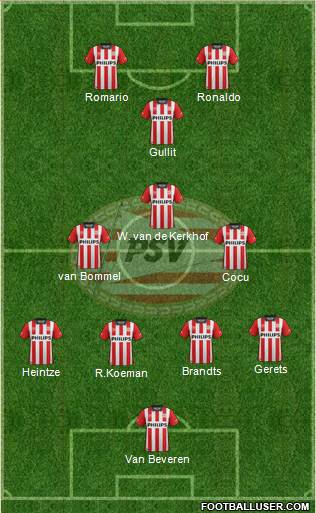
Formation
Coen Dillen should start ahead Ronaldo.  He is PSV through and through while Ronaldo only spent a season here.  


Wednesday, November 2, 2016

FC Koln Greatest All-Time Team

This blogger Artur Yanturin of Russia copied many of my blog teams.  This blog was one of them.  It was my Russia All-Time Team here.  His team was written in 2020, but mine was uploaded in 2014.   His Spartak Moscow All-Time team entry of was published in October 2020, but mine was uploaded in 2017.  His entry of the Dutch-German rivalry between Real Madrid and Barcelona was written in 2020, but mine was uploaded in 2014.  He also copied many many of my blog entries.

His Facebook and Instagram

1963-1964 Bundesliga champion

Please also see my All-Time World Cup Team Index.

Bayern Munich, Borussia Dortmund, 
Borussia Mönchengladbach, Schalke 04, Werder Bremen,
Hamburger SV, Kaiserslautern, Bayer Leverkusen, 
FC Koln, VfB Stuttgart, Eintracht Frankfurt, Wolfsburg.

FC Koln was formed in 1948 as a merger of the clubs Kölner Ballspiel-Club 1901 and SpVgg Sülz 07.  Like many of Germany's other professional football clubs, 1. FC Köln is part of a larger sports club with teams in other sports like handball, table tennis and gymnastics. 1. FC Köln had around 78.500 members as of May 2016, making it the fourth largest club in Germany

This is my selection of a 25 member all-time team for the club.  The number 25 was chosen because it is the official squad size for the Champions' League.

The club's nickname Die Geißböcke (The Billy Goats) refers to the club's mascot, a male goat named Hennes after the veteran FC player and (later) manager Hennes Weisweiler. The first Hennes was donated by a circus entrepreneur as a Cologne carnival joke. The current mascot is Hennes IX as of 1 August 2019 after Hennex VIII was retired by the club due to old age.
Koln won the Double in the 1977-1978 season
Team
GK: Harald Schumacher (Germany)
Harald "Toni" Schumacher had 76 caps between 1979 and 1986.  He won the 1980 European Championship in Italy and came second at the World Cup finals, in both 1982 and 1986.  He was best remembered for a highly controversial incident in the 1982 World Cup semifinal against France when he collided with and seriously injured French defender Patrick Battiston.  He spent the prime of his career with FC Koln, where he won the "Double" in 1978. 
Toni Schumacher
GK: Bodo Illgner (Germany)
Bodo Illgner played for Köln between 1986 and 1996.  He joined  Real Madrid in 1996, winning the Champions league in 1998. His starting position was succeeded by Iker Casillas. He was capped 54 times between 1987 and 1994.  He helped West Germany to the 1990 World Cup, where he became the first goalkeeper to keep a clean sheet in a World Cup final. He also played in 1994 World Cups Finals and two other European Championship.

GK: Manfred Manglitz (Germany)
Manfred Manglitz was a member of the West Germany squad at 1970 FIFA World Cup, playing four times for his country from 1965 to 1970.  His career, however, was remembered for a match fixing scandal known as "Bundesligaskandal" in 1971. He received a lifetime ban. For his club career, he played with Bayer Lverkusen, FC Koln and MSV Duisburg.

RB: Harald Konopka (Germany)
Harald Konopka won three German Cup's with 1. FC Köln and was runner-up with them in two other editions.  Konopka was part of the famous FC Köln squad that won the Bundesliga and the Cup in the same season (double) in 1978. He also played a season for Borussia Dortmund for the remainder of his career. Capped twice. He went to the World Cup Finals in 1978. He played once in the Finals.

ST/RB: Karl-Heinz Thielen (Germany)
Born in 1940, Karl-Heinz Thielen played for his entire career for Koln from 1959 to 1973.  He made nearly 300 appearances for the club. He won the German league in 1962.  Then, he won the first ever Bundesliga in the 1963-1964 with the club. The title was the first ever Bundesliga title in Germany.  He was capped twice for the West german national team in the 1960's.

CB: Jurgen Kohler (Germany)
Jurgen Kohler was regarded one of the best defenders in the 1990's.   He earned 105 caps for West Germany/Germany between 1986 and 1998.  He won the World Cup in 1990 and the European Championship in 1996.  For his club career, he played with Koln, Bayern Munich, Juventus and Borussia Dortmund.  He won the Champions' League in 1997 with Borussia Dortmund.  He was Footballer of the Year in Germany in 1997.
Jurgen Kohler
CB: Gerhard Strack (Germany)
He earned 10 caps and scored one goal for West Germany from 1982 to 1983, and was included in the West German team for the 1984 UEFA European Football Championship, but did not play. The one goal he scored, against Albania in a European Championship qualifier in 1983, was vital: it ensured that West Germany qualified for Euro 84 ahead of Northern Ireland.

CB: Paul Steiner (Germany)
Steiner appeared in 349 games in the Bundesliga, scoring 27 times from 1979 until 1991 with MSV Duisburg and 1. FC Köln. With the latter side, he was instrumental in five league finishes in the top three, also winning the German Cup in 1983 and losing the 1985–86 UEFA Cup to Real Madrid.  Capped once in 1990.

CB: Wolfgang Weber (Germany)
Wolfgang Weber played his entire career for FC Köln between 1963 and 1978.  He was capped 53 times.  He was best remembered for scoring the last minute equaliser For West Germany at the Final of the World Cup in 1966 against England that sent the Final into extra time.  He also played at the European Championship in 1968 and the World Cup Finals in 1970.  He had 53 caps between 1964 and 1975.

CB/LB: Karl-Heinz Schnellinger (Germany)
In his prime, Karl-Heinz Schnellinger was considered one of the best leftbacks in the world.  He participated in 4 World Cup Finals, unfortunaitely sandwiched between West Germany's two World Cup winning tournaments.  He was remembered one of the first German footballer to star in Italy.  He had a remarkable stint with AC Milan and As Roma.  He won the European Cup in 1969 with AC Milan. He was awarded the (German Footballer of the Year) in 1962. 
Karl-Heinz Schnellinger
CB/LB: Herbert Zimmermann (Germany)
Herbert Zimmermann  started as a striker for Bayern Munich.  He never found much playing time, but was a part of the squad of FC Bayern Munich that won the Bundesliga in 1973 and 1974, and the European Cup in 1974.  He joined Koln in 1974 and converted into a successful defender.  He was capped 14 times. He was a part of the team that won the European Championship in 1980.  He also went to the World Cup in 1978.

LB: Jonas Hector (Germany)
After beginning his youth career with SV Auersmacher in his home state of Saarland, Hector transferred to 1. FC Köln in 2010, whee he captained in 2016.  For Germany, he received his first cap in 2014.  He played in the European Championship of 2016 and the 2018 World Cup.  At the time of writing, he has over 40 caps for Germany. He won the 2017 Confederation Cup.

DM/SW: Bernhard Cullmann (Germany)
Bernhard Cullmann began his footballing career in 1969 with SpVgg Porz, until he was signed by 1. FC Köln in 1970. He played 341 matches in the Bundesliga for them before his retirement in 1984. He played 40 matches for the German team between 1973 and 1980, scoring six goals.[4] He participated at the 1974 FIFA World Cup, the 1978 FIFA World Cup, and the victorious UEFA Euro 1980.

CM: Bernd Schuster (Germany)
Schuster was the star of West Germany's Euro 1980 winning team, but disagreed with the German Football Association and seldom played for West Germany after the tournament.  He started with FC Koln in 1978. He was a star at La Liga in the 1980's, playing for Barcelona, Real Madrid and Atletico Madrid. He was the first player to have won the Spanish Cup for the big three in Spain. He later played for Bayer Leverkusen.
Bernd Schuster

LM/CM: Wolfgang Overath (Germany)
Wolfgang Overath was one of the best left midfielders in history,  He won the 1974 World Cup with West Germany at home, where he kept Gunter Netzer from the starting lineup. In total he won 81 caps for the national side between 1963 and 1974, scoring 17 goals.  In addition to 1974 World Cup Finals, he also went to the 1966 and 1970 World Cup Finals. He had World Cup medals for 1st, 2nd and 3rd place. He spent all of his career with Koln, winning the Bundesliga in 1963.  
Wolfgang Overath
RW/AM: Pierre Littbarski   (Germany)
Littibarski was a major star in the 1980's.  He had over 70 caps and played in three World Cup Finals (1982, 1986 and 1990) with Germany reaching the Final all 3 times, winning his final World Cup in 1990. He spent most of his career with Koln, winning the DFB-Pokal once, in 1983, and was three times runner up in the Bundesliga (1982, 1989 and 1990).  He has also played for RC Paris in Ligue 1 as well as for JEF United Ichihara and Brummel Sendai in Japan.
Pierre Littibarki
LW:  Hans Schafer  (Germany)
Hans Schafer played for 1. FC Köln between 1948 and 1965. He also played for the West Germany, earning 39 caps and scoring 15 goals. He played in three World Cups, in 1954, 1958, and 1962, earning a winner's medal in 1954 and scoring a total of seven goals. Between 1957 and 1962, Schäfer captained Germany 16 times. He was German Player of the Year in 1963. He spent all of his career with Koln.
Hans Schafer winning the 1964 Bundesliga

AM: Heinz Frohe (Germany)
He played for 1. FC Köln (1966–1979), winning the Bundesliga title in 1978, and the DFB-Pokal in 1968, 1977 and 1978. He also played for TSV 1860 München (1979–1980). Earned 39 caps and scored 8 goals for Die Mannschaft (West Germany). He was in the winning squad for the 1974 FIFA World Cup. He also played in the 1976 European Football Championship and the 1978 FIFA World Cup.

AM: Josef Rohrig (Germany)
Josef Rohrig played at 1. FC Köln for ten years between 1950 and 1960, and was part of the team which reached the final of the DFB-Pokal and finished second the German football championship. He also made sporadic appearances for the West Germany national football team between 1950 and 1956, playing 12 times and scoring two goals.

AM: Thomas Hassler (Germany)
Hassler was a star player in the 1990's.  He played for Koln, Juventus, Roma, Karlsruher, 1860 Munich and SV Salzburg. He appeared over 100 times for the German national team. He was a member of the teams which won the 1990 FIFA World Cup (as West Germany) and UEFA Euro 1996. He also appeared at the 1994 and 1998 FIFA World Cups, the 1992 and 2000 UEFA European Championships, and the 1988 Olympic Games.

FW: Klaus Allofs (Germany)
Klaus Allofs made his name with Fortuna Düsseldorf, where he was the Bundesliga top-scorer in 1978-1979, winning two German Cup with them.  He later played for Koln, Olympique de Marseille, Bordeaux and Werder Bremen.  With Werder Bremen, he won the 1992 Cup Winners' Cup. He had 56 caps. He was the top scorer at the European Championship in 1980, where West Germany was the champion.  He played at European Championship in 1984 and the World Cup Finals in 1986.
Klaus Allofs

FW: Lukas Podolski (Germany)
Born in Poland, Lukas Podolski grew up in Germany.  He made 81 appearances for Koln before moving to Bayern Munich. With Bayern, Podolski won the Bundesliga and DFB-Pokal double in 2008. Podolski returned to 1. FC Köln in 2009. He later played for Arsenal, Inter Milan, Galatasaray and Kobe Vissel. He was capped over 120 times.  He is a regular member of the national team from 2003 to 2016.  He was a part of the team that won the World Cup in 2014.
Lukas Podolski
ST: Heinz Hornig (Germany)
Hornig was capped by West Germany on seven occasions, making his debut in 1965 and his final appearances the following year. He was a member of the German squad at the 1966 FIFA World Cup, although he did not play a game in the tournament. He played his club football for 1. FC Köln between 1962 and 1970, and he appeared for them in the 1962–63 European Cup against Dundee.

ST: Hannes Löhr (Germany)
Hannes Löhr scored 166 top division goals for 1. FC Köln. He is the all-time leading scorer for the club.  He played with their great team in the 1960's.  He also won the Double in 1978 for the club.  Löhr won 20 caps for West Germany and appeared at the 1970 FIFA World Cup in Mexico.  He was a part of the team that won the 1972 European Championship, but did not play in the Finals.

ST: Dieter Muller (Germany)
Muller played for Koln, Stuttgart, Bordeaux, Grasshopper Club Zurich, FC Saarbrucken and Kickers Offenbach.  He set a record for the most goals scored by a player in a single Bundesliga match. In 1977, he scored six goals to Köln's 7–2 victory over Werder Bremen.  He was crowned Bundesliga topscorer that season and the season before in 1978. He was capped 12 times. He was best remembered for scoring a hat trick against Yugoslavia and a goal against Czechoslovakia at Euro 1976.
Dieter Muller

Honorable Mention
Jonas Hector (Germany), Armin Görtz (Germany), Dieter Prestin (Germany), Thomas Allofs (Germany), Heinz Simmet (Germany), Fritz Pott (Germany), Hansi Sturm (Germany), Roger van Gool (Belgium), Morten Olsen (Denmark), Christian Muller (Germany), Henrik Andersen (Denmark)

Squad Explanation
-- FC Köln had a great team in the early 1960's. They won the first Bundesliga in 1964.  Hans Schäfer, Karl- Heinz Schnellinger, Wolfgang Overath, Wolfgang Weber, Karl-Heinz Thielen and Heinz Hornig. Hannes Löhr was not on the 1963-1964 team. Schnellinger also left for AC Milan in 1963.
-- In 2018, the Bundesliga official website came up with their Best XI: Toni Schumacher, Harald Konopka, Wolfgang Webber, Jonas Hector, Thomas Hassler, Pierre Littbarski, Wolfgang Overath, Heinz Frohe, Hans Schafer, Dieter Muller and Lukas Podolski. Ten of the players listed were selected by my all-time team in 2016. 
-- When I wrote this blog team in 2016, Jonas Hector was too young to be considered at the time.  I put him on honourable mention.  In November, 2019, he replaced Henrik Andersen (Denmark) on the team.  Andersen's career here was affected by his injuries. I feel an additional two seasons to help Hector's position.
-- Hannes Löhr played in the 1960's, but was also a member of the 1978 Double winning team.  He is their all-time leading scorer.
-- From the 1978 "Double"(Bundesliga/German Cup) winning team, I selected Harald Schumacher, Gerhard Strack, Herbert Zimmermann, Harald Konopka,  Bernhard Cullmann, Heinz Frohe and Dieter Muller made the team. Wolfgang Weber was on the team, but did not play that season.  He retired soon afterward.
-- Dieter Muller was Bundesliga top scorer twice (1977 and 1978).  He was the hero at the 1976  European Championship, which was the first major tournament where West Germany played since the retirement of Gerd Muller. His namesake and his performance were newsworthy back then and he lived up to his namesake.
-- FC Koln reached the Final of the UEFA Cup in 1986, where they lost to Real Madrid.  From that period, I selected Harald Schumacher, Pierce Littibarski and Paul Steiner.  Thomas Hassler also played that season, but he was a young player.
-- Goalkeeper Harald Schumacher was also known as Toni Schumacher.  He played for Koln between 1972 and 1987. He was the famous German goalkeeper starting at the World Cup Finals in 1982 and 1986. Anton Schumacher was a goalkeeper for Koln between 1960 and 1968.  He was also known as "Toni Schumacher".  He played with another "Harold", Haraldo Konopka around the same time.  To avoid confusion, he earned the nickname "Toni", but would prove to be more confusing later in the club's history.
-- Manfred Manglitz was not punished for his match fixing scandal in 1971.
-- Schnellinger was one of the best defender in the world during his time with Koln.  He was awarded the (German Footballer of the Year) in 1962. 
-- Bernd Schuster only played two seasons, but he made his name here.  I sometimes selected great players who made their name in a smaller clubs.  It is much harder for a smaller club to keep a player such as Schuster for too long.  The same applied to Jürgen Kohler who also only spent two seasons here, but he made his first senior national team cap here.

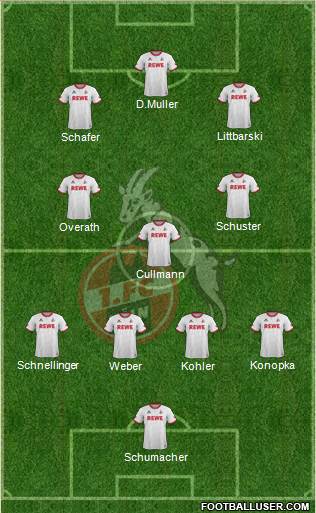
Formation