|
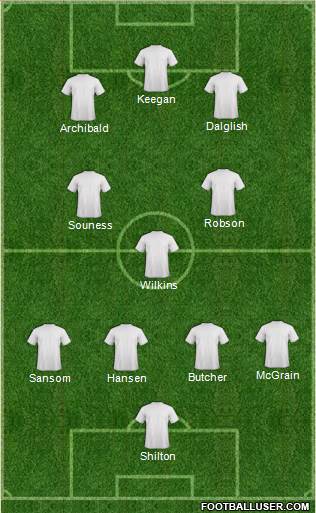
| England at Mexico 1970 |
England
United Kingdom
Greater London
North East England, NorthWest England
Yorkshire and Humber
Brazil World Cup 1958
Scotland World Cup 1970
United Kingdom World Cup 1970
England World Cup 1974
United Kingdom World Cup1982
Scotland World Cup 1970
United Kingdom World Cup 1970
England World Cup 1974
United Kingdom World Cup1982
Italy Euro 1992
United Kingdom World Cup 1994
Yugoslavia World Cup 1994
France World Cup 1994
Germany World Cup 2002
Netherlands World Cup 2002
United Kingdom World Cup 1994
Yugoslavia World Cup 1994
France World Cup 1994
Germany World Cup 2002
Netherlands World Cup 2002
Spain without Catalan players World Cup 2010
USA World Cup 2010
Brazil 1982 with Careca, etc
I do believe United Kingdom could have won the World Cup in 1970. The United Kingdom in 1970 would have been reinforced with George Best who was the greatest footballer ever to come from the UK. Despite not qualifying for the World Cup Finals, Scotland had a talented squad. Celtic won the European Cup in 1967 and reached the Final again that year. Jimmy "Jinky" Johnstone was at his peak. Billy Bremner was the FWA Player of the Year in 1970. Bobby Moore, Bobby Charlton, Gordon Banks and George Best are four of the greatest footballers ever emerged from the United Kingdom. They were at their prime in 1970.
Prediction
England's issue in the 1970 was actually scoring goals. They only scored two goals during the group stage and one of them was a penalty. They recovered and scored 2 against West Germany in the second round. For United Kingdom, the addition of Jimmy Johnstone and George Best should improve. Denis Law was injured throughout the season. I did not forsee a big role for him.
Had the United Kingdom progressed to the semi-final, they would have faced Italy. Italy had not defeated England until 1973, maintaining England's historical dominance over the Italian team up to that juncture.
USA World Cup 2010
Brazil 1982 with Careca, etc
I do believe United Kingdom could have won the World Cup in 1970. The United Kingdom in 1970 would have been reinforced with George Best who was the greatest footballer ever to come from the UK. Despite not qualifying for the World Cup Finals, Scotland had a talented squad. Celtic won the European Cup in 1967 and reached the Final again that year. Jimmy "Jinky" Johnstone was at his peak. Billy Bremner was the FWA Player of the Year in 1970. Bobby Moore, Bobby Charlton, Gordon Banks and George Best are four of the greatest footballers ever emerged from the United Kingdom. They were at their prime in 1970.
Prediction
England's issue in the 1970 was actually scoring goals. They only scored two goals during the group stage and one of them was a penalty. They recovered and scored 2 against West Germany in the second round. For United Kingdom, the addition of Jimmy Johnstone and George Best should improve. Denis Law was injured throughout the season. I did not forsee a big role for him.
England's exit in the quarterfinals wasn't reflective of their potential. Many experts including Sir Ramsey himself considered that the 1970 team was superior to the 1966 squad. The quarterfinal match between England and the eventual semifinalist West Germany were very close. England took a 2-0 lead before West Germany equalised. Initially leading 2-0, England saw their advantage slip away as the Germans equalized. The absence of Gordon Banks, sidelined due to illness, saw his replacement Peter Bonetti, with limited international experience, concede two critical goals, including a blooper by him for the first goal. But most pundits, historians, journalists and even players blamed the comeback on Ramsey's decision to substitute Bobby Charlton, a move that allowed Franz Beckenbauser more freedom to influence the game offensively. Geoff Hurst also had a disallowed goal, further complicating England's fortunes. "England" could have beaten West Germany with reinforcement from the rest of the UK. Pat Jennings would be a better replacement than Peter Bonetti. Billy Bremner's defensive prowess might have curbed the German onslaught. He was more defensive than any midfielders England used that day.
The bitter loss had political repercussions, with Prime Minister Harold Wilson associating it with the Labour Party's subsequent electoral defeat. Up until that point, England has only lost to Germany once in 1968. The 1968 match was a friendly match played three days before England took on Yugoslavia on the semi-final of Euro 1968. It was largely forgotten by people from both sides of the rivalry. However, the subsequent years marked a shift in dominance. After the 1970 World Cup, Germany began almost thirty years of dominance over England.
Had the United Kingdom progressed to the semi-final, they would have faced Italy. Italy had not defeated England until 1973, maintaining England's historical dominance over the Italian team up to that juncture.
In the hypothetical Final scenario, Brazil would have been United Kingdom's opponent. The 1970 Brazilian team was widely regarded as one of the greatest national teams in history. However, during the actual World Cup, England only narrowly lost to Brazil in the first round. England was arguably the only team that gave Brazil a tough challenge in the tournament.
Pele himself regarded Bobby Moore as the greatest defender he had ever faced, highlighting the quality of the English team. The match between England and Brazil in the World Cup Finals was one of the greatest ever matches in World Cup's history. Given the competitive nature of this encounter, it's plausible to imagine that the Final between Brazil and United Kingdom would be epic. With so much talents on the lineup, the United Kingdom could have emerged victorious in a rematch against Pele's Brazil in the Final.
When I edited this blog on February, 2022, I realised that I did not come up a scenario where England qualified first place ahead of Brazil in the Group Stage and went through the knockout route taken by Brazil in the actual World Cup Finals.
In the hypothetical progression through the next rounds, the United Kingdom would have encountered two formidable South American opponents: Peru and Uruguay. Peru had emerged as the surprise team of the tournament, showcasing their strength and making them a challenging adversary. Facing Peru would have posed a significant challenge for the United Kingdom.
Subsequently, a clash with Uruguay in the semi-final awaited the United Kingdom. While England had won a friendly match against Uruguay in 1969, a World Cup match against them would have presented a different and more intense scenario.
If the United Kingdom had advanced to the Final, Brazil would likely have been their opponents once again. This challenging route would have seen the United Kingdom playing three consecutive matches against South American teams in the heat of Mexico, making the outcome of such a journey highly unpredictable.
This would be the 22-member team I would bring to Mexico 1970. * Only 22 member team in 1970.
Team
GK: Gordon Banks (England/Stoke City)
Gordon Banks was named FWA Footballer of the Year in 1972, and was named FIFA Goalkeeper of the Year on six occasions. He won the World Cup in 1966. He also made one of the game's great saves to prevent a Pelé goal in the 1970 World Cup. Along with Lev Yashin, he is considered the greatest keepers of his generation. The prime of his club career was spent with Leicester and Stoke City.
GK: Pat Jennings (N.Ireland/Tottenham Hotspurs)
Pat Jennings is considered among the greatest goalkeeper of all-time. The prime of his career was spent with both Tottenham Hotspurs and Arsenal. In 1973 the Football Writers' Association named him as its footballer of the year. Three years later he won PFA's version of the award – he was the first goalkeeper to receive this accolade, and to this date remains only one of two, along with Peter Shilton. He earned 119 caps for Northern Ireland and went to two World Cup Finals.
GK: Peter Bonetti (England/Chelsea)
Nicknamed as "the Cat", Bonetti was a legend at Chelsea. His finest moment came in the Final of the FA Cup in 1970 where his heroic play helped Chelsea to win the FA Cup. He was the FWA Player of the Year runner-up that year. However, he only earned 7 caps for England. his career was limited by playing with Gordon Banks at the same time. He was Banks' backup in the World Cup 1966.
RB: Tommy Wright (England/Everton)
Wright spent his entire career with Everton. He played in the winning team in the 1966 FA Cup Final. He also won the 1969/70 Football League Championship. Capped 12 times. He made his debut in the 1968 European Championship. He also participated at the 1970 World Cup Finals in Mexico. He was named as an inaugural member of Gwladys Street's Hall of Fame in 1996, and as an "Everton Giant" in 2016.
RB: Keith Newton (England/Everton)
Newton started his career with Blackburn Rovers and first played a League game in the 1960-61 season. Newton went on to play over 300 games for the club. He later played for Everton and Burnley. For England, he was capped 27 times. He played in the 1970 World Cup Finals in Mexico. He gained the distinction of becoming the first England player to be substituted at a World Cup
CB: Bobby Moore (England/West Ham)
Bobby Moore was the captain of the 1966 World Cup winning team. He was regarded one of the greatest defenders of all time. He won a total of 108 caps for the England team, which at the time of his international retirement in 1973 was a national record.For his club career, he played mainly for West Ham, but he also played for Fulham and had a stint in the NASL. He won a UEFA Cup Winners' Cup with West Ham.
CB: Billy McNeill (Scotland/Celtic)
As the captain of "Lisbon Lions, Billy McNeill was the first British footballer to hold aloft the European Cup, when Celtic won the Cup in 1967. He also won nine Scottish League championships, seven Scottish Cups, and six Scottish League Cups. He was voted as Cetlics' greatest captain. He played his entire career with Celtic. He was capped 29 times for Scotland between 1961 and 1972.
CB: John Greig (Scotland/Glasglow Rangers)
Greig played his entire career with Rangers. He was voted as the greatest Ranger ever by the fans in 1999. He scored 120 goals for the club and won three domestic trebles. Greig actually started his career with Rangers as a forward, prior to being moved to defense. He won the 1971–72 European Cup Winners' Cup. He was capped 44 times. He led Scotland in a famous victory over England, their first defeat as World Cup winner at Wembley.
CB Mike England (Wales/Tottenham Hotspurs)
At Spurs, Mike England won the inaugural 1972 UEFA Cup Final and was runner up in the same competition 2 years later; his goal in the first leg of the 1974 final unable to win the cup a second time for Spurs. He also played for Blackburn Rovers, Seattle Sounders (USA) and Cardiff City. He was capped 44 times and was also the youngest Welsh captain at one point. He also played as a center forward.
LB: Terry Cooper (England/Leeds United)
Terry Cooper was Don Revie's trusted left back at Leeds United. He played for Leeds from 1962 and 1975. He was known for his partnership with Eddie Grey on the left flank. He left to join Middlesbrough, which was then managed by his teammate Jack Charlton. He had 20 caps for England between 1969 and 1974.
LB/RB: Tommy Gemmell (Scotland/Celtic)
Tommy Gemmell was a legendary player with Celtic. He scored the opening goal for the Lisbon Lions in 1967 as Celtic became the first British club to win the trophy. He scored again at the European Cup Final in 1970 in a defeat to Feyenoord. He also had a successful career with Nottingham Forest. He also played for Miami Toros and Dundee. Capped 18 times for Scotland.
CM: Alan Ball (England/Everton)
Ball was the youngest member of the WC winning team in 1966. He started his career with Blackpool. He also played with Everton, Arsenal, Southampton and various clubs in North America and Hong Kong. He played 72 times for England and was a key player at the WC finals in 1966 and 1970. He missed the ill-fated match vs Poland in 1973 due a suspension.
CM: Billy Bremner (Scotland/Leeds United)
Bremner was Leeds United's greatest ever player. He was their captain when they dominated English football. He was also named as the FWA Footballer of the Year in 1970. He was known for his rough play. He is a member of both the English Football Hall of Fame and Scottish Football Hall of Fame. He spent 1976 to 1978 at Hull City, before being appointed player-manager at Doncaster Rovers in November 1978. He was capped 50 times. He went to the WC finals in 1974.
LM/CM: Martin Peters (England/Tottenham Hotspurs)
Martin Peters was an all-round midfielder who played for West Ham United, Tottenham Hotspur, Norwich City and Sheffield United. He was briefly a player/coach for Sheffield United. He earned 67 caps for England between 1966 and 1974, and was a member of the 1966 World Cup winning team.
CM: Colin Bell (England/Manchester City)
Bell is considered to be Manchester City's greatest ever player. He won the league in 1967-1968, FA Cup in 1969 and the UEFA Cup Winners' Cup in 1970. While Bell is considered to be one of England's greatest midfielder, he was unable to showcase his talents in the world stage. He was remembered as the substitute for Bobby Charlton at the WC Finals in 1970 against West Germany. In 1973, he was a part of the ill-fated national team that failed to qualify for West Germany 1974.
LW/RW: George Best (N.Ireland/Manchester United)
George Best was considered to be one of the greatest players ever played the game. He was voted #19 as the greatest European player by the UEFA Jublilee Poll. He was known for his "pop star" lifestyle. He was one of the "United's Trinity" that helped Manchester United to their first (and also first ever for an English club) European Cup in 1968. He won the PWA PLayer of the Year award and the Ballon d'Or that year.
AM: Bobby Charlton (England/Manchester United)
Sir Bobby was considered one of the greatest midfielders of all-time. He was capped 106 times by England and led England to World Cup victory in 1966. He is also England's all-time leading scorer and all-time cap leader at the time of his retirement. He was selected for four World Cups (1958, 1962, 1966 and 1970). For club career, he almost played his entire career with Manchester United. He was the hero of Manchester United's the first ever European Cup trophy in 1968. He won the Ballon D'Or in 1966.
RW: Jimmy Johnstone (Scotland/Celtic)
Johnstone played over 500 games for Celtic. In 2002, he was voted as the greatest Cetlic players by the fans. He played over 500 games for them. He was one of the Lisbon Lions. He later played for the San Jose Earthquakes, Sheffield United, Dundee, Shelbourne and Elgin City. He was capped 23 times. He went to the WC Finals in 1974, but did not play.
FW: Denis Law (Scotland/Manchester United)
Law spent 11 years at Manchester United, where he scored 237 goals in 404 appearances. His goals tally places him third in the club's history, behind Bobby Charlton and Wayne Rooney. He partnered George Best and Bobby Charlton at Manchester United, which was considered to be most popular forward line in British history. He was capped 55 times. He managed to play in the 1974 WC Finals.
ST: Francis Lee (England/Manchester City)
Lee played for Bolton Wanderers, Manchester City, Derby County and England. A fast forward, he won League Championship medals with Manchester City and Derby, and scored more than 200 goals in his career. In 2010, he was inducted into the English Football Hall of Fame. He holds the English record for the greatest number of penalties scored in a season, a feat which earned him the nickname Lee Won. Capped 27 times.
ST: Peter Osgood (England/Chelsea)
Osgood was a legend with Chelsea. He helped them to win the Cup Winners' Cup in 1970. Despite his successes with Chelsea, he only earned 4 caps. Sir Ramsey is rumoured to dislike him for his playboy lifestyle. He was a member of the 1970 World Cup squad, making two appearances against Czechoslovakia and Romania as a substitute. Near the end of his career, he played for Southampton, Norwich, Philadelphia Fury and a return to Chelsea.
ST: Sir Geoff Hurst (England/West Ham)
Sir Geoff Hurst was best known for scoring a hat trick at the 1966 World Cup Final against West Germany. He also played in following World Cup Finals in Mexico. He remains the only man to score a hat-trick in a World Cup final. He played 490 times in total for England. His club career was spent mainly with West Ham and Stoke City. He also had a stint in NASL with Seattle Sounders in 1976.
Honorable Mention
Eddie McCreadie (Scotland), Brian Labone (England), Bobby Murdoch (Scotland), Norman Hunter (England), Alan Mullery (England), Willie Henderson (Scotland), Eddie Gray (Scotland).
Squad Explanation
-- Many experts considered England had a better team than their one in 1966. In the World Cup Finals, Brazil only managed to beat them 1-0. Gordan Banks, Bobby Moore and Bobby Charlton were at their prime. They will be reinforced by George Best, who was considered among their greatest ever players from the United Kingdom. Billy Bremner was the FWA Player of the Year in 1970. Celtic also reached the European Cup Final that year.
Team
GK: Gordon Banks (England/Stoke City)
Gordon Banks was named FWA Footballer of the Year in 1972, and was named FIFA Goalkeeper of the Year on six occasions. He won the World Cup in 1966. He also made one of the game's great saves to prevent a Pelé goal in the 1970 World Cup. Along with Lev Yashin, he is considered the greatest keepers of his generation. The prime of his club career was spent with Leicester and Stoke City.
GK: Pat Jennings (N.Ireland/Tottenham Hotspurs)
Pat Jennings is considered among the greatest goalkeeper of all-time. The prime of his career was spent with both Tottenham Hotspurs and Arsenal. In 1973 the Football Writers' Association named him as its footballer of the year. Three years later he won PFA's version of the award – he was the first goalkeeper to receive this accolade, and to this date remains only one of two, along with Peter Shilton. He earned 119 caps for Northern Ireland and went to two World Cup Finals.
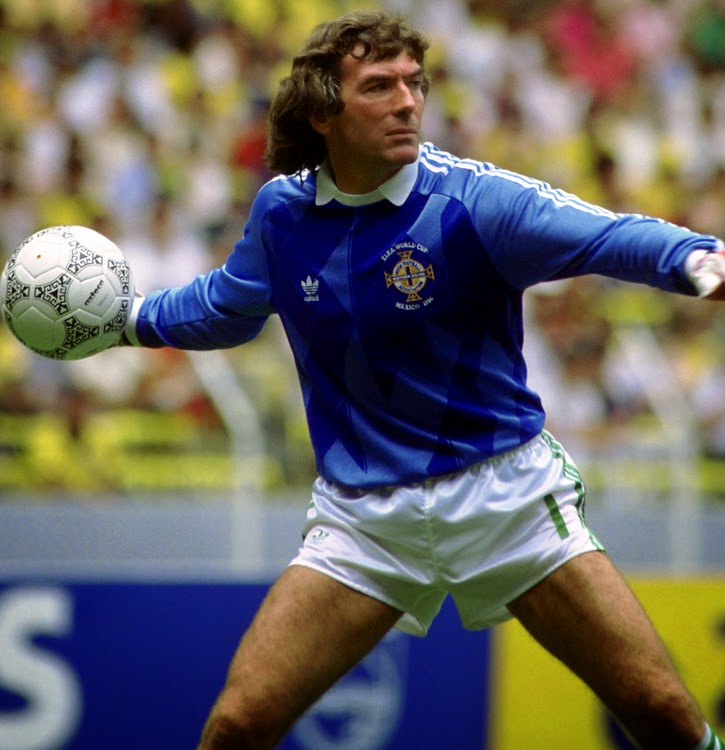 |
| Pat Jennings |
Nicknamed as "the Cat", Bonetti was a legend at Chelsea. His finest moment came in the Final of the FA Cup in 1970 where his heroic play helped Chelsea to win the FA Cup. He was the FWA Player of the Year runner-up that year. However, he only earned 7 caps for England. his career was limited by playing with Gordon Banks at the same time. He was Banks' backup in the World Cup 1966.
RB: Tommy Wright (England/Everton)
Wright spent his entire career with Everton. He played in the winning team in the 1966 FA Cup Final. He also won the 1969/70 Football League Championship. Capped 12 times. He made his debut in the 1968 European Championship. He also participated at the 1970 World Cup Finals in Mexico. He was named as an inaugural member of Gwladys Street's Hall of Fame in 1996, and as an "Everton Giant" in 2016.
RB: Keith Newton (England/Everton)
Newton started his career with Blackburn Rovers and first played a League game in the 1960-61 season. Newton went on to play over 300 games for the club. He later played for Everton and Burnley. For England, he was capped 27 times. He played in the 1970 World Cup Finals in Mexico. He gained the distinction of becoming the first England player to be substituted at a World Cup
CB: Bobby Moore (England/West Ham)
Bobby Moore was the captain of the 1966 World Cup winning team. He was regarded one of the greatest defenders of all time. He won a total of 108 caps for the England team, which at the time of his international retirement in 1973 was a national record.For his club career, he played mainly for West Ham, but he also played for Fulham and had a stint in the NASL. He won a UEFA Cup Winners' Cup with West Ham.
 |
| Bobby Moore vs Brazil in Mexico 1970 |
As the captain of "Lisbon Lions, Billy McNeill was the first British footballer to hold aloft the European Cup, when Celtic won the Cup in 1967. He also won nine Scottish League championships, seven Scottish Cups, and six Scottish League Cups. He was voted as Cetlics' greatest captain. He played his entire career with Celtic. He was capped 29 times for Scotland between 1961 and 1972.
CB: John Greig (Scotland/Glasglow Rangers)
Greig played his entire career with Rangers. He was voted as the greatest Ranger ever by the fans in 1999. He scored 120 goals for the club and won three domestic trebles. Greig actually started his career with Rangers as a forward, prior to being moved to defense. He won the 1971–72 European Cup Winners' Cup. He was capped 44 times. He led Scotland in a famous victory over England, their first defeat as World Cup winner at Wembley.
CB Mike England (Wales/Tottenham Hotspurs)
At Spurs, Mike England won the inaugural 1972 UEFA Cup Final and was runner up in the same competition 2 years later; his goal in the first leg of the 1974 final unable to win the cup a second time for Spurs. He also played for Blackburn Rovers, Seattle Sounders (USA) and Cardiff City. He was capped 44 times and was also the youngest Welsh captain at one point. He also played as a center forward.
LB: Terry Cooper (England/Leeds United)
Terry Cooper was Don Revie's trusted left back at Leeds United. He played for Leeds from 1962 and 1975. He was known for his partnership with Eddie Grey on the left flank. He left to join Middlesbrough, which was then managed by his teammate Jack Charlton. He had 20 caps for England between 1969 and 1974.
LB/RB: Tommy Gemmell (Scotland/Celtic)
Tommy Gemmell was a legendary player with Celtic. He scored the opening goal for the Lisbon Lions in 1967 as Celtic became the first British club to win the trophy. He scored again at the European Cup Final in 1970 in a defeat to Feyenoord. He also had a successful career with Nottingham Forest. He also played for Miami Toros and Dundee. Capped 18 times for Scotland.
CM: Alan Ball (England/Everton)
Ball was the youngest member of the WC winning team in 1966. He started his career with Blackpool. He also played with Everton, Arsenal, Southampton and various clubs in North America and Hong Kong. He played 72 times for England and was a key player at the WC finals in 1966 and 1970. He missed the ill-fated match vs Poland in 1973 due a suspension.
CM: Billy Bremner (Scotland/Leeds United)
Bremner was Leeds United's greatest ever player. He was their captain when they dominated English football. He was also named as the FWA Footballer of the Year in 1970. He was known for his rough play. He is a member of both the English Football Hall of Fame and Scottish Football Hall of Fame. He spent 1976 to 1978 at Hull City, before being appointed player-manager at Doncaster Rovers in November 1978. He was capped 50 times. He went to the WC finals in 1974.
 |
| Billy Bremner |
Martin Peters was an all-round midfielder who played for West Ham United, Tottenham Hotspur, Norwich City and Sheffield United. He was briefly a player/coach for Sheffield United. He earned 67 caps for England between 1966 and 1974, and was a member of the 1966 World Cup winning team.
CM: Colin Bell (England/Manchester City)
Bell is considered to be Manchester City's greatest ever player. He won the league in 1967-1968, FA Cup in 1969 and the UEFA Cup Winners' Cup in 1970. While Bell is considered to be one of England's greatest midfielder, he was unable to showcase his talents in the world stage. He was remembered as the substitute for Bobby Charlton at the WC Finals in 1970 against West Germany. In 1973, he was a part of the ill-fated national team that failed to qualify for West Germany 1974.
LW/RW: George Best (N.Ireland/Manchester United)
George Best was considered to be one of the greatest players ever played the game. He was voted #19 as the greatest European player by the UEFA Jublilee Poll. He was known for his "pop star" lifestyle. He was one of the "United's Trinity" that helped Manchester United to their first (and also first ever for an English club) European Cup in 1968. He won the PWA PLayer of the Year award and the Ballon d'Or that year.
 |
| George Best vs Gordon Banks |
Sir Bobby was considered one of the greatest midfielders of all-time. He was capped 106 times by England and led England to World Cup victory in 1966. He is also England's all-time leading scorer and all-time cap leader at the time of his retirement. He was selected for four World Cups (1958, 1962, 1966 and 1970). For club career, he almost played his entire career with Manchester United. He was the hero of Manchester United's the first ever European Cup trophy in 1968. He won the Ballon D'Or in 1966.
 |
| Bobby Charlton vs Pele in Mexico |
Johnstone played over 500 games for Celtic. In 2002, he was voted as the greatest Cetlic players by the fans. He played over 500 games for them. He was one of the Lisbon Lions. He later played for the San Jose Earthquakes, Sheffield United, Dundee, Shelbourne and Elgin City. He was capped 23 times. He went to the WC Finals in 1974, but did not play.
FW: Denis Law (Scotland/Manchester United)
Law spent 11 years at Manchester United, where he scored 237 goals in 404 appearances. His goals tally places him third in the club's history, behind Bobby Charlton and Wayne Rooney. He partnered George Best and Bobby Charlton at Manchester United, which was considered to be most popular forward line in British history. He was capped 55 times. He managed to play in the 1974 WC Finals.
 |
| Denis Law |
Lee played for Bolton Wanderers, Manchester City, Derby County and England. A fast forward, he won League Championship medals with Manchester City and Derby, and scored more than 200 goals in his career. In 2010, he was inducted into the English Football Hall of Fame. He holds the English record for the greatest number of penalties scored in a season, a feat which earned him the nickname Lee Won. Capped 27 times.
ST: Peter Osgood (England/Chelsea)
Osgood was a legend with Chelsea. He helped them to win the Cup Winners' Cup in 1970. Despite his successes with Chelsea, he only earned 4 caps. Sir Ramsey is rumoured to dislike him for his playboy lifestyle. He was a member of the 1970 World Cup squad, making two appearances against Czechoslovakia and Romania as a substitute. Near the end of his career, he played for Southampton, Norwich, Philadelphia Fury and a return to Chelsea.
ST: Sir Geoff Hurst (England/West Ham)
Sir Geoff Hurst was best known for scoring a hat trick at the 1966 World Cup Final against West Germany. He also played in following World Cup Finals in Mexico. He remains the only man to score a hat-trick in a World Cup final. He played 490 times in total for England. His club career was spent mainly with West Ham and Stoke City. He also had a stint in NASL with Seattle Sounders in 1976.
 |
| Sir Geoff Hurst |
Eddie McCreadie (Scotland), Brian Labone (England), Bobby Murdoch (Scotland), Norman Hunter (England), Alan Mullery (England), Willie Henderson (Scotland), Eddie Gray (Scotland).
Squad Explanation
-- Many experts considered England had a better team than their one in 1966. In the World Cup Finals, Brazil only managed to beat them 1-0. Gordan Banks, Bobby Moore and Bobby Charlton were at their prime. They will be reinforced by George Best, who was considered among their greatest ever players from the United Kingdom. Billy Bremner was the FWA Player of the Year in 1970. Celtic also reached the European Cup Final that year.
-- The Scottish national defeated England in 1967, becoming the first team in the world to beat the World Cup holder. However, they failed to qualify for the World Cup Finals in Mexico. They finished behind West Germany in their qualifying group after a 3-2 defeat in Hamburg. Scotland actually scored first on that match, but they needed to overcome a big goal difference heading toward the game. I also did a blog team for Scotland 1970.
-- Sir Alf Ramsey's tactical genius was one of the prime reasons why England did so well in 1966 and 1970. However, this team was not England. It was the United Kingdom. The blog team was not managed by Sir Alf Ramsey. I was only using his selection as a reference. Sir Ramsey was known for his wingless formation. But with Jimmy Johnstone and George Best at his disposal, I was not sure if he was the right person to be in charge of this UK team. Perhaps, he would tempted to use wingrs with such great players on his team. That was besides the point. I never use existing managers on any of my "what if blog" team. I was in charge of the team.
-- The core of the team was still the England 1970 team. Nine non-English players were added. They are Pat Jennings, Billy Bremner, George Best, Denis Law, John Greig, Jimmy Johnstone, Mike England, Tommy Gemmell and Billy McNeill.
-- George Best, Bobby Charlton, Bobby Moore, Gordon Banks and Pat Jennings are my United Kingdom All-Time Team. Jimmy Johnstone, Billy Brenman and Denis Law are named in that team's honorable mentions. They were all in their prime in 1970.
-- George Best, Bobby Charlton, Bobby Moore, Gordon Banks and Pat Jennings are my United Kingdom All-Time Team. Jimmy Johnstone, Billy Brenman and Denis Law are named in that team's honorable mentions. They were all in their prime in 1970.
-- England, Wales and Scotland shared the trophy of the 1969-1970 British Home Championship. The three teams drew with one another while beating Northern Ireland. All matches were low scoring, except the England-Northern Ireland match.
-- I "retained" the following English players from the 1966 World Cup winning team: Gordan Banks, Bobby Moore, Bobby Charlton, Alan Ball, Peter Bonetti, Tommy Wright, Geoff Hurst and Martin Peters.
-- Denis Law, John Greig, Jimmy Johnstone, Billy McNeill, Tommy Gemmell and Billy Bremner are on my Scotland All-Time team.
-- Mike England was selected because he was the only player from Wales who deserved a place on the squad. I believe in spreading the team around. Yes, his selection was political. He is on my Wales All-Time Team. John Toshack was relatively unknown in 1970. He was playing in the second division with Cardiff City. He would join Liverpool in November, 1970. So I left him out of the squad.
-- Four of the "newcomers" did not play in the English league. They were John Greig, Jimmy Johnstone, Tommy Gemmell and Billy McNeill. Three of them played with Celtic and the other with Rangers.
-- The three Celtic players were members of "Lisbon Lions". That season, they also reached the Final of the European Cup before losing to Feyenoord. In the semifinal, they met and eliminated Leeds United in the first ever all-British tie in the tournament's history. Billy Bremner described Jimmy Johnstone's performance in the series as "one of the greatest exhibitions I have ever seen". Jimmy Johnstone whom I considered as one of the top five greatest ever right wingers in the history of British football was in top form.
-- Denis Law, John Greig, Jimmy Johnstone, Billy McNeill, Tommy Gemmell and Billy Bremner are on my Scotland All-Time team.
-- Mike England was selected because he was the only player from Wales who deserved a place on the squad. I believe in spreading the team around. Yes, his selection was political. He is on my Wales All-Time Team. John Toshack was relatively unknown in 1970. He was playing in the second division with Cardiff City. He would join Liverpool in November, 1970. So I left him out of the squad.
-- Four of the "newcomers" did not play in the English league. They were John Greig, Jimmy Johnstone, Tommy Gemmell and Billy McNeill. Three of them played with Celtic and the other with Rangers.
-- The three Celtic players were members of "Lisbon Lions". That season, they also reached the Final of the European Cup before losing to Feyenoord. In the semifinal, they met and eliminated Leeds United in the first ever all-British tie in the tournament's history. Billy Bremner described Jimmy Johnstone's performance in the series as "one of the greatest exhibitions I have ever seen". Jimmy Johnstone whom I considered as one of the top five greatest ever right wingers in the history of British football was in top form.
 |
| Billy Bremner and Jimmy Johnstone |
-- Leeds United’s 1969-70 season was perhaps the most disappointing campaign for an English club. They were at one point projected to win the Triple, but failed at all three fronts. Only Billy Bremner (Scotland) and Terry Cooper (England) made this team. Their teammates Paul Reaney (England) missed the actual World Cup 1970 due to an injury. Keith Newton of Everton took his place. As mentioned, I dropped Norman Hunter and Allan Clarke from the original 1970 World Cup team. Eddie Gray was also considered.
-- Everton won the English League that season with a 9 points gap over Leeds United. Keith Newton, Tommy Wright and Alan Ball played for them. The original England team also included Brian Labone, but he was one of the players I dropped. With John Greig, Bobby Moore, Billy McNeill and Mike England ahead of him, it would be difficult to select Labone.
-- Manchester City won the Cup Winners' Cup that season. I took Francis Lee and Colin Bell from the team. They were on the original England World Cup team.
Goalkeepers
-- Gordon Banks and Pat Jennings were easy choices. Peter Bonetti had 6 caps while Alex Stepney had a single cap. In real life, Bonetti went to Mexico 1970. He was the hero of Chelsea's victory at that year's FA Cup. He was voted runner-up in the FWA Footballer of the Year awards. He was actually the obvious choice for the third goalkeeper.
-- Ronnie Simpson was 39 years in 1970. He was still with Celtic, but he did not play much that season. An injury late 1969 forced him to retire at the end of the season. He did not play in the European Cup Final. He also did not play in any the World Cup Qualifiers for Scotland.
-- In 1967, Peter Shilton replaced Gordon Banks as Leicester's number one goalkeeper which forced Banks to leave for Stroke. Despite this move, Shilton did not make his international debut until November 1970. During the World Cup Finals, he was playing in the Second Division with Leicester and was not considered ready to be the United Kingdom's third-choice goalkeeper.
-- Scotland's main goalkeepers were Jim Herriot (Birmingham City) and Tommy Lawrence (Liverpool). Ray Clemence also replaced Lawrence as Liverpool's starter in 1970. His first cap however came in 1972.
Defenders
-- I started by selecting Bobby Moore and Billy McNeill.
-- Both Norman Hunter and Brian Labone were left off the team because of politics. John Greig was a big star in Scotland and the captain of the Scottish national team. As mentioned, I took Mike England because he was the only Welsh who could make the team. Greig was overlooked for this team in 2017 when I started the blog. However, upon studying the team, I noticed that no player from Glasgow Ranger was selected. I do not know enough about politics of the 1970's whether it would be controversial to field an all-UK team without a single Ranger. Of course, I could have taken Willie Henderson, but I was happy with my selections in his position. In the end, I took out Norman Hunter out and replaced him with Greig. Norman Hunter was an iconic player in the 1970's for his toughness. It is hard not to take him. However, he was only used once in the World Cup Finals. He was slightly injured during the 1969-1970 season. John Greig, meanwhile, was Scotland's captain.
 |
| Mike England |
-- In 1970, Pat Rice of Northern Ireland was not yet a starter at Arsenal. Sandy Jardine had not played for Scotland. He made his international debut in November, 1970. So I excluded him for the 1970 team. They would have made the UK team a year or two later, but not in the 1970. So I took Tommy Wright and Keith Newton, both from Everton. Newton only joined Everton in December, 1969. Everton used him as a leftback because they already had Wright on the right. On this team, both would be rightbacks. Paul Reaney was out injured.
-- Scotland's Manager Bobby Brown moved leftback Tommy Gemmell to the right side and played both Eddie McCreadie and Gemmell at the same time. For this team, I left out McGreadie and took Terry Cooper of England. Cooper and Gemmell would be my leftbacks. Gemmell scored a goal in the Final of the 1970 European Cup against Feyenoord. Cooper made his debut for England in 1969 and established himself as Sir Ramsey's starting leftback.
Midfielders/Wingers
-- Billy Bremner, Alan Ball, Colin Bell, Martin Peters and Bobby Charlton were easy selections for the midfield positions. Of course, George Best and Jimmy Johnstone made up the winger positions.
-- Duncan Edwards, had he been alive in 1970, would have been 34 years old, just a year older than Bobby Charlton. Many regarded him as a player with the potential to become the greatest English player of all time. If he had survived, Edwards would likely have played alongside Manchester United's "Holy Trinity" of George Best, Denis Law, and Bobby Charlton, potentially forming a legendary Manchester "Fab Four." Imagining a team with the likes of Charlton, Moore, Banks, Best, Law, Bremner, Johnstone, and Edwards playing together throughout the 1960s sparks curiosity and wonder. For this etam, i could not select a dead player.
-- David Pegg and Eddie Colman would have been 35 and 33 years old respectively. I do not want to think about what would have became their careers if they survived the Munich Air Disaster. Jackie Blanchflower survived, but retired from injuries suffered from the crush. He was 37 years old in 1970.
-- In March, 1970, Tottenham Hotspurs broke the transfer record (including Jimmy Greaves in the deal) to buy Martin Peters from West Ham, but the transfer was actually about Peters' lack of form with West Ham and he hoped to get back into fitness with Hotspurs.
-- As mentioned above, Sir Ramsey used a wing-less formation. But this United Kingdom had Jimmy Johnstone and George Best at its disposal. I already talked about Johnstone's performance at the European Cup. He was in his best form in 1970. I also looked at Willie Henderson and Bobby Lennox as backup wingers. In that era, Henderson was comparable to Jimmy Johnstone. The Rangers fan considered him better than Johnstone. Johnstone's performance with Tartan Army was also inferior to his performance at the club level. Eddie Gray scored his famous goal against Burnley that season. It was widely considered Leeds United's greatest goal, but it was hard to drop others for him because of a single goal.
-- Before the start of the 1969-1970 season, Matt Busby retired from football. His departure started the beginning of the end for George Best. Manchester United finished 8th in the League, but Best was Manchester United's top scorer and 5th highest scorer in the league.
Forwards
-- Jeff Astle was the top scorer of the English First Division in the 1969-1970 season. He was on the original England's 1970 team. For this team, I took Denis Law, Francis Lee, Peter Osgood and Geoff Hurst. Ramsey started Lee and Hurst in the actual World Cup Finals. Lee helped to win the Cup Winners' Cup that season with Manchester City.-- Denis Law's 1969-1970 season was marred by injury, which led Manchester United to attempt to sell him during that period. However, despite their efforts, there were no takers, and Law stayed with Manchester United. Additionally, Law did not feature in any games for the Scottish national team in 1970 and 1971, having earned two caps in 1969. Despite all of this, I still brought him to Mexico because he was still one part of the "United Trinity". The idea of sending the trio to a World Cup Finals was too good to pass. In the real world, some managers would take an injured or out of form star player to the World Cup Finals. I was banking on Law to reach his potential in Mexico. Of all my blog teams, the inclusion of Denis Law on this team was my greatest question mark.
-- There was a rumour that Sir Ramsey disliked Peter Osgood. He only earned 4 caps as a result. However, Ramsey included him on the 1970 team and Osgood also played in Mexico. Chelsea won their first ever FA Cup in 1970 by beating Leeds United in the Final. Peter Osgood was in top form. He scored in every round of the Cup and remained the only person to so. He was the top scorer in England (league plus FA Cup combined) that season. So I included him on my team.
-- Allan Clarke joined Leeds United in a record transfer fees in the summer of 1969. He scored 26 goals in his first season at Leeds and earned the nickname "Sniffer", because of his predatory instincts in front of goal. He went to Mexico as an uncapped player and made his international debut during the Finals. His form that season was better than Denis Law, but Law was a legend at that point. England started Francis Lee and Geoff Hurst in Mexico. So I left off Clarke.
-- Jimmy Greaves was only 30 years old in 1970. In the 1968-1969 season, he still managed to score 36 goals for Tottenham Hotspurs. However, he lost his starting position with Tottenham Hotspurs around January, 1970 of the following season. He went to West Ham as a part of Martin Peters' transfer from West Ham to Tottenham Hotspurs (see above). He was probably better than Law in 1970, but he retired internationally. He last played for England in 1967. He was called upon for the Euro 1968, but did not play. So he would unlikely be going to Mexico.
-- Greaves' transfer also ended his partnership with Alan Gilzean at the club. Gilzean along with Colin Stein was the top Scottish forwards in that period. I did not know how to rate Colin Stein against the English attackers. He scored four goals against Cyprus in 1969 for Scotland. He held the distinction of being the last player to score a hat-trick for Scotland until 2015. Bobby Lennox was also around.
Starting lineup
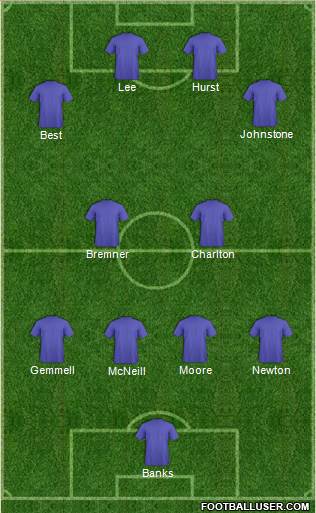
I used England's starting eleven in the 1970 World Cup Finals as the basis for my team, but I added five new players into the lineup. Sir Ramsey used a wingerless formation in both 1966 and 1970, a system he used since his days with Ipswich Town. It was equivalent of the 4-4-2 Diamond formation of the modern game. But this team was actually the United Kingdom of 1970, not England of 1970. I never suggested that Sir Alf Ramsey was the manager of this team at any given point. The wing attacks were very popular in the United Kingdom at the time. With George Best and Jimmy Johnston on the team, most managers would use the classic 4-4-2 formation.
Goalkeeper: Gordon Banks would still start over Pat Jennings, I think. If history repeated itself and Banks suffered an illness, Jenning would have played against West Germany in the quarterfinal.
Defence: England started with Keith Newton, Bobby Moore, Brian Labone (not on this UK team) and Terry Cooper on all games. I do not know the fitness level of the new players in the summer of 1970, but based on my knowledge of the players around the late 1960's and early 1970's. I would have this back four: Keith Newton, Billy McNeill, Bobby Moore and Tommy Gemmell for Team UK. Gemmell was more established than the younger Cooper because he had played in the European Cup Final.
Midfield: England started with Alan Ball, Martin Peters and Alan Mullery (not on this UK team) on the midfield in Mexico. I drop all three of them. Billy Bremner was the FWA Player of the Year in 1970. I would then put Bobby Charlton to the midfield, where he also played for Manchester United. Best had also play on the left wing for them at one point. He could play on both sides. Of course, Johnstone took the right wing spot. As mentioned, Sir Ramsey used a wingless formation, but it won't happen here.
FW: England started Francis Lee and Geoff Hurst in Mexico. Denis Law was injured the season before and was in serious decline. So I would not be starting him. Peter Osgood had a good domestic season, but I stayed with Sir Ramsey's starting pair.

I used England's starting eleven in the 1970 World Cup Finals as the basis for my team, but I added five new players into the lineup. Sir Ramsey used a wingerless formation in both 1966 and 1970, a system he used since his days with Ipswich Town. It was equivalent of the 4-4-2 Diamond formation of the modern game. But this team was actually the United Kingdom of 1970, not England of 1970. I never suggested that Sir Alf Ramsey was the manager of this team at any given point. The wing attacks were very popular in the United Kingdom at the time. With George Best and Jimmy Johnston on the team, most managers would use the classic 4-4-2 formation.
Goalkeeper: Gordon Banks would still start over Pat Jennings, I think. If history repeated itself and Banks suffered an illness, Jenning would have played against West Germany in the quarterfinal.
Defence: England started with Keith Newton, Bobby Moore, Brian Labone (not on this UK team) and Terry Cooper on all games. I do not know the fitness level of the new players in the summer of 1970, but based on my knowledge of the players around the late 1960's and early 1970's. I would have this back four: Keith Newton, Billy McNeill, Bobby Moore and Tommy Gemmell for Team UK. Gemmell was more established than the younger Cooper because he had played in the European Cup Final.
Midfield: England started with Alan Ball, Martin Peters and Alan Mullery (not on this UK team) on the midfield in Mexico. I drop all three of them. Billy Bremner was the FWA Player of the Year in 1970. I would then put Bobby Charlton to the midfield, where he also played for Manchester United. Best had also play on the left wing for them at one point. He could play on both sides. Of course, Johnstone took the right wing spot. As mentioned, Sir Ramsey used a wingless formation, but it won't happen here.
FW: England started Francis Lee and Geoff Hurst in Mexico. Denis Law was injured the season before and was in serious decline. So I would not be starting him. Peter Osgood had a good domestic season, but I stayed with Sir Ramsey's starting pair.