|
| Bela Gutmann with European Cups |
Please also see my All-Time World Cup Team Index.
Benfica
AC Milan
Peñarol
Sao Paulo
This is my selection of a 25 member all-time team for Bela Guttmann. The number 25 was chosen because it is the official squad size for the Champions' League.
Together with Márton Bukovi and Gusztáv Sebes, Bela Guttmann formed a triumvirate of radical Hungarian coaches who pioneered the 4–2–4 formation and he is also credited with mentoring Eusébio. Gutmann led Benfica to become the best in Europe in the 1960's. He won two European Cup with them. In Brazil, he was credited to have brought the 4-2-4 formation to Brazil, where the formation became an icon in Brazilian football.

Team
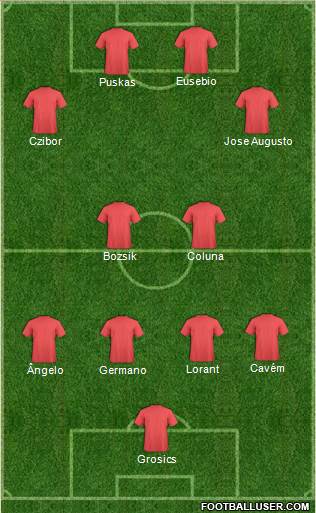
GK: Gyula Grosics (Hungary/Honved)
Gyula Grosics was part of the legendary Golden Team of the 1950s. He was nicknamed "Black Panther". He played in three World Cup Finals: 1954, 1958 and 1962. He won the Olympic Gold medal in 1952. He was the starting keeper when Hungary beat England in 1952. he played for the legendary Honved FC, but transferred to FC Tatabánya after the 1956 Revolution.
GK: Lorenzo Buffon (Italy/AC Milan)
Lorenzo Buffon was one of the best goalkeepers in the 1950's and early 1960's. He helped AC Milan to reach the Final of the 1958 European Cup Final. He also played for Genoa C.F.C. (1959–60), F.C. Internazionale Milano (1960–63), and ACF Fiorentina (1963–64). His cousin is Gianluigi Buffon's grandfather. He had 15 caps for Italy between 1958 and 1962. He went to the 1962 World Cup Finals.
GK: Costa Pereira (Portugal/Benfica)
Costa Pereira is the goalkeeper for both Benfica and Portugal during the golden years in the 1960's. He won two consecutive European Cup with Benfica in 1961 and 1962, and lost two other finals in 1963 and 1965. Costa Pereira played at the World Cup Qualifying rounds for the 1966 World Cup, but was not selected for the Finals. He had 22 caps in total.
De Sordi earned 22 caps for the Brazil national football team. He was part of the 1958 FIFA World Cup winning squad, and played in all matches except the final. During his club career he played for XV de Piracicaba-SP and São Paulo. He played over 500 games for Sao Paulo
RB: Domiciano Cavem (Portugal/Benfica)
Domiciano Cavem is the starting rightback for Benfica's Golden Generation of the 1960's. He could play as forward, midfielder and fullback. He won two European Cups in the 1960's with Benfica, scoring a goal in the 1962 Final. He had 18 caps between 1956 and 1965, but he was overlooked for the World Cup Finals in 1966. His last cap was in 1965.
CB/DM: Germano (Portugal/Benfica)
Germano is probably one pf Portugal's greatest defensive players. He was the captain for both Portugal and Benfica during the 1960's. He played most of his career with Benfica, appearing in 131 official games and winning eight major titles, including two European Cups. He went to the WC finals in 1966, but did not play well and lost his captaincy.
CB: Mauro Ramos (Brazil/Sao Paulo)
Mauro Ramos was considered one of Brazil's greatest centerbacks. He went to both 1954 and 1958 World Cup Finals without playing a game, but in the World Cup Finals of 1962, he lifted the World Cup trophy as Brazil's captain. He was capped 22 times. For his club career, he played for Santos and Sao Paulo. At Santos, he was a part of Pele's great Santos team in the 1960's.
CB: Roberto Matosas (Uruguay/Penarol)
At the club level, he played for C.A. River Plate of Argentina and C.A. Peñarol of Uruguay. In September 1964, Club Atlético River Plate signed Matosas for a then-record transfer fee. He would play 165 league matches for the club from 1964 to 1968, with 12 goals. He finished his playing career in Mexico, playing for newly promoted San Luis and Toluca. Matosas also was part of the Uruguay national football team. He participated in the 1970 FIFA World Cup in Mexico, where the Uruguayan side finished in fourth place.
CB: Gyula Lorant (Hungary/Honved)
After the War, he tried to escape to the West, but was captured by the Communists. He was released from detention so that he could represent Hungary. He was a member of the Mighty Magyars that won the Olympic Gold Medal in 1952, beat England twice and went the WC Final in 1954. He also joined Honved during the early 1950's.LB: Ângelo Martins (Portugal/Benfica)
Angelo started playing for Académico do Porto at 15 years of age, but he was scammed by a Porto staff member, that gave him a false document and made him sign a Porto file. The federation punished Ângelo but for only a short period. At 20 years old while serving in the military, a Benfica scout spotted him playing and brought him to Lisbon. He played 14 seasons for Benfica making 285 appearances and scoring 4 goals. He was a part of Benfica's Great team of the early 1960's. Capped 20 times.
CM: Jozsef Bozsik (Hungary/Honved)
Jozsef Bozsik was considered the second best Hungarian player of all-time after his childhood friend Ferenc Puskus and one of the greatest central midfielders in world football history. He was also a member of the Mighty Magyars and played for Honved. After the Revolution of 1956, he returned to Hungary and continued to play for both Hungary and Honved. He picked up 101 caps for Hungary.
CM: Mario Coluna (Portugal/Benfica)
Mario Coluna is one of the greatest player ever for both Portugal and Benfica. He spent most of his career with Benfica, appearing in 525 official games and scoring 127 goals during 16 professional seasons. He was dubbed Monstro Sagrado (Sacred Monster). He won 19 major titles with his main club, including ten national leagues. He won two European Cup with Benfica in 1961 and 1962. He was the captain of Portugal in the 1966 World Cup. He was known to be Eusebio's greatest footballing partner and friend.
 |
| With Eusebio and Mario Coluna |
His name literally mean "the left-footed". He also earned the nickname "the Garrincha of the Left". He was known for hos dribbling skills. For his club career, he played with Sao Paulo and was remembered for his battles with Pele's Santos in the 1960's. He was not selected for the WC Finals in 1958, despite being the original starter of the team.
RM: Luis Cubilla (Uruguay/Peñarol)
Luis Cubilla was a part of Penarol that won two Copa Libertadores in the 1960 and 1961, and he won one more with Nacional in 1971. He also played for Barcelona, River Plate of Argentiona, Santiago Morning of Chile and Defensor Sporting of Uruguay where he helped the club to win their first league championship and break the complete dominance of the league by Peñarol and Nacional. For Uruguay, he played in three WC Finals: 1966, 1970 and 1974.
RW: Jose Augusto (Portugal)
Jose Augusto was a part of Benfica and Portugal's Golden Generation in the 1960s. He served as the right winger playing with Esuebio, Mario Coluna, etc. He started with Barreirense. He spent most of his career with Benfica where he won two European Cup titles and reached 3 other Finals in the 1960's. He won 13 titles over there. He earned 45 caps between 1958 and 1968. He starred at the World Cup Finals 1966 with Portugal.
LW: Zoltan Czibor (Hungary/Honved)
Zoltan Czibor was widely considered to be one of the greatest left winger in history. He was also a member of the Mighty Magyars. After 1956. he fled to the West. He joined Ladislao Kubala and Sándor Kocsis to play for FC Barcelona. Together with Ramallets, Evaristo and Luis Suárez, they formed the great Barcelona team of the 1950's.
LW: Antonio Simoes (Portugal/Benfica)
Antonio Simoes was a part of Benfica's famous squad of the 1960's. He started to make an impact as a teenager. He was the youngest player ever to win an European Cup in 1962. He would win 10 league title with Benfica before moving to play in NASL. He played 46 times for Portugal. He went to the World Cup Finals in 1966, where he scored against Brazil in that famous match.
SS: Juan Schiaffino (Uruguay/AC Milan)
At international level, Juan Schiaffino won the 1950 FIFA World Cup with the Uruguayan national team, and also took part at the 1954 FIFA World Cup; he later also represented the Italy national football team. He was considered one of the greatest Uruguayan players in history. For club level, he played in Uruguay for Penarol and in Italy with Milan and Roma.
AM: Nils Liedholm (Sweden/AC Milan)
Nicknamed Il Barone (The Baron), Nils Liedholm is probably one of Sweden's greatest players. He played for AC Milan between 1949 and 1961. He also won the Latin Cup in 1951 and 1956 and was the captain of Milan that played in the 1958 European Cup Final that lost against Real Madrid. He was a part of the famous "Gre-No-Li" line for both club and country. He won a Gold Medal at the 1948 Olympics and helped Sweden to finish second at the World Cup Finals in 1958.
AM: Zizinho (Brazil/Sao Paulo)
Zizinho was Pele's idol. He was considered the greatest Brazilian player before the 1960's. He was the star of the ill-fated World Cup Finals in 1950 playing alongside Jair and Ademir. For his club career, he played for Flamengo, Bangu, São Paulo FC, Audax Italiano of Chile among others teams. With Flamengo, he won state championships in 1942, 1943 and 1944. He turned down a chance to play in the 1958 World Cup Finals.
 |
| Zizinho |
Gunnar Nordahl is probably one of both Sweden and AC Milan's greatest players. He is played with Gunnar Gren and Nils Liedholm to form the renowned Gre-No-Li line at AC Milan. He was Serie A top scorer for 5 times. He is the all-time leading scorer at Milan. He won the Gold Medal at the 1948 Olympics, but was not selected for the WC in 1950. He played two years with Roma before retiring. His brother Bertil and Knut also played for Sweden.
ST: Alberto Spencer (Ecuador/Penarol)
Alberto Spencer was known as "Cabeza Mágica" (Spanish for magic head). He is still the all-time leading scorer in the Copa Libertadores' history. He is considered one of South America's greatest strikers. He won three Libertadores Cups and two Intercontinental Cups with Uruguay's Penarol. He was elected the 20th best South American footballer of the 20th century in a poll by the IFFHS in 2004. He also played for Everest and Barcelona at home.
 |
| Alberto Spencer |
Eusebio is probably Portugal's greatest player. Along with Pele, he was considered to be the best player in the world during the 1960's. He helped Portugal reach third place at the 1966 World Cup, being the top goalscorer of the tournament with nine goals (including four in one match against North Korea) and received the Bronze Ball award. He won the Ballon d'Or award for European footballer of the year in 1965. He played for Benfica 15 out of his 22 years as a footballer. He won the European Cup in 1961.
 |
| Eusebio |
Sandor Kocsis was a prolific goalscorer for the Mighty Magyars in the 1950's. He scored 75 goals in 68 appearances for Hungary. He scored 11 goals at the WC in 1954, the second highest for a single tournament. He played for Honved at home before he went to play for Barcelona after the Soviet invasion in 1956. With fellow Hungarian exiles Ladislao Kubala and Zoltan Czibor, Barcelona became a force in Europe.
 |
| With Sandor Kocsis and Ferenc Puskas at Honved |
ST/FW: Ferenc Puskas (Hungary/Honved)
Ferenc Puskas was one of the greatest footballers in history. He scored 84 goals in 85 international matches for Hungary. He became Olympic champion in 1952 and led his nation to the final of the 1954 World Cup where he was named the tournament's best player. He played with Honved at home and went to Real Madrid after the Soviet invasion. With Alfredo Di Stefano, Raymond Kapo, etc, Real Madrid became the greatest club team in history.
 |
| Puskas at Honved |
Honorable Mention
Cesare Maldini (AC Milan), Francesco Zagatti (AC Milan), Pablo Forlan (Penarol), Juan Lezcano (Penarol), Juan Joya (Penarol), Jose Aguas (Benfica), Antonio Simoes (Benfica), Jose Augusto Torres (Portugal), László Budai (Honved), Dino Sani (Sao Paulo).
Squad Explanation -
-- This is my selection of the best players who played under Bela Guttmann. This is what I believed to be his greatest players. I do not know if he himself ever came up with his own all-time team. If he had done so, I probably would use it as s source, but I would still come up with a different team.
-- I have done several coaches' selections, but this team was so diverse. It included players from club teams in Eastern Europe, Western Europe and South America.
-- Ferenc Puskas had a fallout with Bela Guttmann at Honved, but I still selected him. Puskas' father was Guttmann's predecessor at the club. Ferenc did not like Guttmann replacing his father. Nevertheless, Puskas' talent was hard to ignore. I tried my best to include players who played best under Guttmann. I made an exception here. I have also done it elsewhere in my blog before.
-- While Zizinho was not in his prime when he played for Sao Paulo, he was a key player with Guttmann's Sao Paulo. Guttmann was credited with revolutionising the 4-2-4 formation in Brazil with Zizinho as his star. The formation became the basis of Brazilian football throughout the 1950's. Brazil won three World Cup, playing in a similar formation and formula. Historians said that he was not the first coach to use it in Brazil, but he was often given credit.
-- I am unfamiliar with the left backs who played for him. So I only have Ângelo Martins of Benfica. Ângelo Martins did not make my all-time team for Benfica. He is the least famous player selected for this team.
-- Many bigger names played for Bela Guttmann in his career. I cannot find space for Jose Augusto Torres, Juan Joya, Pedro Rocha and Jose Aguas.
-- Jose Aguas under Guttmann is the probably the best player not selected. The other players were too legendary to be ignored.
-- Bela Guttmann's greatest spell was with Benfica. Therefore, I selected 9 players from that team. They are Costa Pereira, Eusebio, Mario Coluna, Germano, Domiciano Cavem, Ângelo Martins, Jose Augusto and Antonio Simoes.
-- Guttmann moved from Porto to their rival Benfica. He signed Eusebio on the recommendation of José Carlos Bauer.
-- Guttmann was also known for his Benfica's curse. He said to the club: "not in a hundred years from now will Benfica ever be European champion." Benfica never won anytgig in Europe ever since his departure. In 1990, his former player Eusebio paid at his grave before they took on AC Milan for the European Cup Final, but they also lost.
-- The Communist regime of Hungary helped Honved by sending the best of Hungary to play for them. Guttmann was able to use some of the best ever players from Hungary, which was probably the best ever from the former Warsaw Pact.
-- Guttmann arrived after Penarol already won two straight Copa Libertadores. His first game was the second leg of the semi-final of Coap Liberatdores against rival Nacional. In the Final, they lost to Santos, giving Pele hsi first Copa Libertadores.
-- Cesare Maldini was discovered by Bela Guttmann. He brought him to AC Milan from Triestina Calcio, where Guttmann was also coaching. Maldini made my honourable mention. He coached an AC Milan side that included Nils Liedholm, Juan Alberto Schiaffino and Gunnar Nordahl. Gunnar Gren already left the cliub by the time Guttmann joined AC Milan in 1954. I read that Guttmann had a very high opinion of Juan Alberto Schiaffino.
Formation
Since this a Gutmann's team, I am using a 4-2-4 formation. The team mainly consisted of players from Honved and Benfica.