Sunday, January 7, 2018

What if Sweden World Cup 1950

This blogger Artur Yanturin of Russia copied many of my blog teams.  This blog was one of them.  It was my Russia All-Time Team here.  His team was written in 2020, but mine was uploaded in 2014.   His Spartak Moscow All-Time team entry of was published in October 2020, but mine was uploaded in 2017.  His entry of the Dutch-German rivalry between Real Madrid and Barcelona was written in 2020, but mine was uploaded in 2014.  He also copied many many of my blog entries.

His Facebook and Instagram

Sweden in World Cup 1950
Please also see my All-Time World Cup Team Index.


Sweden won the Gold Medal at the Summer Olympics of 1948 in London.  The tournament was small, but a victory was still a victory.  It was the first major football tournament since the end of the War.  Six Swedish players turned professional after the Olympics. In the 1950's, the Swedish football association did not allow any professional footballers to play for the national team. Consequently, Sweden only fielded amateur players during the World Cup Finals in 1950.  Despite of that, Sweden managed to finish third and the best European team in the tournament.  

So what if Sweden fielded professional footballers in the WC Finals of 1950? That would have put "Gre-No-Li" in their prime with Lennart Skoglund, Gunnar Andersson and the two other Nordahl brothers.
Olympic Gold Medal 1948

Players added to the team
Gunnar Andersson, Bertil Nordahl, Gunnar Gren, Nils Liedholm, Henry Carlsson and Gunnar Nordahl.

Prediction
Sweden finished 3rd at the World Cup Finals behind Brazil and Uruguay. I doubt that the addition of professional players would have improved their standings against the champion Uruguay and the host Brazil. In the Final Round, Sweden was destroyed by Brazil 7-1.  The professional players would not have overturned the result. However, they were only defeated by Uruguay 3-2. Sweden actually led 2-1 at half-time.  Uruguay's winning goal came on the 85th minute.  Lennart Skoglund who was a star of the tournament also did not play due to a row with Coach Putte Kock. Would Sweden able to produce a better result against Uruguay with 8 professional players? We would never find out.  If Sweden beat or drew Uruguay, Brazil would have won the World Cup. Perhaps, the "Maracanazo" would not have mattered.  

Team
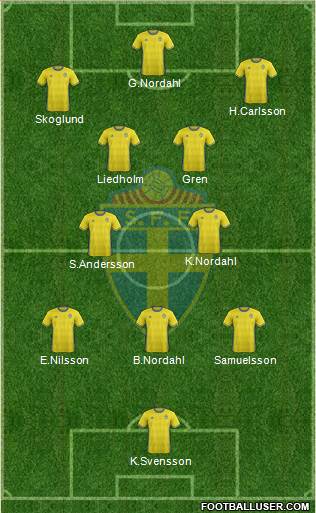
GK: Kalle Svensson (Helsingborgs IF)
Kalle Svensson was capped 73 times between 1949 and 1958.  He played in four big tournaments: 1950 and 1958 WC Finals and 1948 and 1952 Summer Olympics, finishing in the top 3 in all of them.  His 349 matches in the highest league is the third most for a goalkeeper in Allsvenskan. He also has got the less impressive record of being the goalkeeper who has conceded the highest number of goals in Allsvenskan, a total of 575. 
Kalle Svensson 
GK: Tore Svensson (Malmö FF)
Born in 1927, Tore Svensson started playing football at Falkenberg's FF before he moved to IF Elfsborg in 1949. In 1951, he moved to Malmö FF, where he became the main keeper. He stayed there until 1961. For Sweden, he went to both World Cup Finals in 1950 and 1958, and the 1952 Summer Olympics.

GK: Torsten Lindberg (IFK Norrköping)
Torsten Lindberg played club football with Husqvarna IF, IK Tord, Örgryte IS and IFK Norrköping. For Sweden, he won a Gold Medal at the 1948 Summer Olympics as the starting keeper.  However, he served as backup keeper at the World Cup Finals in 1950, where Sweden finished third. He played 19 times for Sweden between 1947 and 1951.

RB/LB: Arne Månsson  (Malmö FF)
Born in 1925, Arne Månsson made his debut with Malmö FF in 1944, where he spent his entire career. He became a regular starter in 1948. He won two league titles with them. Between 1949 and 1951, the club went 49 matches without losing a single match. He retired in 1955.  For Sweden, he went to the World Cup Finals in 1950.

CB/CM: Bertil Nordahl  (Atalanta)*did not go the WC 1950 Finals
Bertil was the eldest of the Nordahl brothers.  He played for Degerfors IF before the Summer Olympics in 1948 where Sweden won the gold medal. After the Olympics, he joined Atalanta in Italy, where he was banned from playing for the Swedish national team because Sweden did not select professional footballers. He had 15 caps for Sweden between 1945 and 1948.

CB: Lennart Samuelsson (Elfsborg)
Between 1950 and 1955,  Lennart Samuelsson capped 36 times with Sweden. He went to the1950 FIFA World Cup, where Sweden came third and also won a bronze medal at the 1952 Summer Olympics. Domestically he played for Elfsborg and in 1951 he played with the French club Nice. His career was cut short due to a broken leg.

CB: Gunnar Johansson (GAIS)
In 1949, Gunnar Johansson made one of the fastest career advancement in Swedish football's history. At the age of 24, he went from Division V team Inlands IF to Gais.  He became a part of Sweden's 1950 World Cup team, where Sweden finished third .  After the World Cup Finals, he joined Marseille in France as a professional player.  It was over the course of a year.

LB: Erik Nilsson (Malmö FF) * captain
Erik Nilsson  was a member of Sweden World Cup team in 1938, where they finished 4th.  He would win the Olympic Gold medal in 1948.  He also played in the World Cup in 1950, where he was on the All-tournament team.  In 1950, Nilsson was awarded the Guldbollen as the year's best Swedish football player. In 2003, he was inducted into the SFS Hall Of Fame. He spent his entire career with Malmo.
Erik Nilsson 
LB: Ivan Bodin (AIK)
Born in 1923, Ivan Bodin started with Mälarhöjdens IK.  He went to AIK in 1948 and debuted for this club as the centre forward.  Bodin played six seasons in AIK, but mostly as defensive player. He went to the World Cup Finals in 1950, without playing a single match.  He was only capped once by Sweden.  He also played bandy for AIK.

CM: Sune Andersson  (AIK)
He was a versatile midfielder, who would take any position: left, right or center. He played 28 times for the Swedish national team, scoring four goals, and won a gold medal at the 1948 Summer Olympics and a bronze at the 1950 FIFA World Cup. His only domestic title was the 1949 Swedish Cup with Solna. His performance at the 1950 World Cup earned him a transfer to A.S. Roma in Serie A, where he played for two seasons and scored 12 goals. 

CM: Knut Nordahl (IS Halmia)
Along with his brothers Bertil and Gunnar Nordahl, he helped Sweden to win the Gold Medal at the 1948 Summer Olympics. While his brothers went to Italy after the Olympics and turned professional, he stayed with IFK Norrköping in Sweden.  After the 1950 World Cup Finals,  he joined AS Roma.  He was capped 26 times for the Sweden national football team between 1945 and 1950. He was a key player at the 1950 World Cup Finals in Brazil.

LM/CM: Ingvar Gärd (Malmö FF)
From 1941 to 1950,  Ingvar Gärd played for Malmö FF, usually as the left half. After the World Cup Finals in 1950, he joined Sampdoria in Italy as a professional.  However, he returned home after a season, playing only 20 games.  He was forced to retire after his return due to losing his amateur status for his professional spell in Italy.

LW: Lennart Skoglund (AIK)
Lennart Skoglund is regarded as one of Sweden's greatest players.  He played in Italy from 1950 to 1963.  His best stint was probably with Inter Milan.  He also played for  Hammarby IF, Sampdoria and Palermo.  He only had 11 caps because of Sweden's ban on using professional players. He was a star at the World Cup Finals in 1950, where Sweden finished 3rd behind Uruguay and Brazil.  He also played in the 1958 World Cup Finals, where they finished 2nd.
Lennart Skoglund

RW/FW/CM: Karl-Erik Palmér (Malmö FF)
Palmer played with Malmö FF, and in Italy for Legnano and Juventus.  He was capped 14 times for Sweden between 1949 and 9152.  He attended the World Cup Finals in 1950, where he was the top scorer for Sweden.  His forward line was known as "Pal-Jep-Sko"(Palmer, Jeppson, Skoglund) as a tribute  to "Gre-No-Li" of the 1948 team.  In 1951, he turned professional by going to play in Italy.

FW: Gunnar Gren  (AC Milan) *did not go the WC 1950 Finals
Gunnar Gren was part of the famous "Gre-No-Li" trio of forwards at AC Milan and the Swedish national team during the 1950's.  He won a Gold Medal at the 1948 Olympics and helped Sweden to finish second at the World Cup finals in 1958 after Sweden recalled its professional footballers. He is considered one of the greatest footballers for both Sweden and AC Milan. At the club level, he also played for IFK Gothenburg, AC Fiorentina, Genoa, and  Örgryte IS.  
Gunnar Gren  
FW: Hasse Jeppson (Djurgårdens IF)
Jeppson began his career with Djurgårdens IF, transferring to Charlton Athletic.  He was the second Swedish player to join an English team, after Dan Ekner at Portsmouth. In 1951, he went to Italy, where he played for Atalanta, Napoli and Torino. In 1952 he was sold to Napoli for 105 million lira, a new world record transfer-fee at the time. Capped 12 times. He went to the WC Finals in 1950.

AM: Nils Liedholm  (AC Milan) *did not go the WC 1950 Finals
In Italy, Nils Liedholm was known as  Il Barone (The Baron).  He is probably one of both Sweden and AC Milan's greatest players.  He played for AC Milan between 1949 and 1961. Liedholm also won the Latin Cup in 1951 and 1956 and was captain of Milan in the 1958 European Cup Final against Real Madrid, losing 2–3 (after extra time). He was part of the famous "Gre-No-Li" line for both club and country.  He won a Gold Medal at the 1948 Olympics and helped Sweden to finish second at the World Cup Finals in 1958. 
Nils Liedholm
ST/FW: Bror Mellberg (AIK)
At home, Bror Mellberg played with Karlstad BIK  and AIK.  After a successful World Cup Finals in 1950, he joined Genoa in Italy. After two seasons playing in Italy, he moved to France playing with Toulouse FC, Paris Red Stars and FC Sochaux.  He was also a part of Sweden's World Cup team in 1958.

ST: Gunnar Andersson (Marseille) *did not go the WC 1950 Finals
Gunnar Andersson started his career in Sweden, before playing for Danish side Kjøbenhavns Boldklub before being transferred to Olympique de Marseille in 1950.  With l'OM,  he was also Division 1 top goalscorer in 1951–1952 and 1952–1953 and runner-up in the Coupe de France 1953–1954. He was their all-time leading scorer. He also played for other French teams such as FC Girondins de Bordeaux and AS Aix.

CF: Henry Carlsson (Atletico Madrid) * did not go the WC 1950 Finals
In 1939, Henry Carlsson made his debut with AIK in Sweden.  After winning the Olympic Gold medal in 1948, he moved to play for Stade Français in France as an amateur. In 1949, he started his professional career with Atletico Madrid at the age of 32, winning two league titles in Spain.  At Madrid, he played under Helenio Herrera alongside Larbi Benbarek. For Sweden, he was capped 26 times between 1941 and 1949.
Henry Carlsson 
ST: Stig Sundqvist  (IFK Norrköping)
Stig Sundqvist played 11 games for the Swedish national team and scored 3 goals in the 1950 FIFA World Cup, helping Sweden to a third-place finish and their first ever world cup medal. After the World Cup he left Swedish side IFK Norrköping for the Italian club A.S. Roma, where he remained until 1953.  During his active days he was known by the nickname "Vittjärv", after the Swedish village where he grew up.

ST: Gunnar Nordahl (AC Milan) did not go the WC 1950 Finals)
Gunnar Nordahl is probably one of both Sweden and AC Milan's greatest players.  He played with Gunnar Gren and Nils Liedholm to form the renowned Gre-No-Li line at AC Milan.  He was Serie A top scorer 5 times.  He is the all-time leading scorer at Milan.  He won the Gold Medal at the 1948 Olympics, but was not selected for the World Cup in 1950.  He also played two years with Roma before retiring.  His brother Bertil and Knut also played for Sweden.
Gunnar Nordahl 

Squad Explanation
--  George Robledo of Chile, who played in England's Football League First Division was the only player in the 1950 World Cup Finals who played his regular club football in a foreign club.  He was born in Chile to a Chilean father and an English mother. He emigrated with his family to the United Kingdom in 1932, at the age of five.  This imaginary team had 6 foreign based players.  It would have been revolutionary at the time.  
-- I added six new players to the World Cup team,  They are Gunnar Andersson, Bertil Nordahl, Gunnar Gren, Nils Liedholm, Henry Carlsson and Gunnar Nordahl.  Please see below for further explanation.
-- I do not know every single Swedish professional footballers in 1950.  I probably miss a few players.  Gunnar Andersson was the only uncapped Swede whom I discovered.  Other Swedish professional players in 1950 included Pär Bengtsson, Åke Hjalmarsson, Ivar Eidefjäll and Dan Ekner.  I do not know much about them.  I ignored them for this team.
-- George Raynor was one of the most successful international managers.  He managed Sweden from 1946 to 1954 and then, from 1956 to 1958.  Sweden won an Olympic Gold medal, and reached the World Cup Final under him.  Liked all of my blog teams, I am the manager, but I used their selections as reference.
-- Bertil Nordahl, Gunnar Gren, Nils Liedholm, Henry Carlsson and Gunnar Nordahl turned professional after the 1948 Olympics. They did not go to the real World Cup Finals in 1950.  I took all five of them because they were key players in 1948.
-- The "Gre-No-Li" line needs no introduction.  They were the best in the world during the 1950's.
-- Henry Carlsson was 32 years old at the time of the World Cup Finals.  He was a star player at Atletico Madrid as they won La Liga that season under legendary manager Helenio Herrera.In 1950, he was still considered a big star.
-- Gunnar Andersson left Sweden before the 1948 Olympics and turned pro before ever playing for Sweden.  He had a very successful career in France. Later he had one cap for the French B team.  He is the all-time leading scorer for Marseille. I am very careful about new player, especially the ones who were not on the players' pool before 1950.  Andersson's career indicated that he was a good player. He became my 6th professional player. 
-- In the World Cup FinalsSune Andersson, Knut Nordahl, Hasse Jeppson, Lennart Skoglund, Stig Sundqvist and Karl-Erik Palmer were the starters.  I took all 10 of them.  The 6 professional players + 10 starters = 16.
-- -- In the 1950's, national teams usually carried less defenders than the modern teams. Sweden only took five defenders to Brazil.  Erik Nilsson and Lennart Samuelsson were mentioned above. The other three defenders were Arne Månsson, Gunnar Johansson and Ivan Bodin.  I took the three remaining defenders and two backup keepers. 16+3 defenders+2 backup keepers = 21.
--  The last spot was between Stellan Nilsson, Bror Mellberg, Olle Åhlund, Kurt Svensson, Egon Jönsson, Ingvar Rydell and Börje Tapper. I took Bror Mellberg because he played the most in Brazil.
-- Kurt Hamrin, Orvar Bergmark and Åke Johansson had not played for the senior national team.  Bergmark was only 19 years old and Hamrin was 15 in 1950.  They would become all-time greats with Sweden, but in 1950, they were not ready.
-- Kjell Rosén was on the 1948 Olympic team, but did not go to the World Cup in 1950.  However, he earned a move to Torino in 1950 at the end of the Swedish season, I believed.  I also discovered that he did not play much that season for Malmo. I suspected that he was injured. So I did not select him.
-- Birger Rosengren was the captain of the 1948 Olympic team, but he retired before the World Cup Finals in 1950.
-- In 1952, Hasse Jeppson became the most expensive player in the world when Napoli paid 105 million lira for him. In the real 1950 Finals, he formed a forward line known as "Pal-Jep-Sko" Lennart Skoglund and Karl-Erik Palmer were his partners in the trio.
 -- Lennart Skoglund was a star of the tournament who later earned a move to Inter Milan in the Fall of 1950. Coach Putte Kock actually dropped him at the latter stage of the Finals because of issues related to his behavior.  He did not play against Uruguay and Spain in the Final round.  Perhaps, the scoreline might have been overturned in the game against Uruguay( see above) and Brazil might have won the World Cup. 
-- Sao Paulo offered Skoglund a contract in Brazil, but he decided to return to Europe. He did not play for Sweden again until the 1958 World Cup Finals when Sweden started to select professional players for the World Cup Finals hosted by Sweden.
-- Karl-Erik Palmer scored 3 goals in the 1950 Finals as the top scorer for Sweden alongside with Stig Sundqvist who also scored 3 goals.

Formation
WM Formation
The starting lineup is similar to the 1948 Olympic Gold Medal winning team.  Skoglund and Sune Andersson were on the Olympic team.

Friday, January 5, 2018

Israel Greatest All-Time Team

This blogger Artur Yanturin of Russia copied many of my blog teams.  This blog was one of them.  It was my Russia All-Time Team here.  His team was written in 2020, but mine was uploaded in 2014.   His Spartak Moscow All-Time team entry of was published in October 2020, but mine was uploaded in 2017.  His entry of the Dutch-German rivalry between Real Madrid and Barcelona was written in 2020, but mine was uploaded in 2014.  He also copied many many of my blog entries.

His Facebook and Instagram


Israel WC Finals 1970
Please also see my All-Time World Cup Team Index.


This is the all-time team for Israel. If there were an All-Time World Cup, this would be the 23 players I would bring to the tournament.

In 1948 the team became, officially, the national football team of (the State of) Israel. The Israel national team's first match as an independent nation was on 26 September 1948, against the US Olympic Team. The game was won by the US 1–3, and in the 20th minute of the game Shmuel Ben-Dror scored the first goal after the creation of the State of Israel.

Due to political issue, Israel was a member of AFC and Oceania before joining UEFA in 1994.  While being a member of AFC, it has won the Asian Cup in 1964 and qualified for the World Cup Finals in 1970. In 1968, Israel reached the quarterfinal of the Summer Olympics. They were only eliminated by Bulgaria by a lucky draw (before penalty kick was created) and Bulgaria went on to win the silver medal.

This is my all-time team for Israel. If there were an All-Time World Cup, this would be the 23 players I would bring to the tournament. 

1964 Asian Cup winner

Team
GK: Ya'akov Hodorov יעקב חודורוב
Nicknamed "the Bird", he was considered by many to be Israel's best goalkeeper in history. He started with Maccabi Rishon LeZion and Hapoel Rishon LeZion. He moved to Hapoel Tel Aviv in 1947, the club where he stayed for most of his career.  Hodorov had 31 caps between 1949 and 1964.  The most memorable match of his career was in 1958 FIFA World Cup qualification against Wales at Cardiff, in which he suffered a broken nose in a collision with Welsh striker John Charles, but continued to play and made dozens of acrobatic saves.

GK: Avi Ran אבי רן
Avi Ran was projected to be one of the greatest players in Israel's football history, but he died at the age of 23 from a boating accident in 1987.  He was voted Israeli Player of the Year in 1986.  He played for Maccabi Haifa between 1981 and 1987. He made his senior debut at the age of 17 in the 1981-1982 season. He conceded only 18 goals in the 1985-86 season, the lowest in Maccabi Haifa's history. At the international level, he earned 8 caps from 1986 to 1987.

Avi Ran 

GK: Dudu Aouate דוד "דודו" אוואט
After playing for several clubs in his country, most notably with Hapoel Haifa. With Maccabi Tel Aviv, he made it the Champions' League Group Stage for the 2002-2003 season, first time for an Israeli club and recorded a victory over Manchester United. In He moved to Spain in 2003, going on to represent Racing de Satander, Deportivo La Coruña and Mallorca. Aouate won 78 caps for Israel, during 14 years.

RB: Alon Harazi אלון חרזי
Harazi finished his career in the 2009/2010 season as the captain and longest-serving member of Maccabi Haifa. He joined the club at the tender age of 18 in 1990 from a third division team.  He set a record by making 400 league appearances with Maccabi Haifa in two stints. He also played for Beitar Jerusalem between the two stints.  Harazi represented Israel in 89 between 1992 and 2006.

RB/CB/DM: David Primo דוד פרימו
Liked Moshe Leon, David Primo was also born in Bulgaria.  He played for a number of clubs in Israel and the United States.  In Israel, Primo mainly played for Hapoel Tel Aviv.  He first appeared in Hapoel Tel Aviv's senior team in 1963, when he was 17. In the US, he played for NY Cosmos with Pele in 1975. He had 32 caps with Israel. He was a member of Israel's team at the 1970 World Cup Finals.  

CB: Itzhak Schneor יצחק שניאור
Shneor made 14 for Israel appearances between 1948 and 1956. He had the honor of captaining the national team on several occasions, including crucial matches for the 1956 Melbourne Olympics qualification against the Soviet team. His last game in the national team uniform took place in the Asia Cup tournament in 1956. Shneor played for Maccabi Tel Aviv in 1949, as he helped the team secure four championships and two state cups during the 1950's.

CB/RB: Tal Ben Haim  טל בן-חיים
At the club level, Tal Ben Haim has played for Maccabi Tel Aviv, Bolton Wanderers, Chelsea, Manchester City, Sunderland, Portsmouth, West Ham United, Queens Park Rangers, Standard Liége and Charlton Athletic. His longest spells were with Bolton Wanderers and Portsmouth. He is also a member of the Israeli national squad. He made his debut for Israel on 13 February 2002 in a friendly match against Germany.  At the time of writing, he has 96 caps between 2002 and 2017.
Tal Ben Haim
CB: Arik Benado  אריאל "אריק" בנאדו
Arik Benado started his career with Maccabi Haifa in 1991, where his father also played for Maccabi Haifa in the 1970's. Besides Maccabi Haifa, he also played for Beitar Jerusalem. He won the Israeli league 9 times. Benado is also a long-standing member of the Israeli national team where at one point he held the record as the most capped player with 94 caps between 1995 and 2007.  He was named the Israeli Premier League Best Defender of the Year: 2007–08.

SW/CB: Zvi Rosen צבי רוז
Born in West Germany, Zvi Rosen is the son of two survivors of the Warsaw ghetto. He played 42 official games for Israel between 1968 and 1974. and went to the Summer Olympics in 1968 and the World Cup Finals in 1970.  He scored 4 goals. Rosen played for Maccabi Tel Aviv from 1965 to 1977, winning three championships, four state cups and two Asian championships. He also played for Hapoel Yehud as a player-coach.

LB: Avi Cohen אבי כהן
Avi Cohen began his playing career with Maccabi Tel Aviv, where he is considered an all-time great. He was best remembered for playing with Liverpool between 1979 and 1981.  He also played for Rangers in Scotland for a single season playing under manager Graeme Souness who was his Liverpool teammate.  He was the first Israeli to play in England. At the international level, he had 51 caps between 1976 and 1988. He went to the 1976 Olympics playing for Israel as the Asian representative.
Avi Cohen
LB: Menachem Bello  מנחם בלו
Menachem Bello played for the Israel national team between 1965 and 1975. He was part of the Israel squad for the 1970 World Cup. He also played in the 1968 Summer Olympics. At club level, Bello played solely for Maccabi Tel-Aviv. He made his debut for them at the age of 16 in 1964. It was the club's greatest period, where they were Asian champion twice.  He was a one club player.

DM: Tal Banin טל בנין
Tal Banin played for a number of clubs in Israel at the club level.  He was best remembered for his stints with Hapoel Haifa and Maccabi Haifa.  In 1993, he joined AS Cannes in France. In 1997, he became the first Israeli to play in Italy's Serie A when he joined Brescia. He played there between 1997 and 2000.  Brescia fell to Serie B in which he helped it to gain promotion again after a single season. At the international level, he had over 80 caps.  He captained the Israeli national team between 1990 and 2003.

Tal Banin
CM/DM: Bibras Natcho ביברס נאתכו
Bibras Natcho began his career at Hapoel Tel Aviv and later joined Rubin Kazan in Russia, where he had notable performances in the UEFA Champions League and Europa League. Natcho also played for PAOK in Greece before returning to Russia with CSKA Moscow, and earned accolades. He then moved to Olympiacos in Greece and later joined Partizan in Serbia. He is also a former captain of the Israel national team who is also the first of either Circassian or Muslim origin, until his international retirement on 25 March 2023.

CM: Uri Malmilian  אורי מלמיליאן
Malmilian is all-time great with Beitar Jerusalem.  He won Beitar's first important trophy, the Israeli Cup in 1976. In 1986 Malmilian was the Top Scorer of the Israeli league with 14 goals in 30 matches. In 1987, he partnered with Eli Ohana to bring the club its first championship. He made his national team debut before at the age of 18. He is the youngest ever player to be on the Israel national team. 

CM: Giora Spiegel גיורא שפיגל
Giora Spiegel is a member of the Israeli Football Hall of Fame since 2009. He played with Maccabi Tel Aviv.  In 1973, he joined Strasbourg, where he played until 1978.  In 1978, he joined Lyon. After a season, he returned to Israel.  He was capped 44 times.  Giora Spiegel is the son of Eliezer Spiegel, who played for Maccabi Petah Tikva and the Israel national football team.  He was an important player for Israel at the 1970 World Cup Finals.

AM/CM: Eyal Berkovic אייל ברקוביץ'
Berkovic started with Maccabi Haifa in 1989.  After a successful loan move to Southampton in England, he joined West Ham in 1997. He went on to play for Celtic, Manchester City, Blackburn Rovers and Portsmouth before returning home to play for Maccabi Tel Aviv in 2005. He had 78 caps for the national team from 1992 to 2004. The Israel Football Hall of Flame selected him as one of the five greatest Israeli footballers of all-time.

AM/RM: Yossi Benayoun יוסי שי בניון
Benayoun is Israel's most well-known player.  He played for Hapoel Be'er Sheva and Maccabi Haifa before moving to Racing de Santander in Spain. Three years later he moved to West Ham United, and later Liverpool. In 2010, he signed for Chelsea, but then onward, his career in Europe was not so successful, despite winning the 2012–13 UEFA Europa League. He later had short career with Arsenal, West Ham(2nd stint) and Queens Park Rangers before returning to Maccabi Haifa. Benayoun is Israel's most capped player of all time with 102 caps.

Yossi Benayoun 

AM/LM: Haim Revivo חיים מיכאל רביבו
Haim Revivo played with Bnei Yehuda, Hapoel Tel Aviv and  Maccabi Haifa before heading in Europe.  Between 1996 and 2000, he played for Celta Vigo in Spain's La Liga.  Then, in 2000, he joined Fenerbahçe and became the first and only Jewish footballer to star in a Muslim country.  He was very successful there. He joined rivals Galatasaray in 2002, but he retuned home a season later in 2003. For international football, he had 67 caps.  He was named co-winner of the 1998 Israel Sports Figure of the Year Award.

LW/ST: Ronny Rosenthal רוני רוזנטל
"Rocket Ronny" started his career with hometown team Maccabi Haifa before he played in Belgium with Club Brugge and Standard Liege.  In 1999, he moved to Liverpool in 1990 for a fee of £1.1million, becoming the first non-British player to move to an English club for more than £1million. He played there for 3 seasons.  He was a cult hero there. He also played for Tottenham Hotspurs between 1994 and 1997 before heading to Watford. He was capped 60 times for Israel between 1983 and 1997.
Ronny Rosenthal 
ST: Eli Ohana  אליהו "אלי" אוחנה
Eli Ohana was considered to be one of Israel's greatest players.  He moved to Mechelen in 1987, where he was a key player winning the UEFA Cup.  He won the Bravo Award by Italy's Guerin Sportivo for the best Under-23 player in Europe. He was capped 50 times for Israel.  During an important World Cup qualifier against Australia in 1989, he scored the first goal and kissed the Star of Davids in front of the Australian coach Frank Arok who alleged to have made an antisemitic remark before the game. 

ST: Nahum Stelmach נחום סטלמך‎
His most recognizable attribute was the quality of his headers, with which he scored most of his international goals. As a result he was commonly nicknamed "the golden head" in Israel. He was chosen third by Yediot Aharonot's greatest Israeli footballers. He made a name for himself as the leader of Hapoel Petah Tikva, where he spent most of his career. He earned 61 caps.  In 1956, he finished as the top scorer of the AFC Asian Cup. 

ST: Eran Zahavi ערן זהבי  
Zahavi was named Israeli Footballer of the Year twice (2013–14 and 2014–15), and finished as the top goalscorer of the Israeli Premier League for 3 consecutive seasons. . In 2016, he broke the Israeli league six-decade-old season scoring record. He was named the 2017 Chinese Super League MVP, and broke the league's single-season scoring record in 2019. He made his debut for Israel in 2010. He is a former national team captain and the current all-time top scorer for Israel with 35 goals.

ST: Mordechai Spiegler מרדכי "מוטל'ה" שפיגלר
Mordechai Spiegler played for Maccabi Netanya along with Paris Saint Germain in France and alongside Pelé for New York Cosmos of the North American Soccer League in the 1970s. He was chosen as the Israeli Player of the Year a record four times, in 1967/68, 1968/69, 1969/70, and in 1970/71.  Spiegler helped Israel to win the 1964 AFC Asian Cup.  He also helped Israel to qualify for the World Cup  in Mexico. He scored Israel's lone goal in World Cup history in a 1–1 draw against Sweden. He captained the Israeli Olympic team at Mexico City 1968. 
Mordechai Spiegler

Honorable Mention
Itzhak Vissoker, Boni Ginzburg, Nir Davidovich,  Amatsia Levkovich, Walid Badir, Haim Bar, Gadi Bromer, Shimon Gershon, Avi Cohen of Jersusalem, Eli Dasa, Shraga Bar, Shlomo Shirazi, Najwan Ghrayib, Moshe Glam, David Pisanti, David Amsalem, Yossi Abukasis, Nir Klinger, Nir Bitton, Idan Tal, Gal Alberman, Itzhak Shum, Moshe Sinai, Avi Nimni, Alon Hazan, Itzik Zohar, Reuven Atar, Aharon Amar, Vicky Peretz, Yisha'ayahu Schwager, Elyaniv Barda, Lior Refaelov, Ronen Harazi, Mu'nas Dabbur, Alon Mizrahi, Oded Machnes, Gidi Damti, Yehoshua Glazer, Yehoshua Feigenbaum.

Squad Explanation
-- The original team was created in 2018.  I completely redid the entire team in June 2024.  I completely revamped the entire team, resulting in a massive overhaul that brought about substantial changes.
-- Mordechai Spiegler, Eyal Berkovic, Haim Revivo, Eli Ohana, and Uri Malmilian were elected by Israel's Hall of Fame as their five greatest in Israel's history. Mordechai Spiegler was chosen as the greatest football player in Israel.  He was also Israel's choice for their UEFA Jubilee Golden player selected in 2004.
-- In the 1960's, Israel played in AFC, where it was a rival to Iran, South Korea and Republic of China (Hong Kong) for supremacy in Asia.  They were the 1964 AFC Asian Cup Champion. Nahum Stelmach and David Primo are on my all-time team.
-- Israel went to its first World Cup Finals in 1970.  Mordechai Spiegler captained the side.  Zvi Rosen, Giora Spiegel, David Primo and Menachem Bello also went to Mexico that year. The same generation of players also qualified for the 1968 Summer Olympics.
-- After the 1976 Olympics, Israel did not qualify for any major tournament, largely due to boycott by Arab teams while in the AFC.  Israel later played in Oceania and the UEFA
-- This is IFFHS's Israel All-Time Dream team: Ya'akov Hodorov, Tal Ben Haim I, David Primo, Zvi Rosen, Avi Cohen, Haim Revivo and Avi Nimni.
-- The One of Israel also created their All-Time Best XI in 2018.Ya'akov Hodorov, David Primo, Zvi Rosen, Avi Cohen, Menachem Bello, Giora Spiegel, Moshe Sinai, Uri Malmilian, Nahum Stelmach, Yehoshua Glazer and Mordechai Spiegler.
-- In 2021, the Sport 5 came up with their own All-Time Best XI: Ya'akov Hodorov, Alon Harazi, David Primo, Avi Cohen, Moshe Leon, Tal Banin, Eyal Berkovic, Yossi Benayoun, Mordechai Spiegler, Eli Ohana and Eran Zahav.
-- There were four players included in all three "Israel All-Time Best XI" lineups - from IFFHS, the One of Israel, and Sport 5.  They were Ya'akov Hodorov, Avi Cohen, David Primo and Mordechai Spiegler. In addition to the four players who were included on all three "Israel All-Time Best XI" lists, three other individuals were also named to the prestigious team on at least two of the lineups. These players were Zvi Rosen, Giora Spiegel and Uri Malmilian.
-- Israel has had a strong connection with Liverpool Football Club over the years. Avi Cohen was probably the first Israeli player to gain significant international recognition playing club football. His career with Liverpool FC was very well-known. Later, Ronny Rosenthal also made a name for himself in England with Liverpool. He was the first non-British player to command a transfer fee exceeding one million pounds in the English game. Yossi Benayoun had a successful start to his career in Spain and England. He played well during his time with Liverpool, but his career in England after leaving Liverpool received more mixed reviews.
-- Three players also played with NY Cosmos during its prime years. Mordechai Spiegler and David Primo played with them alongside Pele.  Roby Young also played with NY Cosmos, but in the early 1970's.  Recently, Kobi Moyal played with the team after its rebirth.
Goalkeepers
-- Ya'akov Hodorov is the obvious choice for goalkeepers. In 2006, Hodorov was awarded the Israel Prize for his contribution to sports, one of few sportspeople who received this honour. 
Ya'akov Hodorov
-- Avi Ran has legendary status, but his career was cut short. He died at the age of 23. He had that "you'll never know" factor that counted against him. Nevertheless, most Israeli fans remembered fondly for his performance.  I selected him as the second goalkeeper. For the third goalkeeper, it went to Dudu Aouate, who had the best European club experience. He tied Mallorca's record for most appearances for a goalkeeper. In online poll by Sport 5, he was voted as Israel's greatest goalkeeper with 27% of the votes. 
-- Itzhak Vissoker is in the Israel Football Hall of Fame.  He also played in the 1970 World Cup Finals, but Dudu Aouate has established a career in Europe at the highest level of football.  He played an extended career playing in Spain.  Boni Ginzburg also had some experience playing in Europe. He was Chris Woods' backup in Glasgow Rangers.  Nir Davidovich was also considered.
Defenders
-- Alon Harazi is undoubtedly one of the greatest symbols of Maccabi Haifa.  He spent 19 years playing for them.  In total, he accumulated an astounding 17 team titles over the course of his storied career.  David Primo was one of the first Israeli to play overseas.  He made all "three lists" of Israel's All-Time Best XI.  He also played with Pele in New York Cosmos, which was regarded as a prestigious and commendable achievement.  He also played as a central defender toward the middle of his career. For rightbacks, I took this two. Shraga Bar, Shlomo Shirazi, Avi Cohen of Jersusalem and Eli Dasa were a few of the top rightbacks in Israel's history. They also made Honorable mention.  
-- There were two distinguished fullbacks from Israel both named Avi Cohen. To distinguish between the two Israeli defenders named Avi Cohen, the right-back Avi Cohen mentioned in this context is often referred to as Avi Cohen of Jerusalem. It was during his time playing for Maccabi that Avi Cohen of Jerusalem became teammates with the other more famous Avi Cohen, who was known simply as Avi Cohen. This other Avi Cohen played as a sweeper or left-back, and was the more renowned of the two, as he went on to play for the English club Liverpool FC.  
-- While Avi Cohen primarily served as a libero in Israel, he took on the role of left back during his time at Liverpool. His tenure at Liverpool coincided with the club's peak.  So he faced competition from Alan Kennedy and Richard Money, which limited his playing time.  Nevertheless, his career in England marked a significant milestone for Liverpool and Israel, as he became Liverpool's first foreign player since the mid-1950s when South African goalkeeper Robert Rudham donned the club's colors.  His significance extended beyond his performances on the field, as he was recognized as a pioneer of the game. For the second leftback, I narrowed it down to Moshe Glam, Moshe Leon, David Pizanti, David AmsalemAdoram Kesi and Menachem Bello. Najwan Ghrayib was one of the few Israeli Arab players who represented the Israeli national team.  He briefly played for Aston Villa. The younger generation of fans probably considered Adoram Keisi as Israel's greatest leftback.  However, Menachem Bello was a pioneer as one of the first attacking fullbacks in Israel.  He also played in the 1970 World Cup Finals.  In the end, I took Bello. David Pizanti who spent some time in Europe could not break into the side with Menachem Bello and Avi Cohen ahead of him
-- Tal Ben Haim is Israel's second most capped player.  He spent over 10 seasons playing in England.  He was mainly a central defender, but also played as a rightback. Arik Benado received the most votes for Israel's greatest central defender by an online poll by Israel's Sports Channel 5.  He was even ahead of Tal Ben Haim.  Zvi Rosen was a big part of Israel 1970 World Cup team.  He was on IFHHS Israel's All-Time Best XI.  So I first selected this three.
Arik Benado
-- Then, I took Itzhak Schneor over Amatsia Levkovich.  Schneor was a club legend with Maccabi Tel Aviv in a period dominated by the club. Amatsia Levkovich was the first player to win Israel Player of the Year twice.  He helped Israel to win the 1964 Asian Cup, but he suffered a head injury on the first match.  With Hapoel Tel Aviv, he won the 1967 Asian Club Championship.  However, Schneor appeared to be more famous.  
-- The other notable central defenders included Noah Reznik, Alon Ben Dor, Walid Badir and Haim Bar.
.
Midfielders/Wingers
-- Defensive midfielder Tal Banin became the first Israeli to play in Italy's Serie A when he joined Brescia, but his career in Europe had been plagued by injuries.  However, he was voted by Sport 5 as Israel's greatest defensive midfielders by 34% of the votes. I believed David Primo also played as a defensive midfielder.  
-- In 2018, I selected Nir Klinger, but I decided to switch to Bibras Natchp. Most lists tended to favor Klinger over Natcho.  In fact, Natcho was seldom mentioned.  However, he was the top assist provider in the Europa League for the 2013-2014 season and earned a place in the UEFA Europa League Team of the Group Stage in the same season. Additionally, he was recognized as the Central Midfielder of the Season in the Russian Premier League for the 2011-2012 and 2014-2015 seasons. So I also decided to select him because he was a deep lying playmaker who was capable of spraying long passes from the deep.  It is an important position for the team.  He also had 88 caps, which is tied with 4th for Israeli players.  
Bibras Natcho 
-- Nir Klinger spent six seasons with Maccabi Haifa before moving to Maccabi Tel Aviv for eight seasons. He won two Israeli championships with Maccabi Haifa and three championships and another two Israel State Cup with Maccabi Tel Aviv. He played 83 caps for the Israel national football team between 1987 and 1997, and captained the team from August 1992 until March 1997.
-- The other notable Israeli defensive midfielders included Yossi Abukasis, Nir Bitton, Idan Tal and Gal Alberman.
-- Eyal Berkovic, Haim Revivo and Uri Malmilian were elected by Israel's Hall of Fame as three of their five greatest players in Israel's history.  Then, I had to add Yossi Benyoun and Giora Spiegel.  So this team was loaded with attack midfielders, but some of them would be used as side midfielders.  Yossi Benayoun could also play on the right. and Haim Revivo could play on the left.
-- Yossi Benayoun holds the record for the highest number of appearances for the national team (102 games over 19 years), where he netted 24 goals. Additionally, he is the only Israeli player to have had a substantial playing time with top European teams.  During his time with Liverpool FC, he scored the winning goal at the Santiago Bernabéu against Real Madrid. He won the Europa League with Chelsea (although he did not participate in the final against Benfica in 2013).  He was an attack midfielder who could also operate on the right.
-- Giora Spiegel played in the 1970 Summer Olympics and scored the winning goal against Australia in the qualifying round. He also scored Israel's only goal in the World Cup against Sweden. He had a close partnership with Mordechai Spiegler, earning them the nickname "The Tooth Duo" in the Israeli press.  He was as important as Eyal Berkovic, Haim Revivo and Uri Malmilian.
-- Eyal Berkovic spent 9 seasons playing in Scotland and England. Many people listed him as Israel's greatest ever player. Haim Revivo not only achieved stardom in Europe.  He also did it in a Muslim country with Fenerbahçe as a Jewish player.  He deserved a special place.  He could also operate on the left. 
 Eyal Berkovic 
-- Moshe Sinai, Avi Nimni, Alon Hazan, Itzik Zohar, Reuven Atar could not make the team because of those five players.
-- Aharon Amar is an All-Time great for Maccabi Haifa. Following Israel's impressive 3-3 draw against Juventus, he received an invitation to join the Serie A side. He also played a crucial role in Israel's 1961 famous victory over Yugoslavia in Belgrade, where they triumphed with a 2-1 score. Unfortunately, a tragic accident abruptly ended his career, causing him to be forgotten by many fans. Nevertheless, some Israelis still consider him a legendary figure in Israeli football, although the lack of information limits his recognition. As a result, I only gave him an honorable mention. 
-- Ronny Rosenthal enjoyed a cult status in Liverpool FC.  He was actually ranked at number 76 amongst the "100 Players who Shook the Kop"(Liverpool's greatest players) in 2006.  He could operate as a wing forward, and this team needed a wide player. Ideally, I should take Roby Young, a wide player as well.  He played in the NASL with NY Cosmos, but I did not have enough room to include him. 
Forwards
-- Mordechai Spiegler is Israel's greatest player.  He was also Israel's choice for UEFA Jubilee Player Award.  He is actually Israel's second highest scorer behind Eran Zahavi.  Eli Ohana was also named as one of the five greatest Israeli players by their Hall of Flame.  The Hall of Flame also chose his goal against Australia in the 1990 World Cup qualification as the most important goal of all time in Israel's history.  In that goal, he dribbled past two defenders and the goalkeepers before scoring.  Then, he ran up to Australia manager Frank Arok who apparently had made antisemitic comments before the game and kissed the Star of David in front him. With KV Mechelen, he also won a Cup Winners Cup.  
-- Eran Zahavi is now Israel All-Time leading scorer. He won the Chinese Football Association Player of the Year twice at a time when good footballers played in China. In 2024, I replaced Yehoshua Feigenbaum with him. Yehoshua Feigenbaum is the all-time leading scorer for Hapoel Tel Aviv with 132 league goals, and a total of 175 goals in all competitions. He was probably the last player dropped.
Eran Zahavi
-- Nahum Stelmach's goal against the Soviet Union and Lev Yashin was considered a defining moment for Israeli football in 1956.  He is considered one of Israeli greatest footballer.
-- In the 1980's, Vicky Peretz played French side RC Strasbourg, before moving to Stade Rennais. I do not have a place left for him on the team.
-- Rifaat Turk holds the distinction of being the first Arab player to represent Israel, making his contribution particularly significant. He receives a special honorable mention for his achievement. Additionally, the names of Alon Mizrahi and Oded Machnes frequently arise in discussions about the greatest Israeli forwards, highlighting their notable impact on the game. Meanwhile, Ronen Harazi and Yehoshua Glazer have also left their mark as noteworthy players in Israeli football.


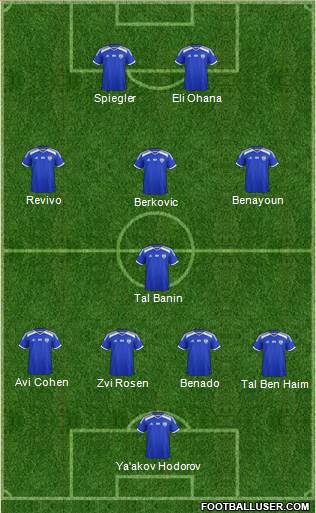
Formation