Friday, May 3, 2019

Juventus All-Time Team for Foreign Players

This blogger Artur Yanturin of Russia copied many of my blog teams.  This blog was one of them.  It was my Russia All-Time Team here.  His team was written in 2020, but mine was uploaded in 2014.   His Spartak Moscow All-Time team entry of was published in October 2020, but mine was uploaded in 2017.  His entry of the Dutch-German rivalry between Real Madrid and Barcelona was written in 2020, but mine was uploaded in 2014.  He also copied many many of my blog entries.

His Facebook and Instagram


Boniek and Platini


Some of the unpublished posts from this blog have been turned into a two-volume book: The Multiverse of the Beautiful Game: National Teams of Pure Fantasy.

Volume 1 takes you back in time and asks the questions every football fan has dreamed about. What if Brazil had a more beautiful team in 1982 — would they have cruised to the title? What if the United Kingdom could send its team to the 1970 World Cup? I believe they would have been the strongest side on earth. What if Argentina had fielded both Omar Sivori and Alfredo Di Stéfano together in 1958? What if Johan Cruyff had lined up alongside Marco van Basten, Ruud Gullit, and Frank Rijkaard? What if Eusébio had played for Brazil? And that's only scratching the surface — Volume 1 is packed with legendary "what ifs" that will keep you turning pages.

Volume 2 brings the fantasy closer to home. What if England had Michael Olise, Erling Haaland and others in 2026 — could they go all the way? What if Yugoslavia had gone to the World Cup in 2018? What if the United States could select more players in 2010? It would be the greatest American side ever. And what if Cristiano Ronaldo and Lionel Messi had actually played for the same national team in 2006? It could have happened — if the soccer gods had smiled on us.

*** Both Volume One and Volume Two are available now on Amazon. ***


Please also see my
 All-Time World Cup Team Index.


Italy All-Time Team
Juventus All-Time Team
Juventus All-Time Team for Italian Players

This is my selection of a 25 member all-time team for Juventus' foreign players.  The number 25 was chosen because it is the official squad size for the Champions' League.

Juventus has won more Serie A titles than any other Italian clubs, but they are known as the unlucky team at the European Cup/Champions League.  They won two European Cup/Champions' league titles.  They also have the misfortune of losing in the Final 6 times.  And their very first title came in 1985, a team consisted of Michel Platini and the backbone of the 1982 Italian World Cup winning team.  A decade later, they won their second title in 1996.
Trezeguet, Davids and Zidane

Team 
GK: Edwin Van Der Sar (Netherlands)
Van Der Sar is the most capped player in Dutch history with 130 caps.  He went to 1994, 1998 and 2006 World Cup and Euro 1996, 2000 and 2004.  He was best remembered for being the Ajax keeper in 1995 that won the Champions' League and then, later for Manchester United for 6 seasons.  He won the Champions' League in 2007-2008. In between, he also played with Fulham and Juventus.

GK: Wojciech Szczesny (Poland)
In 2006, Wojciech Szczęsny joined the Arsenal youth set-up.  He promoted to senior team in 2009.  He found successes with the London club. He joined Juventus in 2017 after a two season loan deal with AS Roma. Following Buffon's departure, he became Juventus' starting goalkeeper. From 2009, he was a member of the Polish national team's pool.  He was a member of the national team at Euro 2012,  2016 and 2020 as well as the 2018 and 2022 World Cup Finals.

Wojciech Szczesny
GK: Fabián Carini (Uruguay)
Fabian Carini played for 3 seasons in Uruguayan club Danubio F.C., before signing with Italian club Juventus in 2001.  In 2004, Carini left Juventus for Internazionale, when he was exchanged for Fabio Cannavaro. From 1999 to 2009, he was capped 74 times for Uruguay. He helped Uruguay to finish 2nd at the 1999 Copa America. He was also their starting goalkeeper at the 2002 World Cup Finals.

RW/RB: Juan Guillermo Cuadrado (Colombia)
At the time of writing, Juan Guillermo Cuadrado is considered one of the best right flank players playing in Italy.  He made his name with Fiorentina in Italy.  Since 2010, he had played for Colombia.  He also had an impressive tournament at the 2014 World Cup Finals in Brazil. He also played for Chelsea, but found more successes when he returned to Italy, playing for Juventus in 2017.  In 2023, he joined Inter Milan.

RB/CB:  Lilian Thuram (France)
Lilian Thuram is France's most capped player. He played in France, Italy and Spain for over 15 seasons, including ten in the Serie A with both Parma and Juventus. He also played for Barcelona FC. With France, Thuram won the 1998 World Cup and the European Championship in 2000, and was in the runner-up squad for the 2006 World Cup in Germany.  He scored two goals vs Croatia in the semifinal of the World Cup in 1998. 

Lilian Thuram 

CB: Jurgen Kohler (Germany) 
Jurgen Kohler was regarded one of the best defenders in the 1990's. He earned 105 caps for West Germany/Germany between 1986 and 1998. He won the World Cup in 1990 and the European Championship in 1996. For his club career, he played with Koln, Bayern Munich, Juventus and Borussia Dortmund. He won the Champions' League in 1997 with Borussia Dortmund. He was named Footballer of the Year in Germany in 1997.

CB: Paolo Montero (Uruguay)
Paolo Montero began his career in Uruguay with Peñarol in 1990, before moving to Italian side Atalanta in 1992. He joined Juventus in 1996, spending 9 seasons there.  He won 4 scudetti titles, but failed to win a Champions League despite playing in 3 Finals.  He also played for San Lorenzo. With La Celeste, he was capped 61 times.  He went to 2002 World Cup Finals in Korea/Japan. His father is former Uruguay international Julio Montero Castillo. 

CB: Julio Cesar (Brazil)
Júlio César began his career in 1979 with Brazilian club Guarani. He moved to Europe in 1986, where he payed for many clubs.  His best spells were with Juventus and Borussia Dortmund. In 1997, he helped Borussia Dortmund to win the Champions' League, beating Juventus in the Final.  He played for Brazil at the 1986 World Cup in Mexico and won the Best Central Defender Award, being elected to the team of the tournament, but he also missed his penalty during the shootout loss to France.

Julio Cesar
LB: Patrice Evra (France)
Patrice Evra began his career with Nice and then, Monaco. He played for the Red Devils from 2006 to 2014, where he became one of the best left backs in the world.  He earned 81 caps and was a key player for France since 2008.  He was the captain of the national team.  At South Africa 2010, he led a player revolt against Raymond Domenech. He was named in the PFA Team of the Year on three occasions, as well as the FIFPro World XI and the UEFA Team of the Year.

CM: Edgar Davids (Netherlands)
Nicknamed "the Pitbull", Edgar Davids was one of the greatest defensive midfielders in the world.  At the club level, he won the European Champions' League with Ajax in 1995, a team considered to be the best ever club side.  He also spent 7 seasons with Juventus in Italy at the height of his career.  He played 74 times for the Dutch national team between 1994 and 2005.  He was an important player at the World Cup Finals in 1998 when Netherlands reached the semi-final. 

DM: Luis Monti (Argentina)
The ruthless central midfielder led Argentina to the World Cup Final in 1930 where they lost to Uruguay.  Four years later, he won the World Cup with Italy. He played 16 times for Argentina and 18 times for Italy. Monti started his career in 1921 with Huracán. The following year he signed with Boca Juniors but left without playing a game. He joined San Lorenzo. In 1930, he joined Juventus in Italy, where he played until 1939.

DM:  Didier Deschamps (France)
Didier Deschamps was only the second player in history to captain his team to lift the three big trophies: the Champions League trophy, the World Cup trophy and the European Championship trophy.  He started his career with Nantes. The prime of his career was spent with Marseille and Juventus, where he won a Champions League for both club.  He earned 103 caps between 1989 and 2000.

CM: Luis del Sol (Spain)
Luis del Sol started with Real Betis in 1953.  In 1960, he joined Real Madrid, winning five major titles with the latter side, and earning several Ballon d'Or nominations.  In the 1962, he signed for Juventus, becoming the club's first ever Spanish player. He made a total of 292 outings in eight seasons.  Del Sol represented Spain at the 1962 and 1966 World Cups and was also part of the championship-winning squad at the 1964 European Nations' Cup. He earned 16 caps between 1960 and 1966.

Luis del Sol 
AM: Michel Platini (France)
Michel Platini is one of the greatest footballers of all time.  He played 72 times for France, He scored 9 of France's 14 goals as they won the European Chamionship in 1984 at home.  It was probably the greatest individual performance in a tournament.  He won the Ballon d'Or three times, in 1983, 1984 and 1985.  With Juventus, he won the European Cup in 1985, the first ever for the club. He started with Nancy and was a member of the famous team with AS Saint-Etienne.

AM/RM/FW:  Helmut Haller (Germany)
Helmut Haller was one of the best midfielders in the world in the 1960's.  In 1966, he helped West Germany to reach the World Cup Final, forming one of the best midfield of the tournament.  He also went to the 1962 World Cup in Chile and the 1970 World Cup Finals in Mexico.  He started with Augsburg in 1957.  He was also known for his spells in Italy, playing for Bologna and Juventus. In Juventus, he played between 1973 and 1976.

AM: Zinedine Zidane (France)
Zinedine Zidane was named the best European footballer of the past 50 years in the UEFA Golden Jubilee Poll, and has been described as one of the greatest players in the history of the game.  He won the FIFA World Player of the Year award three times.  He led France to victory at  the World Cup in 1998 and the European Championship in 2000.  With Real Madrid, he also won the Champions League in 2002, where he scored one of the greatest goals in history at the Final.

Zinedine Zidane

LW: Karl Aage Praest (Denmark) 
Karl Aage Praest attended the Royal Orphanage. The orphanage became the youth team of football club Østerbros Boldklub (ØB) in 1936. He joined Juventus in 1949.  He won a bronze medal at the 1948 Summer Olympics.  His international career was limited to his status as a professional player after he joined Juventus in 1948.  He won the 1949-50 and 1951-52 Serie A championships.  He is a Danish Football Hall of Fame inductee.

LW/AM: Pavel Nedved (Czech Republic)
Pavel Nedved was a key player as the Czech Republic finished second at Euro 1996, and reached the semi-final at Euro 2004.  For club football, he is best remembered for playing for Lazio and Juvnetus.  At Lazio, he won the Scudetti in 1999-2000, only the second league title in Lazio's history.  With Juventus, he led the team to the Final of the 2002-2003 Champions' League final, but he sat out ofthe game due to suspension.  He won the European Footballer of the that year.

Pavel Nedved
FW/LW: Raimundo Orsi (Argentina)
Orsi was considered one of the greatest forwards in Argentina's history.  He started his career with Indpendiente in Argentina before lured away to play for Juventus. he won 5 league titles with Juventus.  Later in his career, he would play in Brazil and Chile.  He was capped by Argentina 12 times winning a silver medal at the 1928 Olympics.  He switched to play for Italy in 1929.  He was a star player as Italy won the World Cup in 1934.

ST/LW: John Hansen (Denmark)
Hansen was capped 8 times, scoring 10 goals. He started his career with Copenhagen club BK Frem in the amateur-only Danish league. After winning a bronze medal at the 1948 Olympics, he turned professional and joined Juventus, ending his amateur status and international career.  His international career was only a single year in 1948. He was the top scorer in Serie A for the 1949-1950 season. He joined Lazio in 1954. He was capped 8 times scoring 10 goals.

SS/FW:  Omar Sivori (Argentina)
Omar Sivori is remembered one of the greatest ever player from Argentina. He won the Ballon d'Or in 1961. After Argentina won the Copa America in 1957, he joined Juventus where he enjoyed 8 successful years.  He was credited with the resurgence of the club.  With John Charles and Giampiero Boniperti, he formed "the Magical Trio" with the club.  In Argentina, he played for River Plate. He represented Argentina 19 times between 1956 and 1957.  kater, he played 9 times for Italy.
Omar Sivori 
FW/RW/LW: Zbigniew Boniek (Poland)
Zbigniew Boniek is one of the greatest Polish players in the history of the game.  He earned 80 caps with 24 goals.  He played at three consecutive World Cups. After the World Cup Finals in 1982, he moved to Italy and played for Juventus, where he won the Champions' League in 1985. Boniek also for Polish clubs Zawisza Bydgoszcz and later at Widzew Łódź, and AS Roma. 

CB/ST: John Charles (Wales)
John Charles was equally adept at centre-forward or centre-back.  In England, he played for Leeds United, Cardiff City and Hereford United.  However, the best part of career was with Juventus. He played in Turin for five years, scoring 93 goals in 155 matches, winning the scudetto (Italian league championship) three times, and the Italian Cup twice. He was 3rd in the Ballon d'Or (Golden Ball) in 1959. He was never booked in his entire career.

John Charles 
ST: Ferenc Hirzer (Hungary)
Ferenc Hirzer began his career in 1913 with Törekvés SE.  He moved to the Czech Republic to play for Makkabi Brno and to Germany to play for Union 03. Altona. For the 1925–26 season, he moved to Juventus, winning the first league title in 20 years. He scored 35 goals in 26 games. From1922 to 1932, he played 32 times for Hungary.  He went to the 1924 Summer Olympics in Paris. He also represented Hungary in the 1927-30 Central European International Cup, where he became top scorer 

ST: David Trezeguet (France)
David Trezeguet started his career in Argentina with Platense, but was snapped up by AS Monaco after a few games.  At Monaco, he was known for his partnership with Thierry Henry.  In 2000, he joined Juventus, where he stayed until 2010.  For the national team, he was selected to play in the 1998 World Cup Finals.  He was a key player throughout his career with France, earning 71 caps.  He won the World Cup in 1998 and then, the European Championship in 2000.
David Trezeguet 
Honorable Mention 
Igor Tudor (Croatia), Matthijs de Ligt (Netherlands), Danilo (Brazil), Dani Alves (Brazil), Stefan Reuter (Germany), Stephan Lichtsteiner (Switzerland), Alex Sancho (Brazil), Douglas Costa (Brazil), Vladimir Jugović (Yugoslavia), Michael Laudrup (Denmark), Thomas Hassler (Germany), Andreas Moller (Germany), Kwadwo Asamoah (Ghana), Patrick Vieira (France), Massimo Bonini (San Marino), Igor Tudor (Croatia), Paul Pogba (France), Arturo Vidal (Chile), Jose Altafini (Brazil), Paulo Sousa (Portugal), Adrien Rabiot (France), Miralem Pjanić (Bosnia and Herzegovina),  Cristano Ronaldo (Portugal), Paulo Dybala (Argentina), Carlos Tevez (Argentina),  Zlatan Ibrahimović (Sweden), Mario Mandžukić (Croatia), Gonzalo Higuaín (Argentina).

Squad Explanation
-- The original team was created in May, 2019.  I redid it on April, 2024.
-- Luis Monti, John Charles, Omar Sivori, Edgar Davids, Pavel Nedved, Michel Platini, Zinedine Zidane and Didier Deschamps made my All-Time Juventus team.  They were my based players.
-- In 1985, Juventus won their first European Cup with three foreigners (Zbigniew Boniek, Michel Platini and Massimo Bonini).  Massimo Bonini only made honourable mention.
-- In 1996, they won their second European Cup (Champions' League).  Only Didier Deschamps made this team, but Edwin Van de sar and Edgar Davids played for their opponent Ajax on that final.
-- In the 1993 UEFA Cup Final, Júlio César, Andreas Moller, and Jürgen Kohler were instrumental in securing Juventus' victory. They triumphed over Borussia Dortmund in the final match. However, the tables turned in 1997 when Andreas Moller and Jürgen Kohler, now playing for Borussia Dortmund, helped their team claim the Champions' League title by defeating Juventus in the final. Unfortunately, Júlio César, who had also joined Borussia Dortmund, was unable to participate in the final due to an injury. Notably, two other former Juventus players, Paulo Sousa (Portugal) and Stefan Reuter (Germany), also contributed to Borussia Dortmund's success in the final.  Reuter played in the 1993 Final for Borussia Dortmund.
-- At the time of writing, Omar Sívori and Luis Monti are the only foreign players who captained the side.  Both also played for Italy.
-- Raimundo Orsi, Omar Sivori and Luis Monti played for Italy, but they would have been cap-tied to Argentina in the modern world. Mauro Camoranesi never played for Argentina.  He is considered to be "Italian".  I did not consider him to be a foreign player.  Jose Altafini made honorable mention as a "Brazilian".
-- According to transfermarkt, Juventus has seen a significant presence of Brazilian players throughout its history, with a total of 30 individuals from Brazil having donned the club's jersey. The Brazilian contingent stands as the largest nationality within the ranks. However, Julio Cesar is the only Brazilian on this team.
-- The French contingent holds the distinction of being the largest group within this All-Time team, boasting an impressive group including David Trezeguet, Patrice Evra, Lilian Thuram, Didier Deschamps, Zinedine Zidane, and Michel Platini. 
-- Juventus had three Danish greats in its history.  I did not make the connection until I started this post. Michael Laudrup only made honorable mention because of Zidane and Platini who were also attack midfielders.   Both Karl Aage Praest and John Hansen made the team. John Hansen is the third highest goal scorer among foreigners for the club.
John Hansen
-- As of 2024, only five Dutchmen has ever played for Juventus.  Three of them were selected for this team.  Poland has two players on this teram with only three ever donned this jersey.
Goalkeepers
-- Juventus did not have many non-Italian goalkeepers.  In 2019, Edwin van der sar was the obvious choice.  By 2024, Wojciech Szczesny emerged as Juventus' greatest foreign goalkeeper.  He has spent 7 seasons with Juventus.  By comparison, Van de Sar only spent two seasons, and he was replaced by Gianluigi Buffon as the starter in his second year.
-- Fabián Carini was once projected to start ahead of Van der sar, but unfortunately, his career with Juventus was derailed by the presence of Gianluigi Buffon. He did not play much. At the time of writing, Neto is enjoying his career with Valencia. He was my other choices. In the end, I took Carini who had a stronger international career than the others. He had 74 caps for Uruguay.
Defenders
-- The task of choosing the centreback position proved to be relatively straightforward. Paolo Montero, Jurgen Kohler and Julio Cesar all solidified their positions within the club. Montero dedicated nine seasons to the team, securing four Serie A titles along the way.  Kohler was named Serie A Foreign Player of the Year,
Paolo Montero
-- There were only 25 spaces. To save a spot for other position, I only carried three central defenders and use Lilian Thuram or John Charles as the emergency fourth back. At the end of his Juventus career, Thuram partnered Fabio Cannavaro in the center. Charles was as good of a centreback as a forward. So the position would be well-covered. Igor Tudor and Matthijs de Ligt were two of the more notable foreign central defenders on the team. They made honorable mentions.
-- Lilian Thuram is widely regarded as Juventus's most exceptional rightback in history. Then, I made the decision to select Juan Guillermo Cuadrado over Danilo and Stephan Lichtsteiner for that second rightback. Danilo, who served as a Juventus player for over 200 games, not only demonstrated his longevity but also earned the honor of becoming the team's captain. Stephan Lichtsteiner dedicated seven years to the club, contributing significantly during his tenure. Despite their contributions, Cuadrado outshone them both, establishing himself as a highly accomplished player at Juventus. He holds the fourth-highest appearance record for a foreign player in Juventus' history. In contrast, Danilo Alves and Stefan Reuter had relatively brief stints with the team, playing for only one season each. Additionally, Jonathan Zebina did not secure a regular starting position during his time at the club.
--Although Patrice Evra did not showcase his prime form during his time at the club, it is worth noting that Evra did reach the final of the Champions League with the team. When considering alternatives, the only viable option that comes to mind is Alex Sancho. As of now, Alex Sancho is just one match away from matching Pavel Nedved's all-time appearance record for a foreign player at the club. On the other hand, Robert Jarni's presence was limited to a single season. In the absence of a strong candidate for the backup right back position, Paolo Montero would serve as the backup leftback. I also considered selecting Douglas Costa who could play both sides of the fullback position, but I saved a spot for other players from different position.
Midfielders
-- Luis Monti helped Juventus to four consecutive Serie A titles (1932 to 1935), also serving as the club's captain.  Didier Deschamps played a pivotal role in Juventus' winning 3 Serie A championships and the prestigious Champions League in the 1995-1996 season, serving as their captain. While Edgar Davids may have won fewer significant trophies during his tenure in Turin compared to Deschamps, his impact on the team could be considered more substantial. Over the course of his impressive 7 seasons with the club (in contrast to Deschamps' 5 seasons), Davids epitomized the role of an engine on the field. While Deschamps' leadership style deserves utmost respect, Davids' presence and performance on the field were instrumental to the team's success. 
Luis Monti
-- Michel Platini was Juventus' best player as they won their first ever European Cup in 1985.  Zidane played 4 seasons and took the team to two Champions' league finals. Both Zidane and Platini also won many individual awards while playing for the club.  I also selected Helmut Haller who helped Juventuis to reach the European Cup Final in 1973.
-- Michael laudrup was a young player when he played for Juventus. He failed to live up the expectations of replacing Michel Platini. Instead, I chose Luis del Sol who was more of a box-to-box midfielder. He is the fifth–most appearances among non–Italian Juventus players.
-- Sami Khedira (Germany),Vladimir Jugović (Yugoslavia), Kwadwo Asamoah (Ghana), Massimo Bonini (San Marino), Paul Pogba (France), Arturo Vidal (Chile), Adrien Rabiot (France), Miralem Pjanić (Bosnia and Herzegovina) and Patrick Vieira (France). Massimo Bonini played for San Marino and is considered a non-Italian.
-- Kurt Hamrin only played briefly here before he became a big star in Serie A.  He departed due to Juventus' acquisition of John Charles in 1957, and the club had an excess of foreign players at the time, given the existing restrictions on foreign player quotas during that period.  He only played one season here, but he earned respects here, particularly by chairman Umberto Agnelli who in 1984 selected him in one of his all-time Juventus Best XI as his right winger.  Nevertheless, I could not select him because his stint was too brief here.  Forward Zbigniew Boniek who could operate on both sides of the wing would be the main threat from the right.  He was well-decorated in his three seasons here.  He was perhaps best remembered for earning the penalty that won the 1985 European Cup, and for scoring the winning in the 1984 Cup Winners' Cup in 1984.  Helmut Haller also played as a right midfielder in his career, and the team also included Juan Guillermo Cuadrado.
-- The left attackers at Juventus were truly exceptional. Karl Aage Præst formed a formidable partnership with fellow Danes John Hansen and Karl Aage Hansen. Præst's remarkable dribbling skills and precise crossing played a crucial role in helping John Hansen secure the top goal-scorer title for the 1951-52 season. While Hansen primarily operated as a striker, he also displayed versatility playing on the left flank. In the realm of legendary players, Pavel Nedved stands out prominently. His time at Juventus was marked by extraordinary achievements, including winning the prestigious Ballon d'Or award. And, of course, we cannot overlook the iconic Raimundo Orsi, whose contributions have left an indelible mark in the club's history.
Forwards
-- Omar Sivori, John Charles and Giampiero Boniperti formed "the Magical Trio" with the club.  John Charles was voted as Juventus' greatest foreign player.  Sivori won the European Footballer of the Year award in 1961. John Charles played as a forward here. During his time at Juventus, Charles became a fan favorite and formed a formidable partnership with Omar Sivori. He was instrumental in helping Juventus win three Serie A titles in 1958, 1960, and 1961. Charles' performances earned him the nickname "Il Gigante Buono" (The Gentle Giant) due to his physical presence on the field combined with his fair play and humility off the pitch. He was voted as Juventus' greatest foreign player.  In the 1959 Ballon d'Or rankings, Charles secured a commendable third place, trailing behind Alfredo di Stefano and Raymond Kopa. During the 1959/60 season, both Charles and Sivori combined their efforts to score an impressive total of 50 Serie A goals. Meanwhile, as a cohesive unit, Juventus netted a remarkable 92 goals in 34 games. 
-- Juventus won the 1949–50 Serie A championship with John Hansen scoring 28 goals in 37 games.  He spent six seasons at Juventus where he scored 124 goals in 187 games in the Serie A. I reunited him with Karl Aage Præst.
-- David Trezeguet is among Juventus' appearance leaders for foreign players.  He is the first all-time leading scorer for foreigners, 4th overall.  He was also Serie A Foreign Footballer of the Year in 2002.
-- Ferenc Hirzer had scored a total of 50 goals in 43 games for Juventus during his time with them.  He scored 35 goals in 26 games in a single season for Juventus.  In total, he scored 49 goals in games (1.11 goal per game). I admitted that I never heard of him before I started this research.  I selected him because he belonged to an era forgotten by the modern fans.
Ferenc Hirzer
-- Cristano Ronaldo actually scored 101 goals in 131 games, but his goal per game ratio was 0.75, which was the highest for players who scored over 100 goals for the club. But it was not enough to make the team. Other big names missing out included Paulo Dybala, Carlos Tevez, Zlatan Ibrahimović, Mario Mandžukić, Gonzalo Higuaín and José Altafini.

Formation


Thursday, April 25, 2019

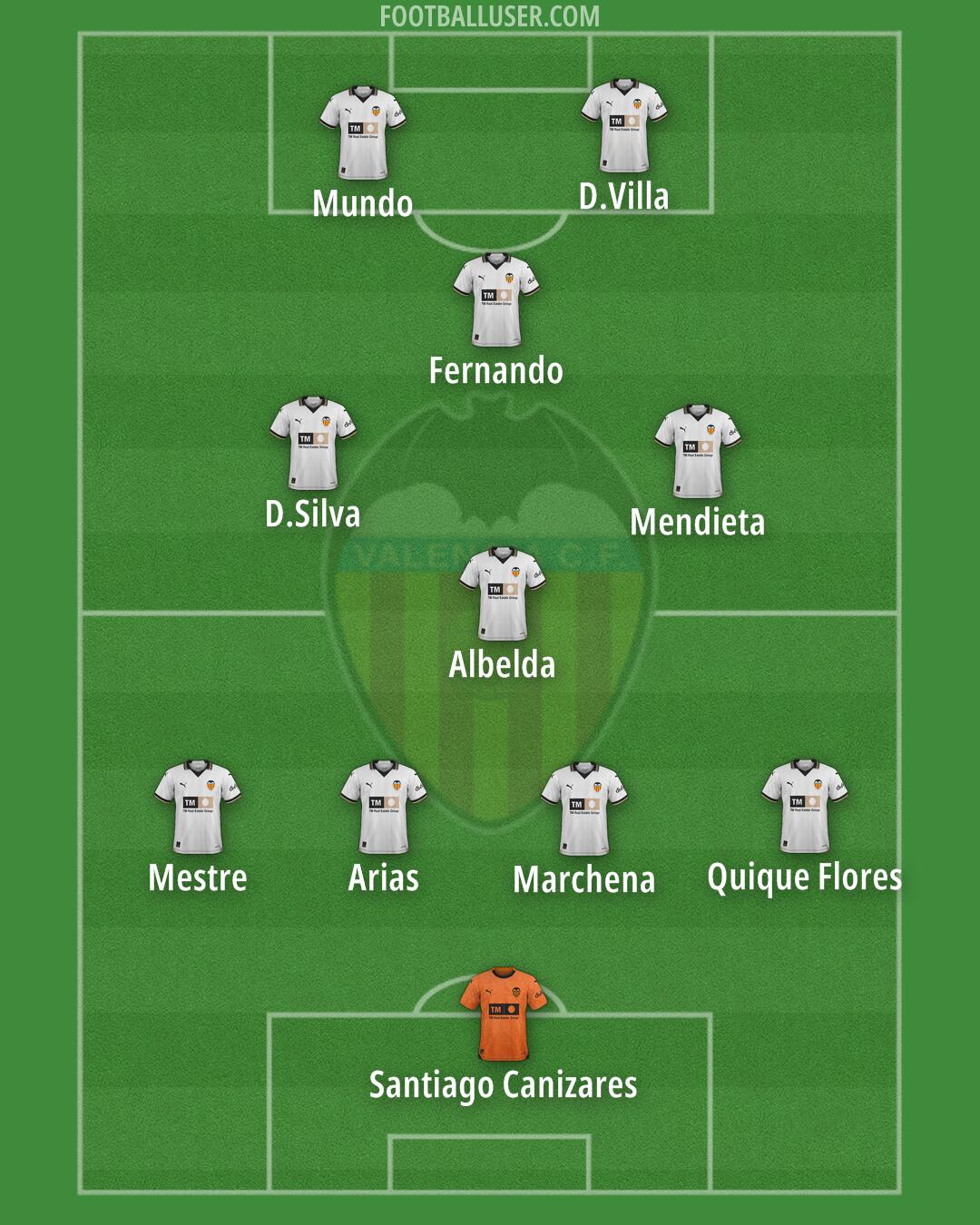
Valencia All-time team for Spanish Players

Gaizka Mendieta and Santi Canizares 


Some of the unpublished posts from this blog have been turned into a two-volume book: The Multiverse of the Beautiful Game: National Teams of Pure Fantasy.

Volume 1 takes you back in time and asks the questions every football fan has dreamed about. What if Brazil had a more beautiful team in 1982 — would they have cruised to the title? What if the United Kingdom could send its team to the 1970 World Cup? I believe they would have been the strongest side on earth. What if Argentina had fielded both Omar Sivori and Alfredo Di Stéfano together in 1958? What if Johan Cruyff had lined up alongside Marco van Basten, Ruud Gullit, and Frank Rijkaard? What if Eusébio had played for Brazil? And that's only scratching the surface — Volume 1 is packed with legendary "what ifs" that will keep you turning pages.

Volume 2 brings the fantasy closer to home. What if England had Michael Olise, Erling Haaland and others in 2026 — could they go all the way? What if Yugoslavia had gone to the World Cup in 2018? What if the United States could select more players in 2010? It would be the greatest American side ever. And what if Cristiano Ronaldo and Lionel Messi had actually played for the same national team in 2006? It could have happened — if the soccer gods had smiled on us.

*** Both Volume One and Volume Two are available now on Amazon. ***


Please also see my All-Time World Cup Team Index.
Real Madrid, Barcelona, Valencia,
Atletico Madrid, Sevilla, Atletic Bilbao, 
Deportivo La Coruna  Real Sociedad,
Real Betis, Real Zaragoza, Espanyol
Valencia All-Time Team for Foreign Players
Valencian Community

This is my selection of a 25 member all-time team for the club.  The number 25 was chosen because it is the official squad size for the Champions' League.


Valencia is among the most successful clubs in Spain.  In 1980, they won a Cup Winners' Cup.  Then, in the 2000's, the team reached its Golden period.  They won two La Liga titles.  In 2003-2004 season, they won the Double: La Liga and the UEFA Cup.  They also reached the Champions' league two years in a row. They won back-to-back Fairs Cup in 1962 and 1963. 

Ricardo  Arias and Miguel Tendillo

 Team
Santiago Canizares was a youth product of Real Madrid. He went to Valencia in 1998, where he led them to two Champions' league Final and winning the 2004 UEFA Cup.  He won Ricardo Zamora Trophy 4 times: 1992–93 (shared), 2000–01, 2001–02, 2003–04. He received 46 caps. He also spent two seasons with Celta. He went to six major international tournaments, but was mainly used as a backup, except at the European Championship in 2000.

GK: Ignacio Eizaguirre
Ignacio Eizaguirre started his career after the Spanish Civil War in 1939 with Real Sociedad.  He played one season and moved to Valencia in 1940.  From 1940 to 1950, ge won three La Liga titles and two Ricardo Zamora trophies for being the best goalkeeper of the season with Valencia.  He also played for Osasuna. At the international level, he earned 18 caps. He was the starting keeper for Spain at the World Cup finals in 1950.
Ignacio Eizaguirre
GK: José Manuel Sempere (Spain)
Sempere finished his youth career with local giants Valencia CF, making his senior debut with RCD Español on loan (no official appearances). Returned to the Che in the summer of 1980, one of his first games was the season's UEFA Super Cup second leg, with the side winning the competition against Nottingham Forest and him being the youngest ever goalkeeper to win that tournament, a record broken 22 years later by Iker Casillas of Real Madrid.

Quique began his professional career with Valencia in 1984, spending 10 seasons over there.  He then spent 2 seasons with Real Madrid before moving to Zaragoza, retiring in 1997. Internationally, he represented Spain at under-18, under-21 and under-23 levels, appearing with the senior side at the 1990 World Cup. Between 1987 and 1991, he had 15 caps for Spain.  His father also played for Real Madrid in the 1960's as a rightback.

From 1965 to 1975, Juan Sol was a player for Valencia. In 1975, he transferred to Real Madrid, where he secured three league titles over a four-year period (1975-1979). Following his successful stint at Real Madrid, he rejoined Valencia CF, playing for them from 1979 to 1981. During this period, he achieved victories in the European Cup Winners' Cup and the European Super Cup. Juan Sol concluded his professional football career at Valencia in 1981.
,
SW: Ricardo Penella Arias 
Ricardo Penella Arias spent 15 seasons out his 16 professional seasons with Valencia and payed 377 matches, winning the 1980 Cup Winners' Cup.  He followed the club to the lower division as it relegated after the 1985-1986 season.  He also played in CD Castellon for one season before retiring. For the Spanish national team, he only played a single game for Spain in 1979 against Portugal.

CB: Miguel Tendillo 
Tendillo started his career with local Valencia CF, being an automatic first-choice since the age of 18 in 1979, winning the 1980 UEFA Cup Winners' Cup.  He played there until 1986. After a single season with Real Murcia,  he joined Real Madrid in 1987.  Tendillo earned his first cap for Spain in 1980 before hwas 20. Subsequently, he was called for that year's European Championship and the 1982 World Cup, appearing in a total of 27 matches.

CB: Carlos Marchena 
In his club career, Carlos Marchena played for Benfica, Sevilla, Valencia, Villareal and Deportivo La Coruna. His peak came with Valencia between 2001 and 2010, where he won the Double in 2002-2003 season.  For the national team, he had 69 caps between 2002 and 2011.  He was a starter at European Championship in 2008 where Spain won its first major trophy since 1964. He also played at Euro 2004 and two World Cup Finals.  In 2010, he was a member of the World Cup winning team.
Carlos Marchena
CB: Quincoces II
Juan Carlos Diaz Quincoes is the nephew of the legendary defender and coach Jacinto Quincoces, from whom he inherited the football nickname.  He was better known as Quincoes II.  He made his debut under his uncle for Valencia in 1953.  He would play for the same club until 1964.  he then played two seasons for Real Murcia.  For Spain, he played 8 times between 1957 and 1959.

LB: Juan Ramon Santiago
Juan Raom started his career with Deportivo Alavés in the first division before making his name with  Gimnástico FC in the 3rd division.  In 1934, he joined Valencia.  After the Civil War, he continued with the club, where he retired in 1952.  With the club, he won three league titles and two Copa del Generalissimo.  In 1950, he won la Medalla al Mérito Deportivo of RFEF.  He was also capped twice, debuting in 1942.

LB/CB: Manuel Mestre

Manuel Mestre estre was born in 1935.  He made his debut with Valencia as a 21 years old in 1956, where he played 14 seasons.  At one point, he was Valencia's all-time appearance record holder until Ricardo Arias.  For the international level, he played twice for Spain in 1959 and 1961 respectively. The two matches were against Austria and Morocco.

DM: Antonio Puchades
From 1949 to 1958, Antonio Puchades played for his hometown Valencia, which should be his only club. He won the only league title in his debut season, but he only played 4 games that season.  For Spain, he received 23 caps between 1949 and 1954, and went to the 1950 World Cup Finals, starting every game. Spain finished 4th in Brazil. The main stadium of the Ciudad Deportiva de Paterna is named after him, the Antonio Puchades Stadium.
Antonio Puchades
DM/CM: David Albelda 
Except for two loan spells, David Albelda played his entire career with Valencia.  He was the heart and soul of the team that won two legaue title, an UEFA Cup and two runnerup medals at the Champions' league.  He was known for his midfield partnership with Ruben Baraja. He also served as their captain from 2001.  He was capped 51 times for Spain. He went to two World Cup Finals and a single European Championship.  He narrowly missed the European Championship in 2008, where Spain won their first major trophy since 1964.

Baraja started his career with Real Valladolid in 1993 and moved to Atletico Madrid.  Atletico Madrid relegated after the 1999-2000 season which allowed him to join Valencia and his career took off.  Forming a midfield with David Albelda, Valencia won two La Liga titles and the 2004 UEFA Cup.  He was also a part of the losing side at the Champions' league Final in 2001.  He earned 43 caps between 2000 and 2005.  He played in World Cuo 2002 and Euro 2004.
Ruben Baraja 
CM: Jose Claramunt 
From 1966 to 1978, Jose "Paco" Claramunt played for his only club, Valencia.  He won the league title in the 1970-71 season, but also lost three Copa del Rey Finals in row during the early 1970's.  He earned 23 caps, six of which as the captain, but he never played in any major international tournament. His brother Enrique also played for Valencia at the same time.  His hometown club UD Puçol's ground was named Estadio José Claramunt in his honour.

RW: Epi

Epi started with Real Sociedad. From 1940 to 1949, Epi played with Valencia, where he was known for playing with Asensi, Amadeo, Mundo and Gorostiza., where Valencia dominated the decade.  Later, he played with Real Sociedad between 1949 and 1955.  At the international level, he made his debut in 1941 against Portugal, where he would gain 15 caps between 1941 and 1949.

LW: Vicente Rodriguez 
Vicente moved to Valencia from Levante in 2000.  He was a part of the great team that won two League titles and the 2004 UEFA Cup. At his peak, he was among the best wingers in the world, but his injuries limited his career.  He later played with Brighton & Hove Albion for two seasons in England at the end of his career. For the national team, he only managed 38 caps between 2002 and 2005. He only made it to Euro 2004. He won the Don Balon Award in the 2003-2004 season.
Vicente Rodriguez 
LB/LW/MF: Vicente Asensi 
Asensi spent all his career with Valencia CF where he played 308 games and scored 33 goals. Together with Epi, Amadeo, Mundo and Gorostiza they made up one of the best attacks in the 1940s. He played as left winger during most of his career but was moved further back as he grew older and ended up playing as a defender. At international level, he also gained six caps with Spain between 1945 and 1950.

AM/RM: Gaizka Mendieta 
Gaizka Mendieta was a big star while playing for Valencia between 1993 and 2001.  He led them to back-to-back Champions' League Final in 2000 and 2001.  He moved to Lazio in 2001, but he failed to find his form.  Then, he played one season with Barcelona, where the club only finished 6th at the league.  He would also play with Middesbrough FC. He earned 40 caps. He went to Euro 2000 and the World Cup Finals in 2002.

AM/FW/RW/RB/CM: Miguel Ángel Angulo
 Angulo began his football career with local Sporting de Gijón B, but he spent most of his career with Valencia, where he won a total of seven major titles, including two La Liga championships and the 2004 UEFA Cup.. He had a brief loan spell with Villarreal and played a few games for Sporting CP for a few games at the end of his career. He played 11 times for Spain between 2004 and 2007.

AM: Fernando Gomez Colomer 
Better known as Fernando, he has the appearance record and 4th highest scorer for Valencia. He made his professional debut wuth them as a 18 years old. He was voted the best player in La Liga for 1988 and 1989.  He also played for English First Division side Wolverhampton Wanderers at the end of his career for a single season. He played 8 times for Spain.  He went to the World Cup Finals in 1990 for Spain, making a single appearance in the Finals against South Korea.
Fernando
AM/LM: David Silva 
David Silva became a starter at Valencia in 2006 which forced Palbo Aimar to leave the club.  In 2010, he joined Manchester City helping the club to win their first Preimership in over 40 years. For Spain, he had over 120 caps from 2006 onward.  He was a key player throughout the period as Spain won the "triple crown": two European Championship and a World Cup.  He also represented Spain at every major tournament from 2008 onward.

ST: Manuel Badenes
Badenes started his career at CD Castellón. His first season at the club saw him score four goals in ten games which resulted in a move to Barcelona in 1947. He spent two season at the club, winning two La Liga titles before moving to Valencia in 1950. He scored 90 goals in 97 games at Valencia before moving to Real Valladolid, where he won the Pichichi trophy awarded to the top scorer in La Liga in 1958.

ST: Mundo 
Edmundo Suárez Trabanco was known as Mundo.  He is the highest scorer in Valencia's history and remained one of the top scorers in La Liga's history.  He started his career with Athletic Bilbao, playing a single game before the Spanish Civil War cut short his stay.  He played for Valencia after the War between 1939 and 1950.  He was capped 3 times between 1941 and 1942.  As of 2009, he was one of the Top 10 all-time goal scorers in the Spanish La Liga, with 195 goals during 231 appearances.

ST: David Villa 
David Villa is the all-time leading scorer for Spain.  He was known for a part of the Golden Generation for Spain, where Spain won three straight international titles: Euro 2008, the World Cup 2010 and Euro 2012. He was the Golden Boot winner at Euro 2008 and the Silver boot in the 2010 World Cup Finals.  He was best remembered for his club career with Valencia. He also played for Barcelona, Seville and New York City FC.
David Villa

Honorable Mention
José Luis Manzanedo, José Manuel Ochotorena, Andoni Zubizarreta, Pep Balaguer, Jose Gaya, José Carrete, Raul Aboil, Fenando Giner, Paco Camarasa, Juan Ramon, Alvaro Perez, Salvador Monzó, Pasieguito, Paquito, Juan Mata, Gerald Lopez, Eduardo Cubells, Paquito, Daniel Parejo,  Joaquin, Ricardo Alós, , Roberto Fernandez, Mista, Enrique Saura, Guillermo Campanal, Daniel Parejo,Vicente Segui, Vicente Asensi, Vicente Guillot, Eloy, Guillermo Gorostiza, Mista, Roberto Fernandez, Arturo Montesinos

Squad Explanation   
-- The original team was cteatyed in 2019.  I redid it in October, 2024.
-- David Villa, David Silva, Santiago Canizares, Ignacio Eizaguirre, , Ricardo Penella Arias, Miguel Tendillo, Carlos Marchena, Antonio Puchades, David Albelda, Ruben Baraja,  Jose Claramunt, Vicente Rodriguez, Gaizka Mendieta, Fernando and Mundo are on my all-time for Valencia.
-- In 1980, Valencia won the Cup Winners' Cup, their first major trophy in Europe. I selected Ricardo Penella Arias and Miguel Tendillo from that team.
Cup Winners Cup 1980
-- From 1999 up until the end of the 2004 season, Valencia had one of their most successful periods in the club's history. With a total of two La Liga titles, one UEFA Cup, one Copa del Rey, and one UEFA Super Cup in those six years. That generation had the best record in Europe.  The following players I selected came from that period: Santiago Canizares, Gaizka Mendieta, Ruben Baraja, David Albelda, Roberto Ayala, Vicente Rodriguez and Carlos Marchena.  Both David Silva and David Villa came up in the mid-2000's. They just missed this generation, but they won Copa del Rey in the 2007-2008 season.
-- In 2019, Marca created an ideal Best XI for Valencia for their centenary celebration. Their lineup was as followed: Santiago Canizares, Ricardo Aries, Roberto Ayala, Quincoces, Ruben Baraja, David Albelda, Jose Claramunt, Antonio Puchades, Fernando, Mario Kempes and Mundo.  The newspaper also held a fan poll to determine the greatest All-Time team as voted by fans.  The following players emerged as the top choices: Santiago Canizares, Quique Flores, Mauricio Pellegrino, Roberto Ayala, Amedeo Carboni, David Albelda, Gaizka Mendieta, Pablo Aimar, David Silva, David Villa and Mario Kempes.
-- In 2024, ESdiario ranked the top 10 players for Valencia in the following order: 1) Mario Kempes, 2) Antonio Puchades, 3) Mundo, 4) David Villa, 5) Rubén Baraja, 6) Waldo, 7) Gaizka Mendieta, 8) Santiago Cañizares, 9) Roberto Ayala and 10) Fernando. 
-- In the 1940's, Valencia had a great team.  Mundo formed the famous line with Vicente Asensi a alongside Epi, Amadeo and Guillermo Gorostiza in the 1940's.  They won La Liga three times during that decade (1941–42, 1943–44, 1946–47) and were runners-up twice, and claimed the Copa del Rey on two occasions (1941, 1948–49) from five appearances in the final.  Mundo, Vicente Asensi and Epi were included on this team alongside goalkeeper Ignacio Eizaguirre  and defender Juan Ramon.
1943-1944 League Champion
-- I had both Vicente Asensi and Vicente Rodriguez on this team.  Vicente Asensi played with Mundo, Epi, Amadeo and Guillermo Gorostiza in the 1940's.  Meanwhile, Vicente Rodriguez was a big part of the 2000's generation. Valencia had a few other great "Vicente". Vicente Guillot formed a lethal partnership with Waldo in the 1960's, but I do not have space for him. Vicente Segui is the top assist provider in the history of Valencia CF, having given 102 assists in 309 games with the club.  I believe the name "Vicente" is very common in Spain.  However, besides Vicente del Bosque, I could not think of another famous footballer named "Vicente".  He never played for Valencia.
-- This team also had three David's.  They were David Albelda, David Villa and David Silva. They played together with the club.  All three players made the team.  Apparently, "David" was a popular name in Spain even through I don't usually associate that name with Spain.  However, besides those players in Valencia, David De Gea is the only other famous Spanish footballer named David I could think of.  And David Ospina is from Colombia. In England, they had David Beckham, David Seaman, David James and David Platt, but they never played for the same club.  
Goalkeepers
-- Santiago Canizares is considered Valencia's greatest goalkeeper. He ranked among the best goalkeepers in the world for several seasons. In Valencia, he won two leagues, two cups, an Intertoto Cup, a UEFA Cup, and was twice a runner-up in the Champions League. 
-- Ignacio Eizaguirre was the first great Valencia CF goalkeeper for the club. He won three leagues and a Cup in the 1940's while over here. He is the only one who could endure a historical debate with Cañizares.  His father Augustin was also a goalkeeper who played for Real Sociedad.  However, he was not related to former goalkeeper Guillermo Eizaguirre who managed him at the 1950 World Cup Finals.  
-- The third goalkeeping spot had many candidates. Over the course of eight seasons, José Luis Manzanedo lifted both the King's Cup and the European Cup Winners' Cup. He also won the He also won the Ricardo Zamora Trophy for the 1978–79 season. José Manuel Ochotorena also won the award at Mestalla.   Andoni Zubizarreta spent 4 great years here, but his name was associated with Barcelona.  With Valencia, Abelardo González won a league title and a cup in the 1960s and 1970s. He won the league title in the 1970-71 season, conceding just 19 goals, which gave him one of the best ratios of goals conceded per game played (0.63) in the history of the league. For Spain, however, he was overshadowed by José Ángel Iribar.  In the Marca's fan poll, he finished third behind Canizares and Sempere. In the end, I chose José Manuel Sempere. He spent a very long career here, but was well-loved over here. In the 2019 Marca's fan poll, he was voted the second greatest goalkeeper ever after Santiago Canizares. He helped the club to win the UEFA Super Cup. 
José Manuel Sempere
-- At the time of writing (2024), Giorgi Mamardashvili was turning into a legendary goalkeeper in Valencia. Pep Balaguer, Neto Murara and Diego Alves were all goalkeepers of note over here.  Goyo Vergel was a largely forgotten goalkeeper who played her ein the 1950's.  he won the Ricardo Zamora award.
Defenders
--Juan Sol, part of a formidable defense alongside Aníbal, Jesús Martínez, and Antón, was instrumental in Valencia CF's 1970/71 La Liga title triumph. The Goal.com put him as one of Valencia's 25 greatest ever players. Quique Sánchez Flores dedicated 10 seasons to the club.  The Marca's fan poll selected him on their  All-Time Best XI.  I took him as my backup rightback.  Joe Carrete won the 1979 Copa del Rey and the 1980 European Cup Winners' Cup Final against Arsenal.  Carrete made two appearances for the Spain national football team in 1978. He only made honorable mentions.
-- At the time of writing, Jose Gaya is a one club player.  He already spent 12 seasons at the club, but he should still be behind Manuel Mestre or Juan Ramon Santiago.  Initially a left-sided defender used in roles similar to the modern winger, Manolo Mestre moved into central defense. Juan Ramon who also played as a central defender played with Valencia until he was 38 years old at a time when it was rare for a player to have long career.  He was also very loyal to the club. He was a left defender, but probably more suitable to a centerback position in the modern game.  As captain, he won many trophies with the club.
-- Ricardo Penella Arias spent 15 seasons out his 16 professional seasons with Valencia.  He is second in appearance for the club. He also followed the team to the lower division. 
-- Carlos Marchena's 359 appearances for Valencia solidify his position as one of the club's appearance leaders. He clinched two League titles, a Cup, a UEFA trophy, and a Super Cup during his successful tenure in Valencia. I also took Miguel Tendillo.  He was the captain of their Cup Winners' Cup victory in 1980. 
Miguel Tendillo 
-- For the final central defender, I went for Quincoces II.  Marca named him as the starting center defender on their All-Time Best XI.  He made his debut with Valencia when his uncle Jacinto Quincoces was the head coach at the club.  The other notable defenders included Raul Aboil, Paco Camarasa and Juan Ramon.  Raul Aboil was from the Golden Generation from Spain that won the 2010 World Cup. For 13 professional seasons, Paco Camarasa  played solely with local Valencia CF, amassing more than 300 overall appearances with the club. He played in the 1994 World Cup Finals. Juan Ramon, a pivotal figure in Valencia CF's history, spent 13 seasons with the team, becoming one of its most decorated players. I selected him as one of my fullbacks. His defensive partner was Alvaro Perez who had a significant place with the club. 
Midfielders/Wingers
--  ESdiario ranked Antonio Puchades as Valencia's second greatest player.  He was a one club player.  Rubén Baraja and David Albelda forged a formidable midfield partnership in Valencia CF's history, playing a major role in a squad that was crowned La Liga champions in 2002 and 2004. Additionally, they contributed significantly to the team's triumph in the 2004 UEFA Cup, solidifying their legacy as key figures in Valencia CF's finest moments. Their combined tenure of 25 seasons and 900 appearances remains a cherished memory among fans.  I have to take both of them together as a unit.  
David Albelda
-- Jose Claramunt could play many positions.  His best position was number "6".  Marca selected him along with Antonio Puchades on their Valencia All-Time Best XI.  
-- Gaizka Mendieta was a big star while playing for Valencia between 1993 and 2001.  He led them to back-to-back Champions' League Final in 2000 and 2001.  Fernando was another disputed choice as the number 10 on this team.   He spent 15 seasons with the club, winning Don Balón’s Best Spanish Player Award for the 1988–89 season.  He was the 4th leading scorer for the club as an attack midfielder. He also leads the club in appearance.  Then, I also selected David Silva.  In real life, the emerge of David Silva also sent Pablo Aimar who was a top La Liga player at the time  away from the club.  He also became one of the best midfielders of his time.  
Gaizka Mendieta
-- Pasieguito and Paquito have similar names, but they played in different eras.  Pasieguito formed a mythical midfield in Valencia with Antonio Puchades. He was the creative force of the duo.  I did not include him because I already had David Silva, Gaizka Mendieta and Fernando.  Paquito was a part of Spain's European Championship winning team. Instead, I took Miguel Ángel Angulo. He was a versatile player capable of excelling in multiple positions, his adaptability proving to be a significant asset to the team.  He was also ranked very high by Goal.com, further underscoring his place in Valencia's history.  Juan Mata was also left off the team.
-- Injuries kept Gerald Lopez from reaching the potential.  
-- I took Epi because I needed a right winger.  He scored a total of 105 goals and added 102 assists in 256 matches in official competition, making him the tenth best scorer and second highest assist-giver in the history of Valencia CF, only behind Vicente Seguí. Vicente Segui who played on the left wing lost out to his namesake Vicente Rodriguez.  Injuries kept Vicente Rodriguez from reaching potential.  However, in his peak, he was one of the best left wingers in the world.   Then, I selected Vicente Asensi as his backup.
Forwards
 -- Mundo holds the title of Valencia's all-time leading scorer. He was the first player from Valencia to finish as the top scorer in the league. He was considered to be one of Valencia's greatest players.
Mundo
-- Of course, I also selected David Villa who was a top striker in Spain during his prime.   He clinched the Spanish Player of the Year award in the seasons 2005-06 and was honored with the Zarra Trophy in the years 2005-06, 2006-07, 2008-09, and 2009-10.  He also became world-renowned by finishing as the top scorer at Euro 2008.
-- I also did not have a spot for Manuel Badenes who averaged almost a goal a game on my Valencia All-Time team, but I took him for this All-Spanish team.  I also looked into other players. Guillermo Gorostiza played in the 1930's for Valencia.  He netted in double digital in four of his six seasons here.  He went to the 1934 World Cup Finals, but while he was playing for Athletes Bilboa.
-- Ricardo Alós only made honourable mention. He was the first Valencia player to win the Pichichi trophy. I also have no space for Roberto Fernandez. Mista made honourable mention as an important member of the team that won four major titles.  
-- In his eight seasons with Valencia, Vicente Guillot was Waldo's striker partner.  The fans of Waldo was known as the "waldistas" and his supporters was known as "guillotistas". 
From 1961 to 1970, he played for Valencia CF, where he became a star.  He moved to Elche CF in 1970. At the international level, he was capped 6 times for Spain.  He was best remembered for scoring a hat trick against Romania in 1962.

Formation