|
| Ruud Van Nistelrooy and Rafael van der Vaart |

Some of the best posts from this blog have been turned into a two-volume book: The Multiverse of the Beautiful Game: National Teams of Pure Fantasy.
Volume 1 takes you back in time and asks the questions every football fan has dreamed about. What if Brazil had a more beautiful team in 1982 — would they have cruised to the title? What if the United Kingdom could send its team to the 1970 World Cup? I believe they would have been the strongest side on earth. What if Argentina had fielded both Omar Sivori and Alfredo Di Stéfano together in 1958? What if Johan Cruyff had lined up alongside Marco van Basten, Ruud Gullit, and Frank Rijkaard? What if Eusébio had played for Brazil? And that's only scratching the surface — Volume 1 is packed with legendary "what ifs" that will keep you turning pages.
Volume 2 brings the fantasy closer to home. What if England had Michael Olise, Erling Haaland and others in 2026 — could they go all the way? What if Yugoslavia had gone to the World Cup in 2018? What if the United States could select more players in 2010? It would be the greatest American side ever. And what if Cristiano Ronaldo and Lionel Messi had actually played for the same national team in 2006? It could have happened — if the soccer gods had smiled on us.
Please also see my All-Time World Cup Team Index.
Netherlands
Surnamese-Dutch,
North Holland, South Holand.
The rest of Netherlands excluding North and South Holland
Netherlands All-Time Team After Johan Cruyff
Netherlands 2002
Netherlands before Johan Cruyff (BC)
Dutch-Indos/Indonesia-born Dutch All-Time Team
Netherlands Euro 1984
It's Miller/Muller time
All Diegos Team
Italian players with surname ending with an "i"
Ronaldo, Ronald, Ronnie, Ron, etc All-Time team
Brazilian footballers who shared names with historical figures
"Van" is a preposition in the Dutch and Afrikaans languages, meaning "of" or "from" depending on the context (similar to de and di in the Romance languages).
"van" is a very common prefix in Dutch language surnames, where it is known as a tussenvoegsel. In those cases it nearly always refers to a certain, often quite distant, ancestor's place of origin or residence; for example, Ludwig van Beethoven "from Bettenhoven" and Rembrandt van Rijn "from the Rhine".
In surnames, it can appear by itself or in combination with an article (compare French de la, de l'). The most common cases of this are "van de", "van der" and "van den", where the articles are all current or archaic forms of the article de "the". Less common are van het and van 't, which use the similar but grammatically neuter article het. The contraction ver- or van der is also common and can be written as a single word with the rest of the surname; an example being Johannes Vermeer (van der meer "of the lake").
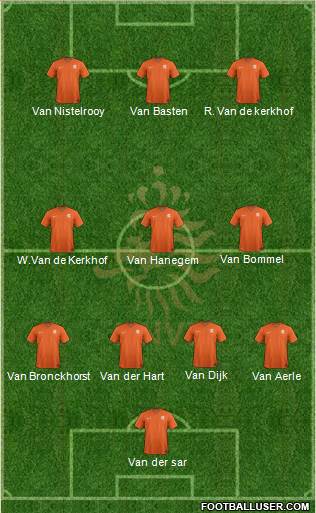
This is my selection of the all-time 23 member team for Dutch players with "Van" as a part of their surnames. All players here has chosen to represent the Netherlands.
Team
GK: Edwin Van Der Sar
Van Der Sar is the most capped player in Holland's history with 130 caps. He went to 1994, 1998 and 2006 World Cup and Euro 1996, 2000 and 2004. He was best remembered for being the Ajax keeper in 1995 that won the Champions' League and then, later for Manchester United for 6 seasons. He won the Champions' League in 2007-2008. In between, he also played with Fulham and Juventus.
GK: Jan Van Beveren
Jan van Beveren was considered one of the best keepers in the 1970's. In 1970, Van Beveren joined PSV Eindhoven, where he won three Eredivisie titles, two domestic cups and the UEFA Cup in 1978. His career with the national team was cut short because of a feud with Johan Cruyff. He did not go to the World Cup Finals in 1974 as a result.
GK: Hans Van Breukelen
Hans Van Breukelen started his career with FC Utrecht and then, Nottingham Forest. He moved to PSV in 1984, where he became a star. For the national team, he was a fixture since 1980. However, he did not help the Oranje to reach a major touranemt until in 1988, where they won the first ever trophy for the Dutch national team. He had 73 caps.
RB: Berry van Aerle
Berry Van Aerle spent 13 years with PSV Eindhoven, helping them to five leagues, which he helped capture the 1988 European Cup. For the national team, he earned 35 senior caps. He helped Netherlands to win European Champion in 1988. It was the first ever international trophy won by Netherlands He was also selected for the 1990 World Cup and the European Championship in 1992.
RB: Sjef van Run
Born 1904, Sjef van Run was capped 25 times in the 1930's. He played for the Dutch National team in the 1934 World Cup Finals, held in France. For his club career, he played his entire career with PSV Eindhoven, appearing in 359 league matches between 1926 and 1942. He died in 1973 at the age of 69.
CB: Virgil van Dijk
Van Dijk started with Groningen before he moved to Celtic in 2013. In S2015, he joined Southampton before signing for Liverpool in 2018 for £75 million, a world record transfer fee for a defender. Van Dijk was named the PFA Player of the Year and the Premier League Player of the Season for the 2018–19 season. Van Dijk starred as Liverpool won the 2019 UEFA Champions League Final where he was named man of the match. From 2015 onward, he played for Netherlands and was named captain.
CB: Henk van der Linden
Van der Linden joined AFC Ajax from AVV TOG in 1939. During the Second World War, he moved played for Be Quick. After the war, he returned to Ajax. He made his debut with the Dutch national team in 1946 against Luxembourg. The central defender was captain of Oranje in two international matches in 1947. In total, he had 7 caps.
CB: Michel van de Korput
At age 15, Van de Korput joined Feyenoord. In 1974, shortly before his eighteenth birthday, he made his debut with the first team of Feyenoord. Between 1980 and 1983, he played for Torino in Italy. Then, he rejoined Feyenoord. He was a part of Johan Cruyff's league winning season with Feyenoord. He played 23 times for the Netherlands.
CB: Cor Van der Hart
He became the third Dutch player in history to play board and one of the first professional player in Holland when he joined Lille in 1950. Before that, he played for Ajax. Widely considered one of the best Dutch defender in history. He had 44 caps, but the cap total largely was limited because the KNVB suspended all players that left the country to play professional football.
LB/DM: Giovanni Van Bronckhorst
Giovanni Van Bronckhorst played for Netherlands in three World Cups, in 1998, 2006 and 2010, as well as three European Championships, in 2000, 2004 and 2008. He was the captain of Netherlands at World Cup 2010, where Netherlands finished second. It was his last international match. He played 106 times for Netherlands He also played club football with Feyenoord, Barcelona, Arsenal and Rangers.
LB: Adri Van Tiggelen
Adri Van Toggelen was the starting left back at Euro 1988, where Holland won its first major international trophy. He earned 56 caps. He also went to the World Cup Finals in 1990 and European Championship in 1992. He played mainly for Sparta Rotterdam early on in his career. He later moved to Anderlectd and PSV.
DM: Mark van Bommel
In Holland, Mark van Bommel's career was associated PSV Eindhoven, where he had two separated stints. However, his most famous part of his career was spent with Bayern Munich. He was their first ever non-German captain. He played 79 times for Holland and was a main player as Holland reached the Final of the 2010 World Cup Finals in South Africa.
CM: Willy van de Kerkhof
AM: Rafael van der Vaart
Rafael Van der Vaart began his career at AFC Ajax's youth academy and worked his way into the first team. He moved to Bundesliga club Hamburger SV, then to Real Madrid, then on to Tottenham Hotspur before returning to Hamburg in 2012. He earned 109 caps for the Netherlands between 2001 and 2013. He represented the nation at three European Championships and two World Cups.
ST: Robin Van Persie
Robin Van Persie started with Feyenoord, but was known for his career playing in England. He spent 8 seasons with Arsenal, winning both PFA and FWA Player of the Year in 2011-2012. Immediately after winning the two awards, he made a controversial transfer to rival Manchester United. At the time of writing, he has earned 102 caps, helping Holland to finish second in 2010 World Cup Finals in South Africa.
ST: Marco Van Basten
Marco Van Basten was probably the second best Dutch player and among the best striker in football's history. He won the Ballon d'Or three times. He led Oranje to the victory at Euro 1988 scoring 5 goals at the tournament. His goal in the Final is considered one of the best in history of the tournament. He started his career with Ajax. He also won two European Cups with AC Milan, a club team that was considered the best ever.
ST: Cor van der Gijp
Cor Van der Gijp made his professional debut at SC Emma. From 1955 to 1964, he played for Feyenoord. He is their all-time leading scorer. From 1964 to 1967, he plated for Blauw Wit. He played 13 times for the Dutch national team between 1954 and 1961. He represented them at the 1952 Olympic Games.
ST: Ruud Van Nistelrooy
Ruud Van Nistelrooy was a prolific goal scorer. He won the top scorer award in three different European domestic leagues. He started with PSV Eindhoven. He spent 5 seasons with Manchester United where he was voted as their best player twice. With Real Madrid, he finished second as the European Golden Boot. Van Nistelrooy earned 70 caps and scored 35 goals for the Netherlands. He played in 2006 World Cup and two European Championship.
Squad Explanation
Netherlands
Surnamese-Dutch,
North Holland, South Holand.
The rest of Netherlands excluding North and South Holland
Netherlands All-Time Team After Johan Cruyff
Netherlands 2002
Netherlands before Johan Cruyff (BC)
Dutch-Indos/Indonesia-born Dutch All-Time Team
Netherlands Euro 1984
It's Miller/Muller time
All Diegos Team
Italian players with surname ending with an "i"
Ronaldo, Ronald, Ronnie, Ron, etc All-Time team
Brazilian footballers who shared names with historical figures
"van" is a very common prefix in Dutch language surnames, where it is known as a tussenvoegsel. In those cases it nearly always refers to a certain, often quite distant, ancestor's place of origin or residence; for example, Ludwig van Beethoven "from Bettenhoven" and Rembrandt van Rijn "from the Rhine".
In surnames, it can appear by itself or in combination with an article (compare French de la, de l'). The most common cases of this are "van de", "van der" and "van den", where the articles are all current or archaic forms of the article de "the". Less common are van het and van 't, which use the similar but grammatically neuter article het. The contraction ver- or van der is also common and can be written as a single word with the rest of the surname; an example being Johannes Vermeer (van der meer "of the lake").
This is my selection of the all-time 23 member team for Dutch players with "Van" as a part of their surnames. All players here has chosen to represent the Netherlands.
Team
GK: Edwin Van Der Sar
Van Der Sar is the most capped player in Holland's history with 130 caps. He went to 1994, 1998 and 2006 World Cup and Euro 1996, 2000 and 2004. He was best remembered for being the Ajax keeper in 1995 that won the Champions' League and then, later for Manchester United for 6 seasons. He won the Champions' League in 2007-2008. In between, he also played with Fulham and Juventus.
 |
| Edwin Van der Sar |
Jan van Beveren was considered one of the best keepers in the 1970's. In 1970, Van Beveren joined PSV Eindhoven, where he won three Eredivisie titles, two domestic cups and the UEFA Cup in 1978. His career with the national team was cut short because of a feud with Johan Cruyff. He did not go to the World Cup Finals in 1974 as a result.
GK: Hans Van Breukelen
Hans Van Breukelen started his career with FC Utrecht and then, Nottingham Forest. He moved to PSV in 1984, where he became a star. For the national team, he was a fixture since 1980. However, he did not help the Oranje to reach a major touranemt until in 1988, where they won the first ever trophy for the Dutch national team. He had 73 caps.
RB: Berry van Aerle
Berry Van Aerle spent 13 years with PSV Eindhoven, helping them to five leagues, which he helped capture the 1988 European Cup. For the national team, he earned 35 senior caps. He helped Netherlands to win European Champion in 1988. It was the first ever international trophy won by Netherlands He was also selected for the 1990 World Cup and the European Championship in 1992.
 |
| Berry van Aerle |
Born 1904, Sjef van Run was capped 25 times in the 1930's. He played for the Dutch National team in the 1934 World Cup Finals, held in France. For his club career, he played his entire career with PSV Eindhoven, appearing in 359 league matches between 1926 and 1942. He died in 1973 at the age of 69.
CB: Virgil van Dijk
Van Dijk started with Groningen before he moved to Celtic in 2013. In S2015, he joined Southampton before signing for Liverpool in 2018 for £75 million, a world record transfer fee for a defender. Van Dijk was named the PFA Player of the Year and the Premier League Player of the Season for the 2018–19 season. Van Dijk starred as Liverpool won the 2019 UEFA Champions League Final where he was named man of the match. From 2015 onward, he played for Netherlands and was named captain.
 |
| Virgil van Dijk |
Van der Linden joined AFC Ajax from AVV TOG in 1939. During the Second World War, he moved played for Be Quick. After the war, he returned to Ajax. He made his debut with the Dutch national team in 1946 against Luxembourg. The central defender was captain of Oranje in two international matches in 1947. In total, he had 7 caps.
CB: Michel van de Korput
At age 15, Van de Korput joined Feyenoord. In 1974, shortly before his eighteenth birthday, he made his debut with the first team of Feyenoord. Between 1980 and 1983, he played for Torino in Italy. Then, he rejoined Feyenoord. He was a part of Johan Cruyff's league winning season with Feyenoord. He played 23 times for the Netherlands.
CB: Cor Van der Hart
He became the third Dutch player in history to play board and one of the first professional player in Holland when he joined Lille in 1950. Before that, he played for Ajax. Widely considered one of the best Dutch defender in history. He had 44 caps, but the cap total largely was limited because the KNVB suspended all players that left the country to play professional football.
LB/DM: Giovanni Van Bronckhorst
Giovanni Van Bronckhorst played for Netherlands in three World Cups, in 1998, 2006 and 2010, as well as three European Championships, in 2000, 2004 and 2008. He was the captain of Netherlands at World Cup 2010, where Netherlands finished second. It was his last international match. He played 106 times for Netherlands He also played club football with Feyenoord, Barcelona, Arsenal and Rangers.
 |
| Giovanni Van Bronckhorst |
Adri Van Toggelen was the starting left back at Euro 1988, where Holland won its first major international trophy. He earned 56 caps. He also went to the World Cup Finals in 1990 and European Championship in 1992. He played mainly for Sparta Rotterdam early on in his career. He later moved to Anderlectd and PSV.
DM: Mark van Bommel
In Holland, Mark van Bommel's career was associated PSV Eindhoven, where he had two separated stints. However, his most famous part of his career was spent with Bayern Munich. He was their first ever non-German captain. He played 79 times for Holland and was a main player as Holland reached the Final of the 2010 World Cup Finals in South Africa.
CM: Willy van de Kerkhof
Overall, Willy Van de Kerkhof appeared 63 times for his country. He was a member of the 1974 World Cup team, but it was the 1978 World Cup Finals, where he carried the team to the Final against the host Argentina. His twin brother Rene was also a part of the 1978 team. For his club career, he played for FC Twente and PSV Eindhoven.
CM/LM: Puck Van Heel
 |
| Willy van de Kerkhof |
Puck Van Heel was an inside-left and left wing-half in the 1930's. He spent his entire career with Feyenoord. He was a cornerstone of the Feyenoord success preceding the World War II, winning five Eredivisie Championships and two KNVB Cups. During his time there, he became the team captain for the club. He was capped 64 times, a record until 1979. He went to the World Cup finals in 1934 and 1938.
CM: Willem Van Hanegem
In the Netherlands, Willem Van Hanegem was widely considered the second best Dutch player in the 1970's and perhaps, the greatest player for Feyenoord. He won the European Cup with Feyenoord in 1970. He was capped 52 times between 1968 and 1979. He was an important player at the World Cup Finals in 1974, but he missed the WC Finals in 1978. He also played in NASL. His nickname was De Kromme (The Crooked). CM: Willem Van Hanegem
 | |
Willem Van Hanegem
|
RW: Rene van de kerkhof
Willy's twin brother. His best year was in 1978 while playing for PSV. He was the runners-up at the World Cup, he also won the UEFA Cup, the Dutch championship and the KNVB Beker. He also played in Hong Kong. Before the 1978 World Cup final, the opponent Argentinians objected to the cast he wore on his injured forearm which delayed his participation in the Final.
LW: John van 't Schip
Born in Canada, Van 't Schip began his career in the Jong Ajax youth academy. He would spend the next 11 seasons with the club. During this period he became league champion in 1982, 1983, 1985, and 1990, and cup champion in 1983, 1986 and 1987. He also helped Ajax win the 1987 European Cup Winners' Cup and the 1992 UEFA Cup. After Ajax's UEFA Cup victory, he was bought by Italian team Genoa, where he played four seasons.
AM: Willy van der Kuijlen
In 1964, he was signed by PSV. Van der Kuijlen ended up playing for the club 18 years, winning three Eredivisie titles, two domestic cups and the UEFA Cup in 1978. He was also crowned Eredivisie top scorer three times. After short periods with MVV Maastricht and Overpelt, he retired at age 37. Capped 22 times. His international career was limited due to his clashes with Johan Cruyff.
AM: Rafael van der Vaart
Rafael Van der Vaart began his career at AFC Ajax's youth academy and worked his way into the first team. He moved to Bundesliga club Hamburger SV, then to Real Madrid, then on to Tottenham Hotspur before returning to Hamburg in 2012. He earned 109 caps for the Netherlands between 2001 and 2013. He represented the nation at three European Championships and two World Cups.
 |
| Rafael van der Vaart |
Robin Van Persie started with Feyenoord, but was known for his career playing in England. He spent 8 seasons with Arsenal, winning both PFA and FWA Player of the Year in 2011-2012. Immediately after winning the two awards, he made a controversial transfer to rival Manchester United. At the time of writing, he has earned 102 caps, helping Holland to finish second in 2010 World Cup Finals in South Africa.
ST: Marco Van Basten
Marco Van Basten was probably the second best Dutch player and among the best striker in football's history. He won the Ballon d'Or three times. He led Oranje to the victory at Euro 1988 scoring 5 goals at the tournament. His goal in the Final is considered one of the best in history of the tournament. He started his career with Ajax. He also won two European Cups with AC Milan, a club team that was considered the best ever.
 |
| Marco Van Basten |
Cor Van der Gijp made his professional debut at SC Emma. From 1955 to 1964, he played for Feyenoord. He is their all-time leading scorer. From 1964 to 1967, he plated for Blauw Wit. He played 13 times for the Dutch national team between 1954 and 1961. He represented them at the 1952 Olympic Games.
ST: Ruud Van Nistelrooy
Ruud Van Nistelrooy was a prolific goal scorer. He won the top scorer award in three different European domestic leagues. He started with PSV Eindhoven. He spent 5 seasons with Manchester United where he was voted as their best player twice. With Real Madrid, he finished second as the European Golden Boot. Van Nistelrooy earned 70 caps and scored 35 goals for the Netherlands. He played in 2006 World Cup and two European Championship.
 |
Ruud Van Nistelrooy
|
Honorable Mention
Dolf van Kol, Cees van Ierssel, Ulrich van Gobbel, Theo van Duivenbod, Henk van der Linden, Piere van Hooijdonk, Dick van Dijk, Gregory van der Wiel, Gerald Vanenburg, Peter van Vossen, Piet van der Kuil, Andy Van De Melde, Joop van Nellen, Fons van Wissen, Tonny van der Linden, Noud van Melis, René van der Gijp, Lothar van Gogh, Jan van Schijndel, Dolf van Kol.
Squad Explanation
-- Edwin Van Der Sar, Jan Van Beveren and Hans Van Breukelen were obvious choices. They took the top three spots. Piet Van Reenen is the all-time leading scorer for Ajax.Gejus van der Meulen was the fourth keeper. He held the Dutch cap record for goalkeepers from 3 March 1928 until 21 June 1990. He fell into disgrace in the late 1940s due to his collaboration with Nazi Germany. Adri van Male was also considered.
-- Lothar van Gogh was a full cousin of Vincent van Gogh. He played twice for Holland. I do not know much about him. I selected him based his interesting background.
-- Gerald Vanenburg was not considered a part of the "Van" team. LOL. I put him on honorable mention for fun.
-- Virgil van Dijk is one of the best player in the world as of 2020. He finished second in the Ballon d'or, an award that should be given to him in 2019. No many defender finished so high in the award.
-- Cor Van der Hart was a pioneer in Dutch football. He was one of the first players to play outside of the Netherlands.
-- The team lacked a suitable 4th centerback. Henk van der Linden who is my 4th back was the only name I came across. I also found Dolf van Kol, but I have no idea who he was.
-- Sjef van Run edged out Gregory van der Wiel. He was considered one of PSV's greatest rightback after Eric Gerets.
-- Sjef van Run edged out Gregory van der Wiel. He was considered one of PSV's greatest rightback after Eric Gerets.
-- Most of the players selected are from the 1970's onward. I do not know much about the older players such as Evert van Linge, Jan van Schijndel, Adri van Male, Fons van Wissen, Henk van Spaandonck, Tonny van der Linden and Noud van Melis. I left them off the team.
-- Jan van Breda Kolff was just a name whose playing career I knew almost nothing. Both his son and grandson, however, were NBA basketball players in the US. His son Butch van Breda Kolff played for e New York Knicks . He was a head coach of LA Lakers, Detroit Pistons, Phoenix Suns, etc. His grandson Jan van Breda Kolff played in the NBA with what was then New Jersey Nets. I considered this as an interesting information.
-- Willem Van Hanegem was known for his 1974 World Cup performance. He also was a legend with Feyenoord.
-- Rene van de kerkhof took Netherlands to the 1978 World Cup Finals. I also took his twin brother Rene. Both were underrated.
-- I found Rafael van der Vaart underrated. I also selected Puck Van Heel from the 1930's.
-- I always feel Pierre van Hooijdonk's career was limited by not playing for a bigger club. His exposure to fans outside that region was limited. He also played in the same generation as many good Dutch strikers. For this team, I have Marco Van Basten, Robin Van Persie and Ruud Van Nistelrooy ahead of him.
-- Marco Van Basten was probably the second best Dutch player and among the best striker in football's history. He won the Ballon d'Or three times. Ruud Van Nistelrooy was a prolific goal scorer. He won the top scorer award in three different European domestic leagues. This team also had Robin Van Persie, who had a decorated career.
-- Cor van der Gijp is Feyenoord's All-Time leading scorer, and Piet van Reenen is Ajax's all-time leading scorer. Pierre Van Hooijdonk lost out to the pair.
-- Belgium also have some all-time "Van-something" players such as Wilfried Van Moer, Paul Van Himst and Franky Van Der Elst.
Formation
I used three midfielders who might get into each other way. Willem Van Hanegem was actually not a pure defensive midfielder, but more of a deep lying playmakers. Van Bommel's duty is to defend.
Ruud Van Nistelrooy on the left is out of position. I could start John van 't Schip over Van Bommel or Willy Van de Kerkhof and switch to 4-4-2.