Sunday, October 18, 2020

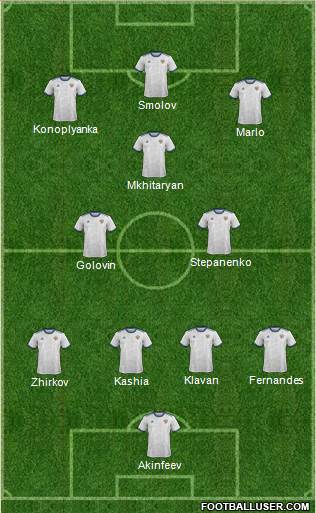
What if USSR went to the World Cup 2018

This blogger Artur Yanturin of Russia copied my blog team.  His entry was written in November 2020, but mine was uploaded in October, 2020.  He seemed to be from the Soviet Union.  He wrote it in Russian.  He still copied mine.  Seriously, I am not from Russia.  He copied from a foreigner. He also copied many many of my blog entries.  His Spartak Moscow All-Time team entry of was published in October 2020, but mine was uploaded in 2017.  His entry of the Dutch-German rivalry between Real Madrid and Barcelona was written in 2020, but mine was uploaded in 2014.  

His Facebook and Instagram

Если бы сборная СССР поехала на ЧМ-2018

Этот блогер Артур Янтурин из России скопировал мою команду блога. Его запись была написана в ноябре 2020 года, а моя загружена в октябре 2020 года. Похоже, он из Советского Союза. Он написал это по-русски. Он все еще скопировал мой. Серьезно, я не из России. Списал с иностранца. Он также скопировал многие из моих записей в блоге. Его запись о московском «Спартаке» за все время была опубликована в октябре 2020 года, но моя была загружена в 2017 году. Его запись о голландско-германском соперничестве между «Реалом» и «Барселоной» была написана в 2020 году, а моя была загружена в 2014 году.

* Due to the conflict in Ukraine, I wanted to state clearly that the intention of this team was not to promote an unification of the former Soviet Union.

Russia World Cup 2018

Please also see my All-Time World Cup Team Index.


During its existence, the Soviet Union had a remarkable record in the European Championships, maintaining the best record until the emergence of West Germany in the 1970s. In terms of the World Cup, the Soviet Union only failed to qualify twice, in 1974 and 1978, and participated in a total of seven finals tournaments. Their most notable achievement was reaching the semifinals in 1966, where they lost 2-1 to West Germany, ultimately finishing fourth.

However, since the collapse of the Soviet Union, the independent republics that emerged did not achieve significant success in international football. While Ukraine managed to reach the quarterfinals in 2006, Russia, inheriting the Soviet football legacy, struggled to advance beyond the group stage until the 2018 World Cup Finals.

If the Soviet Union still existed and Russia had the opportunity to reinforce its team with players from the other republics in this alternative World Cup Finals, it could potentially have a positive impact on their performance. As the host, Russia started the World Cup Finals with two easy wins before losing to Uruguay.  They then pulled an upset victory against Spain in the round of 16 before losing to the eventual World Cup Finalist Croatia.   Can the Soviets do better?

Team
GK: Igor Akinfeev (CSKA Moscow/Russia)
Akinfeev started his career in 2004.  He has spent his entire career with CSKA Moscow. He has won six Russian Premier League titles and six Russian Cups, as well as the UEFA Cup in 2005.  From 2004 to 2018, he played 111 times for Russia.  He captained the Russian team at the 2018 World Cup Finals.  He also went to 2014 World Cup Finals and four European Championships.
Igor Akinfeev
GK: Andriy Pyatov  (Shakhtar Donetsk/Ukraine)
Andriy Pyatov was bought by Shakhtar Donetsk from Vorskla in 2006, helping the club to win the 2008-2009 UEFA Cup.  For the national team, he has played 96 times since 2007.  He was the backup keeper at the 2006 World Cup Finals.  He also went to the 2012 and 2016 European Championship.

GK: Andrey Lunyov (Zenit Saint Petersburg/Russia) 
Lunyou started with Torpedo Moscow in 2009.  In 2015, he played for FC Ufa.  Since 2017, Lunyov has been playing for FC Zenit Saint Petersburg.  At the time of writing, he earned 7 caps for the Russian national team.  He was the backup goalkeeper at the 2018 World Cup Finals.

RB: Mario Fernandes (CSKA Moscow/Russia)
Mario Fernandes made his name with Gremio in Brazil, where he played from 2009 to 2012.  In 2012, he joined CSKA Moscow. In 2014, he played a single game for Brazil against Japan in a friendly match.  After receiving his Russia citizenship in 2016, he opted to play for Russia.  In 2017, he made his debut for Russia. During the World Cup Finals in 2018, he scored an important goal against Croatia in the quarterfinal.

RB: Igor Smolnikov (Zenit Saint Petersburg/Russia) 
Smolnikov played for many clubs in Russia before joining Zenit Saint Petersburg in 2013.  He played there until 2020 when he rejoined Krasnodar, where he played from 2012 to 2013.  He made his debut for the national team in 2013.  He played in the 2018 World Cup Finals. At the time of writing, he has 29 caps.

CB: Ragnar Klavan (Liverpool/Estonia) 
Klavan played for clubs in Estonia, Norway and Netherlands before making a name with AZ and Augsburg.  In 2016, he joined Liverpool FC in a deal that made him the most expensive Estonian player ever.  In 2018, he moved to Cagliari.  Since 2003, he has played over 127 times for Estonia.  He was their captain since 2012.  He was named  Estonian Footballer of the Year a record seven times, in 2012, 2014, 2015, 2016, 2017, 2018 and 2019.
Ragnar Klavan
CB: Yaroslav Rakitskiy  (FC Shakhtar Donetsk/Ukraine)
Rakitskiy played for Shakhtar Donetsk between 2009 and 2018.  In 2019, he made a controversial move to Zenit Saint Petersburg. Zenit are based in Russia and the War in Donbass was ongoing.  Since his move, he has not been called up by the national team.  Before that, he played 54 times for Ukraine.

CB: Alexandru Epureanu (Istanbul Başakşehir/Moldova) 
Epureanu joined FC Sheriff Tiraspol in summer 2004. Since playing for FC Sheriff Tiraspol, he has gone on to play for Dinamo Moscow and Anzhi Makhachkala.  From 2014 to now, he played for İstanbul Başakşehir, winning the league title in 2020. He has won Moldovan Footballer of the Year in 2007, 2009, 2010, 2011 and 2018.  Since 2006, he has 93 caps.

CB: Guram Kashia (Vitesse/Georgia) 
In 2006, Kashia started playing for Dinamo Tbilisi.  In 2010, Kashia moved to Vitesse, where he became their captain.  He won the KNVB Cup in 2017.  In June, 2018, he joined San Jose Earthquake.  For Georgia, he has played 79 times since 2009.  He was named Georgian Footballer of the Year twice, in 2012 and in 2013. In August 2018, he became the inaugural recipient of UEFA's #EqualGame award for his pro-LGBT rights stand in 2017 with Vitesse.
Guram Kashia
LB: Yuri Zhirkov (Zenit St. Petersburg/Russia)
Zhirkov began his career at local club Spartak Tambov before joining CSKA Moscow in 2004.  In 2009 he moved to Chelsea. After two seasons, he joined Anzhi Makhachkala, who sold him to Dynamo Moscow in 2013.  He then signed for Zenit St.Petersburg in 2016.  Since 2005, he earned over 94 caps for Russia.  He was a star at Euro 2008.  He also went to Euro 2012,  and the 2018 and 2014 World Cup Finals.

LW/LB/AM: Oleksandr Zinchenko (Manchester City/Ukraine)
Zinchenko made his Russian Premier League debut for Ufa in 2015.  In 2016, he signed for Manchester City, but he started with a loan spell with PSV.  He returned to Manchester City in 2017.  At the time of writing, he had 33 caps.  He also became Ukraine's youngest player to score an international goal at the age of 19 years and 165 days, beating a record held since 1996 by Andriy Shevchenko

DM: Taras Stepanenko (Shakhtar Donetsk/Ukraine)
Taras Stepanenko began his career with Metalurh Zaporizhya, where he played for 4 seasons.  Since 2010, he plays for Shakhtar Donetsk.  In 2010, he made his debut with the national team against Switzerland.  Since then, he had 57 caps.  He was a part of their team at 2016 European Championship, where he played all three games.

CM: Artur Ionita (Cagliari/Moldova) 
Artur Ioniță played for Zimbru Chișinău and FC Iskra-Stal Rîbniţa in Moldova before he played for Swiss team FC Aarau between 2009 and 2014.  Then, he played for Hellas Verona in Italy between 2014 and 2016.  In 2016, he joined Cagliari.  After 4 seasons, he joined Benevento in 2020.  Since 2009, he has played 45 times for Moldova.  He was Moldovan Footballer of the Year: 2014 and 2019.
Artur Ioniță 
CM: Viktor Kovalenko (Shakhtar Donetsk/Ukraine) 
Viktor Kovalenko is a product of youth team systems of FC Shakhtar Donetsk.  Since 2014, he is a member of the club's senior team.  He won the Golden Boot of the 2015 FIFA U-20 World Cup with 5 goals.  In 2016, he made his debut for the senior national team.  At the time of writing, he has 22 caps.

AM/CM/LM: Alan Dzagoev (CSKA Moscow/Russia)
From 2006 to 2007, Dzagoev played for Akademiya Tolyatti(Krylia Sovetov-SOK) of the Russian Second Division.  Since 2008, he plays for CSKA Moscow.  He was a star at the European Championship in 2012, where he was a joint top scorer with 3 goals.   He also represented Russia at both 2014 and 2018 World Cup Finals.  At the time of writing, he has 59 caps.

AM/CM: Henrikh Mkhitaryan (Arsenal/Armenia)
Henrikh Mkhitaryan started with Pyunik in 2006 in Armenia before moving to play in Ukraine. Between 2013 and 2016, he starred with Borussia Dortmund.  With Manchester United, he became the first Armenian to win a major European trophy.   Then, he played briefly for Arsenal before moving to AS Roma.  At the time of writing, he had 86 caps for Armenia.  He was also voted the CIS Footballer of the Year in 2012 and 2013.
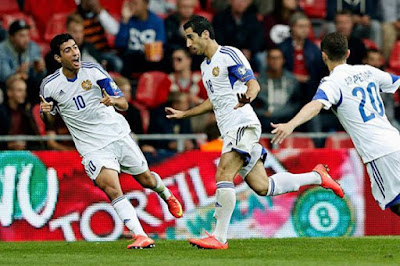
Henrikh Mkhitaryan
RW/AM: Viktor Tsyhankov (Dynamo Kyiv/Ukraine) 
Born in Nahariya, Israel, where his father Vitaliy Tsyhankov played as footballer.  In 2016, Viktor Tsyhankov made his professional debut for Dynamo Kyiv.  He was Ukrainian Premier League best player of season: 2018–19.  He was also Ukrainian Player of the Year in 2018.  For the national team, he made his debut in 2016 against Turkey in a World Cup Qualifier.

RW: Marlos (Shakhtar Donetsk/Ukraine)
Marlos began his career in Brazil with Coritiba. Then, he spent two years with Sao Paulo before moving to FC Metalist Kharkiv in Ukraine.  Since 2014, he played for  Shakhtar Donetsk.  He was the Ukrainian Premier League Player of the Year: 2016, 2017, 2018.  In 2017, he decided to play for Ukraine.  He is the second Brazilian to play for Ukraine. At the time of writing, he has 17 caps.

RW/FW: Andriy Yarmolenko (Borussia Dortmund/Ukraine) 
Yarmolenko was an ethnic Ukrainian born in St Petersburg under the Soviet Union.  He joined the Dynamo Kyiv Youth Academy at age of 13.   From 2008 to 2017, he played for their senior side. After spending a season with Borussia Dortmund, he joined West Ham in 2018.  From 2009 onward, he has played 90 times for the national team.  He was the Ukrainian Footballer of the Year: 2013, 2014, 2015, 2017, and Ukrainian Premier League Footballer of the Year : 2011 and  2014.
Andriy Yarmolenko
LW: Yevhen Konoplyanka (Ukraine/Schalke 04)
Konoplyyanka started with Dnipro Dnipropetrovsk in 2007.  He took the club to the Europa Cup Final in 2015.  From 2015 to 2017, he played for Sevilla and then, from 2017 to 2019, he played for Schalke 04.  He joined Shakhtar Donetsk in 2019.  Since 2010, he has 85 caps for Ukraine.  He was the Ukrainian Footballer of the Year: 2010, 2012, 2013 (jointly shared with Andriy Yarmolenko).  

AM:Aleksandr Golovin (CSKA Moscow/Russia)
Golovin debuted playing for  CSKA Moscow in  2014 .  In 2016, his club won the Russian Premier League.  For the national team, he helped Russia to win the UEFA under-17 Championship in 2013.  In 2015, he made his debut for the senior team.  He was a member of the 2018 World Cup team.  After the WC Finals, he joined AS Monaco.

ST: Artem Dzubya (FC Arsenal Tula/Russia) 
Dzubya began his career with Spartak Moscow, debuting in 2006.  In 2015, he moved to Zenit St.Petersburg.  He spent a loan spell with Arsenal Tula in 2018.  He was the Futbol Footballer of the Year in 2018,  RFU Footballer of the Year: 2018–19 and Sport-Express Footballer of the Year:2018-2019.  Since 2011, he has 47 caps.  After the 2018 WC Finals, he became the captain of the national team.

ST: Fyodor Smolov (Krasnodar/Russia)
From 2007 to 2015, Smolov played for Dynamo Moscow.  He played on loan with Feyenoord, o Anzhi Makhachkala, etc.  He moved to Krasnodar in 2015, where he played until 2018 when he joined Lokomotiv Moscow.  He is Russian Premier League top goalscorer: 2015–16, 2016–17 and Footballer of the Year in Russia (Sport-Express): 2015–16, 2016–17, 2017–18.  He participated in the Euro 2018 and the 2018 World Cup Finals for Russia.
Fyodor Smolov

Honorable Mention
Guilherme Marinato (Russia), Sergei Ignashevich (Russia), Valeri Qazaishvili (Georgia), Jaba Kankava (Georgia), Ilya Kutepov (Russia), Yury Gazinsky (Russia), Vasili Berezutski (Russia), Roman Neustädter (Russia), Konstantin Rausch (Russia), Odil Ahmedov (Uzbekistan), Yevhen Khacheridi (Ukraine), Artem Fedetskyi (Ukraine), Artem Kravets (Ukraine), Artem Fedetskyi (Ukraine), Yevhen Khacheridi (Ukraine), Ruslan Rotan (Ukraine), Ruslan Malinovskyi (Ukraine), Vasili Berezutski (Russia), Roman Neustädter (Russia), Konstantin Rausch (Russia), Alexandr Kokorin (Russia), Aleksandr Samedov (Russia), Roman Zobnin (Russia), Ilya Kutepov (Russia), Denis Cheryshev (Russia), Alexandru Gatcan (Moldova), Fyodor Kudryashov (Russia).

Squad Explanation
-- I also did a Yugoslavia 2018 World Cup team.  I based the team upon the Croatian team at the World Cup. I was able to reinforce "Croatia" with Jan Oblak, Edin Džeko, Aleksandar Kolarov, Nemanja Matić, Miralem Pjani, etc.  However, this "Soviet" team lacks star power and is relatively modest in terms of name recognition.  Among them, Henrikh Mkhitaryan, Igor Akinfeev, and Yuri Zhirkov are the only notable names recognized outside of their respective countries.
-- All of the former republics of USSR did poorly during the World Cup Qualifiers. Russia also did not have an impressive record leading up to the World Cup Finals.
-- I tried to base my team selection with the perspective of the situation before the World Cup Finals. 
-- In this alternate reality where the Soviet Union remains a unified country, the political disputes that had arisen among the different countries of the former Soviet Union are non-existent.  
-- The Ukrainian players dominated the last three World Cup Finals participated by the Soviet Union (1982, 1986 and 1990). This team featured 9 Ukrainians, which is 39% of the team.  However, it is still lower percentage than the last three Soviet's World Cup team.
-- Russia's representation in the team is noteworthy, as they have a  a total of 9 players.  Their percentage on this team is higher than the Soviet teams in the World Cup Finals of 1982, 1986, and 1990. In fact, the percentage of Russian players in the team is the highest it has been since the 1966 World Cup.
-- Georgia contributed 21% of all Soviet players in all World Cup Finals, but Guram Kashia is the only Georgian on this team.
-- No player from Moldova ever played for the USSR in a World Cup Finals.  I have two players from there, Artur Ionita and Alexandru Epureanu.  Also no Estonian player ever played in a World Cup Finals.  I have Ragnar Klavan.
-- Two players were born in Brazil, Mario Fernandes (Russia) and Marlo (Ukraine).
-- The real Russian World Cup team has only two players based outside of Russia.  This team consisted of 8 players playing outside the "Soviet Union".  
-- In the history of the USSR, Dynamo Kyiv sent the most players to the World Cup Finals.  They are followed by Spartak Moscow, Dynamo Moscow, Dinamo Tbilisi and Torpedo Moscow.  The five clubs consisted  81% of all Soviet players in the World Cup Finals.  On this team, however, only one player (Viktor Tsyhankov of Dynamo Kyiv) played for any of those 5 teams.
-- Throughout the history of the USSR, CSKA Moscow has produced a total of 13 players who represented the national team. This places them as the sixth club with the highest number of players contributing to the national squad. In the current team, I have included four players from CSKA Moscow. On the other hand, Zenit Petersburg only had three players who had the opportunity to participate in the World Cup while representing the USSR. However, in the present team, I have included three players from them. It is interesting to note that Shakhtar Donetsk did not have any players who had the chance to represent the USSR in the World Cup. However, in the current team, I have included four players from Shakhtar Donetsk.
Goalkeepers
-- Igor Akinfeev and Andriy Pyatov were the obvious choices for goalkeepers.
--  Both Russian centre-back Viktor Vasin and Georgi Dzhikiya were injured and missed the World Cup Finals.  Sergei Ignashevich came out of retirement to replace them on May, 2018.  He turned out to be a key player for Russia at the World Cup Finals.  But if the team was still the Soviet Union, he would not come out of retirement because the team have plenty of alternatives. I took Alexandru Epureanu (Moldova) who was playing well in Turkey and Guram Kashia (Georgia) who was the captain of Dutch Eredivisie club Vitesse that season.  Ragnar Klavan (Estonia) is the most famous defender of the Soviet Union because he played for Liverpool.
-- Guram Kashia won the UEFA #EqualGame award in 2018. Whilst playing for Vitesse that year, he wore a rainbow armband, in support of LGBT rights, leading to a backlash in his own country.  He was awarded for his political stand.
-- CB Yaroslav Rakitskiy transferred to Zenit Saint Petersburg in 2019.  It was controversial move because of the "War in Donbass".  However, the World Cup Finals took place in 2018 before his transfer.  Furthermore, in this alternative world, the war did not happen.
-- The other Russian starting center back at the World Cup Finals was Ilya Kutepov, but his club career was not remarkable the season before. Vasili Berezutski (Russia), Roman Neustädter (Russia) and Konstantin Rausch (Russia) did not go to the WC Finals. I took them out of consideration.
-- Left wingback Oleksandr Zinchenko did not play much for Manchester City that season, but he is one of the more famous Soviet players.  I also took veteran Yuri Zhirkov who is one of the more experienced and famous players.  I left out Fyodor Kudryashov who was not as well-known outside Russia.
-- Taras Stepanenko had an on field incident with Andriy Yarmolenko during the Shakhtar-Dynamo derby in April 2016.  The pair played together at Euro 2016.  Their rivalry won't be an issue.
-- Henrikh Mkhitaryan transfered to Arsenal from Manchester United in January, 2018.  He had been inconsistent with both Arsenal and Manchester United, but I would still take him since he is probably "Soviet Union's" best player.
-- The 2017-2018 season would be Andriy Yarmolenko's first and only season with Borussia Dortmund.  He only had 3 goals and 2 assists in 18 Bundesliga appearances, but he was one of Soviet Union's best players.
-- I seriously considered Odil Ahmedov (Uzbekistan) who played in the Chinese Super League.  
-- Alan Dzagoev became one of Europe's young stars after Euro 2012.  By 2018, however, his career was derailed by injuries, but I hoped that he might finally live up expectation.  This would have been my prospective at the time of selection. * In the real Finals, he was injured on the first game.
-- Marlos was voted the best player in the Ukrainian league.
-- Roman Zobnin played every minute of World Cup Finals, but I have no spot for him. I also dropped Aleksandr Samedov who was a starter at WC Finals.
-- Denis Cheryshev did not play for the Russian national team between 2015 and 2018.  He barely made the Russian team at the World Cup Finals.  He won't get into this team because of Yevhen Konoplyanka and Oleksandr Zinchenko.  
-- I already have two right-side attackers in Marlo and Andriy Yarmolenko, but I still took Viktor Tsyhankov.  In 2018, Viktor Tsyhankov was only 20 years old.  He only played a handful of games for Ukraine, but he emerged as a new star in the Ukrainian league that season.   I also took two other youngsters from Ukraine, Viktor Kovalenko and Oleksandr Zinchenko.  The trio are considered to be the future of the "Soviet Union".
-- In 2018, Ruslan Malinovskyi was featuring regularly for Ukraine, but I prefer Henrikh Mkhitaryan, Aleksandr Golovin and Alan Dzagoev.  I did not want to drop Viktor Tsyhankov for him.  At the summer of 2018, I would consider Tsyhankov's potential.  Of course, Ruslan Malinovskyi's career also improved after 2018, but I would not know that in June, 2018.  So I took Tsyhankov over him.
-- I only selected two strikers.  I studied Artem Kravets (Ukraine), but he seldom used by the Ukrainian national team that year.  So I only took Artem Dzubya (Russia)  and Fyodor Smolov (Russia).  Dzubya was the Futbol Footballer of the Year in 2018.   Smolov was the Footballer of the Year in Russia (Sport-Express) in the 2017–18 season.

Formation
Andriy Yarmolenko is one of the stars of the team, but I field Marlo instead.  He would have a role in this World Cup.  I do not have preference for either Igor Akinfeev or Andriy Pyatov.  Yaroslav Rakitskiy should also start over Guram Kashia.  I start Yuri Zhirkov now, but Oleksandr Zinchenko deserves the starting position as much.  He is probably the better player at the time of the WC Finals.


Thursday, October 1, 2020

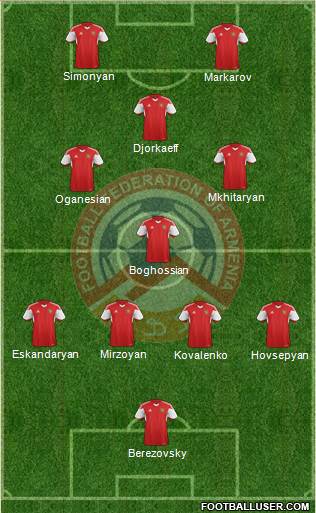
Armenia or Armenian diaspora Greatest All-Time Team

This blogger Artur Yanturin copied my blog team.  His entry was written in October 21, 2020, but mine was uploaded in a few weeks before his 2020. He also copied many many of my blog entries.  My blog entires were uploaded around 2014 and his were 2020.  I also updated mine periodically.  I made many mistakes. He kept my mistakes.  He seemed to be someone from the formerly Soviet Union.  He should know the topic much more than I do, but he still made my mistakes.  His Spartak Moscow All-Time team entry of was published in October 2020, but mine was uploaded in 2017.  His entry of the Dutch-German rivalry between Real Madrid and Barcelona was written in 2020, but mine was uploaded in 2014.  He also copied many many of my blog entries.

His Facebook and Instagram

Этот блогер Артур Янтурин скопировал команду моего блога. Его запись была написана 21 октября 2020 года, но моя была загружена за несколько недель до его 2020 года. Он также скопировал многие из моих записей в блоге. Весь мой блог был загружен примерно в 2014 году, а его — в 2020-м. Я также периодически обновлял свой. Я сделал много ошибок. Он сохранил мои ошибки. Он казался кем-то из бывшего Советского Союза. Он должен знать тему гораздо больше, чем я, но он все равно делал мои ошибки. Его запись о московском «Спартаке» за все время была опубликована в октябре 2020 года, но моя была загружена в 2017 году. Его запись о голландско-германском соперничестве между «Реалом» и «Барселоной» была написана в 2020 году, а моя была загружена в 2014 году. Он также скопировал многие из моих записей в блоге.


* Due to the conflict between Armenia and Azerbaijan, the issue of ethnicity is very sensitive.  I am also including Armenians born outside of Armenia including Azerbaijan.  If I made a mistake in ethnicity, I apologize in advance.

Armenia became an independent state in 1991, the Armenian SSR having previously played for the Soviet Union national football team. The Football Federation of Armenia was founded on 18 January 1992 and established relations with FIFA in 1992 and with UEFA in 1993.

The first professional club in Armenia was established in 1935 as Spartak and was later renamed Ararat. FC Ararat Yerevan is notable for its wins in the Soviet Championship and the Cup in 1973. FC Ararat also reached the quarter-finals of the 1974–75 European Cup, losing to the eventual champions, Franz Beckenbauer's FC Bayern Munich. The first stadium in Armenia was named Spartak as well, built in the late 1920s in front of what is now the Yerevan Circus.  A number of Armenian players played for the USSR national team, including Khoren Oganesian at the 1982 FIFA World Cup and Eduard Markarov in the 1960s.
 
If there were an All-Time World Cup, this would be the 23 players I would bring to the tournament.  The team is not an All-Star team. I tried to be as realistic as possible.   A few of the players are selected for tactical reasons at the expense of more famous players.

Team
GK: Roman Berezovsky (Armenia) 
Roman Berezovsky began his professional career in 1991 with Koshkagorts in the Soviet Top League. He later played in the Armenian Premier League. In 1994, he moved to Zenit St. Petersburg, where he stayed until 2000.  He also played for Khimki and Torpedo Moscow, among other clubs.  He played 94 times for Armenia, the record of second most capped player of the national team.
Roman Berezovsky
GK: Alyosha Abramyan (Soviet Union)
In 1966-1978, Alyosha Abramyan played for FC Ararat Yerevan in the highest group of the USSR championship, He played 276 games for them.  In 1973 he became the USSR champion.  Then, he also won the Soviet Cup in 1973 and 1975.  In 2013, he won the Medal of Merit for Services to the Motherland (Armenia).

GK: Sergey Zatikyan (Armenia)
Sergey Zatikyan was considered as the best goalkeeper of Armenia in the twentieth century.  Zatikyan in 1947 defended the colors of Yerevan "Dynamo", then the team became "Spartak". The club was later renamed "Ararat".  He played for the team until 1963. In the USSR championship, Zatikyan played 59 games. 

RB: Grigory Hambardzumyan (Soviet Union)
Hambardzumyan played in the "Lernagorts" (now "Gandzasar" ) club in his hometown. In 1953 he was invited to the "Spartak" club in Yerevan. He is the first football player from Armenia to be included in the list of the 33 best football players of the  season. In 1961 he was the second in that list (as a right-back).  He was invited to preliminary team of the Soviet national team for the 1962 World Cup, but he did not make the team due to an injury.

RB: Sargis Hovsepyan (Armenia) 
Hovsepyan started his career with FC Malatia when the club was still in the Soviet league.  He was a star with Pyunik Yerevan under an independent Armenia. In 1992, he became the first player to be named Armenian Footballer of the Year.  He also played for  Zenit Saint Petersburg.  From 1992 to 2012, he was capped 132 times for Armenia, a record.  He was the last member of the original Armenian national team to retire.
Sargis Hovsepyan
CB: Marcelo Djian (Ethnic Armenian from Brazil)
Marcelo is of Armenian descent.  In his club career, he played centre-back for S.C. Corinthians, Cruzeiro Esporte Clube, Clube Atlético Mineiro and Olympique Lyonnais.  Marcelo received the "Brazilian Silver Ball" in 1990 and named to Bola de Ouro Best XI in 1998.  He was one of the first Brazilian to play for Lyons.  For Brazil, he was capped once in 1989 against Peru.

CB/FB: Alexander Kovalenko  (Soviet Union)
Alexander Kovalenko was considered a legend in Armenia. From 1960 to 1975, he played for Ararat Yerevan. In the top league of the USSR championship, he played 281 games and scored 19 goals. In European competition played 4 matches.  He led his club to the league champion in 1973.

CB: Michel Der Zakarian (Armenia)
Der Zakarian moved to France with his family as a child.  He spent his entire professional career in France, with Nantes and Montpellier. He was a member of the Armenia national team, participated in five international matches since his debut in home 1998 World Cup qualifying match against Portugal.

CB: Alexander Mirzoyan (Soviet Union)
Born in Azerbaijan of an Armenian descent, Mirzoyan played for Neftchi Baku PFC, Ararat Yerevan and Spartak Moscow in his club career.  With Araray Yerevan, he won the Soviet Cup in 1975. He played twice for the USSR. He made his debut in 1979 against West Germany.

RB/LB/CB: Andranik Eskandarian (Iranian Armenian)
Andranik Eskandarian is probably the most famous Iranian player in the world during the 1970's because he played with Pele in NY Cosmos.  He was a sweeper, but played both rightback and leftback for NY Cosmos.  For the Iranian national team, he had 29 caps.  He won the Asian Cup in 1976 and went to the 1976 Olympics and the 1978 World Cup Finals.  His son played for the USA.  
Andranik Eskandaryan
LB: Norik Mesropyan (Soviet Union)
Norik Mesropyan played his entire career for Ararat Yerevan between 1964 and 1978, winning the Soviet Top League in 1973, and Soviet Cups in 1973 and 1975.  He played 87 straight league games for his club between 1970 to 1973, a record.  He also onlt received one yellow card in his entire career. He made the lists of the 33 best footballers of the USSR twice: 1971 and 1973.  In 1971, he also played 3 matches for the Soviet Olympic team.

DM: Alain Boghossian (French Armenian)
Alain Boghossian began his career with Olympique de Marseille in 1988.  Later, he played in Italy with Napoli and Sampdoria, but his best stint was with Parma, where he won the 1989 UEFA Cup.  For France, he had 26 caps.  He appeared as a substitute against Brazil in the 1998 World Cup Final.  He also was on the 2002 World Cup team. He is of Armenian descent.

LW/LM: Khoren Oganesian (Soviet Union)
Khoren Oganesian was chosen as the best player of Armenia in the 20th century by the Armenian FA.  He earned 34 caps by USSR between 1979 and 1984.  He won a bronze medal at the 1980 Olympics. In 1982, he became the first Armenian to play in the World Cup finals. His career was spent mainly with FC Ararat Yerevan, where the club played in the Soviet Top League and later, participated in the Armenian Premier League.  His domestic career lasted from 1974 and 1996.
Khoren Oganesian 
CM: Hovhannes Zanazanyan (Armenian born in Greece capped by the USSR) 
Hovhannes Zanazanyan aka Oganes Zanazanyan was born in Greece, where his father played for Apollo.  For his club career, he was known as the captain of Ararat Yerevan when they won the Soviet Top league in 1973.  He also played for Lernagots and Spartak Moscow.  He was capped 12 times for the Soviet Union Olympic team as well as 6 other senior caps.  

CM: Arkady Andreasyan (Soviet Union) 
Arkady Andreasyan was Baku, Azerbaijan SSR to an Armenian family, but his club career was all in Armenia.  His club career highlight included Ararat Yerevan won the 1973 Soviet Top League and the Soviet Cup in 1973 and 1975.   In 1975, he scored the winning goal against Bayern Munich in the European Cup.   He had 9 Olympic caps, winning the bronze medal in 1972 in addition his 12 senior caps.

AM/CM: Henrikh Mkhitaryan (Armenia)
Henrikh Mkhitaryan started with Pyunik in 2006 in Armenia before moving to play in Ukraine. Between 2013 and 2016, he starred with Borussia Dortmund.  With Manchester United, he became the first Armenian to win a major European trophy.   Then, he played briefly for Arsenal before moving to AS Roma.  At the time of writing, he had 86 caps for Armenia.  He was also voted the CIS Footballer of the Year in 2012 and 2013.
Henrikh Mkhitaryan
CM/FW: Nazar Petrosyan (Armenian born in Turkmenistan) 
Born in Turkmenistan, Nazar Petrosyan started his career with Ararat Yerevan in Armenia, where he won the Soviet Top League in 1973.  Between 1978 and 1980, he played for Moscow CSKA Moscow.  He later played for Kuban Krasnodar and FC Kotayk.  He played 3 times for the Soviet Union between 1976 and 1977.  His debut was against Argentina.

AM/CM: Youri Djorkaeff (French with an Armenian mother)
Youri Djorkaeff is the son of French international Jean Djorkaeff. He played for many clubs in Europe, including Monaco, PSG, Inter Milan, Kaiserslautern, etc.  With OSG, he won the 1996 Cup Winners' Cup. He won another UEFA Cup a year later with Inter Milan. Internationally, he was a part of the great French team that won the World Cup in 1998 and then European Championship in 2000. He is considered one of the best French offensive players in that era.
Youri Djorkaeff 
FW/RM: Arutyan Kegeyan (Soviet Union)
In 1960, Arutyan Kegeyan was the first Armenian football player to receive the title of Honored Master of Sports and for a long time remained the only Honored Master of Sports in football in Armenia. In his club career, he mainly played for Spartak Yerevan (now Ararat Yerevan), helping them to reach the 1954 USSR Cup Final.  He also played for Spartak Moscow in 1955.  He had represented the national team.

FW: Vakeriy Porkujan (Armenian born in Ukraine)
Vakeriy Porkuyan mainly played for Chernomorets Odessa in his career, but between 1966 and 1970, he played with Dynamo Kyiv.  After his first season with the club, he was chosen by the national football team to attend the 1966 World Cup.  He was the World Cup bronze boot. He also went to the 1970 World Cup Finals.  In total, he had 8 caps, scoring 4 goals (all in the 1966 World Cup Finals).
Vakeriy Porkuyan 
ST: Levon Ishtoyan  (Soviet Union)
Ishtoyan started with FC Shirak, but he played mainly for Ararat Yerevan between 1968 and 1975.  He was a part of the team that won the Soviet Top League in 1973.  He had 8 caps.  He played in UEFA Euro 1972 qualifiers, but was not selected for the final tournament squad. He also played in a 1974 FIFA World Cup qualifier against France.

ST: Eduard Markarov (Soviet Union)
Born in Azerbaijan,  Markarov made his name with Neftchi Baku, where he played between 1961 and 1970.  From 1971 to 1975, he played for Ararat Yerevan.  He was the star on the team that won the 1973 Soviet league.  He played three matches for the Soviet Union national football team and was a member of the Soviet national squad that competed at the 1966 FIFA World Cup. 

ST Nikita Simonyan (Soviet Union)
Nikita Simonyan started with  Krylya Sovetov Moscow, but he played mainly for Spartak Moscow, where he is the top scorer in the history at 160 goals where he played between 1949 and 1959, and is also the top scorer in the Soviet Top League at 133 goals.  He was the Soviet captain at the World Cup Finals in 1958 and also won the Olympic Gold Medal in 1956.  He was capped 20 times. He was awarded the Honoured Master of Sports of the USSR title in 1954.
Nikita Simonyan
Honorable Mention
Sanasar Gevorgyan (Soviet Union), Harutyun Abrahamyan (Armenia), Eduard Eranosyan (Bulgaria), Arsen Avetisyan (Armenia), Hamlet Mkhitaryan (Armenia), Sarkis Ovivyan (Soviet Union), Sergei Bondarenko (Soviet Union), Gevorg Ghazaryan (Armenia), Yura Movsisyan (Armenia), Andranik Teymourian (Iran), Éric Assadourian (Armenia),  Ara Hakobyan (Armenia), Karlen Mkrtchyan (Armenia), Artur Petrosyan (Armenia), Marcos Pizzelli (Armenia),  Karem Dokhoyan (Armenia), Robert Arzumanyan (Armenia), Vyacheslav Ambartsumyan (Soviet Union), Diego Rossi (Uruguay), Lucas Zelerayan (Argentina).

Squad Explanation
-- This team was updated in April, 2022 after I discovered Russian blogger Artur Yanturin copied and stole my blog team.  Now, it was slightly different.
-- The idea of the blog born out of Youri Djorkaeff and Alain Boghossian winning the World Cup for France in 1998.  Wouldn't it be nice to team them up with Nikita Simonyan and Henrikh Mkhitaryan? Thus, the blog team becomes Armenia or Armenian diaspora all-time team.  I am using the "one drop" rule for ethnicity.
-- Eligibility is based on ethnicity and birthplace.  The players from the post-Soviet Union are also based on the national team.  However, the "cap-tied" rule does not apply here since  this is also an Armenian diaspora team.
-- According to the statistics, about 500,000 Armenians lived in Soviet Azerbaijan prior to the outbreak of Nagorno Karabakh War in 1988.  I did my best to avoid any political issue on the team.  All ethnic Armenians from Azerbaijan are eligible, but I would not select any ethnic Azerbaijani born in Armenia.  It would be controversial to force an Azerbaijani to wear the jersey of the Armenian national team.
-- Youri Djorkaeff, Alain Boghossian, Khoren Oganesian, Eduard Markarov, Nikita Simonyan and Henrikh Mkhitaryan are automatic selections.  They are the best ever from Armenia.
-- Before the 1970's, most of the good footballers in the Soviet Union came from Russia.  After the 1970's, many Ukrainian and Georgian footballers emerged, but it was rare to see national team players from outside the three republics.  In 1958,  Nikita Simonyan (Armenia) was one of two non-Russian and non-Ukrainian on the World Cup team.  Simonyan was an Armenian born in Ukraine.  
-- Only five players selected here played for Armenian national team. Artur Petrosyan and Marcos Pizzelli made honorable mention.
-- Six ethnic Armenians participated in a World Cup Finals.  Nikita Simonyan, Eduard Margarov and Khoren Oganesian played for the Soviet Union.   Alain Boghossian was on the French team that won the World Cup in 1998.  His teammate Youri Djorkaeff has a Armenian mother. Andranik Eskandaryan and Andranik Teymourian played for Iran.  Khoren Oganesian is the only Armenia-born player to have played in the World Cup Finals.
-- I have 4 players who represented national team other than Armenia or the USSR. In addition to Eskandaryan, Boghossian and Djorkaeff, I also have Marcelo (Brazil). 
-- Sargis Amirkhanyan and Sahak Achemyan were Armenians from Turkey, who returned to Armenia in 1920's.  I do not know much about them.  They were pioneers of the game.
-- Ararat Yerevan won the Soviet Top League and the Soviet Cup tin 1973 coached by legendary former player Nikita Simonyan, one of Soviet Union's most prominent football figures.  The team is known as "Ararat-73".  I selected 9 players from that team.  They are Levon Ishtoyan, Eduard Markarov, Hovhannes Zanazanyan, Alyosha Abramyan, Alexander Kovalenko, Norik Mesropyan, Hovhannes Zanazanyan, Nazar Petrosyan and Arkady Andreasyan.  Alexander Mirzoyan joined the club in 1975 after the league championship.
Goalkeepers
-- I did not spend much time in analyzing the goalkeeper position.  I started with Roman Berezovsky who was one of the most capped players for Armenia.  Both Alyosha Abrahamyan and Sergey Zatikyan were legends in club football for Armenia during the Soviet era.  Alyosha Abrahamyan was honored because he was the goalkeeper of the 1973 Soviet league winning team.  It was a big achievement in Armenian footyball.
-- Harutyun Abrahamyan and David Yurchenko were contemporary goalkeepers, but Roman Berezovsky was ahead of them.
Defenders
-- I selected righbacks, Sargis Hovsepyan and Grigory Hambardzumyan over Sanasar Gevorgyan.  Hovesepyan is one of Armenia's cap record holders.  Sanasar Gevorgyan was from Ararat-73. He was known for his battle with Oleg Blokhin in the Soviet league, but I took Hambardzumyan who was a pioneer of Armenian footballers in the USSR over him.  He is the first football player from Armenia to be included in the list of the 33 best football players of the  season
-- Youri Djorkaeff's father Jean Djorkaeff was not Armenian.  He was born to a Kalmyk father and Polish mother.  Youri's eligibility came from his Armenian mother.  Jean was a great rightback in his time.
-- For centerback position, I took Marcelo who was named to Brazil's Bola de Ouro twice in his career.  I was selecting because of this two awards.  He is an ethnic Armenian who was capped twice by Brazil. 
-- Michel Der Zakarian who moved to France as a child was included on many all-time list I found on the internet.  He was capped 5 times by Armenia.  He had a long and steady career playing in La Ligue.  Not many Armenians had the same successes playing outside of Armenian. 
--  Karem Dokhoyan (Armenia) was also mentioned frequently, but I only put him on honorable mention.
-- Andranik Eskandarian was the most famous Iranian player before the 1990's generation, but it was largely due to the fact that he was playing with Pele in NY Cosmos.  His ethnicity is Armenian.  He is one of few Armenians who had experience playing in the World Cup.
Midfielders/Wingers
-- József Zakariás was said to be Armenian.   He played 35 times for Hungary between 1947 and 1952.  He was a member of the Mighty Magyars.  He helped Hungary become Olympic Champions in 1952,[1] Central European Champions in 1953 and defeated England twice. He then helped Hungary reach the 1954 World Cup final. During the World Cup finals. According an interview of his family I found online, he was not Armenian.  Thus, he was ineligible for this team.
-- Khoren Oganesian played in a generation when the Soviet Union was full of great midfielders. David Kipiani, Fyodor Cherenkov and Leonid Buryak played around the same time. He was the first Armenian to play in the World Cup Finals.  Both David Kipiani and Fyodor Cherenkov did not feature in the 1982 World Cup Finals.  David Kipiani was injured while Cherenkov was overlooked. The Soviet went with Leonid Buryak, Yuri Gavrilov and Khoren Oganesian.  Buryak travelled to Spain, but did not play in the World Cup Finals because of an injury.  Oganesian who was a regular since World Cup Qualifiers was one of the key midfielders.
-- Alain Boghossian turned down offers to play for the Armenia national football team, but this was also the Armenian diaspora team.  So he was eligible. He was a World Cup winner.
-- Andranik Teymourian had over 100 caps for Iran. He is notably the first Christian to captain the Iran national team. He was a defensive midfielder who could play wide.  I put him on honourable mention because I already had Alain Boghossian and Khoren Oganesian.
-- The reason of this blog came from Youri Djorkaeff.  He was an important player for France when they won the 1998 World Cup and the following European Championship.
-- Henrikh Mkhitaryan established himself at Borussia Dortmund. At the time of writing, he is making a name with Manchester United. He is probably the most accomplished Armenian footballer eligible playing club football in the Western Europe since the breakup of Soviet Union.
-- I knew nothing about Oganes Zanazanyan and Arkady Andreasyan.  Their selections was based upon the fact that they played for the Soviet national team.
Forwards
-- Eduard Markarov is probably the most famous Armenian born in Azerbaijan.  He was a hero of Ararat Yerevan that won the 1973 Soviet Top League and the Soviet Cup in 1973 and 1975.  He also went to the 1966 World Cup.
-- Nikita Simonyan is the top scorer in the history of the club Spartak Moscow at 160 goals.  He was the captain of the 1958 Soviet World Cup team.  
-- Vakeriy Porkuyan scoring 4 goals for the Soviet Union, all in the 1966 World Cup Finals).  He was the tournament's bronze boot.
-- Hamlet Mkhitaryan was probably the best player not selected.  He is the father of Henrikh Mkhitaryan.
-- Yura Movsisyan (Armenia) grew up in the United States.  Sometimes, he was listed among the greatest Armenians, but I only put him on honorable mention.
-- Sergey Bondarenko was also mentioned, but I thought that he was an Russian born in the Far East. I have question marks about him.
-- The football fans in Levon Ishtoya's hometown painted the number 8 of on the back of the most important city monument - Vladimir Ilyich Lenin.  That was how much he was loved.
-- Vyacheslav Ambartsumyan only made honorable mention.
 
Formation
The idea of the blog was actually born out of Youri Djorkaeff and Alain Boghossian winning the World Cup for France in 1998.  The two Frenchmen brought World Cup experiences to the team.  The rest of the starting lineup is a mixture of Soviet players and Armenian players.