|
| European Cup 1983 |
Please also see my All-Time World Cup Team Index and my blog on Hamburger SV of the 1980's.
Bayern Munich, Borussia Dortmund,
Borussia Mönchengladbach, Schalke 04, Werder Bremen,
Hamburger SV, Kaiserslautern, Bayer Leverkusen,
FC Koln, VfB Stuttgart, Eintracht Frankfurt, Wolfsburg.
Northern Germany
HSV's football team had the distinction of being the only team that had played continuously in the top tier of the German football league system since the founding of the club at the end of World War I. It was the only team that played in every season of the Bundesliga since its foundation in 1963, until 2018 when the team were relegated for the first time in history.They won the 1983 European Cup in an upset win over Juventus in the Final.
This is my selection of a 25 member all-time team for the club. The number 25 was chosen because it is the official squad size for the Champions' League.
HSV has won the German national championship six times, the DFB-Pokal three times and the League Cup twice. The team's most successful period was from the mid-1970s until the mid-1980s when, in addition to several domestic honours, they won the 1976–77 European Cup Winners' Cup and the 1982–83 European Cup. The outstanding players of this period were Horst Hrubesch, Manfred Kaltz, and Felix Magath, all of whom were regulars in the German National Team. To date, HSV's last major trophy was the 1986–87 DFB-Pokal.
CB: Albert Beier (Germany)
CB: Peter Nogly (Germany)
Peter Nogly earned four caps for the West Germany national football team all in 1977. He was included in the West German team for the UEFA Euro 1976, but did not play. In Germany, he played mainly for Hamburger SV between 1969 and 1980. He won the Cup Winners' Cup with them. In 1980, he moved to play in NASL, where he played for Edmonton Drillers and Tampa Bay Rowdies. Later, he played for Hertha Berlin and St Pauli after he left the NASL.
CB: Willi Schulz (Germany)
Willi Schulz was one of the best center-backs in the world during the 1960's. He played 66 times for West Germany between 1959 and 1970. He was the starting sweeper in the 1966 World Cup Finals in England. He also went to the World Cup Finals 4 years later in Mexico, but was injured. Helmut Schon preferred Beckenbauer as a midfielder while he played as a sweeper. He started with Schalke 04 in 1960. From 1965 to 1973, he played for Hamburger SV.
AM/CM: Thomas von Heesen (Germany)
Most of Thomas von Heesen's professional career was spent, as a player, with Hamburger SV, with which he won several accolades, both domestic and continental, appearing in nearly 400 official games for the club between 1980 and 1994. With them, he won the 1983 European Cup. He later played for Arminia Bielefeld, helping the club to grain promotion to Bundesliga. For Germany, he only represented them at the Under 21 level.
AM: Felix Magath (Germany)
Felix Magath was the son of an American GI and a German woman. He played for Hamburger SV between 1976 and 1986, winning the European Cup in 1983. He scored the winning goal in the Final against Juventus. He also played for 1. FC Saarbrücken. He was a part of the great West German national team of the 1980's, winning the Euro 1980. He also played in the 1982 and 1986 World Cup Finals. He had 43 caps between 1977 and 1986.
-- Rudi Kargus won the European Cup Winners' Cup with Hamburger SV in 1977, was runner-up with them in the European Cup in 1980 after winning the Bundesliga title the season before.
-- Klaus Stürmer was ranked the 17th greatest player by Bild. During his time at Hamburger SV, he formed an exceptional partnership with Uwe Seeler, contributing to one of the club's most dynamic attacking duos. Rudolf Noack was another prolific figure in HSV’s history, scoring an astonishing 233 goals in 193 competitive matches. Playing as an inside left—a role comparable to a modern-day secondary striker on the left—he was known for his intelligence and clinical finishing.
HSV's football team had the distinction of being the only team that had played continuously in the top tier of the German football league system since the founding of the club at the end of World War I. It was the only team that played in every season of the Bundesliga since its foundation in 1963, until 2018 when the team were relegated for the first time in history.They won the 1983 European Cup in an upset win over Juventus in the Final.
This is my selection of a 25 member all-time team for the club. The number 25 was chosen because it is the official squad size for the Champions' League.
HSV has won the German national championship six times, the DFB-Pokal three times and the League Cup twice. The team's most successful period was from the mid-1970s until the mid-1980s when, in addition to several domestic honours, they won the 1976–77 European Cup Winners' Cup and the 1982–83 European Cup. The outstanding players of this period were Horst Hrubesch, Manfred Kaltz, and Felix Magath, all of whom were regulars in the German National Team. To date, HSV's last major trophy was the 1986–87 DFB-Pokal.
 |
| DFB-Pokal 1987 |
Team
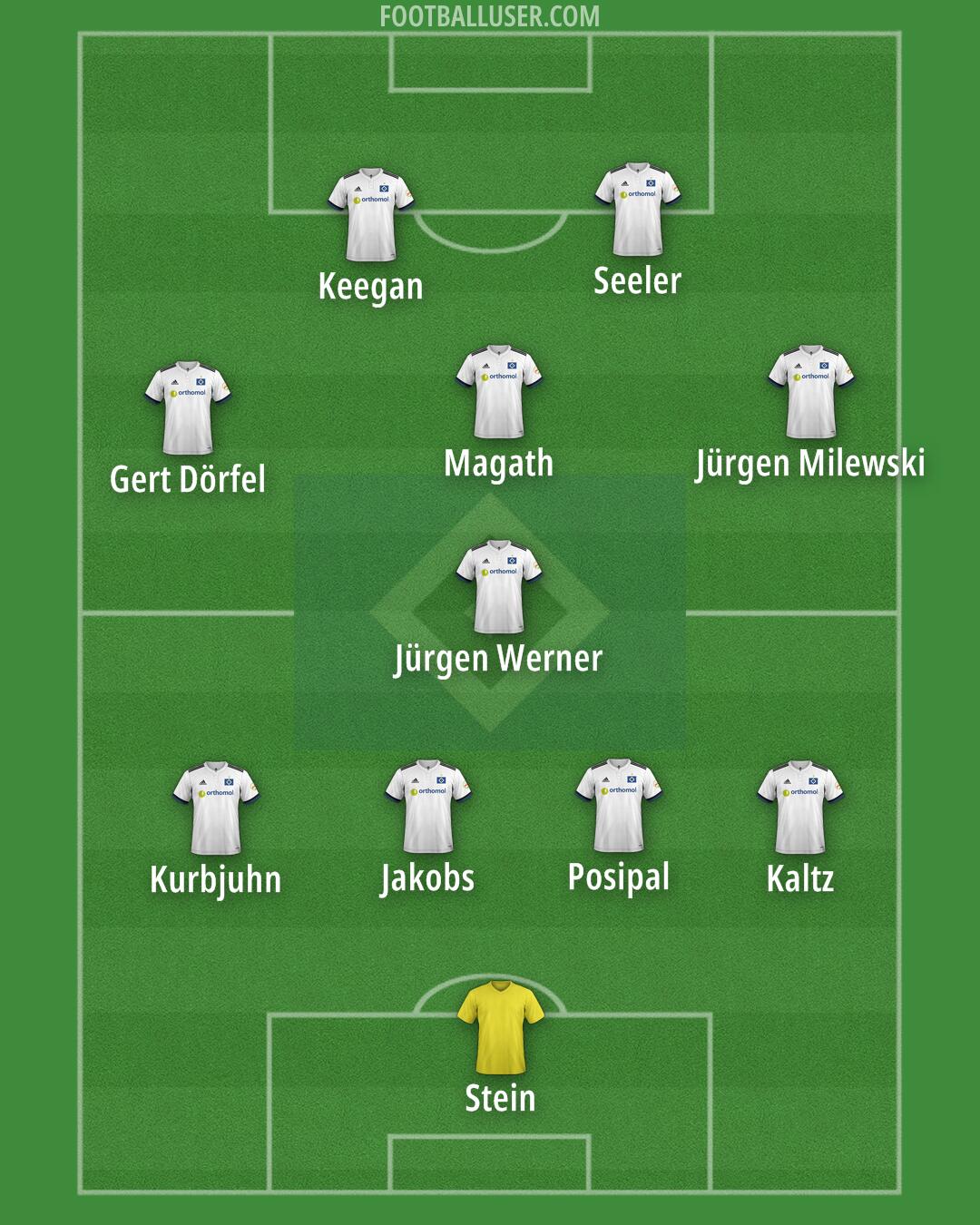
GK: Uli Stein (Germany)
Stein began his career in 1978 with Arminia Bielefeld. After two years, he moved to Hamburger SV where he played from 1980 to 1987. He also played for Eintracht Frankfurt. The highlight of his career was winning the European Cup (UEFA Champions League) in 1983, with Hamburger SV. He also went on to win the DFB-Pokal with Eintracht Frankfurt in 1988. He represented the West German national team 6 times between 1983 and 1986. He went Mexico 1986.
GK: Rudi Kargus (Germany)
Rudi Kargus played mainly with Hamburger SV. He won the European Cup Winners' Cup with Hamburger SV in 1977, was runner-up with them in the European Cup in 1980 after winning the Bundesliga title the season before. Kargus was capped 3 times for West Germany. He was Maier's backup at both 1976 European Championship and the 1978 World Cup Finals.
GK: Horst Schnoor (Germany)
GK: Uli Stein (Germany)
Stein began his career in 1978 with Arminia Bielefeld. After two years, he moved to Hamburger SV where he played from 1980 to 1987. He also played for Eintracht Frankfurt. The highlight of his career was winning the European Cup (UEFA Champions League) in 1983, with Hamburger SV. He also went on to win the DFB-Pokal with Eintracht Frankfurt in 1988. He represented the West German national team 6 times between 1983 and 1986. He went Mexico 1986.
 |
| Uli Stein |
GK: Rudi Kargus (Germany)
Rudi Kargus played mainly with Hamburger SV. He won the European Cup Winners' Cup with Hamburger SV in 1977, was runner-up with them in the European Cup in 1980 after winning the Bundesliga title the season before. Kargus was capped 3 times for West Germany. He was Maier's backup at both 1976 European Championship and the 1978 World Cup Finals.
GK: Horst Schnoor (Germany)
Horst Schnoor began his career at Langenhorner TSV in Hamburg. In 1952, he moved to Hamburger SV . For the next 15 years, he was the club's first-choice goalkeeper until 1967. He played played a total of 507 competitive matches (scoring two goals) in league, cup, and European competitions from 1952 to 1967 fro Hamburger SV. He had been selected for the national team, but never earned a full cap. He represented Germany B team in football.
RB: Manfred Kaltz (Germany)
Manfred Kaltz was one of the finest crosser of the ball in the history of the game. He was famous with his partnership with striker Horst Hrubesch at Hamburger SV. They won the European Cup in 1984. He was capped 69 times. At the international level. he was a key player for West Germany with over 60 caps (sometimes as their captain) in the 1980's and was considered one of Germany's greatest fullbacks. He won the European Championship in 1980.
CB/RB: Josef Posipal (Germany)
Josef Posipal was born to an ethnic German family in 1927 in Lugoj, Romania. He lived much of his life in West Germany. During his club career he played for SV Linden 07 and SV Arminia Hannover, He played for Hamburger SV between 1949 and 1958. He was capped 32 times between 1951 and 1956. He helped West Germany to win their first ever World Cup in 1954. He was one of the best defenders in the 1950's.
Manfred Kaltz was one of the finest crosser of the ball in the history of the game. He was famous with his partnership with striker Horst Hrubesch at Hamburger SV. They won the European Cup in 1984. He was capped 69 times. At the international level. he was a key player for West Germany with over 60 caps (sometimes as their captain) in the 1980's and was considered one of Germany's greatest fullbacks. He won the European Championship in 1980.
CB/RB: Josef Posipal (Germany)
Josef Posipal was born to an ethnic German family in 1927 in Lugoj, Romania. He lived much of his life in West Germany. During his club career he played for SV Linden 07 and SV Arminia Hannover, He played for Hamburger SV between 1949 and 1958. He was capped 32 times between 1951 and 1956. He helped West Germany to win their first ever World Cup in 1954. He was one of the best defenders in the 1950's.
 |
| Josef Posipal |
Beier started his footballing career at Eintracht Lokstedt, before moving to FC Union 1903 Altona for a year and Hamburger SV. From 1921 to 1930, he played for Hamburger SV. He was German Champion three times. He played in two federal cup finals in 1927 and 1928 and he also played in the Olympic football tournament in 1928. He played 11 times for Germany between 1924 and 1931.
CB: Ditmar Jakobs (Germany)
Jakobs played 493 games from 1971 to 1990 for Rot-Weiß Oberhausen, Tennis Borussia Berlin, MSV Duisburg and Hamburger SV. With Hamburger SV he won the 1987 DFB-Pokal. In 1982 and 1983 he became German champion and 1983 he won the UEFA Champions League. Jakobs was a member of the German national football team, which was runner-up in the 1986 FIFA World Cup in Mexico. His career was cut short by a freak accident in 1989.
Jakobs played 493 games from 1971 to 1990 for Rot-Weiß Oberhausen, Tennis Borussia Berlin, MSV Duisburg and Hamburger SV. With Hamburger SV he won the 1987 DFB-Pokal. In 1982 and 1983 he became German champion and 1983 he won the UEFA Champions League. Jakobs was a member of the German national football team, which was runner-up in the 1986 FIFA World Cup in Mexico. His career was cut short by a freak accident in 1989.
CB: Peter Nogly (Germany)
Peter Nogly earned four caps for the West Germany national football team all in 1977. He was included in the West German team for the UEFA Euro 1976, but did not play. In Germany, he played mainly for Hamburger SV between 1969 and 1980. He won the Cup Winners' Cup with them. In 1980, he moved to play in NASL, where he played for Edmonton Drillers and Tampa Bay Rowdies. Later, he played for Hertha Berlin and St Pauli after he left the NASL.
CB: Willi Schulz (Germany)
Willi Schulz was one of the best center-backs in the world during the 1960's. He played 66 times for West Germany between 1959 and 1970. He was the starting sweeper in the 1966 World Cup Finals in England. He also went to the World Cup Finals 4 years later in Mexico, but was injured. Helmut Schon preferred Beckenbauer as a midfielder while he played as a sweeper. He started with Schalke 04 in 1960. From 1965 to 1973, he played for Hamburger SV.
 |
| Willi Schulz |
LB: Jürgen Kurbjuhn (Germany)
Jürgen Kurbjuhn joined Hamburger SV in 1960 when the club had just been crowned German football champion. He was part of the 1963 German Cup winning side of the club. In 1972, he retired, because of injury after ten goals in 242 Bundesliga matches. He played 5 times for West Germany. He went to the World Cup Finals in 1962. His last match was in 1966 right before the World Cup Finals in England.
Jürgen Kurbjuhn joined Hamburger SV in 1960 when the club had just been crowned German football champion. He was part of the 1963 German Cup winning side of the club. In 1972, he retired, because of injury after ten goals in 242 Bundesliga matches. He played 5 times for West Germany. He went to the World Cup Finals in 1962. His last match was in 1966 right before the World Cup Finals in England.
LB: Bernd Wehmeyer (Germany)
At the beginning of his career, Wehmeyer switched back and forth between Arminia Bielefeld and Hannover 96 twice before joining Hamburger SV in 1978. He was part of the great Hamburg team that won three league titles and the European Cup in 1983. He also came second in the European Cup in 1980. He retired in 1986. His nickname was "Fummel." He represented the German Olympic team 13 times between 1982 and 1983.
DM: Jimmy Hartwig (Germany)
Jimmy Hartwig played for Kickers Offenbach, TSV 1860 München, Hamburger SV, 1. FC Köln and FC Homburg of the Bundesliga and for Austria Salzburg of Austria. Hartwig won the European Cup in 1983 with Hamburger SV, and was three times German league champion in 1979, 1982 und 1983. The son of an African-American soldier and a German mother, Hartwig was the second non-white player capped for Germany (after Erwin Kostedde).
DM/LW/LB: Jürgen Werner (Germany)
Werner came from the youth of Hamburger SV with Uwe Seeler. He played 8 seasons with the club winning the league in 1960. He refused to sign a professional contract in 1963 because he was against professional football, and was to become a teacher, retiring from the game of football. Werner played four games for the German team, between 1961 and 1963, and was picked for the 1962 FIFA World Cup, however, due to a training injury, did not pick up a World Cup appearance.
RW/CM/DM: Jochenfritz Meinke (Germany)
Nicknamed "Jocki", Jochenfritz Meinke began his career as a teenager at SC Sperber Hamburg . After the end of the Second World War, he moved to the youth department of Hamburger SV. He played for the Hamburger SV between 1949 and 1960. In 1960, as a veteran of the team, he led a gorup of young players to win league. He never represented Germany in the full level, but he played 5 times for the B team.
RW/SS/FW: Jürgen Milewski (Germany)
Milewski started in the Bundesliga for Hannover 96 in 1975 before moving to Hertha BSC in 1978 for a single season. In 1979, he moved to Hamburger SV. With Hamburg, he became German champion with HSV in 1982 and 1983 and won the European Cup in 1983. He played briefly with AS Saint-Étienne before retiring in 1986. Between 1981 and 1983, he played 3 times for West Germany. And he also represented Germany at other level.
LW: Gert Dörfel (Germany)
Gert Dörfel spent nine seasons in the Bundesliga with Hamburger SV between 1960 and 1972. He also played in South Africa and Canada. He represented Germany 11 times, including at the 1962 FIFA World Cup qualifiers against Northern Ireland (scoring two goals) and Greece (scoring one goal), the 1966 FIFA World Cup qualifier against Sweden, and eight friendlies. His brother Bernd also played for Germany and Hamburger SV.
Gert Dörfel spent nine seasons in the Bundesliga with Hamburger SV between 1960 and 1972. He also played in South Africa and Canada. He represented Germany 11 times, including at the 1962 FIFA World Cup qualifiers against Northern Ireland (scoring two goals) and Greece (scoring one goal), the 1966 FIFA World Cup qualifier against Sweden, and eight friendlies. His brother Bernd also played for Germany and Hamburger SV.
 |
| Gert Dörfel |
LM: Caspar Memering (Germany)
From 1971 to 1982, Memering played for Hamburger SV. He was a part of the Hamburg side that clinched the UEFA Cup Winners' Cup winner: 1976–77 and also reached the 1980 European Cup Final. He also played in Bordeaux and Schalke 04. He was capped 3 times between 1979 and 1980. He was a part of the West German team won that the European Championship in 1980.
From 1971 to 1982, Memering played for Hamburger SV. He was a part of the Hamburg side that clinched the UEFA Cup Winners' Cup winner: 1976–77 and also reached the 1980 European Cup Final. He also played in Bordeaux and Schalke 04. He was capped 3 times between 1979 and 1980. He was a part of the West German team won that the European Championship in 1980.
AM: Rafael van der Vaart (Netherlands)
Rafael Van der Vaart began his career at AFC Ajax's youth academy and worked his way into the first team. He moved to Bundesliga club Hamburger SV, then to Real Madrid, then on to Tottenham Hotspur before returning to Hamburg in 2012. He earned 109 caps for the Netherlands between 2001 and 2013. He represented the nation at three European Championships and two World Cup Finals. He was a part of the team that reached the 2010 Final.
Rafael Van der Vaart began his career at AFC Ajax's youth academy and worked his way into the first team. He moved to Bundesliga club Hamburger SV, then to Real Madrid, then on to Tottenham Hotspur before returning to Hamburg in 2012. He earned 109 caps for the Netherlands between 2001 and 2013. He represented the nation at three European Championships and two World Cup Finals. He was a part of the team that reached the 2010 Final.
AM/CM: Thomas von Heesen (Germany)
Most of Thomas von Heesen's professional career was spent, as a player, with Hamburger SV, with which he won several accolades, both domestic and continental, appearing in nearly 400 official games for the club between 1980 and 1994. With them, he won the 1983 European Cup. He later played for Arminia Bielefeld, helping the club to grain promotion to Bundesliga. For Germany, he only represented them at the Under 21 level.
AM: Felix Magath (Germany)
Felix Magath was the son of an American GI and a German woman. He played for Hamburger SV between 1976 and 1986, winning the European Cup in 1983. He scored the winning goal in the Final against Juventus. He also played for 1. FC Saarbrücken. He was a part of the great West German national team of the 1980's, winning the Euro 1980. He also played in the 1982 and 1986 World Cup Finals. He had 43 caps between 1977 and 1986.
 |
| Felix Magath |
IL/FW: Rudolf Noack (Germany)
Between 1934 and 1937, Noack played 3 times for Germany. In the 1934 World Cup Finals, he scored one goal in the tournament against Czechoslovakia in the semi-finals. For his club career, He was famous player for Hamburger SV. With a total of 193 league games, in which he scored 233 goals From 1932 to 1945, he played as a war guest player with First Vienna FC, winning two Austrian championships in 1943 and 1944.
ST: Horst Hrubesch (Germany)
Horst Hrubesch earned only 21 caps. He was a part of West German national team player pool throughout the 1980's. He scored two goals in the Euro 1980 Final against Belgium. He was known as one of the most powerful header of the ball in the game. He was known for his partnership with Manfield Kaltz who was one of the best crossers in the game. Together, they won the European Cup in 1983 with Hamburger SV. ST/SS: Kevin Keegan (England)
Kevin Keegan was the greatest English player of his generation. He was two-time European Footballer of the Year in 1978 and 1979. He won the European Cup in 1977 with Liverpool. He also found successes in the Bundesliga with Hamburger SV, where he played between 1977 and 1980. He later played for Southampton and Newcastle United. He had 63 caps for England. However, his World Cup appearance was limited to 20 minutes against Spain at the World Cup Finals in 1982.
ST: Klaus Stürmer (Germany)
Klaus Stürmer represented Germany on two occasions, including a 1962 FIFA World Cup qualifier against Northern Ireland. On his debut on 16 October 1954 against France he became the youngest player of the post-war era to score for Germany at age 19 years 68 days, a record that was equalled in 2011 by Mario Götze. He spent most of his career with Hamburger SV.
ST: Uwe Seeler (Germany)
Uwe Seeler was captain of both his club team and the national team for many years. He played in 4 World Cup Finals(1958, 1962, 1966 and 1970), but sandwiched between Germany's two World Cup winning years(1954 and 1974). West Germany came second in 1966 and reached the semifinal in 1970 while playing next to Gerd Muller. However, he is still regarded one of Die Mannschaft s greatest players. He spent his entire career with SV Hamburger and considered its greatest player.
Honorable Mention
Kevin Keegan was the greatest English player of his generation. He was two-time European Footballer of the Year in 1978 and 1979. He won the European Cup in 1977 with Liverpool. He also found successes in the Bundesliga with Hamburger SV, where he played between 1977 and 1980. He later played for Southampton and Newcastle United. He had 63 caps for England. However, his World Cup appearance was limited to 20 minutes against Spain at the World Cup Finals in 1982.
 |
| Kevin Keegan |
Klaus Stürmer represented Germany on two occasions, including a 1962 FIFA World Cup qualifier against Northern Ireland. On his debut on 16 October 1954 against France he became the youngest player of the post-war era to score for Germany at age 19 years 68 days, a record that was equalled in 2011 by Mario Götze. He spent most of his career with Hamburger SV.
Uwe Seeler was captain of both his club team and the national team for many years. He played in 4 World Cup Finals(1958, 1962, 1966 and 1970), but sandwiched between Germany's two World Cup winning years(1954 and 1974). West Germany came second in 1966 and reached the semifinal in 1970 while playing next to Gerd Muller. However, he is still regarded one of Die Mannschaft s greatest players. He spent his entire career with SV Hamburger and considered its greatest player.
 |
| Uwe Seeler |
Honorable Mention
Rene Adler (Germnay), Frank Rost (Germnay), Hans-Jörg Butt (Germany), Richard Golz (Germany), Hans Martens (Germany) Wilhelm Blunk (Germany), Walter Warning (Germnay), Jerome Boateng (Germany), Dietmar Beiersdorfer (Germany), Ivan Buljan (Croatia), ,Heiko Westermann (Germany), Walter Risse (Germany), Holger Hieronymus (Germany), Vincent Kompany (Belgium), Franz Beckenbauer (Germany), Joris Mathijsen (Netherlands), Fritz Laban (Germany), Franz-Josef Hönig (Germany), Marcell Jansen (Germany), Asbjørn Halvorsen (Norway), Hans Lang (Germany), David Jarolím (Czech Republic), Wolfgang Rolff (Germany), Nigel de Jong (Netherlands, Ze Roberto (Brazil), Horst Blankenburg (Germany), Mehdi Mahdavikia (Iran), Sergei Barbarez (Bosnia and Herzegovina),Son Heung-Min (South Korea), Georg Volkert (Germany), Yordan Letchkov (Bulgaria), Thomas Doll (Germany), Heinz Spundflasche (Germany), Ole Björnmose (Denmark), Harald Spörl (Germany), Piotr Trochowski (Germany), Georg Volkert (Germany), Sergej Barbarez (Germany) Son Heung-Min (South Korea), Otto Harder (Germany), Ruud van Nistelrooy (Netherlands), Tony Yeboah (Ghana), Lars Bastrup (Denmark), Ivica Olic (Croatia), Uwe Bein (Germany), Karsten Bäron (Germany), Rudolf Noak (Germany), Bernd Dörfel (Germany).
Squad Explanation
-- The original team was created in 2016. I did a massive review in July 2025. I made many changes to the team.
-- The original team was created in 2016. I did a massive review in July 2025. I made many changes to the team.
-- Willi Schulz and Uwe Seeler were among the best ever German footballers of their generations. Both players played in the generation between West Germany's World Cup victories in1954 and 1974. Seeler played in the World Cup Finals of 1958, 1962, 1966 and 1970. Seeler is on top of many World Cup records and/or milestone. For example, he was the first player ever to appear in 20 World Cup matches (he retired with 21 matches played, tied for third all-time); the first ever to score in four World Cups (beating Pelé by only a few minutes).
-- Hamburger SV's greatest eras were the late 1970's and early 1980's. They first won the Cup Winners Cup in 1977. Then, they reached the Final of the 1980 European Cup Final, before winning it in 1983 by beating Juventus in the Final. Rudi Kargus, Uli Stern, Manfred Kaltz, Kevin Keegan, Felix Magath, Horst Hrubesch, Jürgen Milewski, Ditmar Jakobs, Peter Nogly, Jimmy Hartwig, Casper Memering, and Thomas Von Hessen played in that period. In the 1983 European Cup Final, they overcame a Juventus side that included Dino Zoff, Claudio Gentile, Gaetano Scirea, Antonio Cabrini, Paulo Rossi and Marco Tardelli who won the World Cup the year before. Michele Platini and Zbigniew Boniek were also big stars at the 1982 World Cup Finals. Felix Magath stunned the Italian club with an early goal. Uli Stern, Manfred Kaltz, Felix Magath, Thomas von Heesen, Horst Hrubesch, Bernd Wehmeyer and Ditmar Jakobs were also on the winning team. Notably, both Manfred Kaltz and Felix Magath were ever-present across all three of these major European finals: the 1977 Cup Winners' Cup Final, the 1980 European Cup Final, and the victorious 1983 European Cup Final.
 |
| Manfred Kaltz |
-- In 2022, Bild created the 50 Greatest Footballers for Hamburger SV. The Top 25 ranking was: 1) Uwe Seeler, 2) Felix Magath, 3) Kevin Keegan, 4) Horst Hrubesch, 5) Manfred Kathz, 6) Gert Dörfel, 7) Thomas von Heesen, 8) Josef “Jupp” Posipal, 9) Uli Stein, 10) Ditmar Jakobs, 11) Sergei Barbarez, 12) Horst Schnoor, 13) Peter Nogly, 14) Rafael van der Vaart, 15) Holger Hieronymus, 16) Jochenfritz Meinke, 18) Thomas Doll, 19) Jürgen Milewski, 20) Caspar Memering, 21) Bernd Wehmeyer, 22) Ole Björnmose, 23) Harald Spörl 24) Rudi Kargus and 25) George Volkert.
-- In 2019, Bundesliga came up with Hamburger SV All-Time best XI. The lineup was: Uli Stein, Manfred Kaltz, Ditmar Jakobs, Jerome Boateng, Son Heung-Min, Felix Magath, Sergei Barbarez, Rafael van der Vaart, Uwe Seeler, Kevin Keegan and Horst Hrubesch.
-- I also used HSV1887.de and HSV-history for reference. Both sides have a Hall of Flame.
-- In 2012, Hamburger SV celebrated its 125th anniversary for selecting an All-Time team. However, I could find the Best XI, but a list of 16 players (starting 11, plus the subs). They were Uli Stein, Charly Dörfel, Peter Nogly, Jupp Posipal, Karsten Bäron, Rafael van der Vaart, Willi Schulz, Horst Hrubesch, Uwe Seeler, Thomas von Heesen, Manfred Kaltz, Mehdi Mahdavikia, Thomas Doll, Felix Magath, Kevin Keegan and Ditmar Jakobs.
-- The German newspaper Die Welt made a list of great players from HSV. They were Manfred Kaltz, Uwe Seeler, Kevin Keegan, Uli Stein, Felix Magath, Uwe Bein, Horst Hrubesch, Dietmar Beiersdorfer, Jimmy Hartwig, Karsten Bäron, Thomas Doll, Thomas von Heese, Rafael van der Vaart and Ivica Olic.
-- In 2024, the Sport Nord came up with Hamburger SV All-Time Best XI. The starting lineup were: Uli Stein, Manfred Kaltz, Ditmar Jakobs, Daniel van Buyten, Jupp Posipal, Zé Roberto, Rafael van der Vaart, Kevin Keegan, Felix Magath, Horst Hrubesch and Uwe Seeler. The four bench players were Horst Schnoor, Peter Nogly, Thomas von Heesen and Gert Dörfel.
Goalkeepers
-- Uli Stein was Hamburger SV's greatest goalkeeper. He was a key player in their glorious period in the 1980's.
-- Horst Schnoor played a total of 507 ( a club record for goalkeeper) competitive matches for HSV, winning the German championship in 1960 and the DFB Cup three years later. He was ranked the 12th greatest footballer for the club by the Bild.
 |
| Horst Schnoor |
-- Frank Rost was ranked 28th greatest footballer for the club by the Bild, but I went with Kargus and Schnooer.
-- Rene Adler briefly assumed the role of the starting goalkeeper in 2010 after the death of Robert Enke but missed the World Cup Finals due to an injury, allowing Manuel Neuer to step in and shine in South Africa, ultimately becoming one of Germany's greatets ever goalkeeper. Adler lost his place with the national team before he joined Hamburger because of that injury. However, he recalled back to the national team after joining the club in 2012, but he never got back to the national team pool despite having great performance in Hamburg.
-- Hans-Jörg Butt finished as Hamburger's top scorer in the 1999-2000 season as a penalty taking goalkeeper. He made honorable mention.
-- Hans Martens was a legendary goalkeeper during the 1920's when HSV was the best club in Germany. He was followed by Wilhelm Blunk who was considered one of the best goalkeepers in the German Reich, but he made one national team appearance in 1929. Walter Warning was the starting goalkeeper in the 1930's.
Defenders
-- Franz Beckenbauer played for them between 1980 and 1982. It was the greatest period of the club. The team won the league in 1981-1982 season, but he left before Hamburger SV won the European Cup the season after. His leadership was credited with the club's successes during that era. However, I only put him on honorable mention. Instead, I selected Willi Schulz who actually played as a sweeper for West Germany in the 1966 World Cup Finals while Beckenbauer played as a central midfielder. Schulz spent 8 seasons here, and widely considered one of the best defenders in the 1960's. However, most sources claimed Josip Posipal, Ditmar Jakobs and Peter Nogly as HSV's greatest central defenders. I took all three of them alongside Schulz, but Posipal was put on the rigthback section..
 |
| Ditmar Jakobs |
-- In 2016, Jerome Boateng edged out Holger Hieronymus, Ivan Buljan, Khalid Boulahrouz and Daniel van Buyten for the final spot. During the review of the team in 2025, I studied Albert "Ali" Beier. He formed the best defense in the history of Hamburger SV with Walter Risse in the 1920's. With 25 titles, he is also one of the most successful players. Boateng was voted into Bundesliga's All-Time team for HSV. I do not doubt his importance to German football, but for HSV, he was only here for 3 seasons. He left the club in his early 20s. So, I decided to replace him with Beier in 2025.
-- Manfred Kaltz was known as one of the best crossers of the ball in history. He was known for his early cross. The same style of crosses were later made famous by David Beckham. His teammate Horst Hrubesch's nickname was Das Kopfball-Ungeheuer (the Header Beast) for his heading skills as a centre-forward. The combination of one of the finest crossers and a greatest header of the ball became one of the greatest partnerships in the history of the game. The second rightback I selected would be Josip Posipal who was of a Hungarian descent. The Hungarian spelling of the name Poszipal can be found in the register of the Roman Catholic Church of Lugosch. He understood Hungarian and said to be an advisor to German coach Sepp Herberger before and during the 1954 World Cup Finals on the Mighty Magyars. Ferenc Puskas said to have talked to Posipal during the first World Cup game between Germany and Hungary about defender Werner Liebrich who was guarding and later injured Puskas. In 1952, he moved from the right half back position to that of center half. He was more of a central defender. Basically, my team is carrying 5 central defenders. I have no space for Fritz Laband who was also a 1950 World Cup winner. In the World Cup Finals, Posipal played the semifinal and final as a rightback ahead his club teammate Laband.
-- Many all-time best XI squads I found online excluded the left-back position, which highlights a historical weakness in that area for the club. I selected Jürgen Kurbjuhn, who was listed in both unofficial "Hall of Fame" lists mentioned earlier. The next best choice would be Bernd Wehmeyer, who is very well-known for being part of the great HSV team of the 1980s. For honorable mention, I included Marcell Jansen. In 2019, Jansen was voted president of the club. Remarkably, after retiring from professional football, he continued to play for Hamburg SV II and III, showing his deep personal connection and ongoing commitment to the club. That says a lot about his status and legacy within HSV.
 |
| Jürgen Kurbjuhn |
Midfielders/Wingers
-- Jimmy Hartwig was of the second Black players ever capped by Germany. He was an important player on the 1983 team. Jochenfritz Meinke was ranked 16th byu Bild as HSV's greatest players. He started as a right winger, but later moved to the center of the midfielder. So, I also took him as a winger. In the 1950's and 1960's's, he was the veteran player who led a team of "boys" on the Hamburger SV team that included Uwe Seeler. Jürgen Werner appeared in the two unofficial Hall of Fame lists I found online. According to Transfermarkt.com, he was listed as a left-back. However, I always believed he played as a left wing-half. Footage I found on YouTube shows him operating more as a defensive midfielder, while some sources suggest that he transitioned from a more attack-minded role to a defensive one later in his career.
-- Asbjørn Halvorsen was among the first foreign players to represent Hamburger SV. During World War II, he was imprisoned in a concentration camp—tragically, one where his former teammate and friend, Otto Harder, served as a camp commander. Halvorsen’s legacy carries significant historical and moral weight, but does his achievements on the pitch earn him a place in this All-Time team? I was not sure. I was also not sure about Hans Lang of the 1920's. Both of them made honorable mention while I also looked into David Jarolím, Wolfgang Rolff and Nigel de Jong.
-- Felix Magath won three Bundesliga titles in Hamburg. He scored the only goal in the 1983 European Cup Final against Juventus. Thomas von Heesen was a young player in the Final. He would go on to spend 14 seasons with HSV. He scored 99 goals, one short of becoming the second Hamburger player to reach 100 goals after Uwe Seeler. Magath and von Heesen were probably the club's two greatest attack midfielder. Hamburger SV enjoyed a relatively successful eras when Rafael van der Vaart was playing there. He played with Nigel De Jong, Jerome Boateng and Son Heung-Min. He would be backing up Magath and von Heesen.
 |
| Rafael van der Vaart |
-- Thomas Doll played one successful season in Hamburg before being bought by Lazio for a record transfer fee. He would return for a second stint in 1998, but he was a shadow of himself. I decided not to take him because I already had the three playmakers from above. Heinz Spundflasche from the 1960's also did not make the team. I also thought of Ole Björnmose (Denmark), Harald Spörl (Germany), Piotr Trochowski
-- Jürgen Milewski was ranked by the Bild 17th greatest footballer for the club. He was a part of the great team in the 1980's. This team also included Jochenfritz Meinke who played as a righ winger until 1957 or 1958 before switching to the midfield. Mehdi Mahdavikia was awarded Hamburg Player of the Year in 2003 and 2004 by the fans, and also attained the title of the top assister of goals in the Bundesliga. But I only put him on honorable mention.
-- Georg Volkert was close enough to make the team. Sergej Barbarez was mainly a second striker, but could operate as an attacking midfielder or left winger. He was Bundesliga top goalscorer for the:2000–01 season. Son Heung-Min was the youngest goal-scorer for the club, but his peak career was not with HSV. Hamburger SV has too many left-sided wingers/midfielders. Instead of them, I selected Gert "Charly" Dörfel and Casper Memering. Dorfel was one of Hamburg SV's greatest footballers. He scored 114 times in 347 appearances from 1958 to 1972. The Bild ranked Caspar Memering as the 20th greatest footballer for this club.
Forwards
-- Uwe Seeler, Kevin Keegan, and Horst Hrubesch ranked among Hamburger SV's greatest players—automatic selections in any all-time XI.
-- Uwe Seeler is arguably Hamburger SV's greatest-ever player. Except for a brief publicity stint with Cork Celtic, he spent his entire career at HSV. A three-time German Footballer of the Year (1960, 1964, 1970), his loyalty and brilliance made him a club legend.
-- Kevin Keegan brought global stardom to HSV, winning the Ballon d'Or twice (1978, 1979). His high-profile transfer to Germany in the 1970s was a major milestone, and he led the club to the 1980 European Cup Final.
-- Horst Hrubesch, nicknamed "Das Kopfball-Ungeheuer" (The Header Beast), formed a legendary partnership with Manfred Kaltz. Kaltz's pinpoint crosses met Hrubesch's aerial dominance, creating one of football's most iconic duos.
 |
| Horst Hrubesch |
-- In compiling my list in 2016, I made a conscious decision not to include Otto Harder. Despite his impressive footballing achievements, his legacy is deeply overshadowed by his post-playing involvement as an SS officer and his conviction for war crimes after the Second World War. These actions inevitably cast a dark shadow over his contributions to the sport. Moreover, he was bypassed for Hamburger SV 125th Anniversary team. He only ranked 40th greatest Hamburger SV player by the Bild.
-- I also could not find a spot for Walter Warning.
Formation