|
| 2013 Copa Libertadores |

Some of the unpublished posts from this blog have been turned into a two-volume book: The Multiverse of the Beautiful Game: National Teams of Pure Fantasy.
Volume 1 Picture football's wildest dreams actually coming true. Could Brazil's already-beautiful 1982 side, with Careca leading the line, have cruised to the title? Could Sweden with "Gre-No-Li" have somehow stopped the Maracanazo in 1950? Imagine Pelé, Garrincha, Didi, Zizinho and Julinho all starring for Brazil at once in 1958. And what about the United Kingdom sending its team to the 1970 World Cup? I believe they would have been the strongest side on earth — Gordon Banks, Bobby Moore, Jack Charlton, George Best, Denis Law, Jinky Johnstone and Billy Bremner could have beaten Brazil. What if Argentina had fielded both Omar Sivori and Alfredo Di Stéfano together in 1958? What if Johan Cruyff had lined up alongside Marco van Basten, Ruud Gullit, and Frank Rijkaard? Then there is Eusébio playing for Brazil — he and Pelé on the same team. And that's only scratching the surface — Volume 1 is packed with legendary "what ifs" that will keep you turning pages.
Volume 2 brings the fantasy closer to home. What if England had Michael Olise, Erling Haaland, Antoine Semenyo and Jamal Musiala in 2026 — could they go all the way with Harry Kane and Jude Bellingham? What if Yugoslavia had gone to the World Cup in 2018? Could Spain have won the 2010 World Cup without Catalan players? Could Catalonia do it alone? And could they have won Euro 2024 with only Basque players What if the United States could select more players in 2010? It would be the greatest American side ever. And what if Cristiano Ronaldo and Lionel Messi had actually played for the same national team in 2006? It could have happened — if the soccer gods had smiled on us.
Please also see my All-Time World Cup Team Index.
Some of the unpublished posts from this blog have been turned into a two-volume book: The Multiverse of the Beautiful Game: National Teams of Pure Fantasy.
Volume 1 Picture football's wildest dreams actually coming true. Could Brazil's already-beautiful 1982 side, with Careca leading the line, have cruised to the title? Could Sweden with "Gre-No-Li" have somehow stopped the Maracanazo in 1950? Imagine Pelé, Garrincha, Didi, Zizinho and Julinho all starring for Brazil at once in 1958. And what about the United Kingdom sending its team to the 1970 World Cup? I believe they would have been the strongest side on earth — Gordon Banks, Bobby Moore, Jack Charlton, George Best, Denis Law, Jinky Johnstone and Billy Bremner could have beaten Brazil. What if Argentina had fielded both Omar Sivori and Alfredo Di Stéfano together in 1958? What if Johan Cruyff had lined up alongside Marco van Basten, Ruud Gullit, and Frank Rijkaard? Then there is Eusébio playing for Brazil — he and Pelé on the same team. And that's only scratching the surface — Volume 1 is packed with legendary "what ifs" that will keep you turning pages.
Volume 2 brings the fantasy closer to home. What if England had Michael Olise, Erling Haaland, Antoine Semenyo and Jamal Musiala in 2026 — could they go all the way with Harry Kane and Jude Bellingham? What if Yugoslavia had gone to the World Cup in 2018? Could Spain have won the 2010 World Cup without Catalan players? Could Catalonia do it alone? And could they have won Euro 2024 with only Basque players What if the United States could select more players in 2010? It would be the greatest American side ever. And what if Cristiano Ronaldo and Lionel Messi had actually played for the same national team in 2006? It could have happened — if the soccer gods had smiled on us.
Santos, Flamengo, Sao Paulo, Corithians, Botafogo
Vasco Da Gama, Palmeiras, Internacional
Fluminense, Gremio, Cruzeiro, Atlético Mineiro, Bahia.
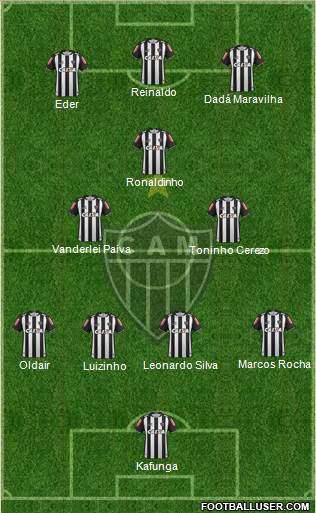
This is my selection of a 25 member all-time team for the club. The number 25 was chosen because it is the official squad size for the Champions' League.
Atlético Mineiro is the oldest active football club in Minas Gerais, founded on 25 March 1908 by twenty-two students from Belo Horizonte. Atlético has won the Campeonato Mineiro a record 43 times. At national level, the club has won the Campeonato Brasileiro once and has finished second on five occasions. Atlético has also won one Copa do Brasil, one Copa dos Campeões Estaduais and the Copa dos Campeões Brasileiros. In international club football, Atlético has won the Copa Libertadores and the Recopa Sudamericana once each, and a record two Copa CONMEBOL; the team has also reached three other continental finals. The club has also competed in other sports throughout its history, with the futsal department becoming especially notable.
 |
| "Trio Maldito" |
GK: Kafunga (Brazil)
Kafunga began playing football with local side Fluminense Atlético Clube (Niterói). He started his professional career with Atlético Mineiro, and made his debut in a friendly defeat 2–0 by Villa Nova in 1935. He helped his club win the Campeonato Mineiro in 1936, 1938, 1939, 1941, 1942, 1946, 1947, 1949, 1950, 1952, 1953, 1954 and in 1955. He retired in 1955, after having played 667 games for the club in two decades. After his retirement, he worked as a football commentator and as a deputy.
 |
| Kafunga |
João Leite spent 17 years with Clube Atlético Mineiro, for which he holds the record for most appearances and most trophies won. He won twelve Campeonato Mineiro and one Copa CONMEBOL. He also played for Vitória de Guimarães, Guarani and América. He was selected for Brazil at the 1980 Mundialito and the 1979 Copa América. He played 5 official games with the Seleção between 1980 and 1981.
GK: Victor (Brazil)
At the time of writing, Victor is still an active player with Atletico Mineiro. He played for Gremio and Paulista before moving there. He was a hero during the club's victory at the Copa Libertadores in 2013. He made a critical penalty save in the quarterfinal that saved the club from elimination. In both semifinal and the final, he made saves during the penalty shootouts.
RB: Mexicano (Brazil)
Alfredo Lúcio de Moura, known better as Mexicano, was an all-time great with Atletico Mineiro. He played for them from 1946 to 1948. The 1948 team was considered one of the club's greatest ever team. He later would play for Palmeiras from 1949 to 1954. He retired at the age of 28 because of an injury.
RB: Marcos Rocha (Brazil)
Marcos Rocha started his career with loans to Ponte Preta and América Mineiro. He returned to Atlético Mineiro in 2011. He was immediately elected as first-choice, and was among the squad which won the state league twice, the Copa Libertadores in 2013, and the Recopa Sudamericana and Copa do Brasil in 2014. At the time of writing, he earned 3 caps.
CB: Luizinho (Brazil)
Luizinho had 34 caps between 1980 and 1983. He was Brazil's starting centerback at the World Cup Finals in 1982, where he also made the team of the tournament. At the domestic club level, he played for several clubs, but mainly with Atlético Mineiro from 1978 to 1989, winning 8 State Championships of Minas Gerais. He also played three seasons overseas for Sporting CP in Portugal. He won the Bola de Prata award twice in 1980 and 1987.
 |
| Luizinho |
Murilo played for Atletico Mineiro between 1944 and 1956. In his first stint, he stayed until the year 1950. He then played with Corinthians until 1954. He returned to the club in 1955. He won the "Belfort Duarte" award, an award given to the most disciplined players of football at the time. He never received any expulsion in the 550 games he played with Atletico and Corinthians. He won the Copa Libertadores. He was selected as an unused sub for Brazil once.
CB: Rever (Brazil)
Rever started his career with Paulista in Serie B, winning g the Copa Brazil in 2005 while the club was in Serie B. After Paulista went down to Serie C, he was sold to Greimo, where he became a star and earned a move to Germany in 2010 with Wolfsburg. A year later, he returned home and played with Atletico Mineiro. He won the Copa Libertadores as their captain in 2013. He was capped 9 times.
CB: Leonardo Silva (Brazil)
Before 2011, Leonardo Silva played for a number of Brazilian club and Al-Wahda in UAE. In 2011, he moved to Atletico Miniero, where he had his career break. He formed a great partnership with Rever. They were known as "Twin Towers" due their heights. They won Copa Libertadores in 2013. He scored the winning penalty in the Final. In 2012, Silva was called by Mano Menezes to play Superclásico de las Américas for Brazil, against Argentina.
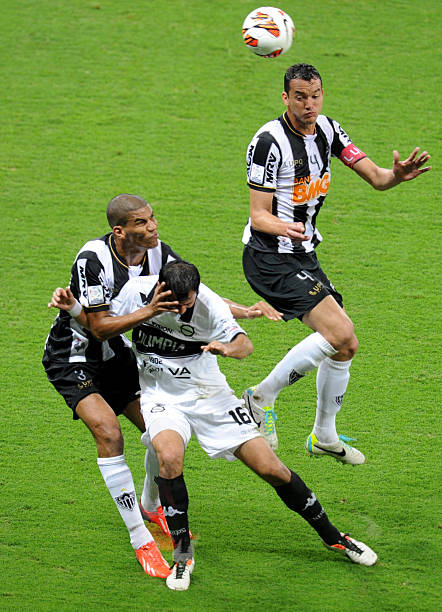 |
| "Twin Towers": Leonardo Silva(L) and Rever |
Oldair began his career at Palmeiras, winning the 1959 São Paulo champion and won the 1960 Rio-São Paulo Tournament. He then played five years for Fluminense and three more for Vasco. With Atletico Mineiro, he won the club's first Brazilian champion in 1971 as its captain. He was on the player pool for the World Cup Finals in 1966, but was not selected for the Finals.
LB: Paulo Roberto (Brazil)
Born in Porto Alegre, in Rio Grande do Sul, Paulo Roberto began his career with Internacional in 1982. He also played for Botafogo and Palmeiras. In 1986, he joined Atletico Mineiro, where he played for ten years. He played over 500 games for them. He won 5 Campeão Mineiro and Campeão da Conmebol in 1992.
DM: Toninho Cerezo (Brazil)
Throughout his career, Cerezo played as a defensive midfielder with Atlético Mineiro, Roma, Sampdoria, São Paulo and the Brazilian national team. He was a legend at Atlético Mineiro. With São Paulo FC, he was the two-times winner of the Intercontinental Cup and Copa Libertadores. He went to Argentina 1978 and Spain 1982. During his time in Italy, Cerezo won the Coppa Italia four times; in 1991 he won the Serie A with Sampdoria, but lost the Coppa Italia final to A.S. Roma.
 |
| Toninho Cerezo |
With Atlético Mineiro, Paiva was a part of the squad which won the first Campeonato Brasileiro Série A in 1971. He played 27 matches and scored one goal in that season, and was selected for the team of the tournament, winning the Bola de Prata, awarded by Placar magazine. He is the second player with most appearances for the club, with 559. He earned 6 caps.
CM/DM: Zé do Monte (Brazil)
Born in 1927, José do Monte Furtado Sobrinho was better known as Zé do Monte. He spent his entire career with Atletico Miniero. He was only 18 years old when he first played for them in 1946. He played 10 years for the club, winning eight Campeonato Mineiro titles. He played 443 matches and scored 26 goals.
LW: Eder Assis (Brazil)
Eder played for many clubs in his career, most notably with Grêmio and Atlético Mineiro in the Campeonato Brasileiro. His career was best remembered for playing with Brazil at the World Cup Finals in 1982. He scored a wonderful, winning goal against the Soviet Union, flicking the ball up and volleying it with blistering power into the net from 25 yards. He followed that up with another outstanding goal in the 4–1 win over Scotland. He earned 52 caps.
 |
| Eder |
Guara started his career with Sport Club Aymorés, where he formed a partnership with Nicola. In 1933, he transferred to Clube Atlético Mineiro along with his teammate Nicola. Guara would earn the nickname Diabo Loiro "Blond Devil". He made 168 goals for Clube Atlético Mineiro that has only been surpassed by Reinaldo, Dadá Maravilha and Mário de Castro. At age 24, Guará became the highest paid player in Minas Gerais football.
AM/LM: Ronaldinho (Brazil)
From 1999 to 2013, Ronaldinho played 97 times for Brazil. He was a member of the "Three R's" with Rivaldo and Ronaldo that helped Brazil winning the World Cup in 2002. At the club level, he started his career with Gemio before moving to Europe. He played with Paris St Germaine and Barcelona before his form started to drop. He formed the REM line with Etoo and Messi before fighting among them destroyed the team. In 2013, he won the Copa Libertadores with Atlético Mineiro.
 |
| Ronaldinho |
Jairo went Belo Horizonte was born in 1904. He first went to Belo Horizonte to study medicine, but divided his time studying and playing for Atletico Mineiro. He played for the club between 1927 and 1933. He formed the famous line known as "Trio Maldito" with Said Paulo Arges and Mario de Castro. Together, they scored more than 450 goals for Atlético Mineiro.
ST: Said Paulo Arges (Brazil)
Said Paulo Arges was a part of the legendary offensive trident known as "Trio Maldito" (Portuguese for Unholy Trio) with Mario de Castro and Jairo de Assis in the late 1920's. Said was studying law when he played for the club. He would also play for Fluminense in Rio de Janeiro. Because of his playing career, he delayed in finishing his law degree by 10 years.
ST: Mário de Castro (Brazil)
Mário de Castro spent his entire career at Atlético Mineiro, with whom he won three Campeonato Mineiro titles. He helped Atlético Mineiro break América's decade-long dominance in Campeonato Mineiro, the state league of Minas Gerais. He was the competition's top scorer twice in that period. Mário was part of offensive line called the "Trio Maldito" with Said and Jairo. Mário was the first Atlético Mineiro player and first outside of Rio de Janeiro or São Paulo to be called up for the Brazilian national football team.
ST: Guilherme (Brazil)
In his career, he played 8 clubs in Brazil, and also competed professionally in Spain and Saudi Arabia during a 13-year career. Over the course of 11 Série A seasons, he amassed totals of 155 games and 68 goals. In 1999, Guilherme signed with Clube Atlético Mineiro, where he experienced his best years as a professional. In the year's Série A, he was crowned top scorer by breaking the record which belonged to club legend Reinaldo, and led the team to the vice-championship. He earned 6 caps.
ST: Diego Tardelli (Brazil)
Diego Tardelli was named after Italian World Cup winner Marco Tardelli. His early career included playing for Sao Paulo, Real Betis, PSV and Flamengo before making a name with Atletico Mineiro between 2009 and 2011. He played with Anzhi Makhachkala and Al-Gharafa. In 2013, he returned to Atletico Mieiro helping them to win the Copa Libertadores. At the time of writing, he plays for Shandong Luneng in China and has 14 caps.
ST: Marques (Brazil)
In his career, Marques has played for Corinthians, Flamengo, Sao Paulo Futebol Clube, Vasco da Gama, Atletico Mineiro and clubs in Japan. His best period was with Atletico Mineiro, where he played in more than 350 games and scored around 130 goals. He won the 1997 Copa CONMEBOL. He was capped 13 times.
ST: Paulo Isidoro (Brazil)
Paulo Isidoro played for many clubs in Braizl, but his best years were spent with Atletico Mineiro. He started his career in 1975 with them, where he formed a great partnership Reinaldo. He later played with Gremio and Santos before returning to Atletico Mineiro in 1985. From 1987, he played for several clubs. He won the Bola de Prata in 1976, 1981 and1983, and Bola de Ouro in 1981. He earned 41 caps. He played in four of five matches at the 1982 World Cup, always as a substitute.
ST: Dada Maraviha (Brazil)
As of 2006, Dada is the third top scorer in the history of Brazilian football, trailing Pelé and Romário. His best club career were spent with Atletico Mineiro and Internacional. In 1969 his prestige was so great that then Brazilian President Emílio Garrastazu Médici asked coach Mário Zagallo to call Dadá to join the national team going to the 1970 World Cup in Mexico. He was benched for most of the tournament, however. In total he was capped 6 times for Brazil between 1970 and 1973.
ST: Reinaldo (Brazil)
Reinaldo was a hero at Atlético Mineiro, where the fans called him the "King"("o Rei", in Portuguese, which also served as a pun on his name). He was their all-time leading scorer. He still holds the record of highest goal average per game in the Brazilian league, with 1.55 goals per match. He won eight Campeonato Mineiro titles including six consecutively: in 1976, 1978–1983 and 1985. For the national team, he earned 37 caps and went to the 1978 World Cup Finals.
Honorable Mention
Bernard, Gilberto Silva, Nelinho, Marques Batista, Carlyle, Lucas Miranda, Cláudio Taffarel, Ladislao Mazurkiewicz, Vantuir, Pierre, Jô, Marcelo Oliveira, Héctor Cincunegui, Guilherme Milhomem Gusmão.
Squad Explanation
-- Atletico Mineiro won the 2013 Copa Libertadores. I selected the following players from that team: Victor, Marcos Rocha, Rever, Diego Tardelli, Leonardo Silva and Ronaldinho.
-- Ronaldinho helped Atlético win the Campeonato Mineiro and led the club to its first Copa Libertadores. He scored four goals and assisted on seven occasions during their dramatic title run, which included consecutive comeback wins from 0–2 first leg defeats in both the semi-finals against Argentinian Newell's Old Boys and the finals against Club Olimpia from Paraguay. It was Ronaldinho's only Copa Libertadores trophy. He won the 2013 South American Player of the Year because of his performance at the tournament. He also won the Bola de Ouro award, selected as the best player in the league in 2012.
-- Leonardo Silva and Rever formed a defensive pair that was known as the "Twin Towers".
-- There are two footballers named "Guilherme" who played for the club. I selected Guilherme de Cássio Alves who played for the club between 1999 and 2003 for my all-time team. The other player was Guilherme Milhomem Gusmão who was a part of the team that won the 2013 Copa Libertadores.
-- Atletico Mineiro has many great keepers. I have no space for the two big names who played for the club. Both Cláudio Taffarel and Ladislao Mazurkiewicz did not play long enough for the club. The other selections have played and won more for the club. Kafunga was widely considered the club's greatest keepers. João Leite holds the record for most appearances and most trophies won. Without Victor, Atletico Mineiro might not have won the Copa Libertadores in 2013. He made several penalty saves as the club advanced through the tournament, including penalty shootouts in both semifinal and the Final.
Diego Tardelli was named after Italian World Cup winner Marco Tardelli. His early career included playing for Sao Paulo, Real Betis, PSV and Flamengo before making a name with Atletico Mineiro between 2009 and 2011. He played with Anzhi Makhachkala and Al-Gharafa. In 2013, he returned to Atletico Mieiro helping them to win the Copa Libertadores. At the time of writing, he plays for Shandong Luneng in China and has 14 caps.
 |
| Diego Tardelli |
In his career, Marques has played for Corinthians, Flamengo, Sao Paulo Futebol Clube, Vasco da Gama, Atletico Mineiro and clubs in Japan. His best period was with Atletico Mineiro, where he played in more than 350 games and scored around 130 goals. He won the 1997 Copa CONMEBOL. He was capped 13 times.
ST: Paulo Isidoro (Brazil)
Paulo Isidoro played for many clubs in Braizl, but his best years were spent with Atletico Mineiro. He started his career in 1975 with them, where he formed a great partnership Reinaldo. He later played with Gremio and Santos before returning to Atletico Mineiro in 1985. From 1987, he played for several clubs. He won the Bola de Prata in 1976, 1981 and1983, and Bola de Ouro in 1981. He earned 41 caps. He played in four of five matches at the 1982 World Cup, always as a substitute.
 |
| Paulo Isidoro |
As of 2006, Dada is the third top scorer in the history of Brazilian football, trailing Pelé and Romário. His best club career were spent with Atletico Mineiro and Internacional. In 1969 his prestige was so great that then Brazilian President Emílio Garrastazu Médici asked coach Mário Zagallo to call Dadá to join the national team going to the 1970 World Cup in Mexico. He was benched for most of the tournament, however. In total he was capped 6 times for Brazil between 1970 and 1973.
ST: Reinaldo (Brazil)
Reinaldo was a hero at Atlético Mineiro, where the fans called him the "King"("o Rei", in Portuguese, which also served as a pun on his name). He was their all-time leading scorer. He still holds the record of highest goal average per game in the Brazilian league, with 1.55 goals per match. He won eight Campeonato Mineiro titles including six consecutively: in 1976, 1978–1983 and 1985. For the national team, he earned 37 caps and went to the 1978 World Cup Finals.
 |
| Reinaldo |
Honorable Mention
Bernard, Gilberto Silva, Nelinho, Marques Batista, Carlyle, Lucas Miranda, Cláudio Taffarel, Ladislao Mazurkiewicz, Vantuir, Pierre, Jô, Marcelo Oliveira, Héctor Cincunegui, Guilherme Milhomem Gusmão.
Squad Explanation
-- Atletico Mineiro won the 2013 Copa Libertadores. I selected the following players from that team: Victor, Marcos Rocha, Rever, Diego Tardelli, Leonardo Silva and Ronaldinho.
-- Ronaldinho helped Atlético win the Campeonato Mineiro and led the club to its first Copa Libertadores. He scored four goals and assisted on seven occasions during their dramatic title run, which included consecutive comeback wins from 0–2 first leg defeats in both the semi-finals against Argentinian Newell's Old Boys and the finals against Club Olimpia from Paraguay. It was Ronaldinho's only Copa Libertadores trophy. He won the 2013 South American Player of the Year because of his performance at the tournament. He also won the Bola de Ouro award, selected as the best player in the league in 2012.
-- Leonardo Silva and Rever formed a defensive pair that was known as the "Twin Towers".
-- There are two footballers named "Guilherme" who played for the club. I selected Guilherme de Cássio Alves who played for the club between 1999 and 2003 for my all-time team. The other player was Guilherme Milhomem Gusmão who was a part of the team that won the 2013 Copa Libertadores.
-- Atletico Mineiro has many great keepers. I have no space for the two big names who played for the club. Both Cláudio Taffarel and Ladislao Mazurkiewicz did not play long enough for the club. The other selections have played and won more for the club. Kafunga was widely considered the club's greatest keepers. João Leite holds the record for most appearances and most trophies won. Without Victor, Atletico Mineiro might not have won the Copa Libertadores in 2013. He made several penalty saves as the club advanced through the tournament, including penalty shootouts in both semifinal and the Final.
-- Nelinho joined the club in 1982 right after he caused a massive brawl between his then team Cruzeiro and Atlético Mineiro less than a year earlier. He was seen attacking Eder. I only put him on honorable mention.
-- Marcos Rocha played over 400 games for the club. He surprisingly took one of the fullback position over Héctor Cincunegui who deserved a spot on the team.
-- Gilberto Silva only played two seasons at the club. He was injured for one of the seasons. The club had many other great defensive midfielders. So I did not pick him.
-- Toninho Cerezo was one of Brazil's greatest midfielders. While at Atletico Mineiro, he won the Bola de Ouro in 1977 and 1980 and the Bola de Prata in 1976.
-- Vanderlei Paiva played over 600 games for the club. He kept Elzo out of this team.
-- Mário de Castro was the first Atlético Mineiro player and first player outside of Rio de Janeiro or São Paulo to be called up for the Brazilian national football team. He formed an attack line known as "Trio Maldito" (Portuguese for Unholy Trio) with Jairo de Assis Almeida and Said Paulo Arges. Together, they scored more than 450 goals for Atlético Mineiro. Said Paulo Arges is among the top ever scorers for the club. I took all three of them.
-- Reinaldo was a legend at the club. He still holds the record of highest goal average per game in the Brazilian league, with 1.55 goals per match. He played with Toninho Cerezo and Eder in the 1980's. Eder who made famous by his participation at the 1982 World Cup Finals. His prime was spent with Atletico Mineiro. I created an alternative Brazil blog team at the 1982 World Cup that featured Toninho Cerezo, Reinaldo and Eder.
Formation