Tuesday, March 5, 2019

Seviila All-Time Team for foreigner players


This blogger Artur Yanturin of Russia copied many of my blog teams.  This blog was one of them.  It was my Russia All-Time Team here.  His team was written in 2020, but mine was uploaded in 2014.   His Spartak Moscow All-Time team entry of was published in October 2020, but mine was uploaded in 2017.  His entry of the Dutch-German rivalry between Real Madrid and Barcelona was written in 2020, but mine was uploaded in 2014.  He also copied many many of my blog entries.

His Facebook and Instagram

Frederic Kanoute and Luis Fabiano 


Some of the unpublished posts from this blog have been turned into a two-volume book: The Multiverse of the Beautiful Game: National Teams of Pure Fantasy.

Volume 1 takes you back in time and asks the questions every football fan has dreamed about. What if Brazil had a more beautiful team in 1982 — would they have cruised to the title? What if the United Kingdom could send its team to the 1970 World Cup? I believe they would have been the strongest side on earth. What if Argentina had fielded both Omar Sivori and Alfredo Di Stéfano together in 1958? What if Johan Cruyff had lined up alongside Marco van Basten, Ruud Gullit, and Frank Rijkaard? What if Eusébio had played for Brazil? And that's only scratching the surface — Volume 1 is packed with legendary "what ifs" that will keep you turning pages.

Volume 2 brings the fantasy closer to home. What if England had Michael Olise, Erling Haaland and others in 2026 — could they go all the way? What if Yugoslavia had gone to the World Cup in 2018? What if the United States could select more players in 2010? It would be the greatest American side ever. And what if Cristiano Ronaldo and Lionel Messi had actually played for the same national team in 2006? It could have happened — if the soccer gods had smiled on us.

*** Both Volume One and Volume Two are available now on Amazon. ***


Please also see my All-Time World Cup Team Index.

Sevilla All-Time Team for Spanish players Real Madrid, Barcelona, Valencia,
Atletico Madrid, Sevilla, Atletic Bilbao, 
Deportivo La Coruna  Real Sociedad,
Real Betis, Real Zaragoza, Espanyol
Andalusia

This is my selection of a 25 member all-time team for Sevilla FC foreign players only.  The number 25 was chosen because it is the official squad size for the Champions' League.


Historically, Sevilla FC has its up and down.  They won the league title in 1945-1946, but they were mainly a mid-table team throughout the the 20th Century.  Then, the millennium came.  From 2005 to 2015, Sevilla won 5 of the 10 UEFA Cups/Europa Cups.  They won back-to-back UEFA Cups in 2006 and 2007, and then, three straight Europa Cups in 2014, 2015 and 2016.  They own the record of the most successful team in the tournament. Prior to their first UEFA Cup, they have never reached the Final of any European major tournament.

Team
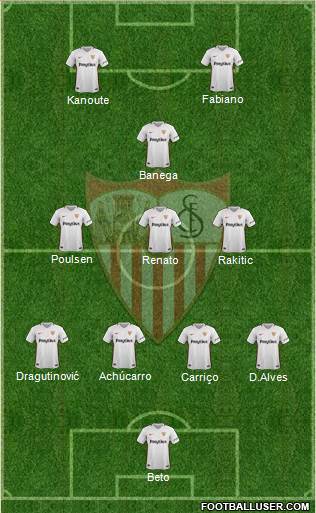
GK: Yassine Bounou "Bono" (Morocco)
"Bono" spent most of his career in Spain, making over 100 La Liga appearances for Girona and Sevilla.  In 2020, he joined Sevilla.  He made some important saves as Sevilla won the European League in the 2019-2020 season in which he was named in the Europa League Squad of the Season.  He also won the La Liga Zamora Trophy in the 2021–22 season.   He was eligible to represent Canada or Morocco, but sicen 2013m he has represented Morocco.  

GK: Tomáš Vaclík (Czech Republic)
Vaclík started out with FC Vítkovice before transferring to Viktoria Žižkov.  From 2012 to 2014, he played for Sparta Prague.  From 2014 to 2018 he played for Basel in Switzerland.  In 2018, he moved to play with Sevilla.  At the international level, he made his senior debut for the Czech Republic in 2012 in a 3–0 friendly victory against Slovakia. 

GK: Beto (Portugal)
Beto started his career with Sporting CP.  He made his name with Leixões before transferring to Porto in 2009.  He was better known for his career with Sevilla.  He was the hero of their 2014 Europa League victory, where he saved two penalties in the shootout against Benfica. He was a backup in the 2015 Final as well as the one he won with Porto. From 2009 onward, he represented Portugal. He was an unused sub at the 2014 and 2018 World Cup Finals as well as the Euro 2012.

Beto

RB: Dani Alves (Brazil)
Dani Alves spent 6 years with Sevilla, winning two UEFA Cup's before joining Barcelona.  He only played 109 times for Brazil at the time of writing, largely because Maicon was the regular starter during his early career.  In 2016, he joined Juventus, where he played a single season.   He appeared in his fourth Champions League final as Juventus were defeated 4–1 by Real Madrid. In 2017, he joined PSG.

CB/DM: Daniel Carriço (Portugal)
From 2007 to 2012, Daniel Carriço played for Sporting CP in Portugal, where he served as the team captain.  After a brief career with Reading, he moved to Sevilla in 2013.  He was a part of Sevilla's team that won three straight Europa Cup.  At the international level, he was only capped once at the time of writing.

CB/LB: Julien Escude (France)
Escudé began his professional career at AS Cannes in 1998. Then, he , played Stade Rennais FC and Ajax before making a name with Sevilla.  From 2006 to 2012, he won six major titles with the Spanish side, including two UEFA Cups.  He later played for Beşiktaş J.K.  Internationally, he was capped 13 times, but never played in a major tournament.

CB: Jules Kounde (France)
Koundé started in his first team debut for Bordeaux in 2017.  Between 2019 and 2022, he played for Sevilla.  He helped the club win the 2019–20 UEFA Europa League for a record sixth time and was named in the competition's team of the season.  He joined Barcelona FC in 2022.  Since 2021, he has represented France.  He played in the 2024 World Cup Finals.

CB: Adi Rami (France)
Rami played amateur football in France before joining Lille in 2006.  He played there until 2011, where he later played for Valencia, AC Milan, Sevilla and Marseille.  He was named as a member f UEFA Europa League Squad of the Season: 2015–16 after Sevilla won the title.  From 2010 to 2018, he has represented France over 35 times.  He was a member of the 2018 World Cup winning team.

CB/LB: Ivica Dragutinović (Serbia)
Dragutinović started playing football with FK Polimlje, FK Bor and FK Borac Čačak before heading to Belgium in 1996 and spending the following nine years there with K.A.A. Gent and Standard Liège. From 2005 and 2011, he played with Sevilla, where he won two UEFA Cups.  At the international level, he was a part of Yugoslavia's Famous Four  with Goran Gavrančić, Nemanja Vidić and Mladen Krstajić in the 2006 World Cup Qualifiers.  He played in the 2006 World Cup Finals.

Ivica Dragutinović 

LB : Adriano (Brazil)
After starting his career with Coritiba, he moved to Spain in 2005, going on to spend several seasons in La Liga with Sevilla and Barcelona and win several major titles with both clubs, including the treble with the latter in 2015. A Brazilian international for ten years, Adriano represented his country in two Copa América tournaments, winning the 2004 edition.

DM/DF: Ignacio Achúcarro (Paraguay)
Achucarro started his career in Olimpia Asunción of Paraguay, where he won two national championships before being transferred to Europe in 1958 to play for Sevilla FC. At Sevilla, he would spend 10 years before returning to Paraguay to play for Olimpia for the 1969 and 1970 seasons. Achucarro was part of the Paraguay national football team that qualified and played in the 1958 FIFA World Cup, where he played all three games for Paraguay.

Ignacio Achúcarro
DM: Christian Poulsen (Denmark)
Poulsen played for a number of clubs, winning the Danish Superliga championship with F.C. Copenhagen, the German DFB-Ligapokal trophy with FC Schalke 04, and the UEFA Cup with Spanish team Sevilla, later also playing for Juventus, as well as Liverpool, Evian, and Ajax. He was Danish Football Player of the Year: 2005, 2006.  He has played 92 matches for Denmark.  He went 2002 and 2010 World Cup, and 2004 European Championship.

DM: Grzegorz Krychowiak (Poland)
Grzegorz Krychowiak started his career in France with Bordeaux, but played mainly with Stade de Reims.  From 2014 and 2016, he played for Sevilla, where he won Europa League each of his two seasons. In 2016, he joined Paris St Germain, but spent his time on loan. Since 2008, he was capped by Poland.  He played in the 2016 European Championship and the 2018 World Cup Finals.

Grzegorz Krychowiak 

CM: Pintinho (Brazil)
In his career, Pintinho played for Fluminense and Vasco da Gama in Brazil, Sevilla and Cádiz in Spain, and Farense in Portugal.  For Fluminense, he played in 381 matches and scored 23 goals between 1972 and 1980.  His second longest career was with Sevilla in Spain, which lasted from 1980 to 1984. At the international level, he earned 3 caps with the Seleção.

CM: Ivan Rakitic (Croatia)
Born in Switzerland of Croatian background, Rakitic started his career with FC Basel. He played with Schalke 04 from 2007 and 2011.  Then, he moved to Sevilla in 2011.  At Sevilla, he won the Europa Cup in 2014.  He moved to Barcelona.  For Croatia, he earned 100 caps at the time of writing. He played in the midfield with Luka Modric as Croatia reached the Final of the 2018 World Cup Finals.

AM/CM/DM: Renato (Brazil)
Renato started with Guarani before moving to santos in 2000. He won two Campeonato Brasileiro Série A in  2002 and 2004. In 2004, he joined Sevilla in Spain, where he played until 2011.  With Sevilla, he won back-to-back UEFA Cup in 2006 and 2007.  He later played for Botafogo before rejoining Santos in 2014.  From 2003 to 2005, he played 27 times for Brazil.  He  was a part of the team that won the 2004 Copa América and the 2005 FIFA Confederations Cup.

Renato 

AM/CM: Ever Banega (Argentina)
Ever Banega started his career with Boca Juniors, and signed with Valencia in 2008 where he remained for several years, appearing in 162 official games and winning the 2008 Copa del Rey. After joining Sevilla in 2014, he conquered consecutive Europa League trophies and a third title in 2020.  He was an Argentine international since 2008, but only went to his first World Cup Finals in 2018.

RW: Biri Biri (Gambia)
Biri Biri is considered the greatest ever player for Gambia. He played for Black Diamonds, Phomtoms and Augustines in Gambia as well as Mighty Blackpool of Sierra Leone before he earned a trial with Brian Clough's Derby County, but did not stay.  He was better known for his stints with Sevilla FC between 1973 and 1978, where he was the first Black player to play for the club.  In Denmark, he played with Herfølge Boldklub.  From 1963 to 1987, he represented Gambia.

Bri Bri

LW: Daniel Bertoni (Argentina)
Daniel Bertoni started playing in Argentine's second division for Quilmes in 1972. After one year he was transferred to first division's team Independiente where he played alongside Ricardo Bochini and won one national and 3 Copa Libertadores. In Europe, Betoni also played for Sevilla, Fiorentina and Napoli. At the international level, he was capped 31 times.  He scored one of the goals at the Final in the 1978 World Cup Finals against Netherlands.

AM: Vassilios Tsiartas (Greece)
In Greece, Vassilios Tsiartas played for Naoussa FC and AEK Athens before becoming a star with Sevilla FC.  He was known in Sevilla as 'El Mago'.  He also played for Koln and  Ethnikos Piraeus.  From 1994 to 2005, he was capped 70 times by Greece. During the Euro 2004 he was used mainly as a substitute by Otto Rehhagel, but managed to claim two vital assists, one against Spain and the other against the Czech Republic. 

FW: José Carlos Diéguez (Argentina)
José Carlos Diéguez was born in 1935. At age 18, he was signed by San Lorenzo in Argentina.  In 1957, he joined Sevilla, where he played 10 seasons until 1967.  He is considered to be one of Sevilla' greatest foreign player.  He represented the club in 1962 Cup Winners' Cup and 1968 Inter-Cities Fairs Cup. He also won the prestigious Teresa Herrera Trophy in 1960. He later played with Gymnastics of Torrelavega, Oviedo and Saint Andreas.

José Carlos Diéguez 
ST: Toni Polster (Austria)
Toni Polster is the all-leading scorer for Austria. He was capped 92 times between 1982 and 2000.  He went to the World Cup Finals of 1990 and 1998. He started his career with Austria Wien in 1982. He played a season with Torino.  He then played in Spain between 1988 and 1993 for Sevilla, Logroñés and Rayo Vallecano. In 1993, he moved to Germany to play for Köln and Borussia Mönchengladbach. In 1999, Polster returned to Austria to play a final season at Austria Salzburg.


ST: Frederic Kanoute (Mali)
Frederic Kanoute's longest domestic club spell was with Sevilla in Spain, where he played from 2005 to 2012.  He won two UEFA Cups with them.  He was the African Player of the Year in 2007.  He was born in France.  He was capped by French youth team, but he did not received any senior callup from France. He represented Mali internationally in the senior level.  At the club level, he also played in France for Lyon, in England for West Ham and Tottenham, and in China for Beijing Guoan.

Frederic Kanoute

ST: Luis Fabiano (Brazil)
Luis Fabiano started his career with Ponte Preta in Brazil.  He was disappointed in his first European adventure with Rennes.  He returned to Sao Paulo in Brazil and then another disappointing stint with Porto FC.  Finally, he joined Sevilla FC in 2005.  He established himself as a star and won two UEFA Cups.  He also played in China. Internationally, he played for Brazil 45 times, and he was a starter at the World Cup Finals in 2010.  

ST: Davor Suker  (Croatia)
Davoe Suker was a part of Yugoslavia's Golden Generation in the 1990's.  He was capped twice for Yugoslavia.  He later played for Croatia, where he earned 69 caps.  He is their all-time leading scorer.  He is best remembered for finishing as the top scorer at the World Cup Finals in 1998, where Croatia reached the semifinal.  He also played with Sevilla, Real Madrid, Arsenal, West Ham and 1860 Munich.  He was a top scorer in La Liga while playing for both Seville and Real Madrid.

Davor Suker

Honorable Mention
Rinat Dasaev (USSR/Russia), Nicolás Pareja (Argentina), Mariano (Brazil), Julio Baptista (Brazil), Enzo Maresca (Italy), Timothée Kolodziejczak (France),  Stéphane Mbia (Cameroon), Bernardo Acosta Miranda (Paraguay), Diego Simeone (Argentina), Fernando (Brazil), Carlos Bacca (Columbia),  Kevin Gameiro (France), Ivan Zamorano (Chile), Wissam Ben Yedder (France), Youssef En-Nesyri (Morocco)

Squad Explanation
-- The original team was created on March 2019.  I redid it on June 2025.
-- Ivan Rakitic, Ever Banega, Dani Alves, Frederic Kanoute, Luis Fabiano and Davor Suker are on my all-time Sevilla team.
-- La Colina de Nervión named the following players as the 5 greatest players from Sevilla.  Davor Suker was the only foreigner.
-- The Sr.Deportes selected the Top 10 greatest ever players from Sevilla in 2023.  The foreigners were: 5) Frederic Kanouté, 6) Davor Suker, 7) Ivan Rakitic and 8) Dani Alves. 
-- The "Dorsales de leyenda(Legendary Number)" is the highest distinction Sevilla FC bestows upon its former players. Since its inception in June 2009. thirteen players have been honored.  Ignacio Achucarro was the only foreigner given that honor.
In total, Sevilla won 7 UEFA Cup/Europa League between 2006 and 2023. The team under Unai Emery that won three straight Europa Cups (2014, 2015, 2016) is underrepresented. They were actually three different teams with different players because Sevilla was unable to hold onto their players after each victory.  Jose Antonio Reyes won a record 5 UEFA Cup/Europa League titles, but two of the them was won with Atletico Madrid.  Jesus Navas and Daniel Carrico won 4 each for Sevilla.  
Goalkeepers
-- In 2018, Beto was the only great foreign goalkeeper to have played for the club. He was the hero of the 2014 Europa League. Since then, Yassine Bounou had emerged. In Sevilla, he won the La Liga Zamora Trophy for the 2021–22 season while being named on the La Liga Team of the Season on the same season. He was also selected for Europa League Team of the Season twice. He was named MOTM as Sevilla won the Europa League in 2023. With that performance, he was nominated for The Best FIFA Men's Goalkeeper at the end of 2022 along with Emiliano Martínez and Thibaut Courtois.
Yassine Bounou
-- Both Rinat Dasaev and Tomáš Vaclík were selected in 2019 because of the lack of great alternative choices.  Dasaev came at the end of his career.  His career over here was considered uneventful while Tomáš Vaclík was still on his first season.  I selected because there was no other suitable alternative. 
-- Tomáš Vaclík played regularly in La Liga during the 2019-2020 season, but in the Europa League where Sevilla emerged as champion, Yassine Bounou was the main starter.  Meanwhile, Rinat Dasaev's career over here was actually disastrous. So, I kept Vaclik.
Defenders
-- Daniel Carriço was a starter in the finals of the last three European titles.  He began as a defensive midfielder, but later became a central defender. He had the most appearances in the Europa League for Sevilla. Jules Kounde was named Europa League Squad of the Season for the 2019–20 season, and on the La Liga Team of the Season for the 2021–22 and 2022–23 season.  In 2019, he was still fresh with the team, but in 2025, he became an undisputed selection for this team. In 2019, I also selected Julien Escude, Nicolás Pareja and Adi Rami as the other three central defenders.  Escude was an important part of the Spanish club as it won six major titles, including two UEFA Cups.  He secured the third spot. Both Pareja and Rami won the Europa League over here, and were named of the Team of the Tournament for their respective years.  Pareja won two trophies and was named of both of those seasons. Pareja had a longer career in Sevilla than Rami, but Rami carried a more famous reputation outside of Sevilla, largely because he represented France. So, I took Rami over Pareja.
-- Dani Alves was one of the best fullbacks in the world when he played for Sevilla.  He was part of the legendary team that won two UEFA Cups, the Copa del Rey, the Spanish Super Cup, and the European Super Cup.  I decided not to select a second rightback.  Mariano (Brazil) would have been my second rightback.
-- On the left, Ivica Dragutinović was undisputed. Adriano Correia won back-to-back UEFA Cups when he played here. He never achieved the same successes elsewhere in the club level.
Midfielders/Wingers
-- Ignacio Achucarro is one of the few foreign footballers named on the "Legendary Number".  I believed that he was a midfielder with a defensive capacity.
-- Ivan Rakitic was named Man of the Match as Sevilla won the Europea League in 2014.  He would also win his secobd Europa Leaguye during his second stint.  He was named on Europa League Team of the Season for both winning seasons.  He was also named on La Liga Team of the Season twice while playing for Sevilla. While playing for Sevilla, Grzegorz Krychowiak won Europa League on both his seasons here as well as being named on Europa League Squad of the Season for both seasons.  He was also named on the La Liga Team of the Season for the 2014–15 season.  
-- Renato played most of his professional career in Spain with Sevilla, appearing in 286 official games with the club (39 goals scored).  Christian Poulsen helped Sevilla defend the UEFA Cup title, winning the 2006–07 edition of the tournament and also won the Spanish Cup that year.
-- Julio Baptista arrived as a defensive midfielder. However, Joaquín Caparrós' turned him as playmaker.  He scored 49 goals in 74 games during his two seasons, but his stint was too short.  I left him on honorable mention.
-- Ever Banega was fundamental in two of Sevilla's victories, but he has been inconsistent in his career.  His status with Sevilla is also harmed by his transfer to Inter Milan.  However, the team lacked great playmakers.  Julio Baptista was probably better than Benega, but he did not win any major trophy with Sevilla. In end, I felt that Benega contributred more to the club.  
Ever Banega
-- Vassilios Tsiartas was relatively unknown outside of La Liga, but he was considered one of the greatest ever players for Sevilla.  He earned the nickname "El Mago (The Magician)" over here.  
-- Diego Maradona also played briefly here. His career here was remembered for his conflict with Carlos Bilardo. He was not serious considered.
-- Both Bri Bri and Daniel Bertoni was selected because the team needed wide players to play on the wing.  Bri Bri is the first Black player to play for Sevilla. He was a cult hero with the club. I don't know if José Carlos Diéguez was a wing forward.  I came upon a single source calling him as a winger.  He was chosen because I wanted to split the team into different eras. He also appeared in several all-time list.  Moreover, he was chosen by CIHEFE (Centro de Investigaciones de Historia y Estadística del Fútbol Español/Center for Research in History and Statistics of Spanish Football as the 7th greatest Argentine player who played in La Liga.  He spent 10 seasons with the club. Adriano Correia played as left wingback or winger.  He would be the backup left wing.
Forwards
-- Frederic Kanoute's partnership with Luis Fabiano was considered the greatest duo in their history.   Kanouté won two King’s Cups, two UEFA Cups, a European Super Cup and a Spanish Super Cup.  So I took both.  At the time of writing, Kanoute is Sevilla's highest scoring foreign player and Fabiano was second.  Negredo came at the end of  the partnership of Luís Fabiano and Frédéric Kanouté.  He sent one of them to the bench.  He scored over 70 goals for the club.
-- Davor Suker was La Liga second Top Scorer while playing for Sevilla.  He was considered to be one of their greatest strikers.
-- In the 1989-1990 La Liga season, Toni Polster finished second in the Pichichi with 33 goals, with Hugo Sanchez with 38 goals.  He remained a legend over here.
Toni Polster 
-- Carlos Bacca was a hero of their Europa League successes, but he is behind Frederic Kanoute, Luis Fabiano, Davor Suker and Toni Polster.
-- Hector Scotta was a player largely forgotten outside of Sevilla.  I only put him on honorable mention.
-- Kevin Gameiro only made honourable mention, despite winning three straight Europa League.  Since 2020, Youssef En-Nesyri started to make a name over here, but it would be hard to surpress the names I selected for this team.

Formation


Sunday, February 24, 2019

Atletico Madrid All-Time Team for Spanish players

Koke and Gabi


Some of the unpublished posts from this blog have been turned into a two-volume book: The Multiverse of the Beautiful Game: National Teams of Pure Fantasy.

Volume 1 takes you back in time and asks the questions every football fan has dreamed about. What if Brazil had a more beautiful team in 1982 — would they have cruised to the title? What if the United Kingdom could send its team to the 1970 World Cup? I believe they would have been the strongest side on earth. What if Argentina had fielded both Omar Sivori and Alfredo Di Stéfano together in 1958? What if Johan Cruyff had lined up alongside Marco van Basten, Ruud Gullit, and Frank Rijkaard? What if Eusébio had played for Brazil? And that's only scratching the surface — Volume 1 is packed with legendary "what ifs" that will keep you turning pages.

Volume 2 brings the fantasy closer to home. What if England had Michael Olise, Erling Haaland and others in 2026 — could they go all the way? What if Yugoslavia had gone to the World Cup in 2018? What if the United States could select more players in 2010? It would be the greatest American side ever. And what if Cristiano Ronaldo and Lionel Messi had actually played for the same national team in 2006? It could have happened — if the soccer gods had smiled on us.

*** Both Volume One and Volume Two are available now on Amazon. ***


Please also see my All-Time World Cup Team Index.

Real Madrid, Barcelona, Valencia,
Atletico Madrid, Sevilla, Atletic Bilbao, 
Deportivo La Coruna  Real Sociedad,
Real Betis, Real Zaragoza, Espanyol
Atletico Madrid All-Time Team for Foreign Players
Spain with Real Madrid and Barcelona 

This is my selection of a 25 member all-time team for Atletico Madrid's Spanish players.  The number 25 was chosen because it is the official squad size for the Champions' League.

Atletico Madrid is the third best team in Spain after Real Madrid and Barcelona. They were runner-ups at the European Cup three times, won a singe Cup Winners' Cup and two Europa League.  In 1995-1996, they also won the Double(La Liga and Copa del Rey).
Feliciano Rivilla and Isacio Calleja
Team
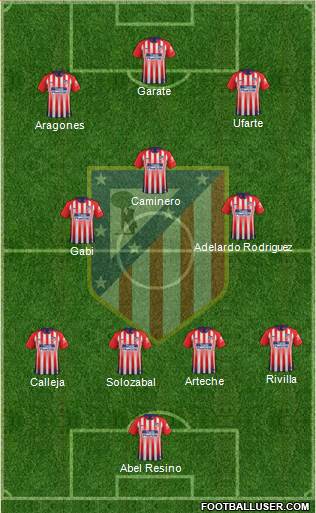
GK: Abel Resino 
Abel Resino was nicknamed the "Cat".  He came to Atletico Madrid in 1986 from lowly CD Ciempozuelos and stayed there until 1995.  He won back-to-back Cops del rey in 1991 and 1992.  He won the Zamora Trophy in 1990-1991 season. He spent a season playing for Rayo Vallecano at the end of his career.  He earned two caps for Span in 1991.

GK: Jose Molina 
Jose Molina joined Atletico Madrid in 1995, he helped the club win a Double (league and Copa del Rey) in his first year. However, after Atletico Madrid relegated after the 1999-2000 season, he moved to Deportivo La Coruna and lasted until 2006.  He played one season with Levante.  He made his national team debut in 1996 as an outfielder because the team had used up all the subs. He had 9 caps in total.

GK: Miguel Reina
Reina started with Cordoba in 1964, but better known for playing with Barcelona and Atlético Madrid (seven years apiece).  He won the Ricardo Zamora Trophy for the 1972–73 season.  With Atletico Madrid, he also reached the final of the 1974 European Cup against FC Bayern Munich at the Heysel Stadium in Belgium.  At the international level, he was capped 5 times.  He was a backup at the World Cup Finals in 1966.  His son is Pepe Reina.
Miguel Reina
RB: Tomas 
Tomas joined Atletico Madrid in 1984 and stayed there until 1996.  His last season was the year Atletico Madrid won the Double. He played two more years in the lower division before retiring.  He was capped 19 times.  He started most of the games at the 1986 World Cup Finals in Mexico and the 1988 European Championship in West Germany.

RB: Feliciano Rivilla 
Feliciano Rivilla was an all-time great with Atletico Madrid.  He started playing football with Real Ávila CF, moving to Real Murcia at the age of 17.  In 1954, he joined Atletico Madrid, where he played until 1968. For Spain, he won the European Championship in 1964 with Spain as a starter, and was a part of two World Cup Finals in 1962 and 1966.

CB: Juan Carlos Arteche 
Juan Carlos Arteche began playing professionally with Racing de Santander after starting in basketball, making his debut in the 1976–77 season.  He joined Atletico Madrid the season after.  He helped the club to reach the Final of Cup Winners' Cup in the 1985-1986 season.  For Spain, he was capped 4 times scoring a goal between 1986 and 1987.

CB: Roberto Solozabal 
Roberto Solozabal was a product of Atletico Madrid academy.  He played there from 1989 to 1997.  He was known for his solid partnership with Juan Manuel Lopez for the season their club won the Double.  He went to Real Betis in 1997.  For Spain, he won the Gold medal at the 1992 Olympics held in Barcelona.  He also earned 12 senior caps.
Roberto Solozabal 
CB: Alfonso Aparicio
At the end of the Spanish Civil War in 1939, Alfonso Aparicio joined Atlético Madrid, then known as Atlético Aviación.  He played 12 seasons there, winning 4 league titles (1939-1940, 1940-1941, 1949-1950, 1950-1951).  In 1952, he joined Boavista FC in Portugal. At the international level, he played 8 times for Spain from 1945 to 1949.

CB: Juanma López 
Juan Manuel López was better known as Juanma López. He was a one club man with Atletico Madrid, where he made his senior debut in 1991. During the 1995–96 campaign, López, often dubbed Super López, formed a solid centre-back partnership withRoberto Solozábal, as the team won an historic double. He was capped 11 times, winning the Gold Medal at the 1992 Olympics in Barcelona. He also went to the Euro 1996 in England.

LB: Isacio Calleja 
Calleja is a long term member of Atletico Madrid.  Safe for a very brief loan spell with CD Guadalajara in the third division, Calleja spent his entire 14-year professional career with Atlético Madrid. He won back-to-back Copa del rey from 1959 to 1961.  In 1962, he won the Cup Winners' Cup. He had 13 caps for Spain. Calleja helped the national side win the 1964 European Nations' Cup on home soil.

LB: José Luis Capón
José Luis Capón played for Atlético Madrid between 1970 and 1980, winning the Spanish League in 1973 and 1977, the Spanish Cup in 1976, and the Intercontinental Cup in 1974. He played in the 1974 European Cup Final, which Atlético lost to Bayern Munich after the replay. He also played Burgos and Elche at the club level. From 1973 to 1977, he won 13 caps for Spain.
José Luis Capón
DM: Juan Vizcaíno
Juan Vizcaíno started playing with hometown's Gimnàstic de Tarragona, not yet aged 17, with the club in the third division. In 1986, Vizcaíno moved to Real Zaragoza. From 1990 to 1998, he played for Atlético Madrid.  He later played for Real Valladolid, Elche CF and his first club, Gimnàstic.  From 1991 to 1992, he played 15 times for Spain.

CM: Adelardo Rodriguez 
Adelardo spent 17 years with Atletico Madrid.  He held the appearance record for the club.  During his spell, the club won three La Liga titles (65–66, 69–70 and 72–73), five Copa del Reys (1960, 1961, 1965, 1972 and 1976), the 1962 European Cup Winners' Cup, the 1974 Intercontinental Cup. He earned 14 caps for Spain between 1962 and 1970.  He went to the World Cup in 1962 and 1966.
Adelardo Rodriguez 
CM: Koke 
Koke spent most of his career with Atlético Madrid since making his debut with the first team in 2009, playing over 300 official games and winning five honours, including the 2014 national championship and the 2012 Europa League. He won the 2013 European Championship with the Spanish under-21 team. He also made his debut for the full side that year, and represented the country at the 2014 and 2018 World Cup and Euro 2016.

CM: Gabi 
At the time of writing, Gabi is the captain of Atletico Madrid.  He played for Atletico Madrid between 2004 and 2007 before moving to Zaragoza.  In 2011, he returned to Atletico Madrid, coinciding with the rise of Simeone's team.  He first took the Copa del Rey in 2013 and then, the league title in 2013-2014.  He captained the side that reached the Champions' league Final twice.

AM/CM: Javier Irureta
Javier Irureta started with local Real Unión in 1965 before joining Atlético Madrid in 1967. During his time at the club he was part of a team that won two La Liga titles and a Copa del Rey, playing alongside the likes of Adelardo, Luis Aragonés and José Eulogio Gárate. They also reached the European Cup final in 1974.  From 1975 to 1990, he played for Athletic Bilbao, where he reached the Final of the 1977 UEFA Cup.  He played 6 times for Spain.

AM/CM: Jose Luis Caminero 
Jose Luis Caminero was a product of Real Madrid, but started his career with Real Valladolid.  In 1993, he moved to Atletico Madrid.  Over there, he won the Double in 1995-1996 and the Spanish Player of the Year that same season. He returned to Real Valladolid. At the international level, he had 21 caps and played in the 1994 World Cuop Finals in the USA and the 1996 European Championship in England. 
Jose Luis Caminero 
RW: Jose Ufarte 
Born in Spain, but Jose Ufarte moved to Brazil as a child.  He started with Flamengo and Corinthians in Brazil before he returned home and signed with Atletico Madrid.  He played on the great Atletico Madrid side of the 1960's.  He later played with Racing Santander.  He earned 16 caps.  Ufarte represented Spain at the 1966 World Cup in England.

RW/FW: José Juncosa
Juncosa began his professional career at CF Reus in the 1941/42 season. Then, he played for Espanyol before he joined Atlético de Madrid in 1944, a club in which he would remain eleven years., 
With Atlético de Madrid, he would be part of two of their best-known attack formations:  "La llamada Delantera de Seda" and "La llamada Delantera de Cristal". At the international level, he was capped twice. One of the caps were played in the 1950 World Cup Finals.

AM/LW/FW: Joaquin Peiro 
Joaquin Peiro is a legend at Atletic Madrid.  He starred as his hometown club won back-to-back Copa del Rey from 1959 to 1961 and the Cup Winners' Cup in 1962. In 1962, he moved to play for Torino in Italy.  Then, in 1964, he joined Inter Milan and won the European Cup in 1965 as a member "la Grande Inter".  He later played and captained Roma. He had 12 caps in a 10 year period.


FW: Luis Aragones 
Luis Aragones is known as the coach of Spain's European Championship winning team in 2008.  As a player, he started with Getafe in 1957 and then, Real Madrid a year later. But he never made a mark.  He finally made a name with Real Betis and signed with Atletico Madrid in 1964, where he won three league titles. He is the club's all-time leading scorer.  H was known for his freekick. He was capped 11 times between 1964 and 1972.
Luis Aragones

LW/RW: Enrique Collar 
Born in 1934, Enrique Collar spent most of his career with Atletico Madrid from 1952 to 1969.  He played a single season with Valencia befoe he retired from playing.  He was a part of the great Atletico Madrid side that won the Cup Winners' Cup in 1962.  He earned 16 caps, scoring 4 goals for Spain.  He also went to the World Cup Finals in 1962 as Spain's captain, but only made a single appearance at the Finals.

ST: Adrián Escudero 
Escudero arrived at Atlético Madrid in late 1945, from local amateurs Club Deportivo Mediodía. He was the all-time leading goalscorer for Atlético Madrid with 170 goals, having appeared for the club in 13 La Liga seasons and played in more than 350 official games.  At the international level, he was capped 3 times between 1952 and 1956.

Fernando Torres started his career with Atletico Madrid in 2001, where he became the captain at age 19. In 2007, he moved to Liverpool FC and became a big star in England.  In 2011, Chelsea allegedly broke the British transfer record to buy him.  He was a part of the Champions' league winning team in 2012.  For the national team, he was a part of the generation that won the World Cup in 2010 and two European Championships (2008 and 2012).  At Euro 2012, he was the top-scorer.
Fernando Torres 
Born in Argentina, Jose Eulogio Garate grew up in Eibar. He was a Basque, but was overlooked by Atletico Bilboa.  He was a member of the legendary Atletico Madrid side that won three league titles in the 1970's. Atletico finished second at the 1974 European Cup, but won the Intercontinental Cup that year. He also won the Pichichi Trophy three straight times: 1969-1970, 1970-1971 and 1971-1972. He was capped 18 times between 1967 and 1975. He never played in a major tournament because Spain failed to qualify for any.
Jose Eulogio Garate

Honorable Mention
Alfonso Silva, David De Gea, Kiko, Juanfranc, Juan Carlos Aguilera, Luis Garcia, Antonio "Toni" Munoz, German Gomez, Machin, Diego Costa, Marcelino, Raúl García, Paco Campos.

Team Explanation
 -- Fernando Torres, Tomas, Gabi, Jose Eulogio Garate, Enrique Collar, Abel Resino, Jose Molina, Feliciano Rivilla, Juan Carlos Arteche, Roberto Solozabal,  Isacio Calleja, Adelardo Rodriguez  Jose Luis Caminer, Jose Ufarte, Joaquin Peiro and Luis Aragones are on my All-Time Team for Atletico Madrid.  I built my team with those players.  So I only need to add 9 players to this group of players.
-- David De Gea might be a better goalkeeper than Miguel Reina,  but Miguel Reina had a longer career here.  He edged out David De Gea for the third keeper spot.
-- José Luis Capón edged out Toni for the left back position.
-- I need to find two centerback to replace the foreign players from the All-Time Team.  I took Juanma López for one of the spots. Alfonso Aparicio edged out Santi and Miguel Ángel Ruiz for the last spot. 
-- Both right backs are from the all-time team.  Juanfran missed out.
-- Koke has earned a spot after playing so many years for Diego Simeone's Atletico Madrid.
-- Juan Vizcaíno was a fundamental player for Atletico Madrid winning the Double in the 1995/1996 season.
-- José Juncosa was chosen because he could operate as a right wing-forward.  
-- The team under Diego Simeone deserved a lot of selections.  They reached the Final of the Champions' League twice. However, only Fernando Torres, Koke and Gabi made the team. 
-- Under manager Helenio Herrera , Atlético Madrid won La Liga in 1950 and 1951.  It was a Golden period for the club. Joaquin Peiro, Adelardo Rodriguez, Isacio Calleja, Feliciano Rivilla  and Jose Ufarte belonged to that generation.
-- Diego Costa is eligible for this team because he is cap-tied to Spain.  Thus, he is considered to be a domestic player.  However, he only made honorable mention.
-- Adrián Escudero edged out Diego Costa because he was more of a historical player. Diego Costa's peak was limited to a single season.

Formation