|
| Duncan Edwards and Billy Wright |
England
Greater London
North East England, NorthWest England.
East Midlands, South West England
East of England
Black English players
United Kingdom World Cup 1970
United Kingdom World Cup 1982
England 1974,
Yorkshire and Humber
England After 1966 All-Time Team
Black English players
United Kingdom World Cup 1970
United Kingdom World Cup 1982
England 1974,
Yorkshire and Humber
England After 1966 All-Time Team
England with Haaland and Musiala in Euro 2024
The West Midlands is one of nine official regions of England at the first level of NUTS for statistical purposes. It covers the western half of the area traditionally known as the Midlands. It contains Birmingham and the larger West Midlands conurbation, which is the third most populous in the United Kingdom.
Aston Villa, Birmingham City, Walsall, Coventry City, Wolverhampton Wanderers and West Bromwich Albion are located in the county known as West Midlands. They are often referred to as the West Midlands county "Big Six". This blog is about the region of West Midlands. Stoke City FC is also located in West Midlands (region). Sir Stanley Matthew, Duncan Edwards and Billy Wright were born over here. Tennis was invented here as well.
This is my All-time 23 member team for players born in the West Midland region. All players are selected according to their place of birth.
Team
GK: Joe Hart (Shrewsbury)
RB: Don Howe (Wolverhampton)
Don Howe started with the West Bromwich Albion and he turned professional in November 1952. He went on to win the FA Cup of 1954 with them. From 1964 to 1966, he played for Arsenal. He was made club captain over there. Howe played in the 1958 FIFA World Cup, and altogether won 23 caps in total for the Three Lions.
CB: Steve Bould (Stoke-on-Trent)
Steve Bould began his career with his hometown Stoke City. At Arsenal, he formed a formidable back line with Tony Adams, Nigel Winterburn and Lee Dixon and ended up with nine major honours to his name. He left the Gunners in 1999 and ended his playing career with Sunderland. Bould won only two caps for England, and didn't make his first full international appearance until the age of 31.
CB: Neil Franklin (Stoke-on-Trent)
Franklin was considered one of England's greatest defenders. From 1939 to 1950, Franklin played for Stoke City. In 1950, he joined Independiente Santa Fe in Colombia for a huge wage, but he only lasted a few games there. He joined Hull City in a deal that was considered the most expensive for a defender. However, he was never the same player after Colombia. For England, Franklin played 26 times. He skipped the 1950 World Cup Finals because of his deal with Colombia.
LB: Nigel Winterburn (Warwickshire)
Nigel Winterburn was known for his role alongside the likes of Tony Adams, Steve Bould, Martin Keown and Lee Dixon playing for Arsenal's backline in the 1990's. He also played for Wimbledon F.C. and West Ham. At the international level, he was capped twice for England. He played at the same time as Stuart Pearce.
LB/CM: David Nish (Staffordshire)
In 1966, Nish began his career with Leicester City. In 1972, Derby County paid a record transfer fee of £225,000 for his contract. At Derby he was part of the team under manager Brian Clough that won the First Division in 1975. At the end of his career, he played in the United States Tulsa Roughnecks and Seattle Sounders. He also played indoor soccer. Nish earned five caps for the England national team in 1973 and 1974.
CM: George Green (Warwickshire)
Green played for a number of local teams before signing for First Division side Sheffield United in 1923. He went on to make 422 senior appearances for the Yorkshire club, scoring 11 times. He was a member of the successful United side that won the FA Cup in 1925. He went on to appear eight times for his country, winning his last cap against Belgium on 19 May 1928.
CM: Carlton Palmer (Sandwell)
Carlton Palmer was an active player between 1984 and 2005, playing for Sheffield Wednesday, Leeds United, Southampton, Nottingham Forest and Coventry City. He also played for West Bromwich Albion, Watford and Dublin City. His longest stint was with Sheffield Wednesday between 1989 and 1994. He was capped 18 times by England all under manager Graham Taylor. He went to Euro 1992.
CM: Duncan Edwards (Dudley)
Duncan Edwards was one of the Busby Babes of Manchester United. He made his professional debut at the age of 16. He was the youngest player to play in the Football League First Division. He died in 1958 during the Munich Air Disaster at the age of 21. Many people considered him to be England's greatest player. He was a dominating central midfielder of his time. For the English national team, he was capped 18 times between 1955 and 1957, scoring 5 goals.
RW: Joe Hulme (Staffordshire)
Joe Hulme started his career in non-League football with Midland League side York City in 1922, before moving to Blackburn Rovers in 1924. He moved to Arsenal in 1926, becoming one of Herbert Chapman's first major signings. He spent 12 years at Arsenal and became part of the great Arsenal side of the 1930s. He played 8 times for England between 1927 and 1933.
RW: Stanley Matthews (Stoke-on-Trent)
Stanley Matthews is the only player to have been knighted while still playing, as well as being the first winner of both the European Footballer of the Year and the Football Writers' Association Footballer of the Year awards. Sir Matthews is widely considered the greatest English player of all-time. Between 1937 and 1957 he won 54 caps for England, playing in the World Cup in 1950 and 1954, and winning nine British Home Championship titles. He played with Stoke and Blackpool.
LW: Alan Hinton (Wednesbury)
Hinton was remembered wearing white boots on the pitch. He started with Wolverhampton Wanderers in 1961. He played for Nottingham Forest from 1964 and 1967. From 1967 to 1975, he played for Derby County. He also played in the NASL. He was a part of Brian Clough's side over there. He played 3 times for England
AM/IL: Freddie Steele (Stoke-on-Trent)
Steele started with Stoke City in 1931 at the age of fifteen, he set a club record when he scored 33 league goals in the 1936–37 season. He continued his Stoke career after the war, before joining Mansfield Town as player-manager in 1949. From 1951 to 1953, he was player-manager with Port Vale. Steele was capped 6 times for England and scored eight goals for his country in total.
FW:IL: Jack Devey (Birmingham)
Jack Devey signed for Aston Villa in 1891; he would go on to become one of Aston Villa's greatest captains. A skilful inside right/centre-forward and an England international with two caps, he was exceptionally clever with head and feet in front of goal and a prolific goalscorer. He was the club's leading scorer in the Championship winning Villa side of 1893–94 season with 20 goals.
FW/ST: Steve Bloomer (Worchestershire)
Bloomer is an all-time with Derby, where he played 1891 to 1906, and from 1910 to 1914. The anthem Steve Bloomer's Watchin' is played at every Derby home game and there is a bust of him at the Pride Park Stadium. He also played for Middlesbrough. With 317 goals and, after Jimmy Greaves, he is the second highest all-time goalscorer in the top-flight. He was capped 23 times, scoring 28 goals. He became England's all-time top goalscorer in 1898, when he surpassed Tinsley Lindley's total of 14 with two goals against Scotland.
ST: Billy Walker (Wednesbury)
Billy Walker is considered by many to be the greatest footballer to ever play for Aston Villa Football Club. He made 531 appearances for Villa between 1914 and 1934, scoring 244 goals, of which 214 came in 478 league matches. He remains Aston Villa's all-time top goalscorer to this day. He was an FA Cup Winner with Villa in 1920. Walker is the only-player to have scored a hat-trick of penalty kicks in a Football League game, doing so against Bradford City in November 1921.
ST: Daniel Sturridge (Birmingham)
Sturridge played with Manchester City and Chelsea. He left Chelsea to join Liverpool in January 2013, where he formed an attacking partnership with Luis Suárez dubbed SAS. He played for England at the 2014 FIFA World Cup and UEFA Euro 2016. He had 26 caps for England. He was also selected for the 2012 Summer Olympics for Great Britain.
ST: Allan Clarke (Staffordshire)
Earlier in his career, Allan Clarke played Walsall, Fulham and Leicester. In 1969, he joined Leeds United, where he was a part of Don Revie's great team. They were the dominating team in England at the time. With Leeds United, Clarke won the Fairs Cup in 1971, scoring in the final against Italy's giant Juventus. They also reached the Final of the European Cup in 1975. He was capped 19 times for England. He made his debut during the 1970 World Cup Finals in Mexico.
Honorable Mention
Alan Smith, Joleon Lescott, William Foulke, Tim Flowers, Ben Forster, Gabriel Agbonlahor, Tonly Daley, Charlie Athersmith, Johnny Hancocks, Jesse Pennington, Steve Bull, Darius Vassell, Jeff Astle, Arthur Bridgett, Gerry Hitchens, Billy Bassett, Joe Bradford, Dennis Wilshaw, Gabriel Agbonlahor, Harry Allen, Don Howe, Joe Bache.
Squad Explanation
-- Sir Stanley Matthews was born in Stoke-on-Trent. Along with Duncan Edwards, he is the greatest footballer from West Midlands. The region also included Billy Wright, the best English defender ever after Bobby Moore. The three of them are on my England All-Time team. Steve Bloomer was one of the greatest players from the pre-War generation.
-- I thought of combining this team with East Midlands.
-- West Midlands produced the third highest numbers of English internationals after Northwest and the Greater London area.
-- Duncan Edwards is often considered to be the great English player ever, but his career was cut short. In recent years, some people doubted his inclusions among the greatest from England. But if Sir Bobby Charlton thinks Edwards was the greatest ever English player, then, I would respect Sir Bobby's opinion.
-- I found a lot of goalkeepers. William Foulke, Tim Flowers and Ben Forster made honorable mention.
Aston Villa, Birmingham City, Walsall, Coventry City, Wolverhampton Wanderers and West Bromwich Albion are located in the county known as West Midlands. They are often referred to as the West Midlands county "Big Six". This blog is about the region of West Midlands. Stoke City FC is also located in West Midlands (region). Sir Stanley Matthew, Duncan Edwards and Billy Wright were born over here. Tennis was invented here as well.
This is my All-time 23 member team for players born in the West Midland region. All players are selected according to their place of birth.
Team
GK: Harry Hibbs (Staffordshire)
Hibbs came to the attention of Birmingham when he was 17 years of age. He played for them between 1924 and 1939. Hibbs earned his forst England cap in 1929. Prior to Hibbs's debut, the England selectors had tried 21 different goalkeepers in the nine years since Sam Hardy's retirement in 1920. He would become England's most capped goalkeeper up to that time with 25 caps in total.
GK: Joe Hart (Shrewsbury)
Hart began his career at Shrewsbury Town. In 2006, he moved to top-flight Manchester City. He spent his early career on loan elsewhere. Hart was was voted as the Premier League goalkeeper of the 2009–10 season while at Birmingham. He returned to Manchester City for the 2010–11 season. He won the Golden Glove 4 time in 5 seasons. Hart has gained over 70 caps and was selected in England's squads for two World Cups and as many UEFA European Championships.
GK: Gil Merrick (Birmingham)
Merrick spent his entire career at Birmingham City, playing more than 700 times between 1939 and 1960. He made 170 appearances during the Second World War and 485 in the Football League following the end of the war. He won 23 caps for the England national team, and played in the 1954 World Cup. He played in the game in the two famous games against Hungary in 1953 and 1954.
RB: Micah Richards (Birmingham)
Micah Richards began his career at Manchester City in 2005, making 245 appearances in ten seasons, winning a Premier League title and an FA Cup. Then, he played for Aston Villa from 2015 to 2019. He had a brief loan spell with Fiorentina in Italy. He played 13 times for England between 2006 and 2012. He was also a member of Great Britain team at the 2012 Olympics. |
| Joe Hart |
Merrick spent his entire career at Birmingham City, playing more than 700 times between 1939 and 1960. He made 170 appearances during the Second World War and 485 in the Football League following the end of the war. He won 23 caps for the England national team, and played in the 1954 World Cup. He played in the game in the two famous games against Hungary in 1953 and 1954.
RB: Micah Richards (Birmingham)
RB: Don Howe (Wolverhampton)
Don Howe started with the West Bromwich Albion and he turned professional in November 1952. He went on to win the FA Cup of 1954 with them. From 1964 to 1966, he played for Arsenal. He was made club captain over there. Howe played in the 1958 FIFA World Cup, and altogether won 23 caps in total for the Three Lions.
CB: Steve Bould (Stoke-on-Trent)
Steve Bould began his career with his hometown Stoke City. At Arsenal, he formed a formidable back line with Tony Adams, Nigel Winterburn and Lee Dixon and ended up with nine major honours to his name. He left the Gunners in 1999 and ended his playing career with Sunderland. Bould won only two caps for England, and didn't make his first full international appearance until the age of 31.
 |
| Steve Bould |
CB: Billy Wright (Shropshire)
Billy Wright is the first football player in the world to earn 100 caps (105 total). He also made a total of 105 appearances for England, captaining them a record 90 times, including during their campaigns at the 1950, 1954 and 1958 World Cup finals. He was one of England's finest center-backs. He spent his whole career at Wolverhampton Wanderers from 1939 to 1959. He won the FA Cup in 1949. He was the winner of FWA Footballer of the Year in 1952 and Ballon d'Or Runners Up in 1957.
CB/FB: Howard Spencer (Edgebaston)
Billy Wright is the first football player in the world to earn 100 caps (105 total). He also made a total of 105 appearances for England, captaining them a record 90 times, including during their campaigns at the 1950, 1954 and 1958 World Cup finals. He was one of England's finest center-backs. He spent his whole career at Wolverhampton Wanderers from 1939 to 1959. He won the FA Cup in 1949. He was the winner of FWA Footballer of the Year in 1952 and Ballon d'Or Runners Up in 1957.
CB/FB: Howard Spencer (Edgebaston)
Spencer was Aston Villa's greatest captains. He played for them between 1892 and 1907. He turned professional in 1894. It was the Golden era for the club. winning many titles. He was known as a gentleman on the field, earning the nickname "Prince of Fullback". Between 1897 and 1905, he played 6 times for England. He was the first player from Aston Villa to captain England.
CB: Neil Franklin (Stoke-on-Trent)
Franklin was considered one of England's greatest defenders. From 1939 to 1950, Franklin played for Stoke City. In 1950, he joined Independiente Santa Fe in Colombia for a huge wage, but he only lasted a few games there. He joined Hull City in a deal that was considered the most expensive for a defender. However, he was never the same player after Colombia. For England, Franklin played 26 times. He skipped the 1950 World Cup Finals because of his deal with Colombia.
 |
| Neil Franklin |
Nigel Winterburn was known for his role alongside the likes of Tony Adams, Steve Bould, Martin Keown and Lee Dixon playing for Arsenal's backline in the 1990's. He also played for Wimbledon F.C. and West Ham. At the international level, he was capped twice for England. He played at the same time as Stuart Pearce.
LB/CM: David Nish (Staffordshire)
In 1966, Nish began his career with Leicester City. In 1972, Derby County paid a record transfer fee of £225,000 for his contract. At Derby he was part of the team under manager Brian Clough that won the First Division in 1975. At the end of his career, he played in the United States Tulsa Roughnecks and Seattle Sounders. He also played indoor soccer. Nish earned five caps for the England national team in 1973 and 1974.
CM: George Green (Warwickshire)
Green played for a number of local teams before signing for First Division side Sheffield United in 1923. He went on to make 422 senior appearances for the Yorkshire club, scoring 11 times. He was a member of the successful United side that won the FA Cup in 1925. He went on to appear eight times for his country, winning his last cap against Belgium on 19 May 1928.
CM: Carlton Palmer (Sandwell)
Carlton Palmer was an active player between 1984 and 2005, playing for Sheffield Wednesday, Leeds United, Southampton, Nottingham Forest and Coventry City. He also played for West Bromwich Albion, Watford and Dublin City. His longest stint was with Sheffield Wednesday between 1989 and 1994. He was capped 18 times by England all under manager Graham Taylor. He went to Euro 1992.
 |
| Carlton Palmer |
Duncan Edwards was one of the Busby Babes of Manchester United. He made his professional debut at the age of 16. He was the youngest player to play in the Football League First Division. He died in 1958 during the Munich Air Disaster at the age of 21. Many people considered him to be England's greatest player. He was a dominating central midfielder of his time. For the English national team, he was capped 18 times between 1955 and 1957, scoring 5 goals.
RW: Joe Hulme (Staffordshire)
Joe Hulme started his career in non-League football with Midland League side York City in 1922, before moving to Blackburn Rovers in 1924. He moved to Arsenal in 1926, becoming one of Herbert Chapman's first major signings. He spent 12 years at Arsenal and became part of the great Arsenal side of the 1930s. He played 8 times for England between 1927 and 1933.
RW: Stanley Matthews (Stoke-on-Trent)
Stanley Matthews is the only player to have been knighted while still playing, as well as being the first winner of both the European Footballer of the Year and the Football Writers' Association Footballer of the Year awards. Sir Matthews is widely considered the greatest English player of all-time. Between 1937 and 1957 he won 54 caps for England, playing in the World Cup in 1950 and 1954, and winning nine British Home Championship titles. He played with Stoke and Blackpool.
 |
| Sir Stanley Matthews |
Hinton was remembered wearing white boots on the pitch. He started with Wolverhampton Wanderers in 1961. He played for Nottingham Forest from 1964 and 1967. From 1967 to 1975, he played for Derby County. He also played in the NASL. He was a part of Brian Clough's side over there. He played 3 times for England
AM/IL: Freddie Steele (Stoke-on-Trent)
Steele started with Stoke City in 1931 at the age of fifteen, he set a club record when he scored 33 league goals in the 1936–37 season. He continued his Stoke career after the war, before joining Mansfield Town as player-manager in 1949. From 1951 to 1953, he was player-manager with Port Vale. Steele was capped 6 times for England and scored eight goals for his country in total.
FW:IL: Jack Devey (Birmingham)
Jack Devey signed for Aston Villa in 1891; he would go on to become one of Aston Villa's greatest captains. A skilful inside right/centre-forward and an England international with two caps, he was exceptionally clever with head and feet in front of goal and a prolific goalscorer. He was the club's leading scorer in the Championship winning Villa side of 1893–94 season with 20 goals.
FW/ST: Steve Bloomer (Worchestershire)
Bloomer is an all-time with Derby, where he played 1891 to 1906, and from 1910 to 1914. The anthem Steve Bloomer's Watchin' is played at every Derby home game and there is a bust of him at the Pride Park Stadium. He also played for Middlesbrough. With 317 goals and, after Jimmy Greaves, he is the second highest all-time goalscorer in the top-flight. He was capped 23 times, scoring 28 goals. He became England's all-time top goalscorer in 1898, when he surpassed Tinsley Lindley's total of 14 with two goals against Scotland.
 |
| Steve Bloomer |
Billy Walker is considered by many to be the greatest footballer to ever play for Aston Villa Football Club. He made 531 appearances for Villa between 1914 and 1934, scoring 244 goals, of which 214 came in 478 league matches. He remains Aston Villa's all-time top goalscorer to this day. He was an FA Cup Winner with Villa in 1920. Walker is the only-player to have scored a hat-trick of penalty kicks in a Football League game, doing so against Bradford City in November 1921.
ST: Daniel Sturridge (Birmingham)
Sturridge played with Manchester City and Chelsea. He left Chelsea to join Liverpool in January 2013, where he formed an attacking partnership with Luis Suárez dubbed SAS. He played for England at the 2014 FIFA World Cup and UEFA Euro 2016. He had 26 caps for England. He was also selected for the 2012 Summer Olympics for Great Britain.
ST: Allan Clarke (Staffordshire)
Earlier in his career, Allan Clarke played Walsall, Fulham and Leicester. In 1969, he joined Leeds United, where he was a part of Don Revie's great team. They were the dominating team in England at the time. With Leeds United, Clarke won the Fairs Cup in 1971, scoring in the final against Italy's giant Juventus. They also reached the Final of the European Cup in 1975. He was capped 19 times for England. He made his debut during the 1970 World Cup Finals in Mexico.
 |
| Allan Clarke |
Alan Smith, Joleon Lescott, William Foulke, Tim Flowers, Ben Forster, Gabriel Agbonlahor, Tonly Daley, Charlie Athersmith, Johnny Hancocks, Jesse Pennington, Steve Bull, Darius Vassell, Jeff Astle, Arthur Bridgett, Gerry Hitchens, Billy Bassett, Joe Bradford, Dennis Wilshaw, Gabriel Agbonlahor, Harry Allen, Don Howe, Joe Bache.
Squad Explanation
-- Sir Stanley Matthews was born in Stoke-on-Trent. Along with Duncan Edwards, he is the greatest footballer from West Midlands. The region also included Billy Wright, the best English defender ever after Bobby Moore. The three of them are on my England All-Time team. Steve Bloomer was one of the greatest players from the pre-War generation.
-- I thought of combining this team with East Midlands.
-- West Midlands produced the third highest numbers of English internationals after Northwest and the Greater London area.
-- Duncan Edwards is often considered to be the great English player ever, but his career was cut short. In recent years, some people doubted his inclusions among the greatest from England. But if Sir Bobby Charlton thinks Edwards was the greatest ever English player, then, I would respect Sir Bobby's opinion.
-- I found a lot of goalkeepers. William Foulke, Tim Flowers and Ben Forster made honorable mention.
-- In 2021, I discovered that I missed Harry Hibbs. He is probably the region's greatest goalkeeper. So I dropped Bert Williams.
-- Bert Williams is an forgotten goalkeeper, but he was the best in his generation. Unfortunately, he was better remembered for being the keeper at the 1950 World Cup Finals. Nicknamed The Cat, Williams spent the majority of his playing career at Wolverhampton Wanderers where he won the League Championship in 1954 and FA Cup in 1949. At the time of his death Williams was the oldest living England international. He played in the 1950 FIFA World Cup, and at that tournament played in England's surprise defeat by the USA.
-- Bert Williams is an forgotten goalkeeper, but he was the best in his generation. Unfortunately, he was better remembered for being the keeper at the 1950 World Cup Finals. Nicknamed The Cat, Williams spent the majority of his playing career at Wolverhampton Wanderers where he won the League Championship in 1954 and FA Cup in 1949. At the time of his death Williams was the oldest living England international. He played in the 1950 FIFA World Cup, and at that tournament played in England's surprise defeat by the USA.
-- Gil Merrick was the first choice goalkeeper in the 1954 World Cup Finals. Joe Hart had 75 caps for England. I thought of taking Tim Flowers who had much less caps due to playing at the same time as David Seaman.
-- Neil Franklin is usually ranked very high among English defenders, but unfortunately, he made the wrong career move to Colombia. On his return to England, Franklin faced the wrath of the Football Association. He was never selected again.
-- Neil Franklin played with Stanley Matthews at Stoke City.
-- Neil Franklin is usually ranked very high among English defenders, but unfortunately, he made the wrong career move to Colombia. On his return to England, Franklin faced the wrath of the Football Association. He was never selected again.
-- Neil Franklin played with Stanley Matthews at Stoke City.
-- I also put Howard Spencer on honorable mention. He was listed as a fullback which was then more liked the modern centerback. In 2021, I replaced Joleon Lescott with him. He was the best central defender of his era.
-- I reunited Nigel Winterburn with Steve Bould. They formed a legendary backline with Arsenal, but both got overlooked by England. I left out leftback Jesse Pennington and took David Nish of Derby County from the 1970's.

-- I reunited Nigel Winterburn with Steve Bould. They formed a legendary backline with Arsenal, but both got overlooked by England. I left out leftback Jesse Pennington and took David Nish of Derby County from the 1970's.
-- Joe Hart and Micah Richards played together at Manchester City as they won their first Preimership.
-- The Alan Smith here played for Leicester and Arsenal in the 1980's and mid-1990's. He is on honorable mention. The other Alan Smith who played for Manchester United and Leeds United is from Yorkshire.
-- There were supposed to be over 50 midfielders from West Midland who had played for England, the most common position from this region. But I only selected four. Freddie Steele was an inside left, which is probably a secondary forward or attack midfielder in the modern game. Jack Devey was an inside left. I admitted not knowing the exact position of the older players. Were they capable of playing as attack midfielders?
-- Stan Collymore and Lee Sharpe actually reached the peak of the English league's football quickly, but they also went down quickly.
-- On the right, Sir Stanley was an easy choice. Then, I took Joe Hulme. Charlie Athersmith, Billy Bassett, Tony Daley and Johnny Hancocks made honorable mention.
-- I have problems finding a left winger. Jimmy Mullen played for Wolves, but he was not born here. As mentioned above, Lee Sharpe's career at the peak was very short. That left Alan Hinton as the only player of note. Hinton was a star winger for Brian Clough's Derby County. He was a left winger while David Nish played as a leftback. In the 1980's, Hinton as the manager of Seattle Sounders also signed Nish to the NASL club.
-- Whilst at Derby Hinton earned his nickname `Gladys` for his white boots and curly blonde perm, along with his elegant and non-aggressive playing style.
-- Steve Bull was known for being selected by England as a lower division player. He was still technically a Third Division player when he won his first cap in 1990. He is on my honorable mention.
-- Jeff Astle was the 1969-1970 top goal scorer in the English league, but I went with Allan Clarke who scored more goals for England.
-- Billy Walker and Jack Devey are all-timers from Aston Villa. I put Tony Daley and Jack Devey on honorable mention.
-- Gerry Hitchens played for Inter Milan, which was very special at the time. Joe Bradford is the all-time leading scoring for Birmingham. They made honorable mention.
-- Steve Bloomer was one of England's greatest players before the pre-war era. He was from the pre-World War One generation.
-- The Alan Smith here played for Leicester and Arsenal in the 1980's and mid-1990's. He is on honorable mention. The other Alan Smith who played for Manchester United and Leeds United is from Yorkshire.
-- There were supposed to be over 50 midfielders from West Midland who had played for England, the most common position from this region. But I only selected four. Freddie Steele was an inside left, which is probably a secondary forward or attack midfielder in the modern game. Jack Devey was an inside left. I admitted not knowing the exact position of the older players. Were they capable of playing as attack midfielders?
-- Stan Collymore and Lee Sharpe actually reached the peak of the English league's football quickly, but they also went down quickly.
-- On the right, Sir Stanley was an easy choice. Then, I took Joe Hulme. Charlie Athersmith, Billy Bassett, Tony Daley and Johnny Hancocks made honorable mention.
-- I have problems finding a left winger. Jimmy Mullen played for Wolves, but he was not born here. As mentioned above, Lee Sharpe's career at the peak was very short. That left Alan Hinton as the only player of note. Hinton was a star winger for Brian Clough's Derby County. He was a left winger while David Nish played as a leftback. In the 1980's, Hinton as the manager of Seattle Sounders also signed Nish to the NASL club.
-- Whilst at Derby Hinton earned his nickname `Gladys` for his white boots and curly blonde perm, along with his elegant and non-aggressive playing style.
-- Steve Bull was known for being selected by England as a lower division player. He was still technically a Third Division player when he won his first cap in 1990. He is on my honorable mention.
-- Jeff Astle was the 1969-1970 top goal scorer in the English league, but I went with Allan Clarke who scored more goals for England.
-- Billy Walker and Jack Devey are all-timers from Aston Villa. I put Tony Daley and Jack Devey on honorable mention.
-- Gerry Hitchens played for Inter Milan, which was very special at the time. Joe Bradford is the all-time leading scoring for Birmingham. They made honorable mention.
-- Steve Bloomer was one of England's greatest players before the pre-war era. He was from the pre-World War One generation.
-- Jack Grealish is a star in the making at the time of writing.
Formation
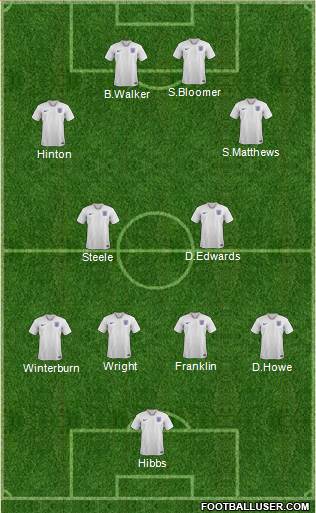
The starting lineup is very old. Nigel Winterburn is the only player whose career took place before the 1960's. David Nish could challenge his Winterburn's position. Billy Wright and Neil Franklin might not be a good pair. They were similar type of defender. I do not really know if Freddie Steele could drop deeper than inside left.
Formation