This blogger Artur Yanturin of Russia copied many of my blog teams. This blog was one of them. It was my Russia All-Time Team here. His team was written in 2020, but mine was uploaded in 2014. His Spartak Moscow All-Time team entry of was published in October 2020, but mine was uploaded in 2017. His entry of the Dutch-German rivalry between Real Madrid and Barcelona was written in 2020, but mine was uploaded in 2014. He also copied many many of my blog entries.
 |
| Juan Mata and Santi Cazorla |

Some of the best posts from this blog have been turned into a two-volume book: The Multiverse of the Beautiful Game: National Teams of Pure Fantasy.
Volume 1 takes you back in time and asks the questions every football fan has dreamed about. What if Brazil had a more beautiful team in 1982 — would they have cruised to the title? What if the United Kingdom could send its team to the 1970 World Cup? I believe they would have been the strongest side on earth. What if Argentina had fielded both Omar Sivori and Alfredo Di Stéfano together in 1958? And what if in the same World Cup, Di Stéfano could play with Kubala, Gento, Basora, Luis Suarez Miramontes and Ramallets? What if Johan Cruyff had lined up alongside Marco van Basten, Ruud Gullit, and Frank Rijkaard? What if Eusébio had played for Brazil? And that's only scratching the surface — Volume 1 is packed with legendary "what ifs" that will keep you turning pages.
Volume 2 brings the fantasy closer to home. What if England had Michael Olise, Erling Haaland and others in 2026 — could they go all the way? What if Yugoslavia had gone to the World Cup in 2018? Could Spain have won the 2010 World Cup without Catalan players? Could Catalonia do it alone? And could they have won Euro 2024 with only Basque players? The Williams brothers, Zubimendi and Laporte? What if Basque could recruit Otamendi, Griezmann , etc? What if the United States could select more players in 2010? It would be the greatest American side ever. And what if Cristiano Ronaldo and Lionel Messi had actually played for the same national team in 2006? It could have happened — if the soccer gods had smiled on us.
Please also see my All-Time World Cup Team Index.
Basque, Catalonia, Castile without Madrid players, Madrid Community, Andalusia, Valencian Community, Galicia, Aragon.
This is my selection of all-time 23 member team for Asturias.
Asturias is situated in a mountainous setting with vast greenery and lush vegetation, making it part of Green Spain. The region has a maritime climate. It receives plenty of annual rainfall and little sunshine by Spanish standards and has very moderated seasons, most often averaging in the lower 20s celsius. Heatwaves are rare due to mountains blocking southerly winds. Winters are very mild for the latitude, especially near sea level.
The most important cities are the communal capital, Oviedo, the seaport and largest city Gijón, and the industrial town of Avilés. Asturias has two main football teams: Sporting de Gijón and Real Oviedo, which have played over 35 seasons in La Liga.
On 23 December 2000, the Royal Asturian Football Federation rescued the Regional team to play a friendly game at Estadio Carlos Tartiere against Macedonia. Juanele scored the only goal of the match, with 30,000 people filling the stadium in Oviedo. Asturias played two more games, against Lithuania in Gijón and Honduras in Avilés, ending its revival unbeaten
Team
During his career he played solely for Sporting de Gijón after being a product of the club's famed youth system, Mareo, and received his first-team debut on 2 January 1983. He earned 4 caps for Spain, the first coming on 24 September 1986 in a 3–1 friendly victory over Greece in Gijón. He was a backup in both the 1986 and 1990 World Cups. He won four Ricardo Zamora Trophy 3 times.
GK: Jesús Castro
Castro spent his entire professional career with neighbouring club Sporting de Gijón, signing on 11 March 1968 from local amateurs CD Ensidesa. From 1971 until 1985, Castro all but competed in the top tier. He was the younger brother of Quini. He died on the Cantabrian beach of Amió after saving the lives of two English children and their father who were drowning.
GK: Óscar Álvarez
Oscar Alvarez played his entire club career in Oviedo. In 1928, he was one of the main promoters of the merger between Stadium Ovetense and Real Club Deportivo Oviedo to become Real Oviedo. He would defend the Real Oviedo shirt, acting as captain, from the first day of its existence until the Civil War interrupted soccer competitions in Spain. For the national team, he was a backup to Ricardo Zamora.
RB: Jose Carrete
Jose Carrete started with Real Oviedo and gained promotion from the Segunda División with them in 1974–75, although following their subsequent relegation he was transferred to Valencia in 1976. He was then a member of the successful Valencia side that won the 1980 European Cup Winners' Cup Final against Arsenal. He capped twice in 1978.
Born in Asturias, he moved to Catalonia at just two months old. He started with Espanyol at the age of 18 years. Due to the Spanish Civil War , his career was interrupted. Except brief stops at RCD Mallorca, Racing de Santander and UE Sant Andreu , he played his career at RCD Espanyol for 13 seasons. He was capped 4 times for Spain between 1941 and 1942.
CB: Marcelo Campanal
Marcelo Campanal was known as "Campanal II" because his uncle Guillermo Campanal was better known as "Campanal I", who was the manager of Sevilla. He played for sixteen seasons at Sevilla FC between 1950 and 1966. He later played two seasons with Deportivo La Coruna , CD Iliturgi and his final season as a professional in the Real Aviles CF. He earned 11 caps with the national team between 1952 and 1957.
Marcelo Campanal was known as "Campanal II" because his uncle Guillermo Campanal was better known as "Campanal I", who was the manager of Sevilla. He played for sixteen seasons at Sevilla FC between 1950 and 1966. He later played two seasons with Deportivo La Coruna , CD Iliturgi and his final season as a professional in the Real Aviles CF. He earned 11 caps with the national team between 1952 and 1957.
 |
| Marcelo Campanal |
CB: César Martín
Over the course of 13 seasons César Martín appeared in 200 La Liga games, mostly in representation of Real Oviedo and Deportivo, after which he had a six-month spell in England with Bolton Wanderers. He spent 7 seasons with Deportivo La Coruna mainly as a backup when they won one league, one Copa del Rey and two Supercopa de España trophies. Between 1999 and 2004, he played 12 times for Spain. César was included in the Euro 2004 squad, but did not play.
CB: Tensi
Born in the village of Sama, Asturias, Tensi started playing football in the Trojan teams and the Alcazar Football Club until he was signed by Real Oviedo on 30 December 1964. He made his first time debut in 1966. He spent 14 seasons with the club and was considered one of their greatest footballers. He is their third in appearance record for the club.
During his career Abelardo Fernández was almost exclusively associated with Sporting de Gijón and Barcelona, having amassed La Liga totals of 385 matches and 24 goals between 1989 and 2003. He also played for Alves. Having won more than 50 caps for Spain between 1991 and 2001, he went to two World Cups (1994 and 1998) and as many European Championships (1996 and 2000). He also won a Gold medal at the 1992 Summer Olympics.
 |
| Abelardo Fernández |
LB: Julio Alberto
Julio Alberto came through the ranks of Atlético Madrid, and also serving a Segunda División loan stint with Recreativo de Huelva in 1979–80. In 1982, he joined Barcelona. He did well in the early art of his career, but from 1988 to 1991, however, he was mainly a backup as the "Dream Team" was coming to fruition. He earned 34 caps for Spain. He appeared in all games for Euro 1984 and the 1986 FIFA World Cup
LB/LW: Francisco Uría
Uría started with Real Oviedo in the 1972–73 season. After the team's relegation the following year he signed with Real Madrid, being relatively used in two of his three seasons and winning his entire silverware. In 1977, he moved to Sporting de Gijón, where they achieved three top-five finishes and played in the UEFA Cup. He earned 14 caps for Spain during seven years, and participated in the 1978 World Cup and Euro 1980.
 |
| Francisco Uría |
Paquito was born in Asturias. Over the course of 14 seasons, he played 327 La Liga games in representation of Real Oviedo and Valencia CF. In the 1970–71 campaign, he appeared in 27 matches (all starts) and netted three times as the latter team won their fourth national championship, the first in 24 years. He earned nine caps for Spain during nearly five years.
AM/CM: Santi Cazorla
Santi Cazorla began his professional career at Villarreal in 2003, where he was Spain's Player of the Year: 2006–07. After spending a season with Malaga, he moved to Arsenal in 2012, where he stayed until 2018, winning a FA Cup in 2014. Between 2008 and 2019, he played 81 times for Spain. He was a semi-regular participant in the nation's triumphs at UEFA Euro 2008 and Euro 2012. He attended the 2014 World Cup Finals.
CM: Manuel Meana
Manuel Meane was the first Asturian to play for Spain. He made his debut with Spain in 1921. In total, he played seven games and became the captain of the national team. He attended the 1924 Summer Olympics. He spent his entire career with Real Sporting de Gijón. He was a member of the Asturian regional team that won the Copa Príncipe de Asturias de fútbol in 1923 , after beating Galicia in the final held in Vigo.
CM/RM/UT: Luis Enrique
Luis Enrique started his career with Sporting Gijon in 1989. From 1991 to 1996, he played for Real Madrid. In 1996, he moved to Barcelona, where he played for 8 seasons. At the international level, Luis Enrique played for Spain in three World Cups: 1994, 1998 and 2002 as well as UEFA Euro 1996), and scored 12 goals while gaining 62 caps. He was also a member of the gold-winning squad at the 1992 Summer Olympics in Barcelona.
Luis Enrique started his career with Sporting Gijon in 1989. From 1991 to 1996, he played for Real Madrid. In 1996, he moved to Barcelona, where he played for 8 seasons. At the international level, Luis Enrique played for Spain in three World Cups: 1994, 1998 and 2002 as well as UEFA Euro 1996), and scored 12 goals while gaining 62 caps. He was also a member of the gold-winning squad at the 1992 Summer Olympics in Barcelona.
 |
| Luis Enrique |
Juan Mata was a youth academy player for Real Madrid, but he started with Valencia in 2007. From 2011 to 2014, he played for Chelsea, where he was a major star for the team. After a fallout with Jose Mourinho, he moved to Manchester United. Ironically, they would reunite again at Old Trafford. For Spain, he was a part of the team that won the World Cup in 2010 and the European Championship two years later.
AM: Joaquín
During his 16-year professional career, he played solely for Sporting de Gijón even though he was born in the city of neighbouring Real Oviedo. After 17 appearances and one goal in his debut season in La Liga he became an undisputed starter, going on to take part in a further 462 top-division games until June 1992 (644 overall).Joaquín earned 18 caps and scored once for Spain, and was selected to the 1982 World Cup squad.
AM/FW/RB: Miguel Ángel Angulo
Angulo began his football career with local Sporting de Gijón, joining Valencia CF in 1995 at the age of 18. He spent most of his career at Valencia where he won a total of 7 major titles, including two La Liga championships and the 2004 UEFA Cup. he also played briefly for Villarreal and Sporting SP. He had a total of 11 caps for Spain, scoring 4 goals between 2004 and 2007.
FW: Javier Manjarín
In a 14-year professional career, Javier Manjarín played mainly for Sporting de Gijón (four seasons) and Deportivo de La Coruña (six seasons). He was considered one of Deportivo's greatest attackers. He also played for Racing de Santander. He moved to play in Mexico in his later years. He had 13 caps for Spain. He went to the European Championship in 1996. He also won a Gold medal at the 1992 Olympics held in Barcelona.
In a 14-year professional career, Javier Manjarín played mainly for Sporting de Gijón (four seasons) and Deportivo de La Coruña (six seasons). He was considered one of Deportivo's greatest attackers. He also played for Racing de Santander. He moved to play in Mexico in his later years. He had 13 caps for Spain. He went to the European Championship in 1996. He also won a Gold medal at the 1992 Olympics held in Barcelona.
 |
| Javier Manjarín |
ST: Eloy
During his career, Eloy played for Sporting de Gijón (being part of a strong 80's team) where he made his debut as a 15 years old. He played for Valencia CF between 1988 and 1995. and CD Badajoz (retiring after an unassuming Segunda División spell). Eloy earned 15 caps and scored four goals for Spain. He played in the 1986 World Cup Finals, where he scored against Algeria.
ST: David Villa
David Villa is the all-time leading scorer for Spain. He was known for a part of the Golden Generation for Spain, where Spain won three straight international titles: Euro 2008, the World Cup 2010 and Euro 2012. He was the Golden Boot winner at Euro 2008 and the Silver boot in the 2010 World Cup Finals. He was best remembered for his club career with Valencia. He also played for Barcelona, Seville and New York City FC.
 |
| David Villa |
Herrerita started with local Sporting de Gijón. In 1933 he moved to neighbouring Real Oviedo for a then-record 30.000 pesetas.
During the better part of the following 15 years, Herrerita would be part of an attacking line that would be dubbed Delanteras Eléctricas (Electric Forwards). He was Real Oviedo's all-time top scorer in La Liga, with 117 goals in 213 games. He played six games with Spain, during three years between 1934 and 1947.
ST: Quini
In a career totally connected with Sporting de Gijón and FC Barcelona, Quini was widely regarded as one of the country's best strikers, having won a total of seven Pichichi Trophy awards, five of those in La Liga. He won the Don Balón Award – Best Spanish Player for the 1978–79 season. With a total of 35 caps and eight goals, Quini participated in two World Cups, 1978 and 1982, as well as UEFA Euro 1980. He was also remembered for being kidnapped in 1981.
 |
| Quini |
Esteban, Juanjo González, Óscar Rodríguez López, Chus Herrera, Guillermo Campanal, Jose Maria, Enrique Morán, Ricardo Bango, Adrián López, Juanjo González, Luis Manuel, Vili, Marcelino Elena, Cundi, José Ángel Valdés Díaz, Javier Paredes, Chus Herrera, Emilín, Galé, Toni Cuervo, Eloy, Chus Alonso, Emilin, Michu, Oli, Adrián López, Berto, Cote, Sergio Boris, Juanele, Luis Garcia Fernández, Ricardo Bango
Paquito Garcia, Marcial.
Paquito Garcia, Marcial.
Special Recognition
Robert Pires (France), Diego Johannesson (Iceland).
Squad Explanation
-- David Villa is the all-time leading scorer for Spain. Luis Enrique, Quini, Juan Mata and Marcelino Campanal were the other disputed selections for this team. I considered them to be their greatest ever players.
-- Approximately, 40 Asturian players have played for Spain at the time of writing. In 1921, Manuel Meana was the first Spanish international from Gijón.
 |
| Manuel Meana |
-- I used overseas Basque and Catalonian players for my respectively all-time teams. I found many information on these players online. However, I could not really find much information on Asturias diaspora. Robert Pires was the only player of note I found. I was certain that there must be some great Asturian footballers from Uruguay or Argentina around.
-- Asturias featured three players during the glorious period of the Spanish national team between 2008 and 2012. However, the three of them did not win the same tournament together. Juan Mata had not played for the senior national team in 2008. Santi Cazorla missed the 2010 World Cup while David Villa did not attend Euro 2012 because of injuries. The three went to the 2014 World Cup Finals.
-- Abelardo, Javier Manjarín and Luis Enrique went to Euro 1996 together. The three of them also won the Olympic Gold medal in the 1992 Olympics. Luis Enrique appeared in three World Cups and one European Championship. He played with Abelardo since they were 6 years old. The pair also went to the 1994 World Cup Finals with Juanele.
-- The 1986 World Cup also saw Eloy, Julio Alberto and Juan Carlos Ablanedo in the squad. Joaquín and Quini also went to the 1982 World Cup Finals. Quini played in two World Cup Finals. César was included in the Euro 2004 squad
-- The goalkeeper selections were limited. Juan Carlos Ablanedo
and Jesús Castro were considered to be Sporting Gijon's greatest goalkeepers. Ablanedo was capped by Spain. Several websites listed him among the greatest in Spain's history. As mentioned above, he was a backup goalkeeper in two major tournaments, but he won three Zamora trophies. Jesús Castro died while rescuing two young boys from drowning. The city of Oviedo dedicated a street to him in the La Corredoria neighborhood. Along with his football career, he was a folk hero in Asturia. His brother Quini was probably one of the region's greatest footballers. Óscar Álvarez was a forgotten player. He helped the merger of Stadium Ovetense and Real Club Deportivo Oviedo to create Real Oviedo. He acted as the club's captain. He also represented Spain in the Olympics, but was a sub for Ricardo Zamora throughout his international career. Estaban who played over 200 La Liga matche and Juanjo González made honorable mention.
-- Marcelino Campanal was considered the greatest ever defender for Sevilla. Abelardo Fernández played 54 times for Spain. They were undisputed selections for central defenders.
-- Tensi never played for Spain, but he spent 14 years with Real Oviedo. He was third in appearance record for the club. I rewarded him a spot for being a star in a local club. By comparison, Luis Manuel had 4 caps for Spain and also played for Real Oviedo. In Real Oviedo, however, Tensi was a much more legendary player than Luis Manuel. The last spot was between César Martín and Marcelino Elena. Both of them was plagued with injuries during their careers. They failed to make a grade in the bigger clubs. César Martín was capped 12 times, but was mainly as a backup during Deportivo La Coruna's La Liga winning season. Marcelino Elena did find some successes with Mallorca, but only earned 5 caps. In end, I took César Martín for his caps.
-- Sergio Boris then joined Real Sociedad in 2002, being an historic signing as he was the first Spanish native player from outside the Basque Country to be signed by the club for 35 years. I did not know how good he was.
-- I only had two realistic rightbacks to choose from: Jose Carrete and Ricard Garcia Teruel. I do not know anything about the ethnic background of Armando Álvarez who was born in France. His name was on my initial list of potential selections. Diego Johannesson who played for Iceland was also born here.
-- Julio Alberto was the obvious choice for leftback. He had 34 caps for Spain. The Sporting de Gijón fans might considered Cundi over Francisco Uría, but Francisco Uría went to two major tournaments for Spain. He also did relatively well with Real Madrid. He also played as a winger.
 |
| Julio Alberto |
-- The midfield was the strongest section on this team. Luis Enrique and Manuel Meana who was first Asturian to cap for Spain were my first two selections. Both Santi Cazorla and Juan Mata belonged to Spain's glorious period between 2008 and 2012. They also established themselves in the Premiership. The four players were easy choices for midfielders.
-- Juan Mata was born in Burgos, where his father was playing football. He grew up in Oviedo. He is often listed as an Asturian footballer. I had no doubt about his eligibility.
-- Then, I took Miguel Ángel Angulo for his versatility. I also needed someone who could operate as a right winger. Joaquín Alonso González played sixteen seasons with Sporting, where he set the record for games in the First Division (479). He was a local hero. His name was frequently mentioned as an all-timer from here.
-- Marcial Pina had a remarkable career with Barcelona FC, but I did not have a spot for him. Juan Mata, Santi Cazorla and Miguel Ángel Angulo were ahead of him.
-- Luis Garcia who played for Espanyol made honorable mention. He was born in Oviedo. I was not honoring the Luis Javier García Sanz who played for Barcelona, Liverpool and Atletico Madrid. He was born in Catalonia. Both played roughly around the same time.
-- It would have been nice if I could select Robert Pires whose mother was a native of Asturias, but I stayed with Spanish internationals. I have selected Jose Santamaria for my Galicia all-time team because he was also capped by Spain.
-- Chus Alonso was born in Cuba of Asturian parents. He played for Spain. I put him on honorable mention.
-- Chus Herrera was mainly used as a backup to the likes of Alfredo Di Stéfano, Francisco Gento, Raymond Kopa, Ferenc Puskás and Héctor Rial. He had a few memorial games for Real Madrid in that period, which made him well-known during his era. He went to Real Sociedad in 1962, but sadly he died at the age of 24 shortly after his arrival. Perhaps, he would have became a greater player if he had a longer career.
-- David Villa and Quini were undisputed selection for forwards. Then, I selected Javier Manjarín who was listed as one of Deportivo La Coruna's greatest players. The trio was very well-known in the modern era.
-- Quini was also remembered for being kidnapped for 25 days in 1981. He won Pichichi Trophy 5 times and two more times in Segunda División.
-- The attacking quartet of Emilín, Galé, Herrerita and Isidro Lángara of Real Oveido all represented Spain in this period. Isidro Lángara was actually a Basque, and he also played for Basque. He was ineligible for this team. For this quartet, I only had a space for Herrerita. Herrerita was listed among the greatest footballers in the region. He was Real Oviedo's all-time top scorer in La Liga, with 117 goals in 213 games.
-- Guillermo Campanal was the uncle of Marcelo Campanal. Liked his nephew, he was a Sevilla's legends. He might be the biggest name missing on this team. Toni Cuervo was a star with Real Oviedo. Michu, Oli and Adrián López were also considered.
-- I did not have a space for Juanele who went to the 1994 World Cup Finals. Instead, I took Eloy from the 1986 World Cup Finals. He had 15 caps against Juanele's 5. Furthermore, he played for Sporting de Gijón during its greatest period of time.
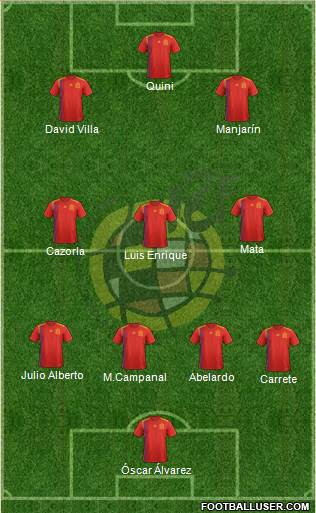
Formation
Most information suggested that Juan Carlos Ablanedo was Asturias' greatest goalkeeper, but I started with Óscar Álvarez who was associated with Ricardo Zamero. Luis Enrique and Santi Cazorla could drop deeper than Juan Mata.