This blogger Artur Yanturin of Russia copied many of my blog teams. This blog was one of them. It was my Russia All-Time Team here. His team was written in 2020, but mine was uploaded in 2014. His Spartak Moscow All-Time team entry of was published in October 2020, but mine was uploaded in 2017. His entry of the Dutch-German rivalry between Real Madrid and Barcelona was written in 2020, but mine was uploaded in 2014. He also copied many many of my blog entries.
Please also see my All-Time World Cup Team Index.
South America without Brazil and Argentina.
Argentina, Brazil, Uruguay, Peru, Colombia,
Chile, Paraguay, Ecuador, Bolivia, Venezuela.
 |
| World Cup 1930 |
South America without Brazil and Argentina.
Argentina, Brazil, Uruguay, Peru, Colombia,
Chile, Paraguay, Ecuador, Bolivia, Venezuela.
Club Nacional
This is my all-time team for Uruguay. If there were an All-Time World Cup, this would be the 23 players I would bring to the tournament.
Uruguay is a tiny country with a population of 3 million, but they are one of the best football nations in the world. They dominated international football in the 1930's, winning the 1924 and 1928 Olympic Gold medals. Because of their successes, FIFA decided to award Uruguay as the first ever World Cup host in which they went on to win it. In 1950, Uruguay inspired by Obdulio Varela pulled a big upset in Brazil, a game that broke the hearts of the Brazilians. La Celeste also produced great team in 1970 and 2010. Uruguay also have won the Copa América 15 times, alongside Argentina the most titles in the history of that tournament. Uruguay's most recent title being the 2011 edition.
This is my Uruguay All-Time team. If there were an All-Time World Cup, this would be the 23 players I would bring to the tournament.
Team
GK: Ladislao Mazurkiewicz
Ladislao Mazurkiewicz is considered one of the greatest keepers from South America. He had 37 caps for the national team. He led Uruguay to the semifinal of the World Cup in 1970. He was also a participant at the World Cup Finals of 1966 and 1974. He was voted the best keeper at the tournament. He played with Peñarol at home between 1964 and 1970 before moving to play in Brazil, Spain, Chile and Colombia.
GK Roque Maspoli
Maspoli began playing in the youth ranks of Club Nacional de Football. He would make his Uruguayan Primera División debut with Liverpool de Montevideo in 1939. After one season with Liverpool, he joined C.A. Peñarol. He would spend the rest of his playing career with Peñarol, winning six Primera titles with the club. He was Uruguay's keeper at the World Cup in 1950, where they won it by breaking the hearts of the Brazilians.
GK: Andrés Mazali
Andrés Mazali won two Olympic Gold Medals in 1924 and 1928. He won three South American Championship, prior to the 1930 World Cup Finals, but he was banned playing in the 1930 World Cup Finals after breaking the team's curfew in the days leading up to the start of the first FIFA World Cup in Uruguay. Mazali was a member of the Nacional side that won three consecutive domestic titles between 1922 and 1924.
RB/DM: Jose Leandro Andrade
His nickname was "the Black Marvel' (maravilla negra). He was regarded as the best player at that World Cup and perhaps, in the world at the time. Andrade played for Montevideo club Misiones before signed by Bella Vista. It was at Bella Vista that he was first selected for the national team. Andrade later moved to Nacional where he won four Uruguayan Championships and three national cups. Andrade transferred to Peñarol in 1930 where he played 88 matches over the next few years.
RB/CB: Jose Nasazzi
Jose Nasazzi was the captain of Uruguay's legendary team that won the World Cup in 1930. He is regarded by many as Uruguay's greatest ever football player. He was known as "El Gran Mariscal" (The Great Marshal) and had already won the gold medal at the 1924 and 1928 Olympic Games, as well as the South American Championship in 1923, 1924 and 1926, by the time of the first World Cup.
CB: Jose Santamaria
Jose Santamaria was a member of Real Madrid's all-conquering team of the late 1950's. He spent his 18-year career with Nacional and Real Madrid, winning 17 major titles the two teams combined, Between 1957 and 1966, Santamaria won four European Cups with Real Madrid playing alongside Alfredo Di Stefano. He was considered one of the best ever center-backs. He played for Uruguay at the 1954 World Cup Finals, but played for Spain 4 years later in Sweden.
CB: Darío Pereyra
Darío Pereyra was one of the best center-backs ever to play in the Brazilian league. He was best remembered for his career with Sao Paulo between 1977 and 1988. He was also at one point the second most expensive player in the league. Darío Pereyra started his career at the Nacional de Montevideo and debuted at the Uruguay national squad when he was only 18, becoming the captain of the national team at 19.
This is my all-time team for Uruguay. If there were an All-Time World Cup, this would be the 23 players I would bring to the tournament.
This is my Uruguay All-Time team. If there were an All-Time World Cup, this would be the 23 players I would bring to the tournament.
 |
| World Cup 1950 |
GK: Ladislao Mazurkiewicz
Ladislao Mazurkiewicz is considered one of the greatest keepers from South America. He had 37 caps for the national team. He led Uruguay to the semifinal of the World Cup in 1970. He was also a participant at the World Cup Finals of 1966 and 1974. He was voted the best keeper at the tournament. He played with Peñarol at home between 1964 and 1970 before moving to play in Brazil, Spain, Chile and Colombia.
GK Roque Maspoli
Maspoli began playing in the youth ranks of Club Nacional de Football. He would make his Uruguayan Primera División debut with Liverpool de Montevideo in 1939. After one season with Liverpool, he joined C.A. Peñarol. He would spend the rest of his playing career with Peñarol, winning six Primera titles with the club. He was Uruguay's keeper at the World Cup in 1950, where they won it by breaking the hearts of the Brazilians.
GK: Andrés Mazali
Andrés Mazali won two Olympic Gold Medals in 1924 and 1928. He won three South American Championship, prior to the 1930 World Cup Finals, but he was banned playing in the 1930 World Cup Finals after breaking the team's curfew in the days leading up to the start of the first FIFA World Cup in Uruguay. Mazali was a member of the Nacional side that won three consecutive domestic titles between 1922 and 1924.
RB/DM: Jose Leandro Andrade
His nickname was "the Black Marvel' (maravilla negra). He was regarded as the best player at that World Cup and perhaps, in the world at the time. Andrade played for Montevideo club Misiones before signed by Bella Vista. It was at Bella Vista that he was first selected for the national team. Andrade later moved to Nacional where he won four Uruguayan Championships and three national cups. Andrade transferred to Peñarol in 1930 where he played 88 matches over the next few years.
 |
| Jose Leandro Andrade |
Jose Nasazzi was the captain of Uruguay's legendary team that won the World Cup in 1930. He is regarded by many as Uruguay's greatest ever football player. He was known as "El Gran Mariscal" (The Great Marshal) and had already won the gold medal at the 1924 and 1928 Olympic Games, as well as the South American Championship in 1923, 1924 and 1926, by the time of the first World Cup.
CB: Jose Santamaria
Jose Santamaria was a member of Real Madrid's all-conquering team of the late 1950's. He spent his 18-year career with Nacional and Real Madrid, winning 17 major titles the two teams combined, Between 1957 and 1966, Santamaria won four European Cups with Real Madrid playing alongside Alfredo Di Stefano. He was considered one of the best ever center-backs. He played for Uruguay at the 1954 World Cup Finals, but played for Spain 4 years later in Sweden.
 |
| Jose Santamaria |
Darío Pereyra was one of the best center-backs ever to play in the Brazilian league. He was best remembered for his career with Sao Paulo between 1977 and 1988. He was also at one point the second most expensive player in the league. Darío Pereyra started his career at the Nacional de Montevideo and debuted at the Uruguay national squad when he was only 18, becoming the captain of the national team at 19.
CB: Paolo Montero
Paolo Montero began his career in Uruguay with Peñarol in 1990, before moving to Italian side Atalanta in 1992. He joined Juventus in 1996, spending 9 seasons there. He won 4 scudetti titles, but failed to win a Champions League despite playing in 3 Finals. He also played for San Lorenzo. With La Celeste, he was capped 61 times. He went to 2002 World Cup Finals in Korea/Japan. His father is former Uruguay international Julio Montero Castillo.
CB: Diego Godin
With Uruguay, he reached the World Cup semifinal in 2010 and won a Copa America in 2011. Godín started his professional career with C.A. Cerro at the age of 17. After his good performances, he was transferred to top division powerhouse Club Nacional de Football. In 2007, Godín signed a five-year deal with La Liga side Villarreal CF. He joined Atletico Madrid in 2010. He was a key player for Atletico Madrid when they upset Real Madrid and Barcelona for the La Liga title in 2013-2014.
Paolo Montero began his career in Uruguay with Peñarol in 1990, before moving to Italian side Atalanta in 1992. He joined Juventus in 1996, spending 9 seasons there. He won 4 scudetti titles, but failed to win a Champions League despite playing in 3 Finals. He also played for San Lorenzo. With La Celeste, he was capped 61 times. He went to 2002 World Cup Finals in Korea/Japan. His father is former Uruguay international Julio Montero Castillo.
CB: Diego Godin
With Uruguay, he reached the World Cup semifinal in 2010 and won a Copa America in 2011. Godín started his professional career with C.A. Cerro at the age of 17. After his good performances, he was transferred to top division powerhouse Club Nacional de Football. In 2007, Godín signed a five-year deal with La Liga side Villarreal CF. He joined Atletico Madrid in 2010. He was a key player for Atletico Madrid when they upset Real Madrid and Barcelona for the La Liga title in 2013-2014.
 |
| Diego Godin |
LB/LM: Victor Rodriguez Andrade
Jose Leandro Andrade's nephew. He won the 1950 WC in Brazil . He was Uruguay's greatest left midfielder(or leftback). He played mainly with Peñarol at home. Rodríguez Andrade also played at the 1954 World Cup and won the 1956 South American Championship with Uruguay, and at the club level, he won two Uruguayan First Division titles with C.A. Peñarol.
LB: Ricardo Pavoni
In Uruguay, Ricardo Pavoni played for Defensor. Affectionately known as "El Chivo", he was considered one of Uruguay's top left backs. In 1965, he joined Independiente in Argentina. He was a part of the great Independiente of the 1970's that won 5 Copa Libertadores. He was an idol at the club. He was capped 13 times. He was a member of the 1974 World Cup team in West Germany.
DM: Obdulio Varela
Known as the "Black Chief", Obdulio Varela was the captain of the 1950 World Cup team. His leadership was credited with helping Uruguay to come from behind to beat Brazil. He is considered one of the best players ever from Uruguay. He debuted in first division with Montevideo Wanderers in 1938. In 1943, he joined C.A. Peñarol, club for which he would play until his professional retirement in 1955. He is considered one of the earliest Black star players in the football.
RM: Luis Cubilla
Jose Leandro Andrade's nephew. He won the 1950 WC in Brazil . He was Uruguay's greatest left midfielder(or leftback). He played mainly with Peñarol at home. Rodríguez Andrade also played at the 1954 World Cup and won the 1956 South American Championship with Uruguay, and at the club level, he won two Uruguayan First Division titles with C.A. Peñarol.
LB: Ricardo Pavoni
In Uruguay, Ricardo Pavoni played for Defensor. Affectionately known as "El Chivo", he was considered one of Uruguay's top left backs. In 1965, he joined Independiente in Argentina. He was a part of the great Independiente of the 1970's that won 5 Copa Libertadores. He was an idol at the club. He was capped 13 times. He was a member of the 1974 World Cup team in West Germany.
DM: Obdulio Varela
Known as the "Black Chief", Obdulio Varela was the captain of the 1950 World Cup team. His leadership was credited with helping Uruguay to come from behind to beat Brazil. He is considered one of the best players ever from Uruguay. He debuted in first division with Montevideo Wanderers in 1938. In 1943, he joined C.A. Peñarol, club for which he would play until his professional retirement in 1955. He is considered one of the earliest Black star players in the football.
 |
| Obdulio Varela |
Luis Cubilla was a part of Penarol that won two Copa Libertadores in the 1960 and 1961, and he won one more with Nacional in 1971. He also played for Barcelona, River Plate of Argentiona, Santiago Morning of Chile and Defensor Sporting of Uruguay where he helped the club to win their first league championship and break the complete dominance of the league by Peñarol and Nacional. For Uruguay, he played in three WC Finals: 1966, 1970 and 1974.
RW: Alcides Ghiggia
Alcides Ghiggia scored the winning goal against Brazil in the 1950 World Cup Finals that sealed the World Cup for Uruguay. The match was known as the "Maracanazo". He played for the national sides of both Uruguay and Italy during his career. He had 12 caps with Uruguay and another 5 for Italy between 1957 and 1959. At the club lebel, he played for the club sides of the Peñarol and Danubio in Uruguay and A.S. Roma and A.C. Milan in Italy.
LW/SS: Pedro Rocha
Pedro Rocha won 8 Uruguayan league titles and 3 Copa Libertadores with Penarol from 1959 to 1970. He moved to São Paulo in 1970. He spent 7 successful seasons with the club. He was the league's top scorer in 1972. For the national team, he is the only player to appear in four consecutive World Cups for the Uruguay national football team: 1962, 1966, 1970 and 1974. He also played in the Copa América in 1967.
RW: Alcides Ghiggia
Alcides Ghiggia scored the winning goal against Brazil in the 1950 World Cup Finals that sealed the World Cup for Uruguay. The match was known as the "Maracanazo". He played for the national sides of both Uruguay and Italy during his career. He had 12 caps with Uruguay and another 5 for Italy between 1957 and 1959. At the club lebel, he played for the club sides of the Peñarol and Danubio in Uruguay and A.S. Roma and A.C. Milan in Italy.
 |
| Alcides Ghiggia |
LW/SS: Pedro Rocha
Pedro Rocha won 8 Uruguayan league titles and 3 Copa Libertadores with Penarol from 1959 to 1970. He moved to São Paulo in 1970. He spent 7 successful seasons with the club. He was the league's top scorer in 1972. For the national team, he is the only player to appear in four consecutive World Cups for the Uruguay national football team: 1962, 1966, 1970 and 1974. He also played in the Copa América in 1967.
SS/LW/FW: Ángel Romano
Ángel Romano played 70 games for Uruguay between 1911 and 1927, scoring 28 goals. He won the Copa América 6 times. He won the football Gold medal in the 1924 Olympics. Romano played club football for Nacional between 1910 and 1930, scoring 164 goals in 388 games. The club won 22 titles during his time as a player. He won a total of 32 official titles in his career, 46 including the friendly tournaments. He retired at the age of 37.
AM: Enzo Francescoli
Enzo Francescoli is Known as "the Prince". He was Uruguay's most capped outfield player. He was a big fan favorite in River Plate where he won Copa Libertadores in 1996. He also played in France and Italy. With Uruguay, he won three Copa America's in 1983, 1987 and 1995, where he was voted the best player in two of the tournaments. He played in two World Cup Finals. He was also South America Player of the Year in 1984 and 1995.
SS: Juan Schiaffino
At international level, Juan Schiaffino on the 1950 FIFA World Cup with the Uruguayan national team, and also took part at the 1954 FIFA World Cup; he later also represented the Italy national football team. He was considered one of the greatest Uruguayan players in history. For club level, he played in Uruguay for Penarol and in Italy with Milan and Roma.
FW: Hector Scarone
Scarone was known to be Uruguay's greatest players during the 1930's. He was a Double Olympic Gold medalist and won the 1930 World Cup Finals. He scored 31 goals for Uruguay. He was Uruguay's all-time leading scorer until 2011. At club level, Scarone spent most of his career with Nacional, with whom he won the Uruguayan championship eight times. He scored a total of 301 goals for the club in 369 appearances. He also played for Spanish side FC Barcelona, and Inter Milan and Palermo in Italy.
ST: Pedro Petrone
Throughout his career, Petrone played for Nacional, where he won two National Tournaments (1924, 1934), and in Italy with Fiorentina, where he was the top goalscorer in Serie A during the 1931–32 season). Whilst in Italy, Petrone was said to be the fastest player in the League. He was a double Olympic Gold medalist in 1924 and 1928, where he was the top scorer in 1924. He also won the World Cup in 1930.
ST: Diego Forlan
Diego Forlan's career in Europe started slowly, but his career finally took off after heading to Spain in 2004. He was two-time European Golden Shoe winner in 2004-2005 and then, 2008-2009. His best years were with Villarreal and Atletico Madrid, winning the UEFA Europa League with the latter. At the international level, he had 112 caps, leading Uruguay to the 2011 Copa America title as well the semi-final of the 2010 World Cup Finals. He won the Golden Ball at South Africa 2010.
ST: Edinson Cavani
With Napoli, Cavani was the Serie A top scorer in the 2012-2013 season. He moved to Paris St Germain in 2013, where the club dominated French football. At the time of writing, he is the club's all-time leading scorer. For Uruguay, he earned over 100 caps starting in 2008. He helped Uruguay to reach the semifinal in the 2010 World Cup Finals and won the Copa America in 2011.He also played in 2014 and 2018 World Cup Finals.
Enzo Francescoli is Known as "the Prince". He was Uruguay's most capped outfield player. He was a big fan favorite in River Plate where he won Copa Libertadores in 1996. He also played in France and Italy. With Uruguay, he won three Copa America's in 1983, 1987 and 1995, where he was voted the best player in two of the tournaments. He played in two World Cup Finals. He was also South America Player of the Year in 1984 and 1995.
 |
| Enzo Francescoli |
At international level, Juan Schiaffino on the 1950 FIFA World Cup with the Uruguayan national team, and also took part at the 1954 FIFA World Cup; he later also represented the Italy national football team. He was considered one of the greatest Uruguayan players in history. For club level, he played in Uruguay for Penarol and in Italy with Milan and Roma.
FW: Hector Scarone
Scarone was known to be Uruguay's greatest players during the 1930's. He was a Double Olympic Gold medalist and won the 1930 World Cup Finals. He scored 31 goals for Uruguay. He was Uruguay's all-time leading scorer until 2011. At club level, Scarone spent most of his career with Nacional, with whom he won the Uruguayan championship eight times. He scored a total of 301 goals for the club in 369 appearances. He also played for Spanish side FC Barcelona, and Inter Milan and Palermo in Italy.
ST: Pedro Petrone
Throughout his career, Petrone played for Nacional, where he won two National Tournaments (1924, 1934), and in Italy with Fiorentina, where he was the top goalscorer in Serie A during the 1931–32 season). Whilst in Italy, Petrone was said to be the fastest player in the League. He was a double Olympic Gold medalist in 1924 and 1928, where he was the top scorer in 1924. He also won the World Cup in 1930.
ST: Diego Forlan
Diego Forlan's career in Europe started slowly, but his career finally took off after heading to Spain in 2004. He was two-time European Golden Shoe winner in 2004-2005 and then, 2008-2009. His best years were with Villarreal and Atletico Madrid, winning the UEFA Europa League with the latter. At the international level, he had 112 caps, leading Uruguay to the 2011 Copa America title as well the semi-final of the 2010 World Cup Finals. He won the Golden Ball at South Africa 2010.
 |
| Diego Forlan |
With Napoli, Cavani was the Serie A top scorer in the 2012-2013 season. He moved to Paris St Germain in 2013, where the club dominated French football. At the time of writing, he is the club's all-time leading scorer. For Uruguay, he earned over 100 caps starting in 2008. He helped Uruguay to reach the semifinal in the 2010 World Cup Finals and won the Copa America in 2011.He also played in 2014 and 2018 World Cup Finals.
ST: Luis Suarez
Luis Suarez both the 2013-2014 FWA and the PFA Player of the Year while playing for Liverpool in England. He was also the European Golden Shoe winner that year. Unfortunately, he was known for biting an opponent at a few occasions. With Barcelona, he was a part of the MSN line. For Uruguay, he helped them to win the Copa America in 2011 and controversially a 4th place finish at 2010 WC Finals.
Luis Suarez both the 2013-2014 FWA and the PFA Player of the Year while playing for Liverpool in England. He was also the European Golden Shoe winner that year. Unfortunately, he was known for biting an opponent at a few occasions. With Barcelona, he was a part of the MSN line. For Uruguay, he helped them to win the Copa America in 2011 and controversially a 4th place finish at 2010 WC Finals.
Honorable Mention
Rodolfo Rodríguez, Cayetano Saporiti, Diego Lugano, Juan Mujica, Luis Ubiña, Roberto Matosas, Ruben Sosa, Fernando Morena, Edinson Cavani, Oscar Miguez, William Martínez, Fernando Muslera, Atilio Ancheta, Hugo de León, Ruben Paz, Gus Poyet, Isabelino Gradín, Schubert Gambetta, Federico Valverde, Julio César Abbadie, Antonio Alzamendi, José Piendibene, Michele Andreolo, Nestor Gonçalves, Álvaro Gestido, Egidio Ríos, Atilio Ancheta, Pedro Cea, Héctor Castro, Isabelino Gradin, Severino Varela, Néstor Gonçalves, Pablo Bengoechea, Arévalo Ríos, Diego Pérez, Alvaro Recoba, Jose Piendibene, Gus Poyet, Walter Gomez, Óscar Míguez, Isabelino Gradín, Fernando Morena, Antonio Alzamendi, Rubén Sosa.
 |
| Copa America 2010 |
Squad Explanation
-- I created this team in November, 2014. I decided to do a completed review of the team in May, 2022. I expanded this section.
-- I created this team in November, 2014. I decided to do a completed review of the team in May, 2022. I expanded this section.
-- Enzo Francescoli, Jose Nasazzi, Hector Scarone, Jose Leandro Andrade, Juan Schiaffino and Obdulio Varela were automatic selection. Luis Suarez, Jose Santamaria and Diego Forlan were very close. They were the greatest ever players from Uruguay.
-- I carried most of the bigger names from the old days, but I also included three modern players, Diego Forlan, Diego Godin and Luis Suarez. All three of them have successful careers playing in Europe. Uruguay also reached the semifinal of the 2010 World Cup Finals. Edinson Cavani, Maxi Pereira and Fernando Muslera also made my honorable mentions. Edinson Cavani was added to this team during the review in May, 2022.
-- Uruguay won the 1930 World Cup. Andrés Mazali, Hector Scarone, Pedro Petrone and Jose Nasazzi were on the team. Jose Leandro Andrade was the first ever World Cup hero while Jose Nasazzi was their team captain.
-- I carried most of the bigger names from the old days, but I also included three modern players, Diego Forlan, Diego Godin and Luis Suarez. All three of them have successful careers playing in Europe. Uruguay also reached the semifinal of the 2010 World Cup Finals. Edinson Cavani, Maxi Pereira and Fernando Muslera also made my honorable mentions. Edinson Cavani was added to this team during the review in May, 2022.
-- Uruguay won the 1930 World Cup. Andrés Mazali, Hector Scarone, Pedro Petrone and Jose Nasazzi were on the team. Jose Leandro Andrade was the first ever World Cup hero while Jose Nasazzi was their team captain.
-- Obdulio Varela led Uruguay to victory in the 1950 World Cup Finals. The "Black Chef"'s leadership was decisive in the match later know as "Maracanazo" against Brazil. Uruguay defeated host Brazil 2-1, in which the entire nation of Brazil was devastated by the result. Alcides Ghiggia scored the winning goal. Victor Rodriguez Andrade , Roque Maspoli, Juan Schiaffino and were on that team.
-- Club Atlético River Plate played in Montevideo. It won a few Uruguayan Segunda División titles. However, most of the players on this list was associated with Club Atlético River Plate in Argentina.
Goalkeepers
-- Ladislao Mazurkiewicz was considered one of the greatest keepers from South America. The IFFHS ranked him as the 12th greatest goalkeepers of the Century in 1999. Roque Máspoli was twenty-ninth. He was another obvious choices. He played in two World Cup Finals, winning the one in 1950 while reaching the semi-final in 1954. Of course, the "Maracanazo" was a big factor why he was selected.
-- In 1966, Ladislao Mazurkiewicz told Queen Elizabeth "You are on the show" before the kickoff in the first match of England's quest for the World Cup. The game ended in a draw between England and Uruguay. His teammates later credited that his comment kept them relaxed for the match.
-- For the third goalkeeper, I narrowed it down to Andrés Mazali and Rodolfo Rodríguez. Andrés Mazali supposed to be the greatest, but his dismissal from the World Cup Finals hurt his reputation. History had forgotten about him, but I have not. On July, 1984, Rodolfo Rodríguez made 5 saves in row for Santos against América SP in a Paulistão match. His saves became legendary in Santos' history. He also won the 1980 Mundialito and the 1983 Copa América for Uruguay. In the end, I took Mazali, simply because of the World Cups.
-- Fernando Álvez saved a penalty from Brazil's Tulio in the penalty shootout at the 1995 Copa America Final. With Peñarol, he played 30 times against rival Nacional and only lost once in "Clásico del fútbol Uruguayo". Fernando Muslera played 130 times for Uruguay. Cayetano Saporiti also missed out. The three made honorable mentions.
Defenders
-- Jose Nasazzi was the captain of Uruguay's World Cup winning team in 1930 as well as two Olympic winning teams. He was often listed as a rightback, but he was playing on the right side of the WM formation. He should be closer to being a centerback, but for this team, I continued to list him as a rightback. Jose Leandro Andrade was right-half. He could be interpreted as a rightback or defensive midfielder. Although both were not natural rightback, I had no plan to take additional player in that position.
-- Righback Maxi Pereira is Uruguay's second leading cap holder, but his position as mentioned was occupied by Jose Leandro Andrade and Jose Nasazzi. Schubert Gambetta was probably a rightback as well, but I have too many players who could play there. During the "Maracanazo", he helped to keep Zizinho and Ademir out of the gamem in which he was selected onto the 1950 World Cup team of the tournament. William Martínez who was a legend with Peñarol was a central defender and a right-half. He captained his club side at one of their best period in history. Juan Mujica was an important player in the 1970 World Cup Finals. I left them on honorable mention.
-- On the left side, Victor Rodriguez Andrade and Ricardo Pavoni were also household names.
-- Victor Andrade was Jose Leandro Andrade's nephew. Both are among the best footballers in Uruguay's history. Both played as halfbacks, but could easily use as fullbacks in the modern game. Victor Andrade usually played on the right, but played on the left in the 1950 World Cup Finals. I was planning to use them as midfielders as well. Ricardo Pavoni played for Independiente during its glorious period. He won 5 Copa Libertadores with them during the 1970's.He was actually my only true fullback on the team. I also looked into Juan Mujica.
-- Diego Godin, Pablo Montero. Jose Santamaria and Darío Pereyra were supposed to be the best of Uruguay. As mentioned above, Nasazzi should be a centerback in a modern formation. Obdulio Varela could also move to the back. So I had 6 players who could play as central defenders on this team.
-- Both Diego Godin and Pablo Montero were considered the best central defenders in the world at their time. Their career in club football spoke for themselves. With over 150 caps, Godin is Uruguay's most capped players.
 |
| Paolo Montero |
-- José Santamaría made the 1954 World Cup all-stars team. He had a long career with Real Madrid, winning 4 European Cups. He was considered among the greatest player in his position.
-- Darío Pereyra was a big star in the Brazilian league. In São Paulo FC, his partnership with Brazil's Oscar was supposed one of the greatest ever central defender duo in the Brazilian league's history. However, he was not well-known outside of South America.
-- Diego Lugano was also highly rated in South America, but his European club career was not as good as other contemporary defenders selected. Roberto Matosas from the 1970 World Cup Finals was also highly rated, but he seemed to be unknown outside of South America. Both Roberto Matosas and Diego Lugano could not get onto the team.
-- William Martinez, Atilio Ancheta and Hugo de Leon lost out to more famous defenders playing in Europe. They were probably as good since the South American leagues in their generations was probably better than most European leagues. I might have overrated the European-based defenders. At the end, I went with what I know best. Besides, I rated Roberto Matosas and Diego Lugano higher than them.
Midfielders/Wingers
-- The English magazine "FourFourTwo" produced a list of the 100 most important players in the history of football in 2017. Obdulio Varela and Jose Leandro Andrade finished 72nd and 96th respectively (Juan Alberto Schiaffino was ranked No. 46). Obdulio Varela was considered Uruguay's greatest captain. His position as a defensive midfielder was not in doubt. Jose Leandro Andrade was also frequently listed as a defensive midfielder. Víctor Rodríguez Andrade was a halfback. I drafted him as a fullback for this team, but he could also serve as a backup defensive midfielder (Please see above about the Andrades). The three of them took care of the defensive midfielder positions.
 |
| Victor Andrade |
-- With Obdulio Varela, Victor Andrade and Jose Leandro Andrade, I did not have a space for Nestor Gonçalves or Álvaro Gestido. The brother of Álvaro Gestid was Óscar Diego Gestido who was President of Uruguay in 1967.
-- Michele Andreolo's contribution to Uruguayan national team was very limited. He was a part of their 1935 South American Championship winning team, but I found no record of him ever entering the field playing for La Celeste. He won the World Cup for Italy in 1938 while making the team of the tournament. In 2014, I took him because I needed an extra defensive midfielder. During my review in 2022, I could not understand why I needed him. My team already had Obdulio Varela, Jose Leandro Andrade and Victor Andrade. So I replaced him with Ángel Romano.
-- Many source pointed out that Ángel Romano was Uruguay's greatest player. Angel Romano had done more for Uruguay than Michele Andreolo. He won 6 Copa Americas as well as an Olympic Gold in 1924. He was also a versatile player. He could play in different positions, but his prime position should be a left wing, a position that I needed reinforcement. At this moment, my team lacked a good left winger.
-- Ramón Villaverde was a striker who played wide for Barcelona FC in the 1950's. He was a largely forgotten player. He never played for Uruguay. I just could not consider him just because of his club career. He was a left winger, but I put him on honorable mention.
-- I had Luis Cubilla and Alcides Ghiggia on the right side. Alcides Ghiggia scored the most important goal in Uruguay's history in the upset win over Brazil in the 1950 World Cup Finals. So I rewarded him with a spot here. His goal inflicted so much pain in Brazil that his name remained more immortal in Brazil than in Uruguay.
-- Pedro Rocha is the only player to appear in four consecutive World Cups for Uruguay. He was well-decorated with Peñarol, winning two Copa Libertadores in 1961 and 1966.
 |
| Pedro Rocha |
-- Enzo Francescoli needed no introduction. He was somewhat underrated during his club career in Europe. Nevertheless, Zinedine Zidane named his son after him. In Argentina, he is the top foreign scorer in the history of River Plate. In addition, he brought home the long-awaited Copa Libertadores. For Uruguay, he won the Copa America in 1995.
-- Alvaro Recoba and Gus Poyet were a star from the 1990's playing in Europe. Their names were widely recognised around the world. I omitted them because there were too many legends before the 1950's.
Recoba could operate on the wide, but he was known for his left-footed. His play was geared toward the right or the middle, where he could shoot. So I put both of them on honorable mentions.
-- I also looked into Pablo Bengoechea.
Forwards
-- Juan Schiaffino later had a great career with AC Milan. He was in the AC Milan Hall of Fame. According to the IFFHS's Century Poll as well as a list produced by FourFourThree, he was the highest ranked player from Uruguay.
-- Hector Scarone was Uruguay's highest scorer for 81 years until both Diego Forlan and Luis Suarez broke his record in the 2010's. He scored 31 goals, which was a big number in his time.
-- Diego Forlan was a two-time winner of both the Pichichi Trophy and the European Golden Shoe, and also received the Golden Ball as the best player at the 2010 World Cup.
-- Diego Forlan was a two-time winner of both the Pichichi Trophy and the European Golden Shoe, and also received the Golden Ball as the best player at the 2010 World Cup.
-- Luis Suarez's numbers also spoke for itself. In 2014, he was a borderline case, but by time of the review of the team in 2022, he was a sure-in. In fact, I ranked him ahead of Diego Forlan. He has won two European Golden Shoes, an Eredivisie Golden Boot, a Premier League Golden Boot, and the Pichichi Trophy. He has scored over 500 career goals for club and country
-- In 2014, I took Walter Gomez over Edinson Cavani. In 2022, I selected Cavani over Gomez. Cavani contributed more to the national team. He is the second all-time leading scorer. Walter Gomez played with River Plate (Argentina) in 1950 at the end of La Maquina. Later in his career, he formed a famous partnership with Omar Sivori there. So he was a connection between the two generations of Argentine club football. His national team appearance was very limited because he moved to play in Argentina in 1950. He only played 4 times for the national team.
 |
| Luis Suarez and Edinson Cavani |
-- Óscar Míguez is Celeste's top scorer in World Cups with a ridiculous eight goals in seven games. Fernando Morena is the all-time top goal scorer in the history of the Uruguayan Primera División with 230 goals in 244 games. Antonio Alzamendi was South America of the Year in 1986 because of the Copa Libertadores and Intercontinental Cup won by River Plate. They only made honorable mention. Juan Schiaffino, Pedro Petrone, Hector Scarone, Luis Suarez and Diego Forlan ahead of them.
-- Jose Piendibene might be the best Uruguayan player in the post-World Cup era. He was nicknamed "El Maestro" for the reason not only because of his extraordinary football skills. It was also because of his fair-play. In addition goal scoring ability, he could track back and set up the goals. I took Angel Romano over him because he played on the left. Pedro Petrone was famous because of the 1930 World Cup and his career in Italy.
Starting lineup
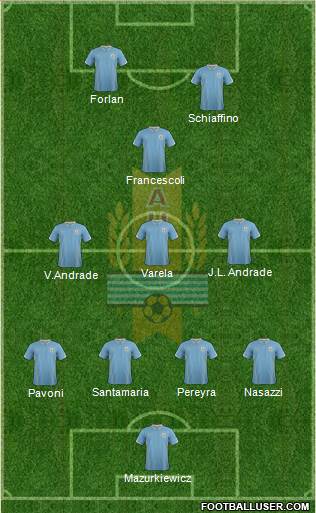
Formation 4-3-3
Victor Andrade and Jose Leandro Andrade were more of a box-to-box midfielder in the modern era. So I used them in the midfield. In 2022, I considered replacing Diego Forlán with Luis Suarez.

Formation 4-3-3
Victor Andrade and Jose Leandro Andrade were more of a box-to-box midfielder in the modern era. So I used them in the midfield. In 2022, I considered replacing Diego Forlán with Luis Suarez.