Showing posts with label asia. Show all posts

Friday, November 14, 2014

East Asia Greatest All-time 23 member team

This blogger Artur Yanturin of Russia copied many of my blog teams.  This blog was one of them.  It was my Russia All-Time Team here.  His team was written in 2020, but mine was uploaded in 2014.   His Spartak Moscow All-Time team entry of was published in October 2020, but mine was uploaded in 2017.  His entry of the Dutch-German rivalry between Real Madrid and Barcelona was written in 2020, but mine was uploaded in 2014.  He also copied many many of my blog entries.


His Facebook and Instagram


North Korea 1966

This is my 23-member all-time team for East Asia.While football in East Asia is not considered strong in the world, they have made some achievements in the world.  North Korea made a dream run in 1966 when they beat Italy and played one of the most dramatic matches in WC history against Portugal.  Japan and South Korea made miracle runs at the WC in 2002 with South Korea reaching the semifinal.

I have also create other Asian teams:  AustraliaSaudi ArabiaIran,
ChinaJapanSouth Korea.
Hong KongIndia
East AsiaWest Asia(without Iran and Saudi Arabia),
Central AsiaSouth East Asia(ASEAN).

South Korea 2002
Team
GK:  Lee Woon-Jae (South Korea)   
Lee Woon-Jae was a part of four World Cup Finals between 1994 and 2010.  His best tournament was in 2002 where South Korea reached the semifinal and he was inspirational as he saved a penalty in the penalty shootout of the quarterfinal vs Spain.  He spent his entire career playing in Korea with Suwon Samsung Bluewings and Chunnam Dragons.

GK: Lee Se-yeon(South Korea)
Lee Se-yeon is regarded as one of the greatest South Korean goalkeepers of the 20th century. In 2002, he was selected as the goalkeeper of the Korean Football All-time Best XI by a survey of MBC and Gallup Korea in which 1,500 South Koreans participated.  I  club footyball, he played for Yangzee and Korea Trust Bank.  From 1966 to 1973, he played 81 times for the national team.


GK:  Chow Chee Keong (Malaysia)
Chow Chee Keong was a Malaysian Chinese.  He earned his first senior cap as a 15 years old.  He played for Aveley F.C. in England when he was a student studying in the UK.  He also trained with West Ham. From 1966 to 1970, he was voted the best keeper in Asia for 5 straight seasons.  In 1970, he went to play in the Hong Kong league, which was the only professional league in East Asia. In Hong Kong, he played for Jardines, South China, Rangers and Tung Sing. He was voted as the AFC Goalkeeper of the Century.  

RB: Atsuto Uchida (Japan)
Uchida played with Kashima Anthlers before joining Schalke 04 in 2010. He has been playing for Schalke 04 for the past 5 seasons.  He was on the Bundesliga team of the Year for the season 2012-2013 and 2013-2014.  He went to both World Cup Finals in 2010 and 2014. He also played Union Berlin before returning to Japan in 2018.

RB:  Sun Jihai (China)
Sun Jihai joined Crystal Palace with teannate Fan Zhiyi in 1999 and became the first Chinese national to play in England.  In 2002, he made a big move to Manchester City where he spent 7 seasons and became a regular starter for his first three seasons.  However, he suffered an injury in his fourth season.  He spent the rest of his career in and out of the lineup.  He represented China at the WC Finals in 2002.

CB:  Jia Xiuquan (China)
Jia Xiuquan was the Chinese captain from 1987 to 1992.  In 1984, he won the MVP award at the Asian Cup, where China finished second.  He joined Yugoslavia's FK Partizan in 1987 becoming one of the first footballers from PRC to play in Europe.  In China, he played club football with Baiyi.  He later played in Malaysia and Japan.  He played for Gamba Osaka during J-League's inaugural season.

Jia Xiuquan

CB: Masami Ihara (Japan)
Masami Ihara was the Asian player of the Year in 1995.  He was at one point Japan's all-time leading appearance record holder with 122. He led Japan to its first ever World Cup Finals in 1998. He was a star in the J-League throughout the 1990's.  He spent most of his career with Yokohama Marinos.  Later, Ihara played for Jublio Iwata and Urawa Reds.

CB:  Fan Zhiyi (China)
Fan Zhiyi was the Asian Player of the Year in 2002.   He captained China as it reached the WC Finals for the first time in 2002.  He played three seasons for Crystal Palace and became a captain there. At home, he played mainly for clubs in Shanghai, notably with Shanghai Shenhua.  He had a stint playing for Rangers in Hong Kong.

CB:  Hong Myung-bo (South Korea)
Hong Myung-bo is the all-time cap record holder for South Korea.  He played in 4 WC Finals.  In 2002, he captained South Korea to reach the WC semifinal, where he won the Bronze Ball.  He is probably the greatest defender in Asian history.  He played mainly for Pohang Steelers in the K League, Bellmare Hiratsuka and Kashiwa Reysol in Japan and, LA Galaxy in USA's Major League Soccer.
Hong Myung-Bo
LB:  Lee-Young-Pyo (South Korea)
Lee Young-Pyo enjoyed one of the most successful career for an Asian playing in Europe.  He was a starter with PSV Eindhoven and Tottenham Hotspurs.  Lee started his professional career at FC Seoul, then known as Anyang LG Cheetahs in the Korean K League 1. He also spent time in Saudi Arabia and the MLS. He played 127 times between 1999 and 2011 for South Korea.  

LB:  Yuto Nagatomo (Japan)
Yuto Nagatomo  started his career with FC Tokyo. He is known for his offensive skills.  He joined Cesena in 2010.  Since 2011, he was a starter with Inter Milan.  He can also play as a rightback.  In 20918, he joined Galatasaray in Turkey.  He collected over 100 caps for Japan. He played in the World Cup Finals in 2010 and 2014.  He won the Asian Cup in 2011.

CM: Kim Joo Sung (South Korea)
From 1988 to 1990,  Kim Joo Sung won three straight Asian Player of the Year.  He was known for his long hair during his career, and was an Asian football icon in the early 1990's.  He played in three World Cup Finals.  For his club career, he played for Chosun University and Busan Daewoo Royalsat home.  Later, he spent two seasons with Vfl Bochum in Germany.
  
CM: Yasuhiko Okudera (Japan)
When soccer was still an amatuer sport in Japan, Okudera made his way to Germany.  He played with FC Klon and Werder Bremen in the 1980's. Okudera was the first Japanese footballer to play professionally in Europe, as well as being the first Asian football player to score in the European Cup, while playing for 1. FC Köln in the 1979 semi-final match against Nottingham Forest F.C. and made 32 appearances – scoring nine goals – with the Japanese national team.

RW/LW: Park Ji-Sung (South Korea)
He is the most decorated Asian footballer in history, as the first Asian footballer to have won the Champions League trophy, the first Asian footballer to play in a Champions League Final, as well as the first Asian footballer to have won the Club World Cup.   He spent 7 seasons with Manchester United. He also played Kyoto Purple Sanga, PSV and QPR.  For the national team, he earned 100 caps and went to 4 World Cup Finals: 2002, 2006, and 2010.

LW: Son Heung-min  (South Korea)
Son finished his development at Hamburger SV, where he made his debut in the German Bundesliga in 2010. In 2013, he moved to Bayer Leverkusen for a club record €10 million, and played for the club in the Europa League and Champions League. Two years later, he signed for Tottenham for £22 million, becoming the most expensive Asian player in history. While at Tottenham, he became the top Asian goalscorer in Premier League history.

AM: Shunsuke Nakamura (Japan)
Shunsuke Nakamura was a star player at Celtics.  He won the SPF Player of the year and SFWA Player of the Year in 2007.  Before that, Nakamura began his professional career with J1 League club Yokohama Marinos in 1997.  Later,  he played with Reggina in Serie A.  After he left Celtic, he played briefly for Espanyol. He played in three WC Finals, but he was not selected for the WC in 2002 at home.
Shunsuke Nakamura
AM:  Hidetoshi Nakata (Japan)
Nakata was the first Japanese player who reached stardom in Europe.  He scored 10 goals in his first season with Perugia.  He had a successful substitute role with Roma, but he never settled down after his first season.  He also played with Parma, Fiorentina and Bologna.  He later went to play in England with Bolton Wanderers. He picked up 77 caps.  He went to three World Cup Finals: 1998, 2002 and 2006.

AShinji Kagawa 香川 真司
Kagawa began his professional career in his homeland with Cerezo Osaka before joining Borussia Dortmund in 2010. After two years with Dortmund, Kagawa signed for Manchester United on a four-year contract. Two years later, he returned to Dortmund, where again he was a star player. Since 2008, he has over 90 caps. He was a member of the 2014 WC team while controversially left off the 2010 team.

FW:  Kazuyoshi Miura (Japan)
Miura became the first Japanese footballer to play in Italy, joining Genoa for 1994-1995.  He was the Asian Player of the Year in 1993.  Despite being the best Japanese player in the 1990's, he never played in the WC Finals.  He was not selected for the 1998 WC in France. He had 89 caps. On 5 March 2017, Miura became the oldest ever player to feature in a professional match when he started in Yokohama's 1–1 draw against V-Varen Nagasaki. 

FW:  Lee Wei Tong (Republic of China/Hong Kong)
Lee Wei Tong was born in Hong Kong, but elected to play for the Republic of China.  He went to play in 1936 Olympics, where he made a strong impression.  Some experts considered him among the best footballer in the world at the time, but limited exposure outside Asia limited his name recognition.  At home, he predominantly played for South China and helped establish the club in being the most successful team in Hong Kong history.
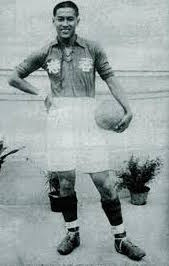
 Lee Wei Tong 李惠堂

FW:  Pak Doo-ik (North Korea)
Pak Doo-ik scored the winning goal vs Italy in the 1966 World Cup Finals.  He was the star of North Korea's run in that World Cup Finals.  His football career outside of the World Cup Finals is unknown. It was widely reported that he was a military officer in North Korea.  He was born in 1943.

ST:  Cha Bum Kun (South Korea)
Cha Bum Kun is probably the greatest Asian player in the modern era.  He won two UEFA Cups, one each for Eintracht Frankfurt and Bayer Leverkusen. he also played for Air Force in South Korea and SV Darmstadt 98. He was widely considered one of the best forwards in the Bundesliga throughout his career. He became the third-highest-paid footballer in Germany while playing there. For the national team, he had 135 caps and went to Mexico 1986.
Cha Bum Kun

ST:  Paulino Alcántara (the Philippines)
Born in the Philippines of a half-Spanish, half-Filipino, he made his debut for Barcelona at the age of 15 and remains the youngest player to play or score for the club. He also scored 100 goals in 69 matches, making him the club's highest goalscorer He was selected for the Philippine national football team in 1917 and represented his country at the Far Eastern Championship Games.  In 1921. he was selected to play for Spain.  he scored 6 goals in 5 games for Spain.

Alcantara
Honorable Mention
Hwang Sun-Hong (South Korea), Cheung Chi Doy (Republic of China/Hong Kong), Keisuke Honda (Japan).

Squad Explanation
  •  The criteria seemed to be gearing toward playing outside of Asia.
  • I tried to include older players. Chow Chee Keong was relatively unknown from the 1980's onward. He was voted AFC Goalkeeper of the Century. He also played briefly in England when he was a student.  He was one of the first goalkeeper from Asia to play in Europe. He was not actually signed with West Ham, but he trained regularly with them. 
  •  Lee Se-yeon (이세연) was voted as South Korea's greatest goalkeeper in 2002. Originally, I have goalkeeper Choi In-young (최인영).  He was voted as one of Asia's greatest goalkeeper by 'IFFHS', but his performance at the 1994 World Cup Finals was poor.  So I put him on honorable mention.
  •  I do not have much information about Pak Doo-ik, but he had done more for Asian football for the few games he played at the World Cup Finals in 1966 than anyone else.  I rewarded him with a spot on the team.   
  • Sun Jihai was at one point a top fullback in the English Premiership.
  • Cheung Chi Doy (Republic of China/Hong Kong)spent a season with Blackpool, which was then a big club in England.  He was one of the first Asian players playing in Europe.  Cheung Chi Doy and his brother were the first two players ever signed by Bobby Robson.  Unfortunately, his career was cut short after Bobby Robson left Vancouver Royals.  He earned honorable mention.
  • Shinji Kagawa was orginally dropped because he had not played a lot of first team football when I was writing the blog while there are many Asian players making impacts around the world.  In 2018, I decided to drop Hwang Sun-Hong.  Kagawa's status with Borussia Dortmund improved. Hwang Sun-Hong lacked exposure outside Asia.
  • Shunsuke Nakamura won the SPF Player of the year and SFWA Player of the Year in 2007. 
  • Lee Wei Tong's football career was relatively unknown, but some experts claimed that he could be the best ever Asian player. 
  • Paulino Alcántara's record with Barcelona FC spoke for itself.  Some of the greatest ever players could not break his record. 
  • Son Heung-min was put on the team in February, 2019.  He reached stardom in the English Premiership. Keisuke Honda was moved to honourable mention.  I selected Kim Joo Sung, Lee Wei Tong, Kazu Miura and Yasuhiko Okudera over them because they contributed to the history of Asian football. They were pioneers of the game.
  • Keisuke Honda was dropped basically lacked the exposure by playing with AC Milan when the club was in crisis. As mentioned, I went with historical players.
  • Marcelino Gálatas was born in the Philippines, but he played for Spain in 1927.  Unliked Paulino Alcántara, he never played for the Philippines. 

Starting lineup
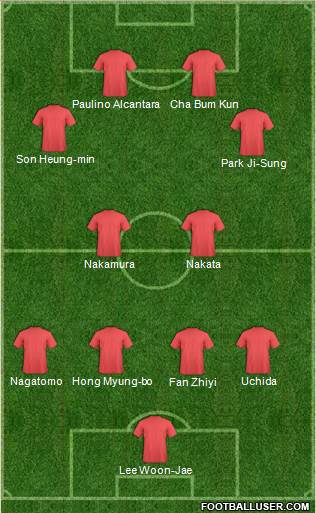
Formaation: 4-4-2
Both Nagatomo and Lee Young-Pyo are almost the same level.  I can start either of them.   I prefer a midfield of Nakata and Nakamura.  Son Heung-min, Paulino Alcantara, Cha Bum Kun and Park Ji-Sung are the best Asian players in history.


Thursday, November 13, 2014

Australia Greatest All-time team

This blogger Artur Yanturin of Russia copied many of my blog teams.  This blog was one of them.  It was my Russia All-Time Team here.  His team was written in 2020, but mine was uploaded in 2014.   His Spartak Moscow All-Time team entry of was published in October 2020, but mine was uploaded in 2017.  His entry of the Dutch-German rivalry between Real Madrid and Barcelona was written in 2020, but mine was uploaded in 2014.  He also copied many many of my blog entries.

His Facebook and Instagram


World Cup 2006
 

This is my all-time team for AustraliaIf there were an All-Time World Cup, this would be the 23 players I would bring to the tournament.  

Please also see my All-Time World Cup Team Index.

Oceania All-Time Team
Croatian-Australian
If Ronaldo and Messi played for Australia in 2006
New Zealand All-Time Team

Australia's journey in the World Cup has been marked by both triumphs and heartbreaks. After a remarkable qualification for the WC Finals in 1974, the Socceroos endured a lengthy 22-year wait for their second appearance on the grand stage. However, their quest for glory was met with disappointment in 1997 when they faced Iran in a World Cup qualifying continental playoff match. Despite initially taking a commanding 2-goal lead, the Socceroos were left devastated as Iran made an impressive comeback, ultimately eliminating them in a heart-wrenching fashion.

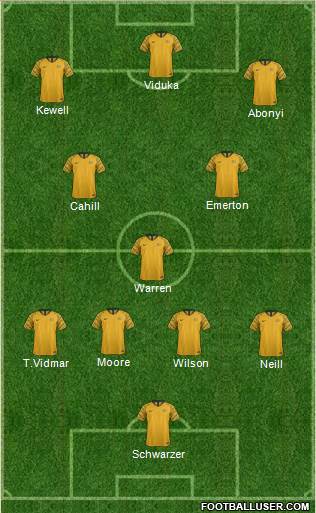
Nevertheless, the turn of the millennium brought a new era for Australian football, as a crop of talented players like Harry Kewell, Mark Viduka, and Tim Cahill made a name for themselves in England, propelling the Socceroos into what became known as their Golden Generation. They secured qualification for the 2006 World Cup Finals. 

However, the team remained resilient, and in 2005, they made a historic decision to switch from the Oceania Football Confederation (OFC) to the Asian Football Confederation (AFC).  The significant moment in the Socceroos' history came in 2015 when they lifted the AFC Asian Cup on home soil.

If there were an All-Time World Cup, this would be the 23 players I would bring to the tournament.  The team is not an All-Star team. I tried to be as realistic as possible.   A few of the players are selected for tactical reasons at the expense of more famous players.
Asian Cup winner 2015
Mark Schwarzer played in Germany, but he did not find success until he moved to England in 1997.  He started over 500 games in the Enghish Premiership.  He was known for his seasons at Middlesbrough and Fulham.  With 109 caps, he is the cap record holder in Australia. He played in two World Cup Finals: 2006 and 2010. He was in the World Cup Qualifying playoff against Uruguay in 2005, where he saved two penalties.

GK: Mark Bosnich
Mark Bosnich was voted as Oceania Goalkeeper of the Century.  He was known for his career with Aston Villa.   He earned himself a transfer back to Manchester United in 1999, but his career started to fall apart over there.  He also played for Chelsea. He also played in Australia for Sydney United, Central Coast Mariners and Sydney Olympic. For the national team, he only earned 17 caps due to club's commitment.
Mark Bosnich
GK: Matt Ryan
Ryan made his senior debut for Blacktown before moving to the Mariners' senior squad in 2010. In 2013, Ryan moved to Club Brugge, where he played for two years before joining Valencia. Ryan made his senior international debut in 2012, and has since played at the FIFA World Cup in 2014, 2018, and 2022, as well as the AFC Asian Cup in 2015, 2019 and 2023, winning the Best Goalkeeper award at the 2015 tournament which his country won on home soil.

RB:  Bob Bignall
Bob Bignall was the captain of Australia at the 1956 Olympics playing at home.  He started his career in 1939 and played over 400 matches in NSW for Corrimal Rangers, Woonona, North Shore and South Coast United as a defender before going onto represent both NSW and national sides as their captain.  He was inducted to the Football Federation of Australia Hall of Fame in 1999.

CB/RB: Lucas Neill
Lucas Neill earned 96 caps during Australia's Golden Generation and 61 of them as the team captain.   He played 15 seasons in England for Blackburn Rovers, West ham, etc.  He represented Australia at the 2006 World Cup, the 2007 Asian Cup, the 2010 World Cup in South Africa, and also the 2011 Asian Cup in Qatar.  He was probably remembered for the controversial penalty he gave away vs Italy at the round of 16 duirng the Germany 2006.

CB: Peter Wilson 
"Big Willy" was the captain of the 1974 World Cup team.  He was a sweeper.  He was capped 65 times between 1970 and 1979 and he was their captain a record 61 times.  Born in Felling, England in 1947, Wilson migrated to Australia in 1969 to join South Coast United after failing to break into the first team for English club Middlesbrough. He also played for Sydney club Western Suburbs, Marconi and APIA Leichhardt.
Peter Wilson
CB:  Joe Marston
Joe Marston was the first Australian to play in the English FA Cup Final, when his club Preston North End reached the Final in 1954.  He played over 180 games in England and was one of the first Australians to play aboard.  In 1954, he represented the Football League side against the Scottish Football League XI.  He returned home in 1955. He played 37 times for the Australian national team between 1947 and 1964.

CB: Craig Moore
Craig Moore played over 250 games for Rangers in Scotland. After Rangers, he played with Borussia Mönchengladbach, Newcastle United and his hometown club Queensland Roar (later renamed Brisbane Roa in the Australian A-League, as their captain and Marquee player.  In 2012, he was voted into the Australia's All-time Best XI.  He went to both 2006 and 2010 World Cup Finals while picking 52 caps.

LB: Tony Vidmar 
Tony Vidmar is currently Socceroos's third highest capped player with 76 caps, but he never played in the World Cup Finals.  He withdrew from the World Cup selection right before Germany 2006 due to health problems. He represented Australia at the 1992 Summer Olympics. For club football, he spent 5 seasons with Glasgow Rangers in Scotland. He also played in NAC Breda Holland and Cardiff City in Wales. His brother Aurelio also played for Australia.
Tony Vidmar
LB:  Alan Davidson
Alan Davidson was voted into the Hall of Champions, the highest honor in the Football Hall of Flame in Australia. He was voted as Australia's greatest leftback in 2012.  He played for numerous clubs all over Melbourne, Australia.  He played with Nottingham Forest in the  1984-1985 season, but a head injury cut short this career there.  He played 79 times for Australia (51 official).

Jedinak moved to Central Coast Mariners in 2006. He next played in Turkey, for Gençlerbirliği and Antalyaspor before joining Crystal Palace and subsequently playing a role in the club earning promotion to the Premier League. In 2016, he joined Aston Villa. He played 79 times for Australia from 2008 to 2018. This includes participation in the 2010, 2014 and 2018 World Cups and two AFC Asian Cups, including captaining Australia to victory on home soil in the 2015 edition.

DM/RB: Johnny Warren
Johnny Warren was probably one of Australia's greatest players.  The best player award for the A-League was named after him.  He was named as Australia's all-time best XI in 2012.  He spent most of his career with St. George in the 1960's. He was capped 42 times, captaining the side over 20 times.  He went to the World Cup Finals in 1974.  He sometimes was known as the Godfather of Australian soccer.
John Warren
CM: Mark Bresciano
Mark Bresciano spent 12 seasons playing in Italy with Empoli, Parma, Palermo and Lazio.  When he joined Parma, he became the most expensive Australian player ever in 2002.  He also played in three World Cup Finals for Australia.  His goal against Uruguay in the 2006 World Cup qualification play-off sent the match to a penalty shootout which Australia won to qualify for the first time in 32 years.  He played 84 times for Australia.

CM: Ned Zelic
Ned Zelic played with cubs around Sydney.  He had a successful career playing in Bundesliga.  He started his career in Germany with Borussia Dortmund.  Then, he moved to Queens Park Rangers as the club's record signing in 1995.  He failed to settle there. He later played in France and then, Germany again, where he made a name with Munich 1860. Zelic was captain of the Australian team that competed and finished 4th at the 1992 Summer Olympics in Barcelona.
Ned Zelic
LM:  Jimmy Rooney
Born in Scotland, Jimmy Rooney had a brief career in England with Lochee United, Peterborough United and Montrose F.C. before moving to Australia in the late 1960's. He played in the World Cup Finals of 1974.  He made his Australian debut against the England in 1971, going on play 100 times for his country in a career spanning a decade.  The Jimmy Rooney Medal, awarded from 1992 onwards to the man of the match in the Victorian Premier League Grand Final, was named in his honour.

AM: Tim Cahill 
Cahill is the all-time leading scorer for Socceroos and was considered one of greatest Australian players ever.  He played for Millwall, Everton, the New York Red Bulls, Shanghai Shenhua, and Hangzhou Greentown. At Everton, he was one of their star players for 8 seasons.  He represented Samoa at youth level.  Later, he switched to Australia in 2004.  He went to three WC Finals.  He led Australia in winning the Asian Cup in 2015.
Tim Cahill
RM/RB: Brett Emerton
Brett Emerton is the third most capped player for Socceroos.  He went to two World Cup Finals.  He was captain of the "Olyroos", Australia's Olympic football team, at the 2000 Summer Olympics in Sydney.  He spent his career notably with Sydney Olympic, Sydney FC, Feyenoord and Blackbrun Rovers.  He spent 9 seasons with Blackburn Rovers. He was Oceania Player of the Year in 2002.

RW: Attila Abonyi
Born in Hungary, Abonyi moved to Australia as a young boy. He was a member of the 1974 World Cup team played in West Germany.  He was also the 5th all-time leading scorer for Australia.  He was voted into the Hall of Champions, the highest honor in the Football Hall of Flame in Australia. He spent his entire domestic football career in Australia.
 
In 2012, Harry Kewell was voted the greatest ever Australian player.  At Leeds United, he won the PFA Young Player of the year in 1999-2000.  With Mark Viduka, the team reached the semifinal of the Champions' League in 2000-2001.  At Liverpool, he won the Champions League in 2005, where he started the final match.  He became the first Australian-born player to win a Champions' League medal.  He played 58 times for Socceroos.  He was a member of the 2006 World Cup team.
Harry Kewell
Kosmina began his career at Polonia and later moved to West Adelaide. In 1978, he joined Arsenal, becoming the first Australian to play for the club, but his time there was limited to 1 league game and 5 appearances in the UEFA Cup. Back in Australia, Kosmina played for several teams including Adelaide City, West Adelaide (again), Sydney City, Sydney Olympic, and A.P.I.A. Leichhardt Tigers. Kosmina also captained the Australia, helping them win the Merlion Cup twice. 

ST:  Ray Baartz
Ray Baartz joined Manchester United at the age of 17.  He returned home after two seasons. In 1966 he returned to Australia and transferred to Sydney Hakoah for a then Australian record of ₤5600. He played 236 club matches scoring 211 goals.  He went to the WC Finals in 1974. He was named in the Greatest Australian team in 2012. A career-ending injury kept him from the 1974 World Cup Finals.

ST: Mark Viduka
Viduka started with Croatian-based club Melbourne Knights FC.  He went to Europe in 1995, where he was probably the most famous Australian playing in Europe.  He played in Croatia, Scotland and England.  In Scotland, he was the top scoring in the Scottish league and won the SPFA Player of the Season with Celtics. And then, he joined Leeds United, where the club reached the semifinal of the Champions' League.  He also played for Middlesbrough and Newcastle United.
Viduka and Kewell

Honorable Mention
Zeljko Kalac,  Jimmy Fraser, Jack Reilly, Ron Corry, Terry Greedy, Norman Conquest, Robert Zabica, Bill Henderson, Ron Lord, Milan Ivanovic, Mehmet Duraković, Manfred Schaefer, Tony Popovic, Charlie Yanko, John Watkiss, Colin Curran, Graham Jennings, Harry Williams, Mehmet Duraković, Jim Tansey, George Keith, Doug Utjesenovic, Luke Wilkshire, Harry Williams, Stan Lazaridis, Scott Chipperfield, Branko Buljevic, Aaron Mooy, Jimmy MacKay, Charlie Yankos, Paul Okon, Reg Date, Alf Quill, Rudy Masters, Adrian Alston, Mark Milligan, Trent Sainsbury, Massimo Luongo, Alex Tobin, Josip Skoko, Jason Culina, Joshua Kennedy, Vince Grella, Paul Wade, David Mitchell, Damian Mori, Aurelio Vidmar, John Aloisi and Damian Mori, George Smith.

Squad Explanation 
-- The original team was created in November, 2014.  I redid the entire team in January, 2024.  
-- Harry Kewell, Mark Viduka and Tim Cahill were the greatest Australian footballers.  Johnny Warren was also an undisputed selection due to being a pioneer of the game.
-- In 2022, Football Australia honored 100 years of Australian soccer by creating the Subway Socceroos’ Team of the Century.  
Goalkeepers: Jimmy McNabb, Matthew Ryan and Mark Schwarzer.  
Defenders: Scott Chipperfield, Joe Marston, Craig Moore, Lucas Neill, Alex Tobin, Tony Vidmar and Peter Wilson.  
Midfielders: Mark Bresciano, Brett Emerton, Mile Jedinak, Harry Kewell, Aaron Mooy, Johnny Warren.
Forwards: John Aloisi, Tim Cahill, Reg Date, John Kosmina, Judy Masters, Alf Quill, Mark Viduka. 
-- In 2012, a poll of the greatest Australian footballlers was put together by the Johnny Warren Football Federation.  The selections were as followed: Mark Schwarzer, Lucas Neill, Joe Marston, Craig Moore, Alan Davidson, Johnny Warren, Ned Zelic, Tim Cahill, Ray Baartz, Harry Kewell and Mark Viduka. Harry Kewell was named Australia's greatest ever footballer.   The source was located here.
-- IFFHS selected the following players as their All-Time Best XI for Australia.  They were Mark Schwarzer. Lucas Neill, Joe Marston, Milan Ivanović, Alan Davidson, Johnny Warren, Ned Zelic, Tim Cahill, Harry Kewell, Frank Farina, Mark Viduka.  They also created a "Substitutes Team B".  They were Mark Bosnich, Bob Bignall, Peter Wilson, Craig Moore, Stan Lazaridis, Jimmy Mackay, Paul Okon, Attila Abonyi, Reg Date, George Smith and Jim Rooney.
-- In 2000, the RSSSF conducted a poll for an Australia Team of the Century.  The Best XI was as followed: Mark Bosnich, Joe Marston,  Peter Wilson, Milan Ivanovic, Alan Davidson, Ned Zelic, John Warren, Jim Rooney, Reg Date, Ray Baartz and Atti Abonyi.
-- The 2000s Golden Generation of Australian football left an indelible mark on the national team. I selected with a total of nine players from the 2006 World Cup squad.  They were Mark Schwarzer, Tim Cahill, Mark Viduka, Lucas Neill, Craig Moore, Brett Emerton, Mark Bresciano, and Harry Kewell. Mark Bosnich and Tony Vidmar were also part of this generation, although they narrowly missed out on the 2006 team. Additionally, Stan Lazaridis, Paul Okon, Josip Skoko, Jason Culina, and Joshua Kennedy deserve honorable mention for their contributionsThe Golden Generation's impact extended beyond the 2006 World Cup. Some of these players also represented Australia in the 2010 and 2014 World Cup Finals, showcasing their continued excellence. It's worth noting that the Golden Generation wasn't limited to Australian international players. Christian Vieri of Italy and Josip Šimunić of Croatia were also part of this remarkable era for Australian football. 
-- Australia qualified for the 1974 World Cup Finals.  It was their first ever World Cup Finals.  From that team, I took Attila Abonyi, Peter Wilson, Johnny Warren and Jimmy Rooney.  A serious injury prevented Ray Baartz for joining the team in West Germany.
World Cup 1974
-- From the 2015 Asian Cup winning team, I only found space for Tim Cahill, Mathew Ryan and Mile Jedinak. Trent Sainsbury and Massimo Luongo made honourable mention.  Cahill, of course, belonged to the early 2000's generation.
-- I used the FFA Football Federation Australia Hall of Fame (previously Soccer Hall of Fame) as one of my sources. It has recognized numerous individuals for their contributions to Australian football. The Hall of Fame previously had three distinct levels based on the nature of an individual's contribution. However, these distinctions are no longer in placeThe number of Hall of Famers is huge, with 43 players or participants being selected in 1999, but in 2019, the induction saw only two players and two other participants being honored.
Goalkeepers
-- Mark Schwarzer and Mark Bosnich were natural choices for the goalkeeper position. Both enjoyed lengthy careers in the Premier League. Schwarzer holds the record for the most appearances for the Australian national team. Bosnich, despite his struggles at Manchester United, excelled in the Premier League with Aston Villa and performed admirably for the national team.
Mark Schwarzer
-- Zeljko Kalac's inclusion as the third goalkeeper in my 2014 selection was a controversial choice. His role as AC Milan's backup goalkeeper during their Champions League victory in 2007 influenced my decision. Kalac's club-level experience surpassed many other Australian keepers. However, upon reevaluation in 2024, I explored other alternatives for this position.
-- Ron Lord was widely regarded as one of Australia's greatest goalkeepers before the Golden Generation. Jimmy McNabb's penalty save in 1937 secured a significant 4-3 victory over England and marked a milestone for Australian football. Jimmy Fraser played a heroic role in the 1974 World Cup Qualification, but he skipped the World Cup due to personal reasons and Jack Reilly started in the World Cup Finals. Bill Henderson represented Australia in the 1956 Olympics, while Ron Corry and Terry Greedy were also esteemed goalkeepers. Ultimately, Matthew Ryan's contributions, including helping Australia win the Asian Cup in 2015, led to his selection.
-- Norman Conquest had one of the best names in football.
Defenders
-- Joe Marston, Craig Moore, and Peter Wilson were undisputed selections for their contributions to Australian football. Marston made history as the first Australian to play in the FA Cup, leaving a lasting impact. Moore had a remarkable career with Glasgow Rangers, winning multiple domestic league and cup honors. Wilson, the captain of the 1974 World Cup team, led the national team with distinction, serving as captain a record 60 times. Their inclusion in the official All-Time teams in both 2012 and 2022 from Socceroos further solidifies their status as exceptional players in Australian football history.
-- Selecting the last central defender proved challenging. John Watkiss played behind Peter Wilson and Manfred Schaefer in the 1974 World Cup Finals. Ned Zelic, Paul Okon, Charlie Yank, and Tony Popovic were also considered. Eventually, it came down to Alex Tobin, voted into Australia's official Team of the Century in 2022, and his former defensive partner Milan Ivanovic, who was part of the RSSSF Team of the Century. Tobin's extensive appearances and captaincy for Australia gave him the edge.  Ivanovic was a naturalized player.  He did not pick up his first cap until he was 31 years old.  So naturally, Tobin would have earned more caps. In 2014, I initially chose Ivanovic, but changed my decision in 2024 due to Tobin's inclusion in Australia's official Team of the Century.
-- Milan Ivanovic started his career with Red Star Belgrade.  After stints with OFK Belgrade and Radnički Niš, he emigrated to Australia and on arrival in 1989, he joined Adelaide City.  He was elected into Australia's Team of the Century.  He was voted into the Hall of Champions, the highest honor in the Football Hall of Flame in Australia. He earned 59 caps between 1991 and 1998.
--Lucas Neill's inclusion in both of Australia's official All-Time teams solidifies his undisputed place. As for the backup spot, it was awarded to Bob Bignall, who captained the 1956 Olympic team. George Keith was described as a "right-side player".  I did not know his true position.  And then, I put Doug Utjesenovic and Luke Wilkshire on honorable mention.
Lucas Neill
-- Tony Vidmar's reputation as one of Australia's greatest players secured his place in the team. Alan Davidson, recognized in Australia's official All-Time team in 2012, was initially chosen, but in 2022, Scott Chipperfield took his spot on the newer All-Time team. Stan Lazaridis, having played for West Ham and Birmingham, received honorable mention. I honored Harry Williams who was the first Aboriginal man to represent Australia in soccer and to participate in the 1974 World Cup Finals. Tony Dorigo, although born in Australia, played for England and was ineligible for selection.
Midfielders/Wingers
-- Johnny Warren's career had a significant impact on the development of soccer in Australia.  He is regarded as the Godfather of Australian football.
-- Mark Bresciano who was behind Ned Zelic in the official Australia All-Time team in 2012 was selected ahead of Zelic in the 2022 edition.  So what did he do as a player that push him ahead of Zelic? His career was winding down by playing club football in Qatar.  Nevetheless, both Zelic and Bresciano made the team.  Bresciano played 12 seasons in the Serie A.  
-- In 2024, I recruited Mile Jedinak. He ranked among the top 10 greatest Australian players in many lists, and proved influential as a midfielder and captain during his time at Crystal Palace from 2011 to 2016.  Aaron Mooy was another name who came along since 2014.  I put him on honorable mention.
Mile Jedinak
-- Robbie Slater belonged to the generation preceding the Golden Generation.  Paul Okon's relatively low number of appearances for the Socceroos (28) weighed against his inclusion.  Both were left off the team.
-- Many consider Tim Cahill, not Harry Kewell, as Australia's greatest ever player. While I won't delve into the debate itself, it's worth noting that if Cahill had played for a bigger club than Everton, he might have garnered similar recognition to Kewell.
-- Paul Wade, Murray Barnes, Jimmy MacKay, Vince Grella, Josip Skoko, Jason Culina, Les Scheinflug 
-- Bert Emerton was Australia's 4th most capped player.  He appeared regularly in most lists.  He could cover the entire right side the pitch. Attila Abonyi is Australia’s equal fifth highest goalscorer of all time.  He also played an instrumental role in Australia's historic victory in the Quốc Khánh Cup (Friendly Nations Tournament) securing the nation's first-ever international silverware. 
-- Craig Johnston, although a key player for Liverpool and winner of the 1984 European Cup, never represented Australia at the senior level. Despite being born in South Africa to Australian parents and growing up in Australia, he compared playing for the national team to "surfing" in England. His public rejection of Australia and lack of senior caps led to the decision not to select him.  He does not want to be on this team.
-- This All-Time team does not need Johnston when it has Harry Kewell.  He is the GOAT from Australia according to many. For club football, Jimmy Rooney never played in the highest level.  He only spent a short time with Peterborough United FC, but he was one of the most important player in the 1974 World Cup Finals, and the tournament was a big milestone for Australia.  Mark Bresciano could also play as a left midfielder. The left side was set. I had no room for Stan Lazaridis.
Forwards
-- Christian Vieri, who grew up in Australia, was ineligible for this all-time team because he played for Italy. He could have been the greatest ever Australian player.  His club career was much better than Kewell, Viduka and Cahill.  His brother Max did play for Australia.  In a playful blog scenario, I created Cristiano Ronaldo and Lionel Messi playing for Australia in the 2006 World Cup with Vieri and the Golden Generation.  I also included Australian-born players such as Joey Didulica, Josip Šimunić, and Anthony Šerić.  
-- Mark Viduka is considered Australia's greatest striker and is also regarded as one of the greatest players in the history of Leeds United. Interestingly, Viduka and Harry Kewell were his teammate at Leeds United,  but they had a well-known feud between them. At one point, their relationship became so strained that they didn't even speak off the field.
-- John Kosmina was an important player. The award given to the player of the match in the National Premier Leagues Grand Final each year is named in his honour.   He was on the Team of the Century created in 2022.
John Kosmina
-- After considering the two official all-time teams created in 2012 and 2022, the final decision for the last spot came down to Roy Baartz and Reg Date. Date had an impressive record, scoring 664 goals in competition games between 1937 and 1953, and he was included in the Team of the Century in 2022. However, I ultimately chose Baartz due to his greater significance for Australian national team. Baartz, though he couldn't participate in the 1974 World Cup Finals due to a severe injury that nearly cost him his life, played a vital role in the World Cup Qualifiers. On the other hand, Date faced several exclusions from the national team during his prime, allegedly due to political reasons. In other words, he did not play much while Baartz was a key player in one of Australia's greatest moments up to that point.  Furthermore, Baartz was also recognized in the All-Time team in 2012. Therefore, Baartz's overall significance and contributions outweighed Date's, leading to my decision to select Baartz for the final spot.
-- I seriously looked at other players.  Frank Farina found successes playing for Brugge in Belgium, where he won the Golden Booth and the best Foreign Player Award in 1989-1990 season.  He was on the RSSSF's All-Time team for Australia.  Judy Masters, Reg Date and Alf Quill were early pioneers of the game. They were almost forgotten.  Judy Masters recognised as one of Australia's best players of his time.  He scored 5 goals in 6 matches for Australia between 1923 and 1924.  Quill played 24 seasons between 1927 and 1949.  They were selected into honorable mention. Aurelio Vidmar, John Aloisi and Damian Mori were the other notable players I considered.

Starting lineup
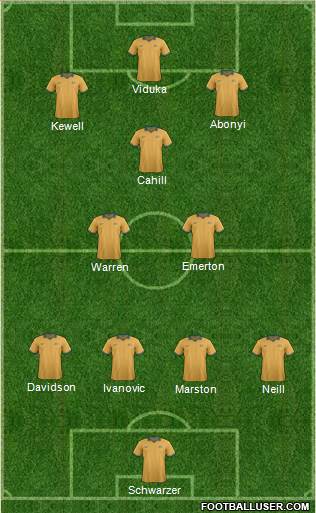
Formation: 4-2-1-3
Schwarzer got the start because he had a much longer and steadier career than Bosnich.  Emerton started because he was more offensive than the other candidates.