Showing posts with label italy. Show all posts

Sunday, February 8, 2015

Italian diaspora Greatest All-time 23 member team

This blogger Artur Yanturin of Russia copied many of my blog teams.  This blog was one of them.  It was my Russia All-Time Team here.  His team was written in 2020, but mine was uploaded in 2014.   His Spartak Moscow All-Time team entry of was published in October 2020, but mine was uploaded in 2017.  His entry of the Dutch-German rivalry between Real Madrid and Barcelona was written in 2020, but mine was uploaded in 2014.  He also copied many many of my blog entries.

His Facebook and Instagram

Dunga vs Maradona
Italy saw a large-scale migration of its people away from Italy in the period Between the unification of Italy in 1861 and the rise of Italian Fascism during the 1920s, as well as one last wave can be observed after the end of World War II.  Today, Italian diaspora is one of largest in the world.  Some of the greatest footballers are overseas Italians. There are 20 World Cup Finals at the time of writing.  Five of them were lifted by captains who are of Italian descent (1930, 1958, 1978, 1986 and 1994).   Italy won four more (1934, 1938, 1982 and 2006).

This is my All-time 23 Italian Diaspora team.  I have excluded all Oriundo players because those players have been capped by Italy and the Italian national team did not "lose" them.

Please also look at my all-time Italy team here and my All-Time Team Index.

Southern ItalyCentral Italy.
Northern Italy(excluding Lombardy)Lombardy
Italy after 1982Italy between 1938 and 1982.
What if Italy went to Euro 1992

Team
GK: Peter Bonetti (England)
Nicknamed as "the Cat", Peter Bonetti was a legend at Chelsea. His finest moment came in the Final of the FA Cup in 1970 where his heroic play helped Chelsea to win the FA Cup. He was the FWA Player of the Year runner-up that year.  However, he only earned 7 caps for England.  his career was limited by playing with Gordon Banks at the same time.  He was Banks' backup in the World Cup 1966.
  
GK: Rogerio Ceni (Brazil)
Roger Ceni is known as the goalkeeper who was known as a dead-ball specialist and scored a lot of goals.  He is recognized as the highest scorer in history for a goalkeeper.  He is a long-term keeper for Sao Paulo.  With them, he won two Copa Libertadores: 1993, 2005.  For Brazil, he had 16 caps.  He went to two World Cup Finals (2002 and 2006) as a backup.

GK Roque Maspoli (Uruguay)
Maspoli began playing in the youth ranks of Club Nacional de Football. He would make his Uruguayan Primera División debut with Liverpool de Montevideo in 1939. After one season with Liverpool, he joined C.A. Peñarol. He would spend the rest of his playing career with Peñarol, winning six Primera titles with the club. He was Uruguay's keeper at the World Cup in 1950, where they won it by breaking the hearts of the Brazilians.
  
RB:  Javier Zanetti (Argentina)
He was the starting rightback for Inter Milan for almost 20 years.  He served as their captain from 1999, earning him the nickname "Il Capitano" (The Captain).  He held all kind of appearance records in Italy.  He widely considered to be Argentina's best ever rightback.  He holds the record of the most capped player in the history of the Argentine national team and played in the 1996 Olympic tournament, five Copa América tournaments and two World Cups, in 1998 and 2002.

RB: Severino Minelli (Switzerland)
Minelli was considered one of the best European rightbacks in history.  He played 80 times for Switzerland.  He played in the 1934 and 1938 WC Finals.  In 1938, Switzerland knocked out Germany, a team boosted by additional Austrian players in the first round. For his club career, he played for FC Zurich, Grasshopper and Serviette FC.  

RB/CB: Jose Nasazzi (Uruguay)
He was the captain of Uruguay's legendary team that won the World Cup in 1930.   He is regarded by many as Uruguay's greatest ever football player. He was known as "El Gran Mariscal" (The Great Marshal) and had already won the gold medal at the 1924 and 1928 Olympic Games, as well as the South American Championship in 1923, 1924 and 1926, by the time of the first World Cup.

CB: Daniel Passarella (Argentina)
Daniel Passarella was one of the best center-backs ever played the game.  He captained Argentina when it won the World Cup in 1978. He also went to the World Cup Finals in 1982, but he was forced into have a non-playing role in 1986 after a row with Diego Maradona. He was also known for scoring over 140 goals in his career, very high for a defender. His career was associated with River Plate. He also played for Fiorentina and Inter Milan in Italy.
Daniel Passarella 
CB: Roberto Perfumo (Argentina)
Nicknamed El Mariscal, Perfumo is considered as one of the best Argentine defenders ever. At club level, Perfumo played for Racing, River Plate and Brazilian team Cruzeiro. He was a legend with Racing Club in Argentina winning the Primera title, the Copa Libertadores and the Intercontinental Cup.  He was considered their greatest player. He had 37 caps.  He played in 1966 and 1974 WC Finals. 

CB: Oscar Ruggeri (Argentina)
Oscar Ruggeri played in 3 World Cup Finals, winning the one in 1986 and finishing second in 1990. He was La Liga Foreign Player of the Year in 1989 and South American Player of the Year in 1991. He played for both River Plate and Boca Juniors as well as Real Madrid in Spain. He also had career with Vélez Sarsfield, San Lorenzo, etc.

LB: Silvio Marzolini (Argentina)
In 1959, Silvio Marzolini started his career with Ferro Carril Oeste. A year later, he joined Boca Juniors where he played until 1972 and became an idol. He was considered one of the greatest leftbacks in Latin American football history.  For Argentina, he had 28 caps between 1960 and 1969.  He went to the 1962 and the 1966 World Cup Finals.

LB:  Alberto Tarantini (Argentina)
Alberto Tarantini had 61 caps between 1974 and 1982. He was the starting leftback for Argentina in 1978 and 1982, where Argentina won their first WC in 1978.  He was infamously known for his career in England where he only lasted 28 matches. He played for River Plate, Boca Juniors and Talleres de Córdoba, River Plate, and European teams SC Bastia, Toulouse and FC St. Gallen.

DM: Nestor Rossi (Argentina)
One of Argentina's greatest defensive midfielders.  Nicknamed "Pipo", he started his career at River Plate, playing from 1945 to 1949, and then again from 1955 to 1958, winning a total of 5 Argentine leagues. He also won 6 more with Millonarios in Colombia. He played in the 1958 World Cup Finals and was a part of their 1957 Copa America winning team.

DM: Dunga (Brazil)
Dunga's bluecollar and defensive style of football symbolized a new era in Brazil's football during the 1990's.  He played 91 times for Brazil.  He was the captain of Brazil's World Cup winning team in 1994. He also went to Italia 1990 and France 1998.  He is one of onlytwo men to have played in a World Cup, Olympic Games, Confederations Cup and continental championship final. He played in Brazil, Japan, Italy and Germany in his club career. 
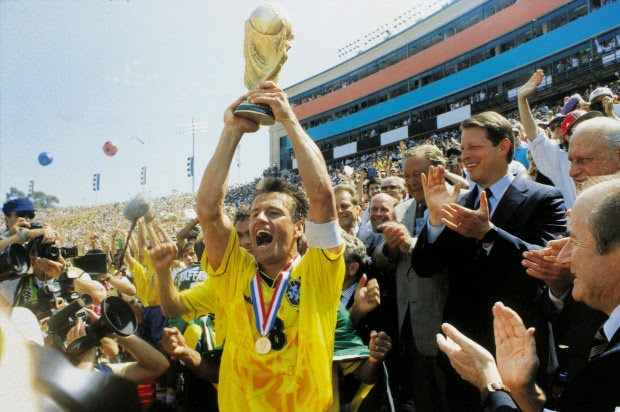
Dunga
CM: Esteban Cambiasso (Argentina)
Cambiasso has won 23 official titles (as of the end of 2011), being the Argentine footballer with most honours in history, one more than Alfredo Di Stéfano. The majority of his titles were won during his ten seasons at Inter Milan, including the 2009–10 UEFA Champions League. He won 52 caps for Argentina, and represented the country at the 2006 World Cup.

DM: Diego Simeone (Argentina)
Simeone started his career with Velez Sarsfield. He first joined Pisa and Sevilla before going to Atletico Madrid.  He won the Double with them in 1995-1996.  He then moved to Inter Milan, where he won the UEFA Cup in 1998.  In 1999, he moved to Lazio.  Again, he won the Double.  For Argentina, he was capped 106 times. He won Copa America in 1991 and 1993.  He went to play in three WC Finals; 1994, 1998 and 2002.  

CM/AM/FW:  Alfredo Di Stefano (Argentina)
The best player in the world before the emerge of Pele and Maradona. He was one of the younger member of the great River Plate in the 1940's.  In 1949, he moved to play in Colombia before moving to Europe in 1953.  He won 5 straight European Cups with Real Madrid. He was credited in turning Real Madrid into a legendary club. His international career was limited to the fact that Argentina did not select overseas players.  He played for Argentina, Colombia and Spain.

AM: Enzo Scifo (Belgium)  
Born in Belgium of Italian background,  Enzo Scifo made his name with Anderlecht, helping the team to the 1984 UEFA Cup Final.  He also played in both France and Italy at the club level.  He was capped over 80 times between 1984 and 1998.  He appeared for Belgium in the World Cups of 1986, 1990, 1994, and 1998, playing sixteen games in total.  He was a star at the World Cup Finals in 1986 and 1990, where he scored one of the best goals of the tournament in 1990.  
Enzo Scifo 
LW/M: Rivelino (Brazil)
Rivelino is considered to be one of the greatest left-sided midfielder ever.  His signature move was the "flip-flap". He was a member of Brazil's great 1970 team and also played in the 1974 team.  He had 92 caps for Brazil.  He started his career with Corinthians, but in one of the club's worst period in history. He moved to Fluminense in 1974, forming a great team with Carlos Alberto.  He also played for Al Hilal in Saudi Arabia.

RW/FW: Lionel Messi (Argentina)
At time of writing, Messi won 4 World Player of the Year and Ballon d'Or.  In 2016, he was convicted for 21 months in jail for tax fraudDespite his tax evasion conviction and fraud with his charities, he is considered a clean-cut player.  Born and raised in central Argentina, Messi was diagnosed with a growth hormone deficiency as a child. At age 13, he relocated to Spain to join Barcelona, who agreed to pay for his medical treatment. 

AM: Michel Platini (France)
Michel Platini is one of the greatest footballers of all time.  He played 72 times for France, He scored 9 of France's 14 goals as they won the European Championship in 1984 at home.  It was probably the greatest individual performance in a tournament.  He won the Ballon d'Or three times, in 1983, 1984 and 1985.  With Juventus, he won the European Cup in 1985, the first ever for the club. He started with Nancy and was a member of the famous team with AS Saint-Etienne.
Michel Platini 
AM:  Enzo Francescoli (Uruguay)
Enzo Francescoli is known as "the Prince". He was Uruguay's most capped outfield player.  He was a big fan favorite in River Plate where he won Copa Libertadores in 1996.  He also played in France and Italy. With Uruguay, he won three Copa America's in 1983, 1987 and 1995, where he was voted the best player in two of the tournaments.  He played in two World Cup Finals.  He was also South America Player of the Year in 1984 and 1995. 
Enzo Francescoli 
AM: Diego Maradona (Argentina)
Maradona was considered the second best player in history after Pele.  He won the World Cup in 1986, scoring the best goal in the history of the World Cup when he scored against England.  He also played in the WC Finals in 1982, 1990 and 1994.  For club football, he was best remembered for leading Napoli to break the dominance of the Northern Italian clubs in the Serie A.  Napoli won two league titles and a UEFA Cup.  He was also considered to be Boca Juniors' greatest player.
Diego Maradona 

ST:  Gabriel Batistuta (Argentina)
Gabriel Batistuta is the current top-scorer for Argentina.  He first gained international recognition when Argentina won the Copa America in 1991 where he finished as the top scorer. He earned a move to Fiorentina spending the next 9 seasons there while becoming their all-time leading scorer.  In 2000, he moved to Roma and won the scudetto in his first season. He went to the WC Finals in 1994, 1998 and 2002.
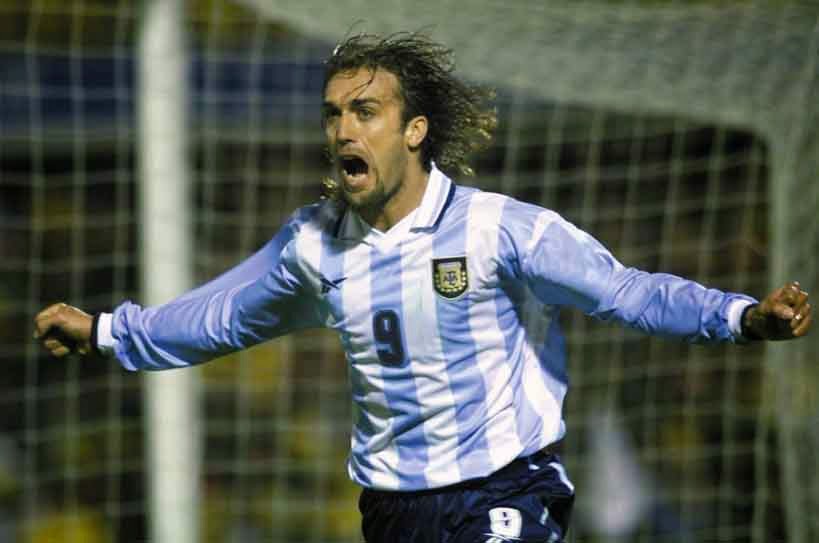
Gabriel Batistuta 

Honorable Mention 
Paul Caligiuri (USA), Tony Meola (USA), Miguel Brindisi (Argentima), Nestor Sensini (Argentina), Ciriaco Sforza (Switzerland), Tony Cascarino (Ireland), Hilderaldo Bellini (Brazil), Roger Piantoni (France).

Squad Explanation
-- I have excluded all Oriundo players because those players have been capped by Italy and the Italian national team did not "lose" them. Omar Sivori, Luis Monti, etc are ineligible. Alfredo Di Stefano played for Spain, but Italy.  He is eligible.
-- Tony Cascarino (Ireland) turned out that he was adopte, would make him ineligible for Ireland.  His father was not Italian, I supposed.  Nevertheless, he has an Italian surname and that it all mattered to me. He made honourable mention.
-- It is estimated up to 25 million Argentines have some degree of Italian descent (up to 62.5% of the total population).  Therefore, almost all of the great Argentinian footballers are Italians.  Daniel Passarella, Alfredo Di Stefano, Diego Maradona, Roberto Perfumo, Gabriel Batistuta, Nestor Rossi, Oscar Ruggeri, Lionel Messi, Silvio Marzolini, Alberto Tarantini and Javier Zanetti are on my Argentina All-Time team.  Diego Simeone made my honorable mention.
-- Four World Cup winning captains are selected. They are José Nasazzi, Dunga, Passarella and Maradona. Hilderaldo Bellini  would have been the fifth one, but he only made honourable mention here.  Italy also won 4 World Cup with 4 different captains.  At the time of writing, there are 21 World Cup captain, which meant 9 of the 20 captains are of Italian heritage.
-- Hilderaldo Bellini lost out to Oscar Ruggeri, Daniel Passarella, José Nasazzi and Roberto Perfumo.
-- Severino Minelli was one of the best right backs in the world during the 1930's. He is from Küsnacht, near Zurich.  It is not an Italian speaking part of the region.
-- Peter Bonetti's parents are actually Italian-Swiss.  They are from Ticino, an Italian-speaking region in Switzerland.
-- Alfredo Di Stefano's father came from Sicily.  His mother was half-French and half-Irish.
-- Michel Platini's father came from Agrate Conturbia, Piedmont, not far from Turin, where he played for Juventus.
-- Dunga's full name was Carlos Caetano Bledorn Verri.  He is also of German descent.  
-- Rivelino's family origibally came from Macchiagodena in Southern Italy.
-- The Honorable mention should be longer. I am sure that I am missing someone with Italian blood from maternal side of the family.
-- I only selected a single striker, which is very unrealistic.  But who can I leave out for another striker? Enzo Francescoli, Diego Maradona, Alfredo Di Stefano, Michel Platini and Lionel Messi got ahead of any striker.  I supposed that there might be a space if I take out Enzo Scifo.


Formation 
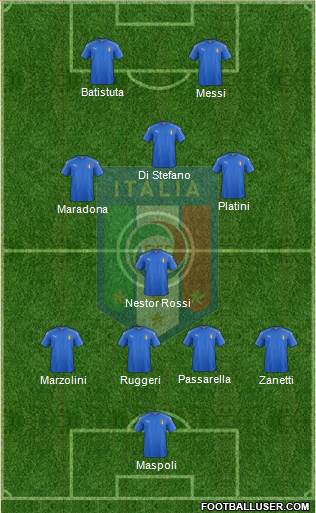

Wednesday, February 4, 2015

Southern Italy Greatest All-Time Team

This blogger Artur Yanturin of Russia copied many of my blog teams.  This blog was one of them.  It was my Russia All-Time Team here.  His team was written in 2020, but mine was uploaded in 2014.   This entry of his was written in October 21, 2020, but mine was uploaded in a few weeks before his 2020.   Another entry of his was written in October 2020, but mine was uploaded in 2017.  His entry of the Dutch-German rivalry between Real Madrid and Barcelona was written in 2020, but mine was uploaded in 2014.  He also copied many many of my blog entries.


Two Southerners vs Germany at the 2006 World Cup Finals

Please also look at my all-time Italy and my All-Time World Cup Team Index.

Italian diaspora
Central Italy.
Northern Italy(excluding Lombardy)Lombardy
Italy after 1982Italy between 1938 and 1982.
Italian Players' surnames ending with an "i"

Southern Italy covers the historical and cultural region that was once politically under the administration of the former Kingdoms of Naples and Sicily (officially denominated Regnum Siciliae citra Pharum and ultra Pharum, that is "Kingdom of Sicily on the other side of the Strait" and "across the Strait"), and which later shared a common organization into Italy's largest pre-unitarian state, the Bourbon-led Kingdom of the two Sicilies. The island of Sardinia, which had once been under the rule of the Alpine House of Savoy, had a different history from the aforementioned region, but is nonetheless often subsumed into the Mezzogiorno.

Southern Italy (Mezzogiorno) consists of the administrative regions of Abruzzo, Basilicata, Campania, Calabria, Molise, Puglia, Sicily and Sardinia. The big clubs in the area are Napoli, Cagliari, Palermo, Bari, Messina, Lecce and Catania.  Italian football is dominated by the Northern clubs, but Diego Maradona led Napoli to break monopoly in the 1980's.  

All players are selected based upon place of birth.  I cannot go into the ancestry of every Italian player in history to determine if they are Southerners.  I tried to add all great Southern Italian footballers not born there to honourable mention.
Iaquinta and Di Natale

Team
GK: Morgan Da Sanctis (Abruzzo)
Morgan Da Sanctis is brilliant keeper, but his international opportunities limited by playing at the same time as Gianluigi Buffon. He only had 6 caps.  He was, however, included in squads for Euro 2008, the 2010 FIFA World Cup and Euro 2012.  From 1999 to 2007, he played for Udinese.  Then, he had another long career with Napoli.  

GK: Salvatore Sirigu (Nuoro, Sardinia)
Salvatore Sirigu began his career with Venezia, and then Palermo. In 2011, he moved to Paris Saint-Germain. Twice voted the Ligue 1 Goalkeeper of the Year, his honours at the club include four consecutive league titles, and all four domestic competitions in both the 2014–15 and 2015–16 seasons. After spending the 2016–17 season on loan to Sevilla and Osasuna, he was signed by Torino in 2017.
  
GK: Franco Tancredi (Abruzzo)
Tancredi began his career with Giulianova, and later also played with Milan and Rimini, before joining Roma. He made 288 Serie A appearances for Roma between 1979 and 1990, winning the Scudetto in 1983 and four Coppa Italia titles. In 1987, during a game against Milan at the San Siro, he was hit on the head by a firework thrown by a Milan supporter. He stopped breathing for a short time but was eventually resuscitated by paramedics. 

RB: Massimo Oddo (Abruzzo)
Massimo Oddo was a product of AC milan academy, but he made his name with Lazio, where he played from 2002 to 2007.  He eventually returned to Milan in 2007, where he won the Champions' League in 2007. He also played for Napoli, Bayern Munich and Verona. He had 34 caps. He was a member of Italy's championship winning squad during the 2006 FIFA World Cup under Marcello Lippi,

CB: Fabio Cannavaro (Campania)
Fabio Cannavaro was capped 138 times for Italy between 1997 and 2010. He was the captain and perhaps, the best Italian player of the 2006 World Cup winning team.  He was named the 2006 FIFA World Player of the Year, and won the Ballon d'Or award in 2006 which made him the third defender to win the award. At the club level, he started his career with Napoli and had spells with Parma, Inter Milan, Juventus and Real Madrid as well as a spell in the Middle East.
Fabio Cannavaro
LB/CB: Felice Gasperi (Abruzzo)
Felice Gasperi was only capped 6 times because Italy started a lineup consisted of Juventus players at his time.  He played for Italy during the 1920's, winning a Bronze medal at the 1928 Olympics.  However, his name was not listed among medalists.  He was born in Abruzzo, but he joined Bologna in 1924, where he played his entire career club career.

SW: Ciro Ferrara (Campania)
Ciro Ferrara was considered one of the best defenders in the world during his prime.  However, his international career was limited by the same period with Franco Baresi, Alessandro Costacurta, Pietro Vierchowod, Riccardo Ferri, Giuseppe Bergomi, Fabio Cannavaro, and Alessandro Nesta.  For club football, he played nearly a decade for Napoli during Diego Maradona's years before moving to Juvnetus.  At Juventus, he won 6 scudettis and a single Champions' League.

CB: Marco Materazzi (Apulia)
Marco Materazzi was highly controversial defender in his prime.  He was remembered for scoring the equaliser against France at the Final of the 2006 World Cup Finals, and then, the headbutt incident in which  Zidane was sent off.  From 2001 to 2006, he payed 41 times for Italy.  His best club football was played with Inter Milan.  He won 6 straight scudettis with them and a single Champions' League in 2010. He also played for Perugia and Everton.
Marco Materazzi 
LB: Giuseppe Pancaro (Calabria)
Pandora made his name with Cagliari.  After Cagliari were relegated in 1997, he transferred to S.S. Lazio.  He was better known for his six seasons with Lazio. He was a part of Lazio's Serie A winning team in 2000. He also played for Milan, Torino and Fiorentina.  He earned 19 caps for Italy, but never played in a major tournament.

LB: Francesco Coco (Sicily)
Francesco Coco was a part of the Azzurri at the 2002 World Cup Finals co-hosted by Japan and Korea. Coco spent the majority of his club career with the Milan clubs; first with A.C. Milan between 1993 and 2002 and later with F.C. Internazionale between 2002 and 2007. He also had several loan spells with Vicenza Calcio, Torino F.C. and FC Barcelona. He won two Scudetti with Milan.  He had 17 caps for Italy.

DM: Gennaro Gattuso (Calabria) 
Gennaro Gattuso was a highly regarded destroyer in his prime. He spent 13 years with AC Milan, forming a famous partnership with Andreas Pirlo. His strength and brutal style complemented well with Pirlo's creativity. He also played for Rangers, Perugia and Sion. He won two Champions' League with AC Milan in 2003 and 2007.  For the Azzurri, he earned 73 caps.  He went to three World Cup Finals, winning the 2006 World Cup Finals, playing along side Pirlo again.
Gennaro Gattuso
CM: Fernando De Napoli (Campania)
Fernando De Napoli was a part of the successful Napoli side that also featured Diego Maradona.  He won the scudetto in 1987 and 1990, the Coppa Italia in 1987, the UEFA Cup in 1989, and the Supercoppa Italiana in 1990. He also won two scudettos with AC Milan, where he played between 1992 and 1994.  He also played for Reggiana. For his country, De Napoli took part in the 1986 World Cup, the Euro 88 and the 1990 World Cup.

CM: Antonio Juliano (Campania)
Juliano played the majority of his club career with Napoli (1962–78), winning the Coppa delle Alpi in 1966, and the Coppa Italia and the Anglo-Italian League Cup in 1976. He finished his playing career after a season with Bologna, retiring in 1979, after helping the club to avoid relegation.  He went to three World Cup Finals: 1966, 1970 and 1974, but only played one match.

CM/DM: Antonio Conte (Apulia)
From 1985 to 1991, Antonio Conte played for Lecce.  From 1991 to 2004, he played for Juventus.  He is one of Juventus' most decorated players.  He captained the team and won the 1996 Champions League, as well as five Serie A titles, among other honours.  From 1994 to 2000, he was capped 20 times for Italy.  he scored a bicycle against Turkey at the Euro 2000.  He also participated at the World Cup in 1994.

RW/LW:  Franco Causio (Apulia)
Franco Causio capped 63 times for Italy.  He was a part of the Azzurri at Euro 1980 and then, the World Cup in 1982, where Italy won.  For his club career, he played 11 years for Juventus between 1970 and 1981.   During a highly successful period with the club, he won the scudetto six times, as well as winning a Coppa Italia, and an UEFA Cup. He also reached the European Cup final with Juventus during the 1972–73 season.
Franco Causio 
AM: Stefano Fiore (Calabria) 
Stefano Fiore started out with Cosenza in 1992, but known for his career with Parma in the 1990's, where he won two the UEFA Cups.   He later played with Lazio, Udinese, Padova, Chievo, Valencia, Fiorentina, Torino, Livorno, etc. He was capped 38 times for Italy between 2000 and 2004 in period when Italy had many great attacking midfielders.  He played at  the European Championship in 2000 and 2004.

AM: Gianfranco Zola (Sardinia)
Gianfranco Zola played with Diegoi Maradona at Napoli as a young player. He played for Parma between 1993 and 1996, winning the 1995 UEFA Cup with Tomas Brolin, Fernando Couto, Faustino Asprilla and Stefano Fiore. He moved to Chelsea in 1996 and won the FWA Footballer of the Year.  His transfer to Chelsea started a wave of foreign players heading over to England. For the national team, he only played 35 times for Italy due to overcrowding of attack midfielders during his prime. 
Gianfranco Zola

FW: Antonio Di Natale (Campania)
Antonio Di Natale played 5 seasons with Empoli before signing with Udinese, where his career took off.  He was the Seria A top scorer for two seasons: 2010 and 2011. At the international level, he only played 42 times for Italy.  He was a key player at the World Cup Finals in 2010. He also went to the European Championship in both 2008 and 2012.  He is one of Udinese's greatest player.

FW: Antonio Cassano (Puglia)
Antonio Cassano was controversial figure known to have clashes with managers, teammates, etc.  He made a big move to Roma as a 19 years old as one of Italy's brightest young players.  Initially, he found successes with the club, but clashes with manager Fabio Capello led to his falling out with the club.  He would play for Real Madrid, Sampdoria, AC Milan, Inter Milan and Parma with mixed results.  He gained his first caps in 2003, but he was in and out of the players' pool.
Antonio Cassano 
ST: Riccardo Carapellese (Apulia)
Carapellese started his career in the 1942–43 season with Spezia Calcio 1906 in Serie B.  After a stint with Como, he played with Milan, in which he remained until 1949.  After the Grande Torino Superga tragedy, he joined Torino, inheriting the captain's armband from Valentino Mazzola. In 1952, he moved to Juventus and then, played for Genoa.  He participated at the 1950 FIFA World Cup as Italy's captain. 

ST: Toto Schillaci (Sicily)
Salvatore Schillaci started with Messina at home before moving to Juventus in 1989.  He was a relatively, unknown player at the beginning of the 1990 World Cup Finals in Italy. He started off as a substitute in the first two matches, where he scored decisive goals coming off the bench.  He became a starter by the third match.  He went on to form a great partnership with Roberto Baggio.  He scored 5 goals and finished as the top scorer and won the Gold Ball.
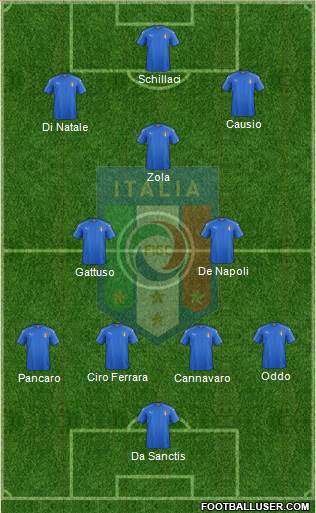
Toto Schillaci
ST: Vincenzo Iaquinta (Calabria) 
At the club lebel, Vincenzo Iaquinta made a name as the offensive partner of Antonio Di Natale while they played for Udinese.  He also played for Juventus between 2007 and 2013.  He played 40 matches for the Italy national football team between 2005 and 2010, scoring 6 goals. He was a part of Italy's World Cup winning team in 2006. He played in 5 out of 7 of Italy's matches in Germany.
 
ST: Vincenzo Montella (Campania) 
Vincenzo Montella played for Empoli, Genoa, Sampdoria and Roma in Italy, and also had a spell on loan in England with Fulham. His best years were spent with Roma, where he won the Serie A title and the Supercoppa Italiana during the 2000–01 season. He was voted into the Hall of Flame of AS Roma in 2013. For Italy, he went to the European Championship in 2000 and the World Cup Finals in 2002, but saw limited action. 
Vincenzo Montella 

Honorable Mention 
Ciro Immobile (Campania), Fabio Quagliarella (Campania), Giuseppe Galderisi (Campania), Leonardo Costagliola (Puglia), Roberto Galia (Sicily), Giuseppe Furino (Sicily), Claudio Gentile (Sicilian born in Libya), Simone Perrotta (born in England of parents from Calabria), Gianluigi Donnarumma (Campania),  Mario Balotelli (Sicily), Fabio Quagliarella (Campania), Domenico Criscito (Campania), Attilio Lombardo (Campania), Antonello Cuccureddu (Sardinia), Antonio Benarrivo (Apulia), 

Squad Explanation
-- Toto Schillaci (Sicily), Fabio Cannavaro (Campania), Gennaro Gattuso (Calabria) and Fernando De Napoli (Campania) were probably the greatest Italian players from the South.
-- Franco Causio won a World Cup in 1982.  Claudie Gentile is a Sicilian, but he was born in Libya.  
-- Fabio Cannavaro had one of the greatest performance of a defender in a World Cup Finals.  He was Italy's best player in 2006 as Italy won the World Cup.
-- The whole of Italy might be disappointed with the result of the 1990 World Cup Finals as expectation was high.  Italy was eliminated in the semi-final by Argentina in Naples.   Diego Maradona tried to split the loyalty of the Southern Italians in that match.  “The Neapolitans are being asked to be Italians for one night, while the other 364 days of the year they get called terroni (an Italian slur roughly translated as peasants),” he told reporters.  Nevertheless, Italy would have been worst without the performance of Toto Schillaci of Sicily.  He was the hero of that World Cup Finals.  Fernando De Napoli and Ciro Ferrara also came from the South.  Andrea Carnevale played for Napoli, but he was born in Lazio.
-- Five members of the 2006 World Cup winning squad made this all-time team.  They are Fabio Cannavaro, Massimo Oddo, Marco Materazzi, Vincenzo Iaquinta and Gennaro Gattuso.  Simone Perrotta's parents are from Calabria too.  
-- Gianluigi Donnarumma was born in Campania.  At the time of writing, he is too young. He needed to earn a spot.
-- Mario Balotelli was born in Palermo, Sicily, but he grew up in North with his foster parents. Since I have been using birthplace as the main criteria, he is eligible for this team. I do believe that Mario Balotelli is overrated, but he got better name recognition than Ciro Immobile (Campania) and Giuseppe Galderisi (Campania) at the time when I wrote the blog.  Since then, his reputation have fallen down. 
-- I did a review of the team in January, 2021.  Ciro Immobile probably deserved to be on the team over Mario Balotelli.  In 2019–20 season, he equalled the record for most Serie A goals in a season with 36 goals.  Mario Balotelli had a higher profile club career than Immobile because he was always on the limelight.  Then, I discovered Riccardo Carapellese.  So I have to take off Mario Balotelli and Immobile remained on my honorable mention.  I also removed Fabio Quagliarella (Campania) and replaced him with Antonio Conte.  I need a midfielder more than an attacker.  Besides, Cinte definitely had a better club career than Quagliarella.
I also discovered Attilio Lombardo (Campania) whom I might need an extra winger.  I simply have too many forwards. At the time of writing, I am reviewing my team.
-- Three of the bad boys of Italian football are on this team: Marco Materazzi, Antonio Cassano and Mario Balotelli (who was on the original team).  Cassano did not live up to his talents. Balotelli is following his footsteps.
-- A few players were unlucky to live in a period where there are fierce competition for their positions.  Morgan Da Sanctis, Gianfranco Zola, Stefano Fiore and Ciro Ferrara would have a different international career if they were born in a different era. 
-- Because of Gianluigi Buffon, De Sanctis seldom got to play for Italy.  He was a year older than Buffon.
-- Marco Materazzi contributed to Italy's 2006 World Cup winning team, but his total caps was limited by playing with the same time as some of the greatest centerbacks.  He partnered Fabio Cannavaro who also came from Campania at the 2006 World Cup Finals after Alessandro Nesta was injured.  He also scored the equaliser against France in the Final as well as involving in Zinedine Zidane's infamous red card.
-- Ciro Ferrara had a much more fierce competition than Materazzi on the Italian national team.  He played with Franco Baresi, Ricardo Ferri, Giuseppe Bergomi, Pietro Vierchowod and Alessandro Costacurta.
-- Gianfranco Zola was playing around the same time as Robert Mancini, Roberto Baggio and Alessandro Del Piero.  He was known for his career with Napoli and Parma, but probably earned a much better reputation playing in England. He also played for Sardinia, a non-FIFA national team.
-- Luca Riva was associated with Cagliari, but he was born in Lombardy.
-- Fernando De Napoli's name indicated that he is from the region. He was born in Campania. He and Ciro Ferrara are the only members from Diego Maradona's Napoli who got selected to my all-time team.  Napoli put Southern Italian club on the map.  Zola was an understudy to Diego Maradona at the club.   Fabio Cannavaro played for the youth team at the time of Maradona.
-- Vincenzo Iaquinta made a name as the offensive partner of Antonio Di Natale with Udinese, a club located in Friuli Venezia Giulia in the Northeast Italy.
-- Riccardo Carapellese was the captain of the national team in the 1950 World Cup Finals.
-- Simone Perrotta was born in England to parents from Cosenza, Calabria. Claudio Gentile is Sicilian, but he was born in Libya.  By my birth rule, they are not eligible for this team. I added both to the honorable mention.  

Starting lineup
Formation: 4-2-1-3


Sunday, February 1, 2015

Central Italy Greatest All-Time Team

Gianluigi Buffon and Fabio Grosso at the 2006 World Cup


Please also look at my all-time Italy team here and my All-Time World Cup Team Index.
Italian diaspora
Southern ItalyCentral Italy.
Northern Italy(excluding Lombardy)Lombardy
Italy after 1982Italy between 1938 and 1982.
What if Italy Euro 1992

Central Italy is one of the five official statistical regions of Italy used by the National Institute of Statistics (ISTAT), a first level NUTS region and a European Parliament constituency.consists of the administrative regions of Lazio, Tuscany, Marche and Umbria.  The big clubs located in this area included AS Roma, Lazio, Fiorentina, Empoli and Livorno.

Marche, Tuscany and Umbria – together with Emilia-Romagna – are considered to be the most left-leaning regions in Italy, and together are also referred to as the "Red Belt".  Lazio, except for Rome, is more politically conservative, a trait which it shares with Southern Italy.  The fans of S.S Lazio tended to be more right wing.  They considered the left-lending Livorno as one of their rivals.  

Tuscany is known for its landscapes, history, artistic legacy, and its influence on high culture. It is regarded as the birthplace of the Italian Renaissance[5] and has been home to many figures influential in the history of art and science, and contains well-known museums such as the Uffizi and the Pitti Palace. Umbria is the only Italian region having neither a coastline nor a common border with other countries. 

This is my selection of Central Italy All-Time Team. The number 23 was chosen because it is the official squad size for the World Cup Finals.
Paolo Rossi and Bruno Conti at the World Cup 1982

Team
GK: Gianluigi Buffon (Tuscany)
Gianluigi Buffon is considered to be one of the greatest keeper ever.  He made his Serie A debut at the age of 17 in 1995 with Parma.  He earned his first cap when he was only 19.  He had a total of 175 caps. His biggest achievement must be winning the World Cup in 2006.  He has been named the Serie A Goalkeeper of the Year a record eight time. He became the most expensive goalkeeper of all time following his transfer from Parma to Juventus in 2001.  He moved to PSG in 2019.
Gianluigi Buffon
GK: Enrico Albertosi (Tuscany)
Enrico Albertosi  was one of the best keepers in his generations.  He played with Fiorentina that won the Cup Winners' Cup in 1961.  Then, he moved to Calgary in 1968, where he won a scudetti with Caligari in 1970.  He later transferred to AC Milan in 1974, where he won yet another Serie A title and Coppa Italia.  For Azzurri, he was a part of Italy's European Championship team in 1968.  He went to the both 1966 and 1970 World Cup Finals.
Enrico Albertosi 

GK: Angelo Peruzzi (Lazio)
Peruzzzi played for Roma, Hellas Verona, Juventus, Internazionale and Lazio. He had a highly successful spell with Juventus, where he won three Serie A titles, the Coppa Italia, the UEFA Cup and the Champions League. His cap total was limited to 31, largely because he was playing in the same generation as Buffon. He missed both France 1998 and Euro 2000 through injuries. He was the backup keeper at World Cup 2006.

RB: Mauro Tassotti (Rome/Lazio)
After making his Serie A debut with Lazio, he went on to play with Milan for 17 years. He won 17 major titles with Milan, including five Serie A championships and three UEFA Champions League tournaments, reaching five finals in total.  He was a part of both Arrigo Sacchi's and Fabio Capello's AC Milan.  He also went to the World Cup Finals in 1994, where Italy came second.

RB: Francesco Rocca (Rome/Lazio)  
Francesco Rocca played his entire career with AS Roma.   He played 18 games for the Italy national football team from 1974 to 1976.  He retired at the age of 26 because of a serious injury. He was nicknamed "Kawasaki"(Japanese motorcycle brand) for his pace and work rate.  He is a member of AS Roma's Hall of Fame.   

CB: Alessandro Nesta (Rome/Lazio) 
Alessandro Nesta is considered one of the best defender of his generation.  He was the Serie A defender of the Year for 4 times. He started his career with Lazio.  Later, he played with AC Milan where he won two Champions' league.  He also played in MLS.  He earned 78 caps.   He played on the 2006 World Cup winning team, but injured on the third game of the tournament.  He also went to 1998 and 2002 World Cup Finals as well as the European Championship in 1996, 2000 and 2004.
Alessandro Nesta

CB: Leonardo Bonucci (Rome/Lazio)    
Leonardo Bonucci started his career with Inter Milan, but became famous with Bari during the 2009-2010 season. In 2010, he joined Juventus. He was a part of Antonio Conte's great defensive unit at Juventus, playing alongside Giorgio Chiellini and Andrea Barzagli. He was capped 75 times. He went to both World Cup in 2010 and 2014. He was a member of Italy's Euro 2020 winning team.

CB: Andrea Barzagli (Tuscany) 
Barzagli first made his name with Palermo.  Later, he moved to Wolvesburg. He was a later bloomer. In 2011, he joined Antonio Conte's Juventus.  He finally established himself as one of the best in the world.   He played 73 times for Italy between 2004 and 2017.  He was a member of the 2016 World Cup winning team.  He also went to the 2014 World Cup and three European Championships (2008, 2012, and 2016), 

CB/LB: Giorgio Chiellini (Tuscany)
Giorgio Chiellini played with Livorno, Roma and Fiorentina before moving to Juventus in 2005. With Juventus, he has won eight consecutive Serie A titles from 2012 to 2019. For the national team, ge earned over 90 caps. He was selected for the 2004 Olympics, winning a bronze medal, as well as for three European Championships, two World Cups and two Confederations Cups, helping them to reach the final of Euro 2012.

LB: Amedeo Carboni (Tuscany)
Amedeo Carboni played for a number of Italian clubs before joining Roma in 1990. He stayed there for 7 seasons mainly as a starter before he went to Valencia in 1997.  With Valencia, his team made it to the Champions' League Finals twice and won the UEFA Cup/League Double in 2003/2004. He represented Italy at the European Championship in 1996, where he earned two of his 18 caps for Italy.

LB: Fabio Grosso (Rome/Lazio)   
From 2003 to 2009, Fabio Grosso played 48 times for Italy.  He was the hero of Italy's 2006 World Cup winning team.  He earned the penalty that beat Australia at the round of 16, scored the winning goal in the semifinal, and then, the final penalty kick in the Final.  At the club level, he started his career in the lower divisions in Italy before making a name with Perugia.  He helped Palermo to gain promotion in 2004.  He later played for Inter Milan, Lyon and Juventus.
Fabio Grosso
DM: Marco Tardelli (Tuscany)
Marco Tardelli played at the 1978 World Cup Finals in Argentina and the 1980 European Football Championship at home.  He was the unsung hero of Italy's 1982 World Cup winning team.  He was capped 81 times.  He also won all the three major European competitions with Juventus. He also played for Pisa, Como, Inter Milan and St.Gallen of Switzerland.

DM: Daniele De Rossi (Rome/Lazio)  
At the time of writing, Daniele De Rossi has played his entire career with Roma.  He inherited the captaincy of Roma in 2017 following the retirement of Francesco Totti.  Since 2004, he went to every major international tournaments.  He had 117 caps before his retirement from the national team in 2017. He was a member of the 2006 World Cup winning team.  He was Italian Footballer of the Year in 2009. 

DM: Attilio Ferraris (Tuscany) 
Attilio Ferraris played 10 seasons (254 games, 2 goals) in the Serie A, for A.S. Roma, S.S. Lazio and A.S. Bari.  Ferraris had 28 caps for Italy.  He won the bronze medal at the 1928 Olympics, and was part of the World Cup winning team of 1934, being named to the tournament's All-Star Team for his performances.

RW: Bruno Conti (Rome/Lazio)
Bruno Conti was the greatest winger in Italy's history.  He won the World Cup in 1982 and also took part at the 1986 World Cup Finals. Except with two loan spells with Genoa, he played his entire career with AS Roma. The season after the World Cup Finals in 1982, he helped Roma to win the league title.  He also led them to the 1984 European Cup Final but were defeated on penalties by Liverpool.

AM/LM: Francesco Totti (Rome/Lazio)
Francesco Totti was the long serving captain of AS Roma and perhaps the greatest ever player for the club.  He brought the scudetti back to AS Roma in 2001 after a 20 year drought.  He was named the Italian Footballer of the Year for 2000 and 2001. He won the European Golden Boot award in 2006-2007.  He won the 2006 World Cup winner and reached the Euro 2000 final with Italy, Totti was selected in the All-Star team for both tournaments. He also represented his country at the 2002 World Cup and Euro 2004.  
Francesco Totti
AM: Giuseppe Giannini (Rome/Lazio)
Nicknamed "Il Principe" (The Prince),  he was a symbol of Roma before the emerge of FrancescoTotti.  He played for AS Roma between 1982 and 1996. After AS Roma, he played in Austria for Sturm Graz, and for Napoli and Lecce in Italy. Giannini was capped 47 times for Italy between 1986 and 1991, scoring 6 goals. He represented Italy at both Euro 1988 and the 1990 World Cup.

FW: Roberto Mancini (Marche)
Roberto Mancini started his career with Bologna, but probably best remembered for his years with Sampdoria.  He formed a great partnership with Gianluca Vialli there, winning the Cup Winners' Cup in 1990 and the scudetti in 1991. He only played 36 times for Italy because of fierce competition from other offensive midfielders.

AM: Giancarlo Antognoni (Umbria)
Giancarlo Antognoni  was Fiorentina's greatest ever player .  He was a key player for Italy's World Cup winning team in 1982, but he missed the Final because of an injury.  He was capped 73 times for the Azzurri. In 1972, he joined Fiorentina. Because of his loyalty with his club, he never won anything at the club level.  He holds the record for the most appearances in Serie A for Fiorentina, with 341 appearances.

FW: Paolo Rossi (Tuscany)
Paolo Rossi was the hero of Italy's World Cup winning team in 1982, notably for scoring a hattrick against Brazil in Spain, and went on to win the Golden boot. He was also the European player of the Year in 1982 because of his performance at the World Cup Finals. At the club level, he was a part of the great Juventus team of the 1980's, winning the 1985 European Cup as Juventus' second top scorer.  He also went to the 1978 World Cup Finals. He played 48 times for Italy.

Paolo Rossi
FW: Alessandro Altobelli (Rome/Lazio)
Alessandro Altobelli played for Latina and Brescia before joining Inter Milan in 1977, where he became a star at the club.  He also spent a season with Juventus in the 1988-1989 season.  For the national team, he had 61 caps. He was best-remembered for scoring a goal against West Germany at the World Cup Final in 1982. He also played in the 1986 World Cup Finals.

ST: Francesco Graziani (Rome/Lazio)
Francesco Graziani earned 64 caps.  He played every game in 1982 as Italy won their first World Cup since 1938. He started his club career with Arezzo. He was an all-time great at Torino, winning the league in 1976.  He was the top scorer in Serie for 1976-1977 season.  He also played for Fiorentina, Roma and Udinese.

ST: Giorgio Chinaglia (Tuscany)
Born in Italy, Giorgio Chinaglia grew up in Wales, where he started his career with Swansea. Lazio voted him as their greatest ever player.  In 1973-1974, he led the league in scoring as Lazio won the scudetto. Later, he played for NY Cosmos with Pele and Franz Beckenbauer. He was one of the few players who played in NASL during their prime. He played 14 times for Azzurii between 1972 and 1975. He went to the 1974 World Cup Finals in West Germany.

Honorable mention
Bruno Giordano (Rome/Lazio), Luigi Di  Biagio (Rome/Lazio), Ardico Magnini (Tuscany), Angelo Di Livio(Rome/Lazio), Alberigo Evani, Fabrizio Ravanelli (Umbria), Paulo Di Canio (Rome/Lazio), Lionello Manfredonia (Rome/Lazio), Agostino Di Bartolomei (Rome), Giovanni Galli (Tuscany), Stefano Tacconi (Umbria), Ardico Magnini (Tuscany).

Squad Explanation
-- This team is not the best teams out of all of my all-time teams from Italy, but it included many players who contributed enormously for Italy winning the World Cup. Both Paulo Rossi and Fabio Grosso were World cup heros.  
-- Paulo Rossi's achievements in the 1982 World Cup Finals are well-known.  Without him, the world of football would be very different.  He not only won the World Cup for Italy.  He also changed the way how Brazil played football.  
-- All three goal scorers at the 1982 World Cup Final against West Germany are on this team. Paulo Rossi, Marco Tardelli, Alessandro Altobelli scored in the 3-1 victory. Along with Bruno Conto and  Giancarlo Antognoni, the Central Italians were well-represented on the offensive line of the 1982 team. 
-- Fabio Grosso sealed the penalty against Australia in the round of 16.  He scored a goal against germany in the semi final, and the last and World Cup winning penalty of the shootout against France in the World Cup Finals.  Of course, the 2006 World Cup team also included Francesco Totti, Angelo Peruzzi, Daniel De Rossi, Alessandro Nesta  and Gianluigi Buffon.   Nesta was injured during the tournament, but Buffon was probably one of the main reasons why Italy won the World Cup.  Daniel De Rossi's role was limited due to a red card he received in the first round and being suspended.  Totti, however, was one of the key players.
-- Most players selected played for AS Roma, Fiorentina and Lazio at one point of their career.  
-- Gianluigi Buffon, Enrico Albertosi and Angelo Peruzzi were obvious choices.  Buffon is probably the greatest goalkeeper of all-time. The other goalkeepers would be Giovanni Galli (Tuscany), Stefano Tacconi (Umbria)
-- Francesco Totti was born in the region. He also played his entire career for AS Roma.  Daniele De Rossi, Bruno Conti, Francisco Totti and Giuseppe Giannini are born in the Lazio/Roma area, where they became icons of AS Roma.  Giuseppe Giannini enjoyed a Totti-like status with AS Rioma before the emerge of Totti.  Then, De Rossi inherited that status from Totti.  Francesco Rocca who was a one club man with AS Roma was also born in the area.  
-- Giancarlo Antognoni was also born in the region, but not in Tuscany where Fiorentina was located.  He was born in Umbria, but still a part of Central Italy.  
-- Both Totti and Antognoni won the the World Cup for Italy, but their club career was limited due to their loyalty toward their clubs.  Both players were considered their club's greatest players.  Antognoni was actually not a one club player.  However, no one doubted his loyalty to Fiorentina.  The Coppa Italia in 1974 was his only trophy he won in club football.
-- Both Bruno Conti and Daniele De Rossi also played their entire career with AS Roma. They also won the World Cup for Italy.  Upated: De Rossi played a few games for Boca Juniors at the end of his career.
-- Luciano Re Cecconi was born in Milan, but known for his career in Lazio.  He is ineligible for this team.
-- Italy and Juventus was known for its solid defensive unit with Gianluigi Buffon and the three centerbacks of Andrea Barzagli, Leonardo Bonucci and Ciorgio Chiellini.  They were all from Central Italy.  Leonardo Bonucci was born in Lazio while the other three are born in Tuscany.
-- Giorgio Chinaglia (Tuscany) received a lot name recogination because he played with NY Cosmos and Lazio during their glorious days.  Lazio also voted him as their greatest player.  And since this an all-time team for the region, I gave him a lot of credits for his career with Lazio.
-- Paulo Di Canio (Rome/Lazio) never got his chance with Italy.  I also dropped him because there are too many forwards/attack midfielders on this team.  I only put him on honorable mention.


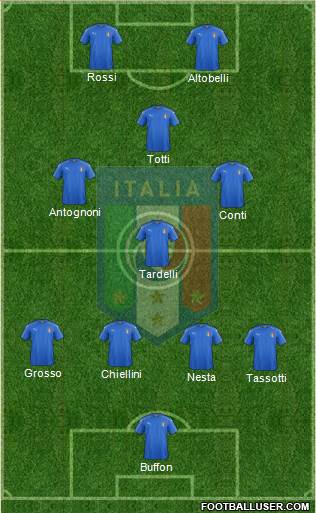
Starting lineup
Formation: 4-4-2 (Diamond)
This formation is based on the 4-4-2 used by Fabio Capello and Carlo Ancelotti with AC Milan.  The offensive lineup was almost identical to the 1982 World Cup winning team with Paolo Rossi, Alessandro Altobelli, Mauro Tassotti, Bruno Conti and Giancarlo Antognoni.  I started Altobelli over Graziani because he emerged as a star of the Azzurri in the mid-1980's. I converted Bruno Conti into a runner, where many wingers successfully made the transition. Antognoni served as my registra while I also put Francisco Totti behind the two strikers. Fabio Grosso was rewarded a starting position for his World Cup contributions.  In real life, Gianluigi Buffon played with three of four starting defenders.