Friday, August 29, 2014

Sporting Lisbon SP Youth Academy All-Time Team

This blogger Artur Yanturin of Russia copied many of my blog teams.  This blog was one of them.  It was my Russia All-Time Team here.  His team was written in 2020, but mine was uploaded in 2014.   His Spartak Moscow All-Time team entry of was published in October 2020, but mine was uploaded in 2017.  His entry of the Dutch-German rivalry between Real Madrid and Barcelona was written in 2020, but mine was uploaded in 2014.  He also copied many many of my blog entries.

His Facebook and Instagram


Luis Figo

Please also see my All-Time World Cup Team Index

Portugal
BenficaPortoSporting SP

This blog was originally written before I started my entire All-Time World Cup Team series.  It was just few paragraphs about the wingers groomed Sporting Clube de Portugal (Academia Sporting).  They are  known for producing great wingers/wing forwards. Paulo Futre, Cristiano Ronaldo, Luis Figo, Nani, Simao, Ricardo Quaresma and Luís Boa Morte all came through the academy.  Two of them won Ballon D'Or.  In 2019, I started to write about youth academies.  Sporting CP is among the best in the world, largely because of their wingers. So I simply edited this blog entires.

Sporting Clube de Portugal is one of the big three in Portuguese football.  They won numerous of domestic titles and the 1963-1964 European Cup Winners' Cup.  They are also famous for their football academy.  Paulo Futre, Cristiano Ronaldo, Luis Figo, João Moutinho, Nani, Simao, Ricardo Quaresma, Rui Patricio, Nuno Valente, etc are some of their most famous graduates.  Eight of Portugal's starting eleven and two of three subs used at the Final of Euro 2016 came from the academy.
Ricardo Quaresma and Cristano Ronaldo

Team
GK: Rui Patrício (Portugal)
Rui Patrico was a graduate of Sporting CP's academy. Between 2006 and 2018, he played for their first team.  In 2018, he moved to play in for Wolverhampton Wanderers. He became a part of Portugal's player pool in 2008, but only made his debut in 2010.  He was the starting keeper at Euro 2012 and 2016, World Cup Finals 2014 and 2018. Euro 2016.  His performance at Euro 2016 helped Portugal to win their first major international tournament.  


GK: Vitor Damas (Portugal)
Vitor Damas was the starting keeper for Sporting CP from 1966 to 1976, winning two leagues and three cups, including the double in 1973–74. He had spells with Racing Santander in Spain.  He played for with Vitória S.C. and Portimonense SC before returning to Sporting in 1984.  He had 29 caps.  He was second-choice at both Euro 1984 and the 1986 World Cup, but in the latter tournament, he played two matches. 
Vitor Damas 
GK: Manuel Bento (Portugal)
Manuel Bento is the Portugal Goalkeeper of the Year for 8 times.  He represented Portugal at the European Championship in 1984, where Portugal nearly pulled an upset over eventual winner and host France in the semifinal.  He also played in the 1986 World Cup. He earned 63 caps in total.  At the club level, he played nearly 20 years for Benfica,  appearing in 630 appearances. He was Portuguese Footballer of the Year in 1977.

RB: Miguel (Portugal)
Miguel played the vast majority of his professional career with Benfica (five seasons) and Valencia (seven). Miguel gained 59 caps for Portugal during the 2000s, and represented the country in two World Cups (2006 and 2010) and as many European Championships (2004 and 2008). In 2004, he was a part of the national team that finished second in Euro 2004.

RB: Cédric Soares (Portugal)
Cédric Soares's career started with Sporting CP, going on to appear in 93 competitive games over the course of four Primeira Liga seasons and scoring two goals. He signed for Southampton in 2015.  At the time of writing, he is on loan with Arsenal.  He has 33 caps at the moment. He was a part of the team that won the Euro 2016.  He also went to the 2018 World Cup Finals.

CB: Alexandre Baptista (Portugal)
Baptista played his entire professional career, which spanned 11 years, with Sporting Clube de Portugal, winning five major titles whilst being first-choice in four of those. He took the pitch as the Lisbon side defeated MTK Budapest FC to conquer the 1963–64 edition of the UEFA Cup Winners' Cup.  For Portgual, he earned 11 caps.  He played on all matches at the 1966 World Cup Finals.

CB: José Fonte (Portugal)
Fonte started his professional career with Sporting CP B, moving to England with Crystal Palace in 2007. In 2010 he signed with Southampton where he made 288 appearances in all competitions, until he joined West Ham United in January 2017; he then represented Dalian Yifang in China and Lille in France. Fonte was part of Portugal's squad at Euro 2016 and the 2018 World Cup, winning the former tournament.

CB: Marco Caneira (Portugal)
Marco Caneira started his career at Sporting SP, also appearing briefly for Benfica and represented Valencia in La Liga for a couple of years before returning to Sporting. Over ten seasons, he amassed Primeira Liga totals of 126 matches and one goal; he retired in 2015, after a four-year stint with Videoton.  Internationally, Caneira appeared for Portugal at 2002 and 2006 World Cups and earned 25 caps in six years.

CB: João Laranjeira (Portugal)
From 1970 to1979, João Laranjeira played for Sporting CP.  Then, he played for Benfica from 1979 to 1982.  Then, he played a single season with Amora. Laranjeira gained 12 caps for the Portugal national team.  He played his first national team match on June 11, 1972 as part of the Brazilian Independence Cup against Ecuador.  Portugal finished second.
João Laranjeira
LB: Augusto Inácio (Portugal)
Inácio started playing for Sporting CP, signing at the age of 27 for FC Porto and winning several Primeira Liga championships and domestic cups with both clubs. He was a part of Porto's 1986–87 European Cup victory. He earned 25 caps for Portugal.  His debut came on 5 December 1976 in a 2–1 win over Cyprus in the 1978 World Cup qualifiers, and he represented the nation at Euro 1984 and the 1986 World Cup. 

DM: William Carvalho (Portugal)
Born in Luanda, Angola, Carvalho moved to Portugal when he was just a few years old. At the time of writing, except two loan spells, he has mainly played for Sporting SP.  Carvalho first grained international recognition when he was named player of the tournament at the 2015 European Under-21 Championship.  At Euro 2016, he established as a starter of the national team.  He was also a member of Portugal's team at the 2014 WC Finals.  

DM: Miguel Veloso (Portugal)
Miguel Veloso started his career with Sporting CP in 2005.  Later, he payed with Genoa, FC Dynamo Kyiv and Verona.  From 2007 onward, he has over 50 caps for Portugal. He was a member of the 2008 European Championship team as well as the 2010 and 2014 World Cup team.  His father António Veloso also played for Portugal.

DM: Eric Dier (England)
Eric Dier grew up in Portugal with British parents and was signed by Sporting CP at an early age. He spent two seasons on the first there. In 2014, he joined Tottenham Hotspurs in England. Dier was one of models for England's Umbro kit in 2011 as a 16 years old before he was considered by England at any level. In 2015, he received his first senior cap.  He was a part of the team at Euro 2016 in France. 
Eric Dier 
CM: Fernando Mendes (Portugal)
Fernando Mendes was a star in the 1960's.  Except for one season, he played his entire career for Sporting CP.  He earned 21 caps between 1959 and 1965.  During the World Cup qualifying round for England 1966, he got injured and never fully recovered.  He did not make it to the World Cup Finals and never played for Portugal again.  He later played for Atlético Clube de Portugal.

CM: Carlos Xavier (Portugal)
Born in Portuguese Mozambique, Carlos Xavier played 11 seasons with Sporting CP before joining Real Sociedad with teammate Oceano in 1991.  He returned to Sporting CP also with Oceano in 1994.  At the international level, he was capped 10 times between 1981 and 1993.  His twin brother Pedro was also a capped player for Portugal.

CM Joao Mario (Portugal)
João Mário started with Sporting CP.  In 2016, he joined Inter Milan.  He played briefly on loan to West Ham, but at the time of writing, he is now on loan to Russian club Lokomotiv Moscow.  Since 2014, he had over 40 caps for Portugal. He played every matches at Euro 2016, where Portugal won their first major international trophy.  He also went to the 2018 World Cup Finals.

CM: Joao Moutinho (Portugal)
Joao Moutinho established himself at Sporting before moving to Porto.  In his first season, he won the treble, including the 2011 Europa League.  In 2013, Porto sold him to Monaco. For Portugal, he became a key player since Euro 2012.  He was a part of the team that won the Euro 2016 in France. In 2012, he missed the penalty against Spain in semifinal shootout. Four years later, urged by Cristano Ronaldo, he converted his penalty kick against Poland.

RW: Nani (Portugal)
Nani came through the ranks of Sporting CP.  In 2007, he joined Manchester United, where his career was up and down. He was a part of the team that won the Champions' League in 2009. He earned over a 110 caps for Portugal.  He is a regular member of the national team from 2006 onward. He contributed to Portugal's winning Euro 2016 as one of their key players. He also particoipated at the 2014 World Cup Finals in Brazil.
Nani
RW: Luis Figo (Portugal)
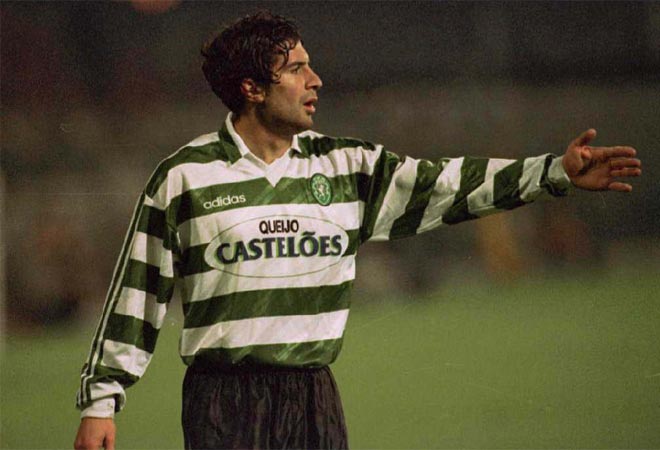
Luis Figo is probably one of Portugal's greatest players.  He was the 2000 European Footballer of the Year and  the 2001 FIFA World Player of the Year. He started with Sporting CP. He was known for his controversial 2000 transfer from Barcelona to bitter rivals Real Madrid. It set a world record fee of £37 million (€62 million).  With Real Madrid, he was the first member of the Galacticos. He won the Champions' League title in 2002. He played for Inter Milan and Sporting SP.

RW/LW: Ricardo Quaresma (Portugal)
Ricardo Quaresma started his career with Sporting CP and moved to Barcelona as a highly, rated winger in 2003.  After three successful years with Porto, he went to Inter Milan and then, Besiktas.  He is often seemed as a player unable to fulfill his talents.  However, he had a great Euro 2016, where Portugal won its first ever major trophy. He scored the lone goal vs Croatia in the round of 16 and the winning penalty kick in the quarterfinal against Poland.

LW:  Paulo Futre (Portugal)
Paulo Futre won a European Cup with Porto in 1987. He was the best Portuguese player in the 1980's. He gained more than 40 caps for his country, representing it at the 1986 World Cup in Mexico.  He played in Spain, France, Italy and Japan, most notably with Atlético Madrid and Porto.  With Porto, he won the European Cup in 1987, putting on a Man of the match performance in the final against FC Bayern Munich.
Paulo Futre 
LW: Simão Sabrosa 
Having played in his country for two of the three biggest teams in the nation, Benfica and Sporting, he also spent several years of his professional career in Spain, notably with Atlético Madrid. He won the 2004–05 national championship with the first club and the 2010 Europa League with the third, amongst other accolades.  from 1998 to 2010, he earned 85 caps.  He was a member of Euro 2004 and 2008 as welll as the 2006 and 2010 World Cup team.  

FW/RW: Adolfo Mourão
Adolfo Mourão was born in 1912.  He played his entire career with Sporting CP from 1928 to 1944.  He made his national team debut 11 March 1934 in Madrid, in a 0-9 defeat against Spain.In total, he played 15 times for Portugal, scoring two goals.  According various source, he was also a right winger.

FW/LW: Cristano Ronaldo (Portugal)
Cristano Ronaldo is one of the greatest forward of his generation.  He is the most expensive players in history from 2009-2013 when he moved from Manchester United to Real Madrid.  At the time of writing, he won the Ballon d'Or winner twice and won Champions' League titles with both Manchester United and Real Madrid.  He helped Portugal to reach the Final of European Championship in 2004 and 2016, winning it in 2016.  
Cristano Ronaldo
ST: Rui Águas
Águas started his career with amateurs Real Desportivo Benfica and played in the lower division before joining Benfica in 1985.  He later also played for Porto.  He also played in Italy for Reggiana. In total, Águas received 31 caps for the national team, scoring ten goals. His last game was for the 1994 World Cup qualifiers on 17 November 1993, losing to Italy 0–1.

ST: Jorge Cadete (Portugal)
From 1987 to 1995, Jorge Cadete played for Sporting CP.  He was remembered for playing with Celtic in Scotland, where he was the league scorer in his only season there(1996-1997).  He later played with Celta Vigo, Benfica, etc.  Cadete won 33 caps for the Portuguese national team scoring five goals, 22 while at Sporting, nine while at Celtic and two as a Celta player.   He went to Euro 1996.
Jorge Cadete
Honorable Mention
Fernando Manuel Antunes Mendes, Nuno Valente, Hugo Viana, Luís Boa Morte, Adrien Silva, Silvestre Varela.

Squad Explanation
-- Sporting CP helped produce two FIFA World Player of the Year winners (Luís Figo and Cristiano Ronaldo), two Ballon d'Or winners (Luís Figo and Cristiano Ronaldo) and one runner-up (Paulo Futre), and one FIFA Ballon d'Or winner (Cristiano Ronaldo).
-- Vitor Damas, Beto, Fernando Mendes, Carlos Xavier, Luis Figo and Cristano Ronaldo are on my Sporting CP All-Time team.
-- The criteria is the overall career of individual players.  For example, Manuel Bento, Paulo Futre, Cristano Ronaldo, etc did little with the club, but they are still considered the greatest players ever produced by this academy.
-- The blog was created in August, 2014 before I created my first All-Time team in October, 2014.  I was amazed by the numbers of wingers produced Sporting CP.  It was simply a paragraph or two describing the wingers.  I mentioned Paulo Futre, Cristiano Ronaldo, Luis Figo, Nani, Simao, Ricardo Quaresma and Luís Boa Morte.  
-- Portugal won the 2016 European Championship with significant contributions from Sporting CP.  Eight of Portugal's starting eleven and two of three subs used at the Final of Euro 2016 came from the academy.  They are Cristano Ronaldo, Rui Patricio, Joao Mario, William Carvalho, Adrin Silva, Jose Fonte, Joao Moutinho, Nani, Ricardo Quaresma and Cedric.  However, only Rui Patricio, Joao Mario, William Carvalho and Adrien Silva were active player for the club in 2016, but they are largest representatives from a Portuguese club.  
-- I took Augusto Inácio over Fernando Mendes and Nuno Valente for the leftback position.
-- The centerback position is relatively weak. João Laranjeira and Alexandre Baptista are club legends.  Marco Caneira was capped 25 times.
-- I selected Fernando Mamede Mendes who was a midfielder.  The other Fernando Manuel Antunes Mendes was a leftback.
-- Carlos Xavier's twin brother played for South China, a club that I supported.
-- Eric Dier was an important player as England reached the semifinal of the 2018 World Cup Finals.  He was also responsible for Tottenham Hotspurs reaching the Champions' League Final.
-- Since the original blog team was aboiut wingers,  I am overloaded with wingers.  I have three left wingers.
-- Paulo Futre was the greatest Portuguese players between Esuebio's generation and Luis Figo. He did not play much for Sporting CP, but the criteria for this team is about the overall career.  He have done enough with his club career.
--Cristano Ronaldo was more of a wing forward.   I do not need to explain why I selected him.  Cristiano Ronaldo was the first player to play for Sporting CP's U16, U18, U19, U21, B team and the senior team in one season.
-- I could not drop Simão Sabrosa so I took him as well.
-- I brought three right wingers because I could not decide between Nani and Ricardo Quaresma. Both players were often described as flops.  Their careers largely affected by false expectations when they were young players.  They have decent careers and contributed to Portugal's Euro 2016 victories, which was Portugal's highest honors.   
-- Adolfo Mourão played his entire career with Sporting SP, but I do not know if the academy existed in the 1930's.  He was also listed as a right winger.  So I have four right wingers.
-- Ricardo Quaresma is less than two years older than  Cristano Ronaldo.  He made his senior debut with Sporting CP the season before Ronaldo made his.  Both were rated as good as each other.  They were transferred out of the club on the same summer.  He went to Barcelona while Ronaldo headed to Manchester United.  His career was not as good as Ronaldo, but he did help Portugal to win the European Championship in 2016 as an important player of the team.
-- I have no space for wingers, Luís Boa Morte and Silvestre Varela.

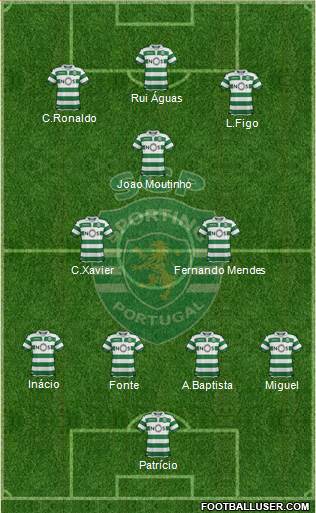
Formation


Monday, August 18, 2014

La Quinta del Buitre


Please also see my
 All-Time World Cup Team Index.
Real Madrid All-Time Team Under Florentina Perez
Real Madrid All-Time Team Under Miguel Munoz
Real Madrid Argentine Best XI
Real Madrid Castilla Greatest All-Time
Real Madrid All-Time Team for Foreign Players

Real Madrid All-Time Team for Spanish players

     In 1984, Real Madrid's reserve team coached by Amancio Amaro won the Segunda Divisió.  The club was ineligible for promotion because the Spanish league disallowed the reserve team from playing together with the senior team in the same division. Even before the team sealed the title, Spanish sport journalist Julio César Iglesias already nicknamed the five home grown players as "La Quinta del Buitre" (Vulture's Cohort) in an article he wrote for El Pais.  "El Buitre" or "Vulture" was the nickname of Emilio Butragueño, the most charismatic player of the group. The other four members were Manolo Sanchís, Martín Vazquéz, Míchel, and Miguel Pardeza.Except for Michel, all members of the group would be promoted to the first team even before the publication of the article. 

      Manolo Sanchís and Martín Vazquéz were the first two to make their senior debut in November 4th, 1983.  Manolo Sanchís even scored a goal that evening.  He  was the son of Manuel Sanchís Martínez who won a European Cup with Real Madrid in 1966.  Three months later, it would be Butragueño's turn.  He scored two goals and provided another for Real Madrid to come from 2-0 to win the game.  A legend was born.

     Meanwhile, another future Real Madrid legend Hugo Sanchez joined the club in 1985 from Atletico Madrid.  He would win 4 La Liga scoring titles or Pichichi trophies(he also won one with Atletico Madrid).  He would coin the nickname "Quinta de los Machos"(The Macho Squadron or the Fifth Male) for the remaining veteran players, namely Francisco Buyo, Rafael Gordillo, Jose Antonio Camacho and Antonio Maceda on the team.

     The group would win 5 consecutive La Liga titles and two UEFA Cups.  Ironically,  all five members of La Quinta del Buitre  only played once on the same field together.  It was largely because  Miguel Pardeza left Real Madrid for a loan spell and then a permanent move to Real Zaragoza in 1987.  All five members of  "La Quinta del Buitre" would represent Spain at the 1990 World Cup Finals in Italy.


Monday, June 2, 2014

Lucky #7 Shirt of Man United, Real Madrid, Liverpool and England

Best #7


Please also see my All-Time World Cup Team Index
Liverpool All-Time English Greatest Team
Liverpool All-Time British Isles players without England
Liverpool All-Time Foreign Players
Manchester United All-Time Team English players
Manchester United All-Time Team Under Sir Alex Ferguson 

Manchester United All-Time Team Under Sir Matt Busby
Real Madrid All-Time Team Under Florentina Perez
Real Madrid All-Time Team Under Miguel Munoz
Real Madrid Argentine Best XI
Real Madrid Castilla Greatest All-Time
Real Madrid All-Time Team for Foreign Players
Spain without Real Madrid and Barcelona players
Real Madrid All-Time Team for Spanish players

The number 7 shirt at Manchester United is a legendary number.  George Best, Cristano Ronaldo, David Beckham, Eric Cantona, Bryan Robson, Steve Coppell, Johnny Berry, and Billy Meredith were all Manchetster United greats. However, not all number 7 at Manchester United were great at Old Trafford.  Ashley Grimes, Ralph Milne,  Keith Gillespie, Michael Owen and  Antonio Valencia also wore that famous shirt. Angel Di Maria only spent one season at Old Trafford.

According ESPN, since Cristiano Ronaldo's departure 10 years ago, Manchester United's No. 7s have scored just 15 Premier League goals as of June 2019.


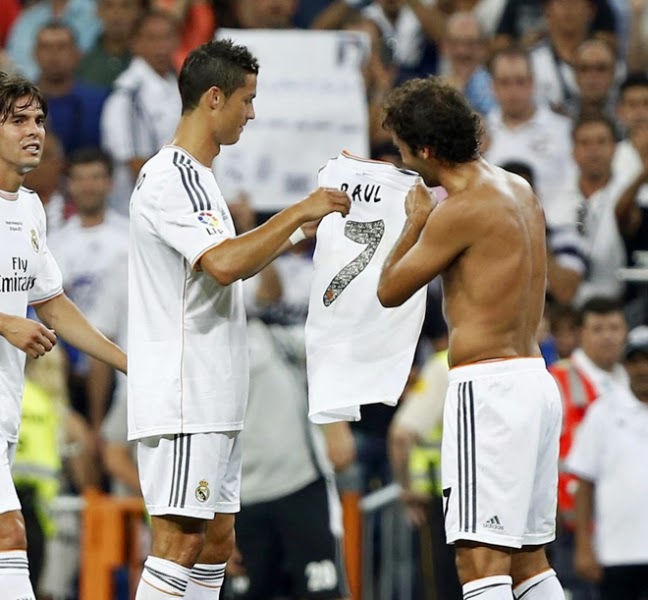
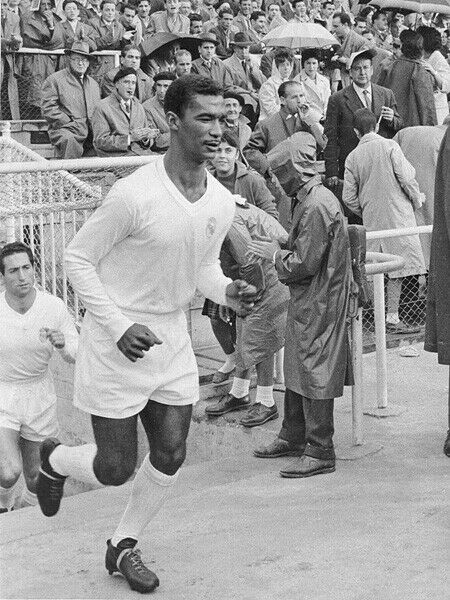
     Raymond Kopa was probably the first, big-name Real Madrid to be associated the number 7. He won three European Cup and a Ballon d'Or while wearing that number.  Then, the shirt was passed onward to  Amancio Amaro in 1962.  He spent 8 years in Madrid scoring 119 goals.  He won the European Cup in 1966 after scoring a brilliant individual goal vs FK Partizan.  In the 1970's and early 1980's, Juanito wore that shirt.  In Madrid, he was best remembered for his competitive spirt.  In fact,  the "Spirit of Juanito" was a term that symbolized the fighting attitude of Real Madrid.  He was killed prematurely in a car accident in 1992.  Since then, the fans would call out his name on the 7th minute of every home match in honor of Juantio.  From Juanito, the shirt was passed onward to Emilio Butragueño.  He was a member of the legendary "La Quinta del Buitre".  he won two UEFA Cup's in the 1980's.  He passed the number 7 shirt to Raul, who would became the icon of Real Madrid football for the next 16 years.  At the time of writing, he is the club's all-time top goalscorer with 323 goals. In 2010, he left Real Madrid for Schalke 04.  Cristano Ronaldo took over the number.  He became the only player to wear the legendary 7 for both Real Madrid and Manchester United.


     Number 7 is also King Kenny's number at Liverpool.  Billy Liddel, Ian Callaghan, Kevin Keegan, Peter Beardsley, Steve McManaman, and Luis Suarez all wore that number too. However, not everyone succeeded wearing that number at Liverpool.  Robbie Keane only lasted 6 months over there.  Harry Kewell often injured during his career there.


Kenny Dalglish
Unlucky 7 of England 
From 1982 onward, England's number 7 jersey is associated with injuries and bad luck.  In 1982,  Kevin Keegan went to Spain carrying an injury.  He only played as a substitute against Spain where he was remembered for missing a header in the match.  In 1986, Bryan Robson injured before the tournament in Mexico.  He only played 4 minutes. Four years later, He played two matches in Italy before injuring himself on the second match.

David Beckham wore the number 7 shirt in 1998, 2002 and 2006.  In 1998, he become Public Enemy #1 after his red incident against Argentina. He did well on 2002, but in 2006, he left the field injured against Portugal in the quarterfinal.  In 2010, Aaron Lennon was injured before the tournament.  However, he managed to play in the tournament.  History repeated itself in 2014.  He made two appearance in 2014. 


Thursday, May 22, 2014

All Eras Draft

This is the team that I selected for my All Eras Draft at Bigsoccer.com.


Team
GK: Peter Shilton (England) 
Peter Shilton is considered one of the greatest keepers ever.  He is England's all-time cap record-holder with 125.  He earned his first cap in 1970 and his last 20 years later in 1990.  He took England to 4th place in the 1990 World Cup.  He played for 11 different clubs in his career, all in England.  He won two straight European Cups in 1979 and 1980 with Nottingham Forrest. He was PFA Players' Player of the Year: 1977–78, an award rarely won by a goalkeeper.

Peter Shilton 

GK: Sam Hardy (England)
Sam Hardy was discovered by Liverpool FC after playing against them with Chesterfield. Sam Hardy joined Liverpool in 1905. By the end of his first season he had bagged a Football League First Division championship medal as Liverpool won their second title in five years. Later, he played for Aston Villa between 1912 and 1921 and Nottingham Forest between 1921 and 1925. He was capped 21 times with the English national team, which was then an astonishing number.  He was widely considered to be England's first ever star keeper. 
Sam Hardy

RB: Jorginho (Brazil)
Jorginho started with América Football Club in Brazil, moving after just one season to Flamengo. In 1989, he went to Bayer 04 Leverkusen in Germany's Bundesliga. Then, he played with Bayern Munich, where he reached the heoght of his club career.  He later played with Kashima Antlers,  São Paulo, Vasco da Gama and Fluminense.  He was capped 64 times for Brazil. He played at both the 1990 and the 1994 FIFA World Cups, winning the one in 1994.
CB/RB: Sergio Ramos 
Sergio Ramos is a part of the all-conquering Spanish team that won the 2010 World Cup and two European Championships in 2008 and 2012.  He is the youngest player ever to receive his 100th caps. He joined Real Madrid as a teenager from Sevilla. He scored the tying goal as Real Madrid won their 10th European Cup in 2014.  He also won his second Champions' League title by scoring a goal in the 2016 Final.  In 2018, he won his fourth Champions League Cup with Real Madrid.
Sergio Ramos
CB: Karl-Heinz Forster (Germany)
With West Germany, Karl-Heinz Forster earned 81 caps between 1978 and 1988. He won the European Championship in 1980, and came 2nd at the World Cup in both 1982 and 1986.  He was regarded one of the best defenders in the 1980's.  For his club career, he played with VFB Stuttgart and Marseille.  With Stuttgart, he won a Bundesliga in the 1983–84 season.  He won two league titles in France. His brother Bernd also played for West Germany and VfBStuttgart.
Karl-Heinz Forster 
CB: Rio Ferdinand (England)
Rio Ferdinand became the youngest defender to play for the Three Lions at the time in 1997.   He played 81 times for England  between 1997 and 2011, and was a member of three World Cup squads.  At one point, he was the most expensive British footballer and also broke the world's record transfer fees for a defender twice. He won the Champions' League with Manchester United in 2008. He also played for Leeds United and West Ham.
Rio Ferdinand 
LB: Antonio Cabrini (Italy)
Antonio Cabrini was one of the best leftbacks in the world during his time.   He spent the best part of his club career with Juventus, winning the European Cup in 1985. He started his career with  U.S. Cremonese. He also played for Atalanta and Bologna. He picked up 73 caps, and went to the 1978, 1982 and 1986 World Cup Finals. He was remembered for being a part of Italy's great defensive unit that won the World Cup in Spain. 
Antonio Cabrini

RB/LB: Denis Irwin (Ireland)
Alex Ferguson considered him his greatest ever signing.  He played over 200 games for Manchester United, winning the Champions' League in 1999 and 7 Premiership titles. He also played for Leeds United and Oldham Athletic, and finished his career with Wolverhampton Wanderers. Irwin was capped by the Republic of Ireland national side 56 times, scoring four goals and featuring in the side that reached the second round (last 16) at the 1994 FIFA World Cup.
Denis Irwin
CM: Edgar Davids (Netherlands)
Nicknamed "the Pitbull", Edgar Davids was one of the greatest defensive midfielders in the world.  At the club level, he won the European Champions' League with Ajax in 1995, a team considered to be the best ever club side.  He also spent 7 seasons with Juventus in Italy at the height of his career.  He played 74 times for the Dutch national team between 1994 and 2005.  He was an important player at the World Cup Finals in 1998 when Netherlands reached the semi-final. 
Edgar Davids
HM/CM: Jozsef Bozsik 
Jozsef Bozsik was considered the second best Hungarian player of all-time after his childhood friend Ferenc Puskus.  He was one of the greatest central midfielders in world football history.  He was also a member of the Mighty Magyars of the 1950's.  At the club level, he played for Honved.  After the Revolution of 1956, he returned to Hungary and continued to play for both Hungary and Honved.  He picked up 101 caps for Hungary between 1947 and 1962.  Honvéd named their stadium, Bozsik József Stadion, after him.
 Jozsef Bozsik 
AM/CM: Didi (Brazil)
Didi is considered one of the greatest players ever from Brazil.  He was capped 68 times for Brazil between 1952 to 1962. He was voted the best player in the 1958 World Cup Finals.  He was also on the 1954 and 1962 team.  He joined Real Madrid in the 1950's, but returned after less than a year because of a personal feud with Alfredo di Stefano. He also played with Garrincha at Botafogo, a team considered among the best ever club side in Brazil.  His longest stint in Brazil was spent with Fluminense FC.
Didi
RW: Stanley Matthews (England)
Stanley Matthews is the only player to have been knighted while still playing, as well as being the first winner of both the European Footballer of the Year and the Football Writers' Association Footballer of the Year awards. Sir Matthews is widely considered the greatest English player of all-time. Between 1937 and 1957 he won 54 caps for England, playing in the World Cup in 1950 and 1954, and winning nine British Home Championship titles.  For his club career, he played with Stoke and Blackpool.
Sir Stanley Matthews
LM/CM: Wolfgang Overath (Germany)
Wolfgang Overath was one of the best left midfielders in history,  He won the 1974  World Cup, where he kept Gunter Netzer from the starting lineup. In total he won 81 caps for the West German national side between 1963 and 1974, scoring 17 goals.  In addition to 1974 World Cup Finals, he also went to the 1966 and 1970 World Cup Finals. He spent all of his career with Koln.  He played for them between 1963 and 1974.
Wolfgang Overath
LW: Ryan Giggs (Wales)
Giggs was Sir Alex's longest serving player at Manchester United, where he played from 1990 to 2014.  He also holds the club record for competitive appearances. During his time at United, he won 13 Premier League winner's medals, four FA Cup winner's medals, three League Cup winner's medals and two Champions League winner's medals. He is widely considered one of the greatest British wingers in modern history. He played 64 times for Wales.  He led Great Britain at the London Olypmpics in 2012.
Ryan Giggs
FW/SS: Dennis Bergkamp (Netherlands)
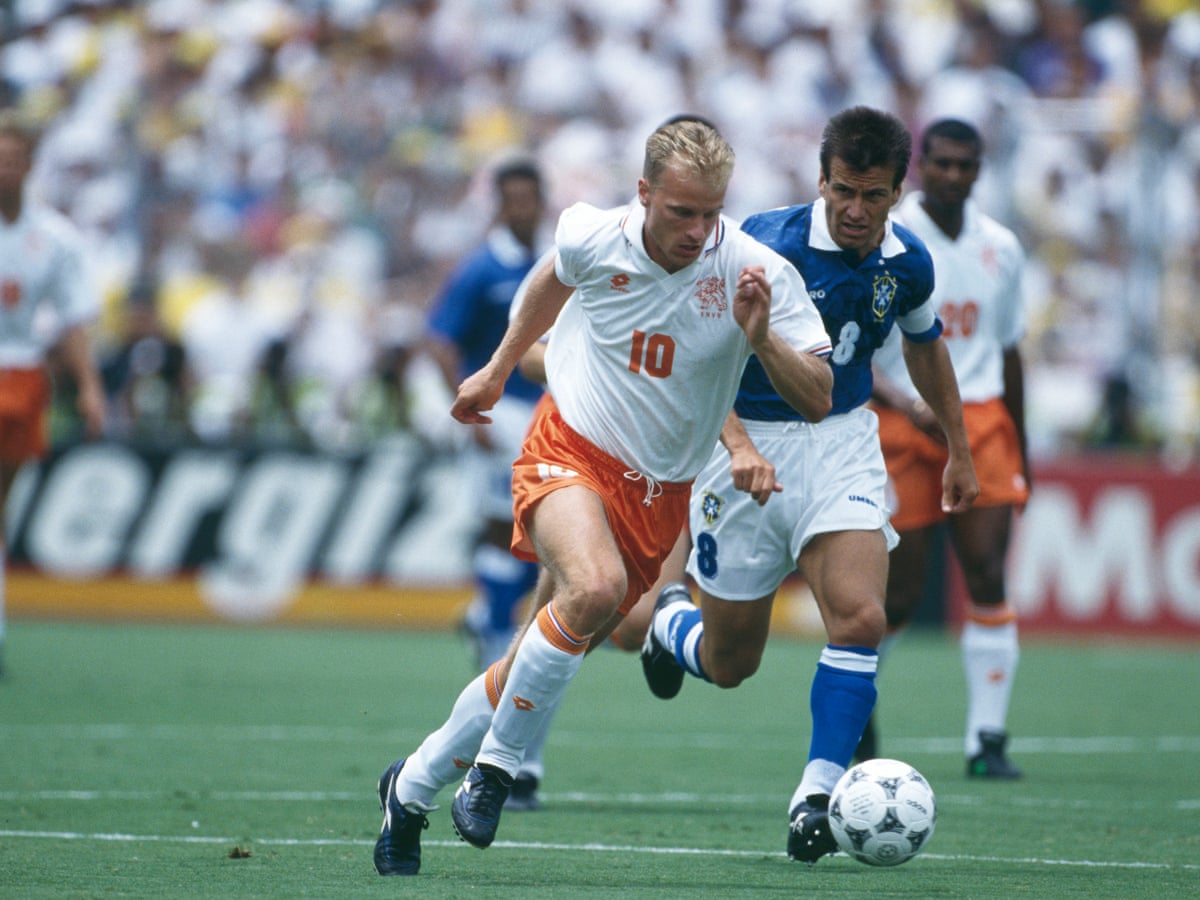
Dennis Bergkamp was the best-known Dutch player of the mid-1990's.  He had 92 caps. He helped Netherlands to reach the semi-final of the 1998 WC Finals in France.  His goal vs Argentina at was considered among the best ever scored in World Cup history.  He also played in the World Cup Finals of 1994 and three European Championship. He started with Ajax and played for Inter Milan.  He also had a very successful career with Arsenal, winning 7 major titles.
Dennis Bergkamp
ST: Gerd Muller 
"Der Bomber" was widely considered to be the greatest striker in history. He scored 68 goals in 62 matches for Die Mannschaft.   He scored 365 goals in 427 Bundesliga appearance, mostly with Bayern Muinch.   He won three straight European Cup with Bayern Munich in 1974, 1975 and 1976. At the international level, he played over 60 times for West Germany.  He won the World Cup in 1974 and the European Championship in 1972. He was the European Player of the Year in 1970. 

Gerd Muller

Rule
-- 1 player from Amateur Era (1872-1929): Sam Hardy.
-- 3 players from Classic Era (1930-1959): Stanley MathhewsJozsef BozsikDidi.
-- 5 players from Modern Era (1960-1989): Gerd MullerKarl-Heinz ForsterAntonio CabriniWolfgang OverathPeter Shilton.

-- 7 players from Nowadays (1989-2020): Ryan GiggsSergio Ramos, JorginhoDennis BergkampEdgar DavidsDenis Irwin

Round by Round

Round 1: Sir Stanley Matthews (15th pick)
I was not prepared.  I have not thought deep about my game plan.  Michel Platini and Zinedine Zidane were high priorities, but I felt that the modern 4-3-3 formation does not need an attack midfielder.  So I targeted the Classic Era for my first pick of the draft without any deep study of the player pool.  Garrincha, Didi and Sir Matthews were my main choices.  In one of the older drafts, I was punished by drafting Garrincha because one poster thought that his dribbling skills would be useless in the modern game.  So I went with Matthews, which l later thought it was a mistake. 

Round 2: Gerd Muller (22th pick)

I still had not gotten a game plan.  The original list was 1) Van Basten, 2) Platini 3) Zidane 4) Didi.  The first three went before my turn. At last minute, I went with Gerd Muller whom I thought was the best player available.  My past experience told me that I needed a goal scorer who could scored a lot of goals.  Besides, I did not want to waste two of my "Classic Players" on the first two rounds.


Round 3: Didi (45th)

I could not believe that Didi was still available.  


Round 4: Jozsef Bozsik (52th)

I believed in a strong midfield.  Bozsik was around.  I have second thoughts because I would be finished with Classic Players in 4 rounds.  I also wondered a midfield of Didi and Bozsik would work, but Bozsik is probably the best player available.  Later, I discovered that Bozsik was a holding midfielder.  The pait could operated together liked Iniesta and Xavi, or Modric and Kross.  The formation was set to be 4-3-3.  I needed a Busquets and Casemiro to team up with Bozsik and Didi.


Round 5: Karl-Heinz Forster (75th)
For awhile, Karl-Heinz Rummenigge was available.  So I studied with the idea of playing him on the left forward/wing forward position.  I don't think he could be used on the left.  Anyway, he was taken before my turn. So I focused on defence.  I thought of drafting a pair of centerbacks in the next two rounds, but the fullback position was getting thin.  Carlos Alberto, Junior, Karl-Heinz Schnellinger, Paul Breitner, Berti Vogts, Claudio Gentile, Guissepe Bergomi, Javier Zanetti, Andreas Brehme and Silvio Marzolini were taken right before my turn.  In the end, I went with Karl-Heinz Forster.  Alan Hansen, Héctor Chumpitaz and Sergio Ramos were considered. I was going to take Alan Hansen in the next round.

Round 6: Antonio Cabrini (82th)
Alan Hansen was going to be my next pick, but the fullback position was going fast. I also only considered wingback because of the modern game.  I went with leftback Antonio Cabrini.  I thought a large number of rightbacks were still around.  I targeted Leandro for my next pick (he was taken soon after).  Sergio Ramos, Kompany, Rio, Campbell, etc would be around in the late rounds, I predicted.

Round 7: Edgar Davids (105th)
I studied the left wing/wing forward position.  I noticed both Michael Laudrup and Omar Sívori were undrafted.  Laudrup was ruled out because he did not play much on the left, but I found Sivori scoring plenty of goals on the left forward position.  He was high on my list, but he was taken(Laudrup too) before my turn.  So I decided to go with a defensive midfielder because the midfield was the most important of my team.  I was looking someone who could defend.  Roy Keane, Edgar Davids, Claude Makelele, Dave Mackay and Billy Bremner were the top choices in that order.  I wanted to draft a "Nowaday" player because I have not spent a pick on that era and I got 7 picks. So Mackay and Bremner were not seriously considered. Keane was my first choice, but he was actually more of a box-to-box midfielder.  I needed a more defensive player, but he was the most famous defensive midfielder.  Luckily, he was drafted a pick before my turn.  I did not have to make a choice. So I went with Edgar Davids who could be a destroyer as well as a box-to-box midfielder.  

Round 8: Ryan Giggs (107th)
Dragan Džajić was my first choice, but I wanted to save my Modern Player slot.  So I went with Giggs.  Stoichkov and Neymar were seriously considered.  They might be a better option for my team than Giggs. Neymar is a controversial and a newer player so I expected him to drop.  I actually thought that I could draft him at a later stage as a sub.  Anyway, I always love wingers who could dribble.

Round 9: Jorginho (135th)
The number of rightbacks were going fast. At that point, I already drafted three Modern Player out of five.  I did not want to waste a 4th Modern Player at that point.  Manfred Kaltz was my first choice. He probably fit better with Matthews.  Meanwhile, I was looking at Wim Suurbier, Eric Gerez, Nelinho, and Phil Neal.  Neal was too defensive while Nelinho probably was a borderline for this draft.  I liked Maicon, but I did not know how much Gareth Bale destroyed his reputation.  Jorginho was the safer bet at this point.

Round 10: Sergio Ramos (142th)
The position is still deep, but I wanted to complete my team before a rundown of centerbacks.  I was worried about how other rated him.

Round 11: Sam Hardy (165th)
I discovered that I must start a player from the Amateur Era in the "ranking".  Dixie Deane would be my first choice for that era, but I do not want to bench Gerd Muller.  So I opted for a keeper.  My top three choices were Sam Hardy, Elisha Scott and Americo Tesoriere were on my list.  .I still have plenty of "Nowadays" picks so I probably would draft Van Der Sar and Cech.

Round 12: Dennis Bergkamp (172th)
The goalkeeper position remained plentiful at that stage. So I went for an attacker.  Although Matthews was my first pick, I feel that he might be a liability when it came to playing with a modern wingback. So I wanted to find a right side forward who could play with Jorginho.  I was also looking at someone who could play as a False 9, a trendy position in the modern game.  Bergkamp seemed to be the right choices.  

Round 13: Peter Shilton (195th)
Mario Coluna went undrafted.  He would probably start over Edgar Davids.  So he was my target, but he was drafted 6 picks before my turn.  Instead, I went for a goalkeeper because Cech and Van de Sar were only "safer" goalkeepers available.  Without Coluna, I could use a Modern Player slot.  I could not believe it when I realized that Peter Shilton went undrafted. 

Round 14: Wolfgang Overath (202th)
Both Sandro Mazzola and Wolfgang Overath went undrafted.  I was thinking of the use of subs.  I would rather bench Davids than Didi or Bozsik.  Overath was not really a box-to-box midfielder, but he could play deeper than Mazzola. I could live with a midfield of Didi-Bozsik-Overath.  Dejan Savićević was also considered, but I did not need a winger.  Manfred Kaltz and Wim Suubier were high on my list because of subs.  I thought that Jorghinho was my weak link.  I need someone to take his place during the tournament, but after I took Overath, I used my last Modern slot.

Round 15: Denis Irwin (225th)
I need to draft a defender and he could only be a Nowaday player.  Vincent Kompany, Rio Ferdinard, Nemanja Vidic and Sol Campbell were on my list. Marcelo was considered, but I did not know how to rank.  In the end, I took Denis Irwin because he was more solid.  He could play on both side of my fullback position. He worked with Ryan Giggs.  As a traditional fullback, he probably would be a better fit with Matthews.

Round 16: Rio Ferdinand (232th)
Vincent Kompany, Rio Ferdinand, Nemanja Vidic and Sol Campbell remained on the board.  I took Rio because FourFourThree voted him as the greatest centre back in Premiership's history.  He is also a cultured defender.  Vidic was my second choice.

Tactics
Barcelona, Real Madrid and Liverpool all used a variation of the 4-3-3 formation. How many Champions League titles did they win since 2014? The 4-3-3 is the way in this decade.

I believe the battle of the midfield is the most important element of the game.  I built my midfield based upon two of the greatest trios of the midfielders in the last decade, namely Real Madrid of Modric, Kroos and Casemiro and Barcelona of Xavi, Andreas Iniesta and Sergio Busquest.  I also considered Jürgen Klopp's Liverpool as an inspiration.

The midfield is very balanced. Bozsik is the holding midfielder(a cross between Xavi and Busquets), Didi my roaming playmaker and Davids my box-to-box midfielder. When defending, Davids can become the best destroyer ever in the game. So my midfield can do short and long passes (Didi/Bozsik), dribble (Didi/Davids), run (Davids), interception (Bozsik and perhaps Davids) and destroy (Davids). They can control the midfield.


Against England on the video below, Jozsef Boszik showed a lot of his defensive side. He intercepted a lot of attacks with smart positioning. He was a good tackler well. When he attacked, he seemed to spray many longer passes from the deep position. He scored a goal at the edge of the box, but he did not operate much near that area throughout the game.


Didi, on the other hand, moved the ball forward by dribbling and short passes. He also operated more advanced than Bozsik.  He is liked a free roaming playmaker.

The relationship between Didi and Jozsef Bozsik would be similiar between Toni Kroos and Luka Modric.  Kroos usually sits deeper in the back while Modric roams freely all over the field.  


Meanwhile, manager Zinedine Zidane normally use Casemiro as a pivot to protect the midfield.  Since Bozsik was a good defensive player, I do not need a destroyer on the team.  Instead, the third member of my midfield is a box-to-box midfielder. Edgar Davids'  dribble skills was better than some of the wingers and attack midfielders.  When defending, Davids could become one of the greatest destroyers in the game.  So I do have a destroyer on the team. I expected Bozsik and Davids to form a defensive line that could stop any attack in this draft.

The front is a basic formation.  Gerd Muller plays in the middle, flanked by two fast and skillful wingers, Ryan Giggs and Stanley Matthews.  Two wingbacks joined in for support.   As shown in the videos, Gerd Muller scored most of his goals from wing plays.

Defence: Karl-Heinz Forster is the starter, but I have no preference for Sergio Ramos or Rio Ferdinand.   I even think Karl-Heinz Forster should be a part of three backs rotation.  Denis Irwin can play on both side of the flank.  I will be using a rotation of the three fullbacks.

Basically, I am using Wolfgang Overath as a sub for Edgar Davids. If going gets tough, I will pull Davids for Overath, an extra playmaker. Bozsik needs to cover the midfield if that happened.
Is Overath a box-to-box midfielder? Not really. But he was not a bad defensive player and he normally operated in the area from box to box in a 4-3-3 formation. He could replace Davids as a sub.  The midfield would probably play with a tiki taka type of passing games.


Thursday, May 8, 2014

Giancarlo Antognoni: the forgotten man of Italian football


Please also see my All-Time World Cup Team Index.
Italian diaspora
Southern ItalyCentral Italy,
Northern Italy(excluding Lombardy)Lombardy
Italy after 1982Italy between 1938 and 1982.
What if Italy Euro 1992


Giancarlo Antognoni was the heart and soul of Fiorentina during the 1970's and 1980's.  He is regarded as one of the club's greatest players ever wore the purple jersey.  He started his career not with Fiorentina but with Italian Serie D club Astimacobi.   In 1972, Nils Liedholm convinced him to join Fiorentina.  He played over 400 games for them and holds the record for the most appearances in Serie A for Fiorentina, with 341 appearances.

During his prime, Antognoni was considered to be one of the Italian players in his generation. However, he does not have the same name recognition of his contemporaries, despite helping Italy to win the World Cup.  Paulo Rossi scored 6 goals and was proclaimed the hero of the World Cup.  Dino Zoff was the captain that organised one of the best defence in history.  Along with Marco Tardelli, Gaetano Scirea, Claudio Gentile and Antonio Cabrini, they also built a dynasty with Juventus at the club level.  Giancarlo Antognoni, on the other hand, stayed loyal with Fiorentina and only won a Coppa Italia in 1975.  He also missed the World Cup Final due to an injury.

Antognoni had his best chance to win a major trophy for his club team during the 1981-1982 season.  Earlier in the season, he suffered a horrible, head  injury after being knocked down by Genoa's goalkeeper, Artemio Franchi.  His career could have ended that day.  Despite Antognoni missing many games, Fiorentina still managed to be level on points with Juventus heading to the final game of the season, but Fiorentina could not break the deadlock against Cagliari while Juventus won by a single goal. Liam Brady who already knew that Juventus had signed Michel Platini as his replacement scored the only goal from the penalty. 


Please also see my All-Time World Cup Team Index.