Tuesday, September 8, 2015

Castile without players from Madrid Greatest All-time member team


Andres Iniesta and Juan Mata

Please also see my All-Time World Cup Team Index.

Spain without Real Madrid and Barcelona players
Spain 
Real Madrid, Atletico Madrid
Real Madrid Castilla Greatest All-Time
Real Madrid All-Time Team for Foreign Players
Real Madrid All-Time Team for Spanish players
Atletico Madrid All-Time Team for Foreign Players
Atletico Madrid All-Time Team for Spanish Players

Castile is a vaguely defined historical region of Spain. There are different conceptions and definitions of Castile, and since it lacks modern day official recognition. It is mainly considered of Castile and Leon, Castile and La Mancha, Cantabria, La Rioja and Madrid. 


This is my selection of all-time 23 member team for Castile without players from the Community of Madrid.  The all-time blog teams of Andalusia, Basque, Valenican, Community , Galicia and Catalonia were based on ethnicity, but this team is based on birth places.  


Castile and Leon, Castilla La Mancha, Cantabria and Madrid has own autonomous football teams. The region is home to Real Valladolid, Albacete Balompie, Salamanca CF, Racing de Santander, Burgos, Mirandés, Numancia and Ponferradina.


Team 
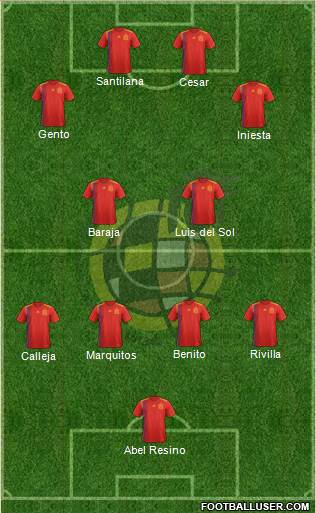
GK: Abel Resino (Castile and La Mancha)
Abel Resino was nicknamed the "Cat".  He came to Atletico Madrid in 1986 from lowly CD Ciempozuelos and stayed there until 1995.  He won back-to-back Cops del rey in 1991 and 1992.  He won the Zamora Trophy in 1990-1991 season. He spent a season playing for Rayo Vallecano at the end of his career.  He earned two caps for Spain in 1991.


GK: José Manzanedo (Castile and Leon)
From 1963 to 1977, Jose Manzanedo played for Burgos. From 1977 to 1985, he played for Valencia CF.  He later played for Real Valladolid, Sabadell and Cultural y Deportiva Leonesa.  He played once for the Spanish national team in 1977 against Switzerland in 2-1 away loss.  He also represented Spain in the 1976 Olympics.


GK: Dani Aranzubia (La Rioja)
Dani Aranzubia is a product of Athletic Bilbao's famed youth academy at Lezama.  From 1996 to 2000, he played for them.  In 2008, Aranzubia joined Deportivo de La Coruña. In 2011,he become the first goalkeeper in La Liga history to score from open play.  He made his only appearance for Spain in 2004, in a friendly match with Andorra.  He was Spain third choice keeper at Euro 2004.

RB: Alvaro Arbeloa (Castile and Leon)
Alvaro Arbeloa started his career with Real Madrid, but he made a name with Liverpool in England before making a return to his mother club in 2009.  He helped Real Madrid to win their 10th European Cup in 2014.  For Spain, he was mainly used as a sub during Spain's glorious run at Euro 2008 and the World Cup in 2010, but he was their starting rightback at the 2012 European Championship.
Alvaro Arbeloa
RB: Feliciano Rivilla (Castile and Leon)
Feliciano Rivilla was an all-time great with Atletico Madrid.  He started playing football with Real Ávila CF, moving to Real Murcia at the age of 17.  In 1954, he joined Atletico Madrid, where he played until 1968. He won the European Championship in 1964 with Spain, and was a part of two WC Finals in 1962 and 1966.

CB: Gregorio Benito (Castile and La Mancha)
Gregorio Benito started as a track and field star. He signed for Real Madrid in the 1963. After two years on loan to neighbouring Rayo Vallecano, he returned to his main club, remaining there for the following 14 seasons and winning six leagues and five Spanish Cups.  He was capped 22 times by Spain.

CB: Marquitos (Cantabria)
Marquitos was a member of Di Stefano's Real Madrid in the 1950's, a team widely considered to be the greatest club side.  They won five straight European Cup titles.  He scored a goal against Stade Reims at the 1956 Final. He also played for Racing de Santander, Hércules CF, Real Murcia, Calvo Sotelo and Toluca de Santander. Capped twice.

CB: Iván Helguera (Cantabria)
Helguera started in the lower division in Spain before joining Roma in 1997.  He then joined Espanyol and made a name there.  In 1999, he joined Real Madrid, where he won two Champions' League titles.  He left Real Madrid in 2007 and played one more season with Valencia.  He was capped 47 times.  He participated at Euro 2000 and 2004, and the 2002 World Cup Finals.

CB: Pablo Ibáñez (Castile and La Mancha) 
Pablo began his career with Albacete, with whom he earned promotion from the Segunda División to La Liga in 2003. A year later, he signed for Atlético Madrid where he made nearly 200 appearances over six seasons.  In 2010 he moved to England where he played for West Bromwich Albion and Birmingham City.  He had 23 caps and represented his country at the 2006 World Cup.
Pablo Ibáñez
LB: Isacio Calleja (Castile and Leon)
Except for a loan spell with CD Guadalajara in the third division, Isacio Calleja spent his entire 14-year professional career with Atlético Madrid. He won back-to-back Copa del rey from 1959 to 1961.  In 1962, he won the Cup Winners' Cup. He had 13 caps for Spain. Calleja helped the national side to win the 1964 European Nations' Cup on home soil.

LB: Pachín (Cantabria)
Pachín signed for Real Madrid in 1959 from Segunda División club CA Osasuna. Pachín left the Merengues in May 1968, having appeared in 218 competitive games and scored two goals. He won 11 major titles during his spell, including seven national championships and the 1960 and 1966 editions of the European Cup.  He earned 8 caps and played in the World Cup Finals in 1962.

CM: Ruben Baraja (Castile and Leon) 
Baraja started his career with Real Valladolid and moved to Atletico Madrid.  Atletico Madrid relegated after the 1999-2000 season which allowed him to join Valencia and his career took off.  Forming a midfield with David Albelda, Valencia won two La Liga titles and the 2004 UEFA Cup.  He was also a part of the losing side at the Champions' league Final in 2001.  He earned 43 caps.  he played in WC 2002 and Euro 2004.
Ruben Baraja 
DM: Vicente del Bosque
Vicente del Bosque almost played his entire career with Real Madrid, except with some loan spells at the beginning of his career.  He won five league titles (1974–75, 1975–76, 1977–78, 1978–79, 1979–80) and four Copa del Rey titles.  He was a part of Spain's team at the European Championship in 1980.  He later became a successful manager.


AM/CM: Andres Iniesta (Castile and La Mancha)
Andreas Iniesta scored the World Cup winning goal in 2010 that gave Spain its first ever World Cup title. At Euro 2012, Iniesta led Spain to their second consecutive continental crown, again being chosen as the Man of the Match for the final against Italy, and was named the Player of the Tournament. He won over 130 caps for Spain. He also won Champion' league trophies with Barcelona.
Andres Iniesta

CM/AM: Juan Mata (Castile and Leon)
Juan Mata was a youth academy player for Real Madrid, but he started with Valencia in 2007.  From 2011 to 2014, he played for Chelsea, where he was a major star for the team.  After a fallout with Jose Mourinho, he moved to Manchester United.  Ironically, they would reunite again at Old Trafford. For Spain, he was a part of the team that won the World Cup in 2010 and the European Championship two years later.

AM/CM: Luis del Sol (Castile and Leon)
Luis del Sol started his career with Real Betis.  He joined Real Madrid in 1960, winning an Intercontinental Cup in his first season with Real Madrid. In 1962, he was lured to play in Italy.  He later played with Juventus and then, Roma.  He was a part of Spain's Euro 1964 winning team. He also played in both 1962 and 1966 World Cup Finals.

RW: Marcos Alonso Peña (Cantabria)
Marcos Alonso made his La Liga debuts for Racing Club de Santander in 1977.  From 1979 ti 1982, he played for Atletico Madrid, where he made his name.  He then played for Barcelona between 1982 and 1987.  He earned 22 caps for Spain. He represented the nation at UEFA Euro 1984, being an unused squad member in an eventual runner-up finish.  His father was Marquitos, and his son was Marcos Alonso Mendoza.

FW/LW: José Amavisca (Cantabria)
José Amavisca played with Real Valladolid and UE Lleida before joining Real Madrid in 1994, where he formed a partnership with Iván Zamorano. He was Don Balón Award Spanish Player of the Year in 1995.  He later played for Racing de Santander and Deportivo la Coruna.  For Spain, he had 15 caps.  He was a part of the team that won the Gold medal at the 1992 Olympics. 

LW: Francisco Gento (Cantabria)
Francisco Gento is regarded as one of the greatest left wings in history.  Gento began his career at Racing Santander in 1952 and moved to Real Madrid the following season. He appeared in a joint record eight European Cup finals, winning a record six, as well as winning 12 La Liga titles.  In a 14-year international career, Gento earned 43 caps for Spain, playing at the World Cup in 1962 and 1966.

Francisco Gento vs Argentina

ST: Mariano Martín (Castile and Leon)
Martín joined FC Barcelona in 1939, proceeding to become one of the club's most prolific scorers. During his nine seasons at the Camp Nou, he netted 128 times in only 150 matches, including 30 in 23 contests in his fourth season, although Barça finished in third place. Martín closed out his career in 1952, after playing for Gimnàstic de Tarragona, Real Zaragoza and UE Sant Andreu.  For Spain, he was capped 3 times.

ST: Chus Pereda (Castile and Leon)
Chus Pereda began his career with Bilbao club SD Indautxu, but was rejected by Athletic Bilbao because of his birthplace. He then joined Real Madrid.  He was better known for his career with Barcelona, where he played from 1961 to 1969.   He earned 15 caps. In 1964 he helped Spain win the European Championship,

ST/FW: Cesar Rodriguez (Castile and Leon)
During his career, Cesar played mainly for Barcelona, appearing in 351 official matches and scoring 232 goals, making him the highest goalscorer in the club's history until he was passed by Lionel Messi.  He won the Pichichi Trophy for the 1948–49 season. He won five La Liga championships with the team in a total of 13 major trophies.  At the international level, César had 12 caps. He represented Spain at the 1950 World Cup. 

ST: Carlos Santilana (Cantabria)
Carlos Santilana was a star during the 1970's.  He moved to Real Madrid at the age of 19 in 1971.  He scored 352 goals and played in 778 games, a record until Manuel Sanchis broke it in the 1997-1998 season.  H is the eighth-highest top scorer of all-time in the Spanish first division, with 186 goals. He made 56 appearance for Spain.  He participated in all major tournament from Argentina 1978 to Euro 1984, helping Spain to finish second in 1984.
Carlos Santilana 
Honorable Mention
Paco Llorente (Castile and Leon), Santi Denia (Castile and La Mancha), Antonio de la Cruz (Castile and Leon), Jesús Ángel Solana (La Rioja), Alfonso Aparicio (Cantabria), Julio Cardeñosa (Castile and Leon),  Iván de la Peña (Cantabria), Quique Setién (Cantabria), Federico Saiz (Cantabria), Javier de Pedro (La Rioja), Felipe Miñambres (Castile and Leon), Sergio Asenjo (Castile and Leon), Eugenio Leal (Castile and La Mancha), Germán Gómez (Cantabria), Eusebio Sacristán (Castile and Leon), Pedro Munitis
(Cantabria).

Squad Explanation
-- In 2015, I created this blog.  The team consists of players from Castile and Leon, Castile and La Mancha, Cantabria, La Rioja and Madrid.  In 2020, I created a separated team for Community of Madrid because I felt the player pool was too big.  This blog team became the Castile All-Time team without players from the city of Madrid.
-- In November, 2021,  I did a review of the team.  I realised that several well-known footballers, namely Vicente del Bosque and Marco Alonso Pena, were missing.  So I did a comprehensive review of the team.  
-- In the future, I would try all-time for each region.  At the time of writing, only 5 players born in La Rioja have played for Spain.  Goalkeeper Dani Aranzubia was the only player selected. Javier de Pedro and Jesús Ángel Solana (La Rioja) were on my honorable mention.  I probably would only do Best XI for them.  I can easily be created an all-time team for Cantabria.
--  The all-time teams of Basque and Catalonia were based on ethnicity, but this team was based on birth places.  Frankly speaking, I do not know how to define the Castilian ethnicity.  Their culture, as well as their language, has influenced the Spanish culture to such an effect that today foreign nationals consider the Castilian language as Spanish.  Basically, almost everyone not in the other ethnic groups in Spain can be considered Castilian.  Am I right? So the task of selecting a Castilian ethnic team is almost impossible. I tried my best not to select players from other ethnicity, but the criteria was actually more opened here. Birthplace becomes the main issue. Juan Mata is also on my Asturias All-Time team.
 -- Juan Mata, Andreas Iniesta and Alvaro Arbeloa were members of the 2010 World Cup winning team.
-- Unlike Basque and Catalonia, Castile is not an official region.  It consists of several official regions in the modern Spain.  They have several autonomous football teams. Castile and Leon, Castilla La Mancha, Cantabria and Madrid have their own autonomous team.  They seemed to be less active than Basque and Catalonia.They play in the UEFA Region Cup, which is an amateur tournament. But I do not see them playing in friendlies with professional players as much as I saw with Basque and Catalonia.
-- I do not have much choice for goalkeepers. Abel Resino (Castile and La Mancha) was relatively well-known after spending many seasons with Atletico Madrid.   I took Dani Aranzubia because he at least attended a major tournament (Euro 2004). There was limited information on José Manzanedo, but I took him over Sergio Asenjo (Castile and Leon) in 2015 when I created the team.  Since 2015, Asenjo had played for Spain.  He established himself at Villarreal, but he was not the starting goalkeeper for their triumph at the 2021 Europa League.  He truly deserved a spot. In the end, I kept Dani Aranzubia because he was the only representative from La Rioja.  I did use political factor in my selections, especially the decision was difficult to make.
-- Santiago Cañizares was born in Madrid but raised in Puertollano, Castile-La Mancha.  In the end, I decided not to consider him.  If I do that for him, I might have to look in the bios of every player on my blog teams to determine their hometowns.
-- Goyo Benito, Marquitos, Iván Helguera and Pablo Ibáñez all had a lengthy career with either Real Madrid or Atletico Madrid.   Except Marquitos and Goyo Benito, the other two were not considered a major star within the club at their time. Marquitos' son is Marcos Alonso Pena (also selected) and his grandson is Marco Alonso.  Marco Alonso Pena was born in Cantabria, but Marco Alonso was born in Madrid.  I also came across Alfonso Aparicio who was probably largely forgotten outside Atletico Madrid.  Santi Denia (played twice for Spain.
Iván Helguera
-- Alvaro Arbeloa and Feliciano Rivilla were well-known rightbacks at their time.   On the left, I took Isacio Calleja and Pachín. Pachín was considered one of the first all purpose defender because he could play across the backline.  He won a title every single season in Madrid.  Leftback Isaac Oceja was born in Cantabria, but he was a Basque.  Although I used birthplace as the main criteria, I also kept the issue of ethnicity on my mind when I looked at players.  However, Oceja was not dropped because of his ethnicity.  I just preferred Isacio Calleja and Pachín.  They had a more well-known career.  I did select Juan Mata for this team.  
-- I needed Vicente del Bosque's defensive presence on the midfield.  And then, I took Ruben Baraja.  Then, I looked into Eugenio Leal, Germán Gómez and Eusebio Sacristán.  Eugenio Leal was on my original team I created in 2015.  In 2021, I struggled to understand how he made the team ahead of Germán Gómez (see below).  In my opinion, their careers were very similar
-- Despite playing for Barcelona FC, Andres Iniesta is from this region. He was born in Fuentealbilla.  No one is going to question his inclusion.  Luis del Sol who starred for Real Madrid and Juventus was another undisputed selections.
Luis del Sol
-- Iván de la Peña was billed as one of Spain's top young players, but his career was unfulfilled.  He had a good career with Espanyol, but he was not getting into the team with Andres Iniesta, Juan Mata and Luis del Sol ahead of him.  The same applied to Felipe Miñambres.
-- Juan Mata came from Real Madrid youth system.  He had a fruitful career in England.  His family was from Asturias, but he was born in Burgos when his father was a professional player there. I also selected him for the Asturias all-time team. For this team, his selection is the only major issue that I have to consider.
-- On the wings, I only selected right winger Marcos Alonso Peña and left winger Francisco Gento.  Ideally, I should take Gento's nephew Paco Llorente who was a right winger.  His father-in-law was also Ramón Grosso, which made him a player from a football dynasty. But basically, he was a backup throughout the prime of his career.  José Amavisca was the Spanish Player of the Year in 1995, but it was probably his only year where he was a major star player.  Javier de Pedro also played on the left midfield.  
-- I do not think the younger fans remembered Carlos Santillana as other Real Madrid legends.  He at one point held the club's highest appearance record.  He is also the 4th all-time leading scorer behind Cristano Ronaldo, Raul and Alfredo Di Stefano.
-- César was Barcelona's all-time leading scorer until Lionel Messi broke it.  At the time of writing, Mariano Martín is the 10th top scorer for Barcelona.
-- The last spots was difficult to choose.  In the beginning, I considered taking a midfielder.  I was looking at Eugenio Leal, Germán Gómez and Eusebio Sacristán, but I have plenty of midfielders on the team.  So I looked into wide attacking players.  I narrowed it down to Pedro Munitis and José Amavisca (see above).  In the end, I took José Amavisca.  Munitis had more caps than Amavisca and played in more important matches, but Munitis did not do much while playing for the bigger clubs.  José Amavisca starred a season or two for Real Madrid. He was Spanish Player of the Year in 1995.

Starting lineup


Friday, September 4, 2015

Catalonia Greatest All-time 23 member team

This blogger Artur Yanturin of Russia copied many of my blog teams.  This blog was one of them.  It was my Russia All-Time Team here.  His team was written in 2020, but mine was uploaded in 2014.   His Spartak Moscow All-Time team entry of was published in October 2020, but mine was uploaded in 2017.  His entry of the Dutch-German rivalry between Real Madrid and Barcelona was written in 2020, but mine was uploaded in 2014.  He also copied many many of my blog entries.

His Facebook and Instagram


Please also see my All-Time World Cup Team Index.

Catalonia is is an autonomous community of Spain, designated as a nationality by its Statute of Autonomy.  Most of the territory (except the Val d'Aran), lies on the northeast of the Iberian Peninsula, to the south of the Pyrenees mountain range. Catalonia consists of four provinces: Barcelona, Girona, Lleida, and Tarragona. The capital and largest city, Barcelona is the second-most populated municipality in Spain and the fifth-most populous urban area in the European Union.

The Catalonia national football team (Catalan: Selecció de futbol de Catalunya) is the official football team of Catalonia. It is organised by the Catalan Football Federation, founded in 1900. The team has been referred to by various names including Selecció Catalana, Selecció de Barcelona and the Catalan XI. Catalonia is not affiliated with either FIFA or UEFA and is therefore not allowed to participate in either the FIFA World Cup or the European Championship. Other than in certain cases where other nationalities are involved, Catalan players are full Spanish citizens who are eligible to play for Spain.  Catalonia is known for its club football teams Barcelona and Espanyol. 

This is my selection of an all-time 23 member team for Catalan players. I excluded guest players who played for Catalan XI, but I included players from Catalan diaspora. 

My all-time teams:
Spain, Barcelona Dutch Best XI
Barcelona All-Time Team for Spanish Players
Barcelona All-Time Team for Foreign Players
Barcelona, Espanyol
Basque, Catalonia, Castile without Madrid players, Madrid Community, Andalusia, Valencian Community, Galicia, Asturias

Team
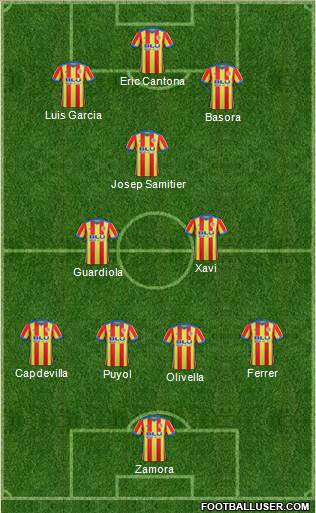
GK: Ricardo Zamora (Spain)
The first ever star goalkeeper in history.  He is also remembered for a spectacular last minute save he made in the 1936 Copa de España final while playing for Real Madrid against FC Barcelona. The award for the best goalkeeper in La Liga, the Ricardo Zamora Trophy, is named in his honour and he was voted one of the greatest players of the 20th century by World Soccer magazine. He was also Spain's most capped player for 45 years.

GK: Antoni Ramallets (Spain)
Antoni Ramallets was the starting keepers of Barcelona in the 1950's.  He played alongside with Laszio Kubalal and Luis Suarez.  He won 6 La liga titles in an era that was known to be dominated by Alfred Di Stefano's Real Madrid.  Ramallets played 35 games for Spain during 11 years, making his debut against Chile on 29 June 1950, during the 1950 FIFA World Cup in Brazil.

GK: Hugo Lloris (France)
Hugo Lloris started his career with Nice.  He moved to Lyon in 2008 to replace Coupet. In 2012, he moved to Tottenham Hotspurs.  Tay the time of writing, he has over 80 caps for France.  He is a key player since the World Cup Finals in 2010, participating in every major tournaments.  He was the starting keeper for France at the Euro 2016 and the World Cup Finals in 2018.
Hugo Lorries
RB: Albert Ferrer (Spain)
Ferrer represented the nation in two World Cups and at the 1992 Olympic Games, winning the latter tournament. He was a part of Barcelona's Dream Team in the 1990's. He won a Champions' League with Barcelona in 1992. After Louis van Gaal took over, Barcelona gradually signed more Dutch players and his places were uncertain.  He left for Chelsea.

CB: Carlos Puyol (Spain)
As an one-club man, Carlos Puyol served as the long-time team captain for his only club Barcelona after taking over from Luis Enrique in August 2004, and went on to appear in 593 official games for the club and win 20 major titles, including  three Champions League: 2005–06, 2008–09, 2010–11. He earned 100 caps for Spain, winning the World Cup in 2014 and the European Championship in 2008.
Carlos Puyol 
CB: Gerard Pique (Spain)
Pique started his career with Barcelona's academy, but left for Manchester Uniued. In England, he was seldom used by the team.  He returned to Spain in 2006 with Zaragoza.  He gradually became a good defender in La Liga.  From 2008 to 2022, he played for Barcelona where he won over 30 trophies. He has been capped 102 times.  He won the 2010 World Cup as well as Euro 2012. His grandfather, Amador Bernabeu, is a former vice-president of Barcelona.


CB: Joan Segarra (Spain)
Joan Segarra played for Barcelona from1949 to 1964.  He was a part of the great Barcelona team of the 1950's. He was the captain of the "Barça of the Five Trophies". They finally reached the 1961 European Cup Final, but losing to Benfica.  It would take Barcelona 31 more years before finally winning the Cup.  For the national team, he had 25 caps.

CB: Ferran Olivella (Spain)
Ferran Olivella was capped 18 times for Spain between 1957 and 1962, but better remembered for being the captain of the Spanish national that won the European Championship in 1964. He was also an unused sub at the World Cup Finals in 1966. For club football, he played his entire career with Barcelona, winning the Inter-Cities Fairs Cup three times in the 1960's.  He won back-to-back La Liga in 1959 and 1960.

LB: Joan Capdevila (Spain)
At the club level, Joan Capedevila started his career with Espanyol in 1998.  He later played for Atletico Madrid, Deportivo la Coruna, Villarreal and Benfica.  The peak of his career was with Deportivo la Coruna and Villarreal. He was capped 60 times for Spain, in a period where Spain won the 2010 World Cup and the 2008 European Championship. He was their disputed starting leftback in that era. He was the only starting player in the 2010 Final who was not a member of Real Madrid or Barcelona.
Joan Capdevilla 

LB: Jordi Alba (Spain)
Alba started his career at Barcelona, but was released after being deemed too small. After joining Cornellà, he moved to Valencia. In 2012 he returned to Barcelona. At the time of writing, he has over 70 caps and was a member of the team that won the Euro 2012. He attended the 2014 and 2018 World Cup Finals.

DM: Sergio Busquets (Spain)
Since 2009, Sergio Busquets had played over 100 times for Spain.  He was known for doing the "dirty work" in the midfield during Spain's glorious run at the World Cup in 2010.  For his club career, he played for Barcelona.  He is probably remembered for his racist against Marcelo during an El Classico game. His father was a goalkeeper who played for Barcelona FC.

DM: Pep Guardiola (Spain)
At the club level, Pep Guardiola won a Champions' League with Barcelona in 1992. It was Barcelona's first ever European Cup. He was their captain from 1997 to 2001.  He also played for Brescia and Roma in Italy, Al-Ahli in Qatar, and Dorados de Sinaloa in Mexico. He was capped 47 times for Spain, winning the Olympic Gold Medal in 1992, and later appeared at the 1994 World Cup and Euro 2000. He also played friendly matches for Catalonia.

Pep Guardiola

CM: Mariano Gonzalvo (Spain)
Gozalvo was a member of Barcelona's team in the 1950's.  The team was known to be Spain's greatest club side before the emerge of Alfred Di Stefano's Real Madrid.  He won 5 league titles.  For the national team, he was capped 16 times.  Between 1947 and 1955 he also played three times for the Catalan XI. His first game was a 3-1 win against Spain on October 10, 1947.

AM: Josep Samitier (Spain)
Josep Samitier played for Barcelona between 1919 and 1932. He is the club's all time third top goalscorer.  He joined Real Madrid in 1932 from Barcelona FC and then played for Nice in France from 1936 to 1939.  In 1920, Samitier was also a member of the first ever Spanish national squad. The squad won the silver medal at the 1920 Olympic Games. He subsequently made 21 appearances and scored 2 goals for Spain.

AM./CM: Xavi (Spain)
Xavi was perhaps one of greatest playmakers of his generation.  He won everything in football.  Xavi has won 31 trophies, only surpassed by Andrés Iniesta as the most successful Spanish player in history.  For the national team, he had 133 caps and was a part of the team that won the  2010 World Cup and two European Championship in between.  He was named Euro 2008's player of the tournament. He was finished third at the Ballon d'Or in 2010 and 2011.
Xavi
RW: Estanislau Basora (Spain)
Estanislau Basora was considered of the Barcelona's greatest players.  He was a member of Barcelona's team in the 1950's, the greatest Spanish club team before the emerge of Alfred Di Stefano's Real Madrid.   He was capped 22 times for Spain between 1949 and 1957. He went to the World Cup Final in 1950. He also represented Catalonia XI on several occasions.

RW: Carles Rexach (Spain)
From 1965 to 1980, Carlos Rexach played for Barcelona.  He won the Pichichi Trophy in 1971.  He also won the Cup Winners' Cup in 1979.  He was also known for his partnership with Johan Cruyff at Barcelona.  For the national team, he was capped 15 times. He went to the 1978 World Cup Finals in Argentina, but only appeared once in the Finals.

LW: Luis Garcia (Spain)
At the club level, Luis Garcia played for Barcelona and Atletico Madrid before moving to Liverpool in 2004. He won the 2005 Champions' League under Rafael Benitez after going down 3-0 at half time against AC Milan. It was marked as one of the greatest comeback in history.  He played in Greece and Mexico. He was capped 20 times for Spain between 2005 and 2008. He went to the 2006 World Cup Finals in Germany.

AM/SS: Cesc Fabregas (Spain)

Cesc Fabregas was lured to play for Arsenal's academy in 2003.  He made his first time debut as a teenager. he helped Arsenal to reach the Champions' league Final in 2005.  He retuned to Spain in 2011 with Barcelona, but returned to England in 2014 to play for Chelsea.  He was a part of Spain that won the World Cup in 2010 and two European Championships.

ST: Raul Tamudo (Spain)
Raul Tamudo was a club legend with Espanyol, where he played from 1997 to 2010.  He captained the side for a decade.  He won two Copa Del Rey with the club as well as reaching the Final of UEFA cup in 2007. He is their all-time leading scorer.  He also played for Real Sociedad, Rayo Vallecano Mexico's C.F. Pachuca and Sabedell FC. He picked up 13 caps for Spain between 2000 and 2007. He was a member of their 2000 silver medal winning team at the Olympics.
Raul Tamudo 

ST/LW: Eduard Manchón (Spain)
Between 1950 and 1957,  Eduard Manchón scored 88 goals in 201 games for Barcelona, where he witnessed one of his most successful periods in his career. Together with László Kubala, César and Estanislau Basora, he formed one of the most dangerous front-lines in the club's history. He belonged to the legendary "Five Cups-Barça" side, which won all five possible trophies in 1952.

ST:  Paulino Alcántara (the Philippines/Spain)
Born in the Philippines of a half-Spanish, half-Filipino, he made his debut for Barcelona at the age of 15 and remains the youngest player to play or score for the club. He also scored 100 goals in 69 matches, making him the club's highest goalscorer He was selected for the Philippine national football team in 1917 and represented his country at the Far Eastern Championship Games.  In 1921. he was selected to play for Spain.  he scored 6 goals in 5 games for Spain.

ST: Eric Cantona (France)
Before joining Leeds United in 1992, Eric Cantona was known as the bad boy of French football.  He moved to England to restart his career.  In England, he became a huge star.  He won the league title with Leeds United and moved to Manchester United.  At Manchester United, he became one of their best ever players. For the national team, he was a part of the ill-fated national team that failed to qualify for the World Cup in 1994. 

Eric Cantona

Honorable Mention
José Parra Martínez, Albert Celades, Crisant Bosch, José Gonzalvo, Vicente Piera, Dani Garcia, Albert Luque, Justo Tejada, Jordi Cruyff, René Llense (France), Jose Vicente Train, Salvador Sadurní, Martí Vergés, Martí Ventolrà, Josep Escolà, Ramón Calderé, Sergio García, Gabri Garcia, Victor Valdes, Sergio, Daniel Solsona, Sergi, Josep Seguer, Gerald Lopez, Juan Vizcaíno, Marti Verges, Joaquín Navarro, Curta, Gerard Moreno, Fernando Navarro, José Parra, Agustín Sancho, Pedro Solé, Sígfrid Gràcia, Eladio Silvestre, Marc Bartra, Enric Gensana, Antonio Olmo, Marcelino Pérez, Toni Jiménez, Miquel Soler.

Squad Explanation
- I did a review of the team in November, 2021.  I discovered more players and expanded the "squad explanation" section.  I was also convinced that Paulino Alcántara was eligible.
-- Catalonia has used non-Catalan guest players such as Johan Cruyff, Hristo Stoichkov, Alfredo Di Stéfano, etc.  However, I only selected ethnic Catalan players for this team. No guest player is considered. 
-- It is hard to identify ethnic Catalan footballers.  I probably made mistakes here and there.  It is impossible to look deep into ancestry of every single footballers in the planet.  Catalonia became part of the Spain since King Ferdinand of Aragon married Queen Isabella of Castille in 1469.  I am sure that many Spanish and Latin American footballers have some Catalan ancestry in them after 550 years of being in the same country.  So I am selecting only the obvious ones.     
-- Lionel Messi supposedly has a Catalan great great grandfather.  I suspected that most Argentine or Latin American footballers have some specific blood ties to a certain region in Spain through a great grandparents, etc.  As mentioned above, Catalonia has been a part of Spain for 550 years.  Most of the population must have some blood from everywhere in Spain. Messi's Catalonia line went too far back. So I am leaving him out at this moment. 
-- Ricardo Zamora, Xavi, Carlos Puyol, Pep Guardiola and Albert Ferrer were on my All-Time Spain Team. They were undisputed choices for this team.
-- My policy on overseas ethnic players varies from team to team.  For this team, I am taking overseas Catalan player. I took them largely because of Eric Cantona who was outspoken about his connection to the region.  I felt he would be honored to be on this team.  
-- Five players here also won the World Cup for Spain in 2010. All of them started in the Final against Netherlands in South Africa.  They were Sergio Busquets, Xavi, Carlos Puyol, Cesc Fabregas and Joan Capedevila.  After the 2018 World Cup Finals, Hugo Lloris replaced Victor Valdes. He too won a World Cup.  There are a estimated of 430,000 Catalans living in France.
 -- For goalkeepers, Ricardo Zamora and Antoni Ramallets were undisputed choices.  Victor Valdes was close to that status, but Hugo Lloris replaced Victor Valdes after France winning the World Cup in 2018.  Although Valdes also won a World Cup, Lloris was the starting goalkeeper for France.  Jose Vicente won four consecutive La Liga titles and three Zamora trophies while playing for Real Madrid. Salvador Sadurní also won three Zamora trophies.  René Llense of France made honourable mention.
-- On the rightback position, Albert Ferrer was the main choice.  Joaquín Navarro was the first Spanish player to be selected to a World XI FIFA team, but I decided to take a single rightback. On the left, I took Joan Capedevila. In 2015 when I created this team, I selected Sergi Barjuán over Jordi Alba. During the review of the team in 2021, Alba got into the team ahead of Sergi.  He had since suppressed Sergi.  I also had Eladio Silvestre and Miquel Soler on honorable mention.  
-- Sergi Barjuán was the best player not selected for this team.  He was promoted to Barcelona's first time in 1993. He helped them to win the UEFA Cup Winners' Cup in 1997.  He moved to Atletico Madrid in 2002.  He played there until retiring in 2005. He was capped 56 times for the Spanish national team. He went to two World Cup Finals (1994 and 1998) and two European Championships (1996 and 2000).
-- Carlos Puyol, Gerrard Pique, Ferran Olivella and Joan Segarra were among Barcelona's greatest central defenders. The other candidates seemed unrealistic after the four of them.   Sígfrid Gràcia was largely a forgotten man.  He did have a long career with Barcelona FC and appeared in the 1962 World Cup Finals.  Antonio Olmo who played in the 1978 World Cup Finals was considered.  Injuries kept Enric Gensana from becoming great. He could have been a serious candidate.
-- Xavi, Josep Samitier, Pep Guardiola, Sergio Busquet and Cesc Fabregas took 5 of the midfield spots.  So not much space was left. Xavi is Catalonia's most capped player.  Cesc Fábregas is the highest goal scorer for the Spanish national team.
Cesc Fabregas
-- I took Mariano Gonzalvo (aka Gonzalvo III) over Marri Verges who was on my original team.  He was a better known player.  His brother José Gonzalvo made honorable mention.
-- Marti Verges was a part of Barcelona's great team of the 1950's.  He won three Inter-Cities Fairs Cup: 1955–58, 1958–60, 1965–66. He was capped 12 times between 1957 and 1962.  He was included in the 1962 World Cup squad fro Spain. 
-- Luis Suarez Miramontes and Andres Iniesta are not Catalans, despite being all-time greats with Barcelona FC.  They had played for the Catalonia national team as guest players. 
-- Gerald Lopez was a star for Valencia between 1997 and 2000, but injuries cut short his career with the club. His international career was limited a few caps in 2000. He only made honorable mention.
-- Sergei Milinkovuic-Savic was born in Lleida when his father played professional football there.  At the time of writing, I am undecided if he is eligible for this team. I have been looking at ethnic Catalan player for now.  Vicente Engonga was the first Spanish-born black player to play for the Spanish national team. He was born in Catalonia  of Equatorial Guinean descent, but not an ethnic Catalan. During his career, he also represented the unofficial Cantabria autonomous team.  Anyway, the midfield position as mentioned is very strong.  They won't be challenging the selected midfield players.  Ansu Fati was born in Guinea-Bissau, and spent his childhood in Andalusia.  Of course, his connection to Catalonia is strong, but he considered himself a "Sevillian".  So I also do not have to decide on this issue.
-- The right wing was very strong.  Estanislau Basora and Carles Rexach were two of the best wingers from Spain.  Vicente Piera a largely forgotten player made honorable mention. On the left, I took Luis Garcia.   Eduard Manchón (Spain) only received a single cap from Spain, but he played with a legendary Barcelona side. I also needed someone to play wide on the left.
-- I did not know the ethnic background of Paulino Alcántara (Spain/the Philippines) when I wrote the blog team in 2015.  According to Marca, he came to Barcelona as a 2 years old.   He was included in their Catalonia All-Time Best XI.  So I decided to follow Marca and went with him as a Catalan footballer.
-- Eric Cantona's mother is Catalan. His grandfather fought in the Spanish Civil War. He has been outspoken for the Catalan nationalism in recent years.
-- Raul Tamudo was a club legend with Espanyol.
-- Jordi Cruyff's mother is from Catalonia. So he is eligible. He made honourable mention.
-- Sergio Garcia has played more times for Catalonia than any player since 2002. He also scored more goals.  He aslo made honorable mention.  Albert Luque might be the most famous attacker not selected.  He would have gotten on the team if I decided not to select overseas Catalan players.  I would have dropped Eric Cantona for him.

Starting lineup


Tuesday, September 1, 2015

The rest of Netherlands excluding North and South Holland All-team 23 member Team

This blogger Artur Yanturin of Russia copied many of my blog teams.  This blog was one of them.  It was my Russia All-Time Team here.  His team was written in 2020, but mine was uploaded in 2014.   This entry of his was written in October 21, 2020, but mine was uploaded in a few weeks before his 2020.   Another entry of his was written in October 2020, but mine was uploaded in 2017.  His entry of the Dutch-German rivalry between Real Madrid and Barcelona was written in 2020, but mine was uploaded in 2014.  He also copied many many of my blog entries.


Robben, Sneijder and Van Nistelrooy 


Please also see my All-Time World Cup Team Index.

Surnamese-Dutch
North Holland, South Holand.
The rest of Netherlands excluding North and South Holland
Netherlands All-Time Team After Johan Cruyff
Dutch Players' surnames starting with "Van"
Netherlands World Cup 2002  

Netherlands Euro 1984 with Cruyff, Van Basten, Gullit


The Netherlands has twelve provinces. I have created an all-time national team for North Holland and South Holland.  This is my all-time 23-member for players who were not born from the two provinces.  The selection are based on birthplace. The remaining provinces are  Zeeland, Noord-Brabant, Utrecht, Flevoland, Friesland, Groningen, Drenthe, Overijssel, Gelderland and Limburg.  This is the rest of Netherlands All-Time excluding North and South Holland.


The Netherlands is also referred to as Holland in various languages, including English. The region of Holland proper consists of North and South Holland, two of the nation's twelve provinces, formerly a single province, and earlier still, the County of Holland, a remnant of the dissolved Frisian Kingdom.  

North and South Holland has the largest populations in the Netherlands. North Brabant and Gelderland are 3rd and 4th.  North Brabant has a population about 2.5 million and Gelderland 2 million.  North Holland has only 2.8 million and South Holland 3.8 million.  So this combined region is not small.Ultrecht is the 4th largest city in the Netherlands after Amsterdam, Rotterdam and the Hague and Utrecht. 

PSV Eindhoven is located in North-Brabant.  They have the second best league record in the Netherlands. FC Twente is the only other Dutch club from here ever won the Eredivisie. They did it in 2010.  

Please also view my all-time Dutch team: here.  

Team
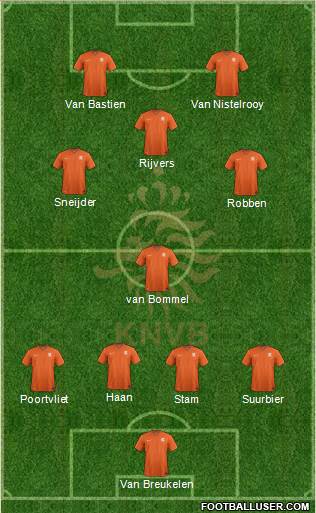
GK: Hans Van Breukelen (Utrecht)
Hans Van Breukelen started his career with FC Utrecht and then, Nottingham Forest.  He moved to PSV in 1984, where he became a star.  For the national team, he was a fixture since 1980.  However, he did not help the Oranje to reach a major touranemt until in 1988, where they won the first ever trophy for the Dutch national team. He had 73 caps.

GK: Frans de Munck (Gelderland)
Nicknamed Black Panther because of his black hair and overall, de Munck was best remembered for his career with DOS Utrecht.  In 1950, he moved to play in Germany for Koln.  He was the club's first ever foreign player. While playing for the club, he starred in a German movie. He was capped 31 times between 1949 and 1960.

GK: Piet Schrijvers (Utrecht)
Between 1971 and 1984, Schrijvers played 46 times for Netherlands.  He was the backup keeper at both World Cup Finals in 1974, but he was the starting keeper at Euro 1976 and 1980, and the World Cup Finals in 1978. At club level, he spent nine years with AFC Ajax, winning five Eredivisie titles and two KNVB Cups.  He also played for DWS, FC Twente and Zwolle.  

RB: Wim Suurbier  (North Brabant)
Wim Suurbier is considered among the best ever rightback in history.  He was the starting rightback for Oranje at the 1974 World Cup in Germany as well as the great Ajax team of the early 1970's where he played 13 seasons. He won three European Cups with Ajax in the 1970's. He also played club football in France, the USA and Hong Kong.
Wim Suurbier
CB:  Jaap Stam (Overijssel)
Stam became the most expensive Dutch player and the most expensive defender in the world when Manchester United bought him for 10.6 million pounds.  He also played for PSV Eindhoven, Manchester United, Lazio, AC Milan and Ajax. Sam was capped 67 times for Netherlands, scoring three goals. He was in their squads for three European Championships and the 1998 World Cup.

CB: Barry Hulshoff (Overijssel)
Barry Hulshoff was a part of the legendary Ajax team that won three European Cups in 1971, 1972 and 1973.  He later played Grazer AK in Austria before retiring from playing. He earned 12 caps for the Netherlands national football team.  He represented Holland at the World Cup Finals in 1974.

CB: Danny Blind (Zeeland)
Blind played for both Sparta Rotterdam and Ajax.  At Ajax, he won all 3 major UEFA trophies, namely the European Cup, the UEFA Cup and Cup Winners' Cup.  He was a part of the 1995 Ajax team that was considered among the best ever club team.  From 1986 to 1996, he picked up 42 caps, but he was not on the team that won Euro 1988. He did, however, appear at the 1990 and 1994 World Cups and the 1992 and 1996 European Championships. 

CB: Virgil van Dijk  (North Brabant)
Van Dijk started with Groningen before he moved to Celtic in 2013. In S2015, he joined Southampton before signing for Liverpool in 2018 for £75 million, a world record transfer fee for a defender. Van Dijk was named the PFA Player of the Year and the Premier League Player of the Season for the 2018–19 season. Van Dijk starred as Liverpool won the 2019 UEFA Champions League Final where he was named man of the match. From 2015 onward, he played for Netherlands and was named captain.
Virgil van Dijk 
LB: Jan Poortvliet (Zeeland)
Jan Poortvliet was a long time member of PSV Eindhoven. He played for them from 1974 to 1983.  After leaving them, he played club football in Austria, Belgium and France. He had 19 caps.  He was a part of Oranje's team at the World Cup Finals in 1978 and European Championship in 1980. 

CM: Willy van de Kerkhof (North Brabant)
Overall,  Willy Van de Kerkhof appeared 63 times for his country.  He was a member of the 1974 World Cup team, but it was the 1978 World Cup Finals, where he carried the team to the Final against the host Argentina.  His twin brother Rene was also a part of the 1978 team.  For his club career, he played for FC Twente and PSV Eindhoven.

CM: Willem Van Hanegem (Zeeland)
In Netherlands, Willem Van Hanegem was widely considered the second best Dutch player in the 1970's and perhaps, the greatest player for Feyenoord. He won the European Cup with Feyenoord in 1970.  He was capped 52 times between 1968 and 1979.  He was an important player at the World Cup Finals in 1974, but he missed the WC Finals in 1978.  He also played in NASL.
Willem Van Hanegem
CB/DM: Arie Haan (Groningen)
Haan won three European Cups with the great Ajax team of the 1970's.  In 1975, he moved to Anderlecht, winning two Cup Winners' Cup.  With Standard Liege,  he reached the Final of 1982 Cup Winners' Cup.  He later played for PSV and Seiko FC in Hong Kong. He was a key player at both WC Finals in 1974 and 1978.  In 1978, he scored two long range goals that were considered among the best ever goals at the WC Finals.

DM: Jan Wouters (Utrecht)
Wouters was a key player for Netherlands in the late 1980's and early 1990's. He had over 70 caps.  He won the Euro 1988 and also made the team of the tournament.  He was the Dutch Player of the Year in 1990.  For his club career, he played for FC Utrecht between 1980 and 1986.  In 1986, he joined Ajax, where he played until 1992.  He also played for Bayern Munich and PSV Eindhoven.

DM: Mark van Bommel (Limberg)
In Holland, Mark van Bommel's career was associated PSV Eindhoven, where he had two separated stints.  However, his most famous part of his career was spent with Bayern Munich. He was their first ever non-German captain.  He played 79 times for Holland and was a main player as Netherlands reached the Final of the 2010 World Cup Finals in South Africa. 

RW/LW/FW: Arjen Robben (Groningen)
Robben was an important player for Bayern Munich's dominance in Europe as they reached three Champions' League Finals in 4 years, winning one in 2013.  He also played with Real Madrid, Chelsea and PSV Eindhoven.  For the national team, he had 96 caps between 2003 and 2017.  He helped Netherlands to reach the Final of the 2010 World Cup Finals and then, four years later the semi-final in 2014. 
Arjen Robben

LW/RW: Marc Overmars (Gelderland)
Known for his speed, Overmars was a member of the youthful Ajax team that won the European cup in 1995. He moved to Arsenal in 1997, where he starred playing under Arsene Wenger.  He won the Double in 1997-1998.  He later moved to Barcelona and Go Ahead Eagles. His career with Oranja lasted from 1993 to 2004, and was an important player.  He won the Best Young Player Award at USA 1994. 

AM: Kees Rijvers (North Brabant)
Rijvers was considered one of the best players in Oranje's history before the emerge of the Golden Generation of the 1970's. He started with NAC Breda before moving to play for St.Etienne in 1950. He would have three different stints with the French club.  He also played for Feyenoord.  From 1946 to 1960, he played 33 times for Netherlands.

AM: Wesley Sneijder (Utrecht)
Sneijder emerged from the Ajax Academy before making to the first team in 2002.  He moved to Real Madrid in 2007, where he won a La Liga title in 2006-2007.  He also won a Champions' League title with Inter Milan in 2009-2010.  At the time of writing, he has 114 caps for Netherlands.  He was the star player for Netherlands as they reached the Final of South Africa 2010. He won the Silver Ball.  He moved to Galatasaray in 2013.
Wesley Sneijder

FW: Abe Lenstra (Friesland)
Abe Lenstra was a club legend at SC Heerenveen in the 1950's. The club was nicknamed "Abeveen" because of his legendary status with the club.   He also played for SC Enschede and Enschedese Boys. For Oranje, he was capped 47 times, scoring 33 goals.  He was at one point Netherlands' all-time leading scorer.  he was known for his partnership with Faas Wilkes and Kees Rijvers. 

ST: Coen Dillen (North Brabant)
Coen Dillen spent 12 years with PSV Eindhoven.  He scored 43 goals in the 1956/1957, a goal record for a single season that still remains unbroken today.  He scored twenty goals in a nine-match period between 27 January and 31 March 1957.  He also played for Brabantia. Internationally, he only played 5 times for Netherlands.

ST: Roy Makaay (Gelderland)
Makaay played for Vitesse and  CD Tenerife before becoming a big star with Deportivo La Coruna.  He helped them to win their first ever La Liga title in 1999-2000.  In 2002-2003, he scored 29 goals and became the European Golden Boot winner.  In 2003, he moved to Bayern Muinch.  He won two Bundesliga title.  For the national team, he was only capped 43 times, largely because he was playing at the same time as Dennis Bergkamp, Patrick Kuivert and Ruud Van Nistelrooy.

ST:  Marco Van Basten (Utrecht)
Van Basten was probably the second best Dutch player and among the best striker in football's history.  He won the Ballon d'Or three times.  He led Oranje to the victory at Euro 1988 scoring 5 goals at the tournament.  His goal in the Final is considered one of the best in history of the tournament. He started his career with Ajax.  He also won two European Cups with AC Milan, a club team that was considered the best ever.  
Marco Van Basten

ST: Ruud Van Nistelrooy(North Brabant)
Ruud Van Nistelrooy was a prolific goal scorer. He won the top scorer award in three different European domestic leagues. He started with PSV Eindhoven.  He spent 5 seasons with Manchester United where he was voted as their best player twice.  With Real Madrid, he finished second as the European Golden Boot. Van Nistelrooy earned 70 caps and scored 35 goals for the Netherlands between 1998 and 2011.
Ruud Van Nistelrooy

Honorable Mention
Joris Mathijsen (North Brabant), Wilfred Bouma (North Brabant), Rene Van de Kerkhof (North Brabant), Simon Tahamata, Berry van Aerle (North Brabant), Jasper Cillessen (Gelderland), Virgil van Dijk (North Brabant), Ernie Brandts (Gelderland), Phillip Cocu (North Brabant), Coen Dillen (North Brabant).

Squad Explanation
-- This is a blog team for Netherlands, excluding players from North and South Holland. North and South Holland are the two biggest provinces in Netherlands.  The Netherlands is also referred to as Holland in various languages, including English. The region of Holland proper consists of North and South Holland.  So this team cannot be considered to be "Holland" because it is aboutr provinces outside the Holland proper.
-- I do not think it is an interesting team because the rest of Holland offers no regional ties.  There are no real conclusion that I can come up through this (although I do not offer any conclusion in any of my blogs).  Except Zeeland, the nine remaining provinces are not located next to the North Sea.  
 -- North and South Holland has the largest populations in the Netherlands. North Brabant and Gelderland are 3rd and 4th.  North Brabant has a population about 2.5 million and Gelderland 2 million.  North Holland has only 2.8 million and South Holland 3.8 million.  So this combined region is not small.
-- I supposed that this blog reflected that the rest of Netherlands can still come up with an All-Time team that could beat many of the all-time teams in the world.
-- PSV Eindhoven is located in North-Brabant.  Hans Van Breukelen, Jaap Stam, Ruud Van Nistelrooy, Williem Van Hanegem and Arjen Robben are on my All-Time team.
-- Netherlands also consists the Caribbean Netherlands (Caribisch Nederland). They are the three special municipalities of the Netherlands that are located in the Caribbean Sea. They consist of the islands of Bonaire, Sint Eustatius and Saba.  They are not included in this team.
-- Ruud Van Nistelrooy, Marco Van Basten, Wim Suurbier, Jaap Stam, Williem Van Hanegem and Arjen Robben are members of my Netherland All-Time Team.  Hans Van Breukelen, Ariel Haan, Wesley Sneijder, Kees Rijvers, Marc Overmars, Mark Van Bommel, Willy van de Kerkho, Jan Wouters and Barry Hulshoff are also among the best in their positions in their generation.  Many of them should be on my Netherlands All-Time Team. This core of team is better than most nations around the world.
-- The emerge of Dutch football started with Johan Cruyff.  The eras before him is sometimes known as "BC" or before Cruyff.  Kees Rijvers is the best Dutch player before Cruyff "BC".  
-- Netherlands reached the Final of 2010 World Cup Finals. Arjen Robben, Mark van Bommel and Wesley Sneijder were the big names on the team.   
-- Arjen Robben won a Champions' League with Bayern Munich.  He took Netherlands to the Final of the 2010 World Cup Finals.  If he did not have as many injuries, his status in the history of the game would have been higher.  I rated him as good as the other star players of his generation.
-- Wesley Sneijder won the 2010 Champions' League with Inter Milan and took Netherlands to the Final of the World Cup Finals in 2010.  For a single year, he was the best in the world.  He deserved more recognition, but unfortunately, his performance has been inconsistent.  
-- Rene Van de Kerkhof is the twin brother of Willy.  He only made honorable mention.  He was a very talented midfielders. This said something about the talents on this team.  I also left off Phillip Cocu (North Brabant).
-- Willem Van Hanegem was widely considered the second best Dutch player after Johan Cruyff.  He was before my time, but I watched a lot of footage of him at the 1974 World Cup Finals.  he is the type of players that I enjoyed and admired.  I often listed him as my favorite player.  He was born in Zeeland.
-- Ruud Van Nistelrooy won the top scorer award in three different European domestic leagues.  He was born on the same date as Patrick Kluivert.  Kluivert, however, was born in Amsterdam.
-- Roy Makaay was underrated.  He did win the European Golden Boot, but his international career was limited because he was playing at the same time as Dennis Bergkamp, Patrick Kuivert and Ruud Van Nistelrooy. 
-- In 2020, I edited the team and added Virgil van Dijk to the team.  He finished second in the Ballon d'or, an award that should be given to him in 2019.   Not many defender could finish high on the award.  I dropped Ernie Brandts.

Starting lineup