|
| Copa Libertadores 1972 |
Please also see my All-Time World Cup Team Index.
Boca Juniors, River Plate, Independiente, Estudiantes de La Plata
San Lorenzo , Racing Club, Velez Sarsfield.
Argentine-born players capped by other national teams
This is my selection of a 25 member all-time team for the club. The number 25 was chosen because it is the official squad size for the Champions' League.
Club Atlético Independiente is considered one of Argentina's Big Five football clubs. It has won a total of 18 titles, with 16 recognised by FIFA, including a record of seven Copa Libertadores won. Additionally, the club has won the Copa Interamericana three times, the Supercopa Sudamericana twice, the Recopa Sudamericana once, the Intercontinental Cup twice (1973 and 1984), and the Copa Sudamericana once in 2010. Their team in the 1970's is considered one of the greatest ever club side in South America. They won Copa Liberadores in a row, between 1972 and 1975.
Team
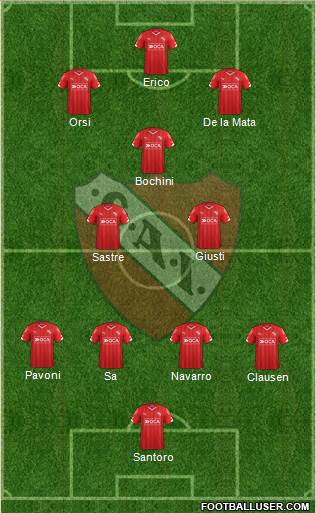
GK: Miguel Angel Santoro (Argentina)
Miguel Angel Santoro made 343 appearances for Independiente between 1962 and 1974, making him the goalkeeper with the highest number of appearances for the club. During his time with Independiente he won 10 titles: 4 league, 4 Copa Libertadores (1964, 1965, 1972, 1973), the Copa Intercontinental and the Copa Interamericana in 1973. He also played with Hércules CF in Spain where he played until his retirement in 1977. He was capped 14 times. He went to the 1974 World Cup Finals.
GK: Fernando Bello (Argentina)
Born in 1910, Fernando Bello played for Independiente from 1933 to 1944 alongside Arsenio Erico, Vicente de la Mata and Antonio Sastre. He was capped 12 times for La Albicelestes, winning the South American Cup(Copa America)in 1937 and 1945. He also particiated in the South American Cup in 1935.
GK: Luis Islas (Argentina)
Luis Islas played for many clubs in Argentina, Mexico and Spain, but better remembered for winning Recopa Sudamericana and Supercopa Libertadores with Independiente . He was capped 30 times for Argentina. He was the substitute goalkeeper during the 1986 World Cup, which Argentina won. He was the starting goalkeeper for Argentina during the 1994 World Cup Finals.
RB: Néstor Clausen (Argentina)
In his career, Néstor Clausen had two separated stints with Club Atlético Independiente in Argentina. He played for FC Sion and Racing Club in between. He won the Copa Libertadores in 1984 with Independiente. He was capped 26 times for La Selección. He was a part of the squad the World Cup in 1986 in which Argentina won their second World Cup.
RB: Roberto Ferreiro (Argentina)
Roberto Ferreiro began his career in 1958 with Independiente. He won three league championships and two Copa Libertadores titles: 1964 and 1965. He also played for River Plate between 1968 and 1970. Ferreiro made a total of 20 appearances for Argentina between 1962 and 1966 and competed at the 1966 World Cup. He played in the controversial England clash, in which started the football rivalry between the two countries.
CB: Francisco Sá (Argentina)
Francisco Sá holds the record for the most Copa Libertadores titles, he won six; 4 consecutive titles with Club Atlético Independiente between 1972 and 1975, and a further two titles with Boca Juniors in 1977 and 1978. He also won two Intercontinental Cup for both clubs. After leaving Boca in 1981 Sá played for Gimnasia de Jujuy for one season before his retirement in 1982. He was capped 12 times for Argentina between 1973 and 1974. He attended the 1974 World Cup Finals.
CB: Enzo Trossero (Argentina)
Torso played with Independiente from 1975 to 1986, but he had a loan stint with FC Nantes in France. During that time he won three Argentine titles (1977–78 and 83), a Copa Libertadores (1984) and an Intercontinental Cup (1984). He was named as one of the club's best defender during Independiente's 90th anniversary. He was capped 22 times. He was an unused sub at the World Cup Finals in 1982.
CB: Hugo Villaverde (Argentina)
Hugo Villaverde started his career in 1973 with his hometown club Colón de Santa Fe at the age of 19. In 1975 he joined Independiente where he became a key player throughout the 1970s and 1980s. He won four league titles, the 1984 Copa Libertadores and Copa Intercontinental. He played 6 times for Argentina in 1979, but never returned to the international scene after suffering an injury in friendly match against Scotland.
CB: Ruben Navarro (Argentina)
Navarro joined Independiente in 1952 and had his professional debut for the club in 1954. He first played as a forward but made a name for himself playing as defender. He is mainly remembered for winning two consecutive Copa Libertadores titles with Independiente (1964, 1965). Capped 32 times. He went to the 1962 World Cup and appeared in two matches at the tournament, captaining the side against England and Bulgaria.
LB: Ricardo Pavoni (Uruguay)
In Uruguay, Ricardo Pavoni played for Defensor. Affectionately known as "El Chivo", he was considered one of Uruguay's top left backs. In 1965, he joined Independiente in Argentina. He was a part of the great Independiente of the 1970's that won 5 Copa Libertadores (1965, 1972, 1973, 1974, 1975). He was an idol at the club. He was capped 13 times. He was a member of the 1974 World Cup team in West Germany.
DM/CM: Claudio Marangoni (Argentina)
Claudio Marangoni played in Argentina and England before joining Club Atlético Independiente in 1982. He won three major titles with the club: 1983 Metropolitano, Copa Libertadores and Copa Intercontinental in 1984. In 1988 he left Independiente to join Boca Juniors where he won the Supercopa Sudamericana 1989 and the Recopa Sudamericana 1990. He was capped 8 times.
DM: Ricardo Giusti (Argentina)
During his career Giusti also played for Unión de Santa Fe, Argentinos Juniors and Newell's Old Boys, but he had most of his success with Independiente where he captained the team. He was named as the club's best midfielder during Independiente's 90th anniversary. He won the World Cup with Argentina in 1986 and was also a runner-up in the 1990 World Cup. With 53 caps, he played a part in 5 major tournaments.
CM: Antonio Sastre (Argentina)
Antonio Sastre played most of his career for Club Atlético Independiente and São Paulo of Brazil. He formed a forward lone with Vicente de la Mata and Arsenio Erico with Independiente. He is one of the 24 players inducted into the Argentine Football Association Hall of Fame. He was an all-round midfielder who could play well almost anywhere on the pitch due to his intelligence and versatility. From 1933 to 1941, he was capped 34 times, winning the Copa América in 1937 and 1941.
CM: Miguel Ángel Raimondo (Argentina)
Raimondo played for Rosario Central and Atlanta before joining Independiente in 1969. He won two league championships, three (of their four in a row) Copa Libertadores titles, two Copa Interamericanas and an Intercontinental Cup. He was selected as the Player of the Year of Argentina in 1974. In 1975, Raimondo joined River Plate where he helped the club to win both of the Argentine league titles that year.
AM/CM: José Omar Pastoriza (Argentina)
El Pato ("The Duck") Pastoriza played with Colón de Santa and Racing Club before joining Independiente, winning 3 first division tournaments and a Copa Libertadores. In 1971 he was awarded the Olimpia de Oro, which is given to the Argentine footballer of the year. After the 1972 season he transferred to French AS Monaco, where he retired as a player. Capped 18 times.
AM: Ricardo Bochini (Argentina)
Ricardo Bochini was Diego Maradona's idol. He was a legend at Independiente. He joined the club during the middle of the club's 4 straight Copa Libertadores victory. In 1984, Bochini would lead them to another Copa Libertadores and the Intercontinental Cup. He never got his opportunity with the national team. In 1986, Maradona insisted the inclusion of then, 32 years old Ricardo Bochini. He only played 5 minutes against Belgium in the semi-final.
RW/LW: Daniel Bertoni (Argentina)
Daniel Bertoni started playing in Argentine's second division for Quilmes in 1972. After one year he was transferred to first division's team Independiente where he played alongside Ricardo Bochini and won one national and 3 Copa Libertadores. In Europe, Betoni also played for Sevilla, Fiorentina and Napoli. At the international level, he was capped 31 times. He scored one of the goals at the Final in the 1978 World Cup Finals against Netherlands.
FW/LW: Raimundo Orsi (Argentina/Italy)
Orsi was considered one of the greatest forwards in Argentina's history. He started his career with Indpendiente in Argentina before lured away to play for Juventus. He won 5 league titles with Juventus. Later in his career, he would play in Brazil and Chile. He was capped by Argentina 12 times winning a silver medal at the 1928 Olympics. He switched to play for Italy in 1929. He was a star player as Italy won the WC in 1934.
FW/AM: Sergio Aguero (Argentina)
El Kun became the youngest player ever to play in the Argentine Primera Division in 2003 when he played for Independiente. In 2006, Atletico Madrid broke their transfer record to sign him. He rewarded the club with the Europa Cup in 2010. In 2011, he joined Manchester City. Again, he rewarded the club with an added time goal that won the Preimership for Manchester City's first ever title. At the time of writing, he had 77 caps.
FW: Ernesto Grillo (Argentina)
Grillo started with Indpendiente before moving to play in Italy. He played three seasons with AC Milan, winning 1958-1958 Serie A title. He returned to Argentina in 1960 to play for Boca Juniors. Capped 21 times. The highlight of Grillo's career came on 14 May 1953 in a match versus England, when he scored a legendary goal for Argentina. He also helped Argentina winning the 1955 South American Championship(Copa America).
FW: Jorge Burruchaga (Argentina)
Burruchaga was capped 57 times. He scored the winning goal in the final of the 1986 World Cup. He was a part of Independiente that won the Metropolitano 1983, the Copa Libertadores and the Intercontinental Cup in 1984. He also played seven years for Nantes. With Valenciennes, he was involved in a bribing scandal involving a league match against Olympique de Marseille on 20 May 1993. He was subsequently given a suspended six months sentence.
FW: Vicente De la Mata (Argentina)
Vicente De la Mata emerged from the youth team of Central Córdoba in 1936, he was soon signed by Independiente where he spent 14 seasons, scoring 151 goals in 362 games for the club. He played alongside Antonio Sastre and Arsenio Erico. Capped 13 times between 1937 and 1946, scoring six goals. He won Copa América on three occasions. In 1937 he scored both goals in the 2–0 win over Brazil in the final.
ST: Manuel Seoane (Argentina)
Manuel Seoane was Independiente's 2nd all-time topscorer after Arsenio Erico and 5th amongst Primera División topscorers. He finished as the Primera División top scorer on three occasions (1922, 1926 and 1929). He played for Argentina between 1924 and 1929, appearing in 4 Copa Américas (1924, 1925, 1927 & 1929). He was part of the winning team in 1925 1927 and 1929 and he was also the top scorer in 1925 with 6 goals.
ST: Hector Yazalde (Argentina)
Hector Yazalde started his career with Club Atlético Independiente. He moved to Europe and played for Sporting. In 1973-1974, He scored 46 goals in one single season with Sporting Clube de Portugal, being awarded that season's European Golden Shoe. The following season, he scored 30 goals and won Europeaan Silver Show. He earned 10 caps, scoring two goals at the World Cup Finals in 1974.
ST: Arsenio Erico (Paraguay)
Arsenio Erico is considered the best Paraguayan footballer of all time and one of the greatest ever to play in the Argentinian league.. He started his club career with Club Nacional of Paraguay in 1930, but better known for his career in Argentina. He is the all-time highest goalscorer in the Argentine first division, with 295 goals, all of them scored with Independiente between 1933 and 1946. He also played for Huracán. He was Alfredo Di Stefano's idol.
Honorable mention
Diego Forlan, Aníbal Tarabini, Raúl Bernao, Miguel Lopez, Pedro Monzón, Jorge Olguín, Luis Artime, Gabriel Milito, Rubén Galván, Daniel Monyenegro,
Squad Explanation
-- Club Atlético Independiente won Copa Liberatadore in 1964 and 1965. In 1964, they beat Pele's Santos in the semifinal. They were the first Argentinian club to win the trophy. They defended their title in the following year. Ruben Navarro and Miguel Ángel Santoro were the only members selected from the team.
-- From 1972 to 1975, Club Atlético Independiente won 4 straight Copa Libertadores. I selected the following players on those team to my all-time team: Ricardo Pavoni, José Omar Pastoriza, Miguel Angel Santoro, Francisco Sá, Miguel Ángel Raimondo, Ricardo Bochini and Daniel Bertoni.
-- Club Atlético Independiente won another Copa Libertadores in 1984. I selected 7 players from that team. Ricardo Bochini, Jorge Burruchaga, Néstor Clausen, Ricardo Giusti, Enzo Trossero, Hugo Villaverde, Miguel Ángel Santoro and Claudio Marangoni.
-- Jorge Burruchaga scored the winning goal against West Germany in the 1986 World Cup Finals.
-- Miguel Ángel Santoro won two Copa Libertadores in 1964 and 1965. He won two more in 1972 and 1973.
-- Ricardo Bochini was Diego Maradona's idol. He won five Copa Libertadores: 1972, 1973, 1974, 1975, 1984, but he did not play for the club in the 1972 edition. Ricardo Bochini was known for his partnership with Daniel Bertoni. Daniel Bertoni scored a goal in the 1978 World Cup Finals and became famous from around the world. Bochini did not have many chances with the national team. Most Argentinian managers at his time ignored him. His exposure outside South America was very limited. I wrote a blog about him.
-- Arsenio Erico is considered the best Paraguayan footballer of all time. He was the al-time Primera Division leading scorer. He was an idol of Alfredo Di Stefano. Over here, he played with another all-time great Antonio Sastre and Vicente De la Mata
-- Sergio Aguero did not play enough games for them, but he was one of the few all-time greats from the modern era. He was also the youngest ever player for them, which was a record and an achievement.
-- Raimundo Orsi was well-known outside Argentina because he later went to play in Europe. In 1934, he was a member of the Italian World Cup team that won the World Cup. Ernesto Grillo
Formation

Argentina World Cup 1946
Angels with Dirty Faces with Di Stefano in the WC 1958
Argentina All-Time Team before 1978,
Argentina All-Time Team After Maradona.
Provincia de Córdoba, Argentina All-Time Team
Provincia de Santa Fe, Argentina All-Time Team
The City of Buenos Aires
Argentina All-Time Team without players from Santa Fe, Cordoba and Buenos Aires
Angels with Dirty Faces with Di Stefano in the WC 1958
Argentina All-Time Team before 1978,
Argentina All-Time Team After Maradona.
Provincia de Córdoba, Argentina All-Time Team
Provincia de Santa Fe, Argentina All-Time Team
The City of Buenos Aires
Argentina All-Time Team without players from Santa Fe, Cordoba and Buenos Aires
This is my selection of a 25 member all-time team for the club. The number 25 was chosen because it is the official squad size for the Champions' League.
Club Atlético Independiente is considered one of Argentina's Big Five football clubs. It has won a total of 18 titles, with 16 recognised by FIFA, including a record of seven Copa Libertadores won. Additionally, the club has won the Copa Interamericana three times, the Supercopa Sudamericana twice, the Recopa Sudamericana once, the Intercontinental Cup twice (1973 and 1984), and the Copa Sudamericana once in 2010. Their team in the 1970's is considered one of the greatest ever club side in South America. They won Copa Liberadores in a row, between 1972 and 1975.
 |
| Copa Libertadores 1984 |
GK: Miguel Angel Santoro (Argentina)
Miguel Angel Santoro made 343 appearances for Independiente between 1962 and 1974, making him the goalkeeper with the highest number of appearances for the club. During his time with Independiente he won 10 titles: 4 league, 4 Copa Libertadores (1964, 1965, 1972, 1973), the Copa Intercontinental and the Copa Interamericana in 1973. He also played with Hércules CF in Spain where he played until his retirement in 1977. He was capped 14 times. He went to the 1974 World Cup Finals.
 |
| Miguel Santoro |
Born in 1910, Fernando Bello played for Independiente from 1933 to 1944 alongside Arsenio Erico, Vicente de la Mata and Antonio Sastre. He was capped 12 times for La Albicelestes, winning the South American Cup(Copa America)in 1937 and 1945. He also particiated in the South American Cup in 1935.
GK: Luis Islas (Argentina)
Luis Islas played for many clubs in Argentina, Mexico and Spain, but better remembered for winning Recopa Sudamericana and Supercopa Libertadores with Independiente . He was capped 30 times for Argentina. He was the substitute goalkeeper during the 1986 World Cup, which Argentina won. He was the starting goalkeeper for Argentina during the 1994 World Cup Finals.
RB: Néstor Clausen (Argentina)
In his career, Néstor Clausen had two separated stints with Club Atlético Independiente in Argentina. He played for FC Sion and Racing Club in between. He won the Copa Libertadores in 1984 with Independiente. He was capped 26 times for La Selección. He was a part of the squad the World Cup in 1986 in which Argentina won their second World Cup.
RB: Roberto Ferreiro (Argentina)
Roberto Ferreiro began his career in 1958 with Independiente. He won three league championships and two Copa Libertadores titles: 1964 and 1965. He also played for River Plate between 1968 and 1970. Ferreiro made a total of 20 appearances for Argentina between 1962 and 1966 and competed at the 1966 World Cup. He played in the controversial England clash, in which started the football rivalry between the two countries.
CB: Francisco Sá (Argentina)
Francisco Sá holds the record for the most Copa Libertadores titles, he won six; 4 consecutive titles with Club Atlético Independiente between 1972 and 1975, and a further two titles with Boca Juniors in 1977 and 1978. He also won two Intercontinental Cup for both clubs. After leaving Boca in 1981 Sá played for Gimnasia de Jujuy for one season before his retirement in 1982. He was capped 12 times for Argentina between 1973 and 1974. He attended the 1974 World Cup Finals.
 |
| Francisco Sá |
Torso played with Independiente from 1975 to 1986, but he had a loan stint with FC Nantes in France. During that time he won three Argentine titles (1977–78 and 83), a Copa Libertadores (1984) and an Intercontinental Cup (1984). He was named as one of the club's best defender during Independiente's 90th anniversary. He was capped 22 times. He was an unused sub at the World Cup Finals in 1982.
CB: Hugo Villaverde (Argentina)
Hugo Villaverde started his career in 1973 with his hometown club Colón de Santa Fe at the age of 19. In 1975 he joined Independiente where he became a key player throughout the 1970s and 1980s. He won four league titles, the 1984 Copa Libertadores and Copa Intercontinental. He played 6 times for Argentina in 1979, but never returned to the international scene after suffering an injury in friendly match against Scotland.
CB: Ruben Navarro (Argentina)
Navarro joined Independiente in 1952 and had his professional debut for the club in 1954. He first played as a forward but made a name for himself playing as defender. He is mainly remembered for winning two consecutive Copa Libertadores titles with Independiente (1964, 1965). Capped 32 times. He went to the 1962 World Cup and appeared in two matches at the tournament, captaining the side against England and Bulgaria.
LB: Ricardo Pavoni (Uruguay)
In Uruguay, Ricardo Pavoni played for Defensor. Affectionately known as "El Chivo", he was considered one of Uruguay's top left backs. In 1965, he joined Independiente in Argentina. He was a part of the great Independiente of the 1970's that won 5 Copa Libertadores (1965, 1972, 1973, 1974, 1975). He was an idol at the club. He was capped 13 times. He was a member of the 1974 World Cup team in West Germany.
 |
| Ricardo Pavoni |
DM/CM: Claudio Marangoni (Argentina)
Claudio Marangoni played in Argentina and England before joining Club Atlético Independiente in 1982. He won three major titles with the club: 1983 Metropolitano, Copa Libertadores and Copa Intercontinental in 1984. In 1988 he left Independiente to join Boca Juniors where he won the Supercopa Sudamericana 1989 and the Recopa Sudamericana 1990. He was capped 8 times.
DM: Ricardo Giusti (Argentina)
During his career Giusti also played for Unión de Santa Fe, Argentinos Juniors and Newell's Old Boys, but he had most of his success with Independiente where he captained the team. He was named as the club's best midfielder during Independiente's 90th anniversary. He won the World Cup with Argentina in 1986 and was also a runner-up in the 1990 World Cup. With 53 caps, he played a part in 5 major tournaments.
CM: Antonio Sastre (Argentina)
Antonio Sastre played most of his career for Club Atlético Independiente and São Paulo of Brazil. He formed a forward lone with Vicente de la Mata and Arsenio Erico with Independiente. He is one of the 24 players inducted into the Argentine Football Association Hall of Fame. He was an all-round midfielder who could play well almost anywhere on the pitch due to his intelligence and versatility. From 1933 to 1941, he was capped 34 times, winning the Copa América in 1937 and 1941.
 |
| Antonio Sastre |
Raimondo played for Rosario Central and Atlanta before joining Independiente in 1969. He won two league championships, three (of their four in a row) Copa Libertadores titles, two Copa Interamericanas and an Intercontinental Cup. He was selected as the Player of the Year of Argentina in 1974. In 1975, Raimondo joined River Plate where he helped the club to win both of the Argentine league titles that year.
AM/CM: José Omar Pastoriza (Argentina)
El Pato ("The Duck") Pastoriza played with Colón de Santa and Racing Club before joining Independiente, winning 3 first division tournaments and a Copa Libertadores. In 1971 he was awarded the Olimpia de Oro, which is given to the Argentine footballer of the year. After the 1972 season he transferred to French AS Monaco, where he retired as a player. Capped 18 times.
AM: Ricardo Bochini (Argentina)
Ricardo Bochini was Diego Maradona's idol. He was a legend at Independiente. He joined the club during the middle of the club's 4 straight Copa Libertadores victory. In 1984, Bochini would lead them to another Copa Libertadores and the Intercontinental Cup. He never got his opportunity with the national team. In 1986, Maradona insisted the inclusion of then, 32 years old Ricardo Bochini. He only played 5 minutes against Belgium in the semi-final.
 |
| Ricardo Bochini |
Daniel Bertoni started playing in Argentine's second division for Quilmes in 1972. After one year he was transferred to first division's team Independiente where he played alongside Ricardo Bochini and won one national and 3 Copa Libertadores. In Europe, Betoni also played for Sevilla, Fiorentina and Napoli. At the international level, he was capped 31 times. He scored one of the goals at the Final in the 1978 World Cup Finals against Netherlands.
FW/LW: Raimundo Orsi (Argentina/Italy)
Orsi was considered one of the greatest forwards in Argentina's history. He started his career with Indpendiente in Argentina before lured away to play for Juventus. He won 5 league titles with Juventus. Later in his career, he would play in Brazil and Chile. He was capped by Argentina 12 times winning a silver medal at the 1928 Olympics. He switched to play for Italy in 1929. He was a star player as Italy won the WC in 1934.
FW/AM: Sergio Aguero (Argentina)
El Kun became the youngest player ever to play in the Argentine Primera Division in 2003 when he played for Independiente. In 2006, Atletico Madrid broke their transfer record to sign him. He rewarded the club with the Europa Cup in 2010. In 2011, he joined Manchester City. Again, he rewarded the club with an added time goal that won the Preimership for Manchester City's first ever title. At the time of writing, he had 77 caps.
 |
| Sergio Aguero |
Grillo started with Indpendiente before moving to play in Italy. He played three seasons with AC Milan, winning 1958-1958 Serie A title. He returned to Argentina in 1960 to play for Boca Juniors. Capped 21 times. The highlight of Grillo's career came on 14 May 1953 in a match versus England, when he scored a legendary goal for Argentina. He also helped Argentina winning the 1955 South American Championship(Copa America).
FW: Jorge Burruchaga (Argentina)
Burruchaga was capped 57 times. He scored the winning goal in the final of the 1986 World Cup. He was a part of Independiente that won the Metropolitano 1983, the Copa Libertadores and the Intercontinental Cup in 1984. He also played seven years for Nantes. With Valenciennes, he was involved in a bribing scandal involving a league match against Olympique de Marseille on 20 May 1993. He was subsequently given a suspended six months sentence.
 |
| Jorge Burruchaga |
FW: Vicente De la Mata (Argentina)
Vicente De la Mata emerged from the youth team of Central Córdoba in 1936, he was soon signed by Independiente where he spent 14 seasons, scoring 151 goals in 362 games for the club. He played alongside Antonio Sastre and Arsenio Erico. Capped 13 times between 1937 and 1946, scoring six goals. He won Copa América on three occasions. In 1937 he scored both goals in the 2–0 win over Brazil in the final.
ST: Manuel Seoane (Argentina)
Manuel Seoane was Independiente's 2nd all-time topscorer after Arsenio Erico and 5th amongst Primera División topscorers. He finished as the Primera División top scorer on three occasions (1922, 1926 and 1929). He played for Argentina between 1924 and 1929, appearing in 4 Copa Américas (1924, 1925, 1927 & 1929). He was part of the winning team in 1925 1927 and 1929 and he was also the top scorer in 1925 with 6 goals.
ST: Hector Yazalde (Argentina)
Hector Yazalde started his career with Club Atlético Independiente. He moved to Europe and played for Sporting. In 1973-1974, He scored 46 goals in one single season with Sporting Clube de Portugal, being awarded that season's European Golden Shoe. The following season, he scored 30 goals and won Europeaan Silver Show. He earned 10 caps, scoring two goals at the World Cup Finals in 1974.
ST: Arsenio Erico (Paraguay)
Arsenio Erico is considered the best Paraguayan footballer of all time and one of the greatest ever to play in the Argentinian league.. He started his club career with Club Nacional of Paraguay in 1930, but better known for his career in Argentina. He is the all-time highest goalscorer in the Argentine first division, with 295 goals, all of them scored with Independiente between 1933 and 1946. He also played for Huracán. He was Alfredo Di Stefano's idol.
 |
| Arsenio Erico |
Diego Forlan, Aníbal Tarabini, Raúl Bernao, Miguel Lopez, Pedro Monzón, Jorge Olguín, Luis Artime, Gabriel Milito, Rubén Galván, Daniel Monyenegro,
Squad Explanation
-- Club Atlético Independiente won Copa Liberatadore in 1964 and 1965. In 1964, they beat Pele's Santos in the semifinal. They were the first Argentinian club to win the trophy. They defended their title in the following year. Ruben Navarro and Miguel Ángel Santoro were the only members selected from the team.
-- From 1972 to 1975, Club Atlético Independiente won 4 straight Copa Libertadores. I selected the following players on those team to my all-time team: Ricardo Pavoni, José Omar Pastoriza, Miguel Angel Santoro, Francisco Sá, Miguel Ángel Raimondo, Ricardo Bochini and Daniel Bertoni.
-- Club Atlético Independiente won another Copa Libertadores in 1984. I selected 7 players from that team. Ricardo Bochini, Jorge Burruchaga, Néstor Clausen, Ricardo Giusti, Enzo Trossero, Hugo Villaverde, Miguel Ángel Santoro and Claudio Marangoni.
-- Jorge Burruchaga scored the winning goal against West Germany in the 1986 World Cup Finals.
-- Miguel Ángel Santoro won two Copa Libertadores in 1964 and 1965. He won two more in 1972 and 1973.
-- Ricardo Bochini was Diego Maradona's idol. He won five Copa Libertadores: 1972, 1973, 1974, 1975, 1984, but he did not play for the club in the 1972 edition. Ricardo Bochini was known for his partnership with Daniel Bertoni. Daniel Bertoni scored a goal in the 1978 World Cup Finals and became famous from around the world. Bochini did not have many chances with the national team. Most Argentinian managers at his time ignored him. His exposure outside South America was very limited. I wrote a blog about him.
-- Arsenio Erico is considered the best Paraguayan footballer of all time. He was the al-time Primera Division leading scorer. He was an idol of Alfredo Di Stefano. Over here, he played with another all-time great Antonio Sastre and Vicente De la Mata
-- Gabriel Milito appeared in many all-time lists, but I selected older players over him. Club Atlético Independiente has too many great players in the 1970's and 1980's.
-- I do not know much about Miguel Lopez.-- Sergio Aguero did not play enough games for them, but he was one of the few all-time greats from the modern era. He was also the youngest ever player for them, which was a record and an achievement.
-- Raimundo Orsi was well-known outside Argentina because he later went to play in Europe. In 1934, he was a member of the Italian World Cup team that won the World Cup. Ernesto Grillo
Formation